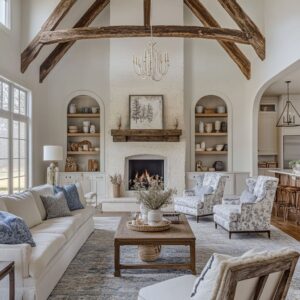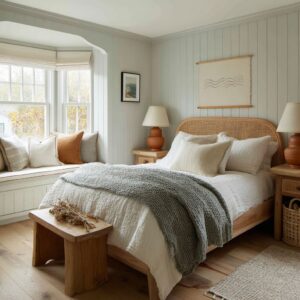

Modern Lowcountry living room design works through balance. It keeps the environmental memory of Southern coastal houses—light, air, shade, timber, porches, marsh color, masonry, woven materials, and long informal sitting—while removing excess visual weight from the room.
The result is a living space that feels settled, breathable, and regionally grounded without sliding into themed coastal decorating or stiff historical revival.
That balance is what makes the style so compelling. A modern Lowcountry room does not depend on a stock coastal formula of blue accents, striped pillows, shell accessories, and white slipcovers.
Those shortcuts often weaken the style. Modern Lowcountry becomes convincing in deeper ways.
It starts with the shell of the room, the quality of daylight, the relationship to outdoor life, the gravity of wood and natural fiber, and the softness of seating arranged for lingering. Only after those conditions are in place do color, art, and smaller decorative layers begin to matter.
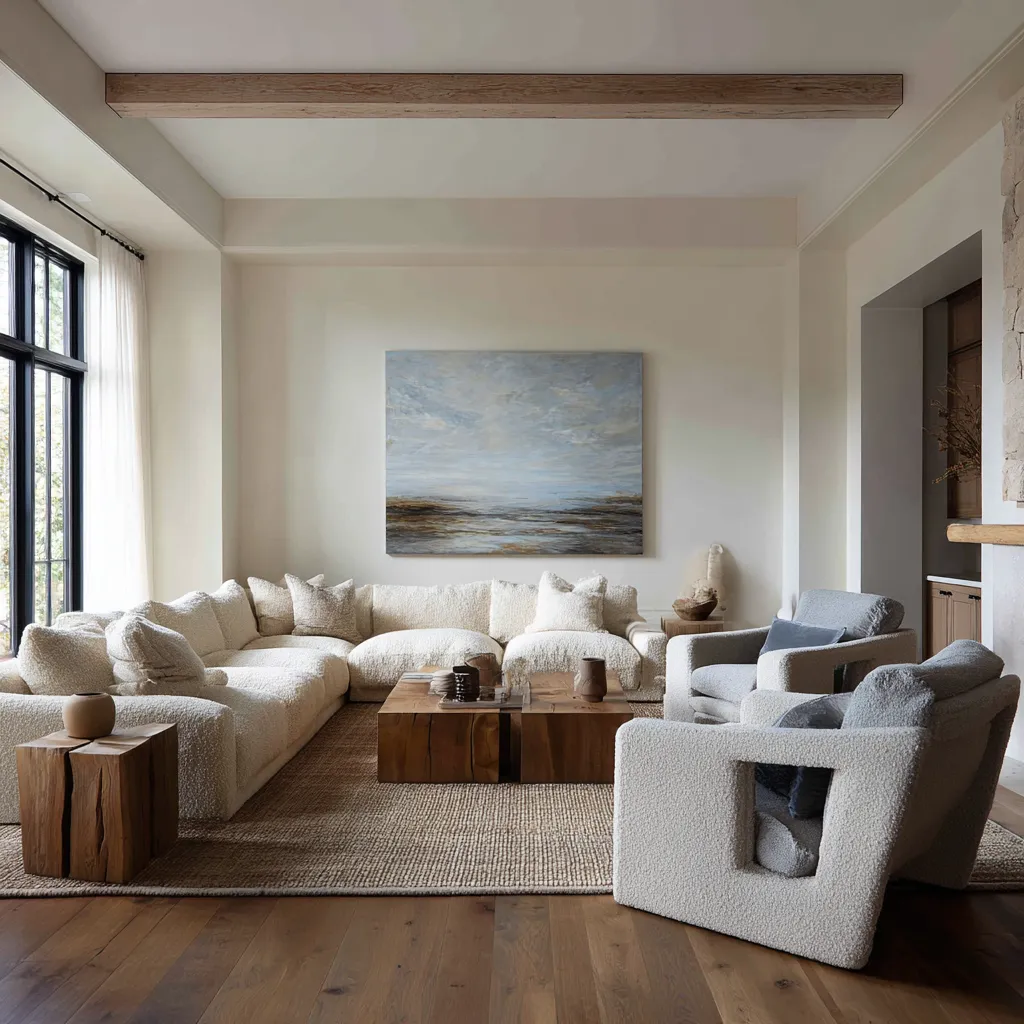
The style therefore works as a conversation between two systems. One system carries place-memory.
The other carries present-day clarity. Place-memory lives in beams, tall openings, plastered walls, dark floorboards, jute, woven seating, masonry, aged wood, and colors linked to marsh, water, shell, tobacco, silt, palmetto, and sun-softened stone.
Present-day clarity lives in broader upholstery, fewer objects, larger and calmer art, simpler tables, lower pattern activity, and more open wall space. The room succeeds when both systems remain visible and neither one overwhelms the other.

Start with the shell, because the shell carries the regional truth
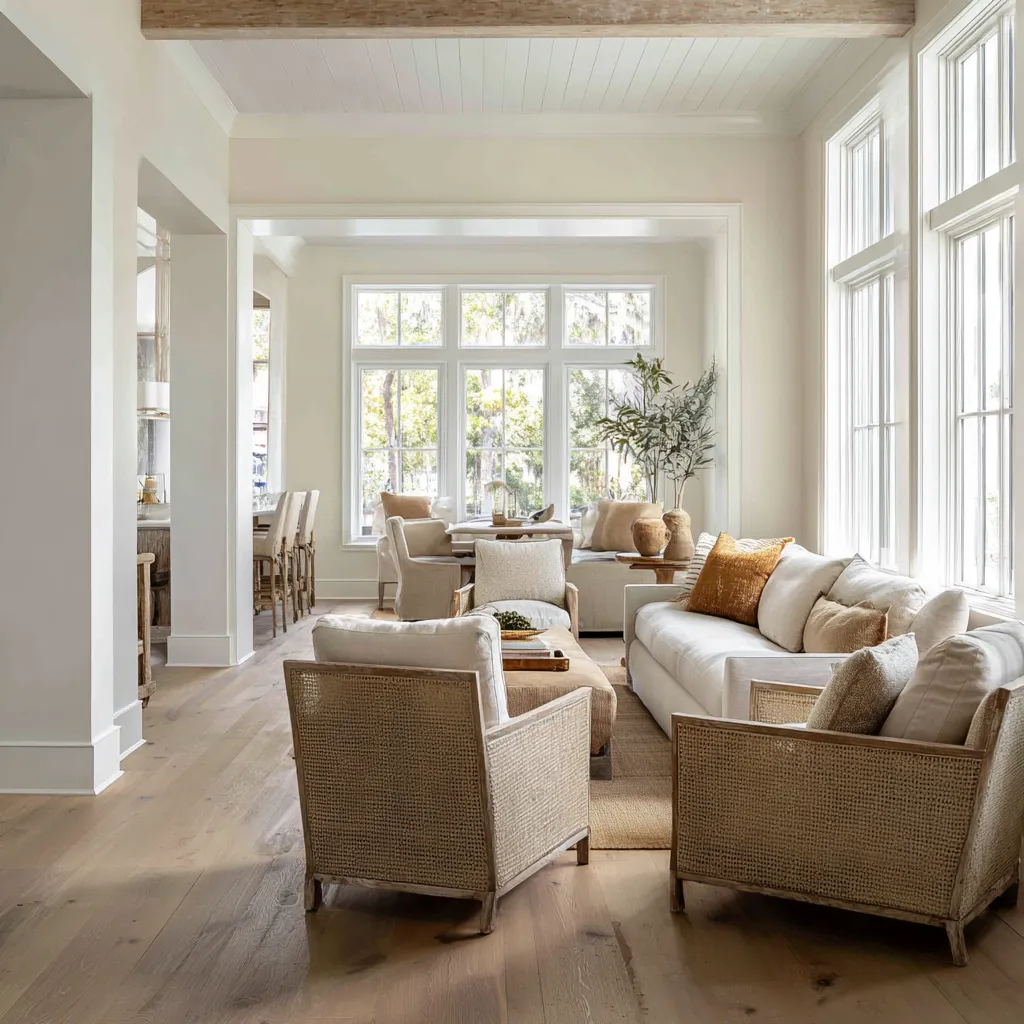
In modern Lowcountry interiors, architecture usually does the first and important part of the work. This may take the form of weathered ceiling beams, white-planked ceilings, tall French doors, black-framed windows, paneled walls, pale brick, arched openings, a deep fireplace mass, a built-in window seat, shutters, or long drapery that stretches the height of the room.
These elements do not function as decoration added after the fact. They establish the house as a coastal Southern interior before the furniture even enters.

That point matters because many coastal living rooms fail by trying to create identity through accessories alone. A basket here, a coral object there, a pale blue painting over the sofa, and the room is expected to do the work of place.
Modern Lowcountry asks for something stronger. It asks for one or more architectural facts that make the room feel tied to climate, land, and building tradition.
A ceiling beam that looks sun-softened rather than glossy. A window wall that reaches high enough to pull daylight deep into the room.
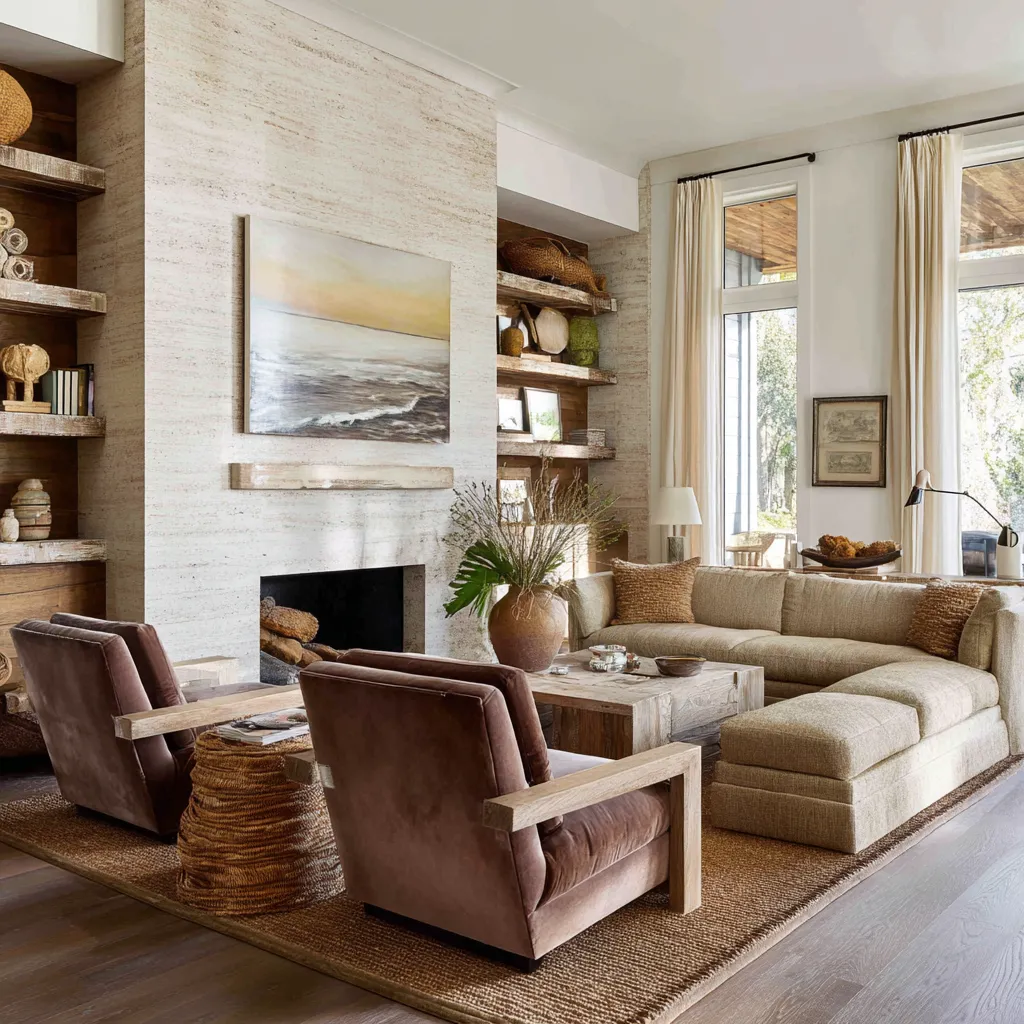
A fireplace treated as a broad plane of pale stone rather than an ornate decorative centerpiece. A plaster or limewashed wall surface that carries slight tonal variation.
These are the kinds of moves that give the room real identity.

This is also why the style can be difficult to imitate in a generic shell. If a room lacks strong openings, material depth, or some sense of architectural memory, the Lowcountry feeling becomes thinner and the design has to work harder through furniture, textiles, and color.
That does not make the style impossible in a newer house, but it changes the strategy. In an ordinary suburban shell, the designer often needs to create a few strong architectural cues—dark window linework, a substantial ceiling treatment, a broad built-in, a pale plaster finish, or a fireplace wall with real mass—so the room has something solid to build on.

Modernity enters through subtraction, not through coldness
The present-day side of modern Lowcountry does not come from making the room severe or sparse. It comes from editing.
The room becomes current because it removes small visual chatter and lets fewer, larger moves carry the composition. That is why so many successful modern Lowcountry living rooms rely on broad upholstered forms rather than lots of smaller traditional seating pieces.
A deep sectional, a generously scaled sofa, a pair of low lounge chairs, or a few rounded upholstered forms will often do more for the room than a full suite of historically styled furniture. The point is not to erase comfort.
The point is to simplify its outline. Southern hospitality remains central, but it is expressed through cleaner silhouettes.

The same principle applies to the walls. In an older coastal Southern room, walls may carry more trim emphasis, more framed pieces, more layered decorative notation.
In a modern version, broad wall planes are often kept calmer. One large horizon-based painting or a restrained pair of coastal works can be enough.
This gives the architecture and the furniture more authority and keeps the room from feeling crowded.
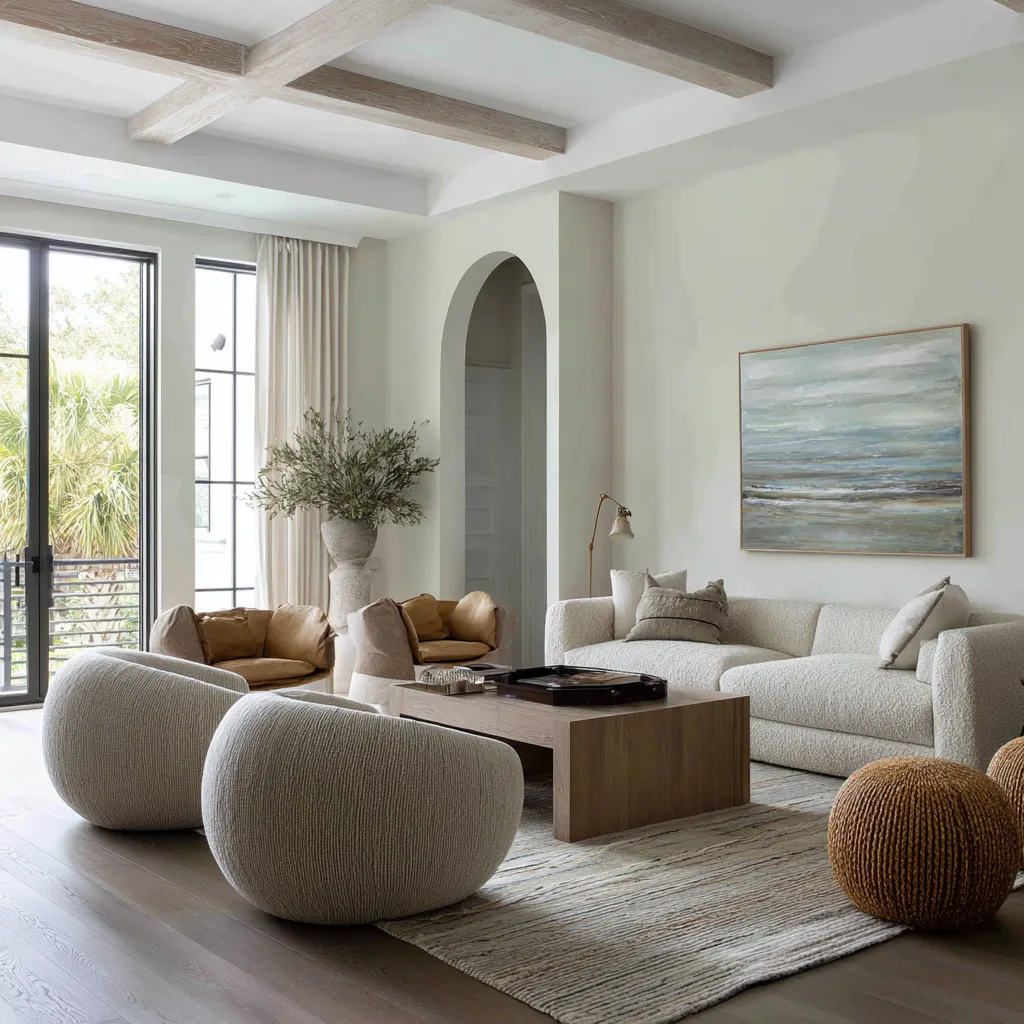
Tables shift in the same direction. Instead of ornate cocktail tables or finely legged traditional pieces, modern Lowcountry often uses heavier, simpler forms: a block wood coffee table, a thick plank table, a dark cube, a pale oak slab, or a grouped set of wood volumes.
These pieces bring mass and grounding without decorative fuss. They are especially useful because they stabilize soft upholstery and help the room feel present-day without becoming urban or hard-edged.
In this style, editing is not about emptiness. It is about clearer hierarchy.
The room should still feel lived in and comfortable. It should still support family use, conversation, reading, feet-up lounging, and a slow everyday rhythm.
But visual activity is reduced so the architecture, the light, and the material palette can remain legible.
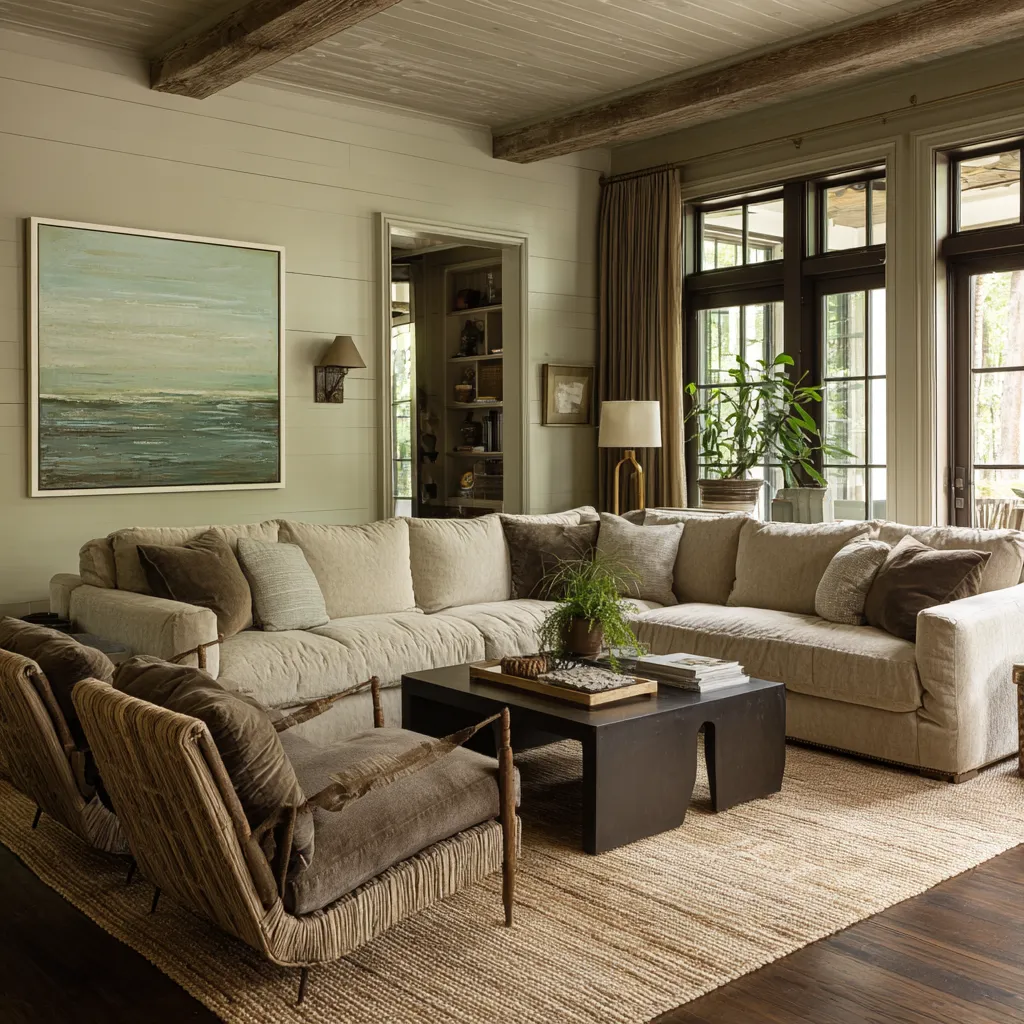
The room needs a grounding device
One of the ideas in modern Lowcountry design is that airy rooms need weight. Otherwise the interior drifts into generic coastal prettiness or upscale neutral softness.
That weight usually appears as one main grounding device. Sometimes the grounding device is timber overhead.
Weathered beams or a pale driftwood ceiling grid can hold the room and carry memory at the same time. Sometimes the grounding device is a dark coffee table placed at the center of a pale seating group.
Sometimes it is a pair of tobacco leather chairs, a dark plank floor, black-framed windows, a deep fireplace opening, or a pale stone wall with enough mass to register as architecture rather than decor.
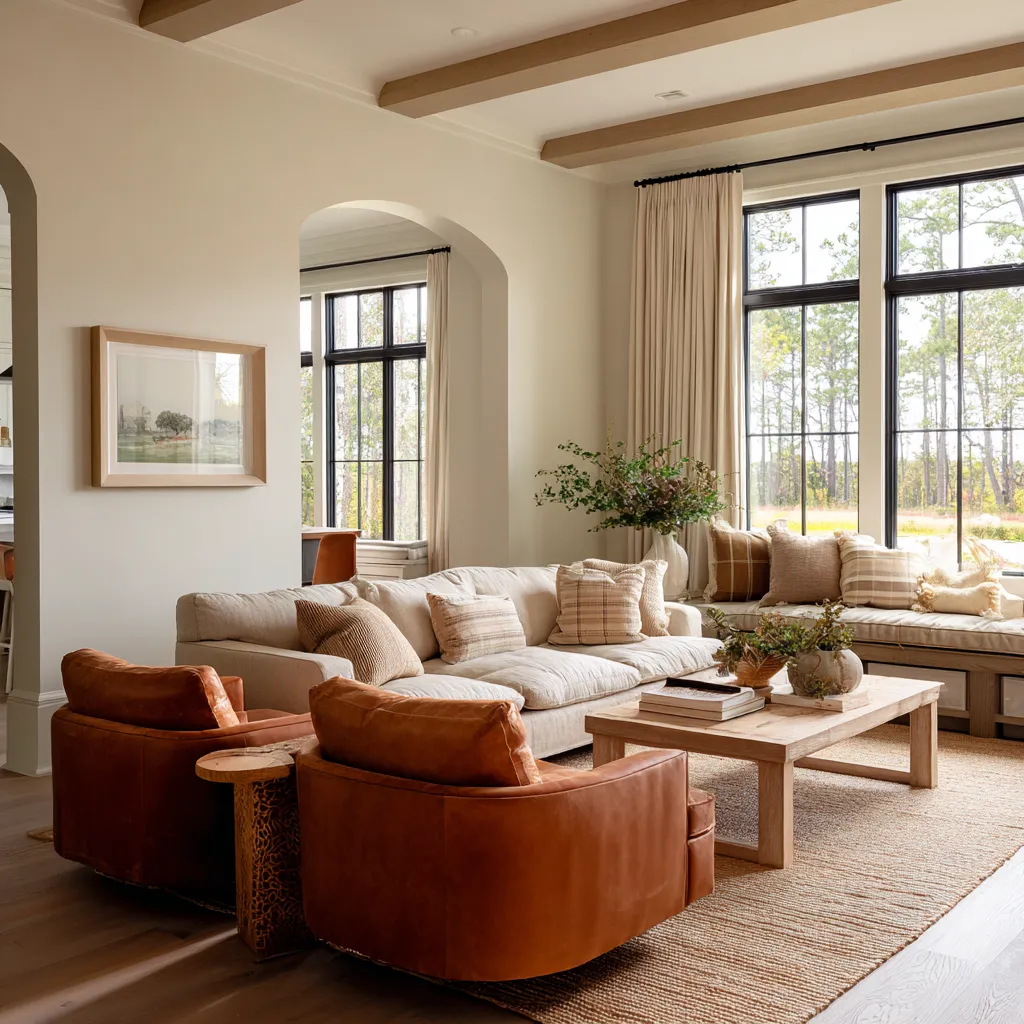
This is especially important in rooms built from cream upholstery, pale walls, soft blue or sage notes, and long drapery. Those rooms need one or two elements with enough gravity to keep the composition from dissolving into atmosphere.
The designer is not trying to make the room heavy. The aim is to make it believable and settled.
A grounded room feels attached to the earth. You can sense wood grain, masonry weight, basketry dryness, leather warmth, beam shadow, or the visual firmness of a dark-framed opening.
These ingredients keep the lighter parts of the palette from floating away.

Blue is useful, but it is not the engine of the style
One of the common misunderstandings about Lowcountry interiors is the idea that blue creates the identity. Blue can absolutely belong in the style.
In many cases it should. But blue on its own is not enough, and in many rooms it is not even necessary.
The blues in modern Lowcountry living rooms are muted, weathered, dusty, watery, or silted. They suggest marsh reflection, distant sky, sea haze, washed paint, and softened horizon.
They do not feel bright, graphic, or nautical. Blue tends to work when it behaves like atmosphere rather than like a decorating statement.
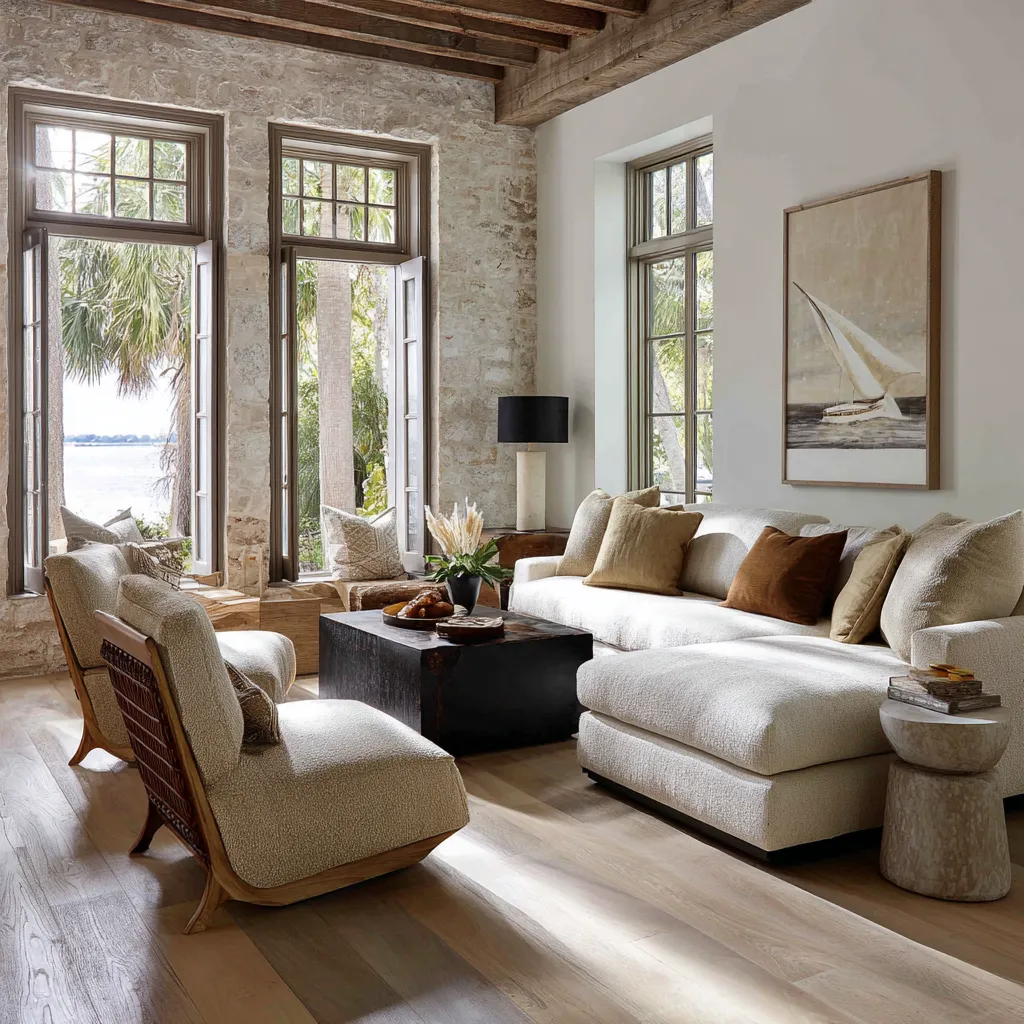
That means the blue should almost always be supported by grounding matter. A blue wall gains strength when it is paired with dark floorboards, warm timber, a black window frame, a substantial wood table, or tobacco leather seating.
Blue chairs become more convincing when their frames tie them back to wood, cane, or a darker architectural line. Blue drapery needs trim, height, and enough other warm materials to keep it from turning precious.
A seascape over the sofa works better when the rest of the room is already grounded in fiber, wood, plaster, or masonry.
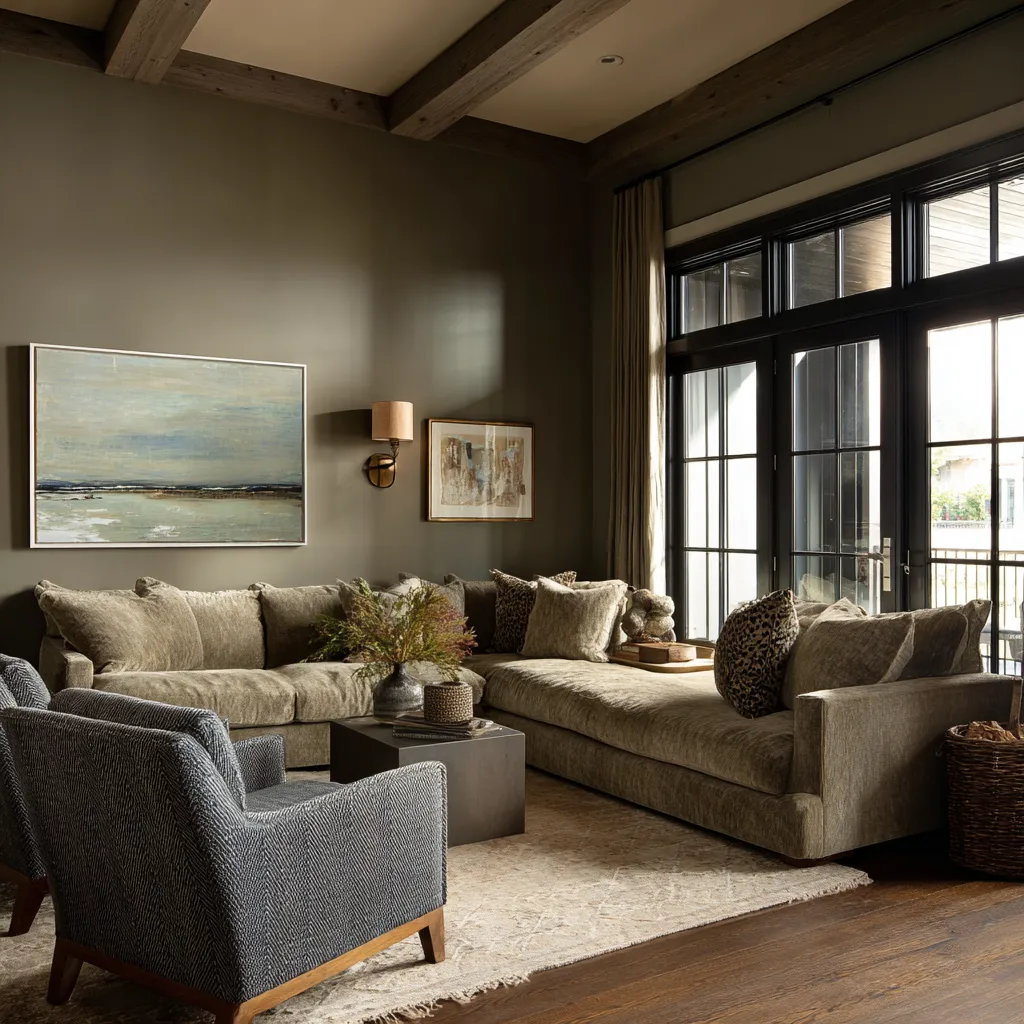
Many excellent modern Lowcountry rooms use very little blue at all. Instead, they lean on oyster, shell, sage, driftwood, olive, sand, river-silt beige, tobacco, pale mineral gray, or weathered green.
These palettes can feel just as coastal and often more mature because they connect the room to marsh grass, bark, reeds, damp wood, limestone, faded paint, and shoreline light rather than to decorative color coding. So the real core pair in the style is not blue and white.
It is a breathable pale field held in place by an earthy counterweight.

Natural fiber is a bridge between old and new
Jute rugs, woven lounge chairs, cane accents, basketry, seagrass ottomans, woven shades, and wrapped stools appear again and again in strong modern Lowcountry rooms. Yet these elements are rarely the sole basis of the style.
Their role is subtler and more important than that. They act as bridges.
Natural fiber connects porch culture to indoor living. It connects rougher craft traditions to broader, more current upholstery.
It connects the dry tactile quality of coastal materials to the softness of deep seating. It also helps translate Southern domestic warmth into a simpler visual language.
A jute rug, for example, can replace a busier traditional rug and keep the room grounded while reducing visual noise. A woven chair can carry craft memory into a room dominated by a modern sectional.
Woven shades can make a tall opening feel climate-aware without introducing heavy formality.
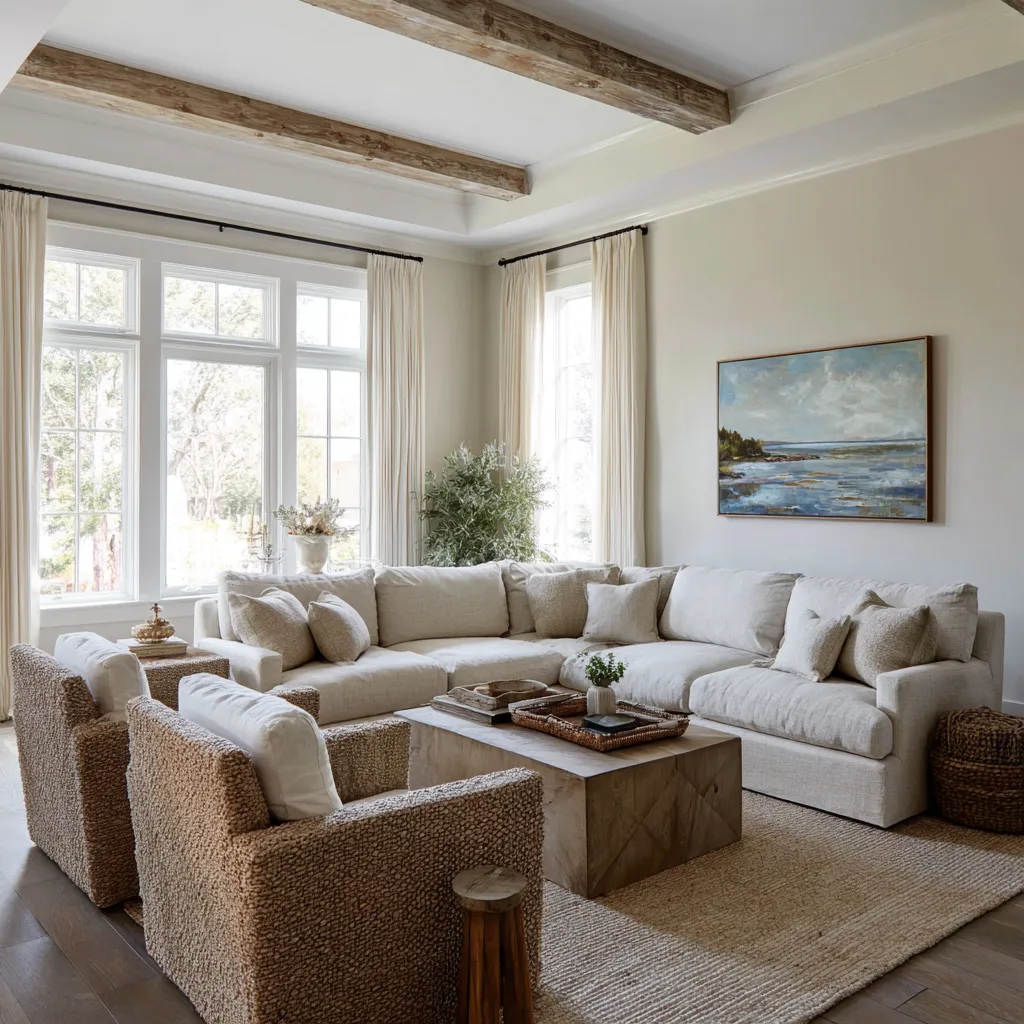
This is why fiber works so well in the style. It is not trying to be the headline act.
It connects one part of the room to another. It takes the place of pattern in many current rooms.
It adds surface variety without turning the space into a patchwork of competing gestures. In pale rooms, fiber is often the detail that saves the interior from feeling too polished.
In darker rooms, it softens the enclosure and keeps the palette tied to natural matter. In open-plan rooms, it gives the living area a material identity that can continue into adjoining zones.

Hospitality is structural, not decorative
A modern Lowcountry living room should feel built for staying. That does not mean oversized furniture pushed into every corner.
It means the room supports lingering in natural ways. Deep sofas, broad sectionals, low lounge chairs, flexible ottomans, window benches, substantial coffee tables, soft rugs, and seating arranged in genuine conversation groups all contribute to this feeling.
The room should allow people to sit for a long time, turn toward one another easily, place a book or tray on a central surface, and move between interior and exterior life without stiffness. This social softness is one of the parts of the style that remains consistent even when color, shell type, and furniture language shift dramatically.
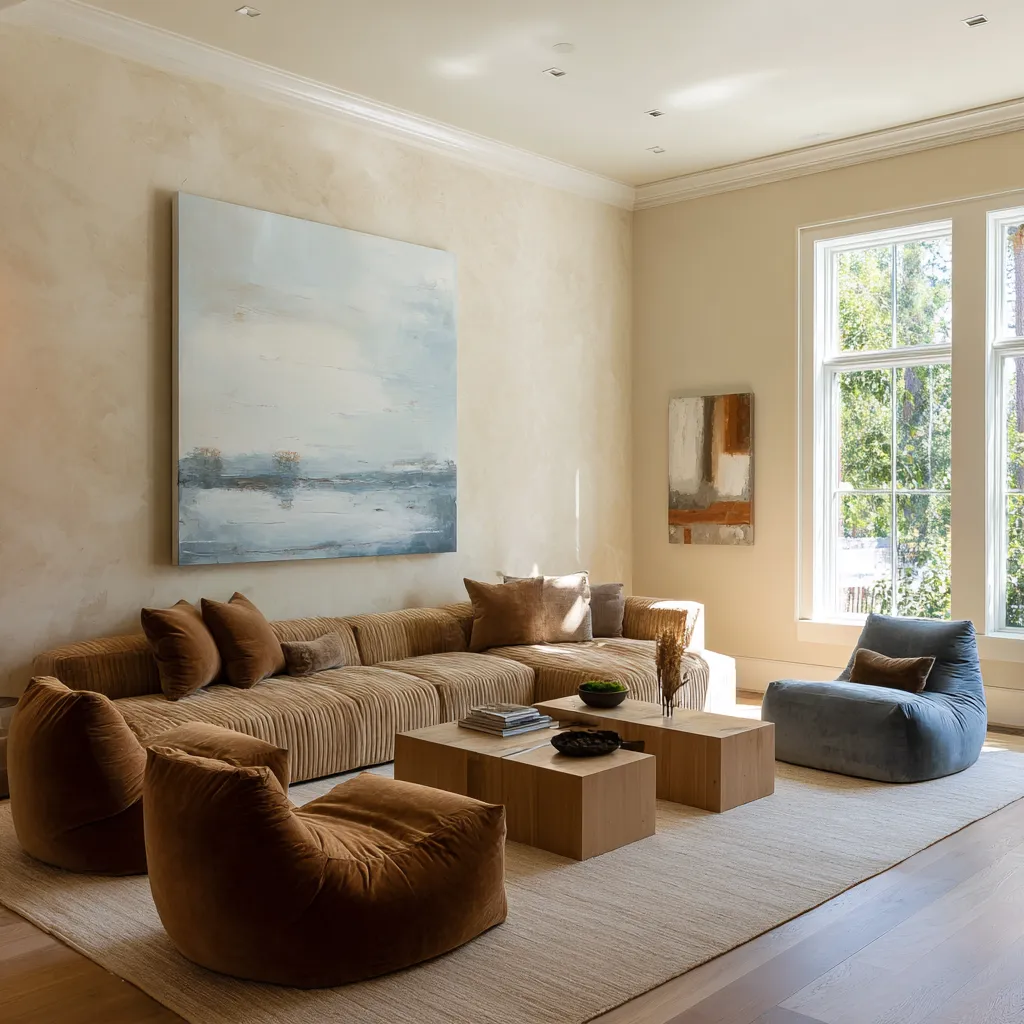
That is why many successful rooms use large central tables rather than delicate accent-only arrangements. The table often functions as a communal surface, not merely a sculptural object.
It holds the room socially. The same goes for sectionals and grouped lounge chairs.
The room is shaped around inhabitation before styling. This emphasis on hospitality also explains why the style tends to prefer broader furniture masses over many small chairs or formal arrangements.
The living room is not treated as a ceremonial salon. It is treated as a place of gathering, conversation, reading, resting, and looking out toward landscape or light.

There are several valid mood families within the style
Modern Lowcountry is not one fixed visual formula. It can move in several directions and still remain coherent.
One branch is bright and blue-atmospheric. These rooms use pale marsh blue, high openings, warm wood, weathered beams, soft cream upholstery, and broad horizon art.
They often feel open, lifted, and linked to water and sky. Another branch is darker and more mineral.
These rooms use gray-green paneling, olive-brown walls, pale masonry, dark beams, black windows, tobacco seating, and a more inward mood. They still feel coastal, but through shade, mass, and protected interior depth rather than through brightness.
Another branch is airy and reduced. Here the shell stays pale, the furniture becomes broader and simpler, pattern nearly disappears, and the room depends on texture, openness, and one or two carefully placed regional cues.
These versions often work especially well in newer open-plan houses.

There is also a transitional tactile branch that uses jute, slipcovered or linen-like seating, warm accent chairs, woven pieces, and quieter versions of traditional comfort. These rooms tend to be highly livable and easier for many homeowners to adapt.
A more collected, pattern-bearing version can exist too, but it requires discipline. Florals, skirted upholstery, and grandmillennial notes can fit the style only when they are controlled by strong architecture, muted palette, and enough darker linear structure to keep the room from turning nostalgic.
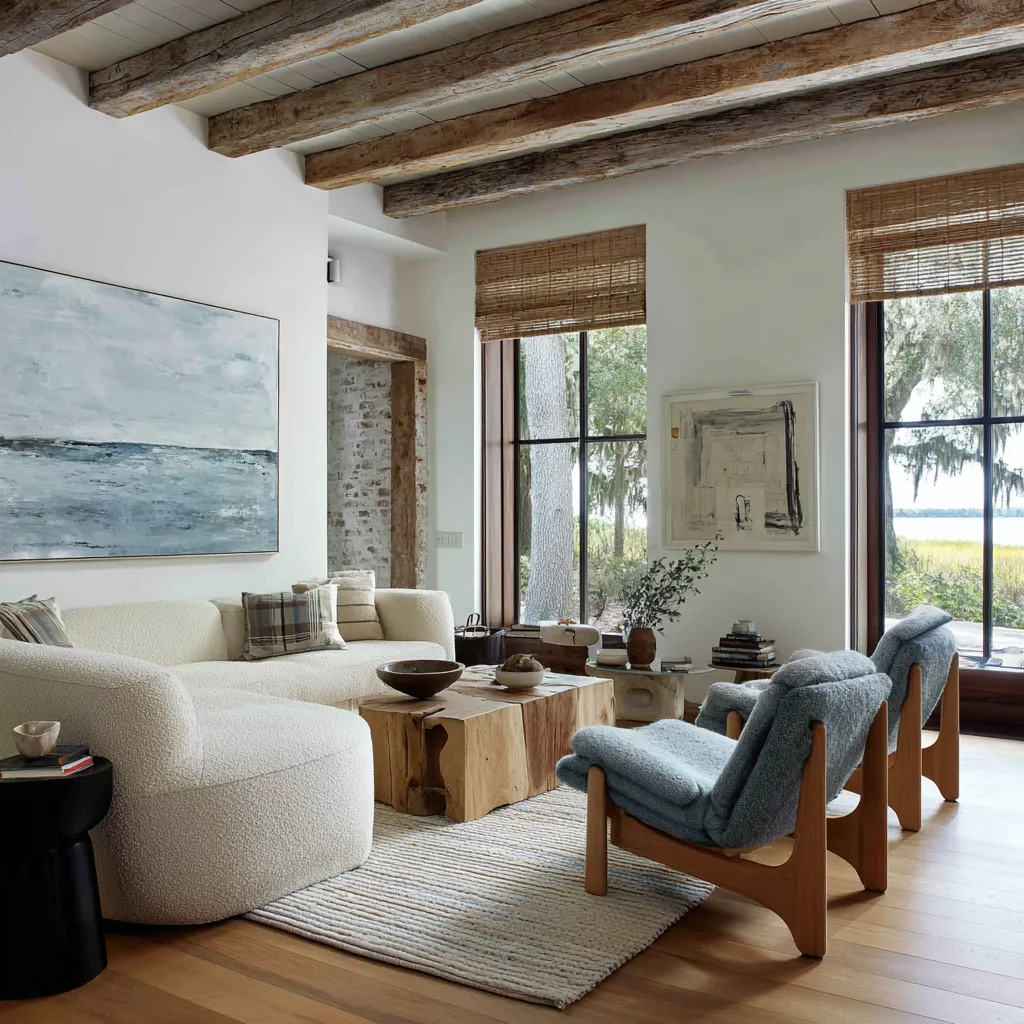
Understanding these families matters because it frees the style from a single stereotype. A homeowner does not need a pale blue marsh room to work in a Lowcountry manner.
A darker, tobacco-toned room with pale stone, black windows, and jute may be equally persuasive. The real question is not whether the room is light or dark.
The real question is how it holds place-memory and present-day editing together.
Pattern can stay, but it needs discipline
Modern Lowcountry room ideas reduce pattern heavily and rely on texture instead. Plaster, jute, boucle, wood grain, cane, linen-like upholstery, leather, pale stone, and drapery folds create richness without the room becoming busy.
This is one reason the style feels current. Texture replaces much of the visual labor that patterned fabric once handled.

That said, pattern is not banned. Pattern becomes a problem only when it spreads too far, becomes too high in contrast, or is layered without a strong structural framework.
A floral chair can work if the architecture is substantial enough and the rest of the furniture stays calm. Plaid or stripe can work if it appears in small doses and stays inside a muted palette.
Patterned rugs become harder because they activate the entire lower plane and can compete with beams, fiber, and art. So the issue is not pattern itself.
The issue is whether the pattern breaks the room’s large-scale calm. In this style, calm matters.
It lets light, shell, and material remain visible.

Open-plan Lowcountry has its own rules
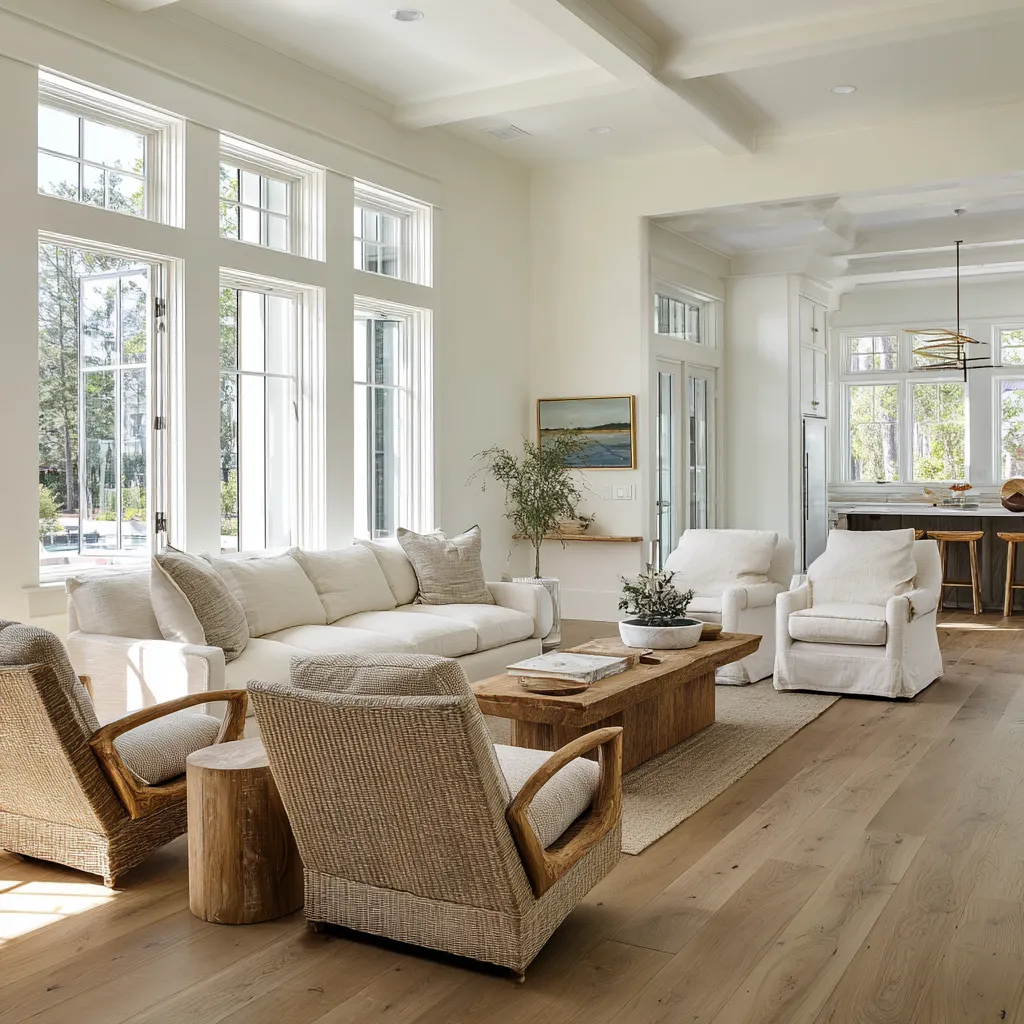
In a more enclosed room, the living area can hold much of the style on its own. In an open-plan house, that is no longer enough.
The material logic has to continue into the kitchen, circulation areas, and nearby seating zones. If the living room uses warm wood, jute, pale upholstery, and marsh-linked color but the kitchen turns glossy, cold, and visually unrelated, the Lowcountry feeling weakens.

That is why good open-plan modern Lowcountry interiors carry certain materials and tones across zones. Wood stools may repeat the wood of the coffee table.
Pale plaster or soft wall paint may extend into the dining area. Fiber may appear in chairs, baskets, or rugs in more than one place.
The ceiling treatment may continue or at least echo itself. The whole space then feels tied to one climate-aware language rather than divided into separate moods.
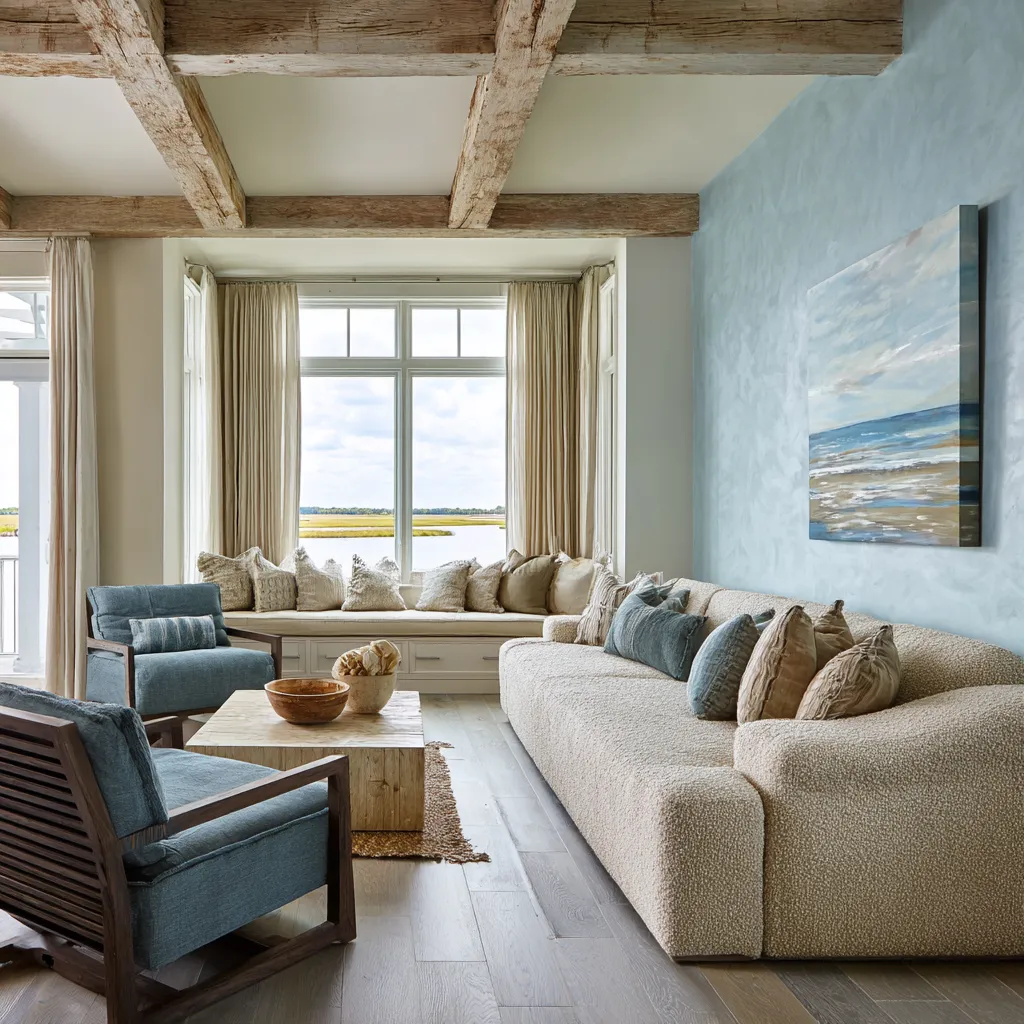
Open-plan rooms also need especially clear anchors so the living area does not dissolve into the surrounding space. A long wood table, a large woven rug, a grouped seating cluster, or a pair of woven chairs can define the living zone without blocking openness.
Here again, the room depends on clear material and furniture decisions rather than on accessory styling.

Ceiling treatment carries hidden memory
One of the discussed but powerful devices in modern Lowcountry design is the ceiling. Exposed timber beams, driftwood-finished grids, white plank ceilings, pale coffers, and board-and-beam combinations often hold more regional memory than the furniture below them.
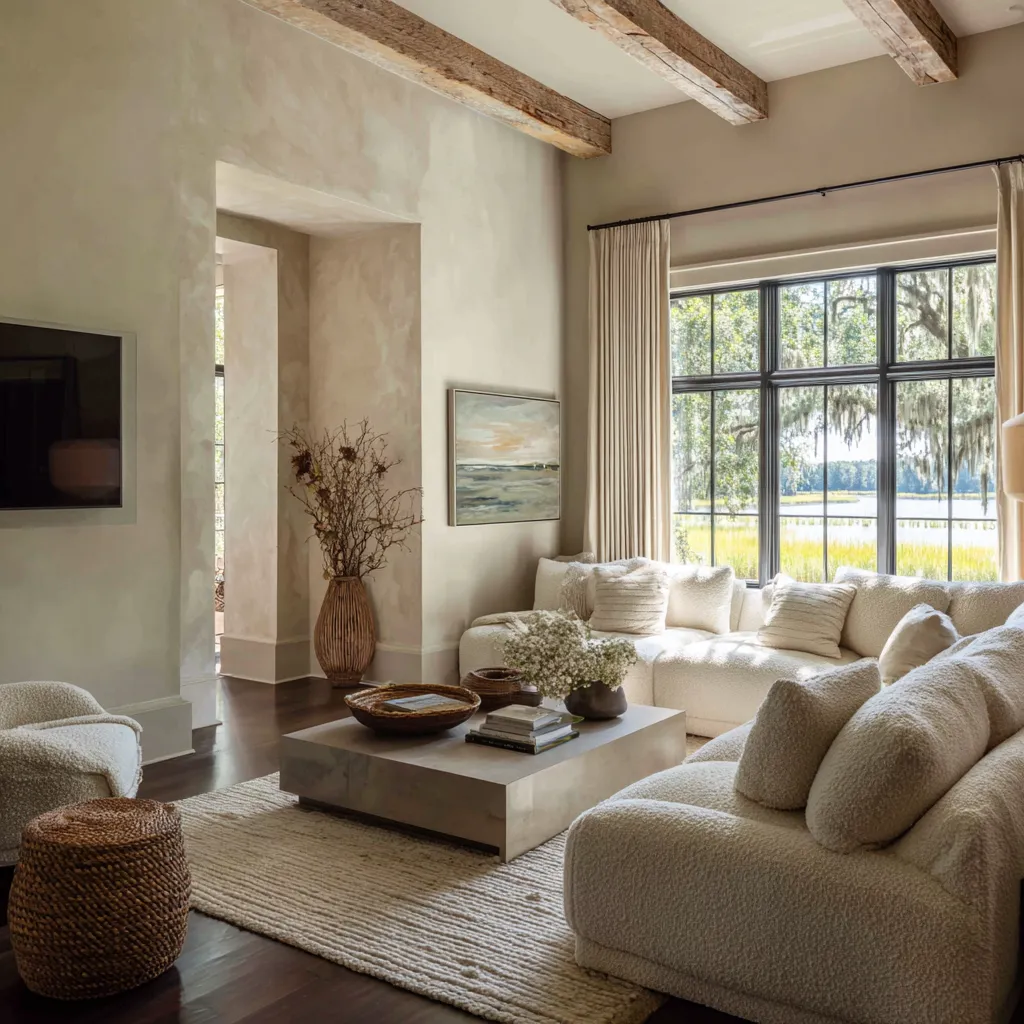
This works because the overhead plane can carry heritage while the lower half of the room becomes simpler and more current. A room with a strong beam rhythm can accommodate a very modern sectional.
A pale coffered ceiling can support rounded lounge furniture without losing its Southern identity. A single dark beam across a plastered room can add enough memory that the rest of the composition can remain quiet.
The ceiling also helps with proportion. In tall rooms it gives the eye an upper register and makes the space feel more inhabited.
In open plans it can help frame the living zone. In pale interiors it brings texture where the walls are kept broad and calm.
The vertical structure of the room matters
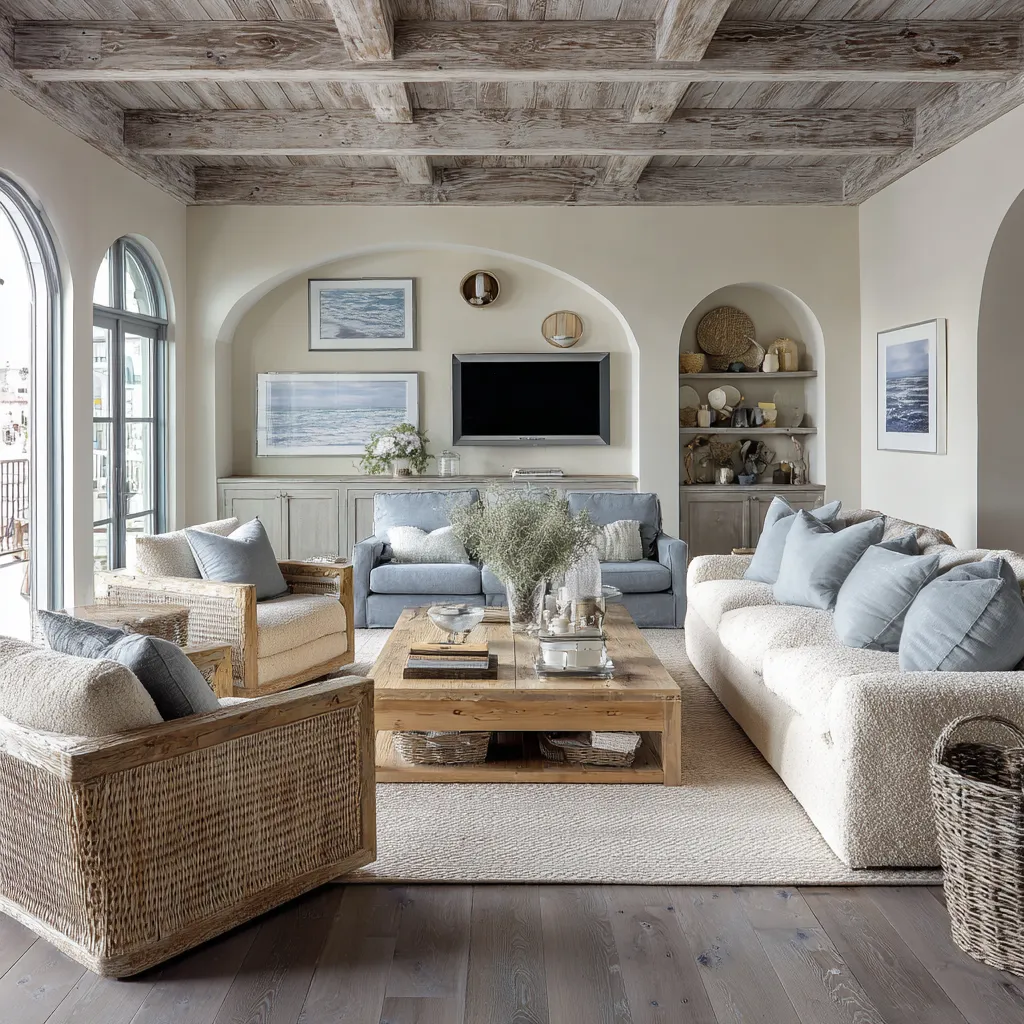
Stylish modern Lowcountry living room designs share a similar vertical organization: lighter upper fields and heavier lower fields. Pale walls, daylight, long drapery, sky-linked paint, and lifted openings occupy the upper half.
Darker floors, wood tables, jute, leather, masonry, and seating weight occupy the lower half. This creates a room that feels airy overhead and settled underfoot.
It is a subtle but important compositional engine. Without this lower-half gravity, pale rooms can feel diffuse.
Without this upper-half lift, grounded rooms can become dense and closed. The style often works through the pull between these two states.
What usually weakens the style
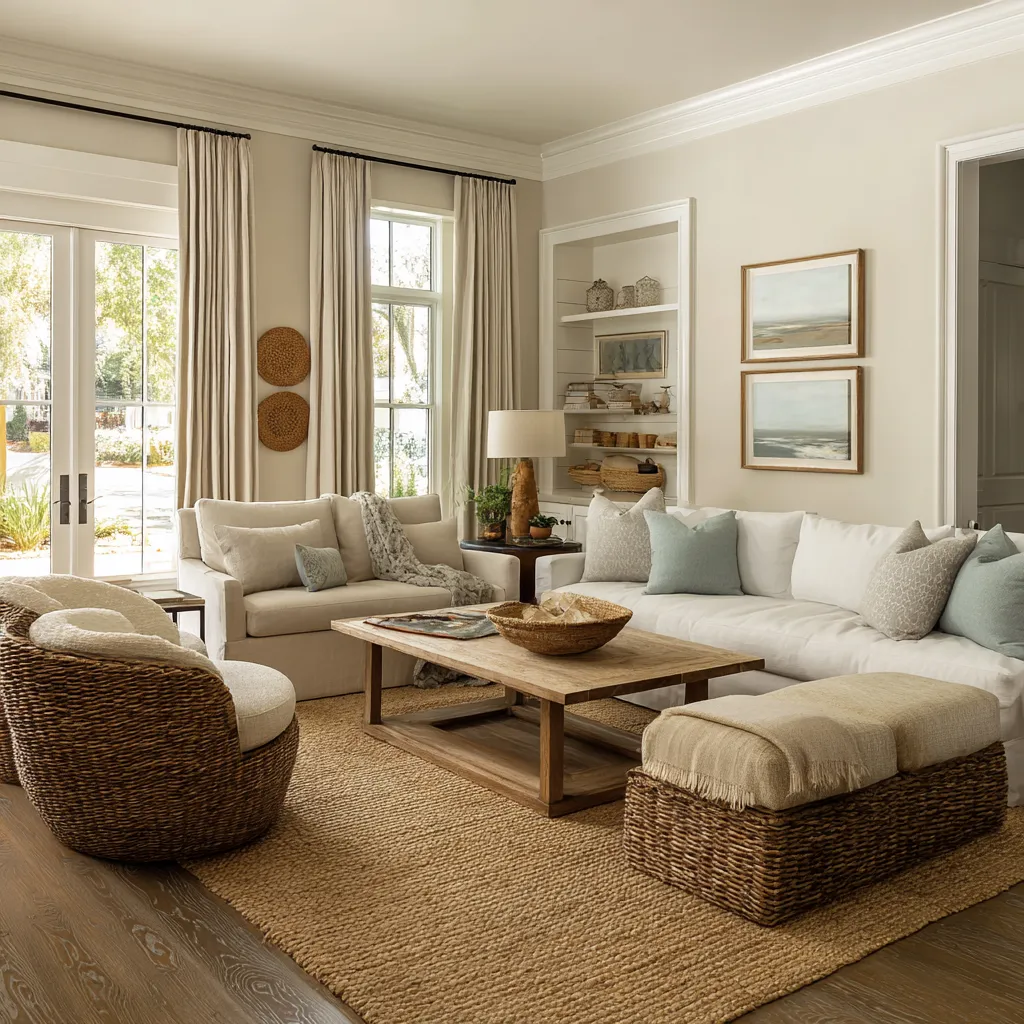
Several common mistakes can push a room away from convincing modern Lowcountry.
- The first is blue without grounding. Pale blue walls, blue pillows, and coastal art are not enough if the room lacks wood weight, darker linework, fiber, or architectural strength. The result tends to feel broadly coastal rather than specifically Lowcountry.
- The second is reduction without a regional fact. A very edited pale room can be beautiful, but if it lacks beams, plaster, black-framed openings, masonry, a horizon-linked art field, or some other strong place signal, it can slip into generic contemporary luxury.
- The third is dark mood without daylight dialogue. Olive walls, dark beams, and deep furniture can work beautifully, but the room still needs tall openings, visible light, pale relief, or an exterior relationship. Otherwise it turns into a den with little coastal character.
- The fourth is too much decorative inheritance at once. A traditional shell, floral pattern, full shelves, multiple framed works, and layered accessories can quickly drag the room backward unless strong editing and darker structure hold everything together.
- The fifth is broken continuity in open-plan spaces. If the living room tries to carry the style alone while adjacent zones ignore its material logic, the regional charge weakens.

How to design the room in practice
A practical way to build a modern Lowcountry living room is to think in layers.
- First, establish one clear shell fact. This might be a beam treatment, a fireplace wall, black-framed openings, a pale plaster finish, paneling, a built-in window seat, or a strong relation to French doors and exterior greenery.
- Second, choose the grounding device. Decide whether the room will anchor itself through timber, masonry, dark contrast, leather, fiber, or a deep floor-plus-table combination.
- Third, choose the atmosphere family. Marsh blue, sage, oyster, shell, tobacco, driftwood, mineral gray, lagoon, pale olive, and washed cream can all work. The important thing is that the palette stays controlled and tied to land, water, light, and weathering.
- Fourth, select broad present-day upholstery. Use one main sofa or sectional with a clear calm silhouette. Add one or two secondary seating types for contrast: woven chairs, wood-framed lounge chairs, leather chairs, or rounded upholstered forms.
- Fifth, keep pattern low and let texture carry the room. Bring in jute, nubby fabric, cane, pale plaster, wood grain, soft drapery, and stone rather than relying on many prints.
- Sixth, keep the accessory layer lean. A few ceramics, a bowl, branches, a lamp, a stack of books, or one strong art field are often enough.
- Seventh, protect the windows and long views. The style depends heavily on daylight and visual relation to outdoor life. Do not bury the openings under clutter or overly assertive treatments.
Why the style continues to matter
Modern Lowcountry living room design remains compelling because it manages something many current interiors struggle to achieve. It feels regionally specific without becoming theatrical.
It feels current without becoming detached from memory. It allows comfort, material warmth, and social softness to remain central while clearing away enough visual excess that the room still feels fresh.
That is the deep appeal of the style. It does not ask the house to forget where it is.
It also does not ask the interior to live in the past. Instead, it takes Southern coastal environmental memory—shade, breeze, timber, masonry, marsh light, porch life, woven texture, long sitting—and gives it a cleaner, broader, calmer form for present-day living.
A convincing modern Lowcountry living room therefore does not begin with a shopping list. It begins with a way of thinking.
Let the shell hold the memory. Let the furniture hold the comfort.
Let the materials hold the place. Let editing hold the room together.
When those parts align, the result feels rooted, open, and fully alive in the present.