A Halloween porch can be playful, atmospheric, botanical, theatrical or almost completely understated. What makes the decoration feel considered is usually not the number of pumpkins or props.
It is the relationship between those seasonal pieces and the house itself. A white Colonial porch, a timber Craftsman entrance, a coastal shingle house and a desert modern home naturally call for different approaches.
Exterior materials, door color, porch proportions, landscaping and permanent lighting already establish a visual framework. Halloween decoration becomes much more interesting when it works within that framework.
That still leaves plenty of space for bats, spiders, ravens and jack-o’-lanterns. They simply become part of a larger composition rather than the whole story.
If you are collecting Halloween decorating ideas for a porch, it helps to look beyond individual accessories. Color, height, scale, silhouette and evening lighting often make a bigger difference than adding another themed object.
The House Already Gives You Half the Halloween Palette
One of the easiest ways to understand a porch is to look at the colors that are permanently there. The exterior itself can determine most of the seasonal palette.
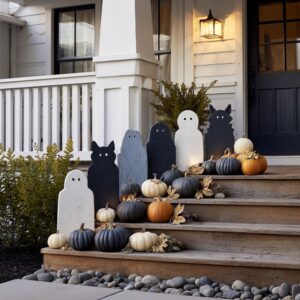
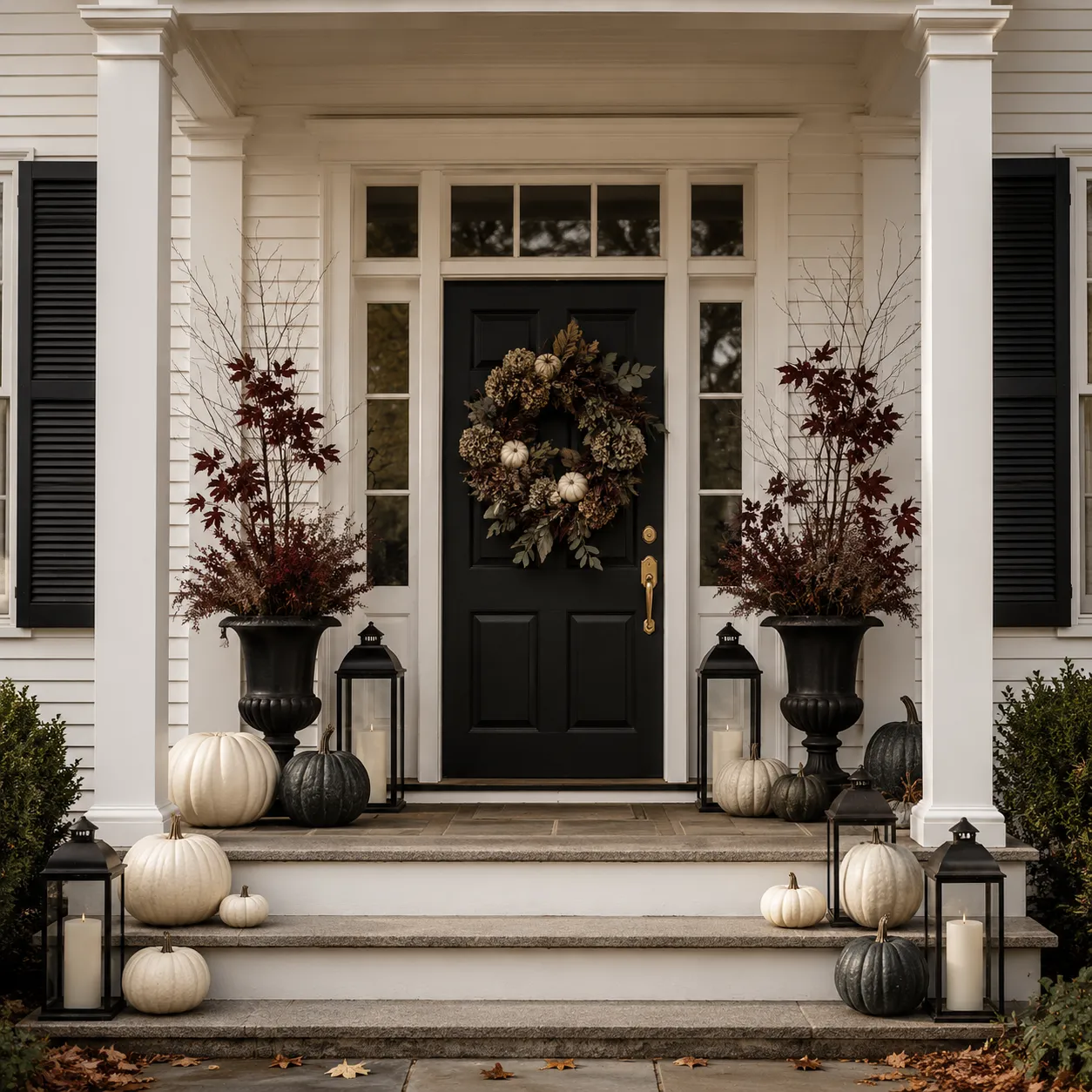
A house with white siding, a black door and black shutters already contains the bones of a Halloween palette. Ivory pumpkins can sit close to the architecture in tone, while charcoal pumpkins, black lanterns and dark foliage connect directly to the permanent black details.
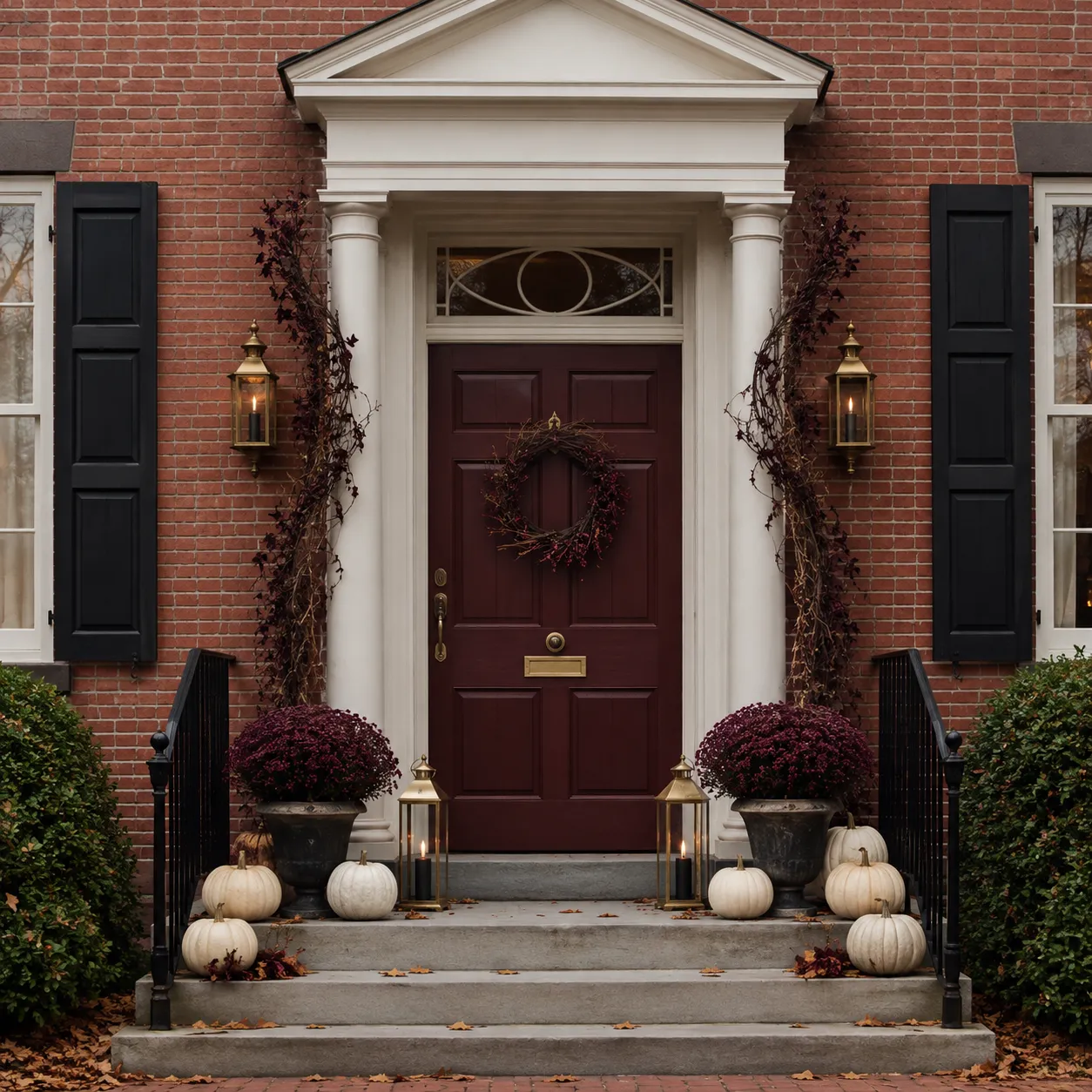
Red brick behaves differently. Traditional orange pumpkins can visually merge with the brick, while cream pumpkins stand apart much more clearly.
Burgundy chrysanthemums, berry branches, deep green leaves and aged brass are often more effective here than adding extra orange. Natural timber and stone invite warmer, earthier colors: cream, dark green, muted orange, charcoal and bronze.
Weathered cedar or grey shingles tend to pair beautifully with dusty blue-green pumpkins, dried hydrangea, faded grasses and aged copper. Desert homes already contain terracotta, sand, olive, gravel and warm stone.
Halloween can grow out of those colors rather than arriving as a black-and-orange layer placed on top. The interesting point is that there is no single Halloween palette.
The exterior can decide most of it.
Pumpkins Become Much More Useful Once They Stop All Doing the Same Job
Pumpkins often get placed one after another along a stair, but they become much more effective when different sizes perform different functions. A large pumpkin can anchor a composition, medium pumpkins can build its mass, and small gourds can connect the gaps.
A large pumpkin might establish the edge of a landing. Medium pumpkins can gather around it, while smaller forms help the group taper toward the path or stairs.
That simple change makes the arrangement feel less like a row and more like a composition. Cream pumpkins are especially versatile.
They stand out against brick, dark doors, timber, foliage and charcoal planters without creating a lot of visual noise. Black pumpkins are useful too, although they tend to work better in smaller numbers.
They can connect a seasonal arrangement to black window frames, railings, lanterns or a dark front door. Used everywhere, they can make a porch visually heavy, particularly if the landscaping is already dark.
Muted green pumpkins are another useful middle ground. On Tudor, Craftsman and garden-heavy porches, they can carry almost the same depth as black while still feeling botanical.
Orange still has an important role. On a timber porch, it can connect naturally with warm wood.
On a Spanish-style house, it can relate to terracotta. On a desert property, it can echo the landscape.
The difference is that orange becomes part of the material palette rather than an automatic Halloween requirement.
Why Tall Branches Change a Porch So Quickly
Pumpkins and lanterns occupy the bottom of an entrance. Tall branches solve the opposite problem.
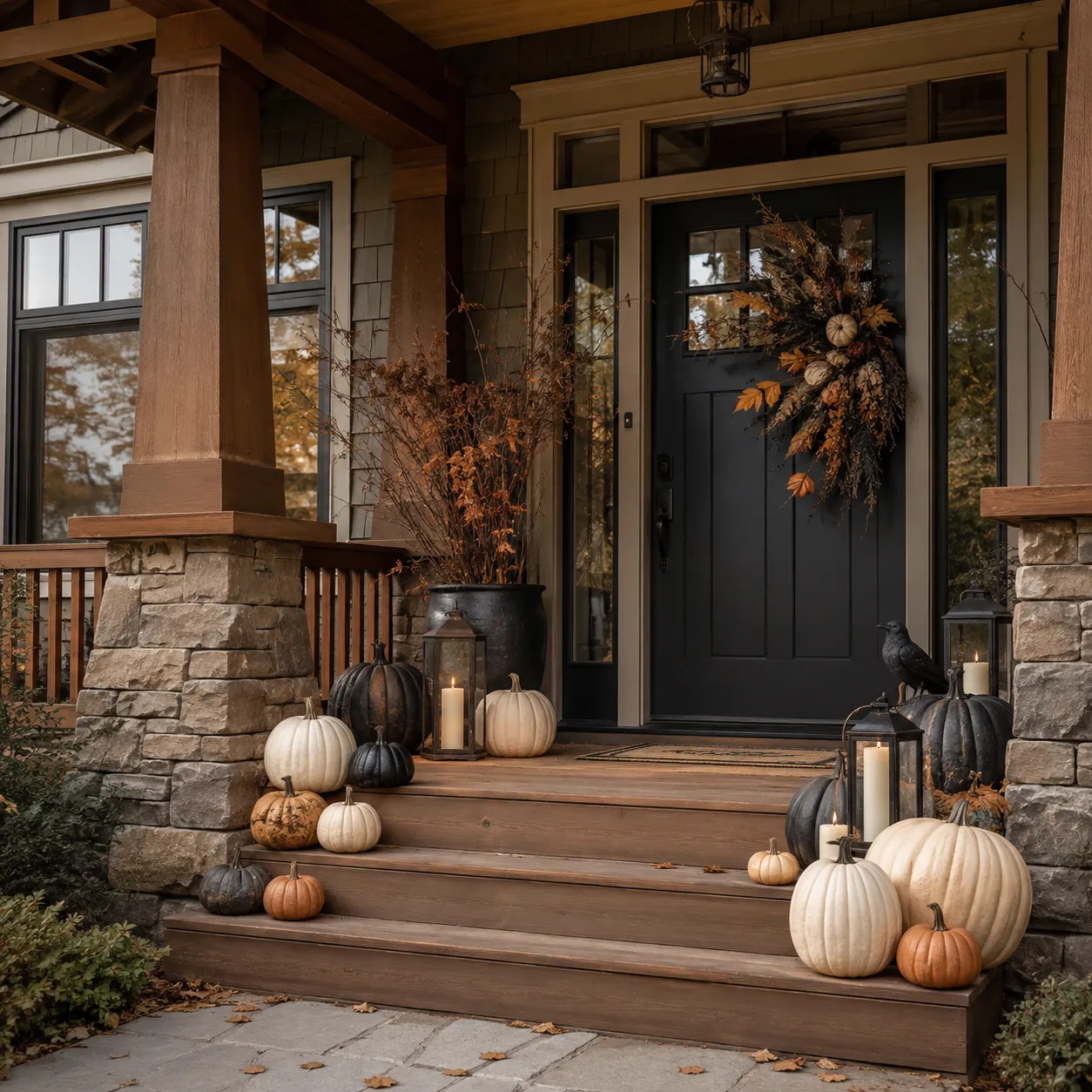
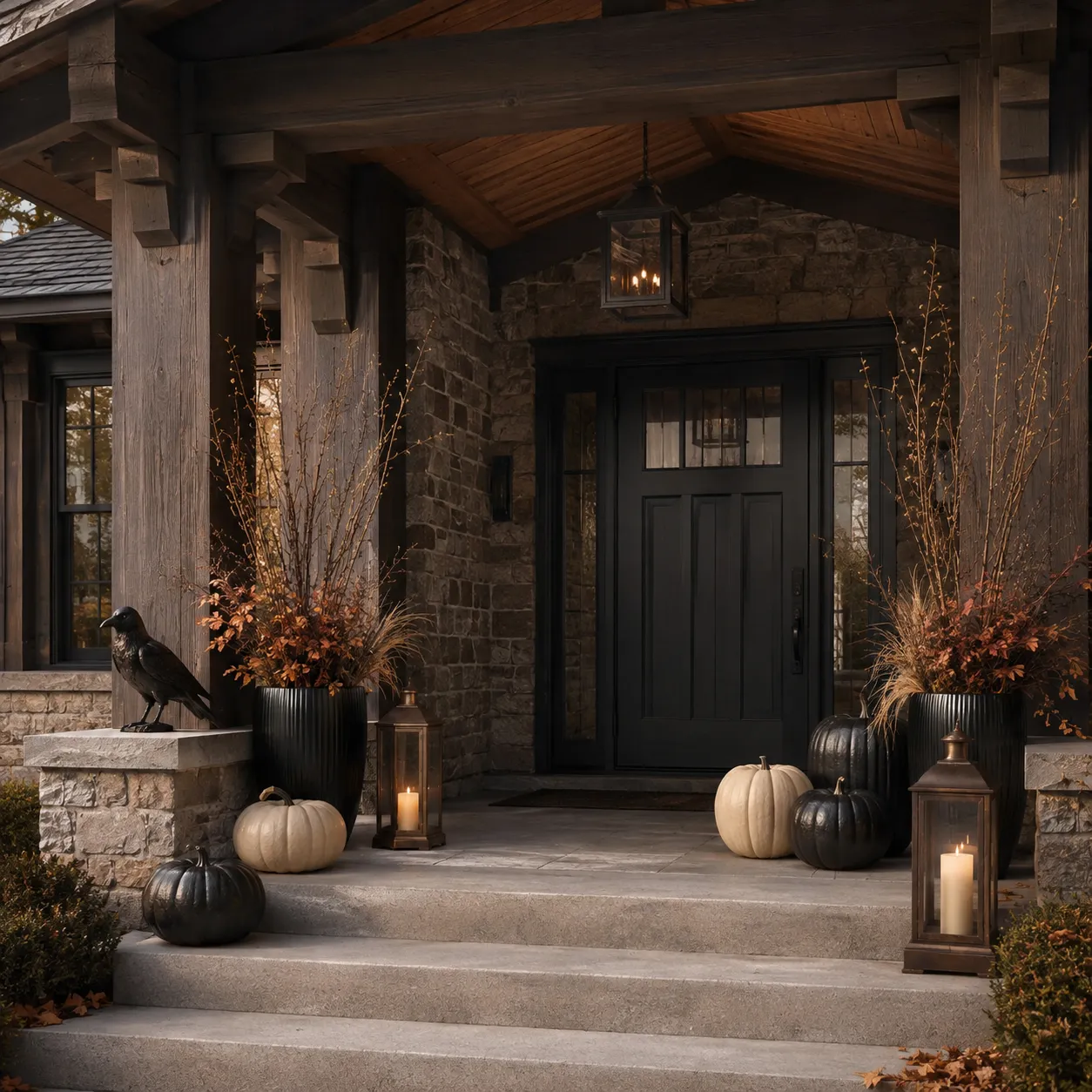
Branches bring seasonal decoration into the upper half of the porch without consuming much floor space. A large urn filled with bare or almost-bare branches can occupy several feet of vertical space without making the entrance feel crowded.
The branching lines also introduce something irregular and slightly wild beside straight columns, clean siding and rectangular doors. That contrast is especially useful on formal or contemporary architecture.
The more interesting arrangements are not necessarily branches alone. A dense lower layer of dried grasses, hydrangea, broad leaves or burgundy foliage gives the container some weight, while the thinner branches extend above it.
Fruiting branches add another seasonal layer. Pomegranate-like fruit, crabapple branches, dark berries and seed pods create small points of color and shadow through the upper part of the entrance.
They suggest late autumn naturally, particularly when the branch itself has already lost most of its foliage. On Mediterranean or Spanish Colonial porches, these branches can be especially effective in oversized clay or earthenware vessels.
The vessel already belongs with stucco, terracotta and ironwork, so the Halloween character comes from the branch rather than from an obvious themed container.
Sometimes the Halloween Detail Is Only One Object
A porch does not need several different spooky motifs competing for attention. One black spider on pale siding can be enough.
A few ravens on twisted branches can be enough. A small group of bats can be enough.
One large jack-o’-lantern can be enough. A single recognizable Halloween symbol often has greater impact when the rest of the porch stays botanical and seasonal.
Dried foliage, pumpkins, lanterns and branches establish October. The spider, bat, bird or carved pumpkin shifts the mood toward Halloween.
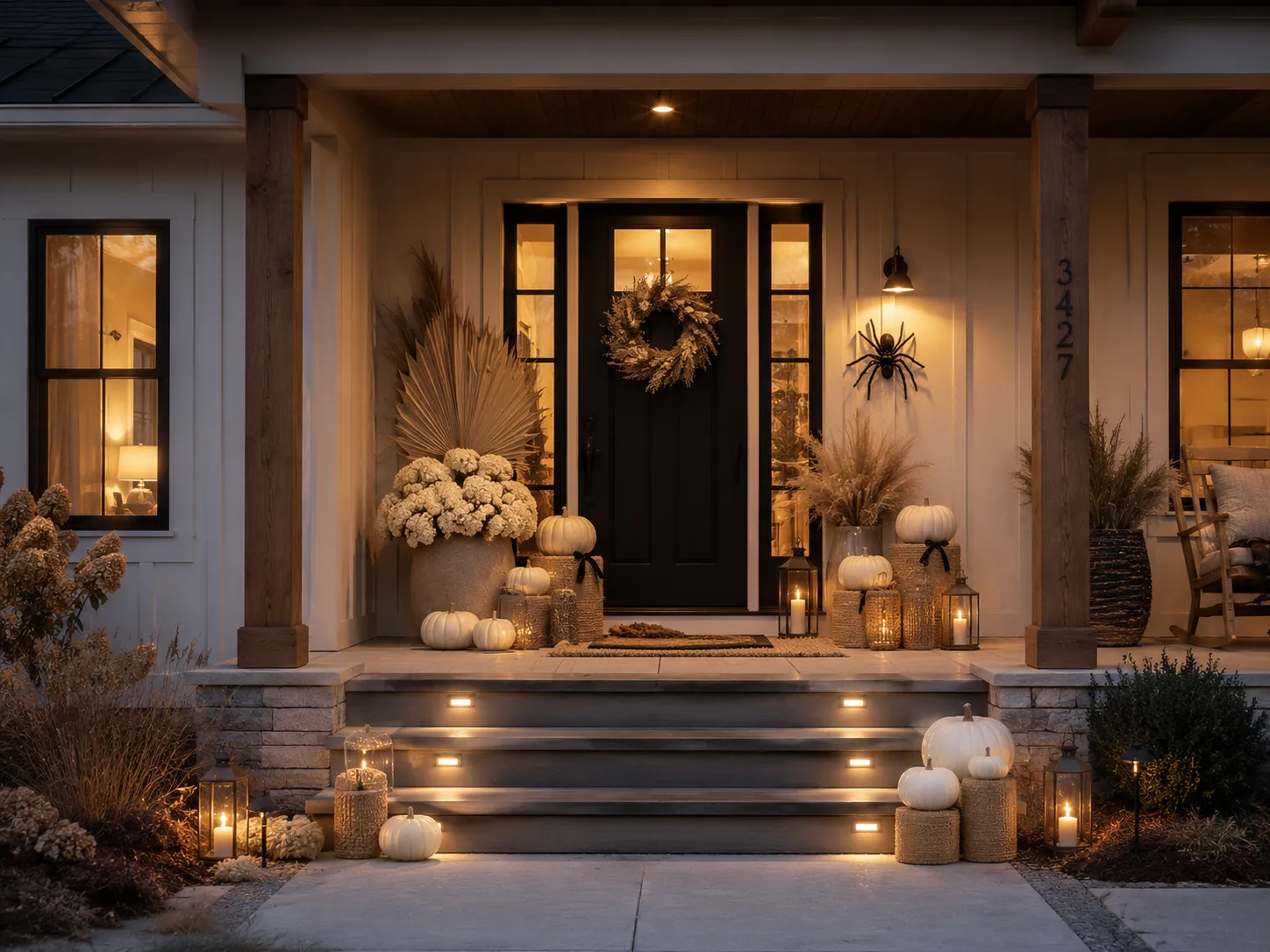
This is particularly effective on homes where the architecture has a clear character of its own. A large spider on a modern farmhouse porch feels more intentional when it is surrounded by ivory pumpkins, black lanterns and wheat-toned grasses rather than several unrelated props.
The same applies to ravens. A bird sitting on a branch or stone wall feels connected to its setting.
Five ravens placed at different heights on one large branch structure can create far more presence than five different Halloween accessories scattered around the porch. Among many Halloween porch decorating ideas, this is one of the simplest ways to keep the house visually important.
The Most Useful Place for a Spider Might Be Under a Light
Lighting changes which decorations work after sunset. A black spider attached to an unlit dark corner may disappear almost completely.
The same spider mounted beneath a warm exterior sconce on white or cream siding becomes much clearer. Dark silhouette decorations become far more effective when they sit inside an existing pool of architectural light.
The light may also throw a slight shadow from the legs onto the wall, which gives a flat decoration additional depth. Bats benefit from the same idea.
Pale stucco, illuminated branches and warm porch lighting all give black silhouettes a clear background. This is one reason permanent architectural lighting deserves attention before adding seasonal lights.
The house may already contain the exact light zones that the Halloween objects need.
Bats Look Better When They Seem to Be Going Somewhere
Bats are often attached to a wall at regular intervals. That tends to make them feel like a pattern.
A more convincing arrangement has a direction. Changing spacing, angle and size can make a group of bats suggest movement rather than decoration repeated on a wall.
Several bats might begin close together near a planter or branch structure, then spread outward and upward toward the roof. Some can turn slightly.
Sizes can change. A few can move from one surface onto another.
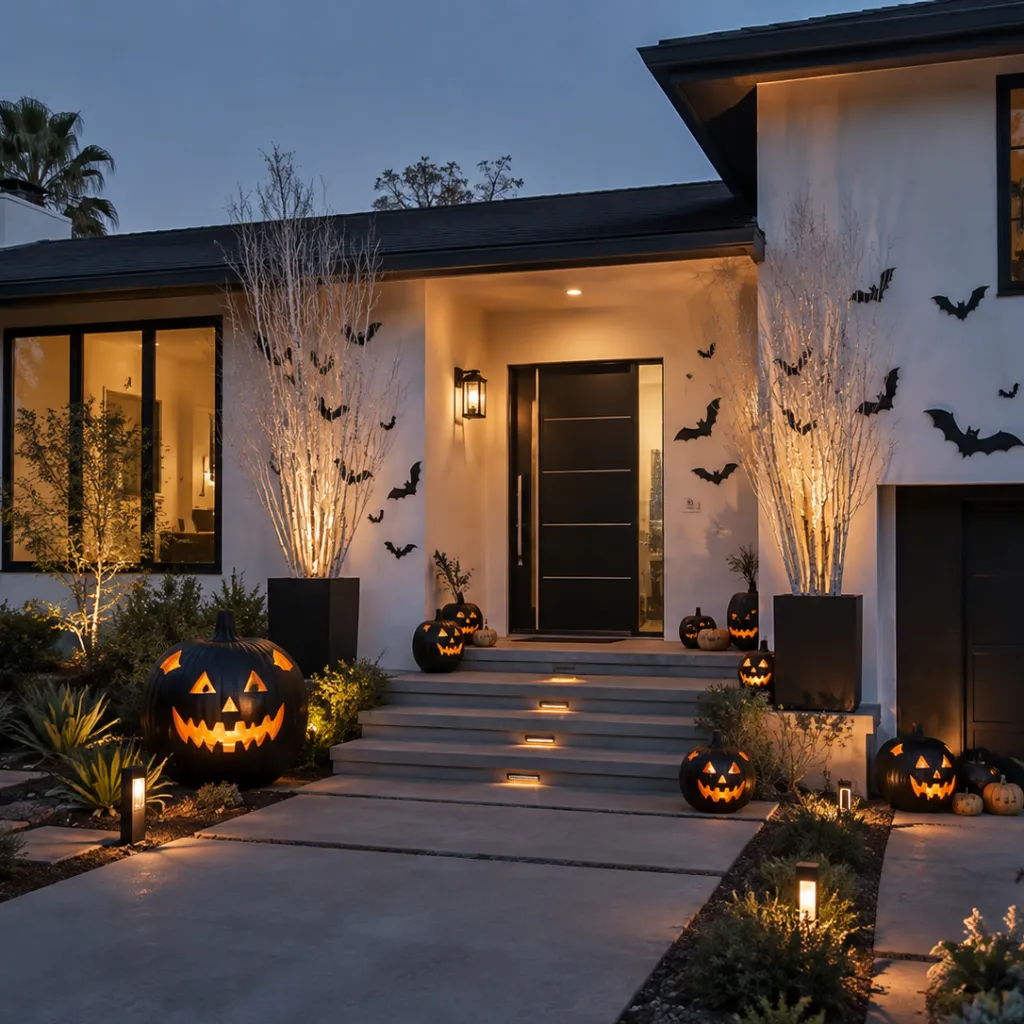
Modern houses are particularly suited to this because large pale walls give the black silhouettes plenty of contrast. They also allow empty areas between groups, which helps individual forms remain visible.
A dense cluster near the entrance and a few isolated bats farther away can create a much clearer sense of motion than covering the whole wall evenly.
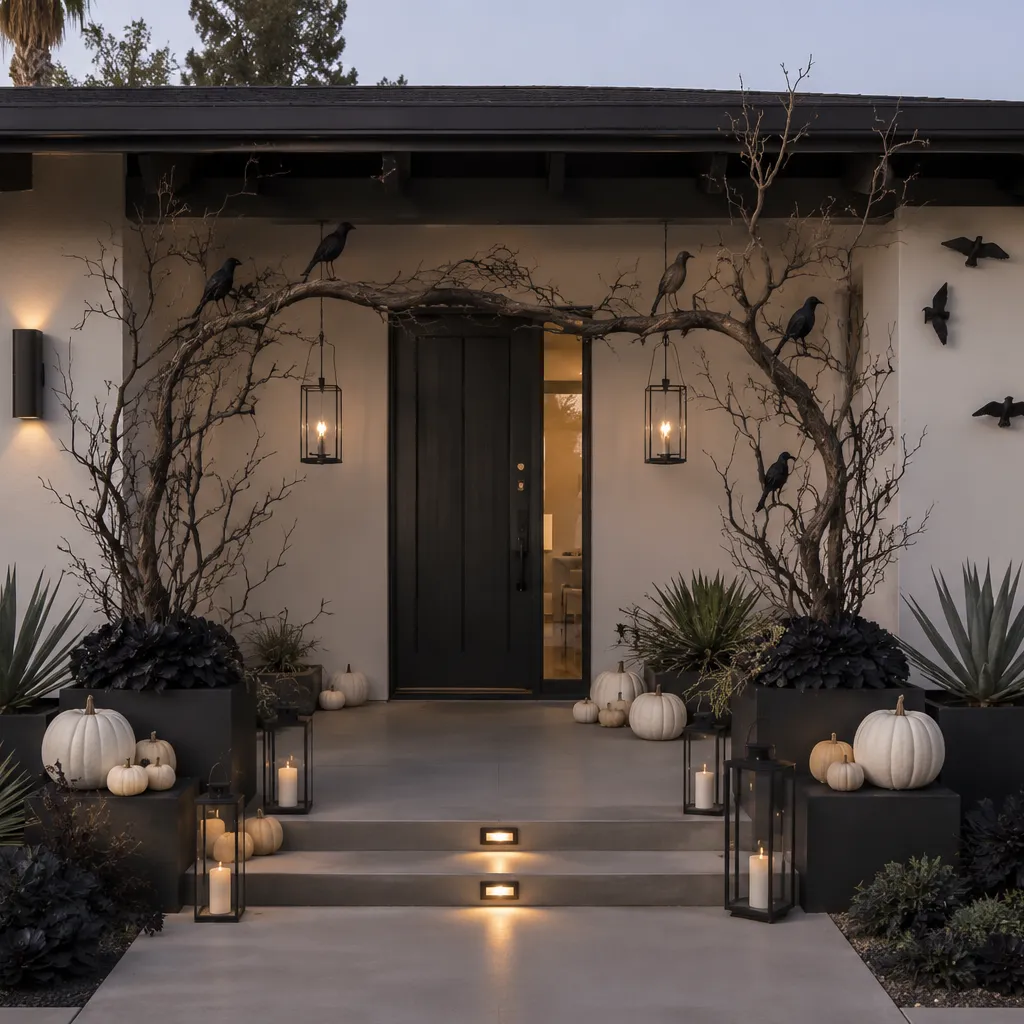
A Branch Arch Can Temporarily Change the Architecture
One of the more dramatic porch ideas uses branches not as an arrangement beside the door, but as a temporary frame around it. Large twisted branches can rise from heavy planters on both sides and curve inward above the entrance.
The branch structure temporarily changes the proportions of the doorway and gives Halloween decoration an architectural role. On a low contemporary ranch house, this introduces vertical height where the permanent architecture is mostly horizontal.
On a rustic or Craftsman porch, the branches can relate naturally to timber and stone. Adding ravens along the upper branches changes the interpretation immediately.
The structure stops feeling like ordinary seasonal planting and becomes unmistakably Halloween. Part of the visual power comes from the contrast between irregular wood and straight architecture.
Square planters, smooth walls and rectangular doors provide order; the branch structure interrupts that geometry. For real installations, stability matters as much as appearance.
Heavy containers, secure connections and generous head clearance are essential.
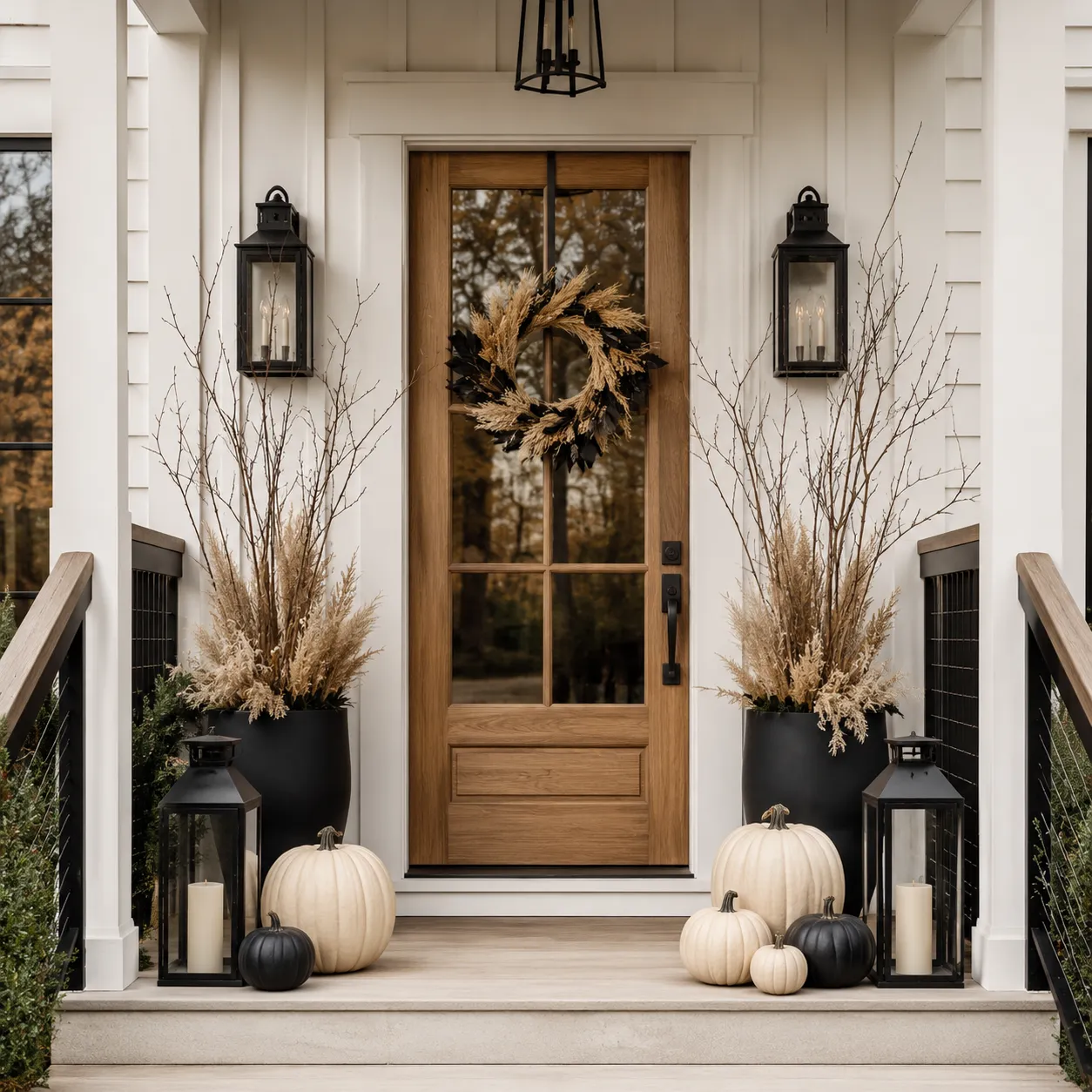
A Wreath Does Not Need to Carry the Whole Theme
The front door is often treated as the automatic home for the main Halloween statement. It does not always need one.
A dark timber door with beautiful grain may already be visually important. Covering it with a large wreath can hide the feature that gives the entrance much of its character.
The wreath works better when its scale and materials respond to the door rather than competing with it. Sometimes a smaller olive wreath, dried botanical ring or narrow arrangement is enough.
On other houses, the wreath can be fuller, but its materials can still relate to the rest of the porch. Dried hydrangea, dark foliage, wheat, grapevine, berries, magnolia leaves and seed pods all work well because they can repeat materials already used in nearby planters.
A wreath made from pale grasses and black foliage suits a modern farmhouse very differently from one made from burgundy berries and grapevine on a red-brick Federal entrance. The important link is continuity.
A wreath feels much more connected when it borrows something from the rest of the porch composition.
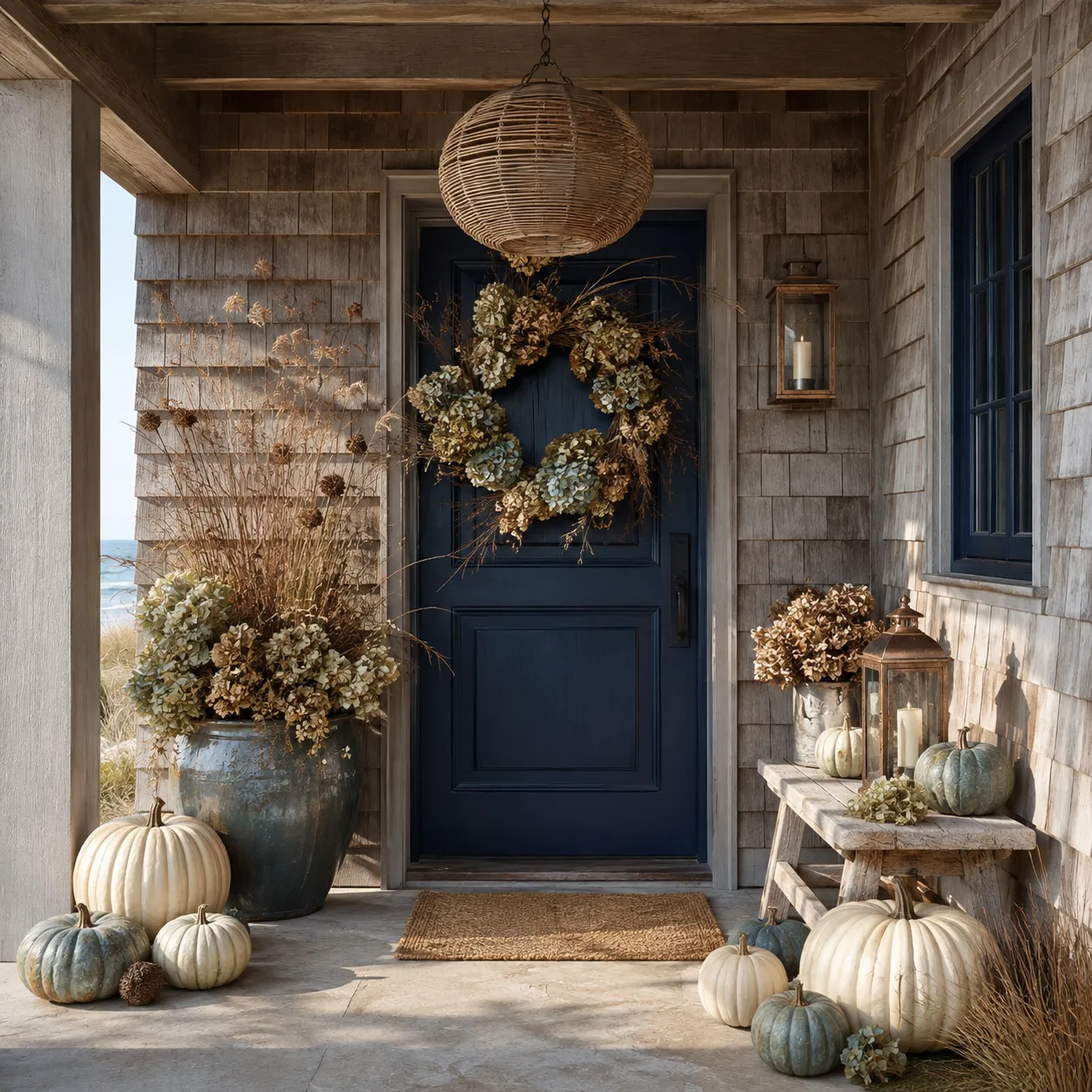
Dried Hydrangea Has an Especially Good Second Life in Autumn
Dried hydrangea is particularly useful on coastal and weathered houses because its color changes naturally as it ages. Fresh flowers move toward beige, muted green, faded blue and brown.
Those tones sit easily beside cedar shingles, grey stone, navy doors and aged metal. Repeating dried hydrangea at several scales can connect the whole porch without making every arrangement identical.
It might appear as a large wreath on the door, a generous planter near the entrance and a smaller arrangement on a bench. Pale pumpkins and dusty blue-green gourds fit naturally into the same family.
The overall effect is seasonal without depending on traditional Halloween color. For coastal homes, this is one of the more adaptable Halloween decoration ideas for a front porch because the display can stay closely connected to weathered materials and existing planting.
The Porch Furniture Can Quietly Join In
Existing furniture can become part of the seasonal display without turning into another decorated surface. A bench can hold a lantern, a small arrangement of dried flowers and two pumpkins.
A stool can raise one object above the floor. A console can support a larger botanical arrangement.
Furniture introduces another display height, which helps keep pumpkins and lanterns from collecting entirely at floor level. Leaving some of the furniture visible also matters.
A bench covered completely with objects starts to feel like a display fixture. A few pieces placed loosely on one end feel much more natural.
Formal Porches Benefit From Symmetry, but Not Perfect Duplication
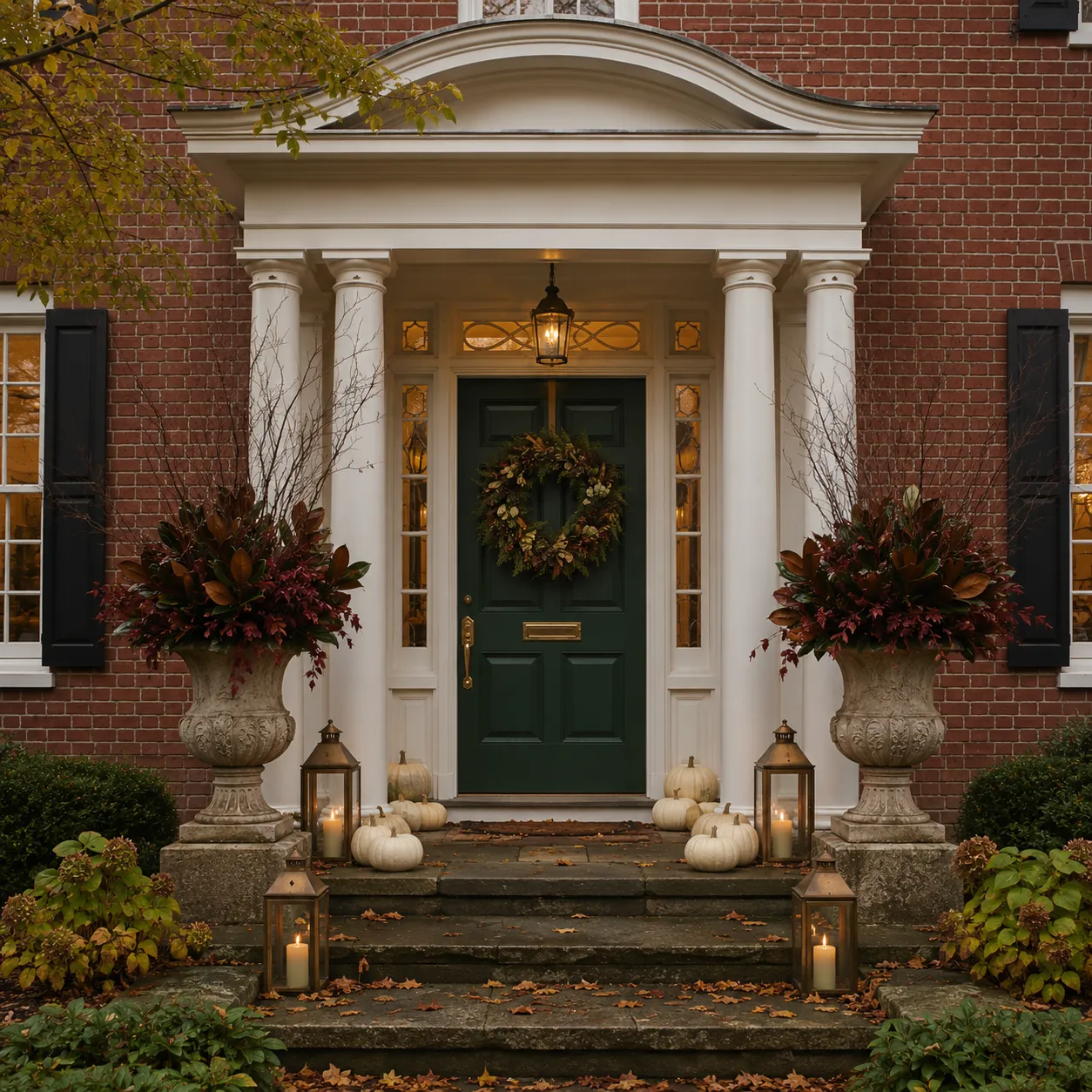
Georgian, Colonial and Federal-style entrances often have very clear symmetry built into them. Paired urns make sense here.
Matching lantern positions make sense too. But exact duplication is not necessary.
The large structural elements can be symmetrical while branches, foliage and pumpkin sizes remain slightly different on each side. Two substantial urns can occupy matching locations while the branches inside them twist differently.
Both sides can contain cream pumpkins without using exactly the same sizes. That balance between order and irregularity keeps a formal porch from feeling stiff.
Deep burgundy foliage works especially well with red brick and dark doors. Cream pumpkins add separation, while brass or bronze lanterns connect seasonal lighting to permanent door hardware.
Rustic and Craftsman Porches Can Carry More Texture
Timber and stone porches already contain a lot of physical texture, so their Halloween decoration can build on that character rather than compete with it. Dark green gourds, cream pumpkins, muted orange, rough branches and aged metal naturally relate to timber posts and stone piers.
Broad stairs also offer more freedom for grouping. Pumpkins can appear at several levels rather than concentrating around the door.
A few lanterns placed at different depths can make the stairs especially appealing in the evening. One may sit near the landing, another halfway down and another closer to the path.
The decoration then becomes part of the approach instead of existing only at the threshold.
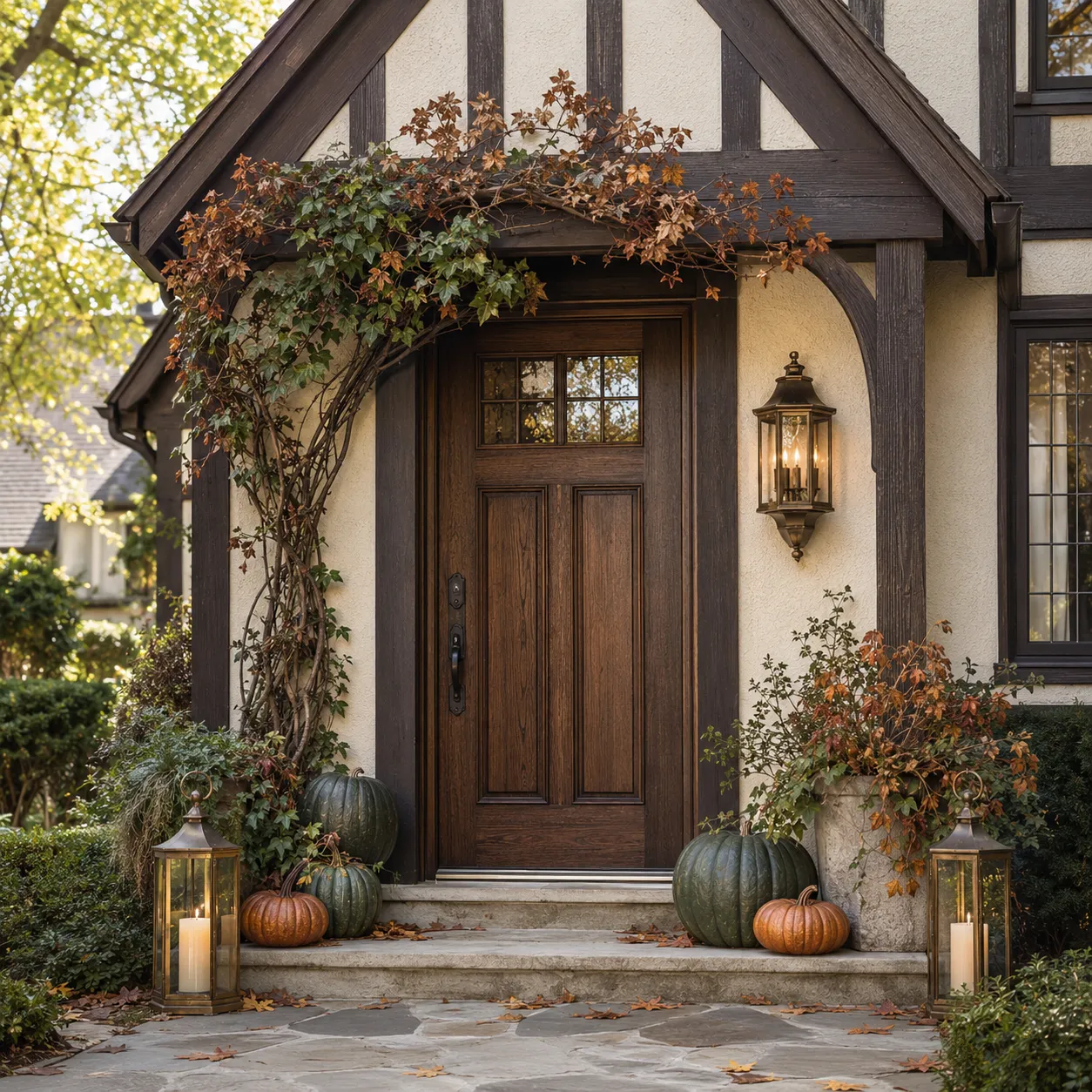
Tudor Houses Can Use Their Vines Almost Like Seasonal Architecture
Tudor Revival homes are particularly interesting because climbing vegetation often already suits them. A vine moving up one side of the entrance and continuing over the top can become part of the Halloween setting as leaves begin turning brown and stems become more visible.
Existing vines can form a natural seasonal frame around the doorway without adding an artificial garland. Dark green pumpkins, rust-colored gourds and aged brass lanterns work well here because they connect to timber framing, ivy and autumn foliage.
In this setting, even fallen leaves can contribute. A few scattered leaves around the steps make the pumpkins feel connected to the garden rather than placed on a perfectly cleaned stage.
Modern Farmhouse Halloween Can Stay Almost Entirely Neutral
White siding, natural oak and black fixtures already offer a useful palette. Ivory pumpkins can connect to the siding.
Black pumpkins and lanterns relate to windows and hardware. Wheat and dried grasses repeat the warmth of the timber.
Black, ivory, wheat and natural wood are enough to create a clear Halloween porch without relying heavily on orange. Tall black planters filled with beige grasses and thin branches are especially effective because they give both density and height.
The branches can rise almost to the wall sconces while the grasses make the base feel complete. A single spider or a few birds can then provide the Halloween note.
The result remains clearly seasonal, but the house stays visually present.
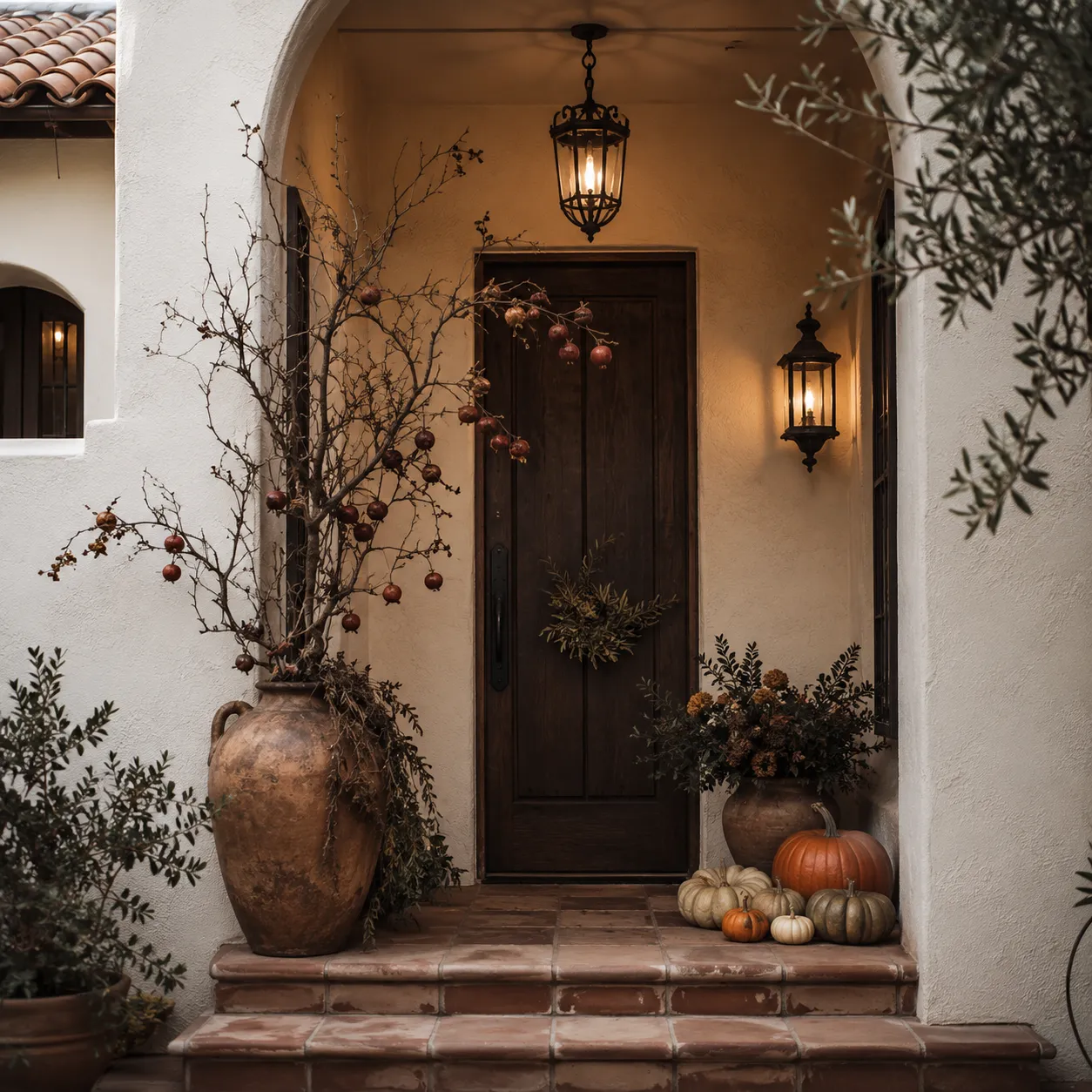
Spanish Colonial Entrances Can Get Their Mood From Fruit, Clay and Iron
Spanish Colonial and Mediterranean porches offer a very different set of materials. Warm ivory stucco, terracotta, dark timber, olive foliage and iron lanterns already create a rich background.
An oversized clay vessel with twisted fruiting branches can become the main seasonal statement. Pomegranate-like fruit introduces dark red points among the branches, while the vessel relates naturally to stucco and terracotta.
A compact pumpkin grouping can sit on the opposite side in muted orange, cream and grey-green. The contrast between one tall, irregular arrangement and one lower, denser cluster is often more interesting than mirroring both sides.
Warm iron lanterns contribute much of the nighttime atmosphere, especially against pale stucco.
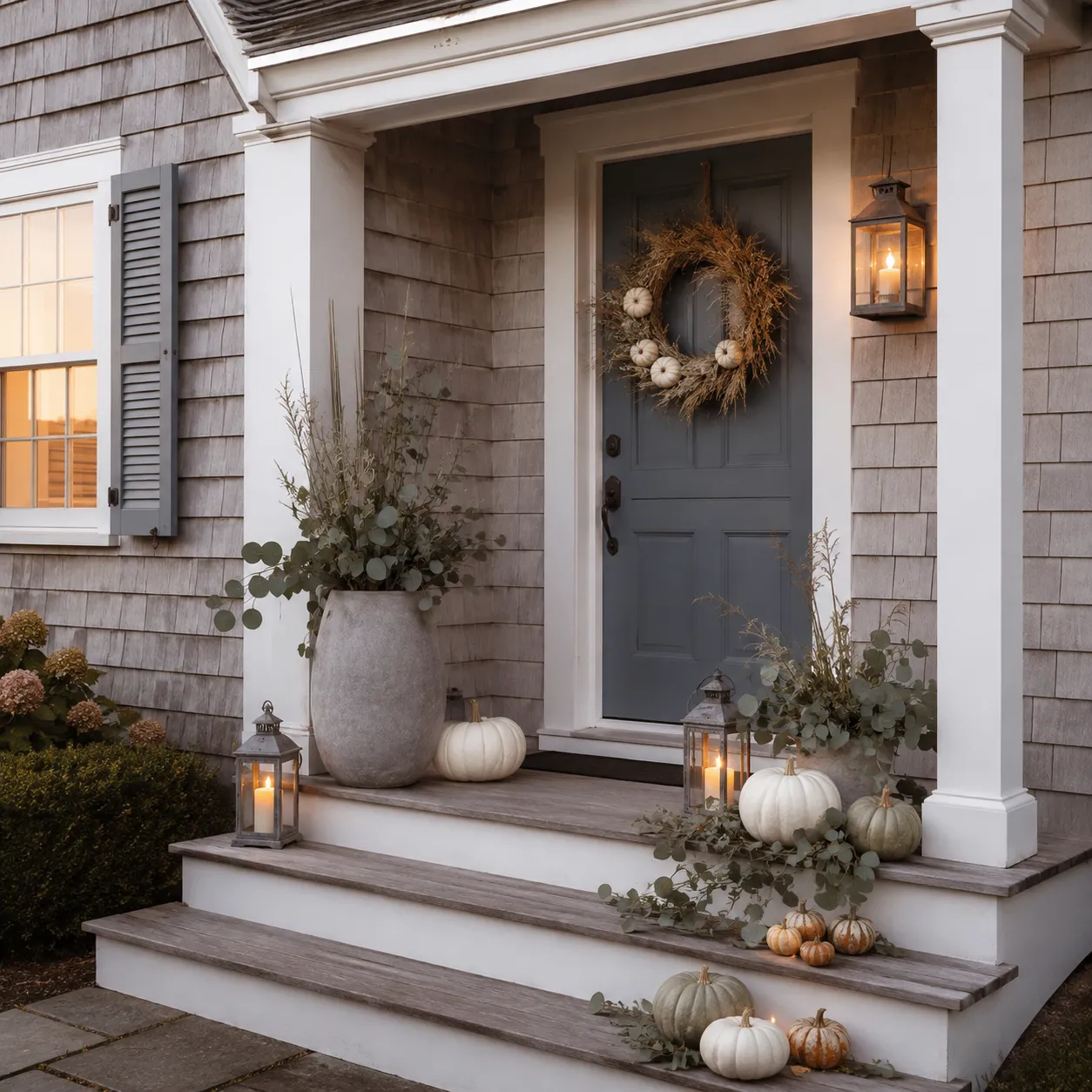
Coastal Halloween Has Its Own Palette
A weathered shingle porch often looks better when Halloween stays faded and botanical. Dried hydrangea, ivory pumpkins, sage or dusty blue-green gourds, weathered ceramic pots and aged copper lanterns fit naturally into the setting.
Coastal Halloween can rely on faded seasonal color rather than black and orange. Black may still appear, but it does not need to dominate.
This approach works because the decoration borrows from the colors of aged cedar, sea-worn materials and late-season plants. The Halloween character comes through pumpkins, dried flowers and candlelight rather than saturated color.
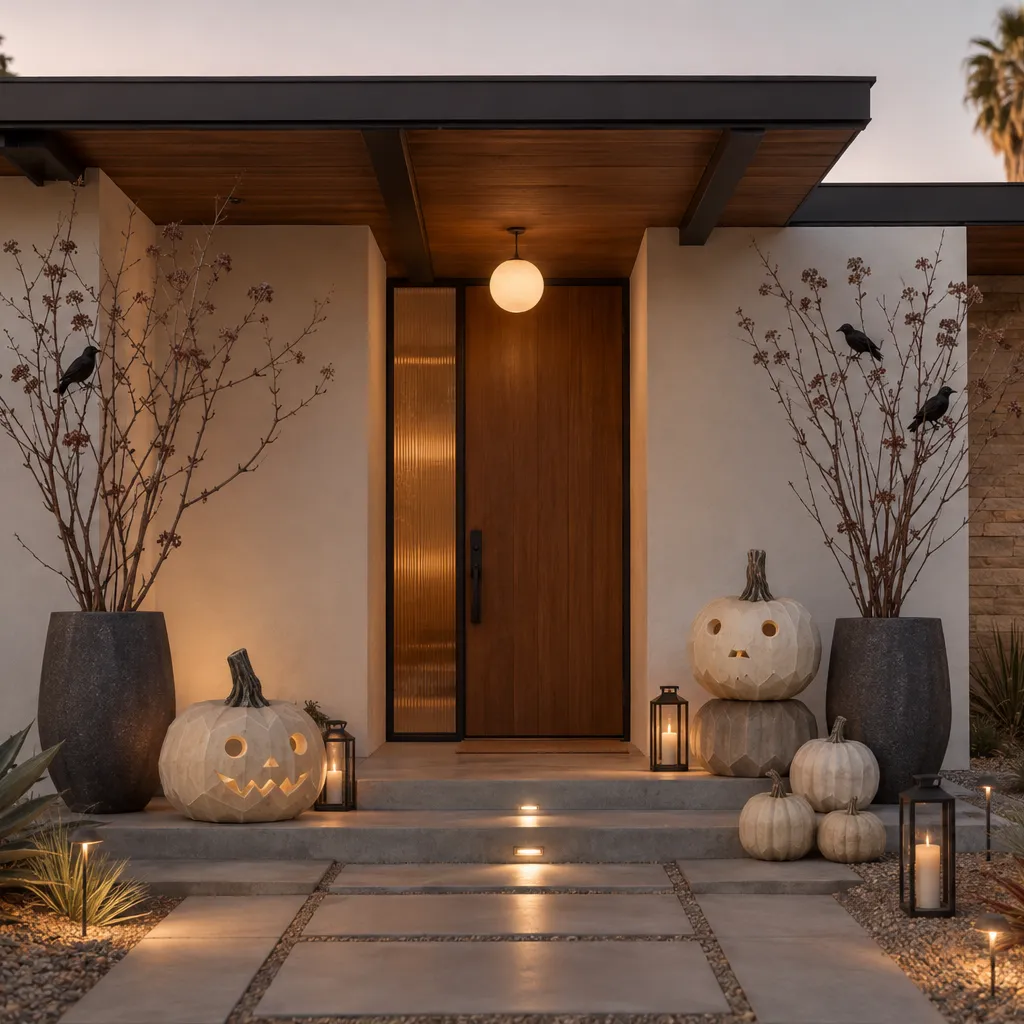
Mid-Century Modern Houses Can Keep the Symbol and Change the Finish
Traditional Halloween objects can work surprisingly well on modern architecture once their material character changes. A jack-o’-lantern does not have to be orange.
A large ivory or stone-colored pumpkin with simple geometric openings can sit comfortably beside white stucco, charcoal planters and a warm timber door. The familiar Halloween symbol can stay while its color, finish and scale change to suit the architecture.
A black pumpkin with an illuminated face works in the opposite direction: dark and graphic during the day, glowing orange after sunset. The same applies to scale.
One oversized pumpkin can feel almost like outdoor sculpture. For modern homes, these kinds of porch Halloween decorating ideas allow traditional symbols to remain recognizable without making the entrance feel disconnected from the building.
Desert Homes Can Start the Halloween Mood in the Landscape
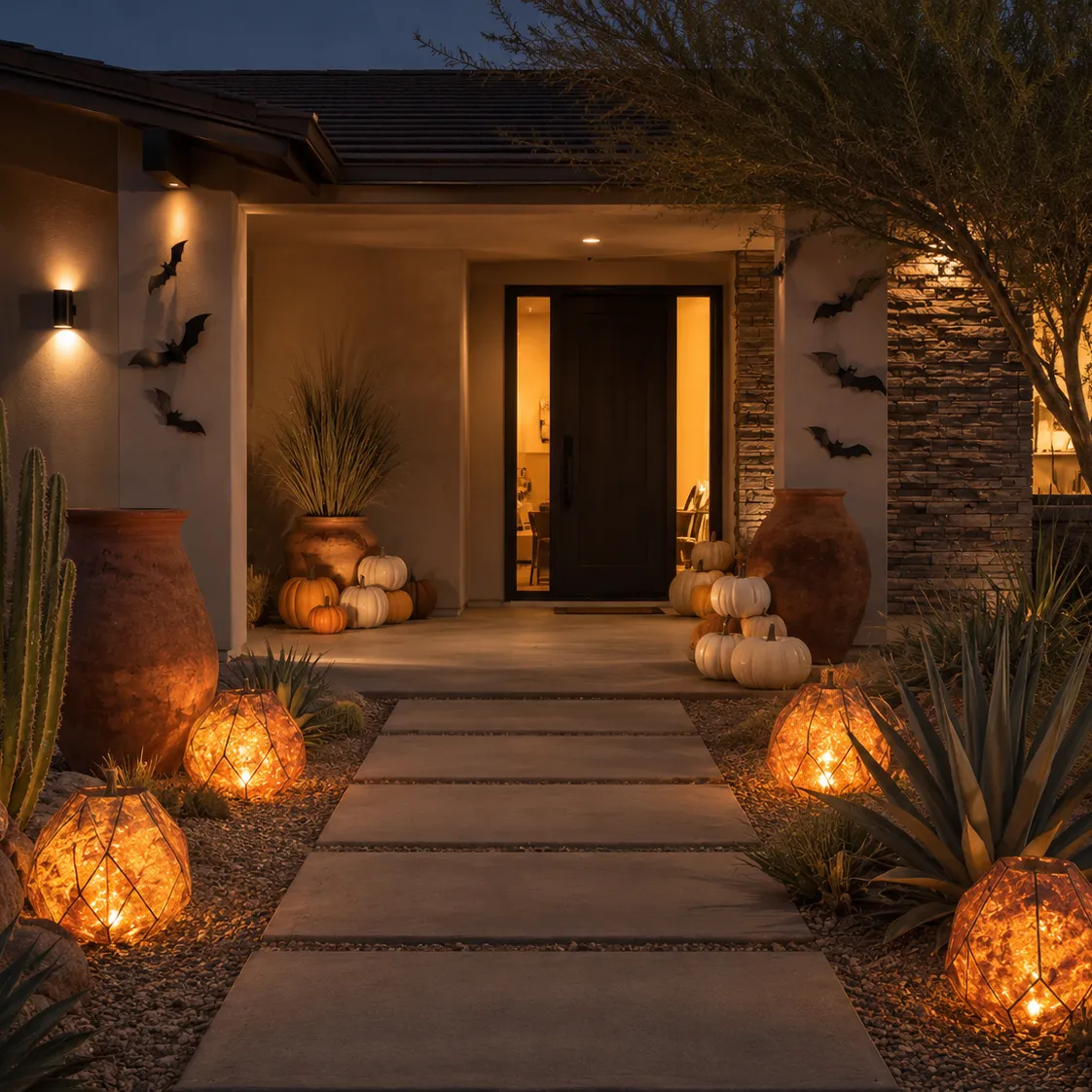
On desert properties, the walkway itself can become part of the seasonal composition. Amber lanterns or glowing sculptural lights can sit among gravel, agave and cactus several metres before the entrance.
The Halloween display can begin in the landscape and become progressively denser as the visitor approaches the front door. Farther out, the seasonal cue may be mostly light.
Nearer the door, pumpkins appear. Bats or another recognizable motif can then occupy the wall closest to the entrance.
This gradual change gives the front approach a clear sequence. It also suits desert landscapes because warm amber light works naturally with terracotta, stone, gravel and dry planting.
Lighting Can Do as Much as the Decorations
Some Halloween porches become much better after sunset because the decoration has been planned around light rather than simply lit afterward. There are several useful layers already present on many homes: wall sconces, porch pendants, step lights, recessed ceiling lights, landscape uplights and warm light coming through windows and sidelights.
Good Halloween lighting is often layered at different heights and distances rather than concentrated beside the door. Lanterns can add another layer, but they do not always need to become the main source.
Placing lanterns at different distances creates depth. A pair at the entrance, another near the middle of the stairs and one near the walkway creates a sequence of warm points rather than one concentrated glow.
Pale branches can also be illuminated from below. In dark planters, the containers recede while the branches become bright vertical silhouettes.
Black bats placed among or behind them remain visible because the branches provide an illuminated background. Warm light tends to work particularly well because it connects naturally to pumpkins, timber, brick, terracotta and dried plants.
The View From the Street Changes What Matters
Small details can be beautiful from a few feet away and almost invisible from the sidewalk. From farther away, scale and silhouette become much more important.
Large forms establish the porch from the street; smaller details become important only as someone approaches the entrance. A large branch arrangement, one oversized glowing pumpkin or two tall illuminated planters may contribute more to the overall composition than several small decorative pieces near the door.
Closer to the entrance, tiny gourds, ribbon, seed pods, dried flowers and candle lanterns begin to matter. A porch can therefore work at two distances rather than trying to make every object equally noticeable.
Empty Space Is Part of the Decoration
It is tempting to keep adding pieces whenever a porch feels unfinished. Sometimes the missing ingredient is actually space.
Empty wall, clear steps and open floor areas give seasonal objects enough contrast to become noticeable. A bat becomes clearer against a section of empty wall.
A pumpkin cluster has more presence when the next step is left bare. A tall urn feels larger when it is not surrounded by several unrelated accessories.
The doorway itself also benefits from some open space. Keeping the central walking route relatively clear usually improves both appearance and function.
It also allows the decoration to gather at the edges, where clusters feel intentional rather than obstructive.
The Most Interesting Porches Usually Have Several Layers, Not More Objects
Looking at all these Halloween decorating ideas for the porch, the recurring idea is not quantity. It is layering.
There may be something tall beside the entrance, something substantial around waist height, smaller pieces near the floor, a few illuminated points and one clearly recognizable Halloween detail. That could mean bare branches, an urn, several pumpkins, two lanterns and a raven.
Or illuminated pale trees, black jack-o’-lanterns and bats. Or dried hydrangea, blue-green gourds and aged copper.
The combinations are different because the houses are different. That is what makes Halloween porch decorating interesting from a design point of view.
The seasonal objects may be temporary, but they can still respond to architecture, material, scale, planting and light in the same way as any other exterior composition.