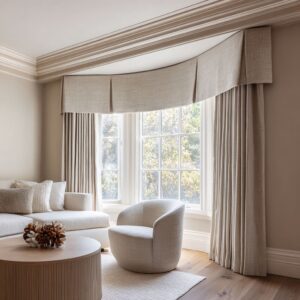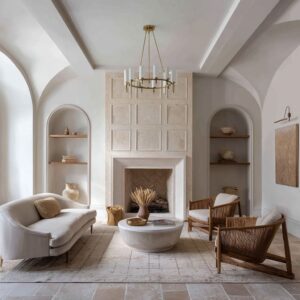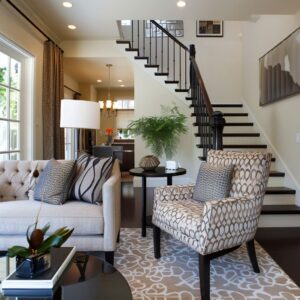
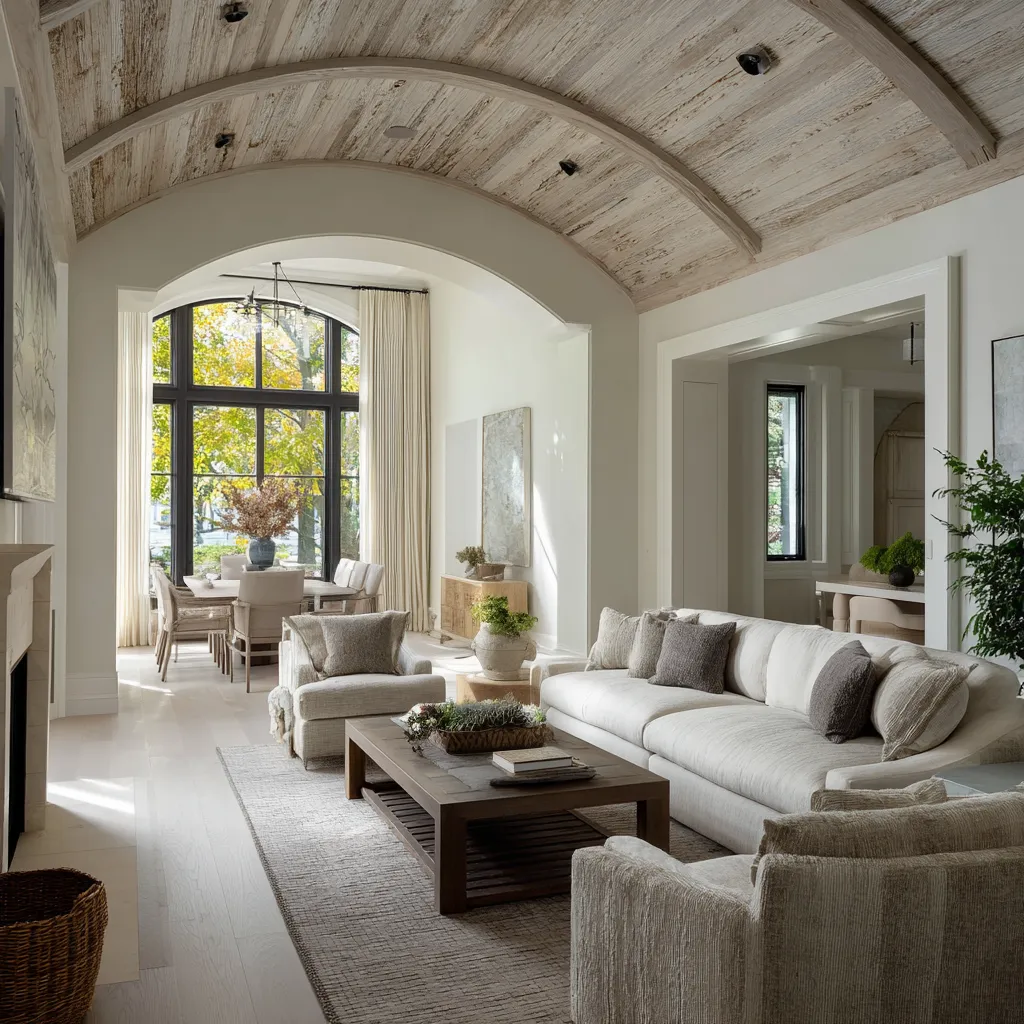
Hamptons style living rooms still hold a special place in interior design because they offer something many people want but rarely achieve in balance: a room that feels polished, welcoming, airy, and rooted in the architecture of the house. The style carries East Coast house character, but it does not need to look stiff.
It can feel fresh without losing depth. It can feel coastal without turning into a themed beach room.
It can feel formal enough for a large home and still remain comfortable enough for everyday life.
People often reduce Hamptons style to blue-and-white palettes, striped textiles, lantern pendants, and wicker accents. Those details can belong to the style, but they are not the heart of it.
The foundation is architectural. A convincing Hamptons living room usually begins with the shell: wall treatment, trim, ceiling shape, openings, daylight, proportion, and the way the room is organized around an axis, a fireplace, or a view.
After that comes furnishing, and then editing. That order matters.
The interior designs that feel stylish usually do not rely on decorative tricks. They let the house speak first.
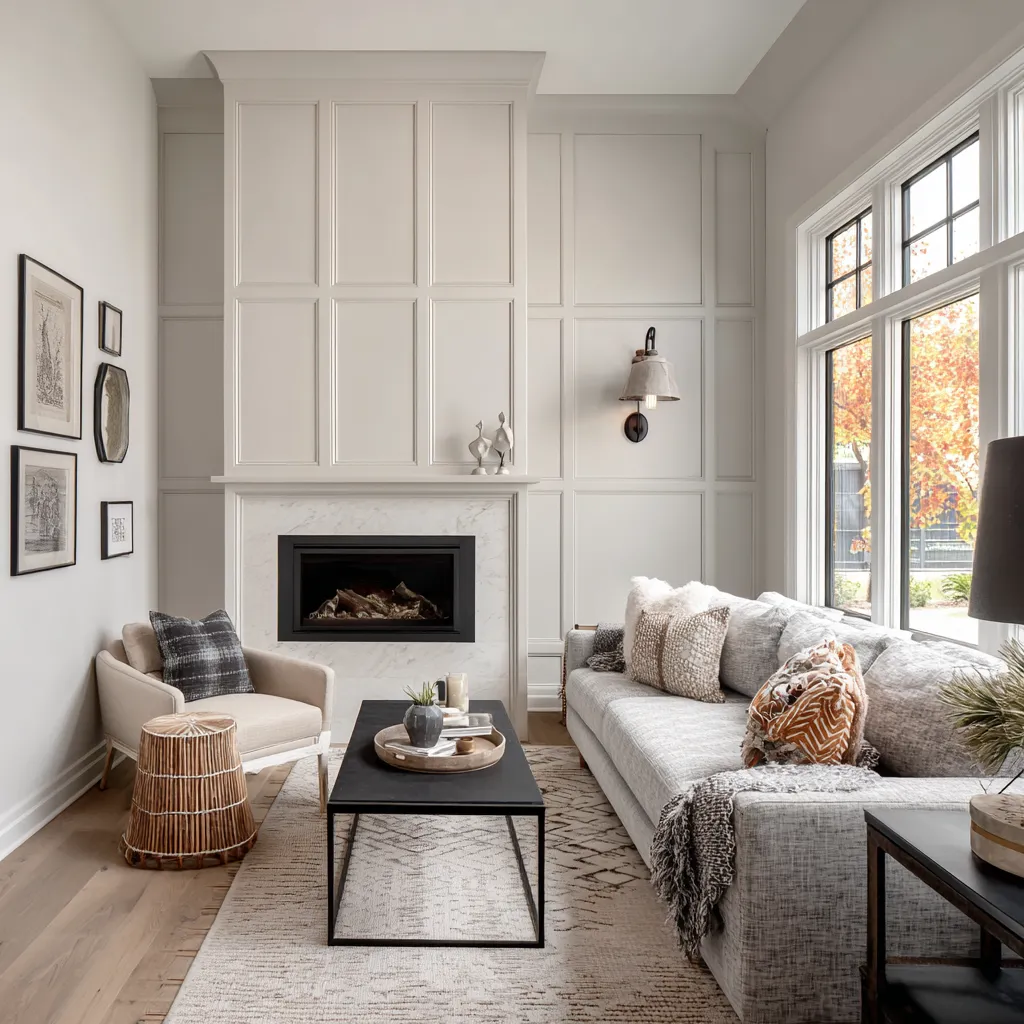
Modern Hamptons living room interiors have developed in a particularly interesting direction. Instead of stripping the style down until it loses character, newer rooms often keep the core architectural language and reduce the clutter around it.
They use fewer objects, broader visual fields, cleaner furniture outlines, and more tonal restraint. The result is a version of Hamptons style that feels current and highly livable while still keeping the settled house quality that gives the style its appeal.
What makes a living room feel Hamptons
At its core, a Hamptons living room usually depends on six conditions working together.
- The first is a strong architectural envelope. This might mean paneled walls, deep casings, substantial crown molding, a coffered ceiling, a tray ceiling, a vaulted plank ceiling, or a fireplace wall with real presence. The room should feel formed by the house rather than filled with furniture after the fact.
- The second is a pale, layered palette. This does not have to mean stark white. In fact, many of the appealing Hamptons rooms lean toward cream, chalky off-white, oat, sand, light taupe, pale gray-beige, limestone, or washed timber. The style often works through close tonal relationships rather than strong contrast.
- The third is softness in the furnishing. Deep sofas, thick rugs, cushioned lounge chairs, slipcovered seating, rounded upholstery, and generous proportions are central to the mood. Even formal Hamptons rooms usually want comfort in plain view.
- The fourth is order. Some designs use strict symmetry, while others use a softer axis, but most still have clear structure. There is usually a felt sense of composition rather than casual scatter.
- The fifth is material variation. The palette may stay narrow, yet the room still needs richness. That richness often comes from stone, painted woodwork, linen, cane, wicker, weathered wood, plasterlike walls, nubby fabrics, and dry botanicals.
- The sixth is restraint. A Hamptons design can contain art, books, flowers, ceramics, and layered textiles, but it rarely benefits from crowded surfaces or too many competing gestures. The style usually improves when each object has room around it.
Why modern Hamptons style is less dependent on blue
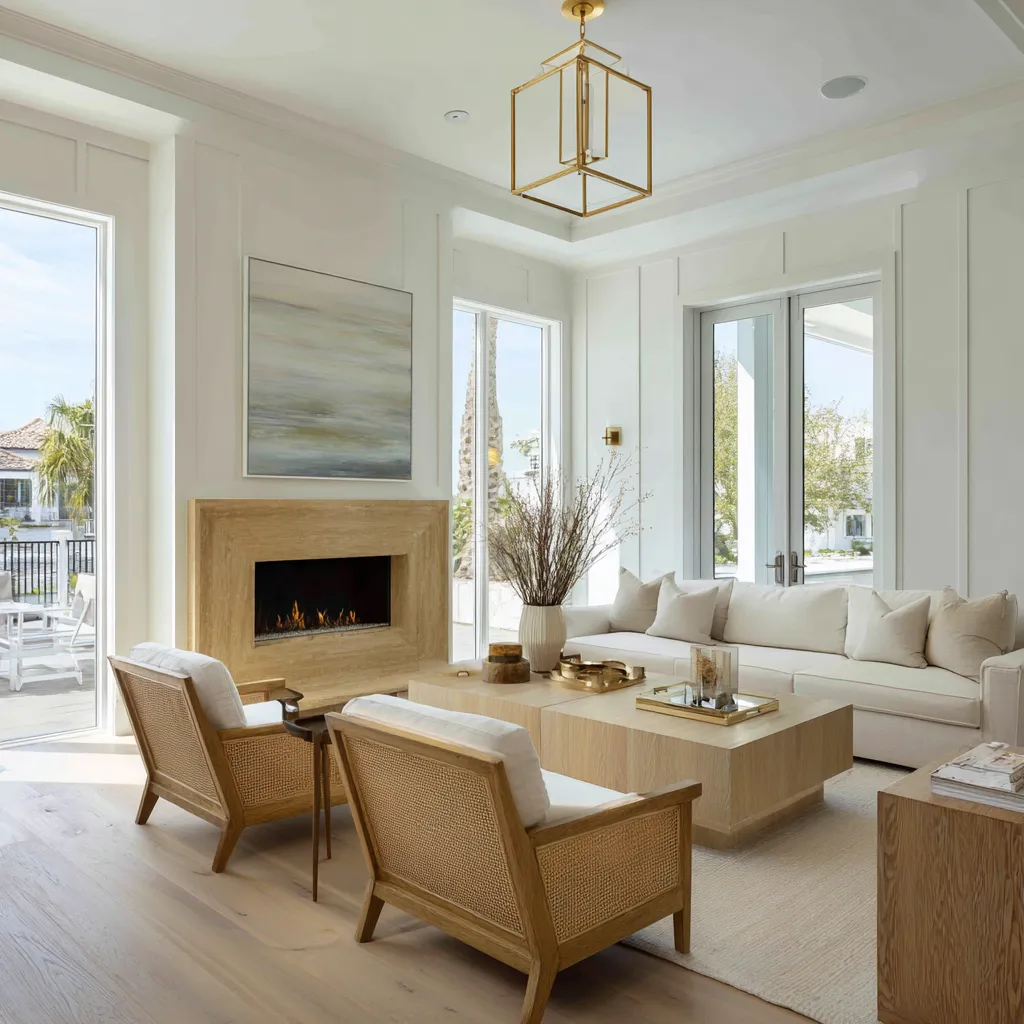
Blue belongs to Hamptons design, but it is not essential in every room. Some modern Hamptons interiors use very little blue or none at all.
They feel Hamptons because the shell is right, the daylight is generous, the furniture is broad and comfortable, and the palette stays pale and coastal in mood even without direct color reference.
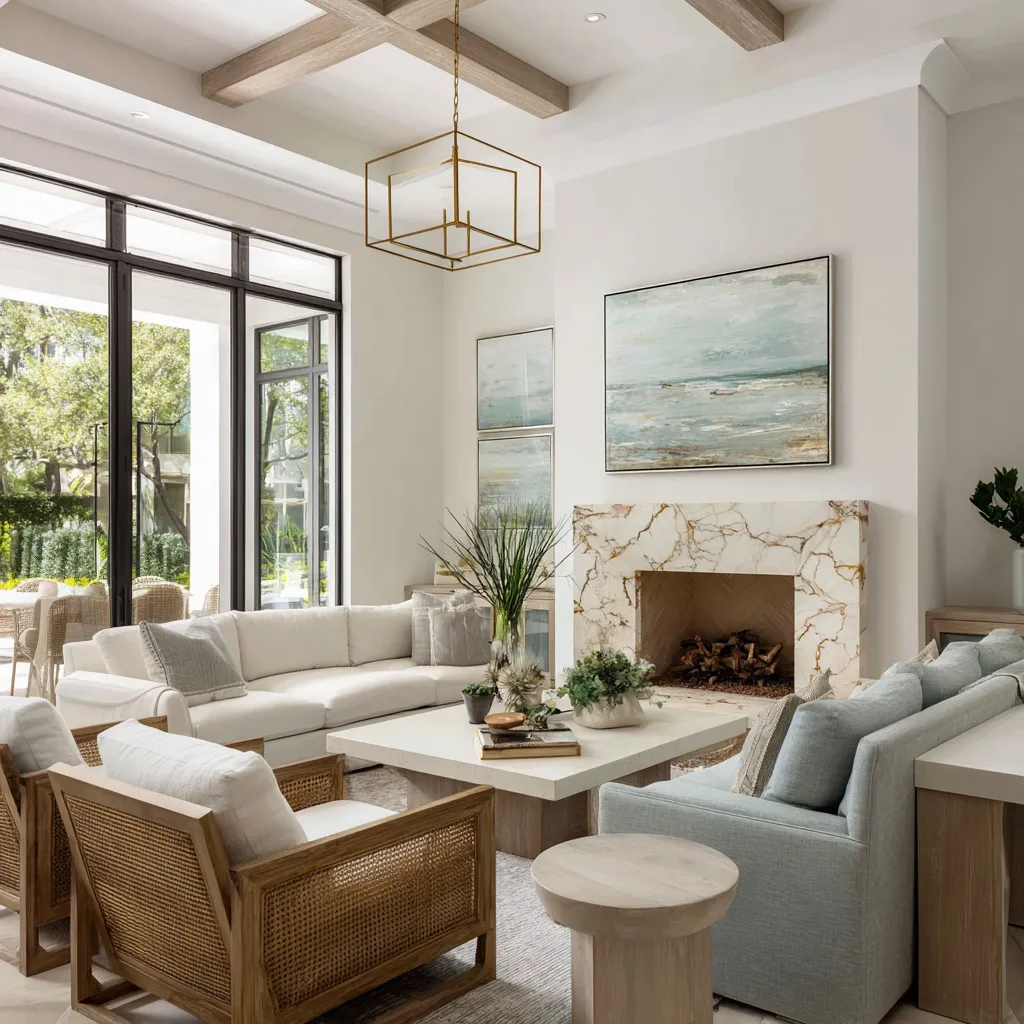
Blue tends to work especially well in rooms that have a strong indoor-outdoor relationship. If there are open garden doors, terrace seating just beyond the glazing, or a bright seasonal atmosphere, pale blue can reinforce that breezier side of the style.
In those cases, dusty blue, sea-glass blue, blue-gray, or watercolor blue can appear in chairs, pillows, artwork, or a single ottoman. The key is moderation.
A few placed notes usually have greater effect than turning the entire room into a marine palette.
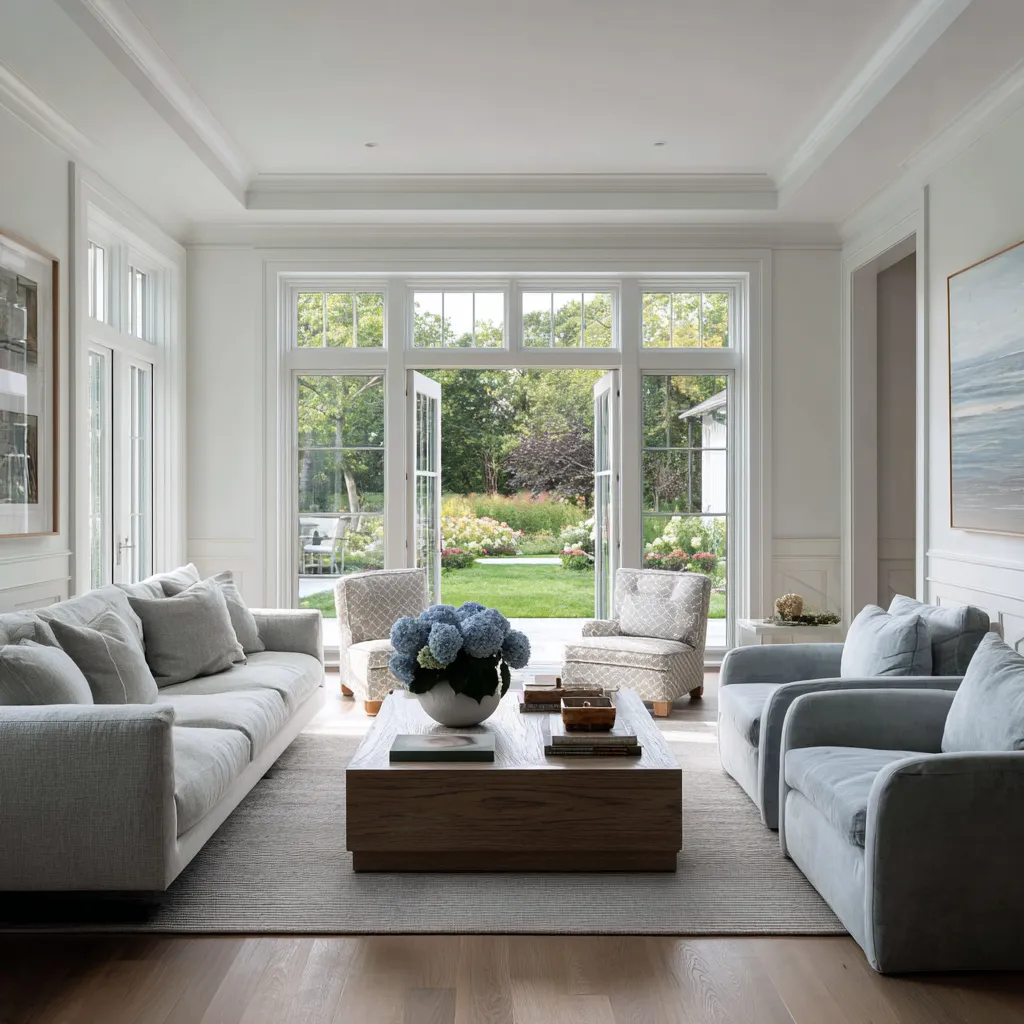
In more architectural Hamptons rooms, especially taller and more formal ones, blue often recedes. The design may rely instead on cream, limestone, pale timber, warm beige, gray-greige, and soft black accents.
That version often feels more grown-up and more connected to the house itself than to the idea of coast as decoration.
The architecture-first version of Hamptons style
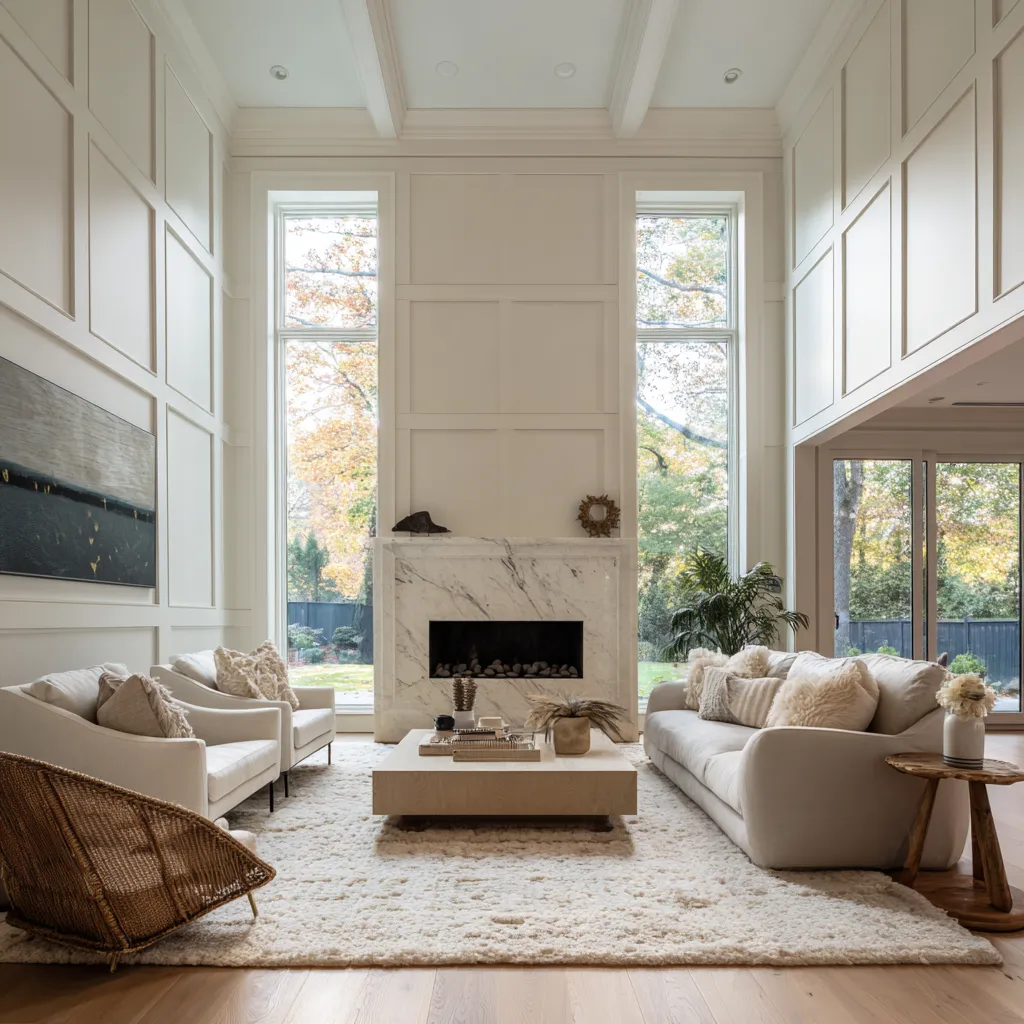
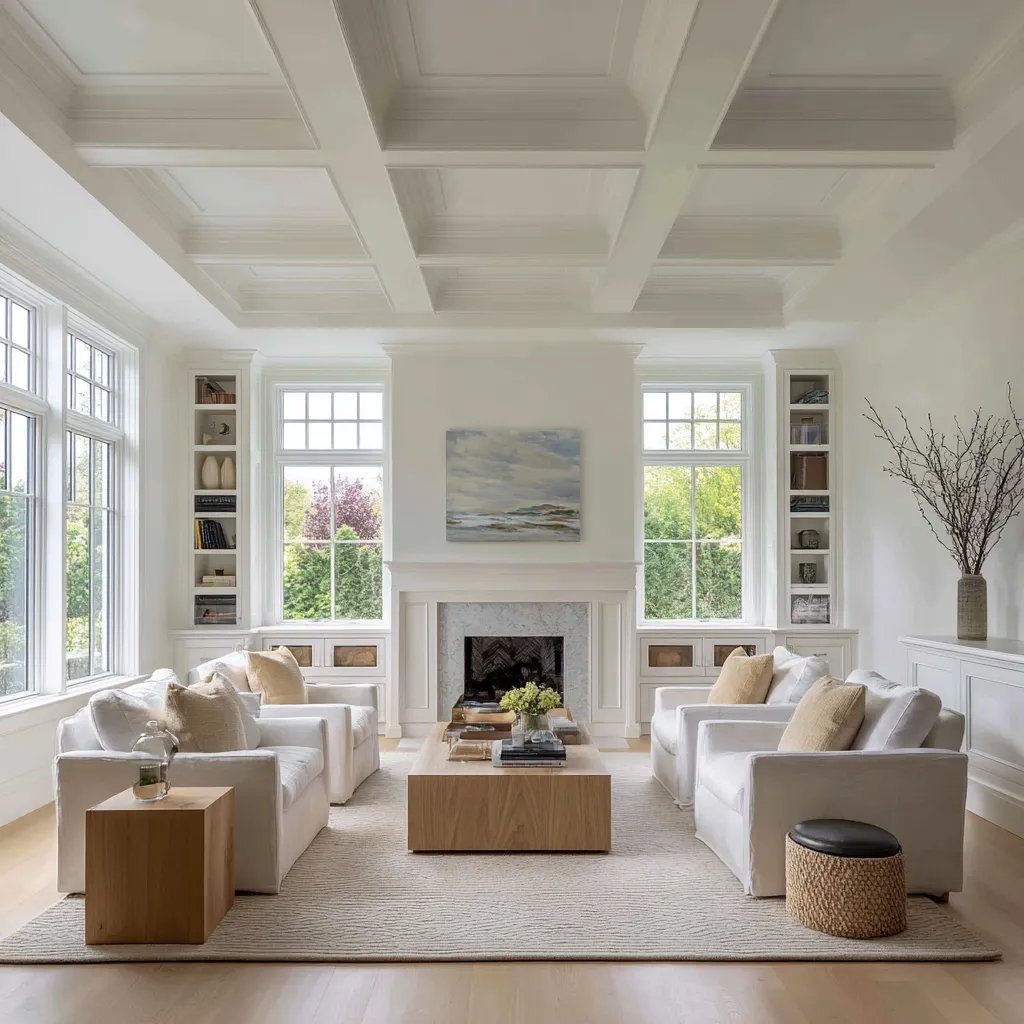
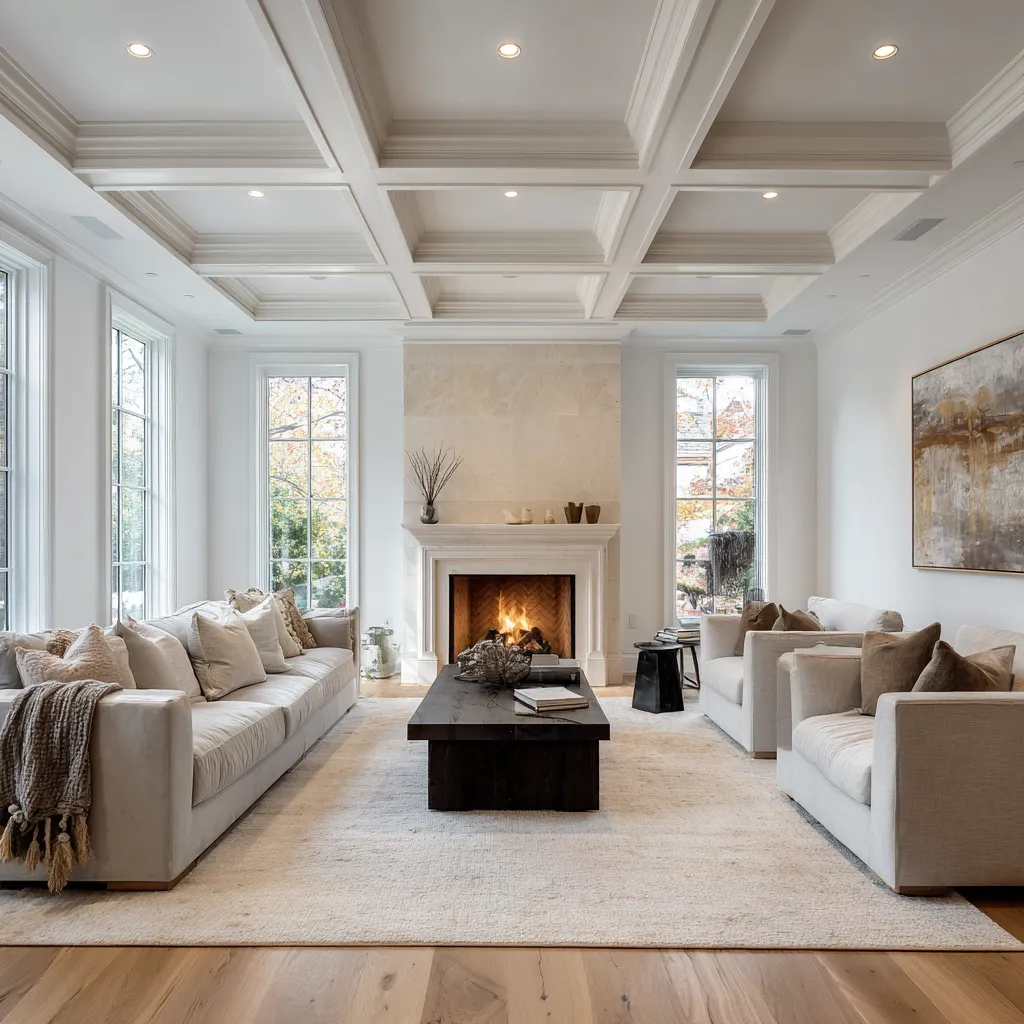
One of the directions in modern Hamptons living room design is the architecture-first approach. Here, the visual weight sits in the structure of the space rather than in many accessories.
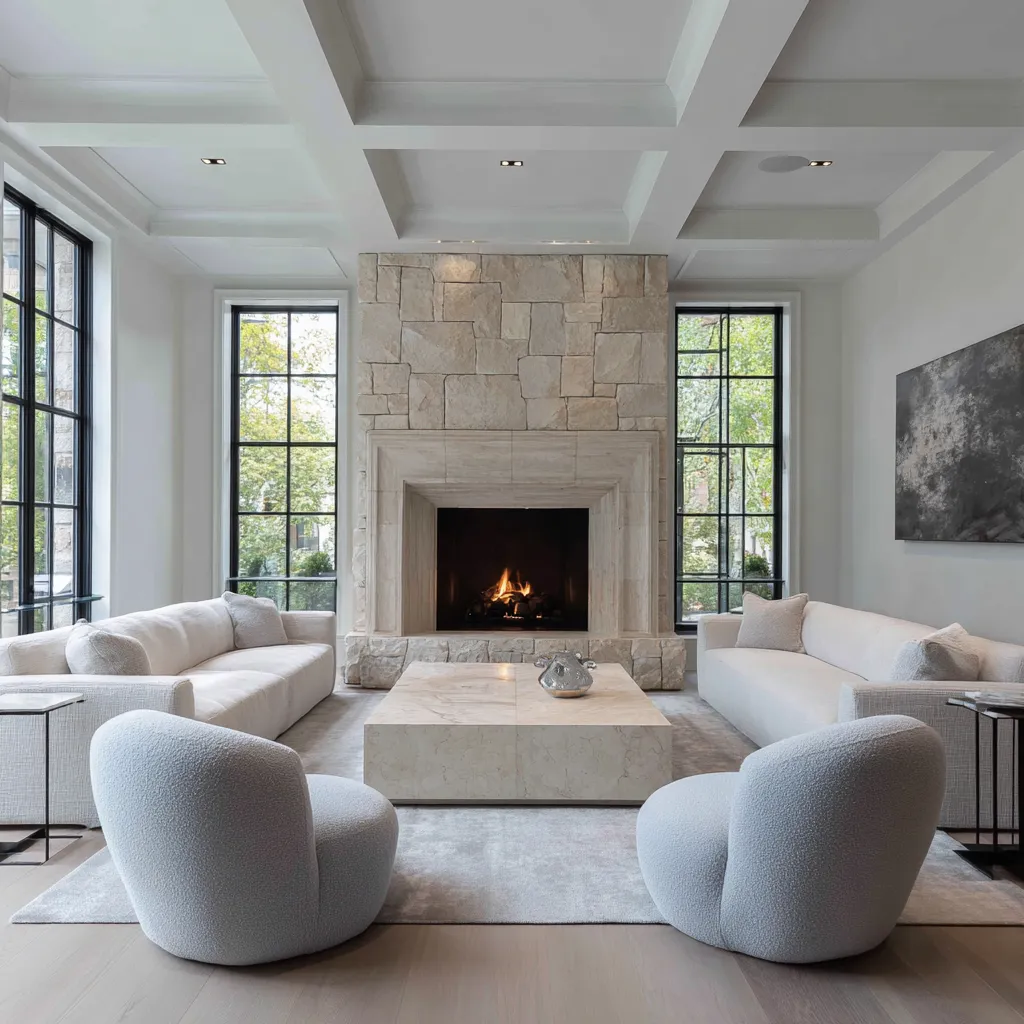
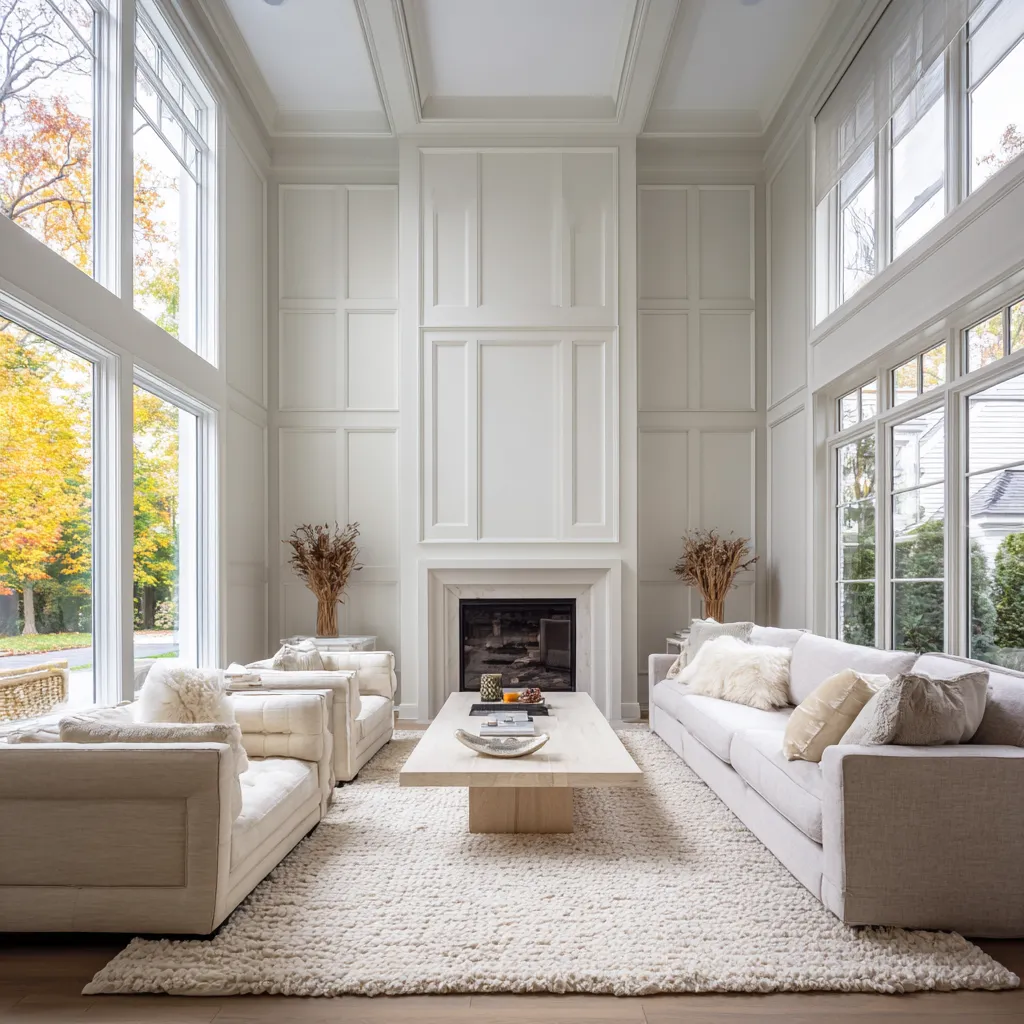
You often can see full wall paneling, deeply trimmed openings, broad coffer grids, very tall walls, formal fireplace compositions, or pale timber ceilings with visible shape and rhythm. The fireplace may be framed by stone, limestone-like slab, or a painted mantel wall with strong proportions.
The furniture stays low and broad, so the shell retains authority.
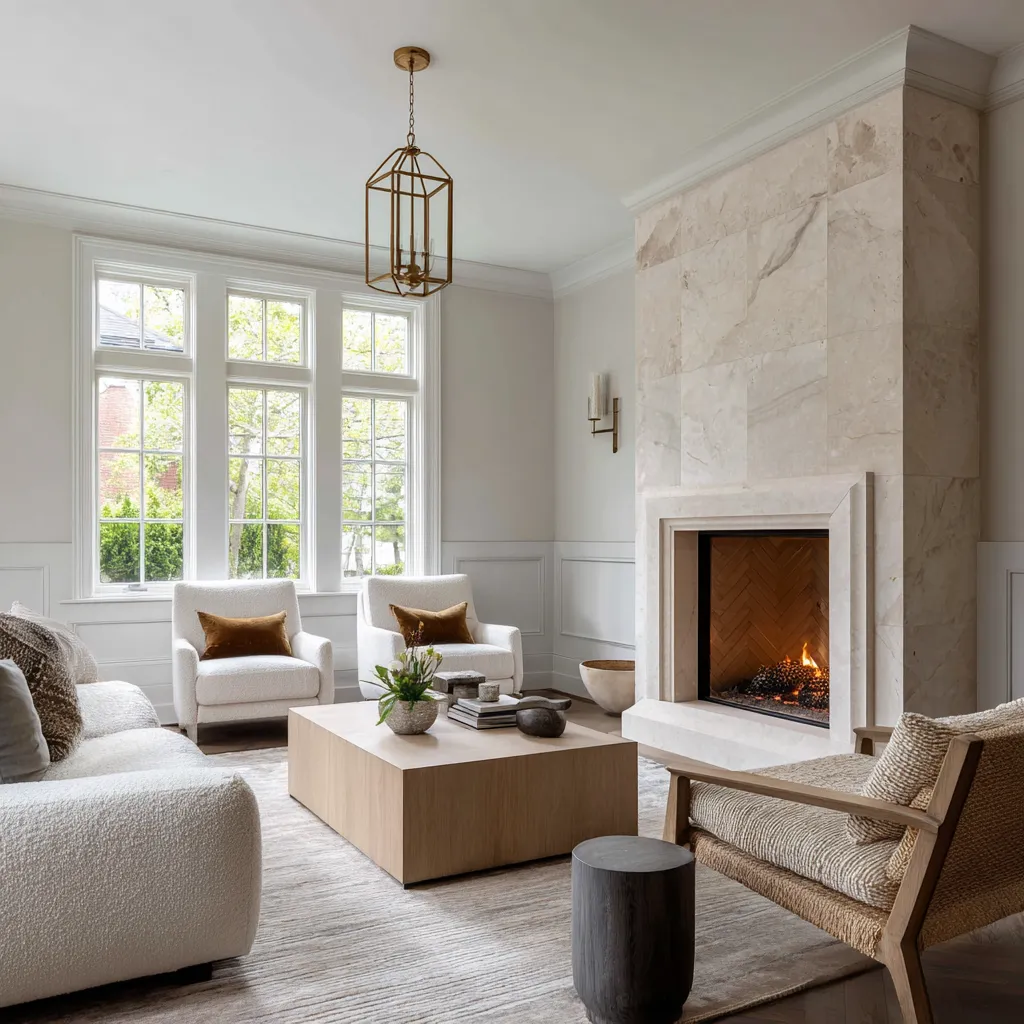
This kind of design can feel quite formal, but it stays inviting if the upholstery is soft and the room is not overfilled. A dark coffee table, a charcoal frame, or one deeper-toned object at the center often helps keep a pale architecture-led room from drifting into weightlessness.
That darker note acts like ballast. It gathers the seating zone and prevents the room from feeling overly airy.
This branch of Hamptons style is particularly suited to houses with ceiling height, formal wall elevations, or a strong central fireplace wall. It gives the room permanence.
It also ages well, because it depends on proportion and material rather than on decorative fashion.
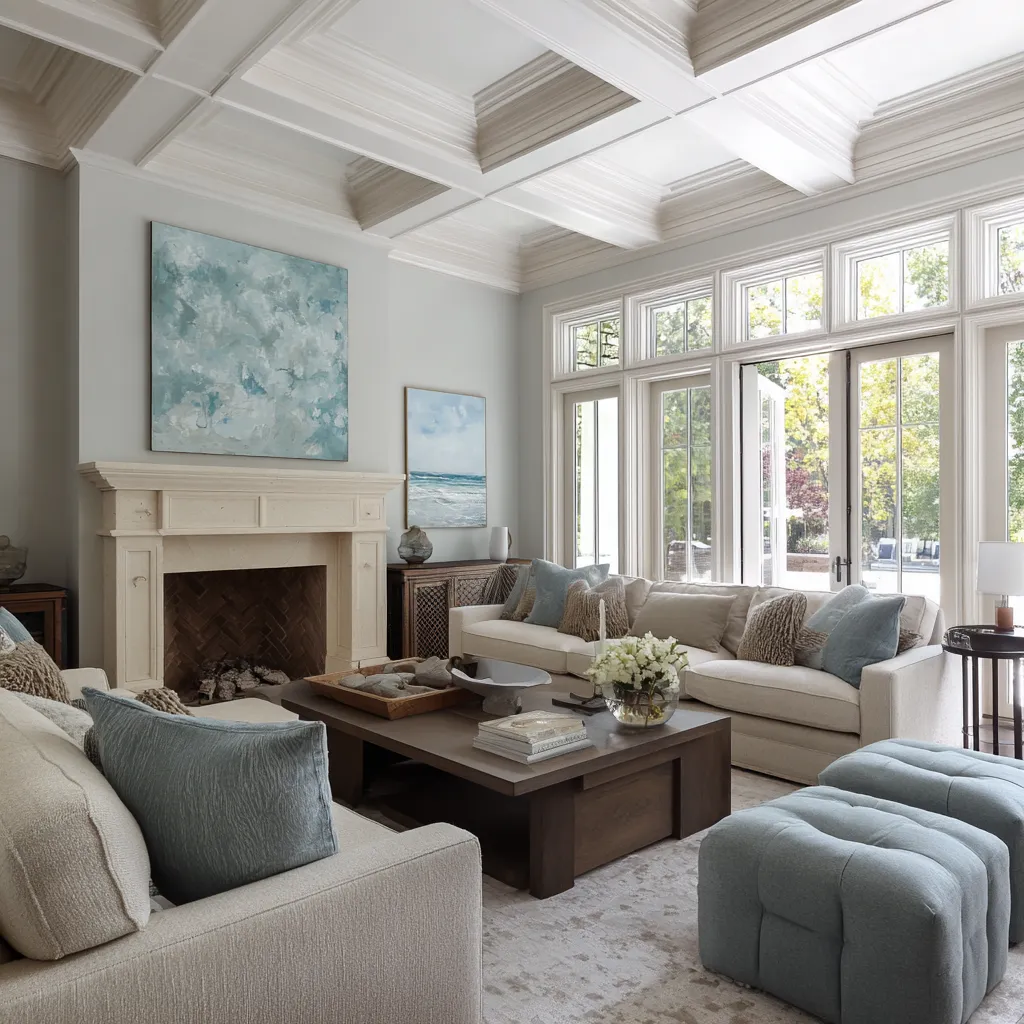
Warm architectural Hamptons: a newer and highly refined direction
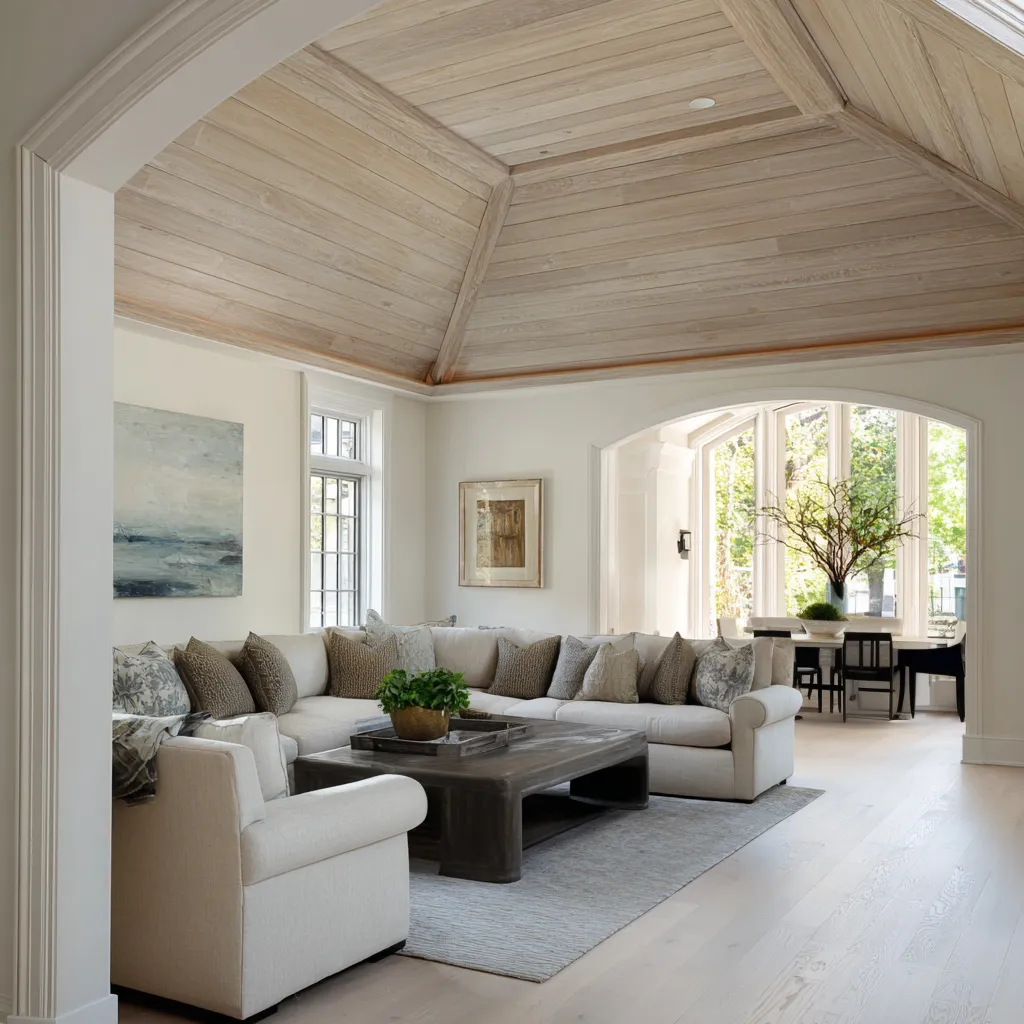
Another direction in modern Hamptons design is warmer and less ceremonial. These designs still keep the architectural depth of the style, but they move away from the centered, salon-like formula and toward a softer type of planning.
Instead of white coffers and crisp axial hierarchy, you may see lime-washed timber ceilings, pale plank vaults, broad interior arches, softened zoning, and more relaxed seating plans. These rooms often feel slightly more intimate, even in large houses.
The architecture remains substantial, but it is not always organized around one strict centerline.
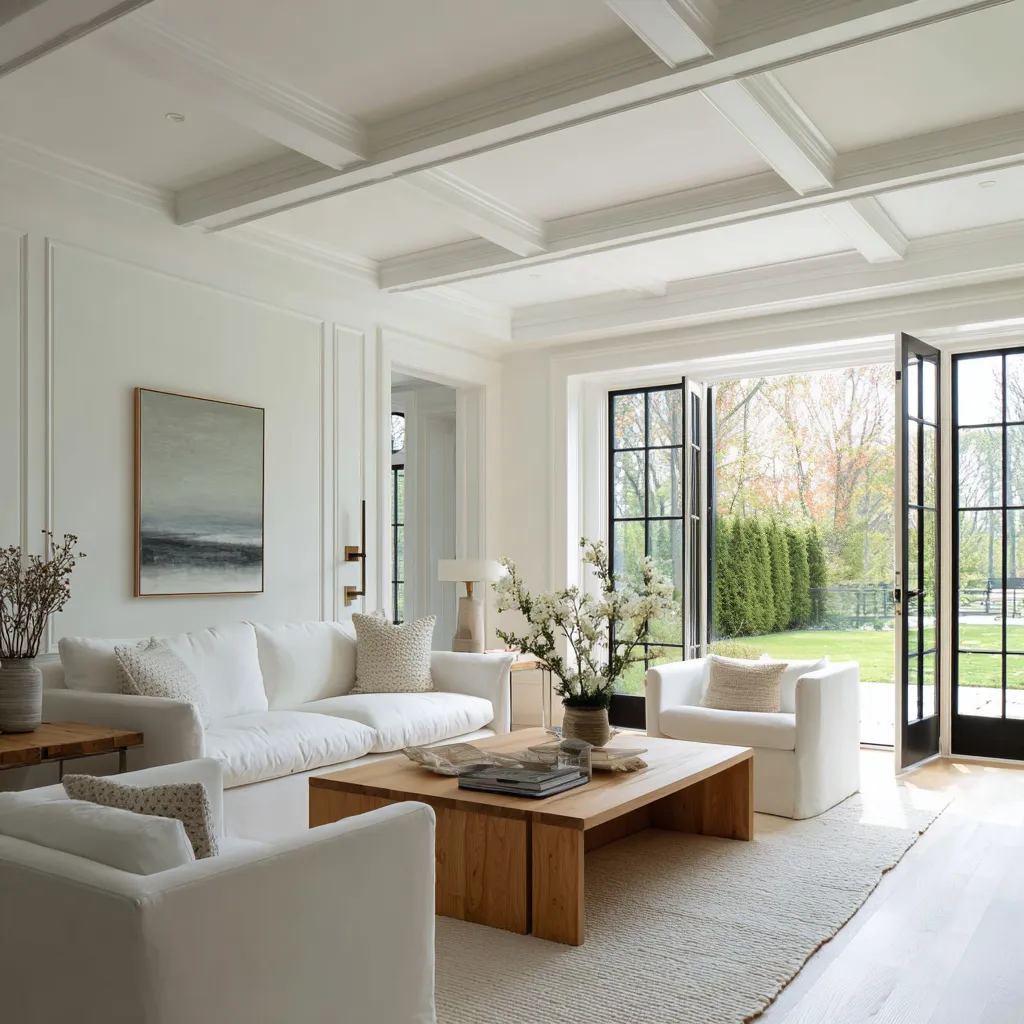
Natural timber plays a much larger role here. Not orange-toned timber and not rustic barn wood, but dry, pale, sun-softened timber with a coastal memory to it.
Cane, wicker, and weathered grain may appear, but in a measured way. The effect is warmer than formal axial Hamptons rooms, yet still distinctly house-led.
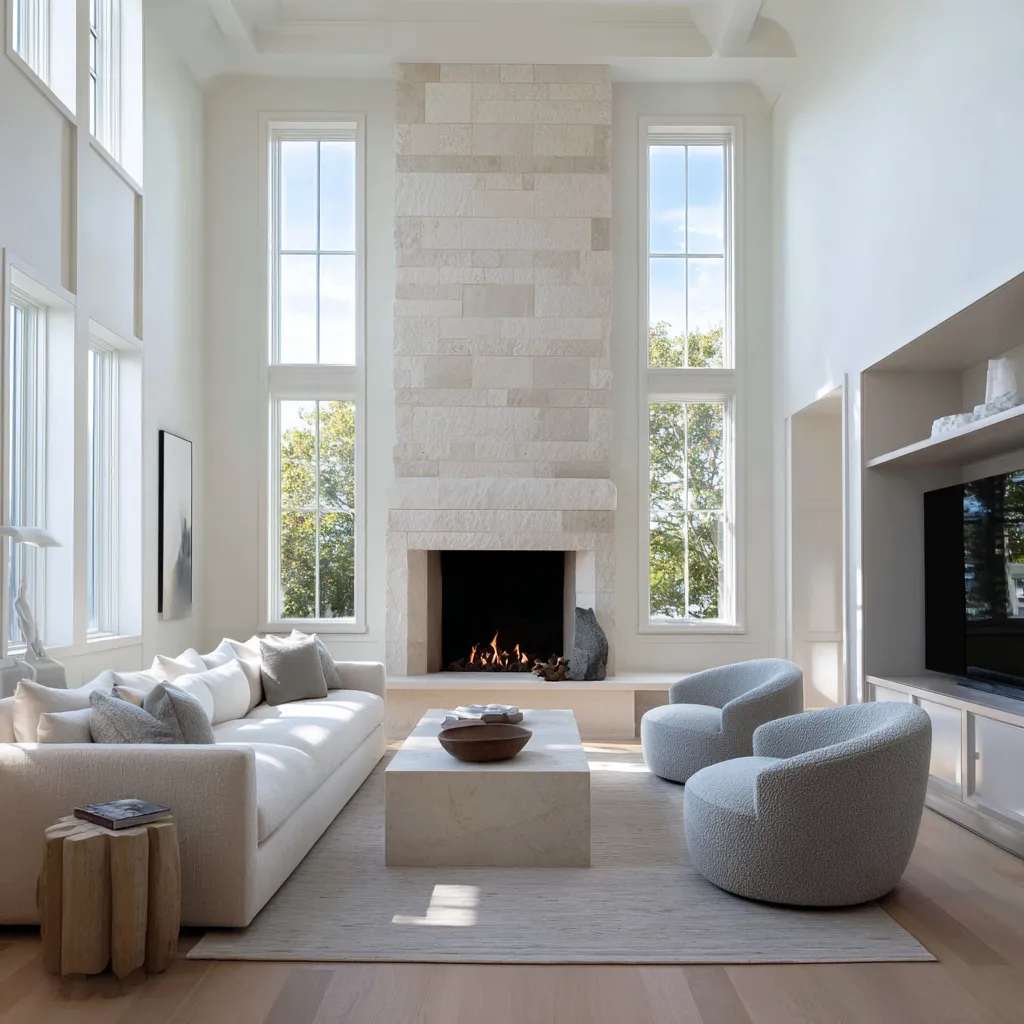
This is also where modern editing becomes very important. The rooms that carry this direction well usually have very low decorative noise.
There may be a beautiful ceiling, a large arch, a broad sectional, one dark coffee table, and only a handful of objects. The style does not lose richness because the architecture is already doing much of the work.
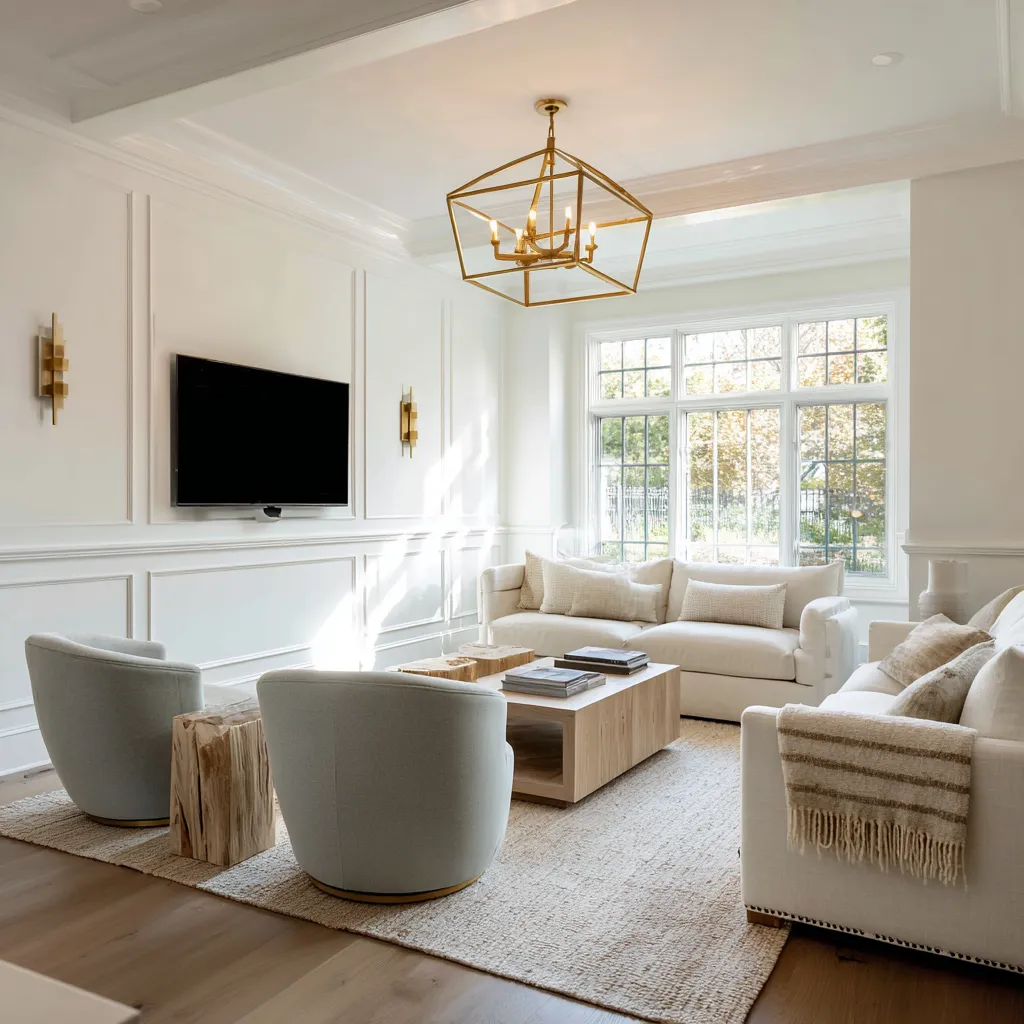
Open coastal lounge Hamptons
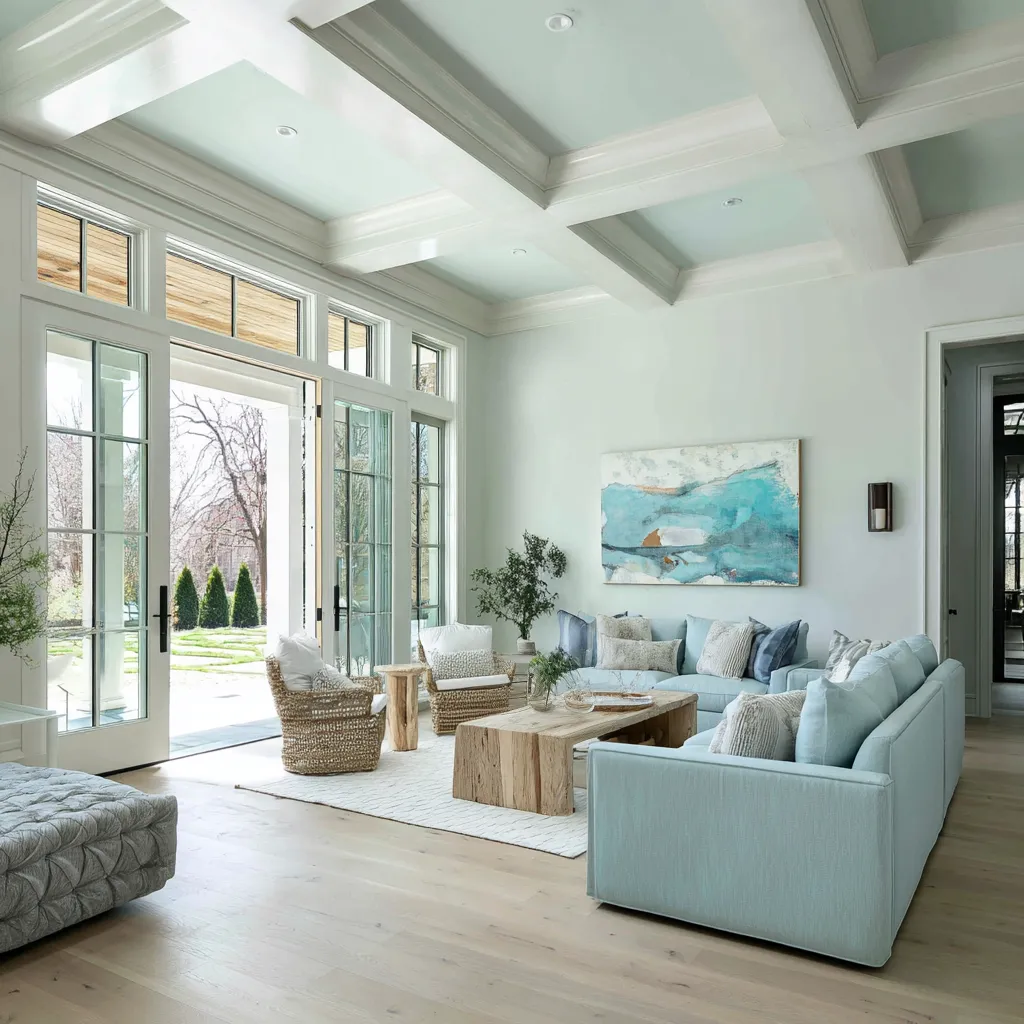
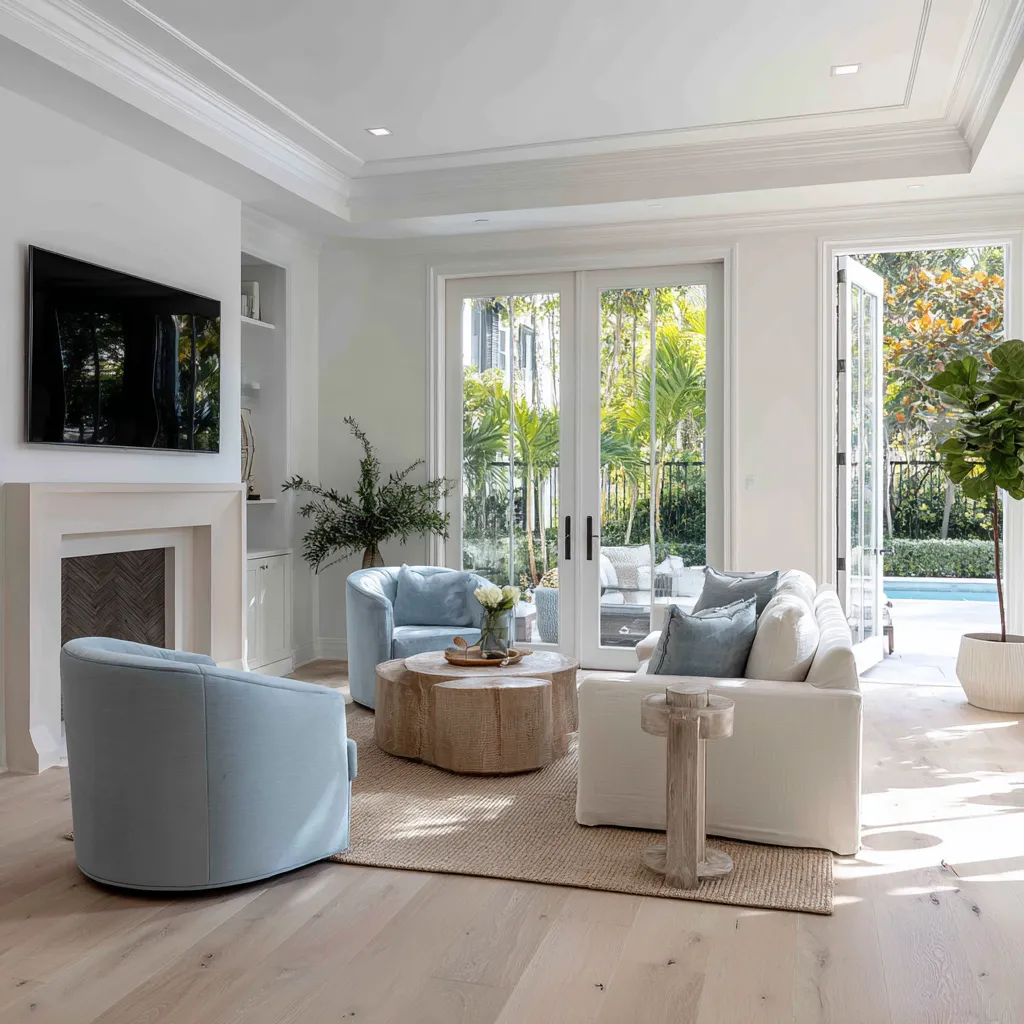
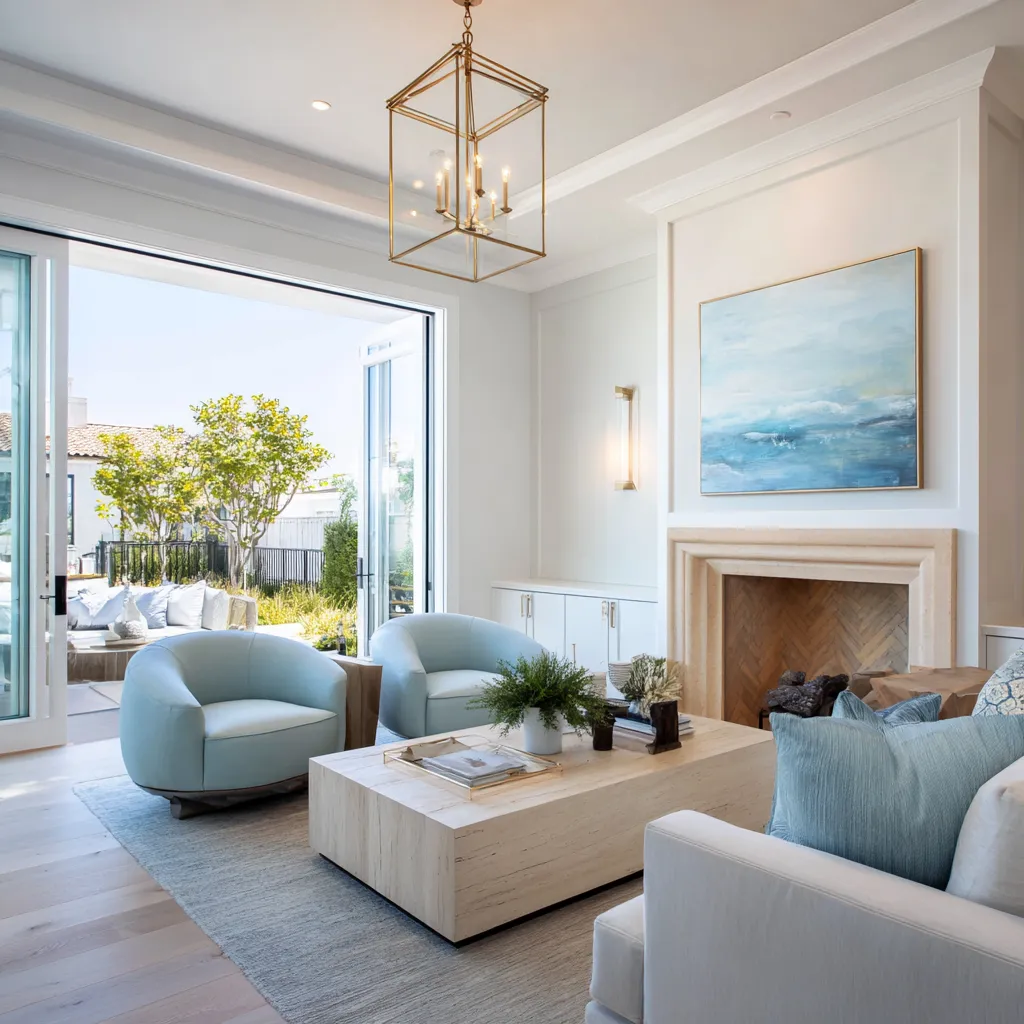
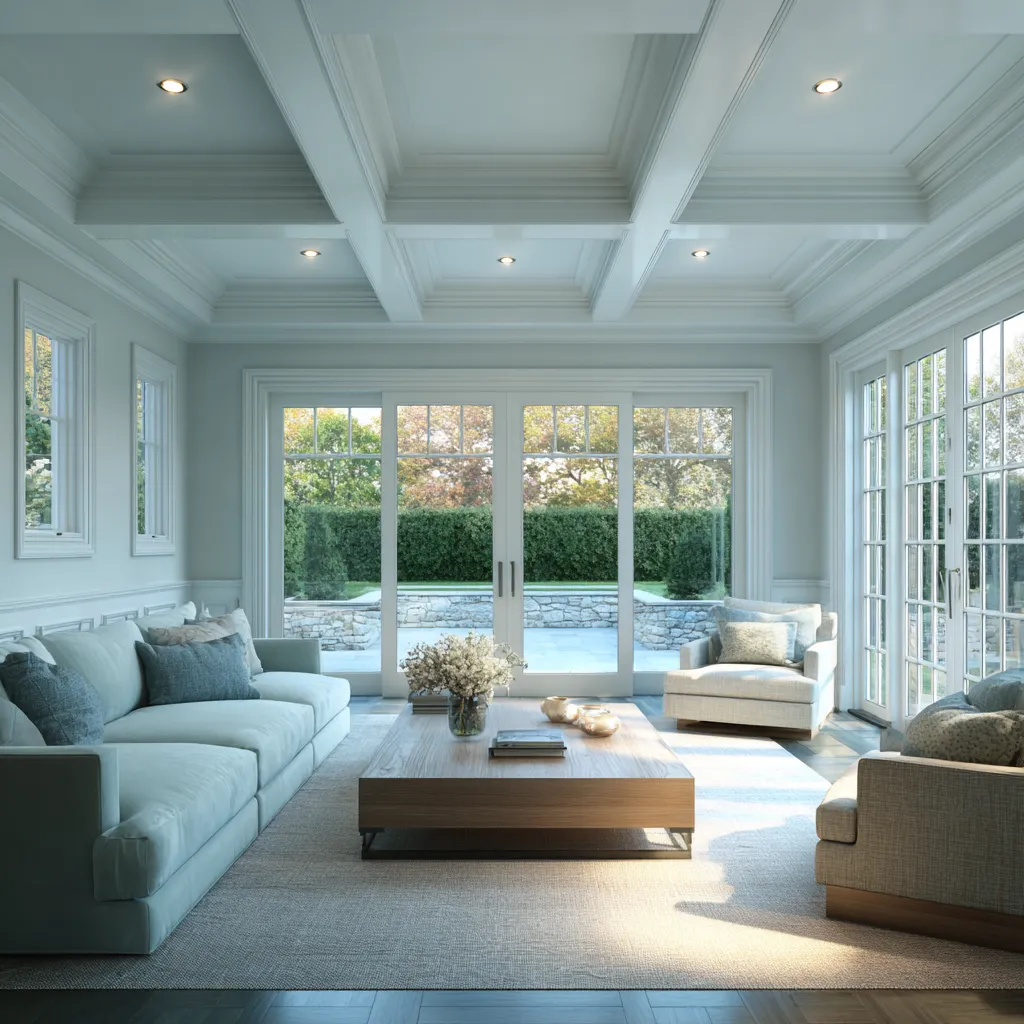
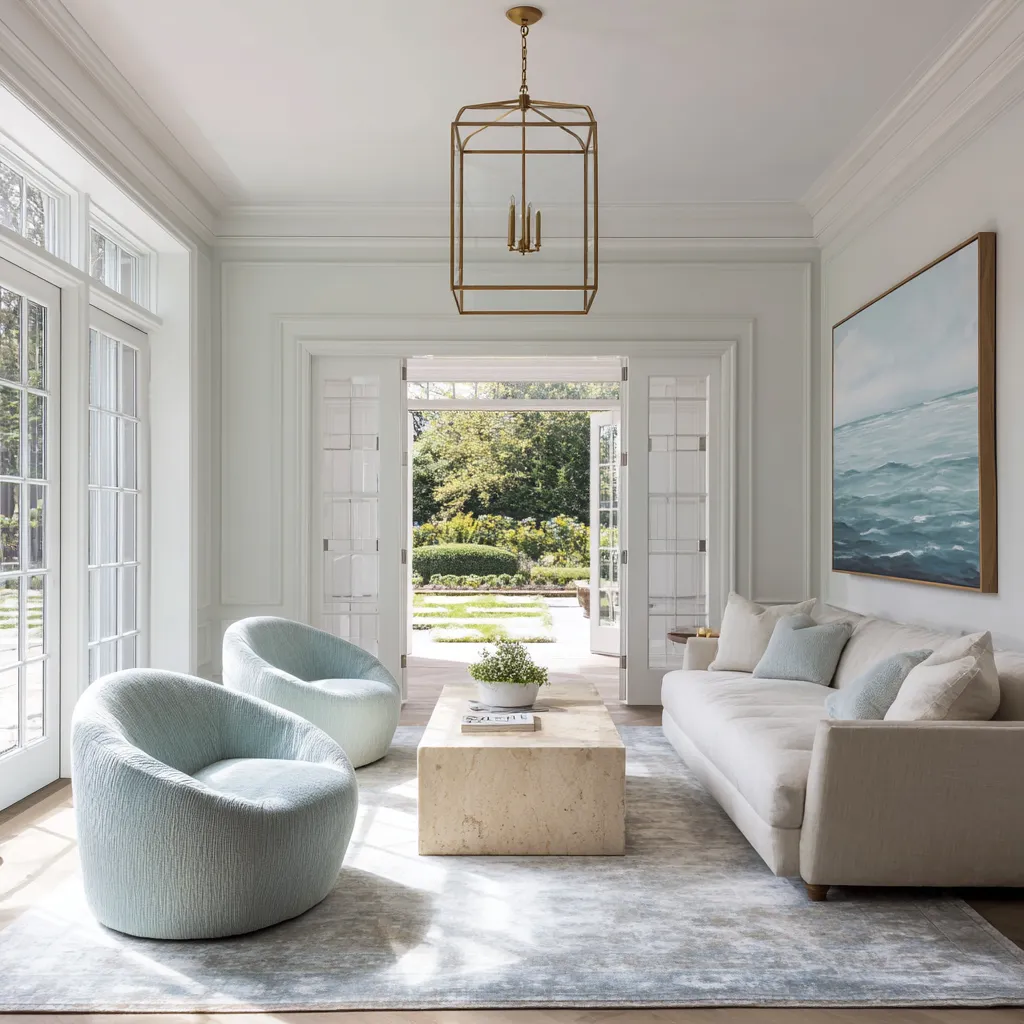
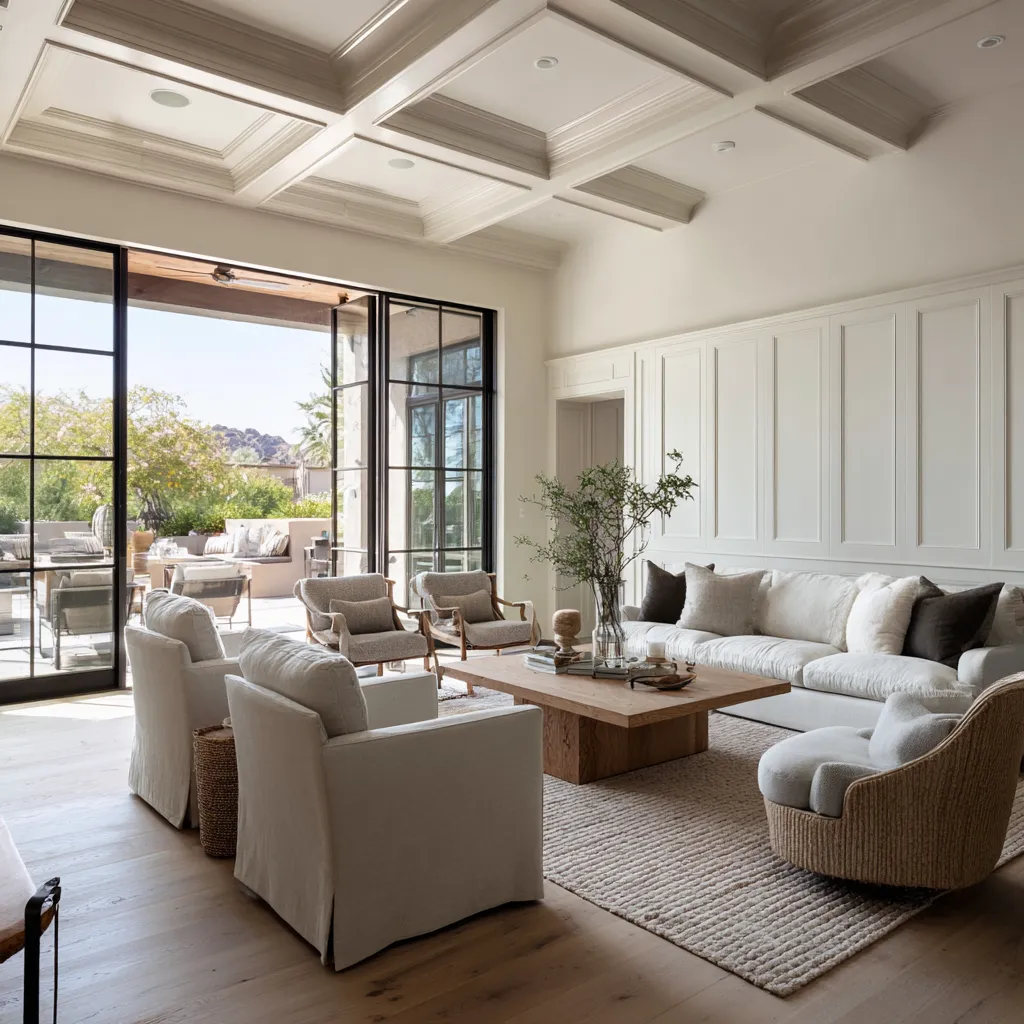
A third branch is the social, indoor-outdoor version of Hamptons living. These rooms are often organized around terrace doors, garden views, folded openings, or bright French doors with transoms.
They still carry Hamptons identity, but their mood is lighter and more seasonal.
This version often includes pale blue more easily than the formal branches. You might see soft blue swivel chairs, blue-gray artwork, a washed coastal canvas above the mantel, or a pale blue-green ceiling infill inside coffered frames.
Wicker chairs near an opening are common because they help the room shift toward the garden without losing the painted-house character inside.
The furniture plan in these rooms is usually more social than ceremonial. Instead of arranging everything around a single hearth wall, the room may stretch toward the exterior.
Seating often supports conversation, guests, and movement between the house and terrace. The danger in this branch is slipping into generic upscale coastal design.
The difference usually lies in discipline. A true Hamptons room still wants good trim depth, well-framed openings, architectural clarity, and furnishing restraint.
Without those elements, the room can lose its East Coast house lineage and become merely coastal.
The role of ceilings in shaping the subtype
Ceilings matter far more in Hamptons living rooms than many realize. They often decide what kind of Hamptons room the space becomes.
- A coffered ceiling introduces order, hierarchy, and house formality. It suits rooms that want centered composition, strong symmetry, and a more estate-like feeling. If the coffers are broad and pale, they can feel current rather than old-fashioned.
- A vaulted timber ceiling shifts the room toward warmth and architecture. It adds overhead texture, age, and shape. This works particularly well in rooms that want a softer, more layered version of Hamptons style.
- A tray ceiling with restrained molding can support a more relaxed branch of the style. It gives enough structure to make the room feel finished without insisting on formal ceremony.
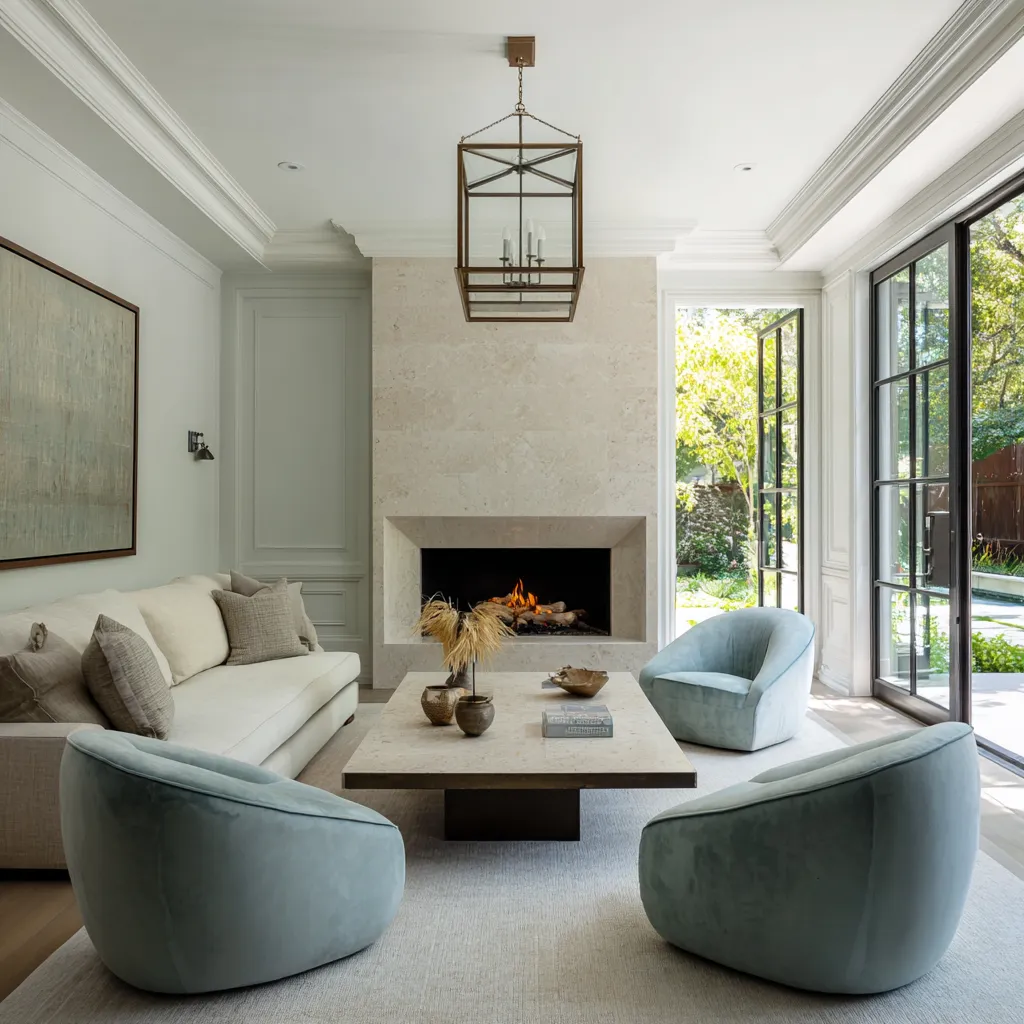
Even a simple ceiling can support the style if it has depth at the perimeter, good trim, and the rest of the shell is doing enough. But in large living rooms, ceiling treatment often makes the difference between a space that feels generic and one that feels rooted.
Fireplaces: important, but not the whole story
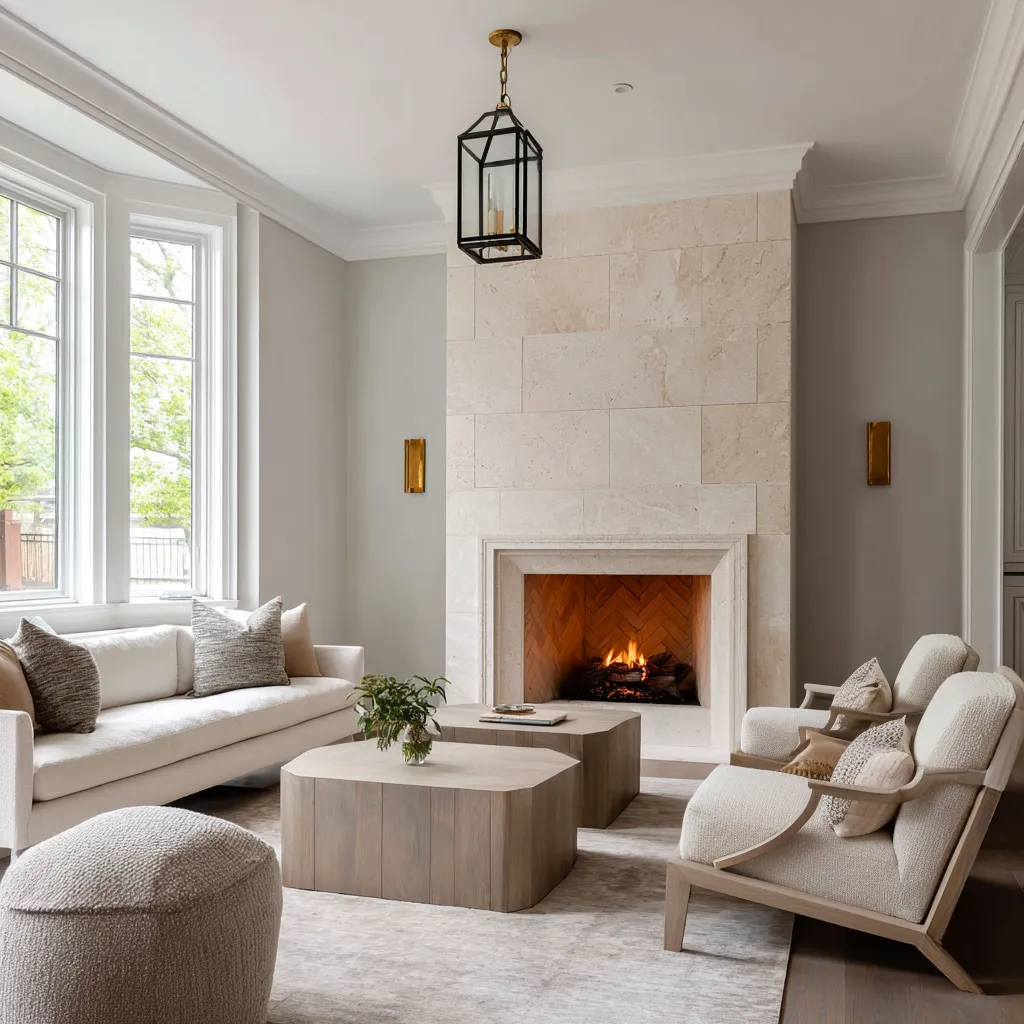
The fireplace is often treated as a defining Hamptons feature, and it does matter. A well-proportioned hearth gives the room emotional center and architectural gravity.
Pale stone, painted mantels, herringbone firebox lining, and generous chimney masses all fit comfortably in the style. At the same time, the fireplace does not have to dominate the room.
In many modern Hamptons interiors, the hearth is surprisingly restrained relative to the wall around it. A small or moderate fire opening can sit inside a much larger paneled elevation or stone field.
That gives the wall dignity without making the room theatrical.
The room often feels better when the fireplace is part of the architecture rather than a decorative event trying to take over the whole composition. Even a living room without a visible fireplace can still feel Hamptons if the shell is disciplined enough.
Panel molding, good windows, a lantern pendant, built-ins, pale layered materials, and balanced furniture can preserve the character.
Why softness is nearly always present
One of the consistent traits of Hamptons living rooms is softness. Formality may rise or fall.
Blue may appear or disappear. Symmetry may be strict or relaxed.
But softness remains. That softness shows up in deep-seated sofas, tactile rugs, cushioned armchairs, rounded edges, generous seat depth, pale woven textiles, and upholstery that looks meant for actual use.
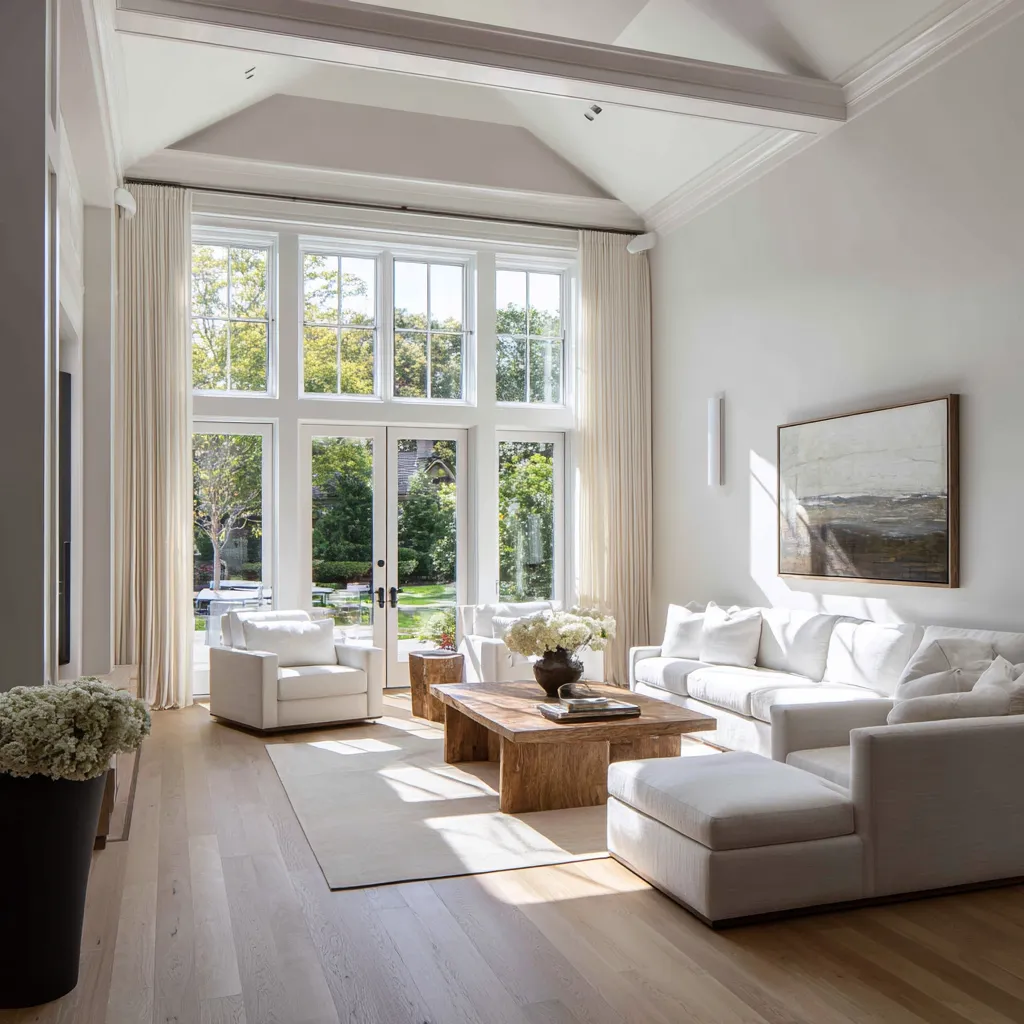
This is what stops Hamptons interiors from feeling ceremonial in a cold way. The room may be polished, but it should still look as though people can spend hours in it.
This is also why overly sharp furniture can disrupt the style. A room with rigid minimal seating, hard-edged forms everywhere, and no tactile relief may still be pale and bright, but it will usually drift away from Hamptons into another design language.
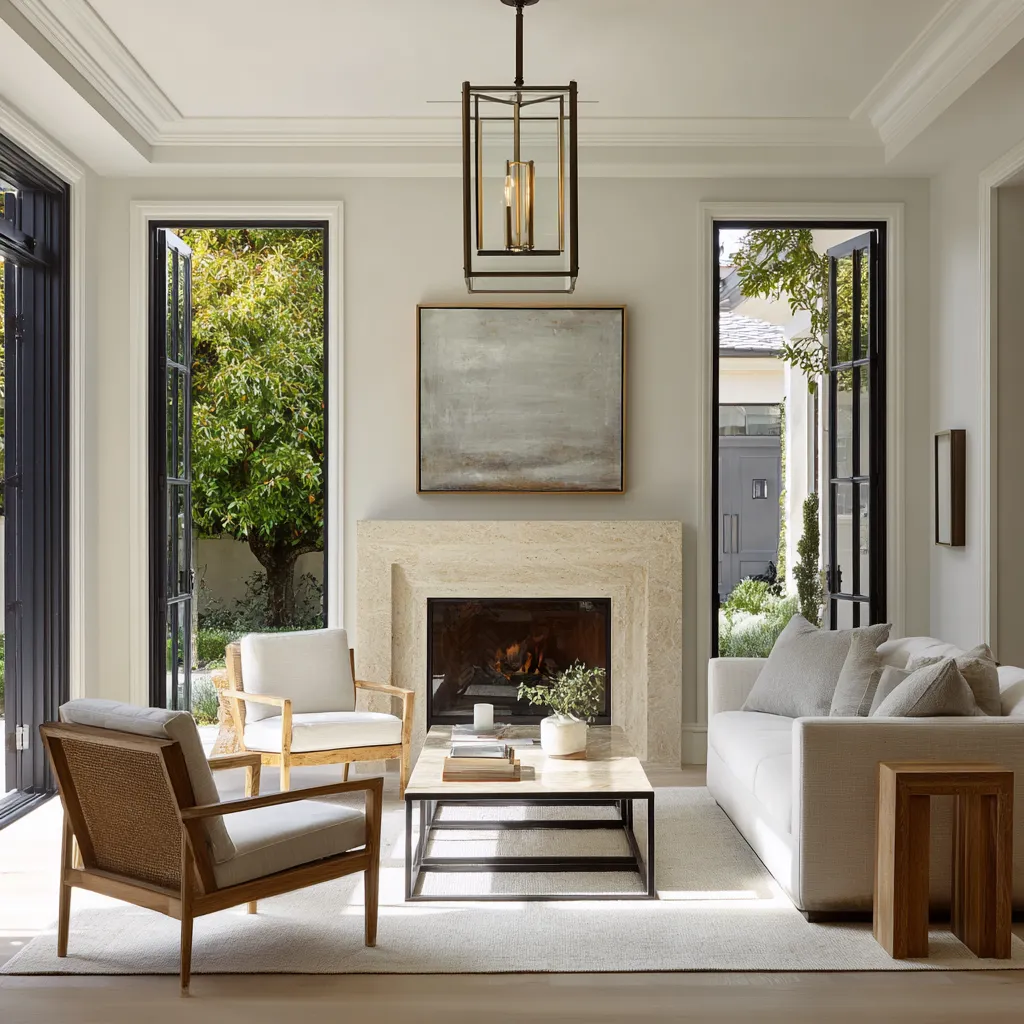
Natural texture as a balancing tool
Natural texture has a very specific role in Hamptons rooms. It is not there only to add variety.
It often softens formality. Wicker, cane, weathered timber, basketry, nubby rugs, dried branches, and grainy wood tables are often used where the room would otherwise feel too composed.
A paneled wall, coffered ceiling, and centered fireplace can become quite ceremonial.
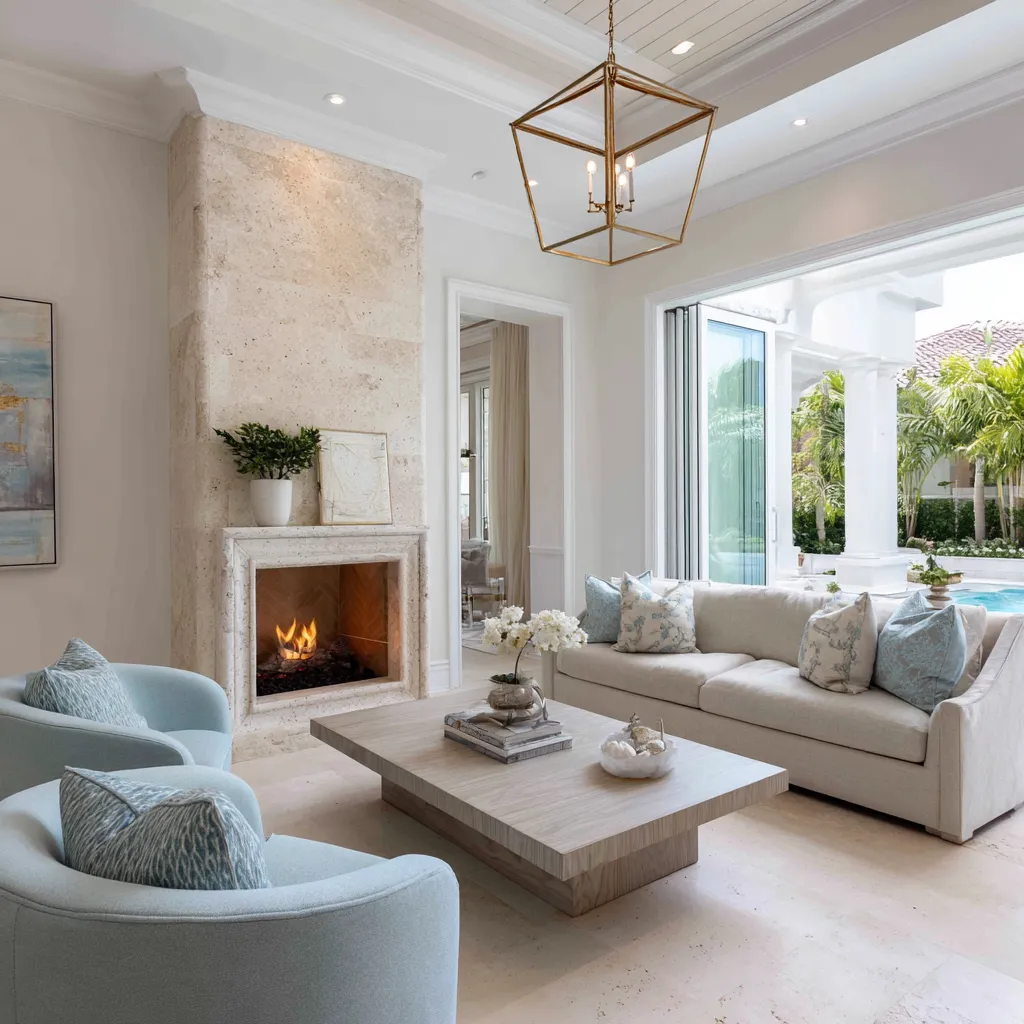
One woven chair, a dry timber table, or a group of dried botanicals can loosen that atmosphere without damaging the structure of the room. This is why natural texture often works better in small doses than in whole-room saturation.
If every surface becomes rustic or fibrous, the room may lose its house-made refinement. Hamptons style usually benefits from a balance between painted structure and natural relief.
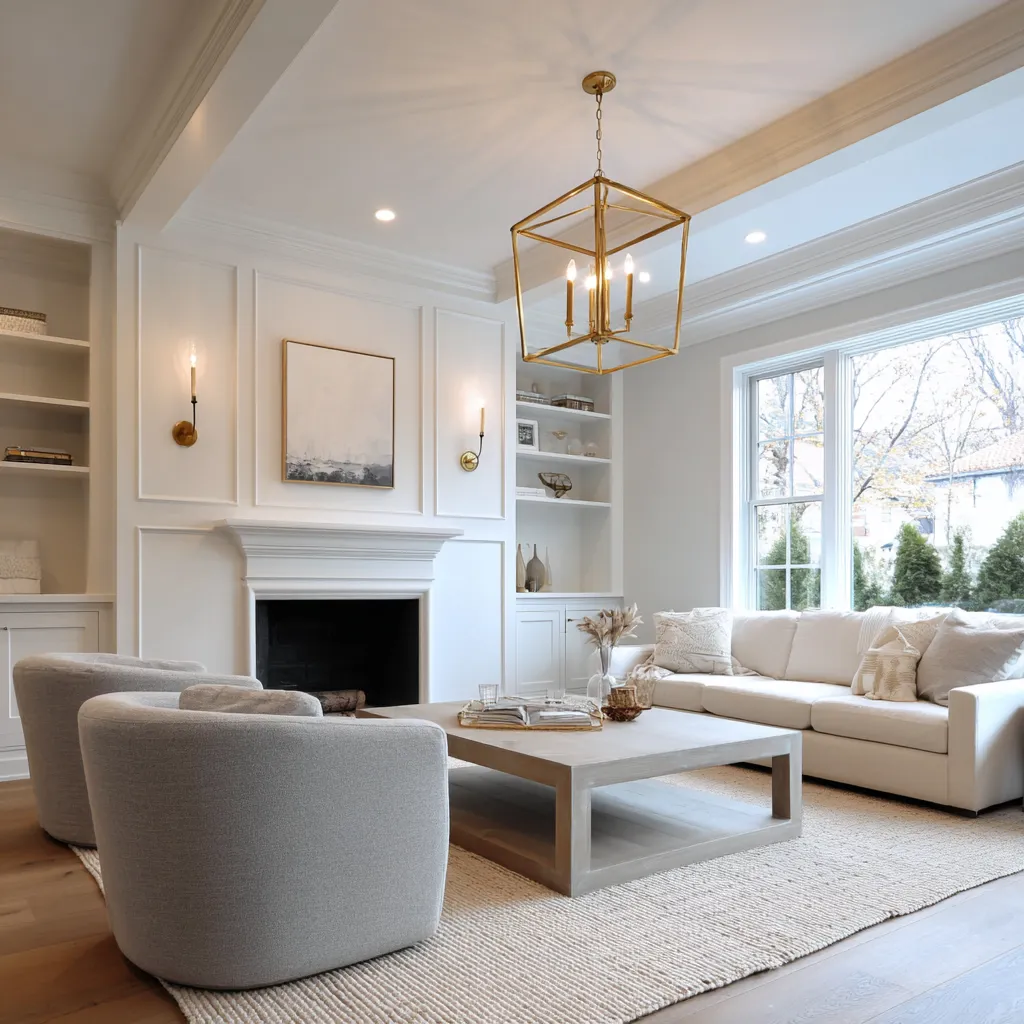
How to make a Hamptons living room feel modern
The modern update is not about deleting the style’s architectural DNA. It is about editing the room harder.
That means fewer accessories on shelves and tables. It means broader wall fields with more breathing room between objects.
It means art that supports the room rather than dominates it. It means furniture silhouettes that are simpler and fuller rather than decorative and busy.
It means color used in a narrow range. It means letting one good coffee table, one strong fireplace wall, or one meaningful ceiling do the work that ten smaller decorative moves might otherwise try to do.
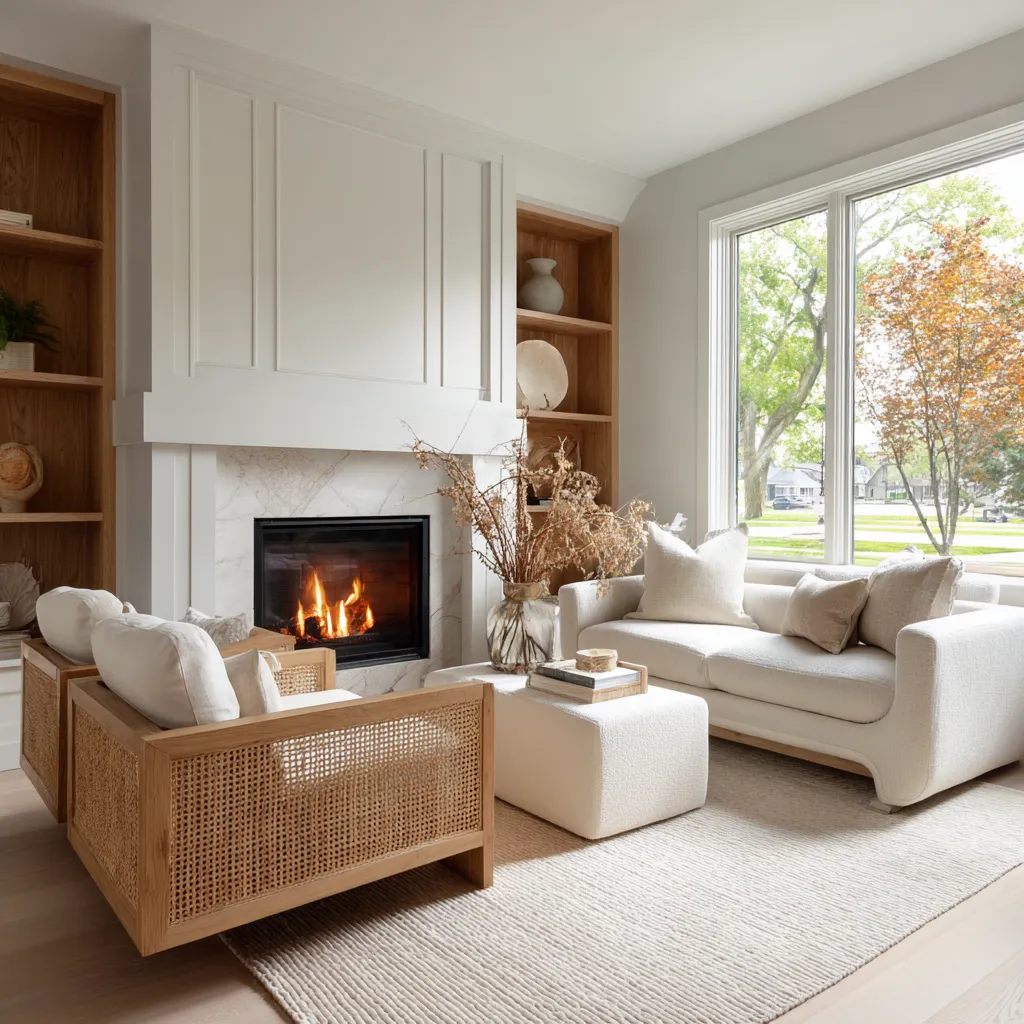
In practical terms, a modern Hamptons living room usually does well with:
- one clear architectural idea
- one grounding center object
- a pale tonal palette
- soft seating with scale
- restrained styling
- a measured use of natural texture
- a strong relationship to daylight
The design should feel settled, not over-explained.
Hamptons style in smaller living rooms
Hamptons style is often associated with large homes, but it can work very well in smaller living rooms. The key is to reduce the scale of the gestures, not remove them completely.
A small Hamptons style living room may use a tray ceiling instead of a dramatic coffer grid. It may have one fireplace/media wall with simplified trim.
It may use built-ins to create a sense of permanence. Rounded chairs can help circulation.
A pale curved sofa can soften the room while preserving openness. A round or softly edged wood table can keep the center from feeling rigid.
In compact spaces, restraint becomes even more important. Too many side tables, decorative objects, patterned fabrics, or heavy color contrasts can make the room lose clarity.
A smaller Hamptons room usually works well when it keeps only the moves that matter: good trim, pale tonal layering, soft seating, one or two natural textures, and a clear relationship to light.
Common mistakes that weaken the look
- One of the common mistakes is treating Hamptons style as a collection of coastal symbols. Too many stripes, shells, rope references, overt marine artwork, or heavy blue use can flatten the room into a predictable theme.
- Another mistake is making every seat matched and every element symmetrical. Balance matters, but slight variation in seating type often helps the room feel lived in.
- A third mistake is filling every surface. Hamptons rooms usually need breathing room. Shelf styling, tabletop styling, and mantel styling should support the architecture rather than crowd it.
- Another frequent problem is allowing pale color to become featureless. A room can stay in creams and whites and still feel rich, but it needs differences in texture, grain, shadow, sheen, and scale. Otherwise it becomes blank rather than layered.
- Finally, a fireplace can become too dramatic relative to the room. Oversized mantels, overly patterned stone, or too much visual weight at the center can disrupt the balance. In many successful modern Hamptons rooms, the wall remains larger than the fireplace itself.
Final thoughts
A well-designed Hamptons style living room begins with the house. That is the point many trend-driven versions miss.
The style is at its most persuasive when the architecture sets the tone and the furnishing supports it rather than trying to perform the whole identity on its own.
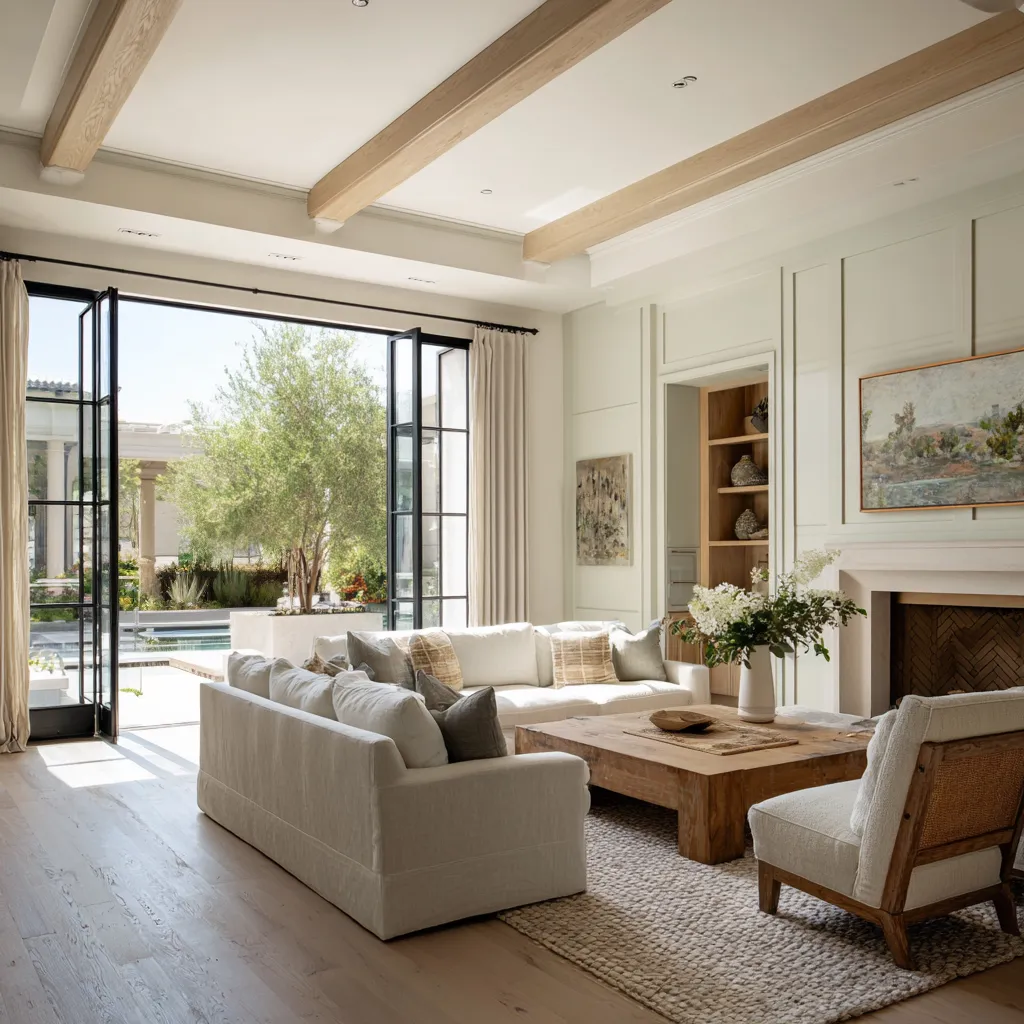
Modern Hamptons living rooms show that the style still has range. It can be formal and axial, warm and architectural, terrace-linked and social, or scaled for family life.
It can use blue or barely touch it. It can have a grand fireplace or a restrained one.
It can feel ceremonial or relaxed. What keeps it within the Hamptons family is not a single color formula but a deeper structure: architectural discipline, pale tonal layering, soft seating, natural light, and edited composition.
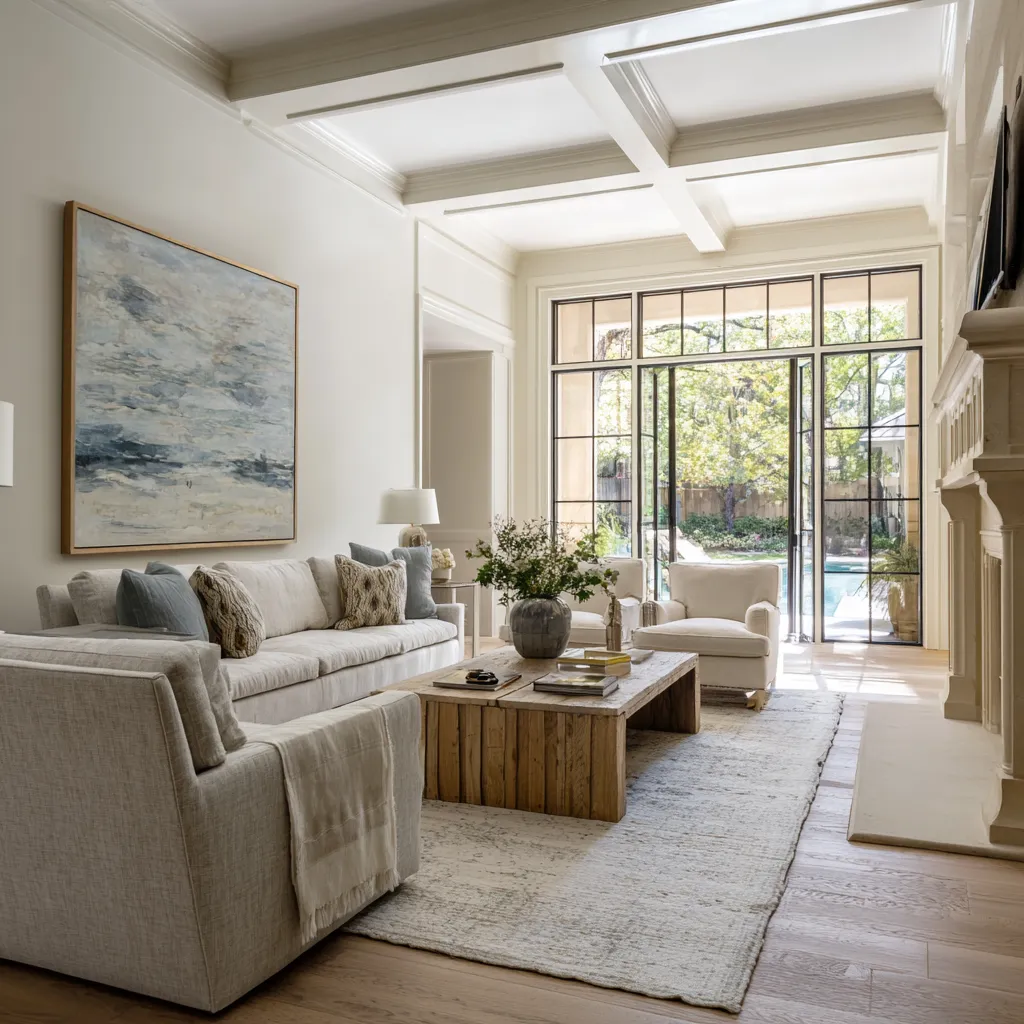
That is why the style continues to hold attention. It offers a rare balance of polish, comfort, and architectural depth.
In the right hands, it gives a living room an atmosphere that feels bright, settled, and enduring without leaning on excess.