Modern eclectic maximalist living rooms are often misunderstood. Many people imagine that the look comes from adding more: more objects, more color, more pattern, more furniture, more visual activity on every surface.
But eclectic maximalist living room ideas that feel refined, memorable, and deeply layered usually follow a different logic. They are not built from indiscriminate accumulation.
They are built from control, hierarchy, and concentrated richness.
That distinction matters. A room can contain many influences and still feel composed.
It can feel full without feeling crowded. It can hold saturated color, mixed materials, books, art, pillows, sculptural forms, and collected accents, yet still remain legible at first glance.
In fact, that legibility is one of the things that keeps a maximalist room current. The space feels generous and expressive, but the eye knows where to go first, where to pause second, and where the quieter background structure begins.
The modern eclectic maximalist living room is therefore best understood as a disciplined room with a thick emotional and tactile surface. Its richness is concentrated in chosen places.
Its palette is often tighter than people expect. Its furniture is usually larger and fewer in number rather than scattered into many medium pieces.
Its art does more than decorate. Its upholstery does more than provide comfort.
Its architecture frames the atmosphere, but does not carry the whole burden alone.
The modern base comes first
For this style to feel current rather than chaotic, the room usually starts with a modern foundation. That does not mean cold minimalism.
It means clarity. A modern base usually includes broad furniture masses, clean wall planes, a readable floor plan, and a calm compositional skeleton.
Instead of many unrelated pieces competing for attention, the room tends to use a few major anchors: one long sofa, one substantial coffee table, one main art field, one shelf wall, one fireplace composition, or one built-in seating zone. These larger gestures establish order before the smaller layers arrive.
This is one reason the style often looks better in rooms that resist over-furnishing. If the base layout is already crowded, any added richness quickly turns muddy.
But if the room begins with a clear structure, then dense textiles, darker tones, sculptural accents, or display objects can sit inside that structure without overwhelming it. Modernity in this kind of room comes from crisp hierarchy, not emptiness.
The room should feel intentional before it feels expressive.
Maximalism here is a matter of concentration, not sprawl
One of the ways to understand this look is to separate soft density from object density. These are not the same thing.
A room can have many shelf objects, books, pottery pieces, and framed works, but still feel milder in maximalist character than a room with a deep sofa, a chaise, layered pillows, heavy drapery, a bench seat, a thick rug, and a saturated wall color. That happens because upholstered abundance changes the emotional weight of the room more directly than accessory count does.
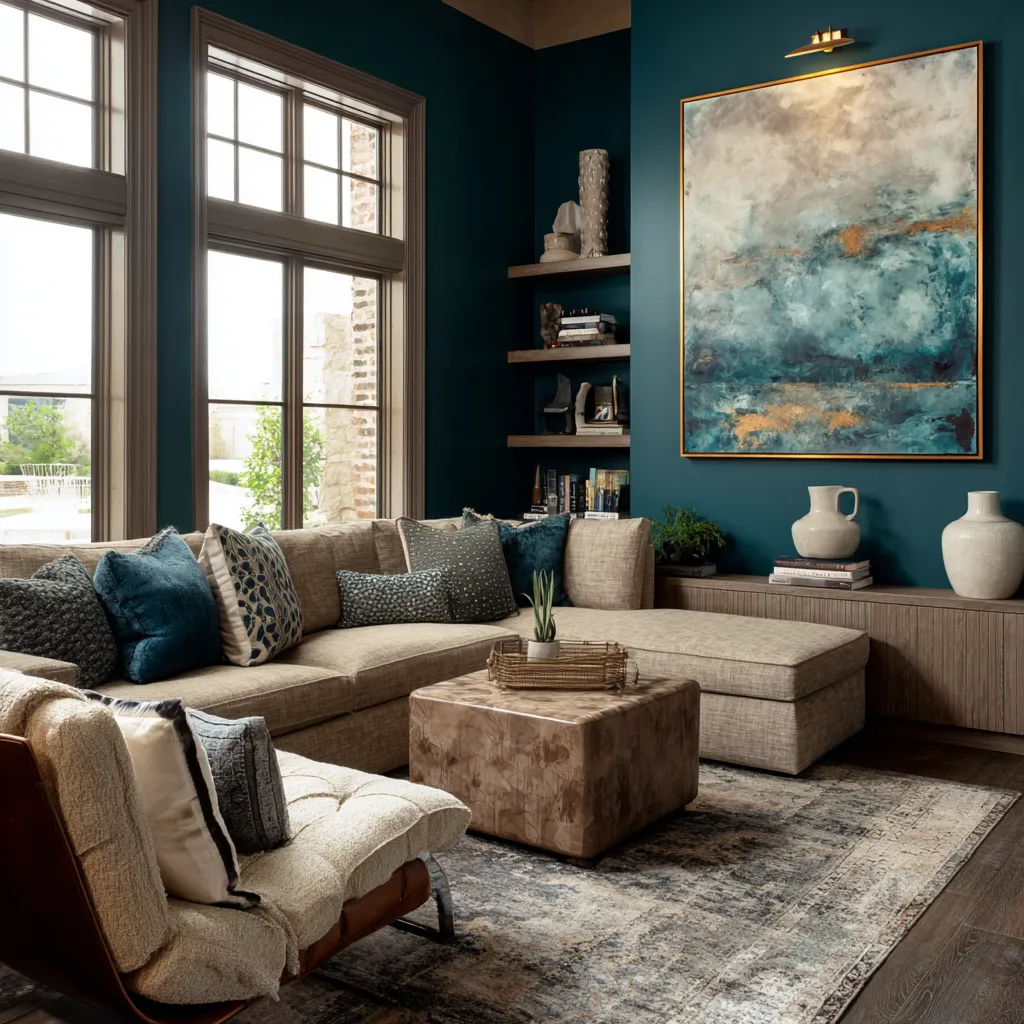
The living rooms that move closer to modern eclectic maximalism often gain that status through a thick soft field:
- deeper seating silhouettes
- denser pillow groupings
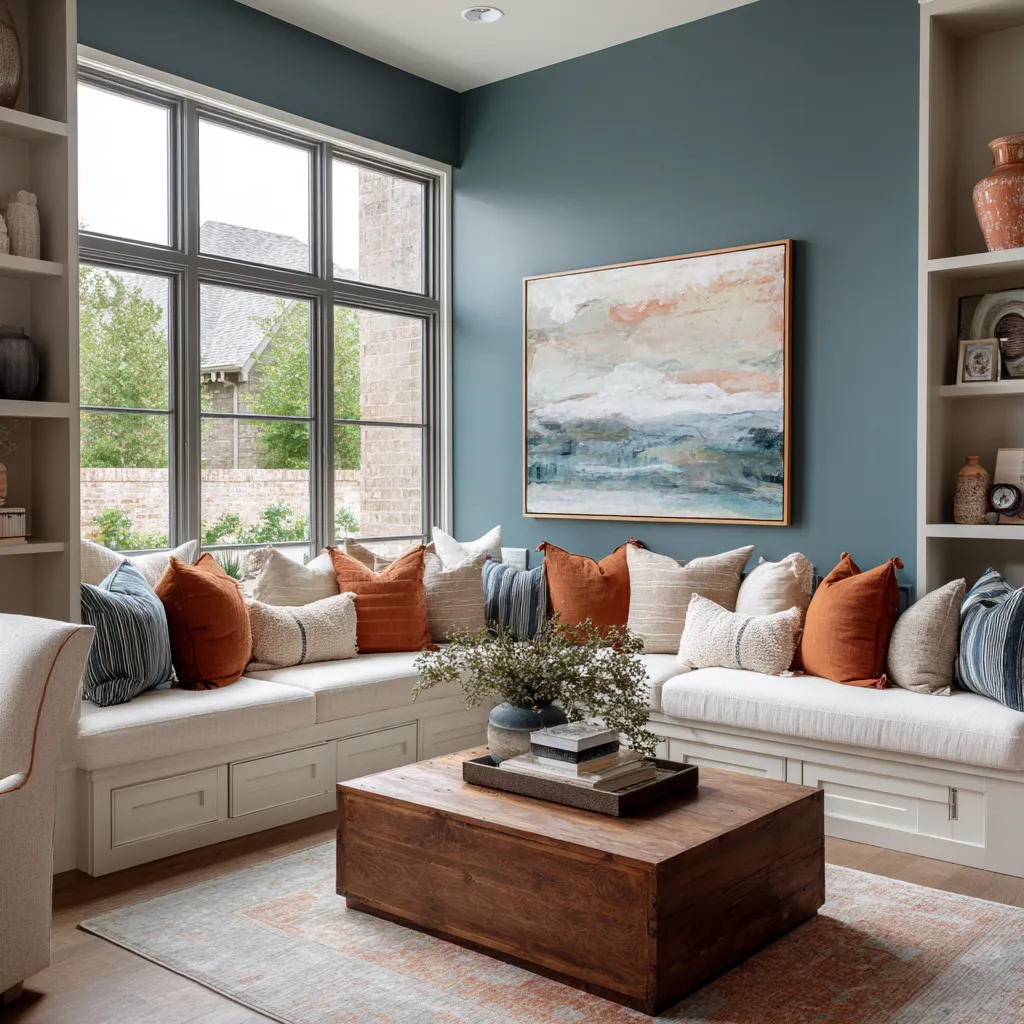
- bench cushions or built-in window seats
- plush lounge chairs
- repeated upholstery textures
- a sense that the room can hold the body, not only the eye
This is an important distinction for design decisions. If a room feels thin, adding more decorative objects may not solve the problem.
It often needs more textile presence first. The style becomes fuller when the room gains bodily depth: softness you can see before you touch it.
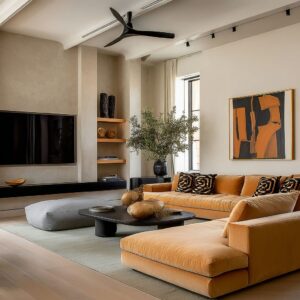
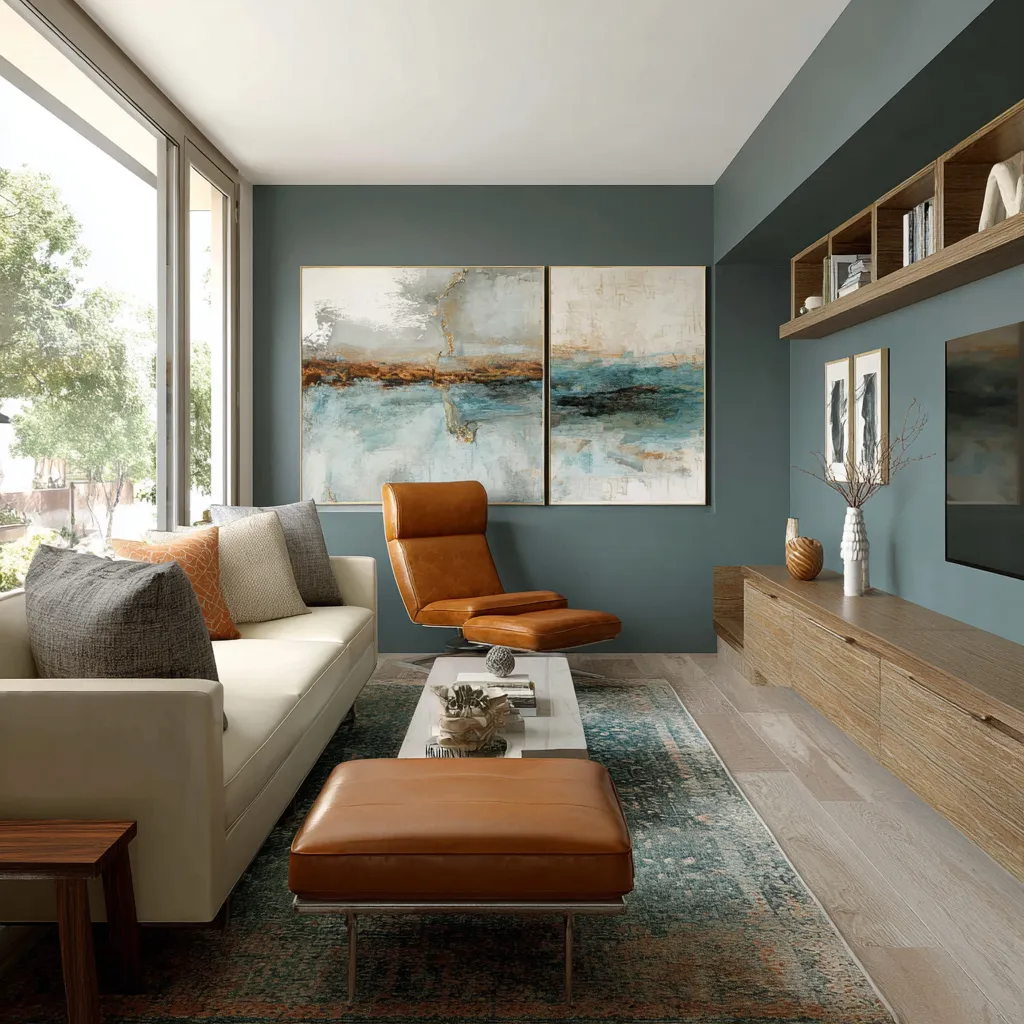
That is why a room with a low sectional, a leather lounge chair, a dense rug, rust or ochre pillows, and one large artwork often feels more complete than a room with many smaller ornaments placed on every surface.
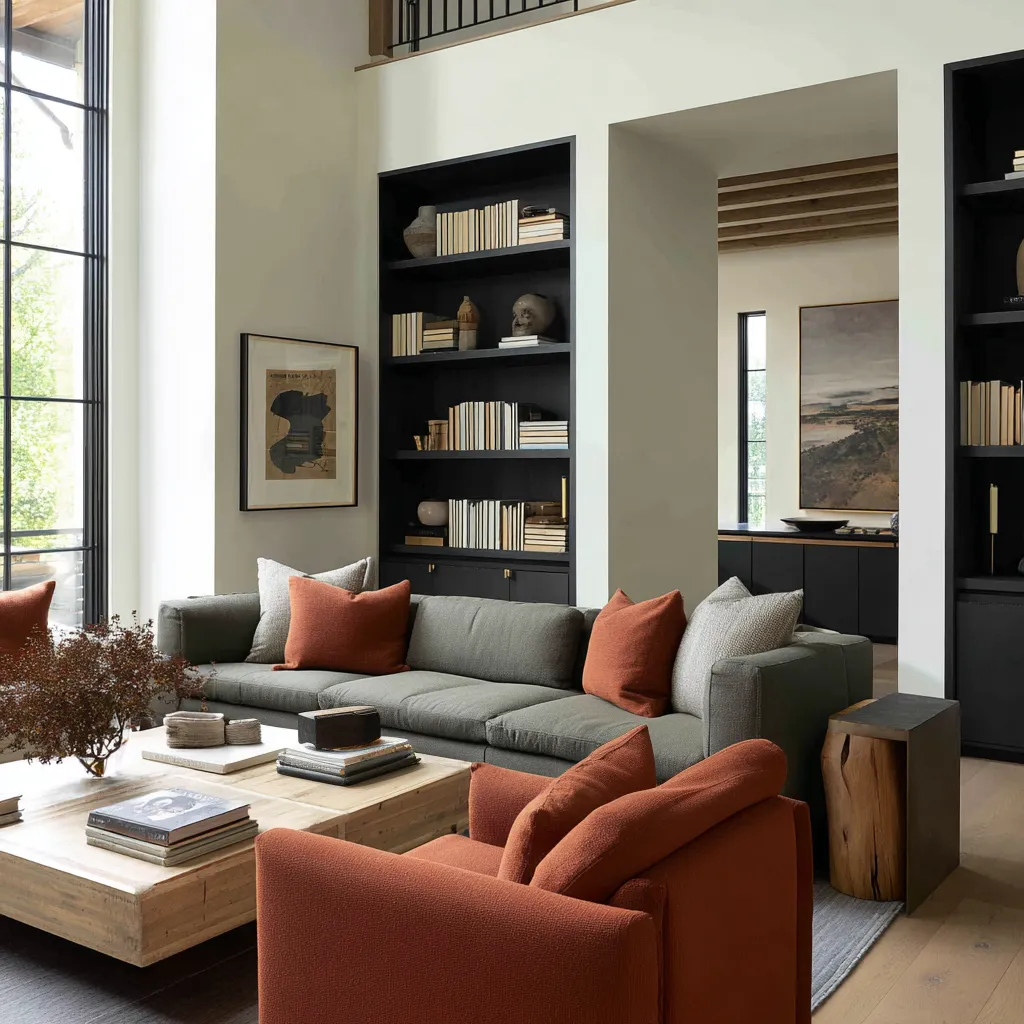
A compressed palette makes the richness visible
People often associate maximalism with a wide color range. Yet many of the satisfying living room ideas in this category are actually built on compressed palettes.
A compressed palette does not mean flat monotony. It means the room commits to one dominant family and then expands that family through value, warmth, texture, and a small number of supporting accents.
A wall may sit in teal, olive, plum-brown, sage-gray, or blue-green. The furniture may stay in cream, taupe, mushroom, or soft gray.
Warmth then enters through leather, rust, cinnamon, walnut, tobacco, or muted ochre. This gives the room more coherence than a many-hued scheme.
The eye can register the room quickly, which frees it to notice depth, form, material, and placement.
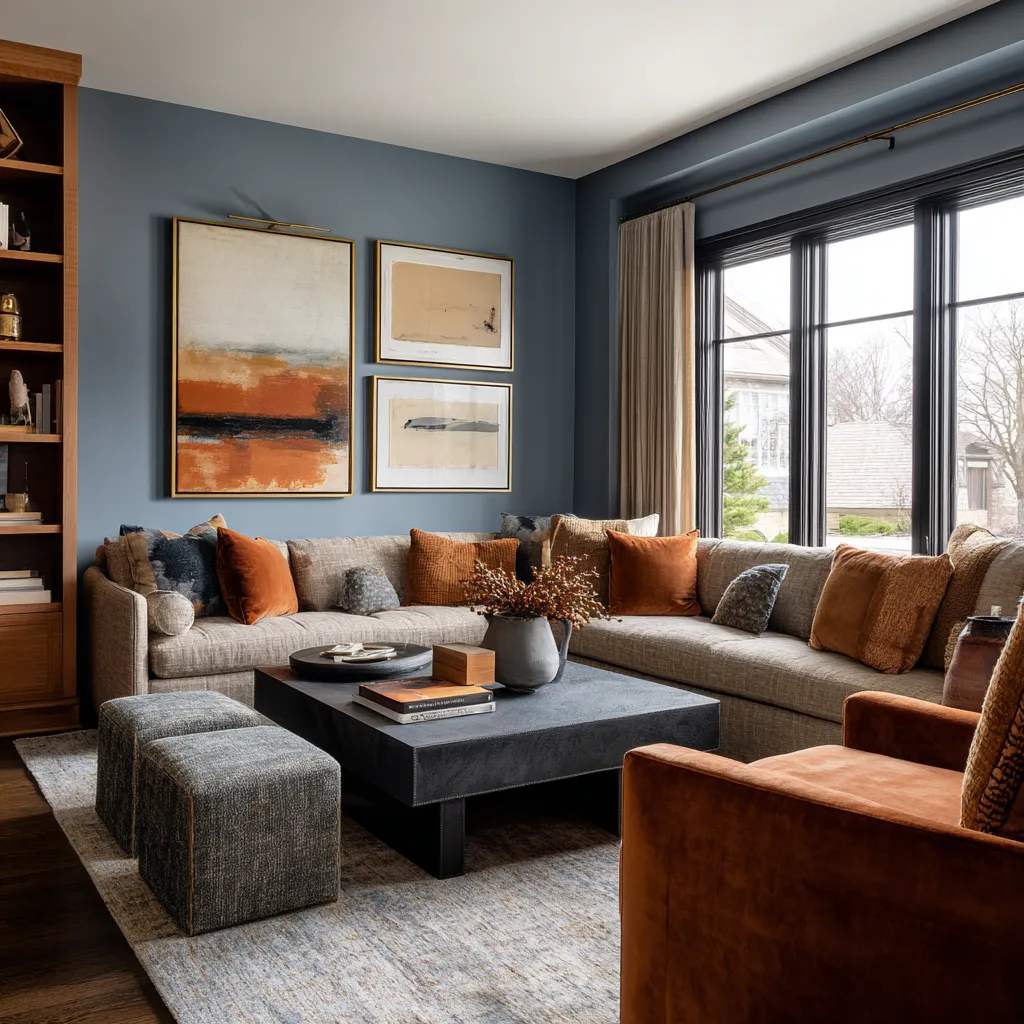
In practice, this means a living room often feels richer when it chooses one of these arrangements:
Cool shell with warm insertions
Deep teal, blue-gray, olive-charcoal, or moss walls paired with cream upholstery, cognac leather, rust pillows, warm wood, and clay-toned art passages.
Warm-neutral shell with controlled cool notes
Taupe, beige, plaster, pale stone, or mushroom envelopes paired with blue art, dusty teal upholstery, charcoal inserts, or green accent pillows.
Tonal room with one repeated accent family
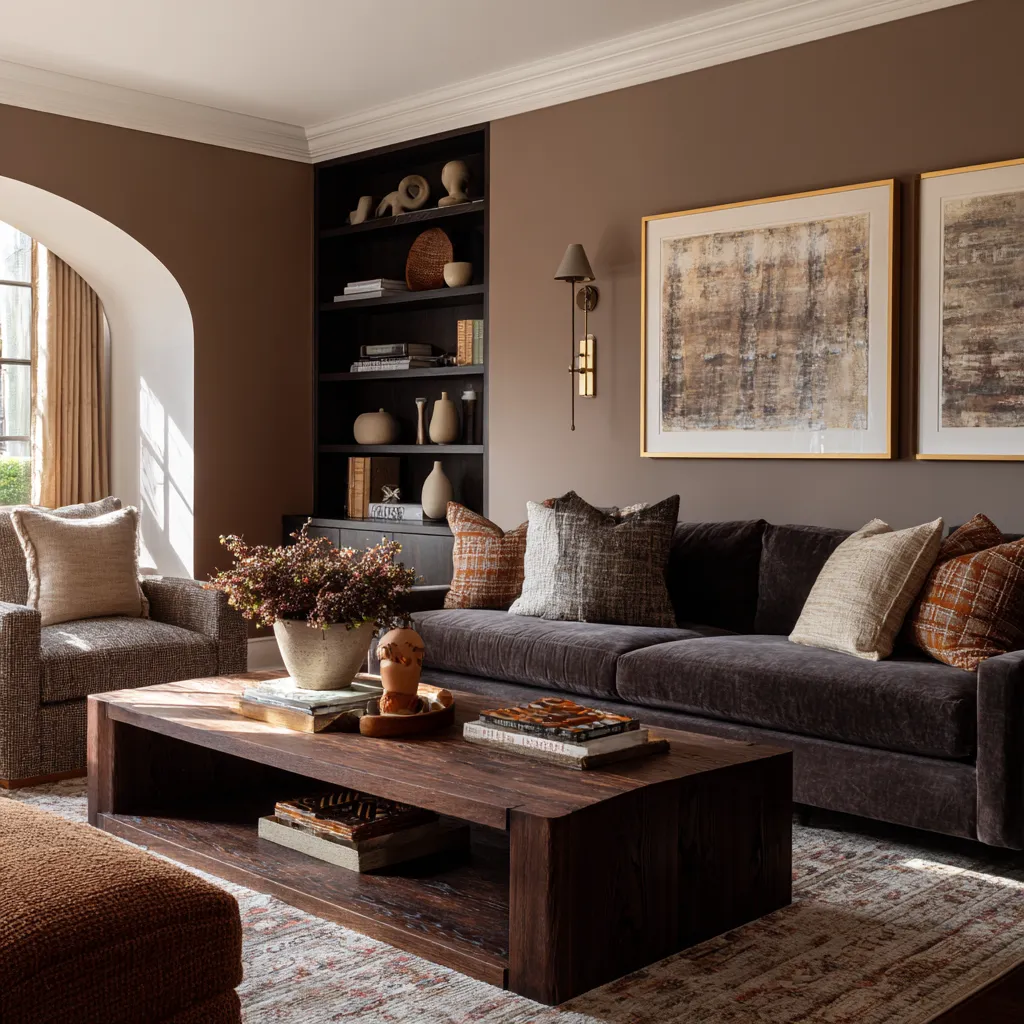
A brown-plum or sage-gray room held together by repeated rust, terracotta, caramel, or ochre notes placed in several scales. The key is repetition with discipline.
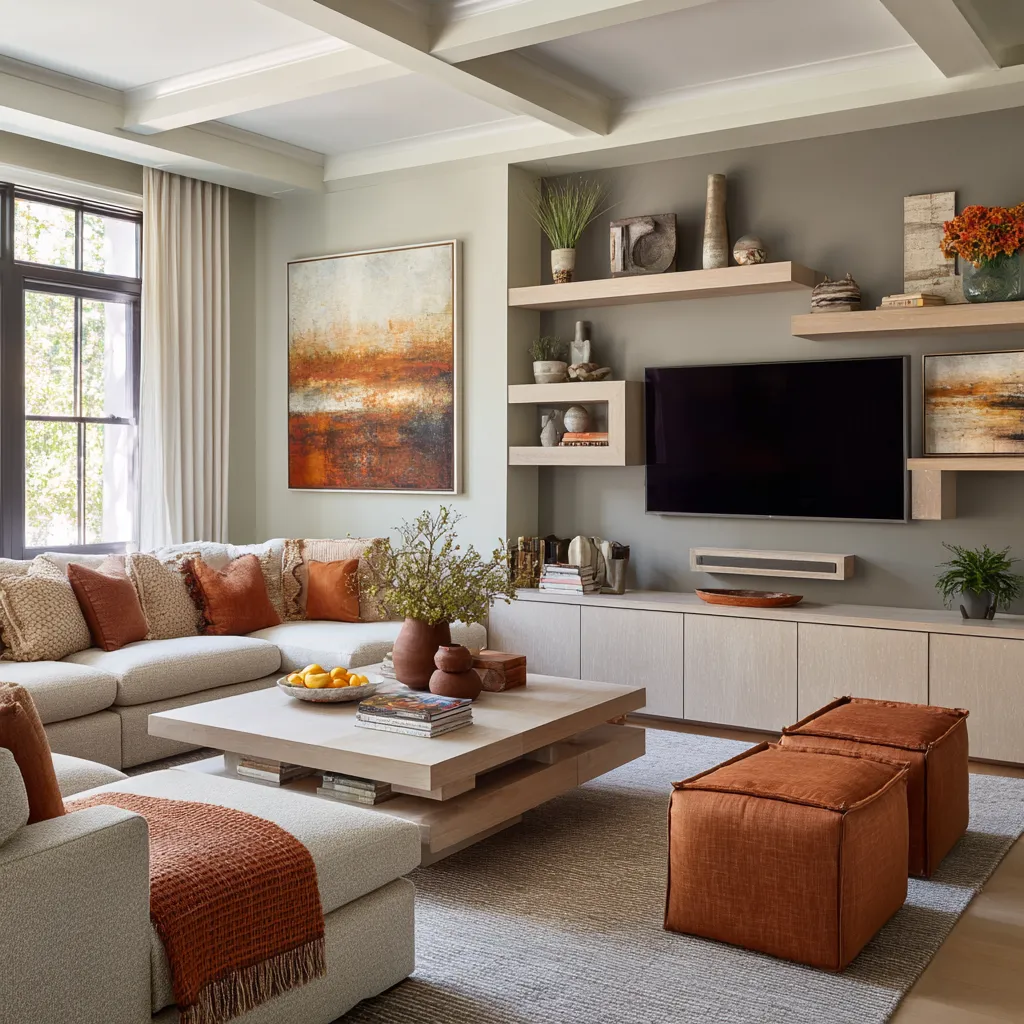
The warm notes do not need to appear everywhere. In fact, they usually work better when concentrated where the eye pauses: on the chair, in the pillows, in the art, at the table center, or inside shelf accessories.
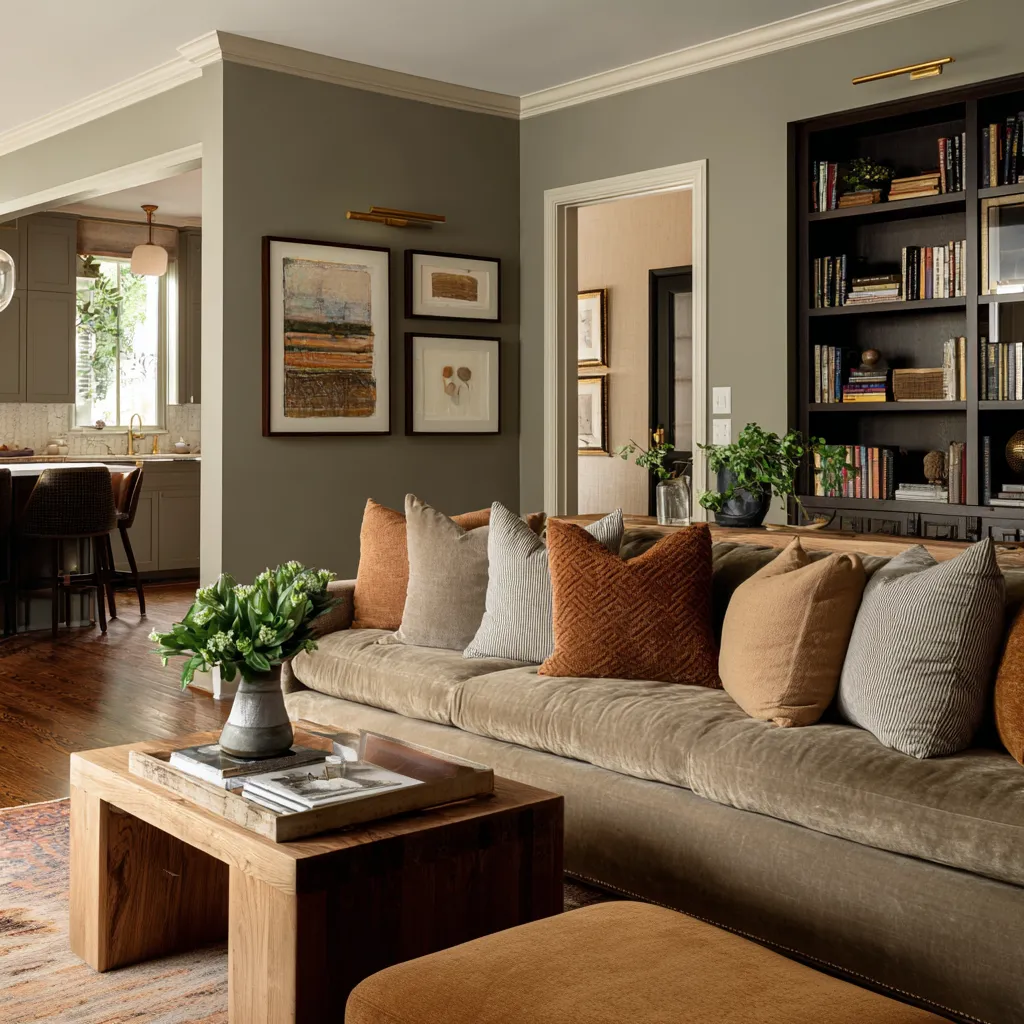
Warm–cool tension is one of the style’s hidden engines
Modern eclectic maximalist living rooms often feel compelling because they hold temperature contrast very well. A cool shell gives depth, seriousness, and calm.
Warm insertions give body, hospitality, and visual pulse. That tension can be dramatic, as in a blue or teal room with rust pillows and cognac leather.
It can also be understated, as in a pale stone room with muted olive upholstery and apricot accents. What matters is not loud contrast for its own sake.
What matters is that the room contains both cool recession and warm punctuation.
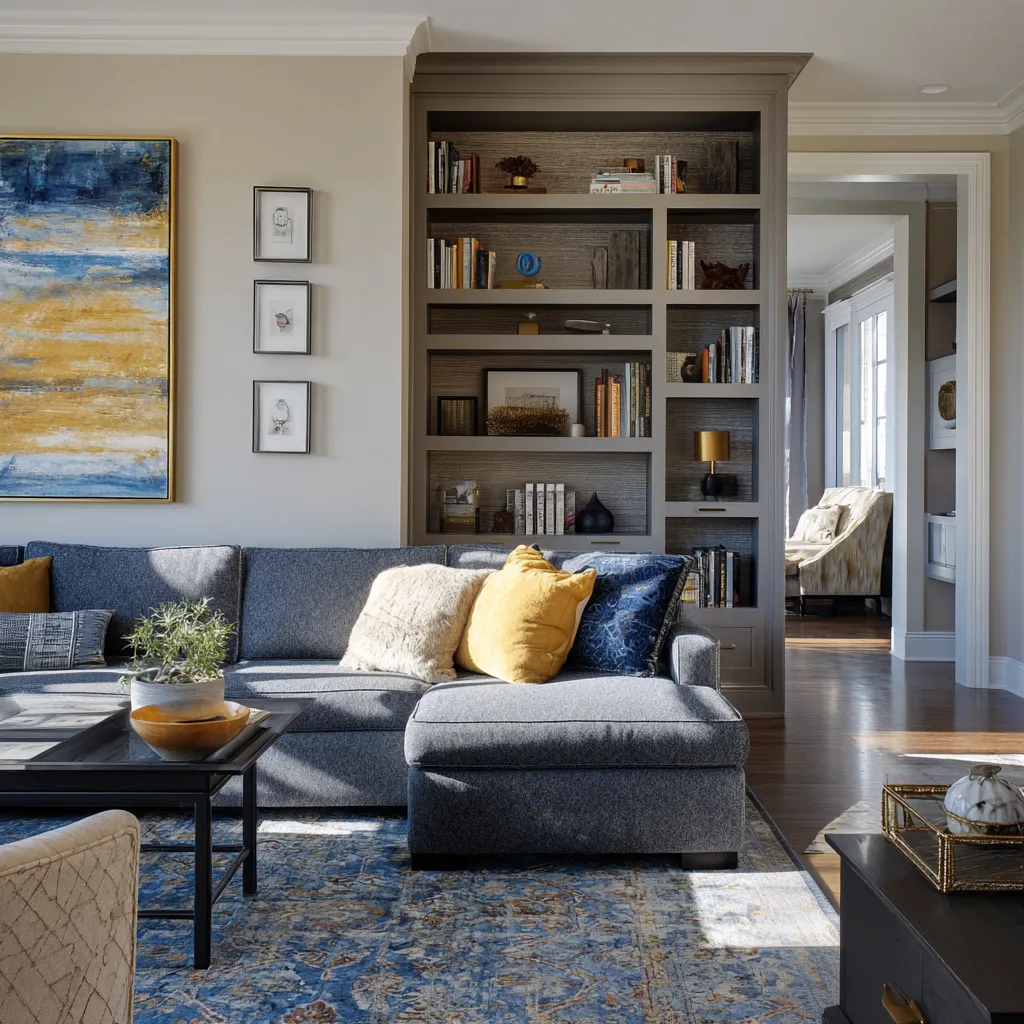
If everything is equally warm, the room can feel heavy and undifferentiated. If everything is equally cool, the room may look polished but emotionally distant.
The memorable designs often let the cool tones shape the envelope while the warm tones shape the points of pause. This is why leather chairs are so useful in this style.
A single cognac or caramel chair can carry a surprising amount of work. It punctuates the cool room, adds tactile difference, and spreads warmth into the foreground without requiring a flood of smaller orange-brown accessories.
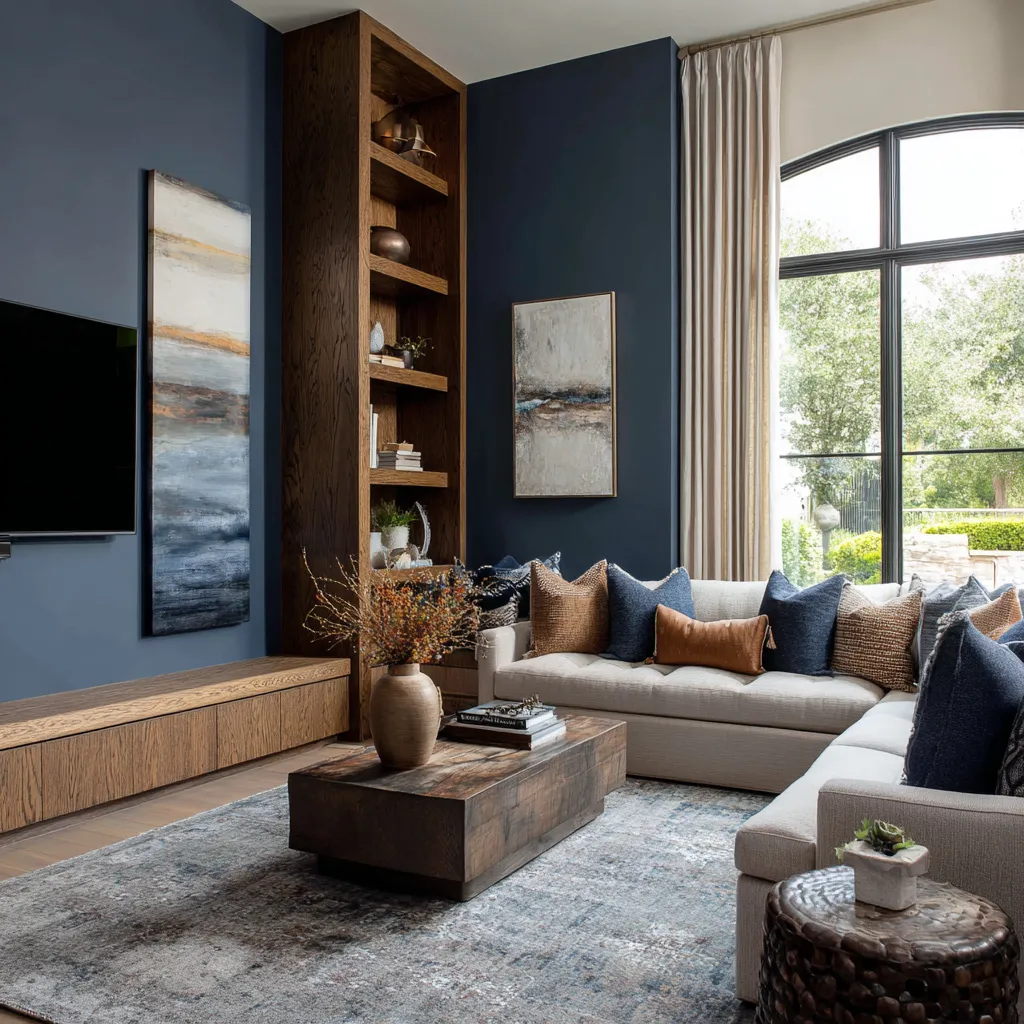
Art is not garnish. It is structure.
Large art plays a central role in the modern eclectic maximalist living room. It often does several jobs at once, and the room feels weaker when it is treated as an afterthought.
A major canvas can anchor the focal wall, bridge wall color to upholstery, distribute accent hues into the room, scale a high wall properly, and introduce rhythm inside a broad architectural surface. In rooms with saturated walls, art often prevents the color field from feeling blunt or unfinished.
In brighter rooms, art can create the missing density that keeps the room from floating apart.
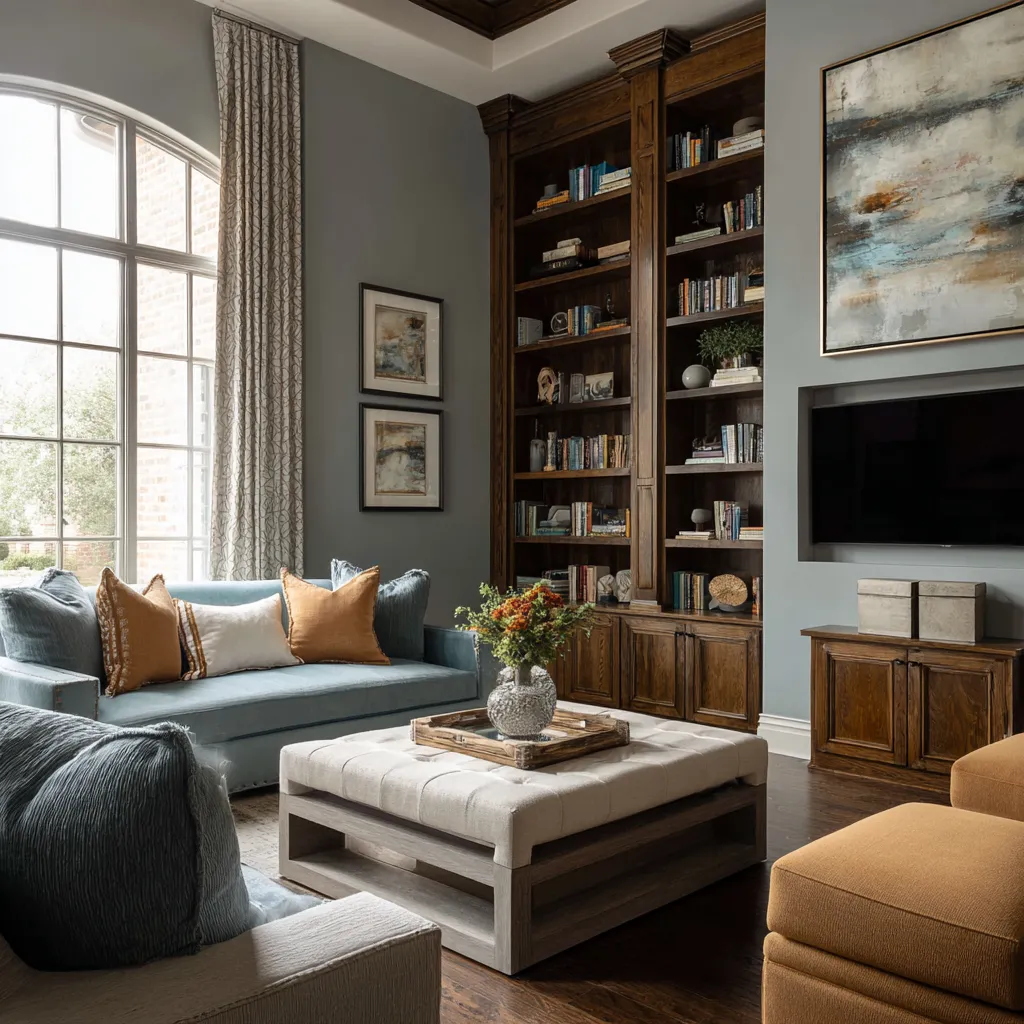
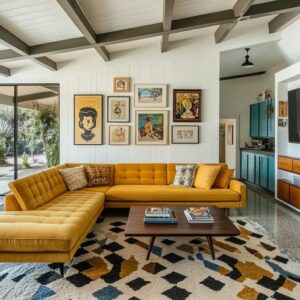
The size of the work matters. Small pieces can be effective in collected gallery arrangements, especially above a sofa or near a library wall, but many of the clearest versions of this style benefit from one major art event.
That event tells the eye where the room begins.
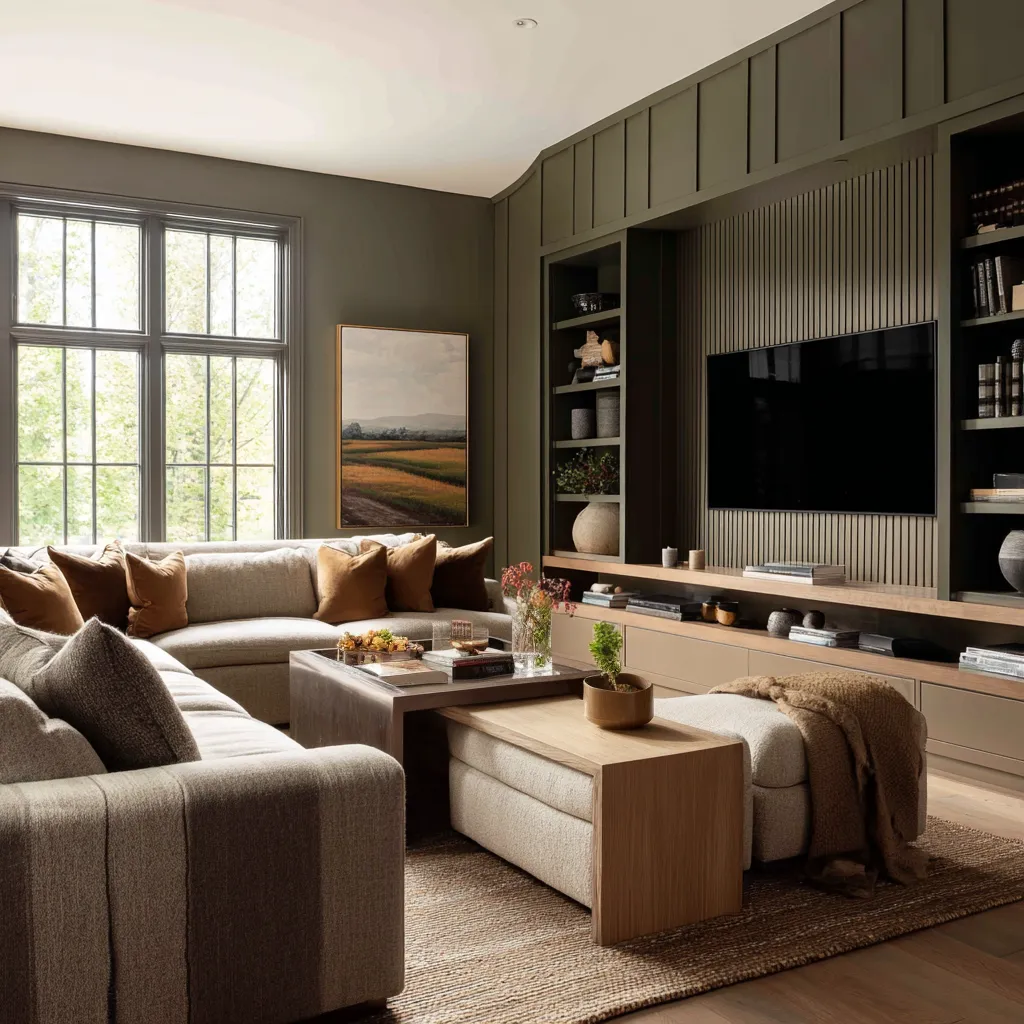
This is especially useful in open-plan rooms. A living area that shares space with a kitchen, dining zone, or circulation path can easily lose identity.
One oversized canvas, or a pair of large canvases, can pull that zone into focus and keep the living room from dissolving into the larger floor plan. The best art in this style does not merely match the room.
It circulates the room’s logic. It repeats the palette, but with enough variation to keep the scheme alive.
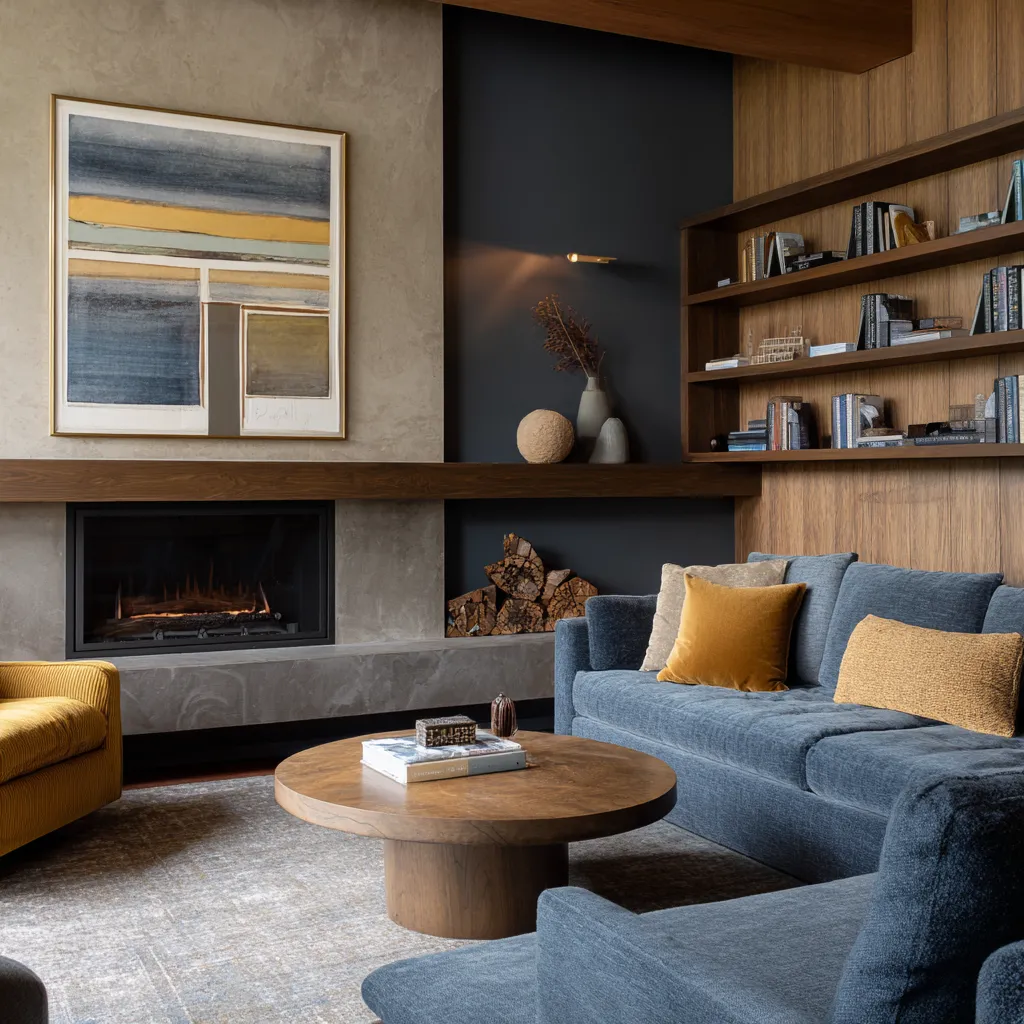
Darker shells help, but they are not required
Moody rooms often sit very naturally inside this design family. Deep teal, olive, plum-brown, charcoal-blue, and mossy tones make a living room feel enveloping.
They increase figure-ground contrast, make pale upholstery stand out, and give warm materials more heat. But darkness is only one route.
It is not a requirement. A bright room can still feel modern eclectic maximalist if it compensates through other forms of density:
- strong upholstery layering
- a major art statement
- a substantial center table
- a built-in bench or secondary nook
- repeated warm accents
- enough textural depth to keep the light shell from feeling thin
This is a useful correction, because bright rooms are often dismissed as too airy for maximalism. In practice, they can carry the style very well if their softness is thick enough and their focal identity is clear enough.
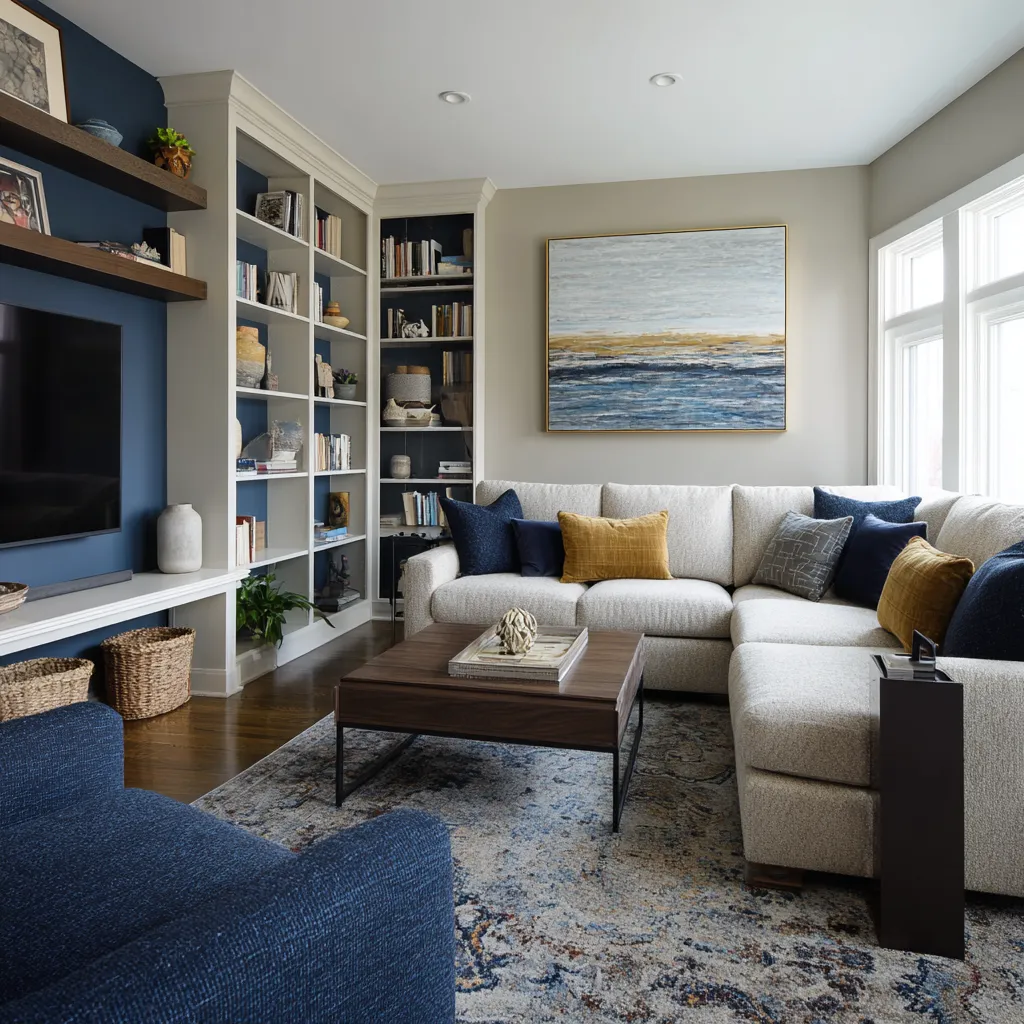
A pale room needs a stronger interior event because it cannot rely on atmospheric darkness to create depth. That event may be a rust chair pair, a dark square table, a grouped art wall, a shelving niche, or a pillow-rich bench corner.
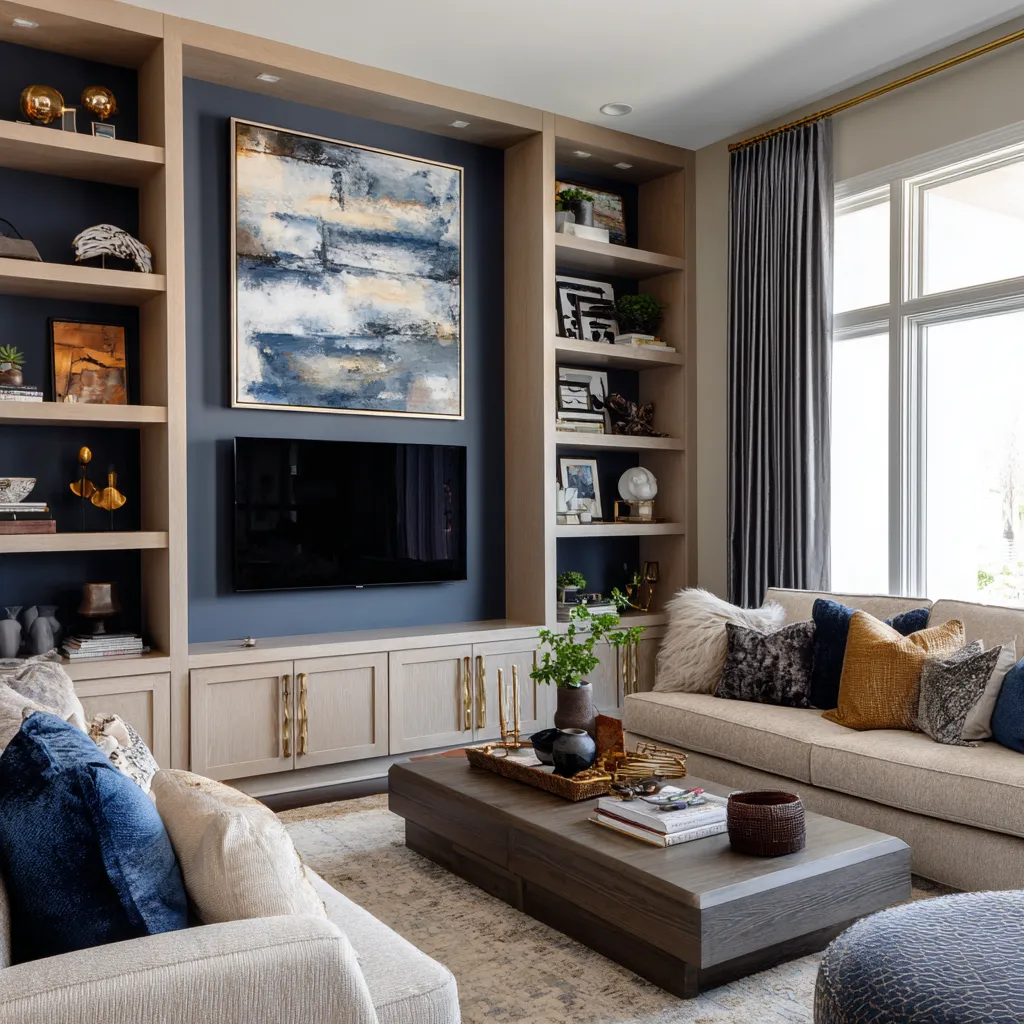
Architecture is the container, not the whole performance
Many living rooms in this style use impressive architecture: fireplace monoliths, millwork walls, built-in shelves, arched windows, niche systems, bench seats, tall cabinetry, media walls, floating shelves, or stone slabs. All of these elements help.
They give the room structure and stature. But architecture by itself does not produce the full eclectic maximalist effect.
A room can have a beautifully articulated media wall and still feel somewhat restrained if the furniture is too thin, the color too neutral, the art too small, or the textiles too sparse. Conversely, a cleaner room with fewer built-ins can feel more expressive if it carries a denser upholstered field, a major artwork, and a well-placed warm accent family.
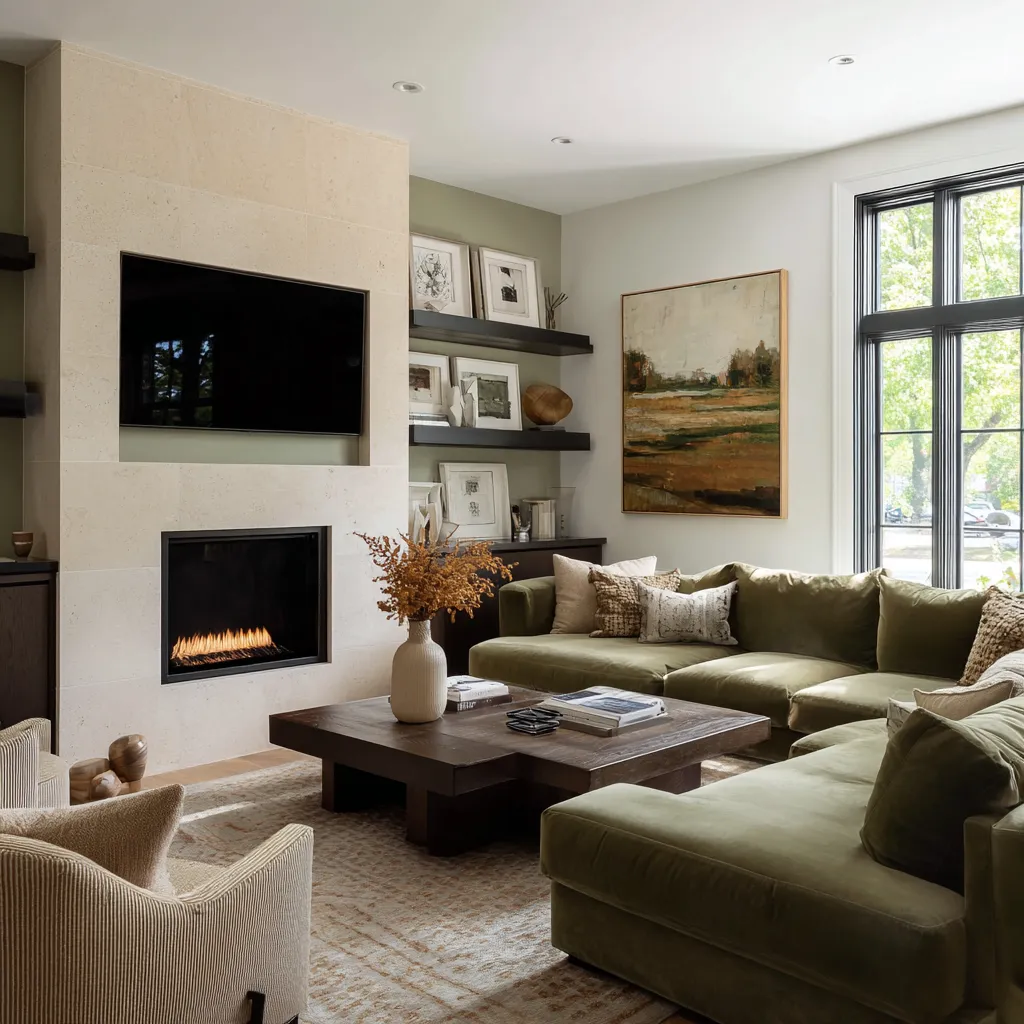
That is why architecture in this style works as a frame. It provides order, proportion, and visual grounding.
Then the room becomes fuller through a softer layer placed inside that frame: art, textiles, books, leather, pillows, bench cushions, and selective color pressure. There is also a point of diminishing return.
Very articulated architecture does not always need heavy display styling. If the wall already has fluting, panel depth, arch recesses, shelving divisions, or stone texture, then additional accessory density can become redundant.
The room may benefit more from one chair in a warmer tone or a thicker rug than from another row of decorative vessels.
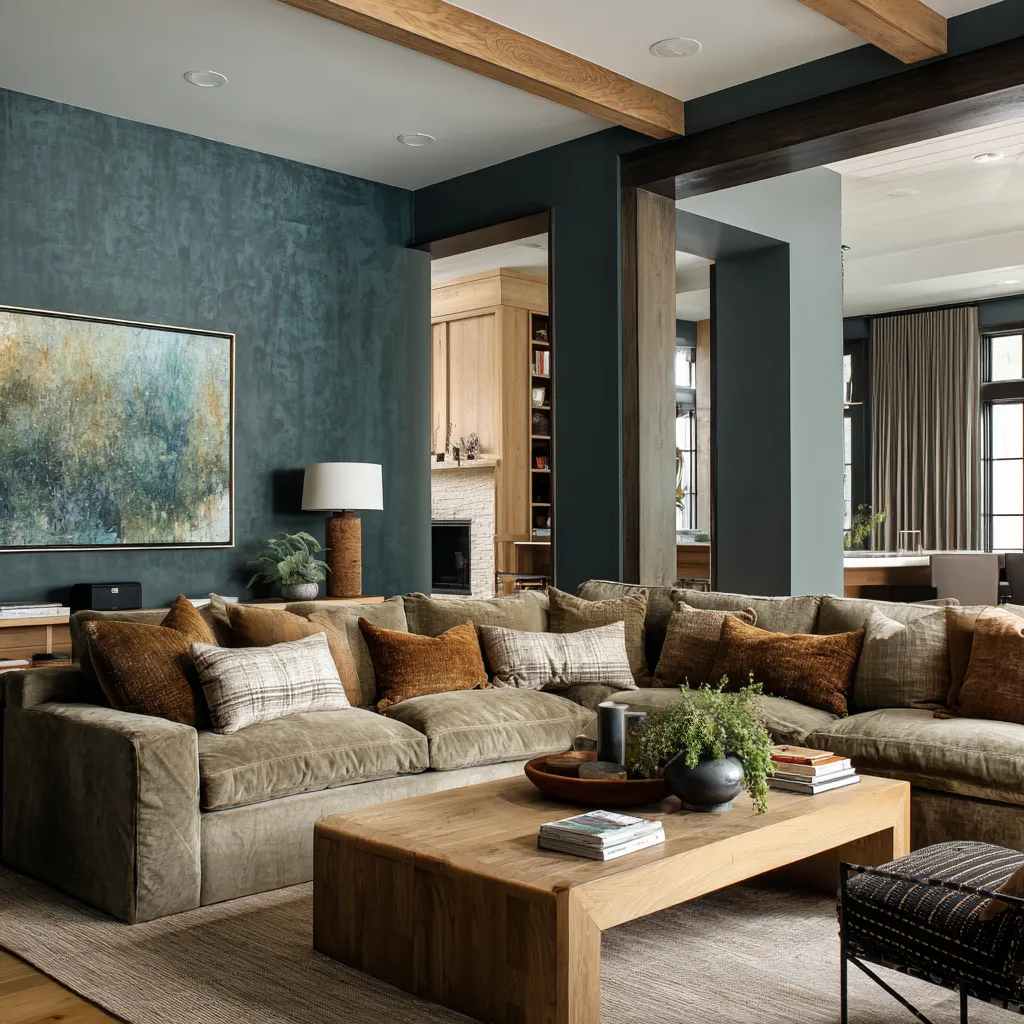
Soft forms matter because they interrupt severity
A great many modern living rooms are built from rectangles: sectional blocks, media consoles, shelf runs, window grids, fireplace slabs, and table planes. The eclectic maximalist version gains nuance when that rectilinear order is interrupted by something softer.
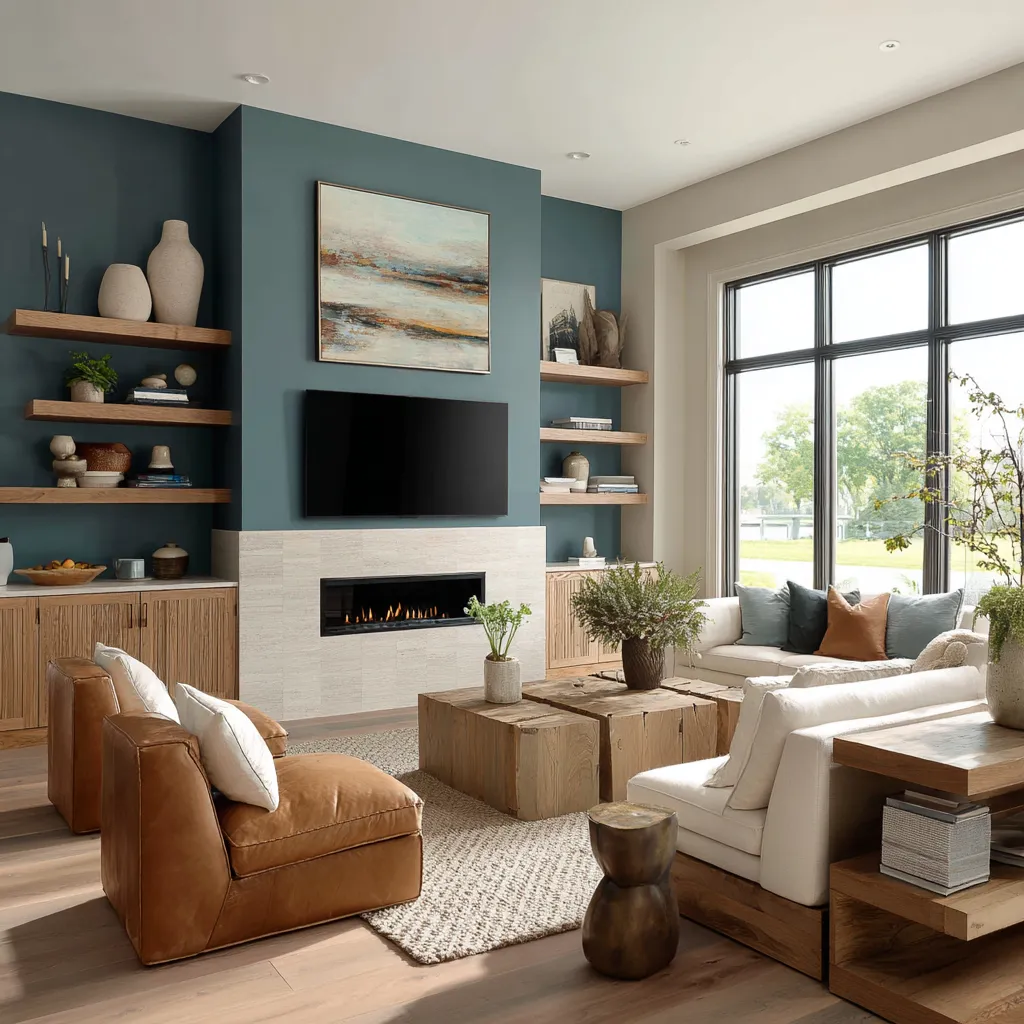
This softness can arrive in many forms:
- an arched window
- a curved sofa
- a rounded or circular coffee table
- a soft-edged lounge chair
- a window bay bench
- a rounded ottoman
- caned or woven chairs with gentler outlines
- layered pillows that soften the edge of built-in seating
These forms do not need to dominate the whole room. In fact, they often work as counterpoints.
One arch against a wall of shelving. One curved chair against a field of straight cabinetry.
One rounded table against a boxy sectional. One window seat in an otherwise linear composition.
The effect is larger than the move itself. A little curvature loosens severity, adds bodily ease, and thickens the emotional tone of the room without requiring extra color or clutter.
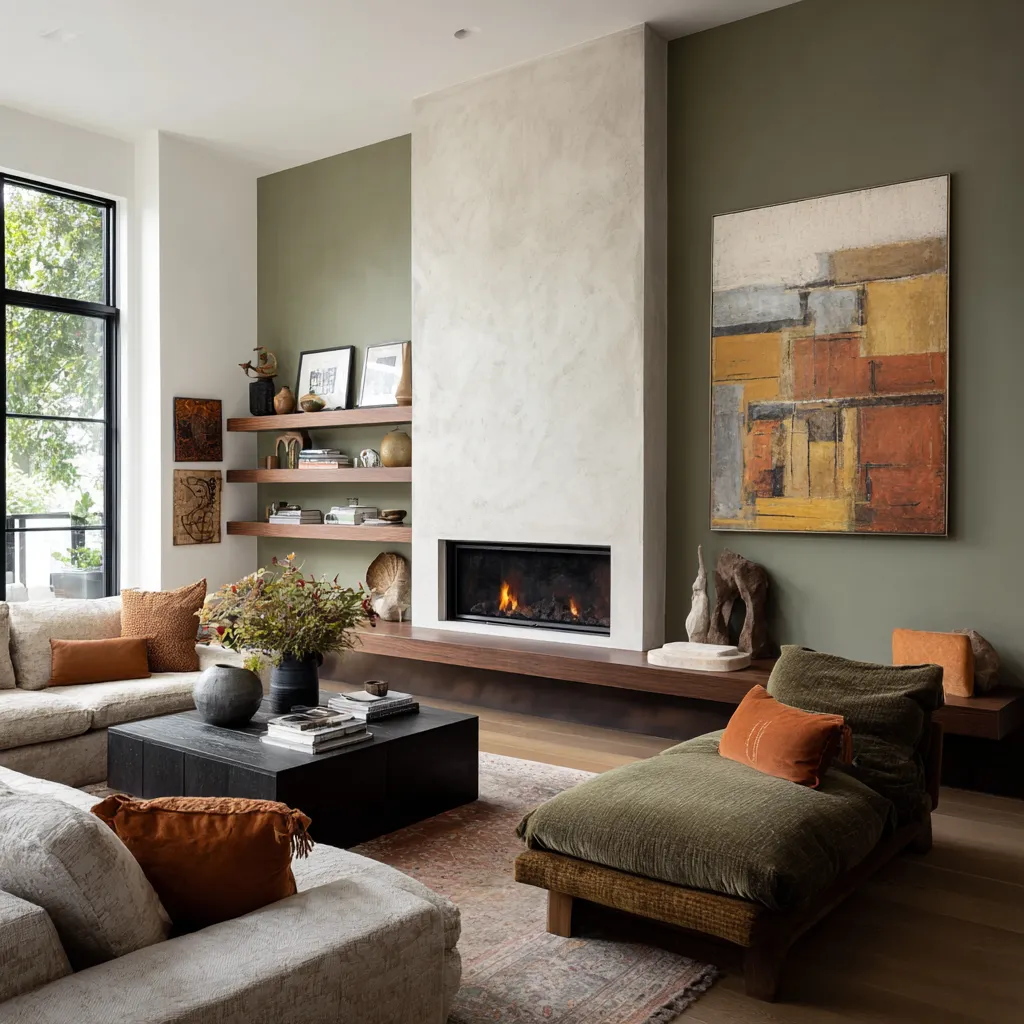
Managed asymmetry often feels richer than strict balance
Many polished suburban living rooms depend heavily on symmetry. That works well for formality and calm, but the modern eclectic maximalist living room usually benefits from a more relaxed kind of order.
It still needs balance, but not rigid mirroring. A dark library wall on one side and a brighter kitchen opening on the other.
A fireplace slab balanced by a chaise. A large art piece on one wall and a shelving bay on the other.
A window bench that counterweights a heavy sofa. A dark media cabinet set against tall drapery and a lighter opening.
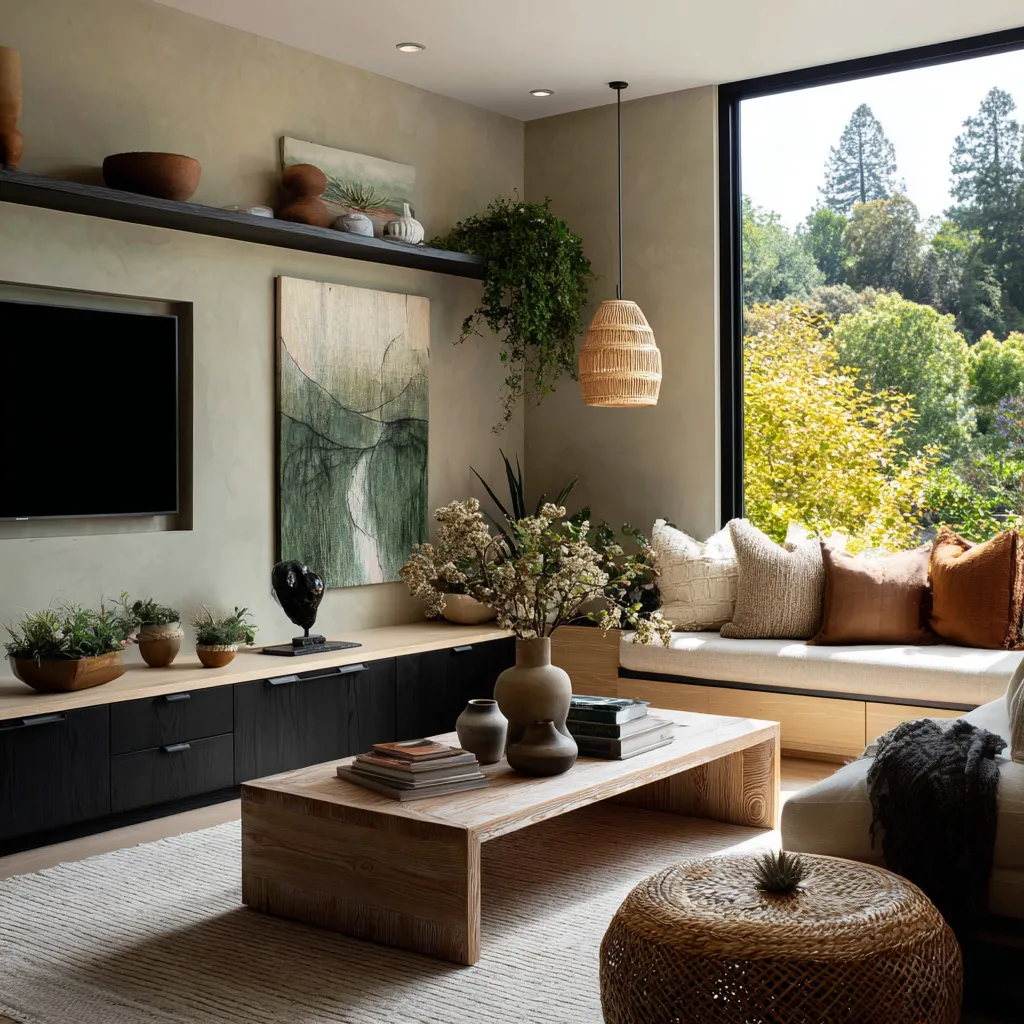
This managed asymmetry gives the room life. It makes the space feel composed without becoming static.
The eye moves through the room in stages rather than stopping at a single centered diagram. That movement is especially helpful in eclectic interiors, because the style depends on layering different kinds of information.
If everything is too bilaterally fixed, the room may lose some of its collected character. A slight shift in weight from one side to the other often produces a more inhabited atmosphere.
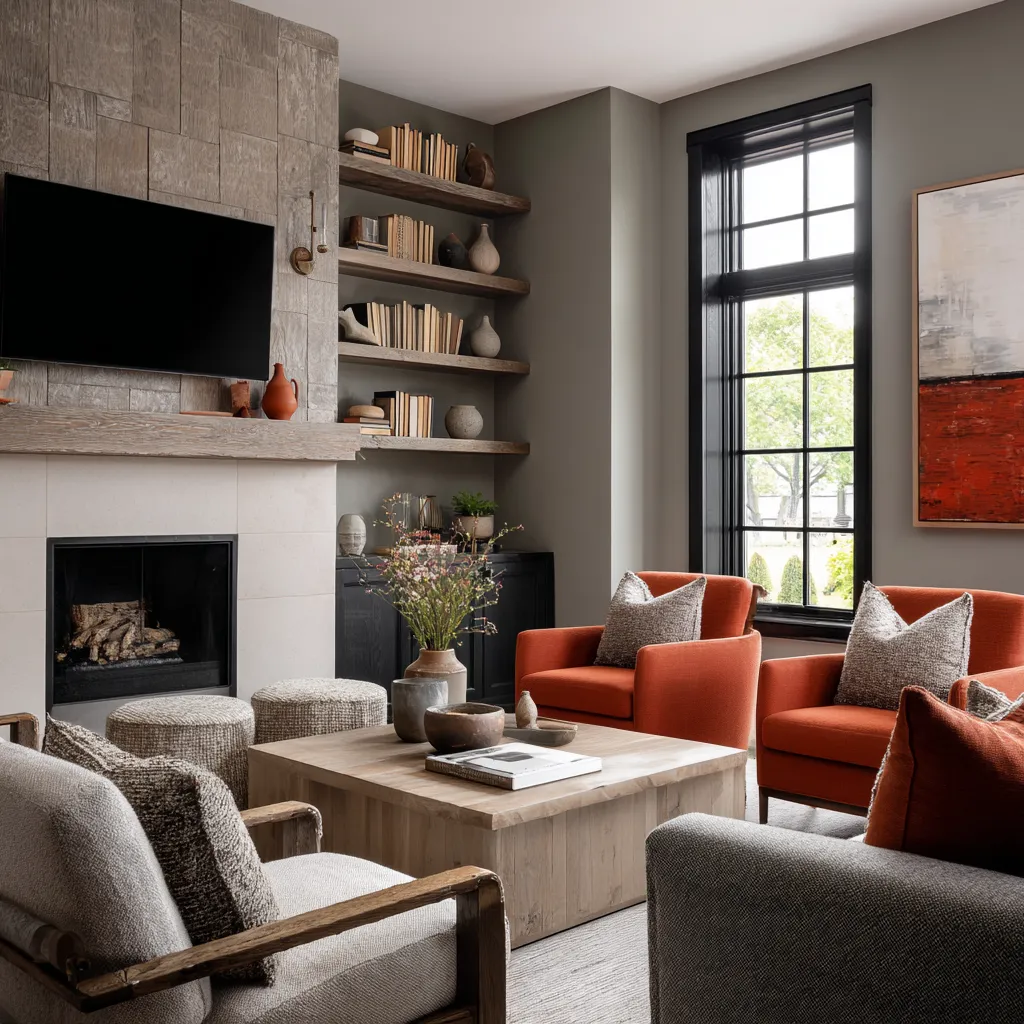
Shelf styling works when housed inside architecture
Object density has a place in this style, but it works when contained. Books, pottery, framed photos, ceramics, baskets, and sculptural pieces usually look better when housed inside niches, built-ins, library walls, shelf bays, or media compositions than when scattered on every available surface.
This is one reason built-in architecture can be so useful. It gives decorative density a home.
The room gains visual memory and collected character, but the objects do not leak into every zone.
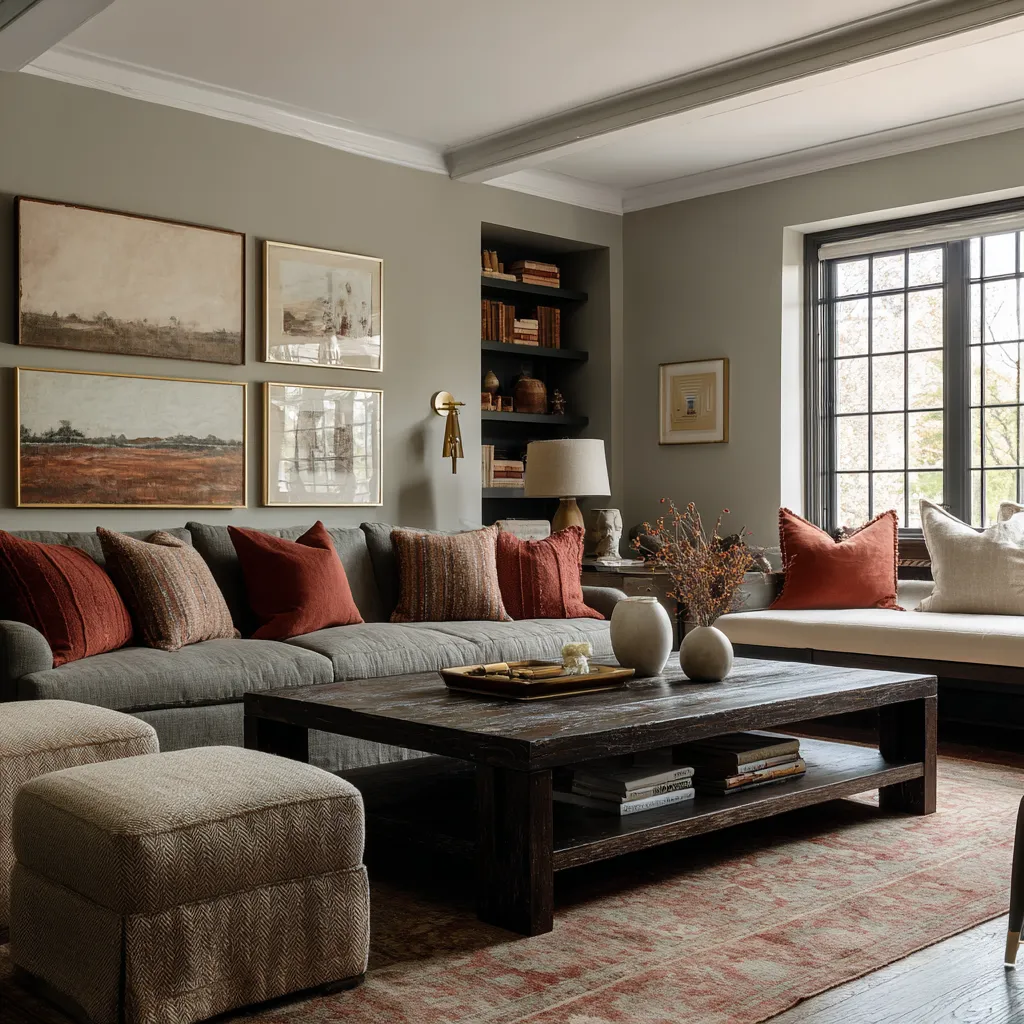
A successful shelf composition often uses a mix of:
- books as rhythm
- pottery as interruption
- greenery as relief
- darker accents as punctuation
- occasional framed pieces for personal note
Negative space is just as important as the objects themselves. If every compartment is full, the room loses hierarchy.
If some bays stay open, the objects feel chosen rather than accumulated. In cleaner, brighter rooms, shelf density can help lift eclectic character.
In already architectural rooms, a lighter display load may be enough. The right balance depends on how much work the wall is already doing.
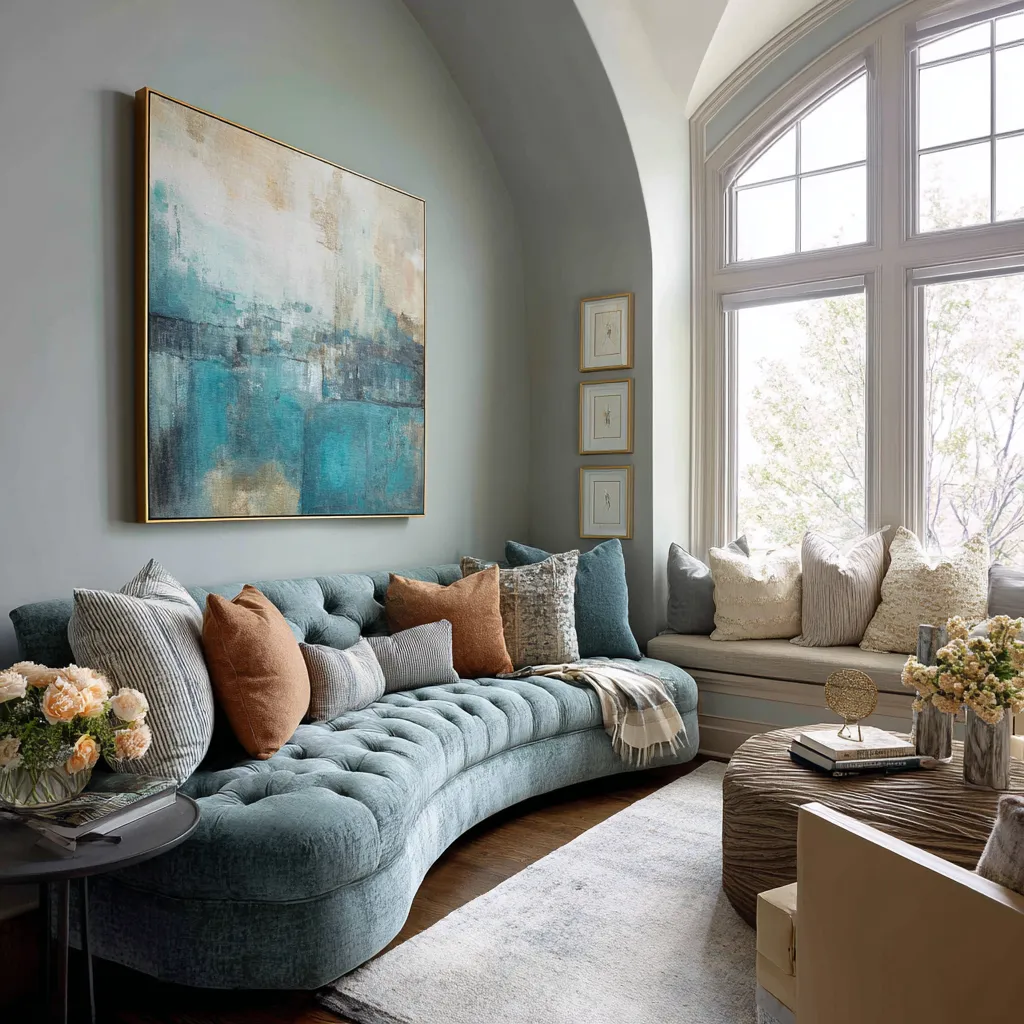
Multi-zone richness gives the room depth without clutter
Some of the compelling living room ideas in this style operate through more than one zone of interest. The room may have a main seating area, but it also contains a secondary condition:
- a window bench
- a library wall
- a reading corner
- a fireplace shelf bay
- a bay seat wrapped in pillows
- a glimpse into another darker space
- an art grouping on a partition wall
- a secondary chair cluster near the hearth
These side conditions matter because they widen the room’s social and visual field. The room feels deeper and more layered, not because it is stuffed with objects, but because it offers more than one place for the eye and body to settle.
This is especially valuable in open-plan homes, where living rooms can feel exposed or under-defined. A bench nook, a shelf recess, or a library wall gives the zone thickness.
It becomes a place with interior depth rather than simply a furniture arrangement inside a larger shell.
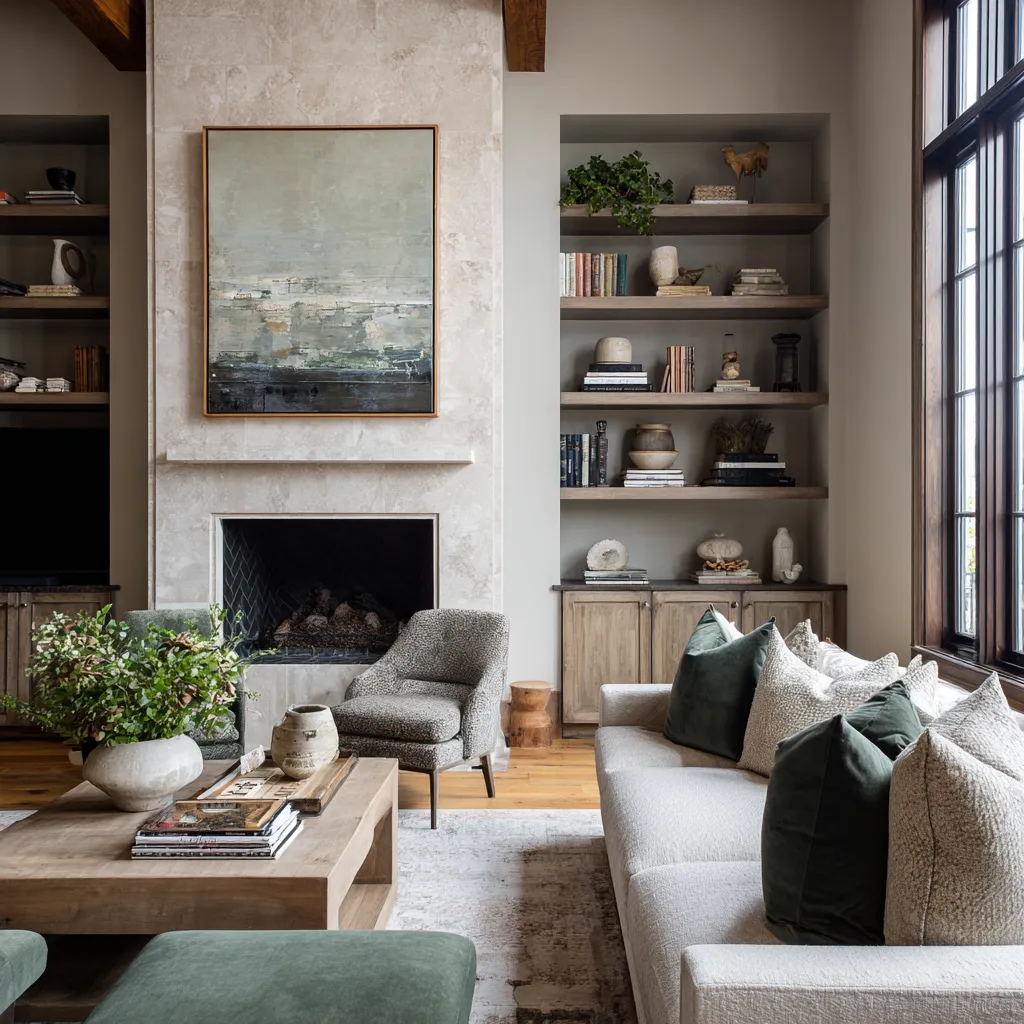
The center table often determines whether the room holds together
In many modern eclectic maximalist living rooms, the coffee table is not a secondary piece. It is one of the elements that stabilizes everything else.
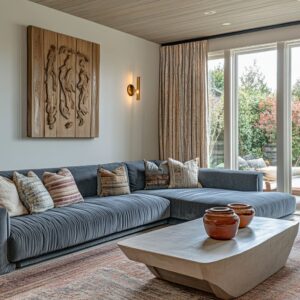
A successful center table in this style usually has real visual weight. It may be a dark square table, a chunky pale wood block, a rustic slab, a thick walnut form, a stone-like cube, or a rounded sculptural piece.
What matters is that it can hold the center against the surrounding softness.
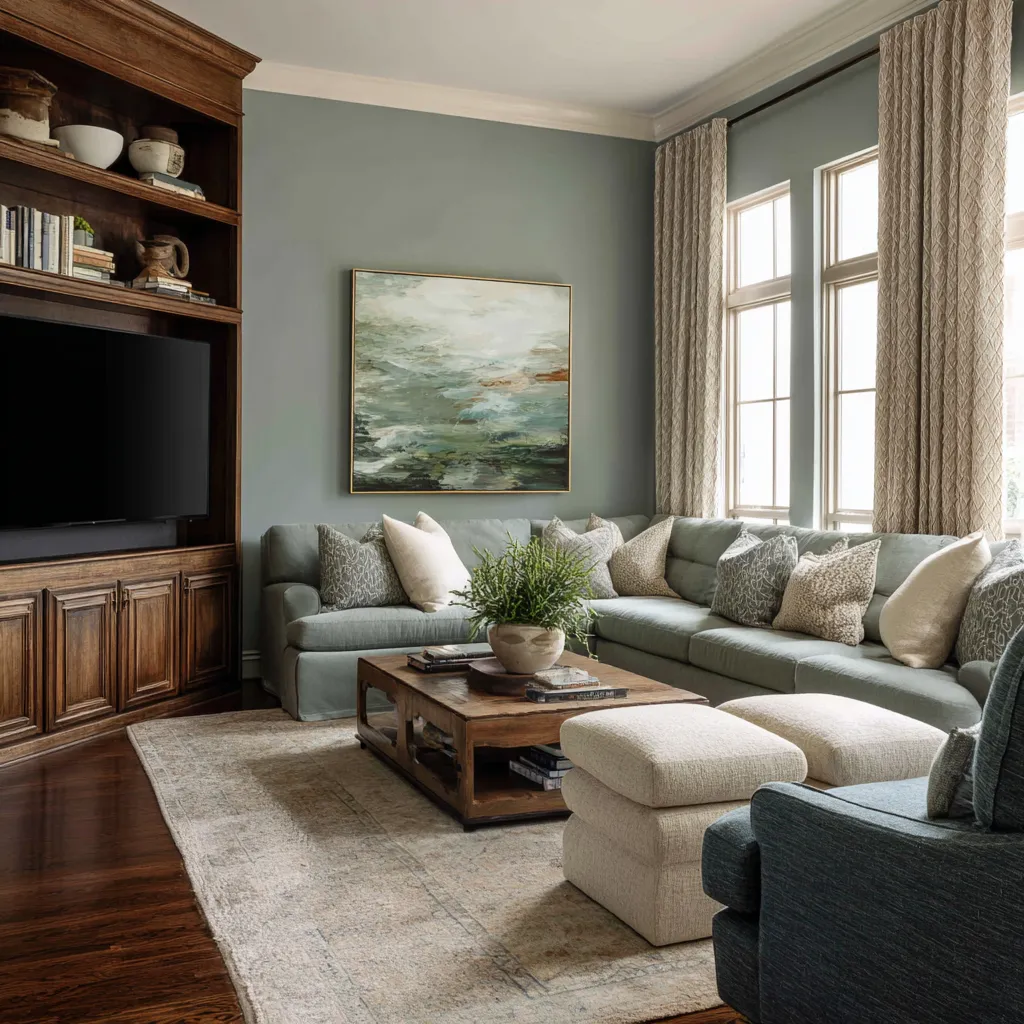
Rooms with pale sofas, light rugs, and luminous windows often need that grounded central mass. Without it, the composition can disperse.
The center begins to feel empty even if the room is otherwise full. The table also gives the designer a place for one compact arrangement: a tray, books, a floral cluster, a few dark sculptural objects, or a vessel with branches.
The arrangement should usually stay contained. A broad scatter of small tabletop accessories tends to weaken the room more than help it.
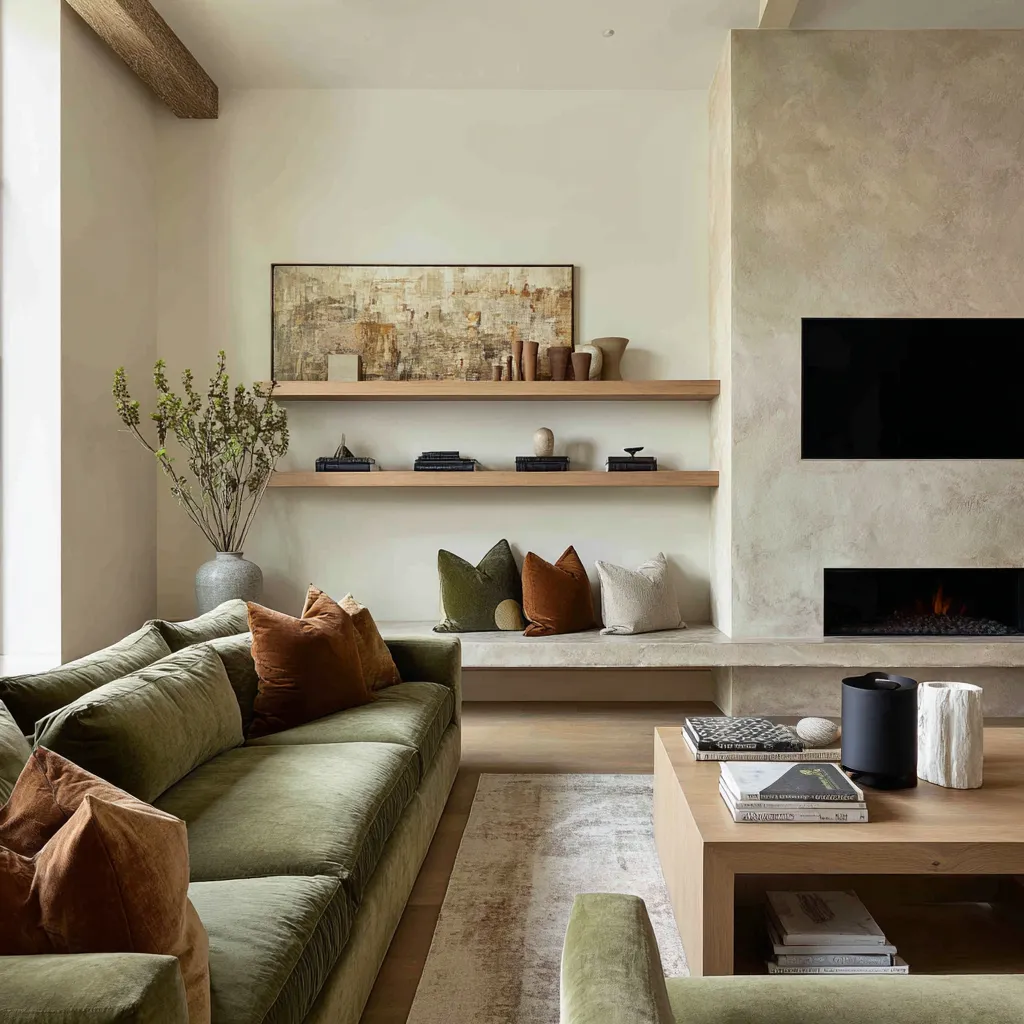
How to make the style feel rich without turning it messy
The principle may be this one: keep the room full in selected categories, not all categories at once.
- A room can be full in upholstery, but lighter in objects.
- It can be full in art scale, but restrained in shelf display.
- It can be full in wall color, but quieter in pattern count.
- It can be full in architectural depth, but spare on the table surfaces.
This selective fullness is what keeps the style sophisticated. The room does not need every design variable turned up at once.
It needs a clear decision about where richness will live. That richness often lives in a few chosen places:
- the sofa and chair field
- the focal wall and art
- the built-in shelves
- the window bench
- the center table
- the contrast between cool shell and warm insertions
Once those are established, the room usually needs less than people think.
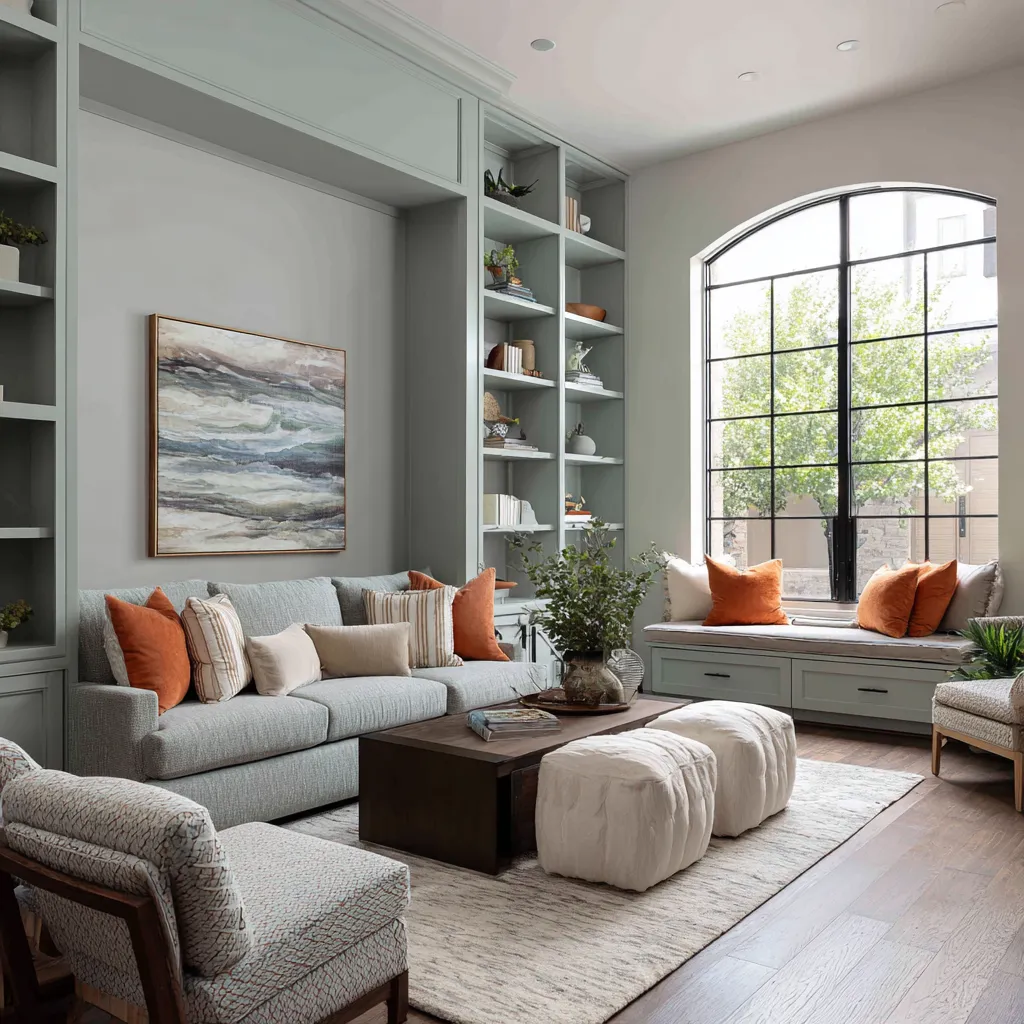
Common mistakes that flatten the style
Several mistakes tend to weaken the look.
Treating wall color as a solitary event
A saturated wall without art, rug echoes, pillow repetition, or chair punctuation often feels unfinished. Strong color needs companions inside the room.
Confusing maximalism with scatter
Small decorative items placed on every surface reduce hierarchy. The room starts feeling busy rather than layered.
Using too many medium-scale furniture pieces
A crowd of medium pieces fragments the room. Fewer, larger masses usually produce better calm and greater richness.
Keeping the room too neutral after adding architecture
Millwork, stone, arches, and shelving can create polish, but without a warm accent family, a dense soft field, or art with enough scale, the room may stay visually thin.
Letting the window become the only focal event
Natural light is beautiful, but the room often feels more complete when the first stop is an interior decision: art, seating mass, a saturated wall, or a focal composition.
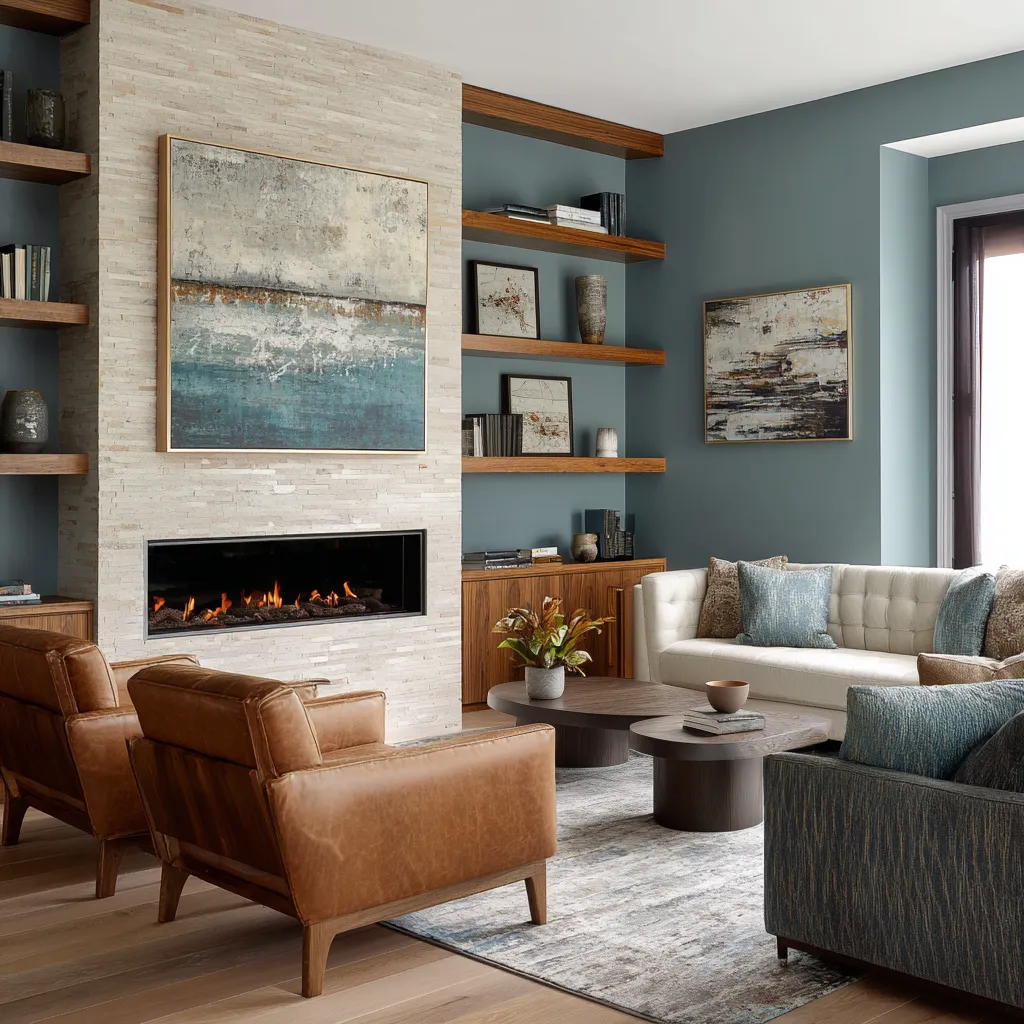
A useful formula for designing the room
A modern eclectic maximalist living room often comes together well when it follows this sequence:
- Start with one dominant architectural or wall event.
- Choose a compressed palette with one main family and one controlled counterpoint.
- Use a few large furniture pieces rather than many medium ones.
- Give the room a substantial center table.
- Add one major artwork or one grouped art composition with real scale.
- Build a thick soft field through pillows, bench cushions, deep upholstery, or a chaise.
- Place warmth where the eye pauses.
- Keep decorative density mostly inside architecture.
- Allow one softened element such as an arch, round table, curved chair, or bay seat.
- Leave enough open zones so the rich parts stay visible.
This sequence gives the room clarity first and fullness second.
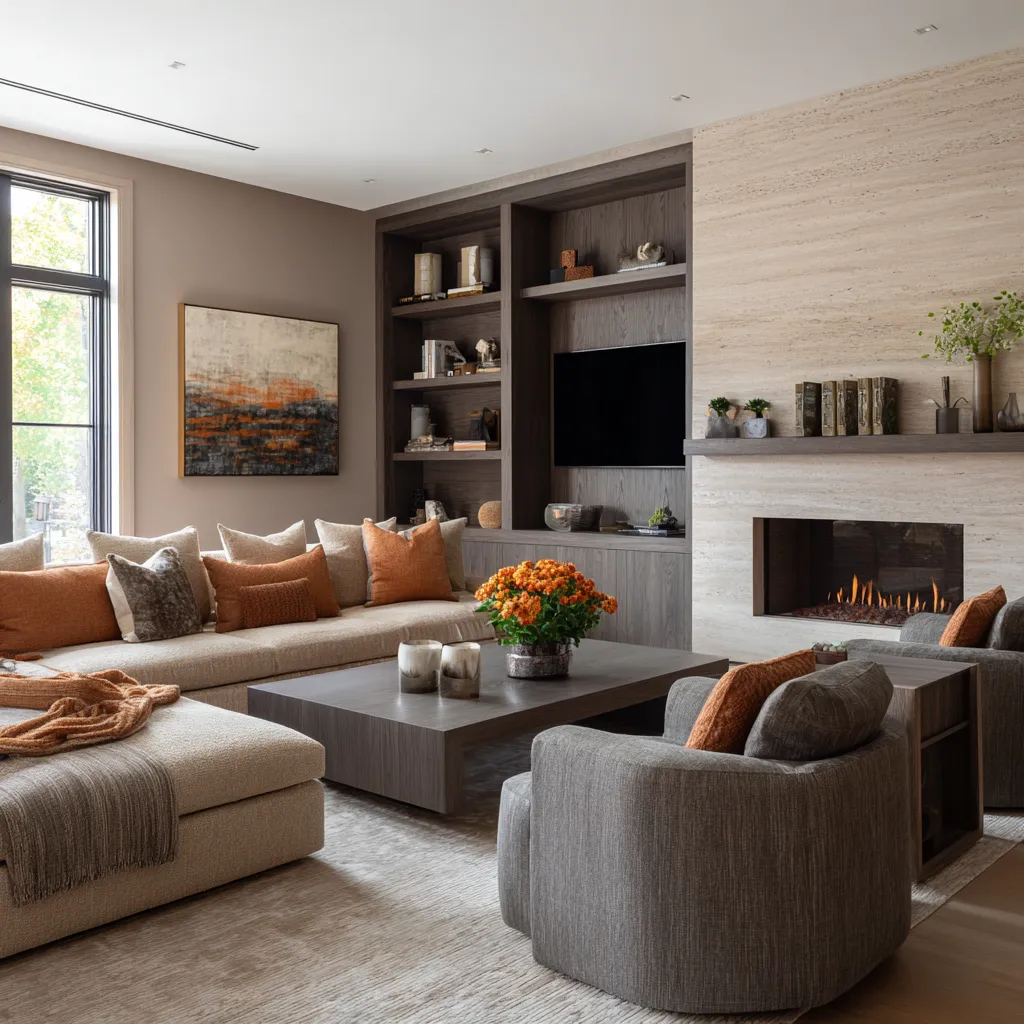
The modern appeal of the style
What makes modern eclectic maximalist living rooms so appealing is not simply visual abundance. It is the way they hold opposites together.
- They are organized, but not rigid.
- Rich, but not indiscriminate.
- Modern, but not sterile.
- Collected, but not crowded.
- Comfortable, but still visually intentional.
The room feels shaped rather than merely furnished. It offers atmosphere and tactility, but it also gives the eye a clean route through the space.
It has enough softness to feel inhabited and enough discipline to feel composed.
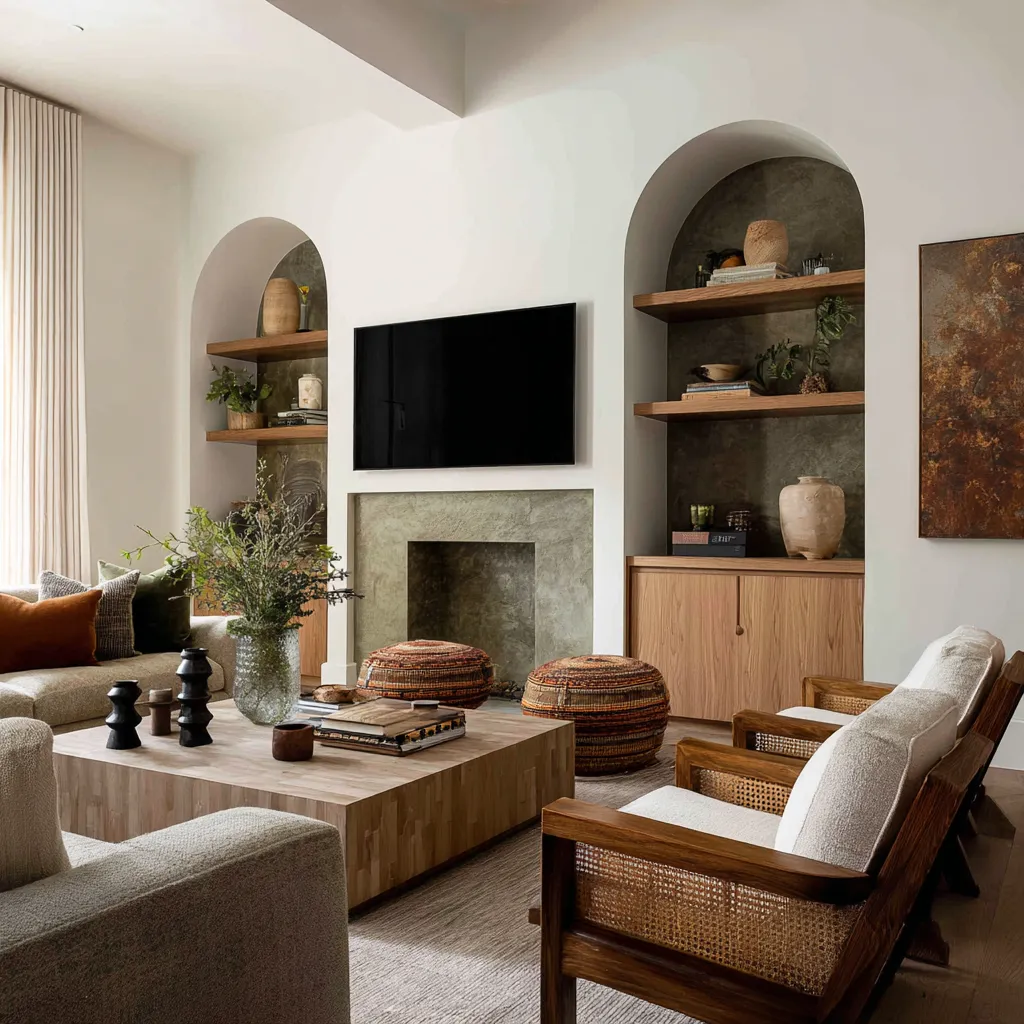
That balance is what gives the style longevity. A well-made room in this category does not depend on novelty.
It depends on a stable design grammar: compressed palette, strong hierarchy, substantial furniture, warm–cool dialogue, meaningful art, and a soft field dense enough to make the room feel lived in and complete.
Modern eclectic maximalism, at its best, is a living room style of concentrated richness. It asks for editing as much as addition.
And that is exactly why the top examples feel so deep, so welcoming, and so visually memorable.