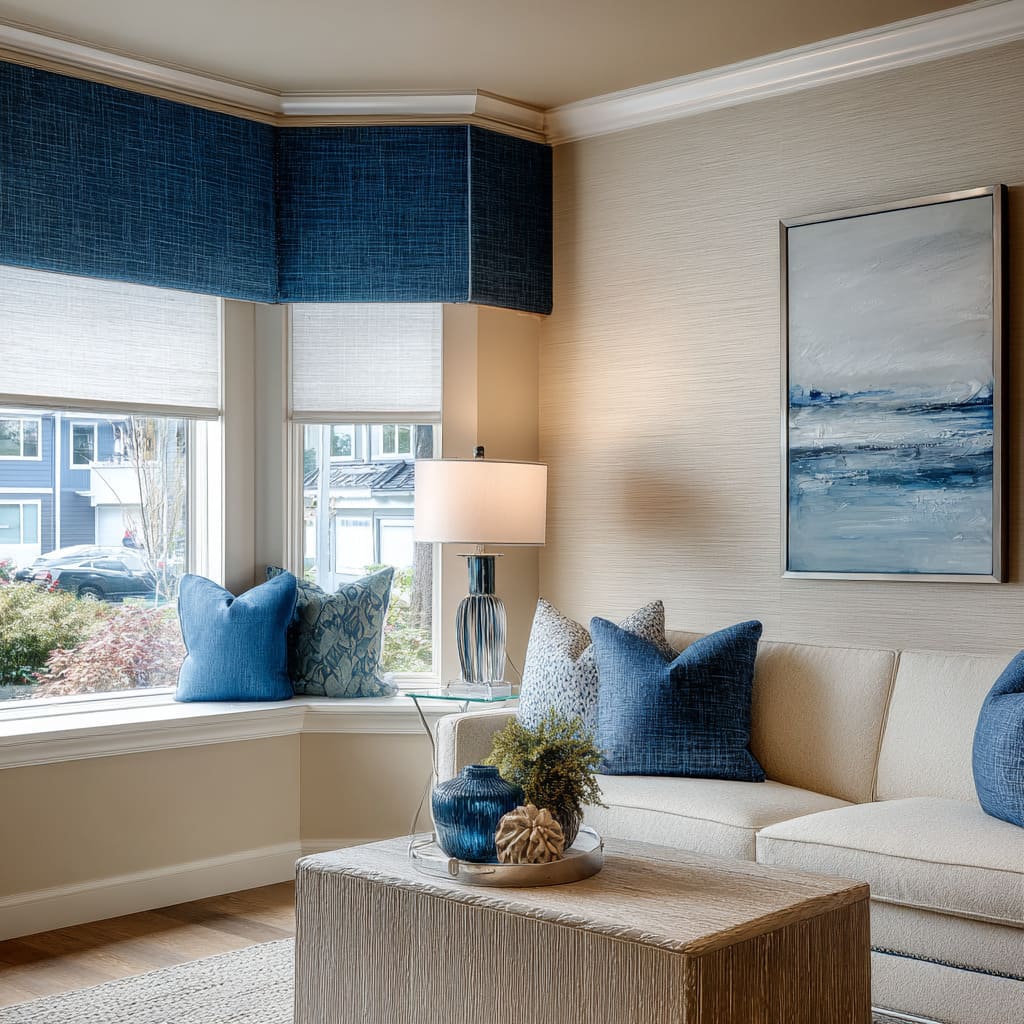
Modern box valances sit at a unique intersection of architecture and textile, and their greatest power lies in how they adjust the perceived height and clarity of a room’s upper boundary. When a valance runs tightly under the crown without a visible strip of wall, the eye accepts the band of fabric as the new top line of the wall, softening the transition between vertical and horizontal planes.
This “second ceiling line” reshapes the architecture without changing any physical structure: it quiets tall walls, tucks seating corners into visual alcoves, and organizes the emotional atmosphere of the design through a single uninterrupted horizontal gesture. In other spaces, a narrow reveal of paint between crown and pelmet creates a floating effect where the valance reads as an intentional object layered onto the room’s shell, gently separating textile from plaster.
This difference in placement—fused or hovering—forms two distinct moods: one enveloping and compositional, the other airy and object-like. These shifts demonstrate how modern box valance design ideas blend architectural perception with textile softness, creating top edges that act as psychological anchors for the entire wall composition.
Vertical Rhythm: How the Valance Establishes the Room’s Main Visual Tempo
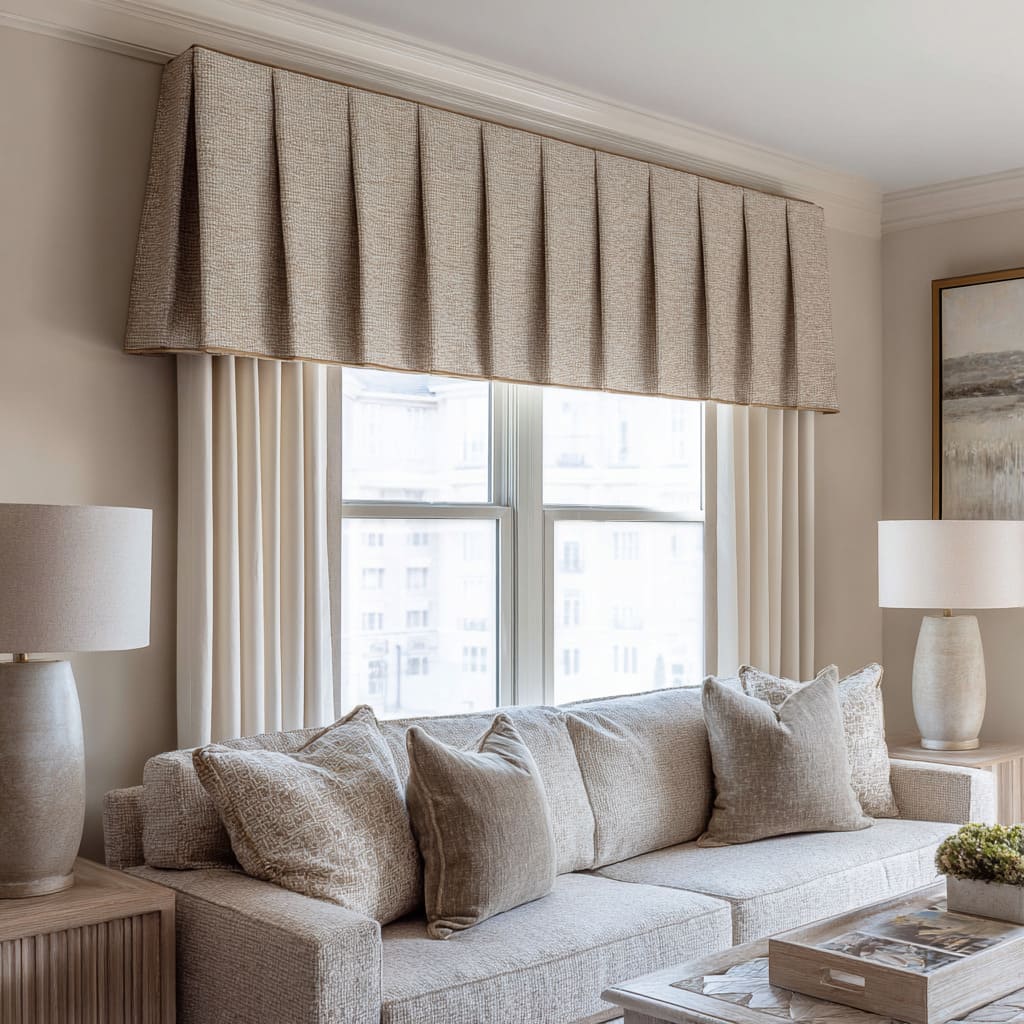
A modern box valance does more than sit quietly at the top of a window; it determines the primary rhythm of the wall by setting a tempo of lines, folds, shadows, and alignments. The spacing of pleats, the presence of stitched channels, vertical seams, or even tiny chevron movements becomes the first set of marks that the room’s other elements respond to.
Once the valance defines this rhythm, the drapery below continues it—sometimes gently, sometimes boldly—carrying the eye downward through soft vertical folds. This relationship extends beyond fabric:.
Rhythmic Echoes in the Room
- Furniture: Fluted wood bases, ribbed tables, and finely textured upholstery repeat the valance’s frequency in solid materials.
- Lighting: Lamps with sculptural grooves or tiered forms reinforce the vertical language.
- Accessories: Dry stems, vertical vases, and tall floral arrangements stretch the rhythm into three-dimensional space.
- Artwork: Horizontal compositions counterbalance the vertical energy, creating a necessary pause.
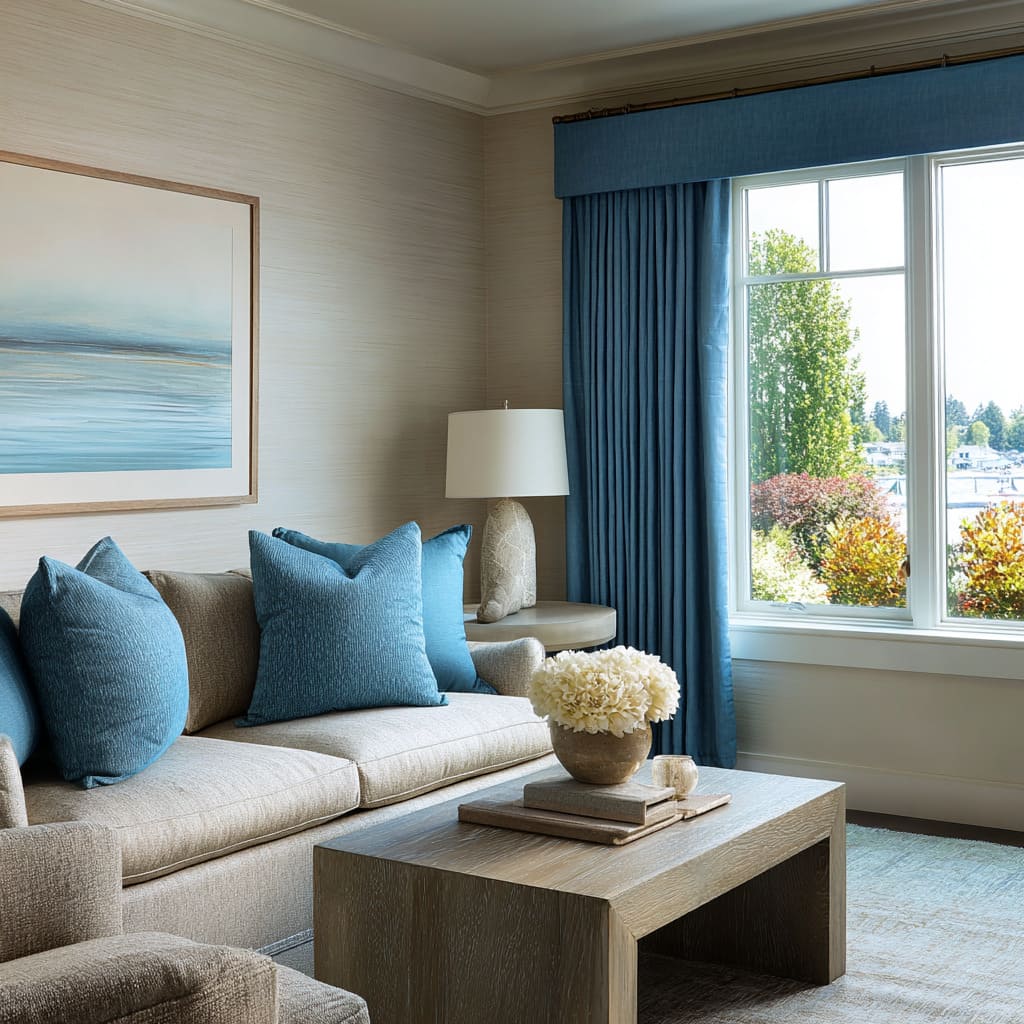
The result is a room in which the box valance acts like a conductor, cueing each design element to play its part in the overall composition and making the entire wall read as a unified visual performance.
Color as Structure: Saturated Bands, Tone-on-Tone Fields, and Linear Accents
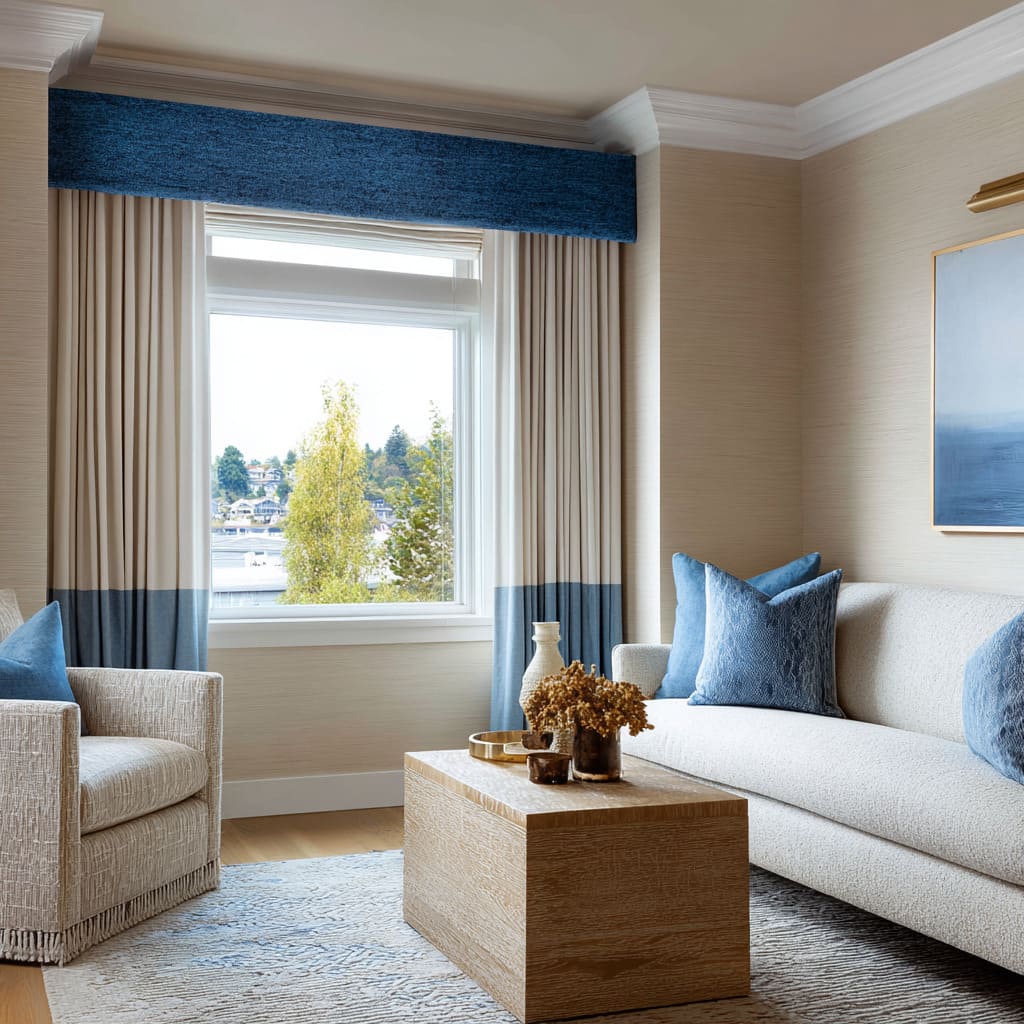
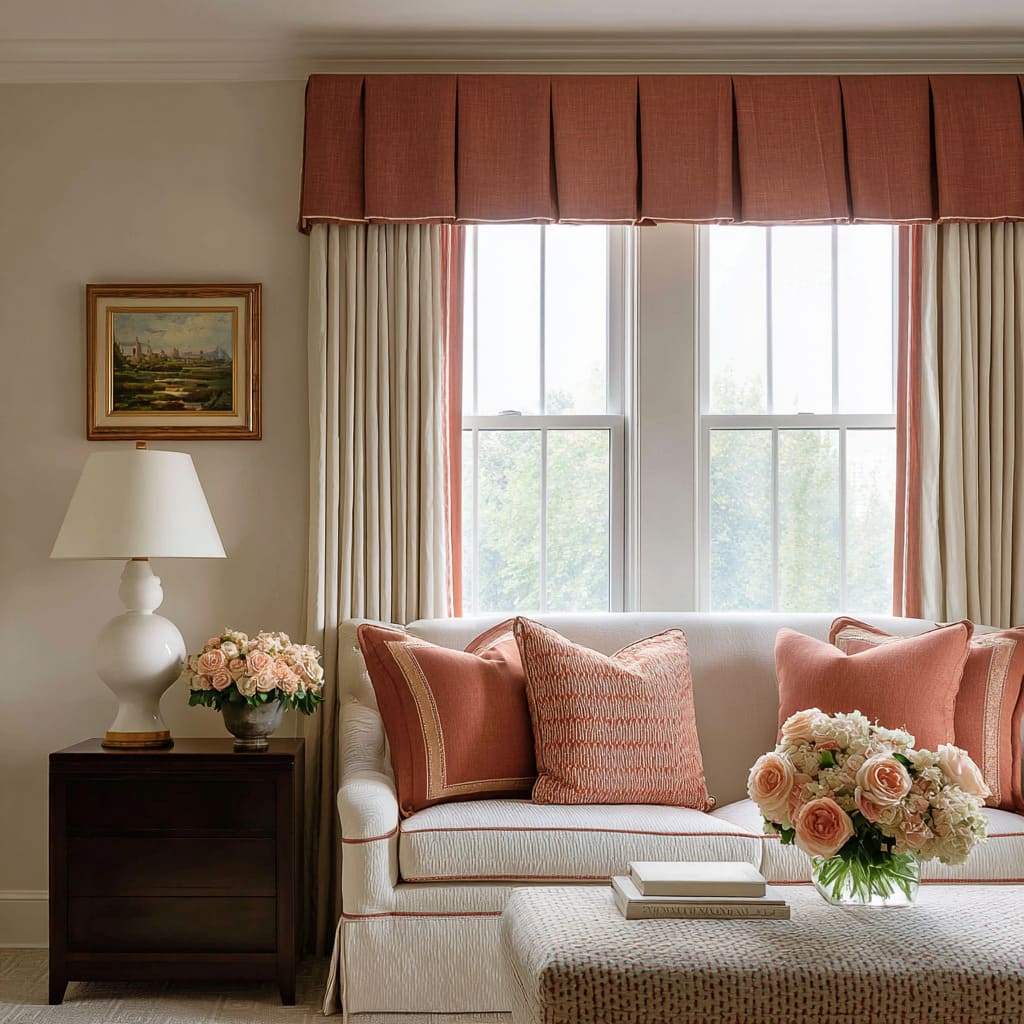
Color in contemporary window valance box ideas behaves not as decoration but as a structural device that shapes spatial perception. Deep blues, clay tones, sea-glass greens, and soft corals appear in crisp horizontal bands across the valance, then reappear in strategic locations—curtain hems, narrow vertical color strips, cushions, art, or vases—forming closed color loops that anchor the design.
These bands behave like elements of architecture, not accents: they give weight, direction, and compositional clarity to the design.
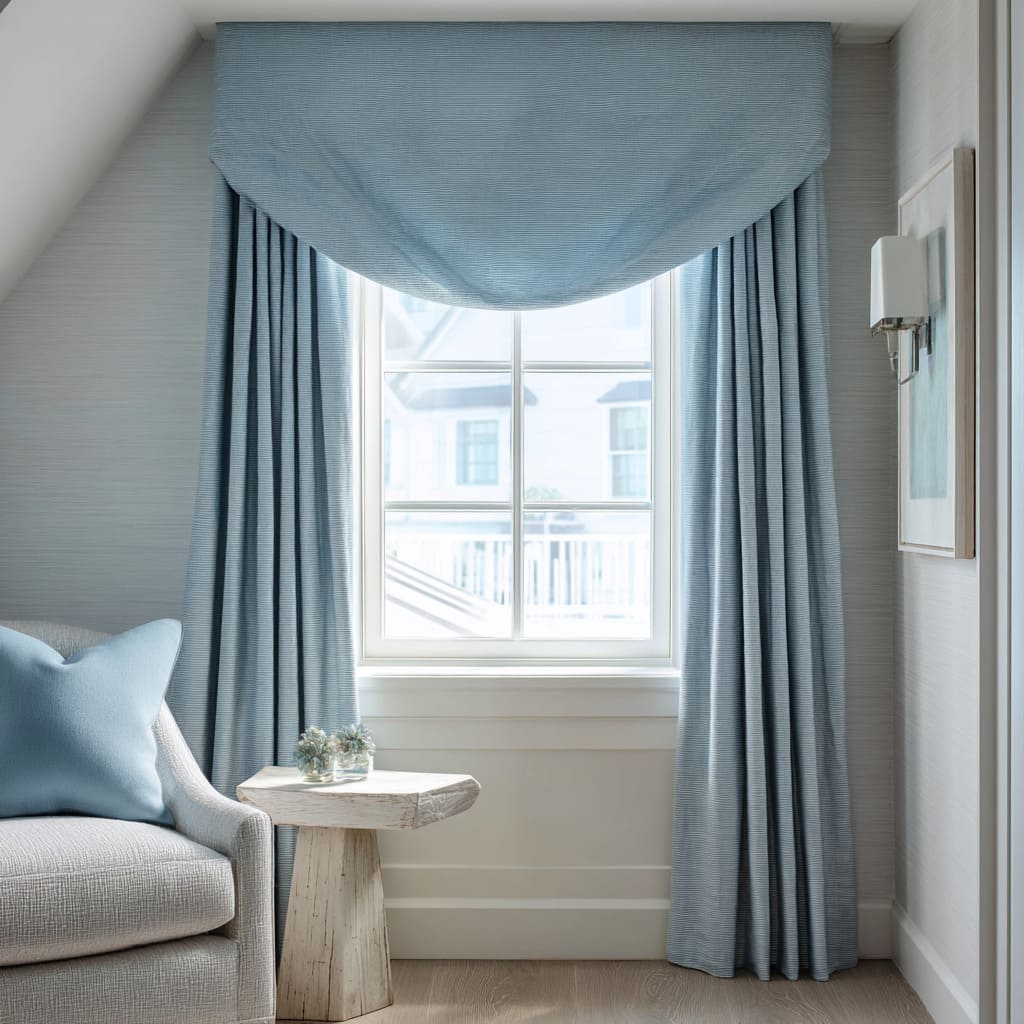
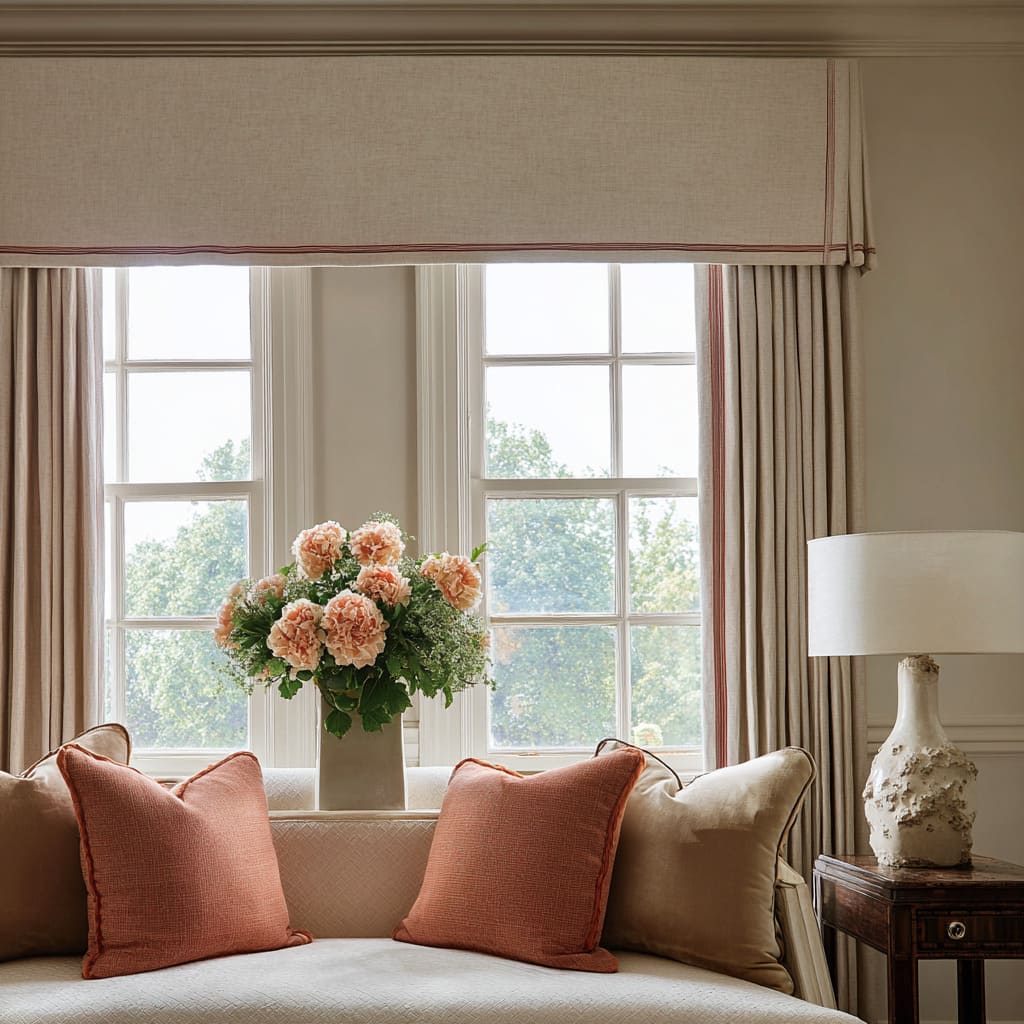
In tone-on-tone schemes, the valance and drapery share nearly identical hues so the entire window wall becomes a soft monochromatic field; texture, not contrast, does the work of defining edges. A third approach uses micro-color: thin piping lines, mini welts, or delicate double stripes introduce color with surgical precision.
These lines act like visual drawing tools, tracing the window’s shape in a whisper rather than a shout. Together, these strategies illustrate a sophisticated understanding of color’s ability to create visual structure and emotional temperature.
Pattern as Light: Dots, Grids, Crosshatch, and Herringbone as Atmospheric Tools
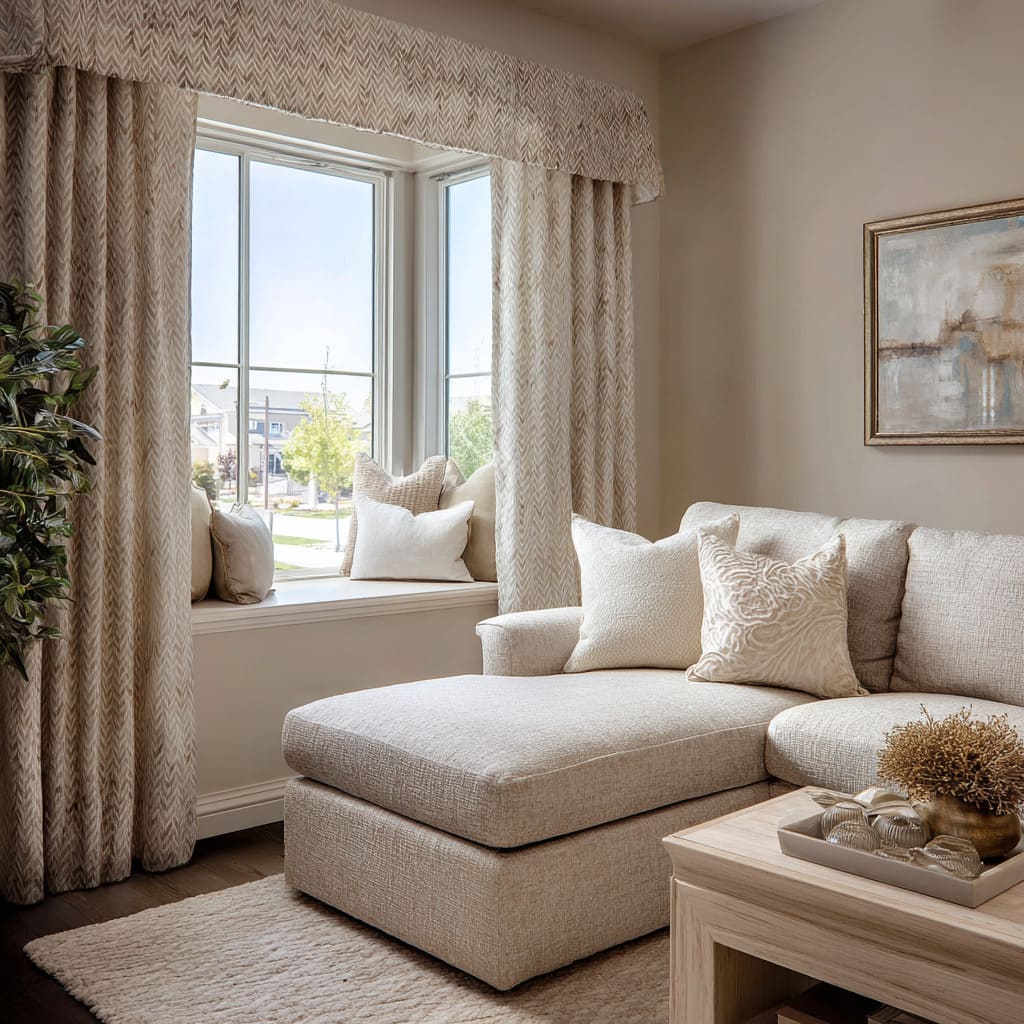
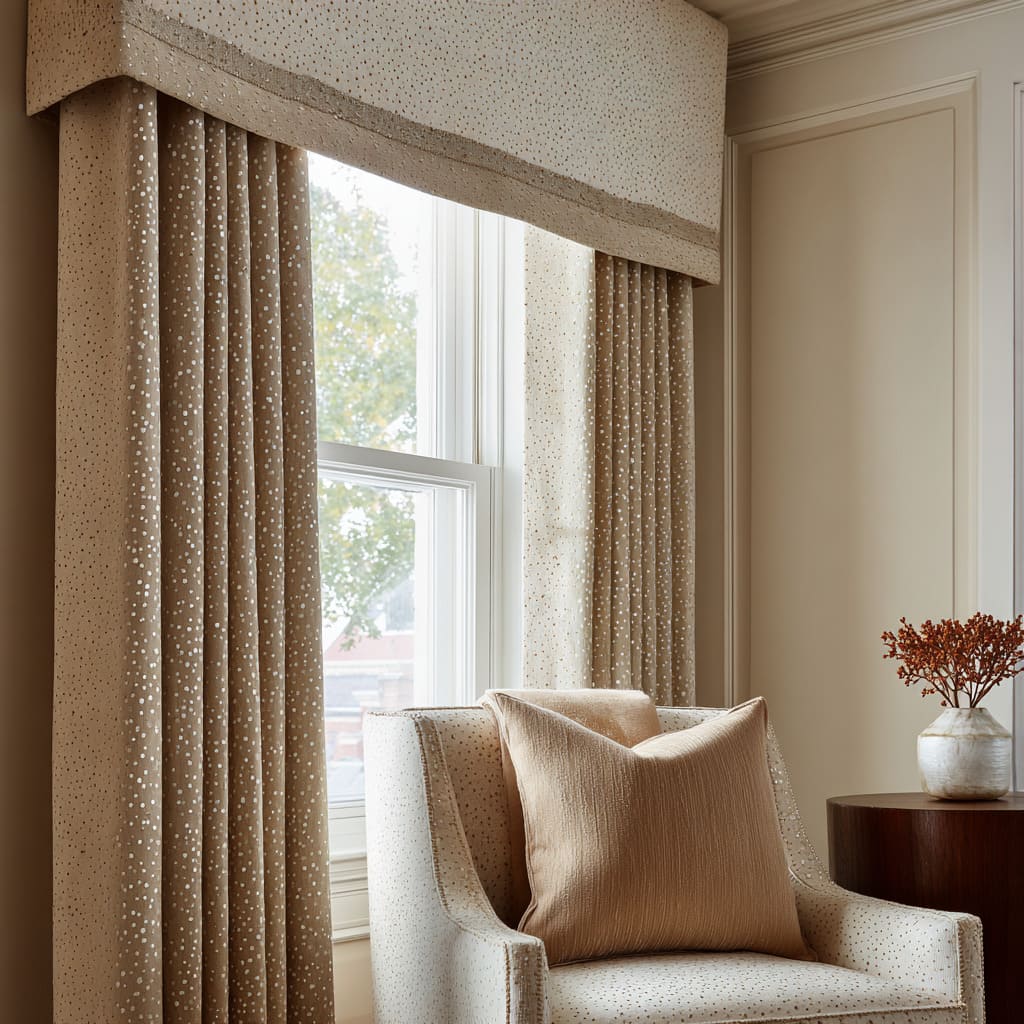
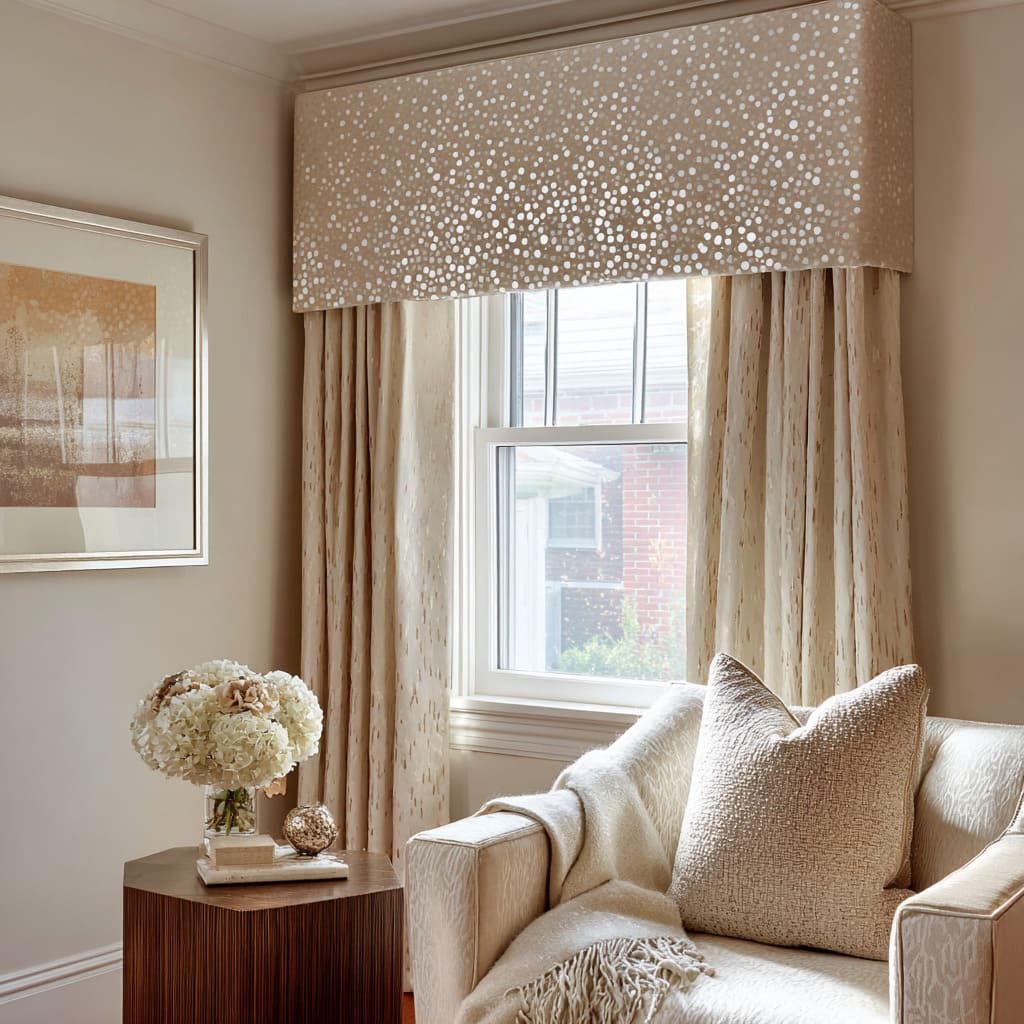
Patterns in box window valance ideas behave like a form of atmosphere—they shift character depending on whether the fabric sits flat on the pelmet or is pulled into folds on the curtains. Tiny dots on a flat header create a soft shimmer, like light scattering across a quiet surface; when the same textile falls into deep pleats, those dots cluster into shadowy pockets and airy streaks, turning into a soft-play of luminosity rather than a graphic print.
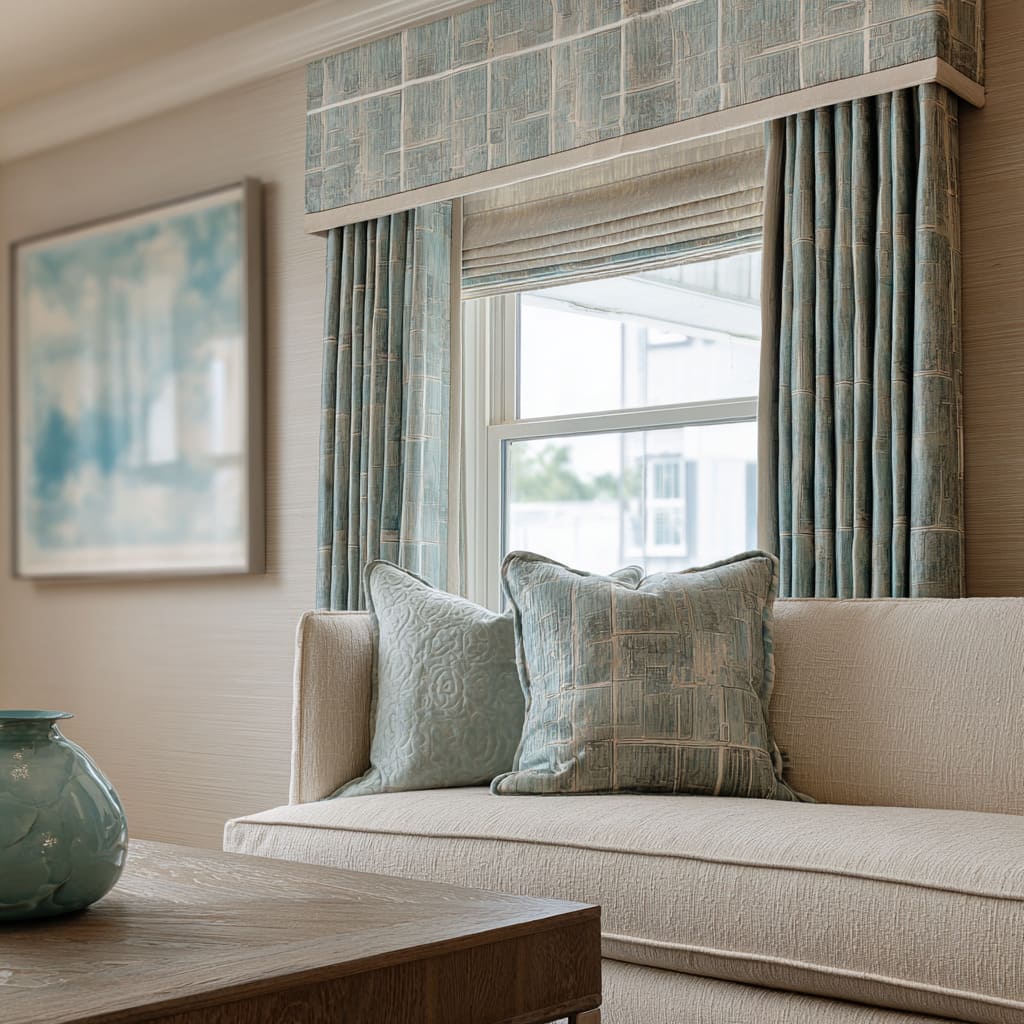
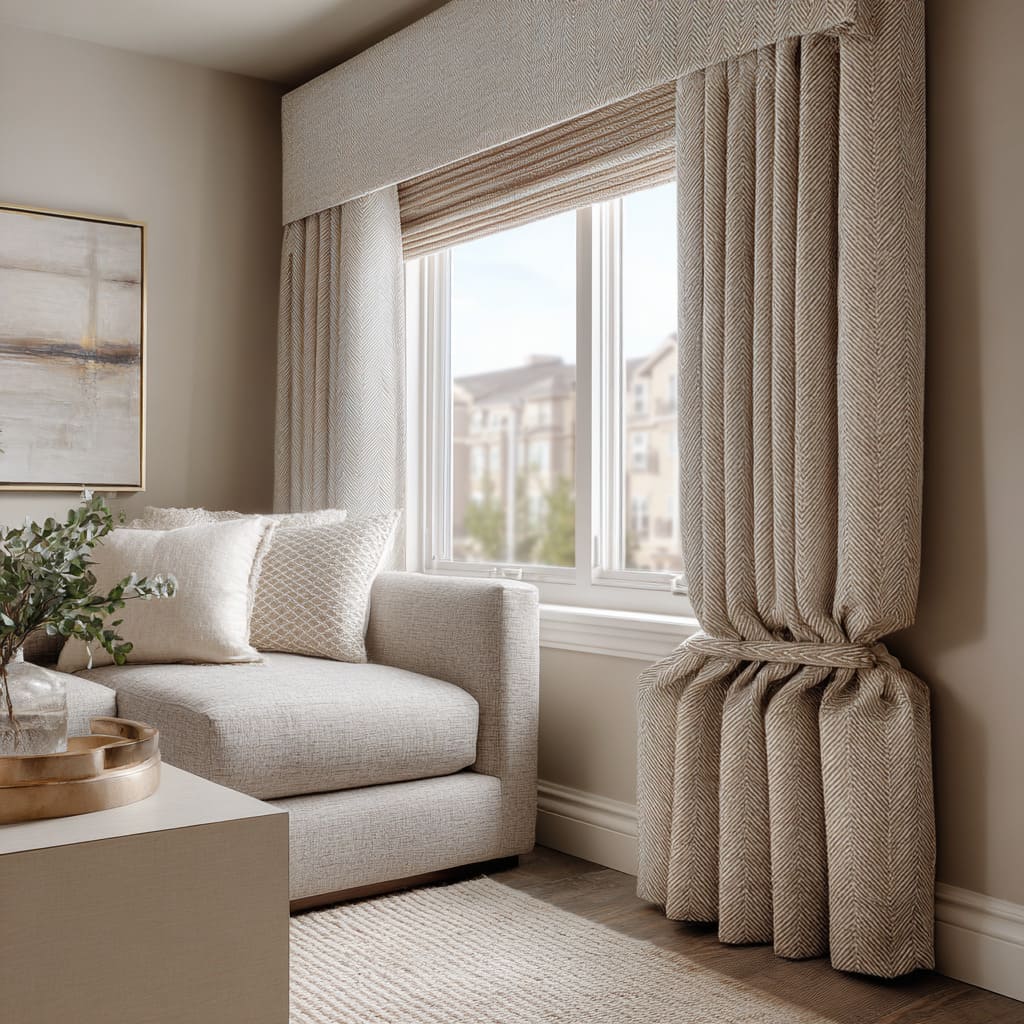
Grids and crosshatches act differently: on the flat box they resemble hand-drawn diagrams or textile canvases, but on folded drapery they stretch, compress, and blur into loosely woven textures. Herringbone or chevron patterns perform yet another function—introducing directionality and quiet movement without disrupting the room’s calm.
Because these patterns repeat across multiple scales (valance, curtain, cushion), the design language builds in layers: strict and legible at the top, softened and adaptive lower down, and distilled into small accents at eye level. The design becomes an interplay of controlled pattern at the header and relaxed pattern in the folds, all shaped by light, depth, and textile behavior.
Straight Lines vs. Curved Lines: How Edge Geometry Shapes Emotional Tone
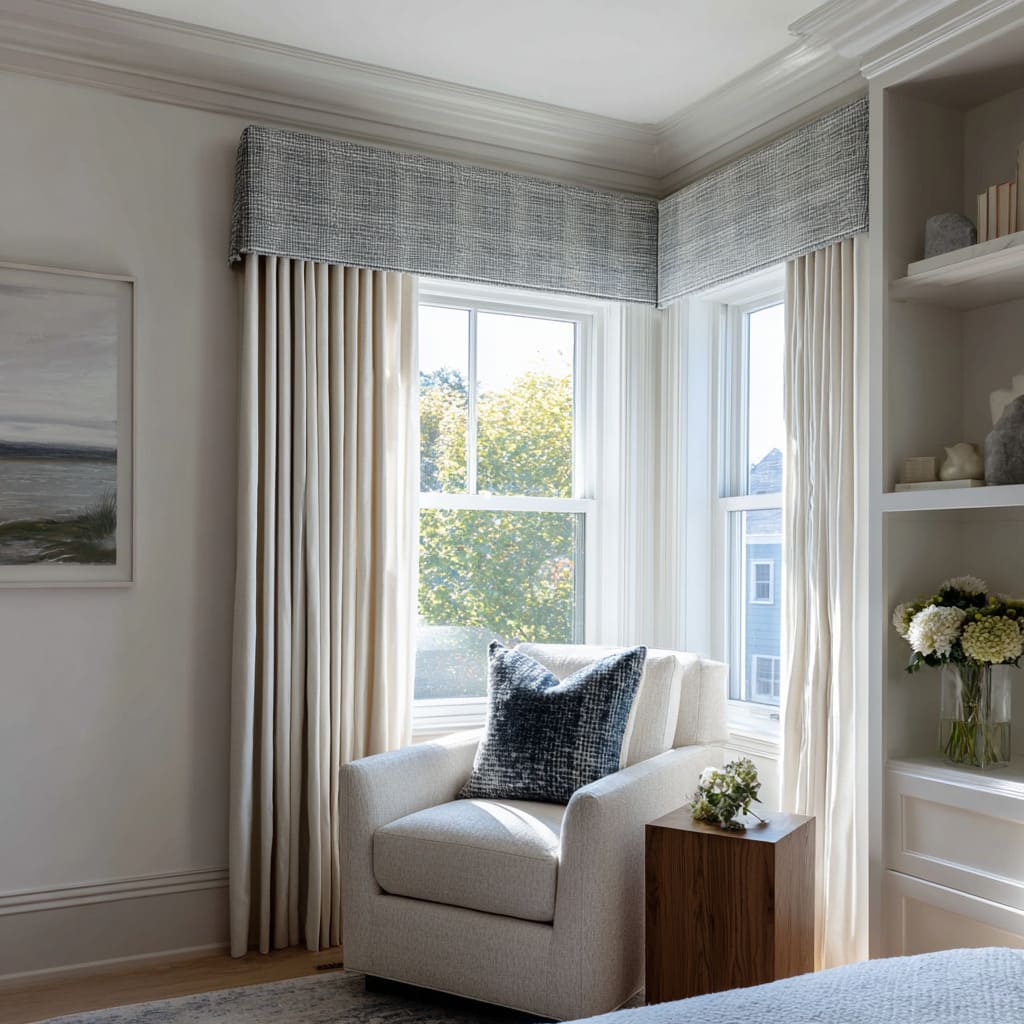
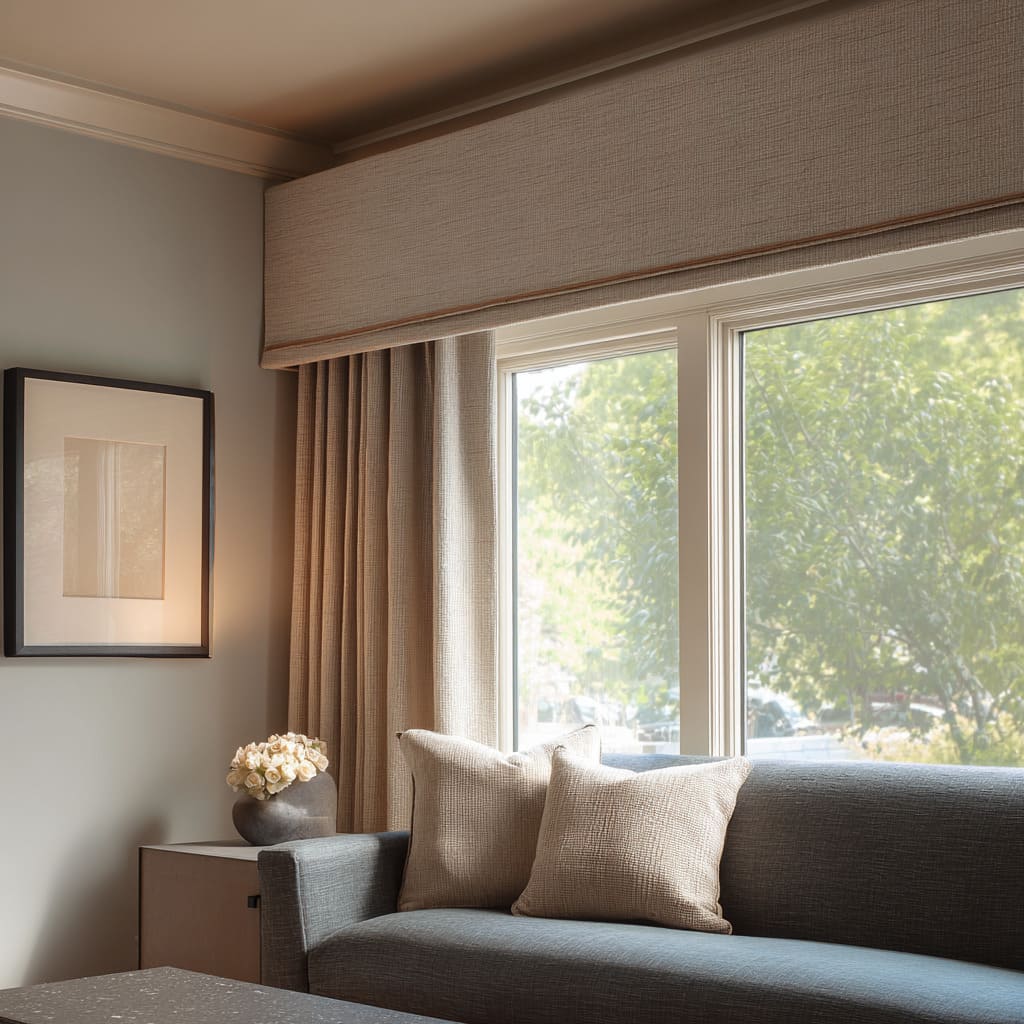
The geometry of the valance’s lower edge—straight, dipped, waved, or angled—carries enormous emotional weight. Straight hems suggest clarity, precision, and order; they suit rooms where the textile aims to reinforce architectural calm.
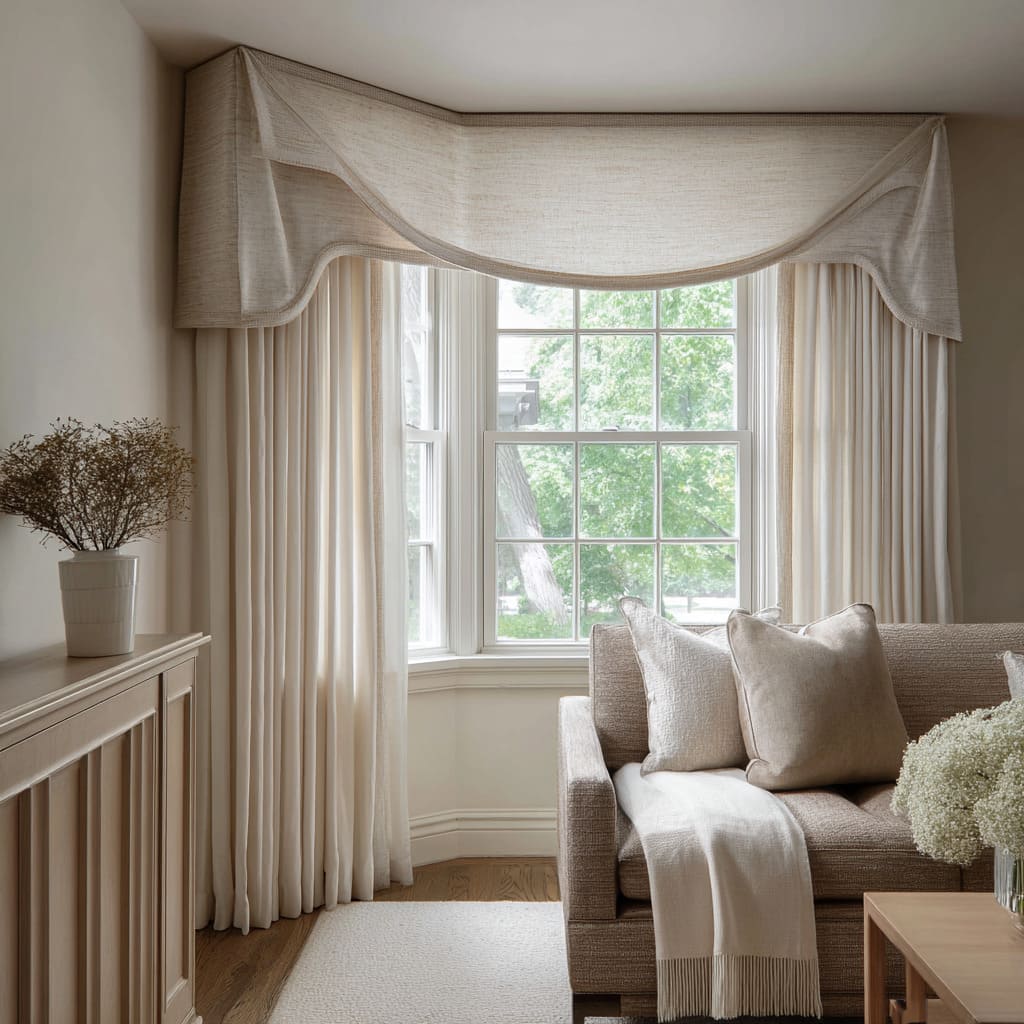
Curved fronts introduce softness without abandoning structure, especially when the curve is shallow and supported by squared side returns. These curves perform visual diplomacy: they smooth harsh ceiling transitions, soften angled architecture, and turn compact rooms into gentle niches.
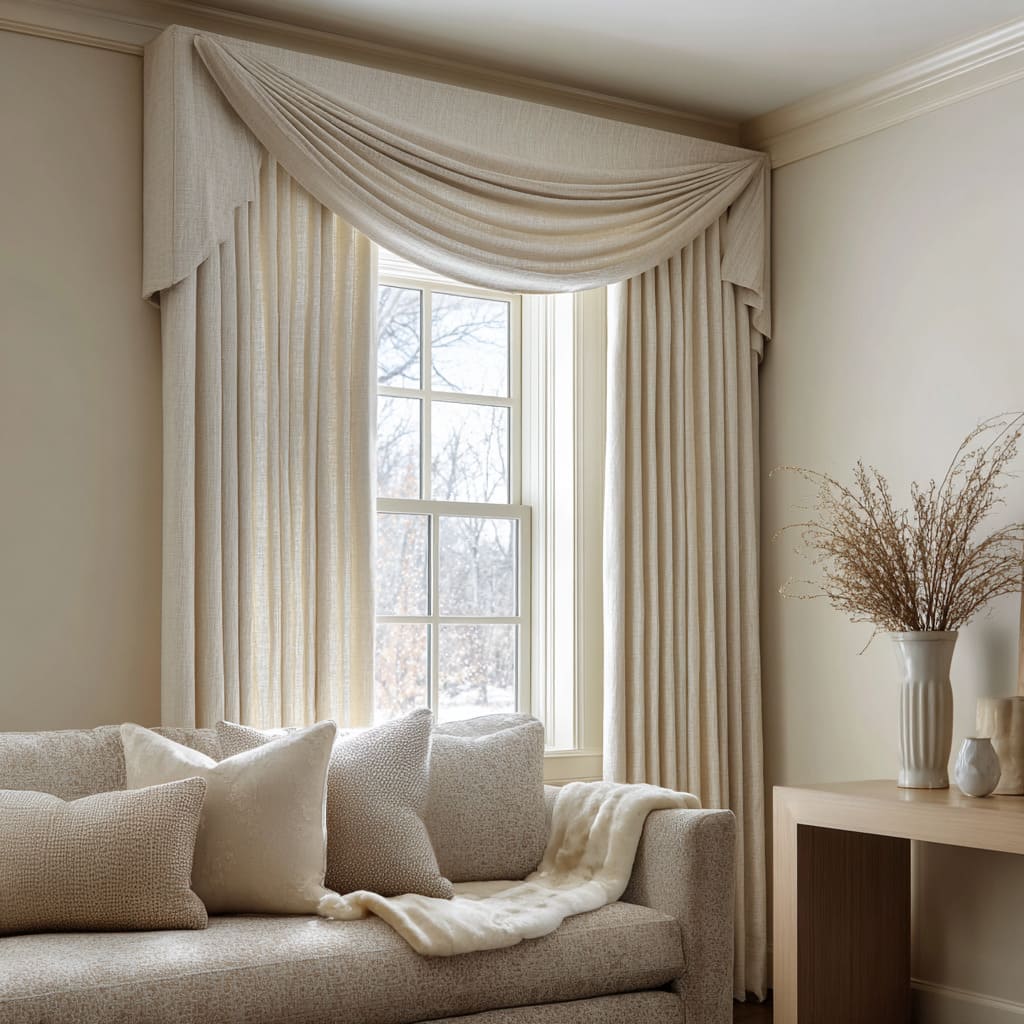
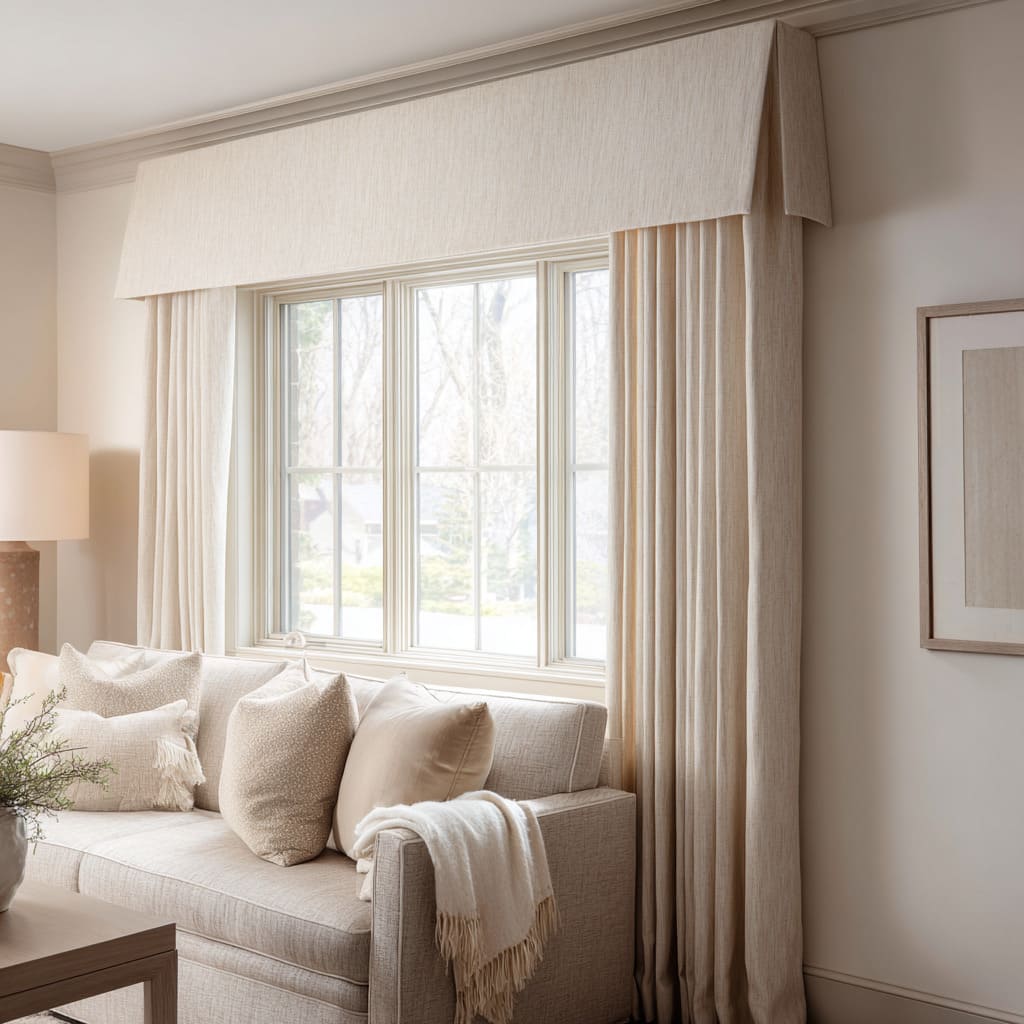
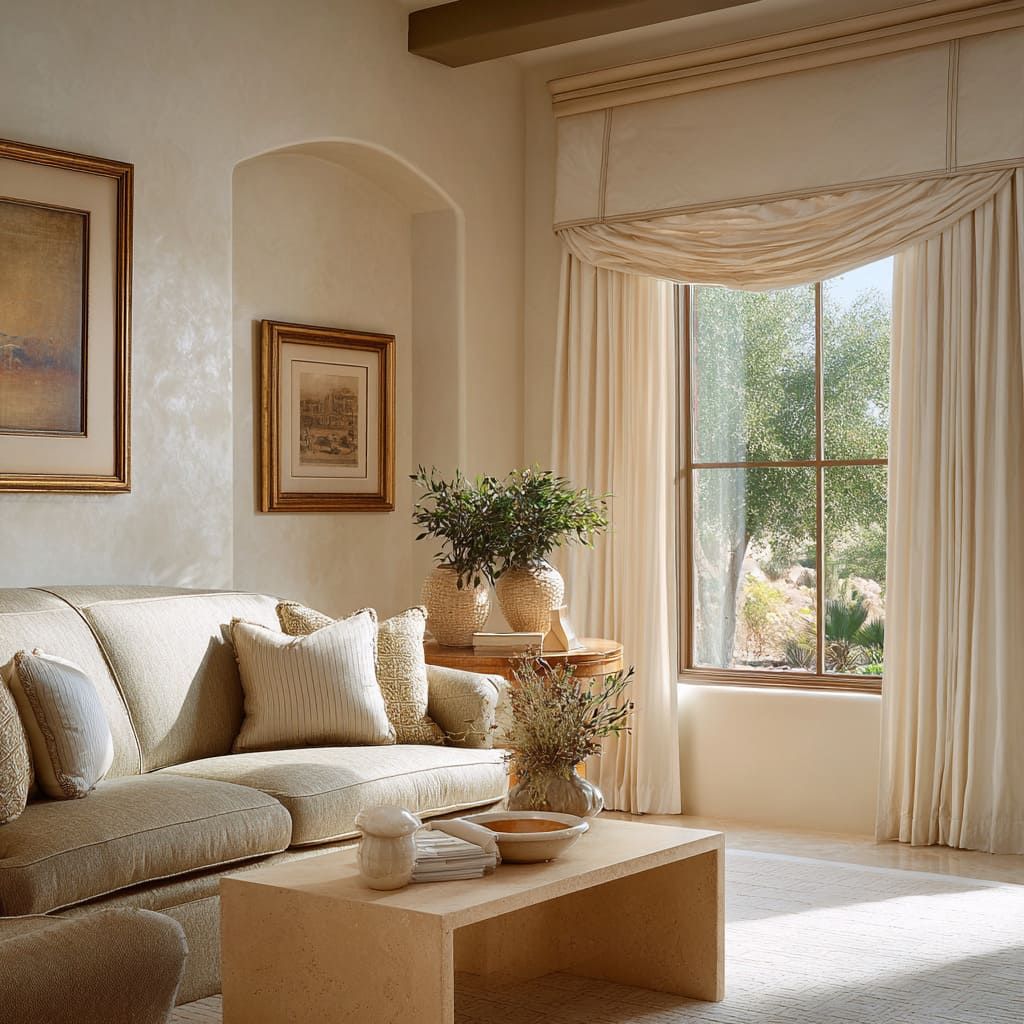
Sweeping draped layers over a box valance introduce a relaxed, almost poetic movement across the window wall—subtle enough not to overwhelm, but strong enough to shift the mood from focused to contemplative. Angled ends, appearing in a few studied examples, lighten long pelmets by creating the impression that they lift gently at the sides.
Each geometry expresses a different emotional register, showing that the box valance is not a static object but a modifiable gesture that defines the emotional profile of the wall.
The Bay as a Textile Room-Within-a-Room
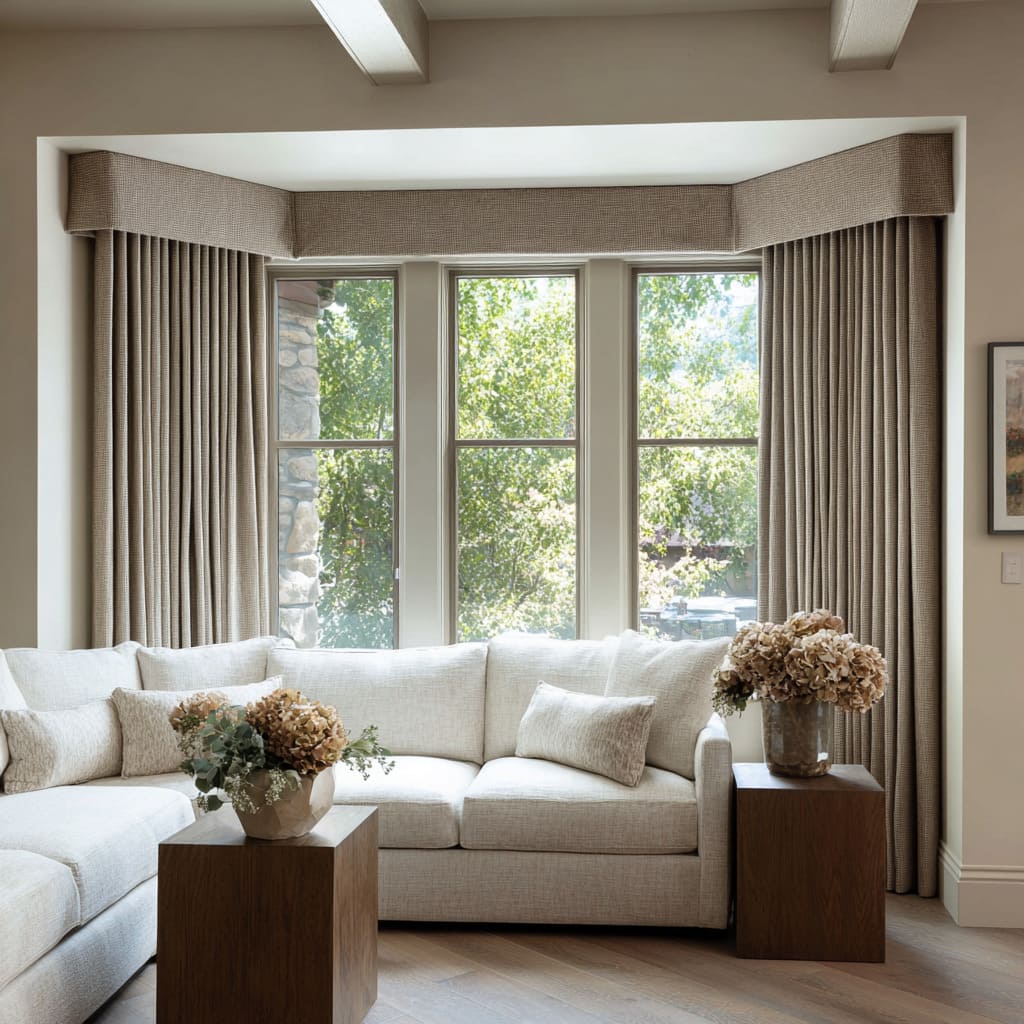
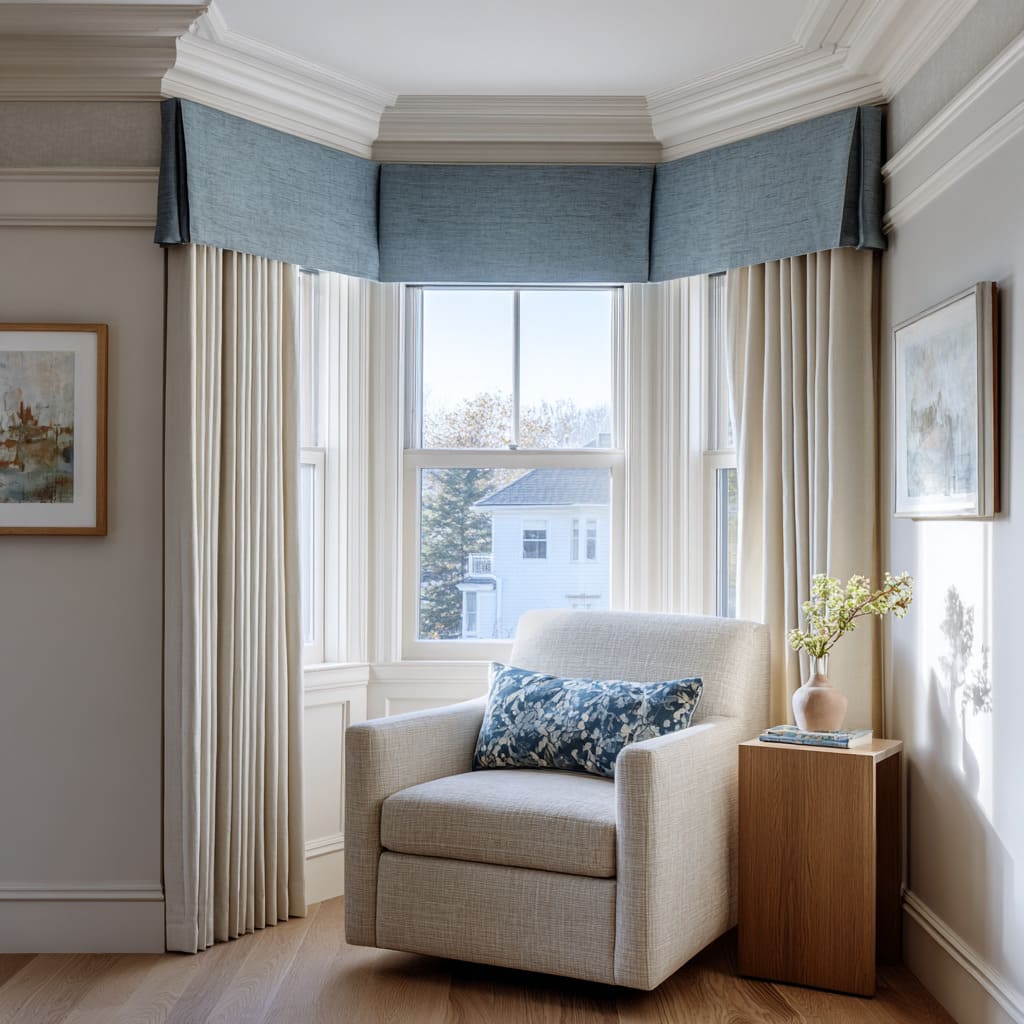
Bays present a unique opportunity for experimenting with upholstered valance box ideas because their multi-faceted geometry amplifies the presence of the header. When the pelmet wraps each angle of the bay with clean mitered turns, the bay stops reading as several windows and becomes one unified pocket—a textile alcove that frames the outdoors as a single composition.
Curtains drawn across angles reinforce this unity, and when furniture extends into the bay (such as a chaise or built-in cushion), the corner behaves like an intimate room inside a larger room.
A second approach overlays a gentle fabric curve on top of the box valance, smoothing the bay’s angularity into a soft envelope that echoes the organic shapes of trees or garden views beyond the glass. In both interpretations, the bay’s identity is redefined through fabric: structure at the top, softness below, and a visual “embrace” that wraps seating, light, and landscape into one cohesive setting.
Mood-Shaping Through Light, Texture, and Quiet Repetition
Modern box valances act as mood engines, changing how daylight enters and how textures register. A dense dotted pelmet creates a shimmering band of luminosity that feels festive yet refined; below it, long curtains with vertical markings soften that energy into something quieter.
A matte clay pleated valance absorbs light instead of bouncing it, giving the room a grounded warmth that feels intimate but controlled.
A pale neutral pelmet in crosshatched linen transforms the window wall into a gallery-like backdrop, emphasizing the silhouettes of branches outside or the tonal variations inside. These moods depend on repeated texture families: boucle sofas echo soft folds, ribbed rugs reinforce pleat rhythms, smooth ceramics balance patterned headers.
When seen together, such relationships form a layered sensory environment where the valance initiates the mood and the rest of the room finishes the sentence.
The Valance as the Organizer of All Decorative Elements
Valances can quietly organize the placement and style of other elements. The color of the header often appears again in cushion accents, floral arrangements, table objects, or artwork washes.
Small details—piping, mini stripes, pleats—reappear as stitching on cushions or edges of throws, creating coherence without repeating full motifs. The rhythm of the header determines the rhythm of objects: a pleated valance encourages vertical lamps and tall vases; a patterned grid header invites abstract artwork with softened, horizontal strokes to counterbalance it.
Even the shape of the coffee table or the grain direction of wood pieces may subtly reflect the valance’s language, forming a chain of visual decisions rooted in the textile beam above the window. In this way, box valance ideas do not merely finish the window—they prescribe the visual logic of the entire seating area, shaping its narrative from top to bottom.
Pattern Density, Texture Shifts, and the Power of Micro-Details
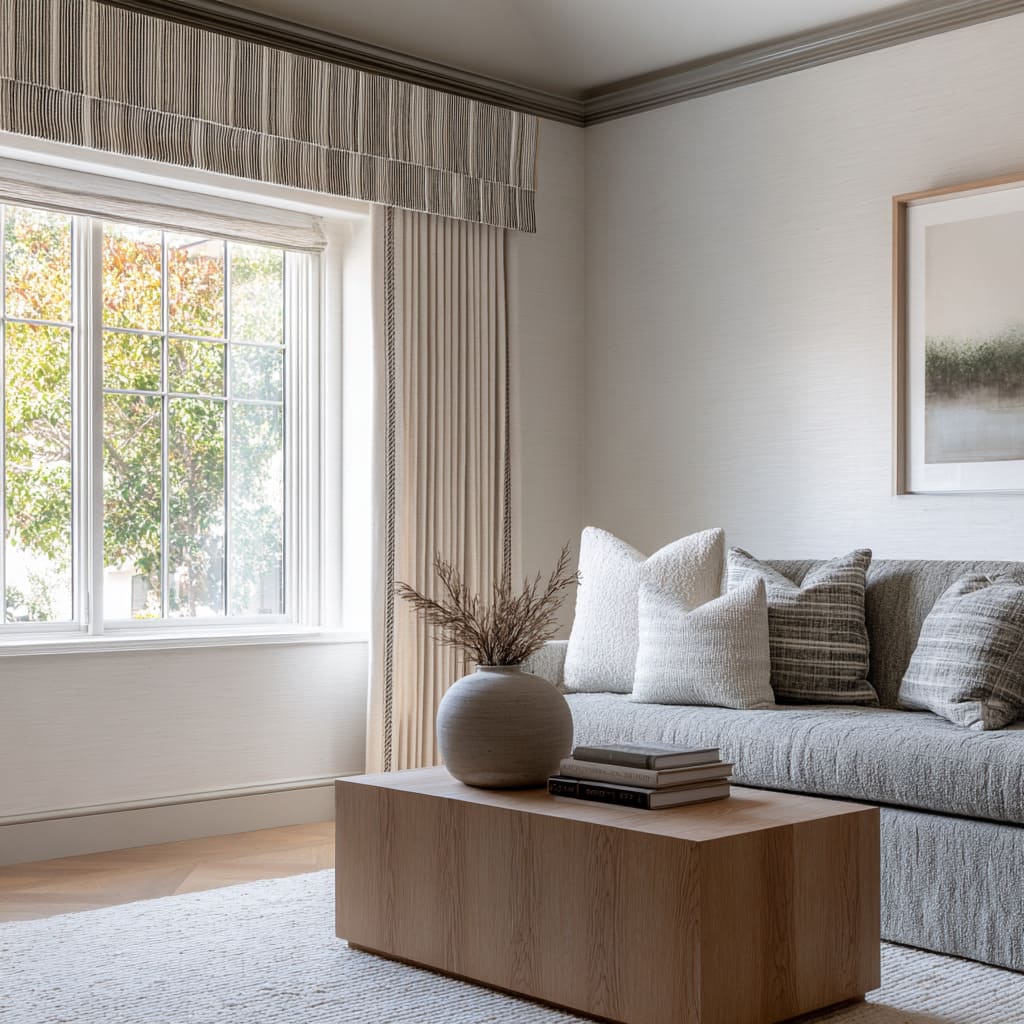
One of the most sophisticated behaviors is the control of pattern density from top to bottom. The most intense pattern zone often lives at the header—dense dots, compact herringbone, crisp stripes, or tight grids—so the room’s pattern energy peaks at the top and softens as it descends.
Curtains stretch, compress, or blur those motifs into quieter versions of themselves; cushions distill those motifs further into tiny repeats or tone-on-tone weaves.
Small details anchor these shifts: a contrast welt at the bottom of the pelmet creates a “hem” that defines where the patterned band ends; pleated lower trims provide shadow and movement without adding bulk; narrow vertical color strips at curtain edges connect the top band to the floor. These micro-gestures offer the refinement that makes box valance design feel deliberate and intelligent, showing how textiles can influence architectural reading even through small, almost whispered details.
How Box Valances Shape the Entire Interior Atmosphere Through Layered Strategies
Stepping back, the most striking theme is how modern valances behave like a vocabulary of soft architecture: they anchor walls, frame views, create alcoves, balance textures, and set the overall emotional tone. Whether the palette leans warm, cool, monochrome, or color-driven, the valance establishes the visual hierarchy.
Designs with strong patterned headers feel structured and intellectually textured; designs with tone-on-tone pelmets feel hushed and gallery-like; designs with curved draped layers feel enveloping and quietly romantic.
These effects do come from the interplay of proportion, shape, texture, and the room’s supporting cast of furniture, natural light, and exterior scenery. This is why window valance box ideas consistently appear in curated interiors: they offer precision, softness, and atmosphere in one move, rewriting the perception of the window wall without altering architecture.
The Box Valance as a Modern Textile Framework for Contemporary Interiors
Looking across all conceptual approaches—from structured beams to draped arcs, from patterned grids to shimmering dotted bands—it becomes clear that the modern valance has evolved into a flexible textile framework rather than a decorative topper. It defines the hierarchy of lines in design, sets up the palette, decides the rhythm, and shapes the emotional temperature.
Through color loops, pattern layering, and the careful softening of architectural edges, valances become anchors for everything beneath them.
In this way, box valance ideas, window valance box ideas, box window valance ideas, and upholstered valance box ideas all converge into a shared design philosophy: the top of the window is a stage for quiet but decisive gestures that influence the entire design. The valance becomes the visual introduction to the interior’s broader story—one that unfolds downward through drapery, furnishings, textures, subtle repetitions, and the interplay between indoor calm and the view outside.