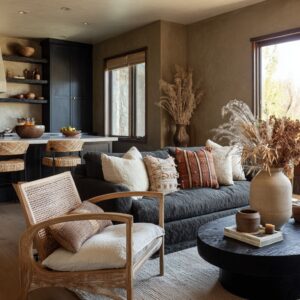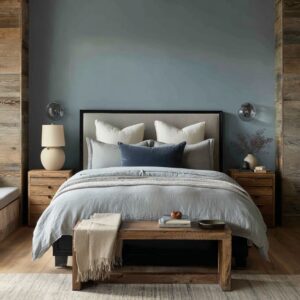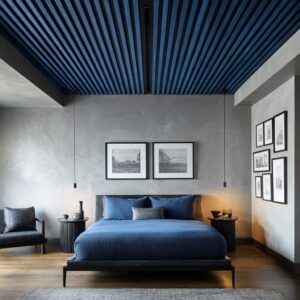
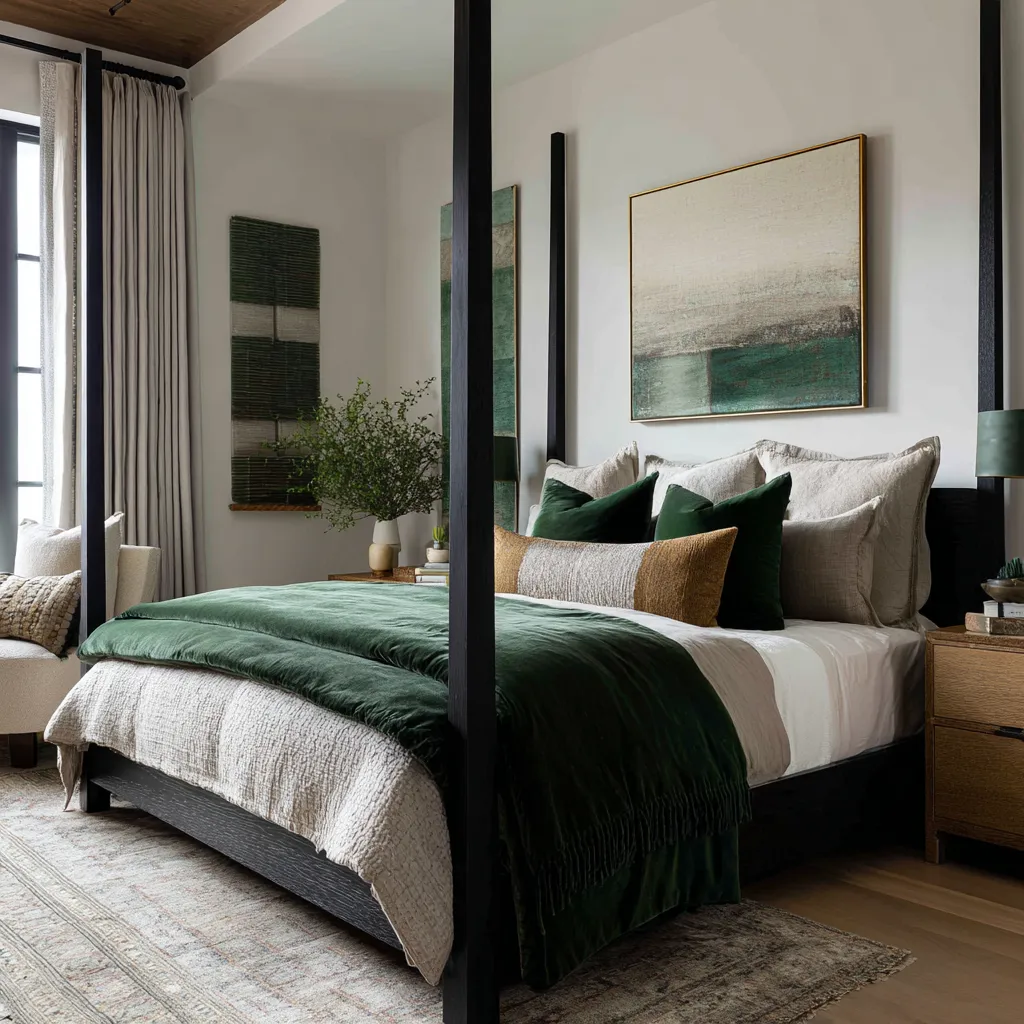
Eclectic maximalist bedroom design succeeds when fullness is placed in the right locations. That is the difference between a room that feels layered, intimate, and memorable, and one that feels overworked.
In a well-made eclectic maximalist bedroom, richness usually gathers at the edges of the room, in the wall treatment, the framing around the bed, the art, the drapery, the rug, the bench, the shelving, or the ceiling line. The bed itself stays inviting, legible, and easy for the eye to rest on.
That balance is what makes the style compelling in a bedroom rather than exhausting.
This is one of the misunderstandings about maximalism in sleeping spaces. Many people assume the style depends on endless accessories, saturated color on every surface, or a pileup of decorative references.
Stronger rooms do something else. They let one or two major elements carry the identity of the room, then allow the supporting elements to deepen that identity without competing for equal attention.
The result feels full, but it does not feel scrambled.
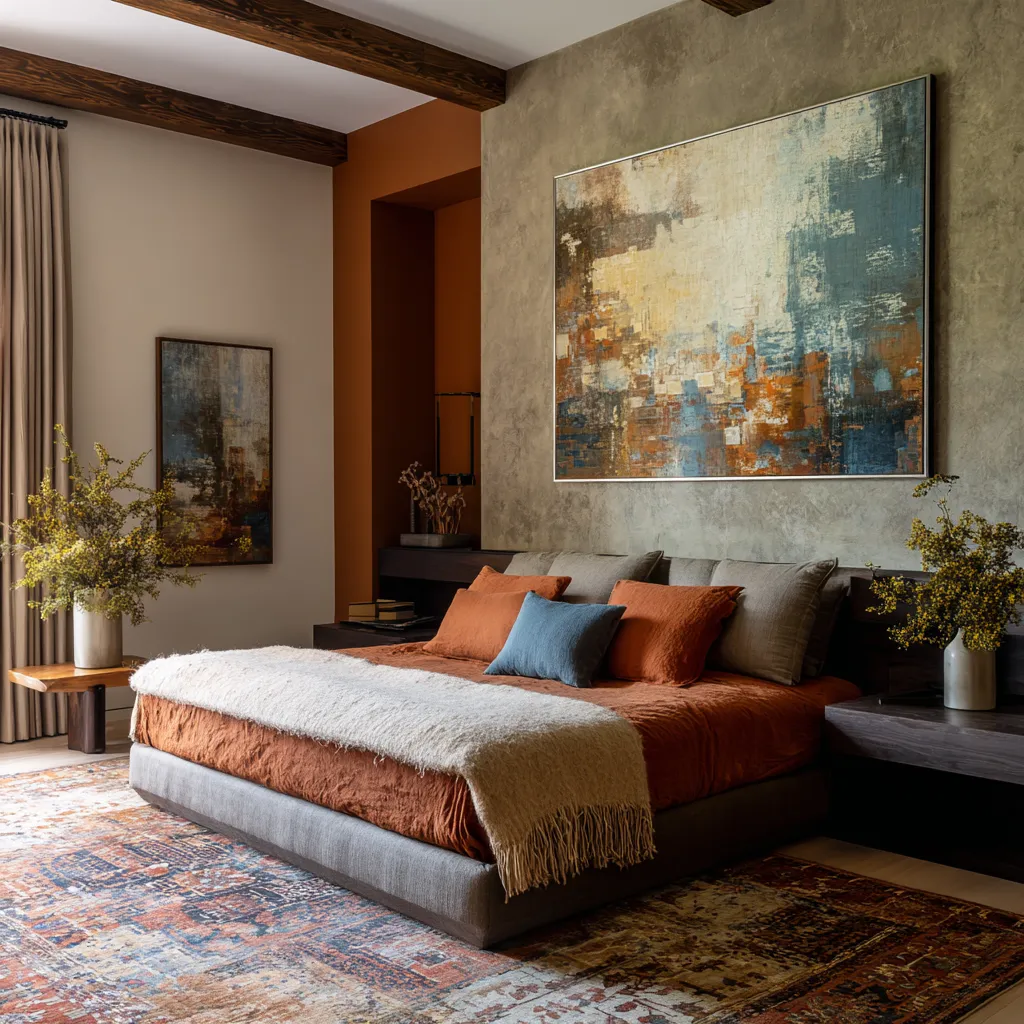
The Core Principle: Perimeter Richness, Soft Bed Center
An eclectic maximalist bedroom design often begins with a single primary move. Sometimes that move is architectural: a portal around the bed, an alcove, paneling, a canopy, a dark inset field, a wood surround, or a sloped ceiling that turns the sleeping area into a smaller chamber inside the larger room.
Sometimes the main move is the wall itself: a mural, a scenic field, a plastered or limewashed finish, a branch motif, a large atmospheric panel, or a dramatic dark surface with visible material depth. In other rooms, the major move comes from curation: a salon wall, an art grid, a group of paintings that establishes the room’s palette and emotional temperature.
And in some bedroom desings, the richest layer is material rather than graphic: leather, woven surfaces, carved inserts, textured woods, aged rugs, mineral walls, or upholstered forms with very different handfeel. The room does not need all of these at full volume.
It needs one central carrier of identity, then a supporting cast.
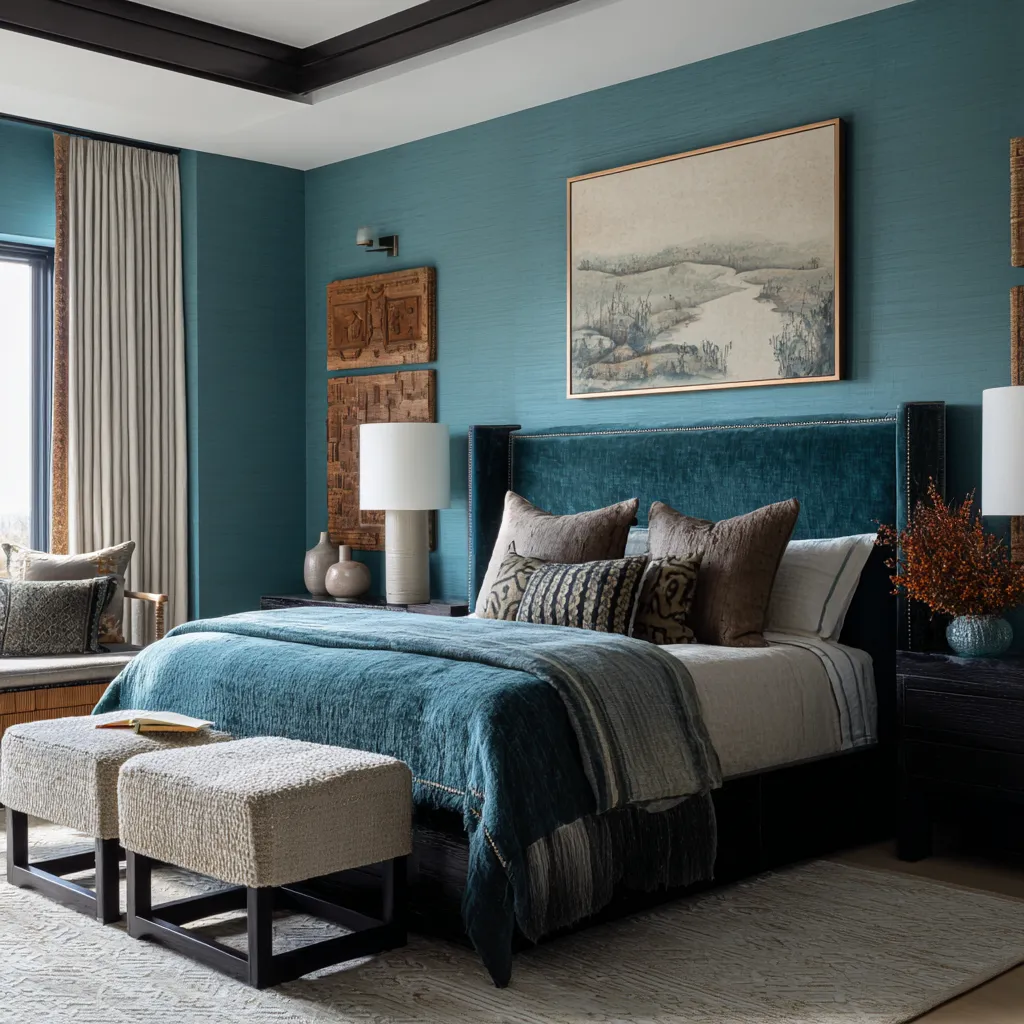
That is why the bed wall matters in eclectic maximalist bedrooms. It often works harder than any other surface in the room.
Instead of acting as a blank backdrop, it becomes a stage, a compressed chamber, a gallery plane, or an atmospheric field. A framed bed niche can make the sleeping zone feel protected without adding visual clutter.
A large mural can give the room depth, narrative, and a developed palette before a single pillow is added. A dark, textured wall can produce mood and gravity, then rely on lighter bedding to keep the center hospitable.
A curated art wall can turn an otherwise simple shell into a room with memory, taste, and collected character. The key is commitment.
If the wall is doing serious work, the rest of the room can ease back.
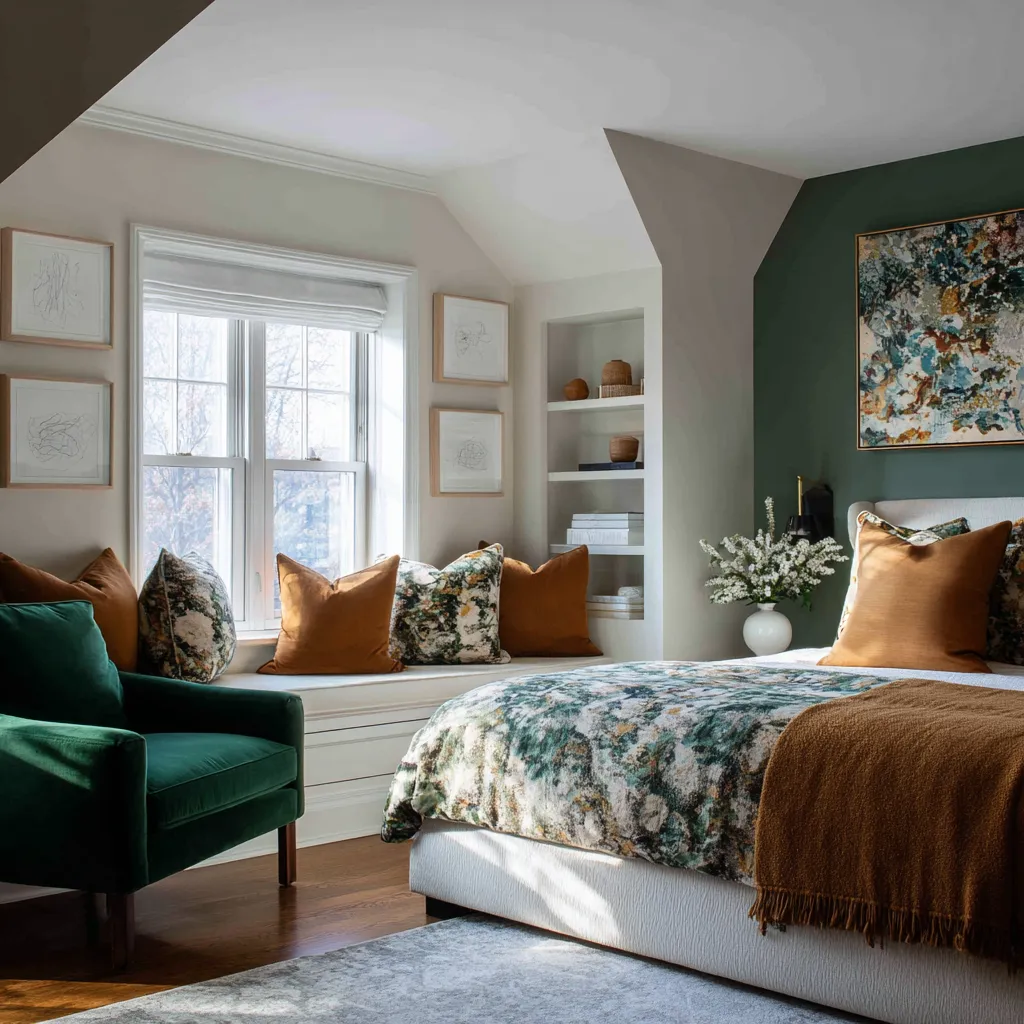
What usually carries the room’s identity
One of these elements can become the main source of character:
- a mural or scenic wall field
- a portal, alcove, or canopy around the bed
- a large art composition
- a tactile material layer such as plaster, dark wood, leather, or woven inserts
- a strong rug and bench pairing supported by quieter walls
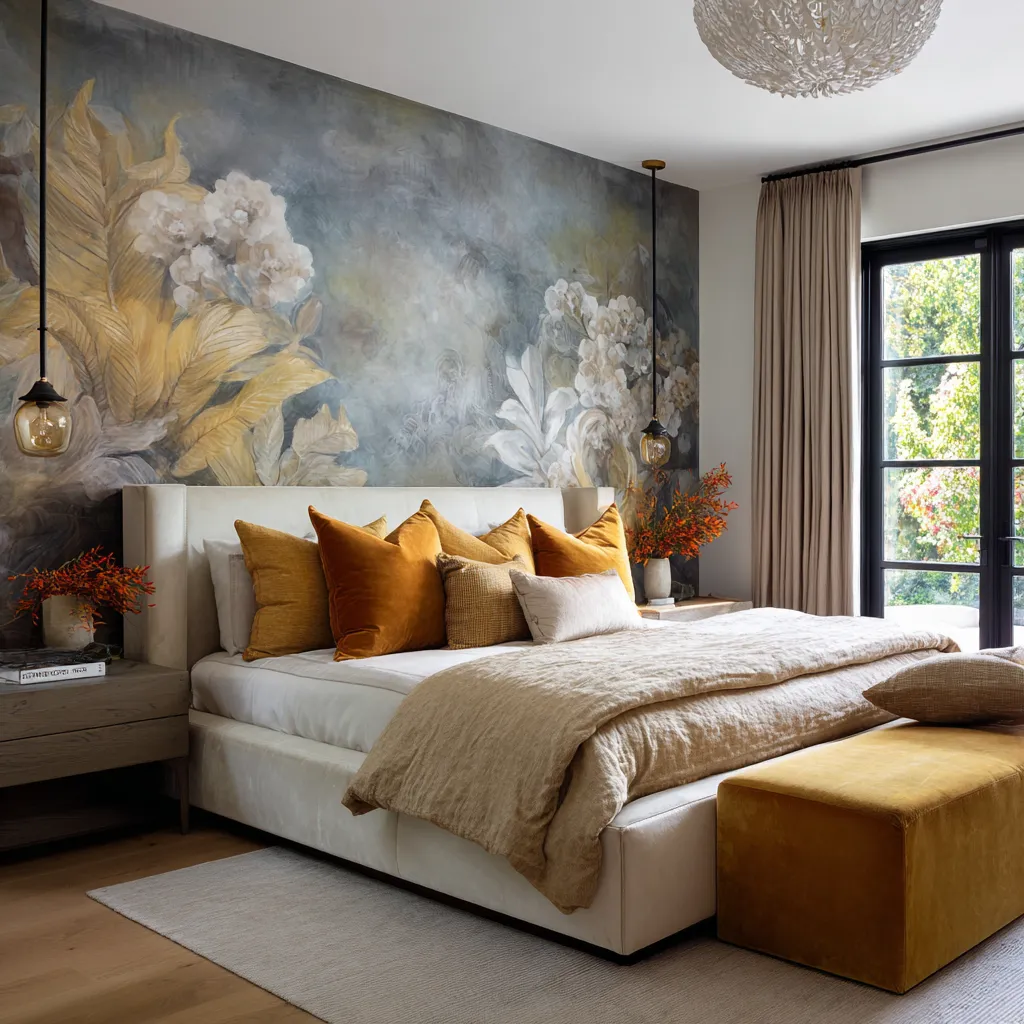
Edited Abundance, Not Decoration Everywhere
This is where eclectic maximalism becomes more sophisticated than decorative accumulation. It is not built from equal-strength statements scattered everywhere.
It is built from hierarchy. A strong room usually has one dominant system, one secondary support system, one compressed accent family, and one pale relief field that protects the bed.
That relief field matters more than many people realize. In bedroom design, the eye needs a place to release tension.
That release often appears as a pale duvet, a broad upholstered headboard in stone or cream, a simplified sheet field, or a light bench that softens the foreground. Without that relief, the room can become dense in a tiring way.
With it, the surrounding drama feels sharper because it has something softer to press against.
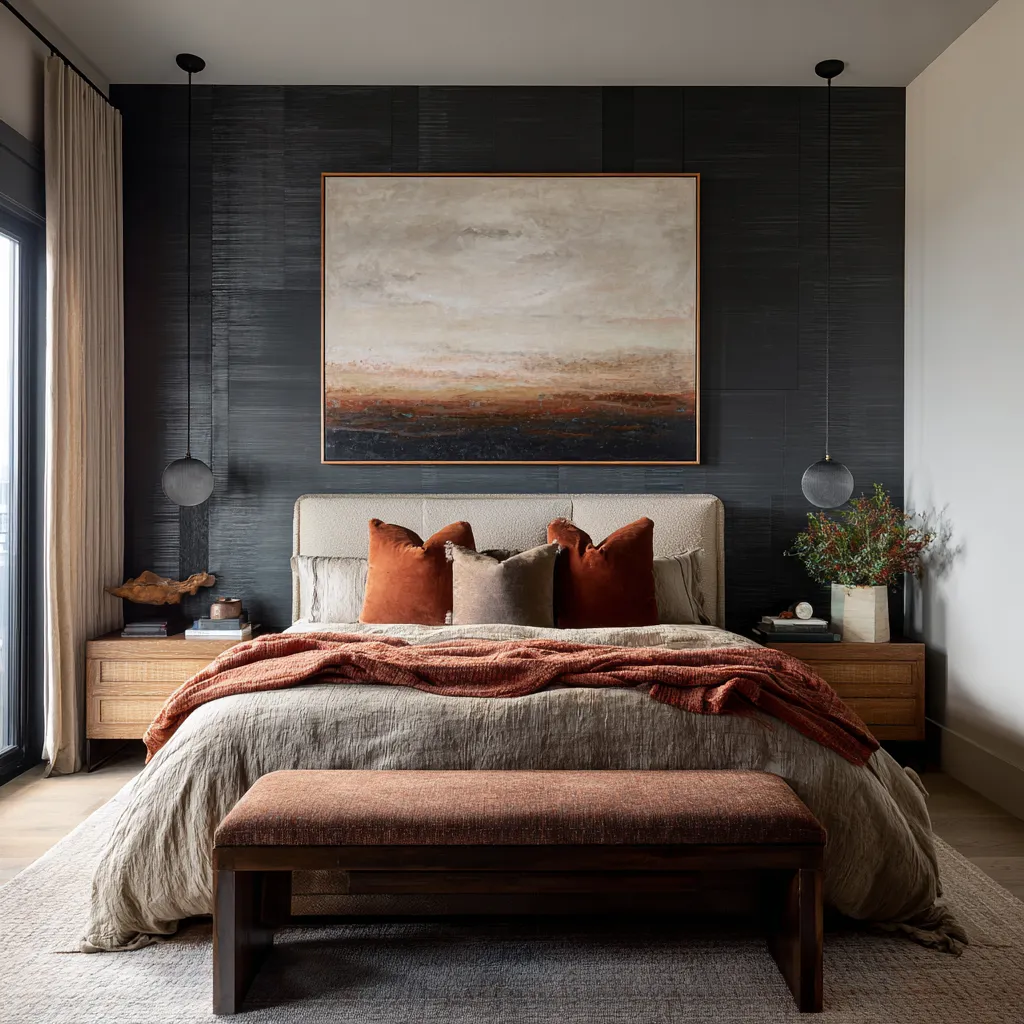
This relationship between perimeter drama and center softness is one of the deepest principles in the style. The room thickens at the edges and opens at the center.
Built-ins, drapery, shelving, dark window frames, mural fields, benches, and side chairs build the perimeter. The mattress zone stays broader, lighter, and easier to read.
Even in moody rooms, the sleeping area often remains the least visually noisy part of the composition. That is why the style can feel immersive without losing bedroom function.
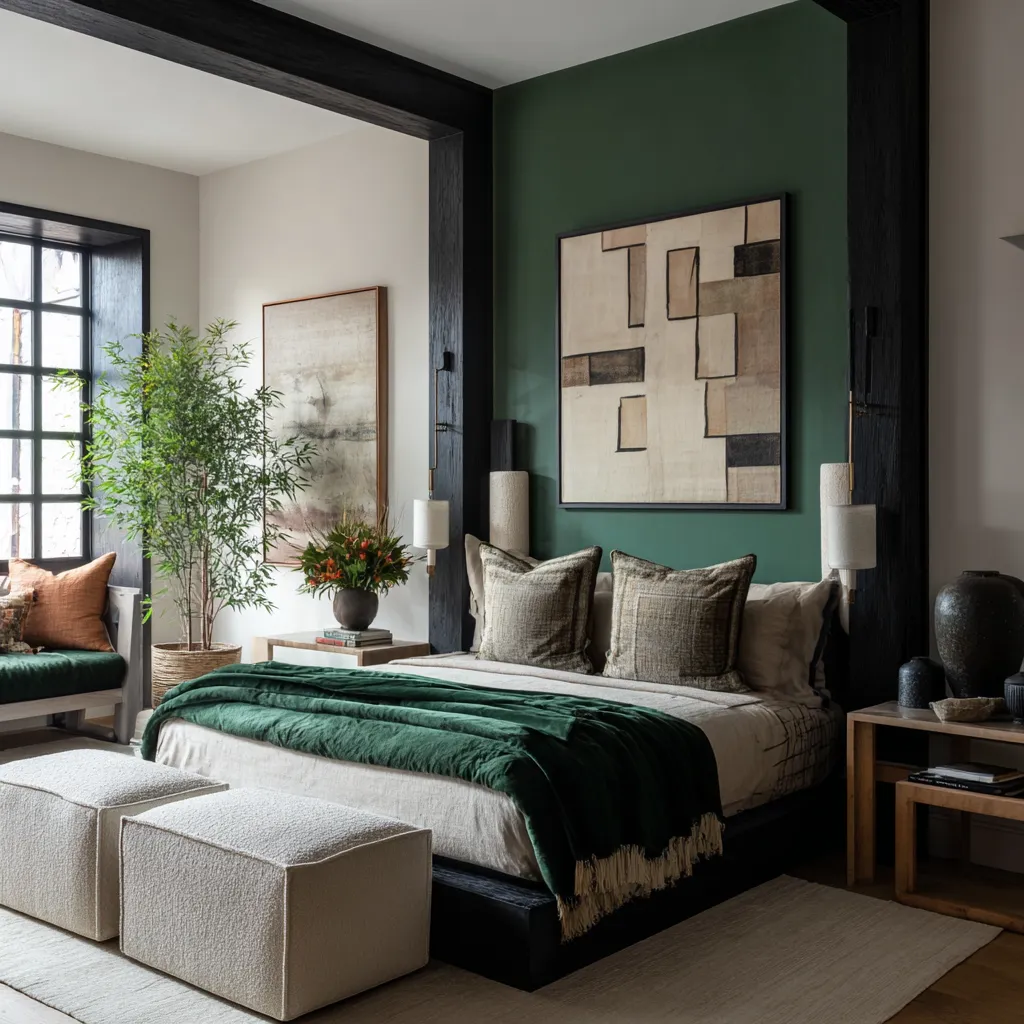
Signs that the balance is working
A design usually stays controlled when you can notice most of these at once:
- the bed is easy to read from a distance
- the strongest color is not spread equally across every surface
- one wall or one structural move clearly leads the room
- the eye can pause on pale bedding or upholstery
- warm accents appear in a narrow band rather than everywhere
- side zones support the composition instead of starting a second unrelated theme
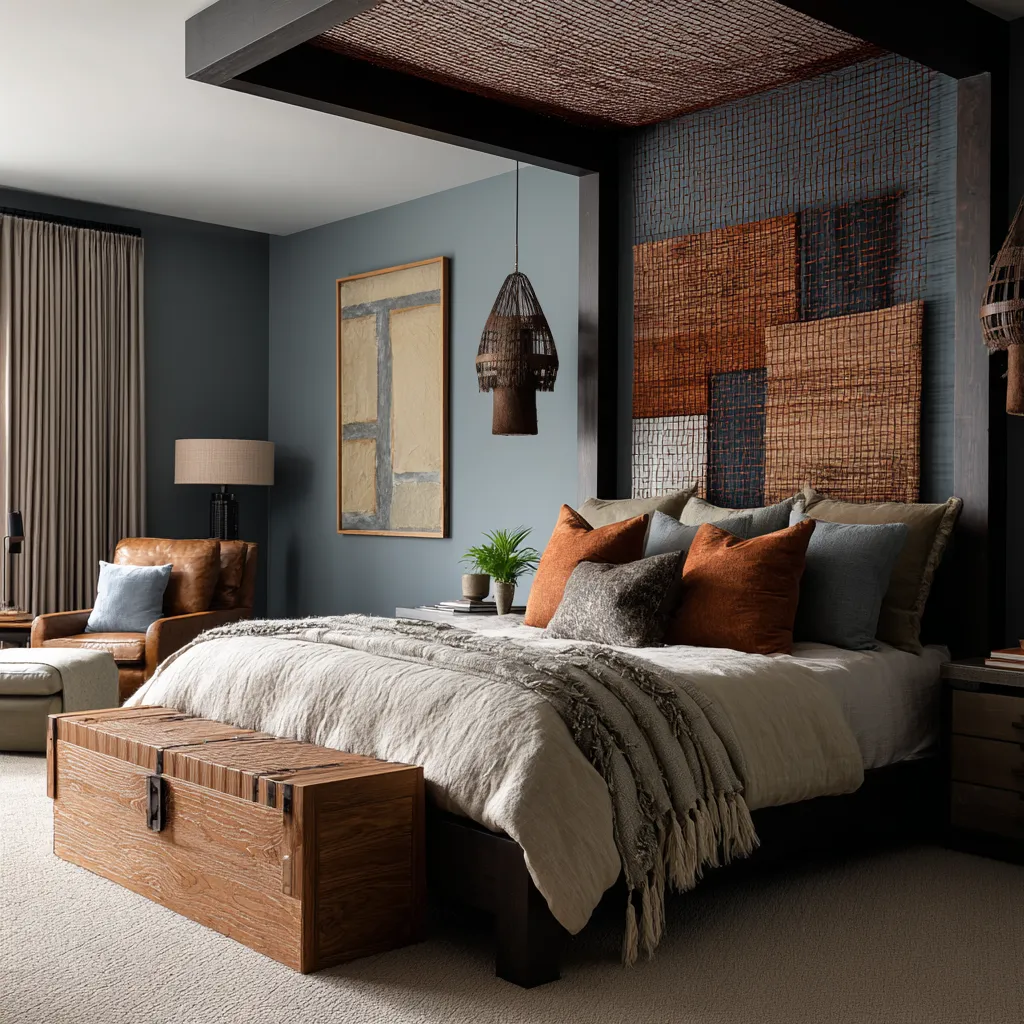
How Color Usually Works
Color plays a major role here, but not in the crude sense of simply mixing many hues. Strong eclectic maximalist bedroom ideas tend to organize color in a hierarchy.
One family shapes the atmosphere of the shell. Another, usually warmer family, appears in a tighter band.
A pale neutral family protects the bed. In many rooms, the cooler or deeper tones occupy larger surfaces: blue-gray walls, deep green millwork, indigo drapery, smoky teal murals, charcoal planking, or dark wood structure.
Warmth then appears closer to the body: rust pillows, saffron throws, caramel leather, apricot cushions in a window seat, amber glass pendants, cinnamon textiles, or blush accents. This creates a kind of thermal zoning.
The room shell may hold cool atmosphere, while the touch points carry warmth. That makes the space feel emotionally richer because the person in the room meets warmth where they physically interact with the design.
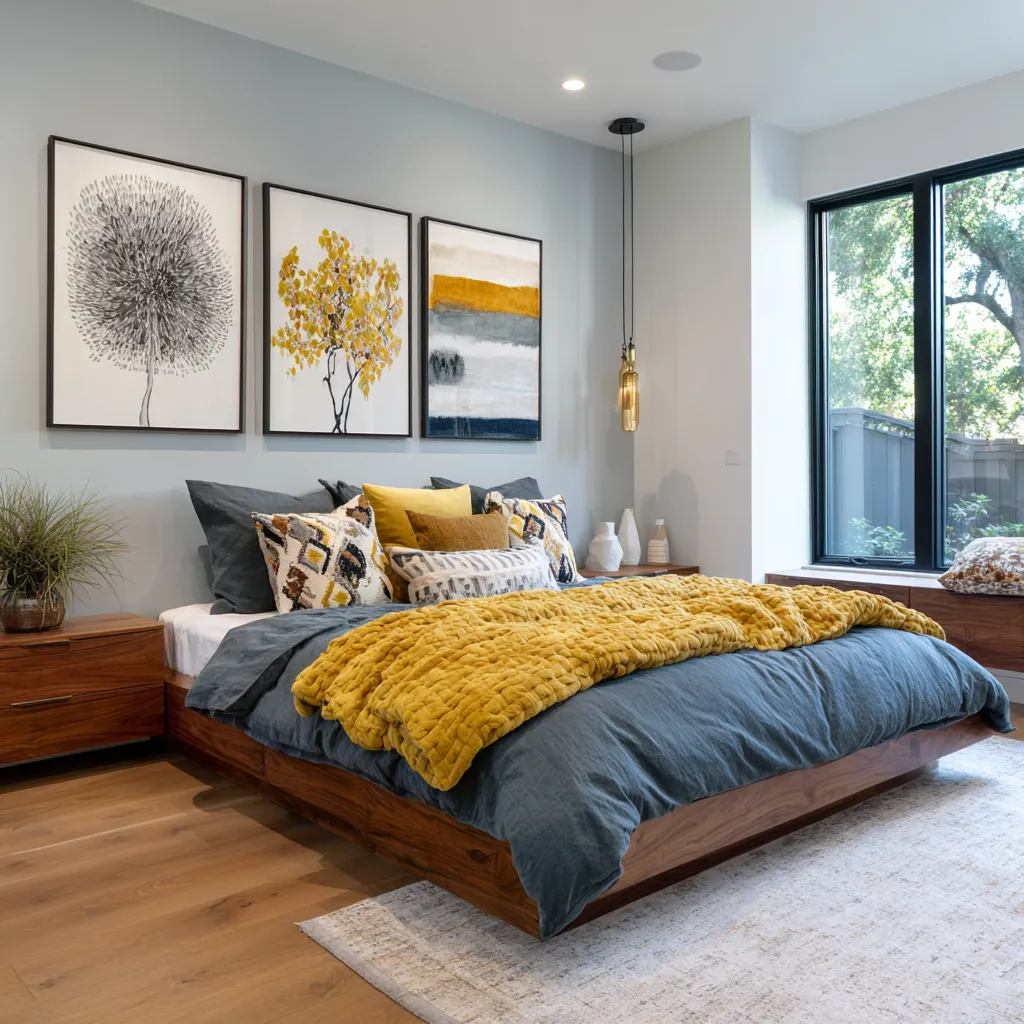
This warm band works well because it is usually concentrated rather than sprayed everywhere. Two rust pillows can do more than twelve small rust accents scattered through the room.
A caramel leather chair by the window can anchor warmth more effectively than several unrelated tan objects. A bench upholstered in a deeper clay or tobacco note can connect the pillow line to the rug in one clear move.
Narrowing the warm accents gives them weight. They stop being decorative confetti and start becoming the room’s internal heat source.
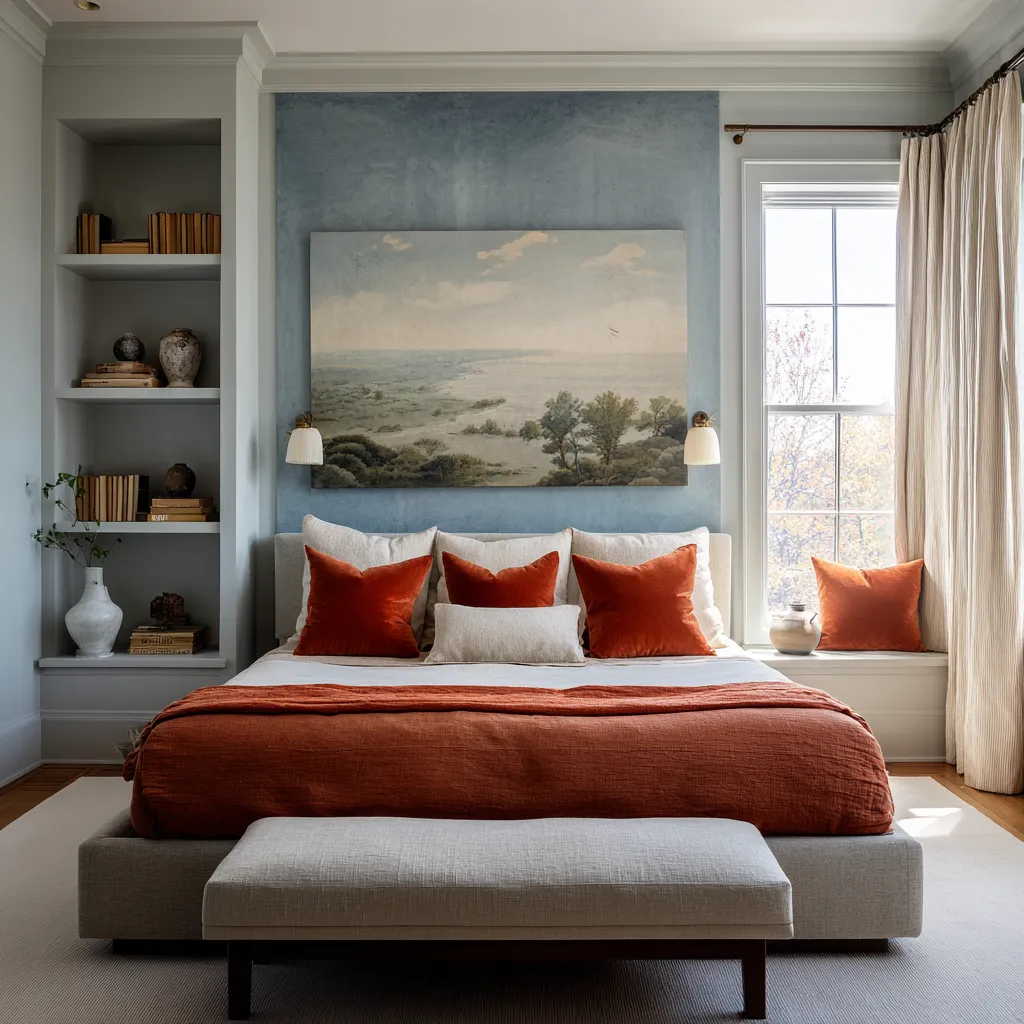
A practical color structure that shows up often
Eclectic maximalist bedroom designs can be built from a three-part palette:
- Atmospheric shell color: deep green, slate blue, smoky teal, gray, indigo, olive
- Accent heat: rust, amber, saffron, terracotta, blush, caramel, cinnamon
- Relief neutral: ivory, oat, cream, pale stone, warm beige
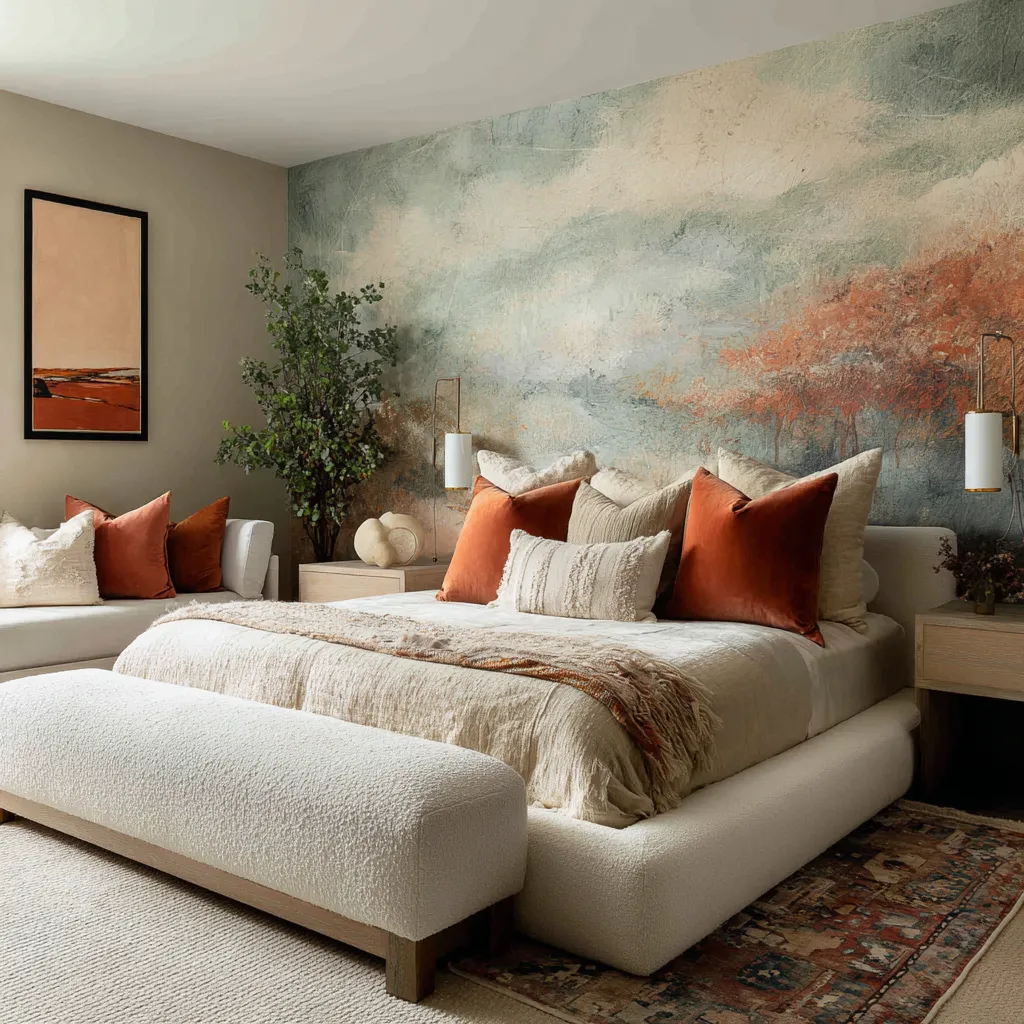
Material Layering Matters More Than Color Count
Material layering is just as important as color, and often more important. Eclectic maximalist bedroom designs do not feel rich because of color count.
They feel rich because smooth, nubby, woven, polished, clouded, patinated, and plush surfaces sit together with intention. A room might combine a plaster-like wall, a velvet headboard, a worn rug, dark oak, boucle seating, glass pendants, a linen duvet, and an aged artwork.
None of those materials has to shout. Their difference in surface character is enough to build density.
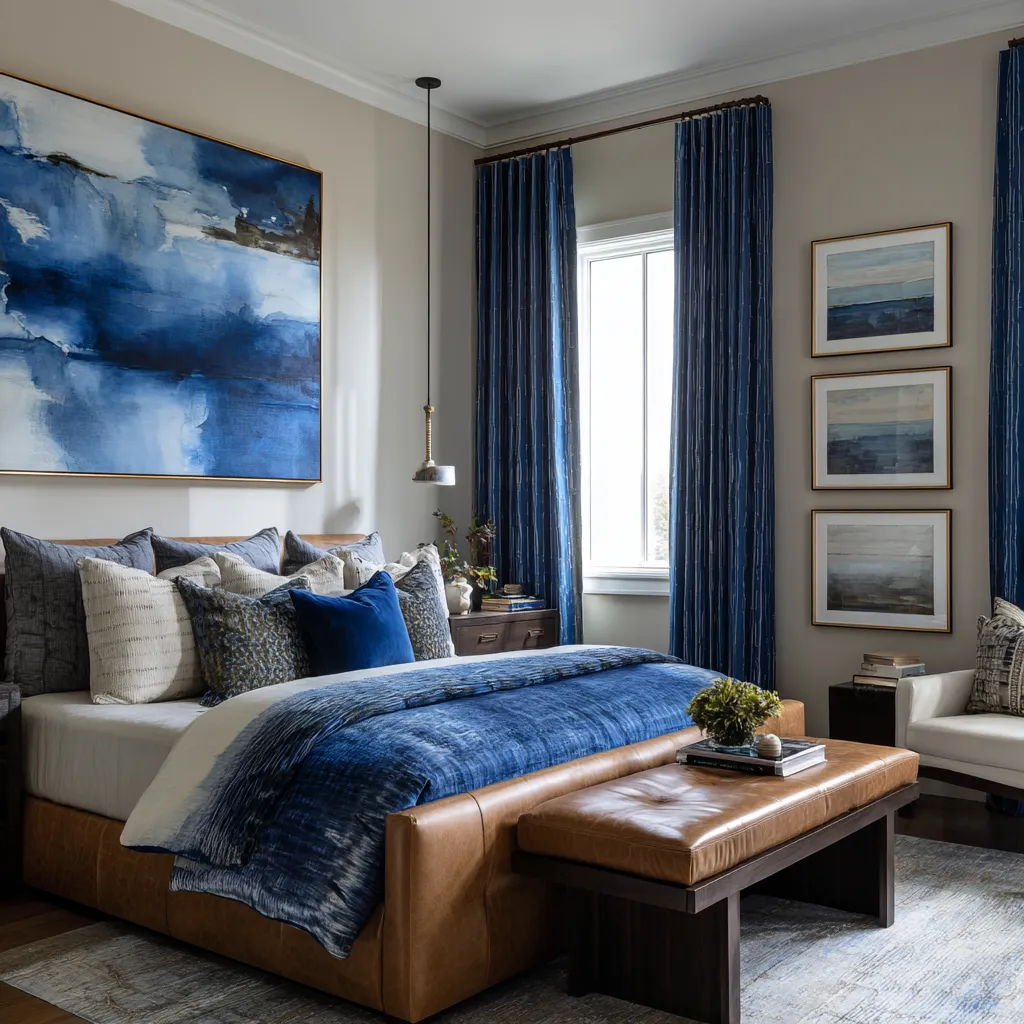
This is also where older references enter the room in a sophisticated way. Time-depth often arrives through material memory rather than literal period furniture.
Weathered mural quality, grainy wood, faded textiles, mineral wall finishes, carved relief panels, and handmade woven pieces can give a bedroom age and character without making it feel locked into a historical set.
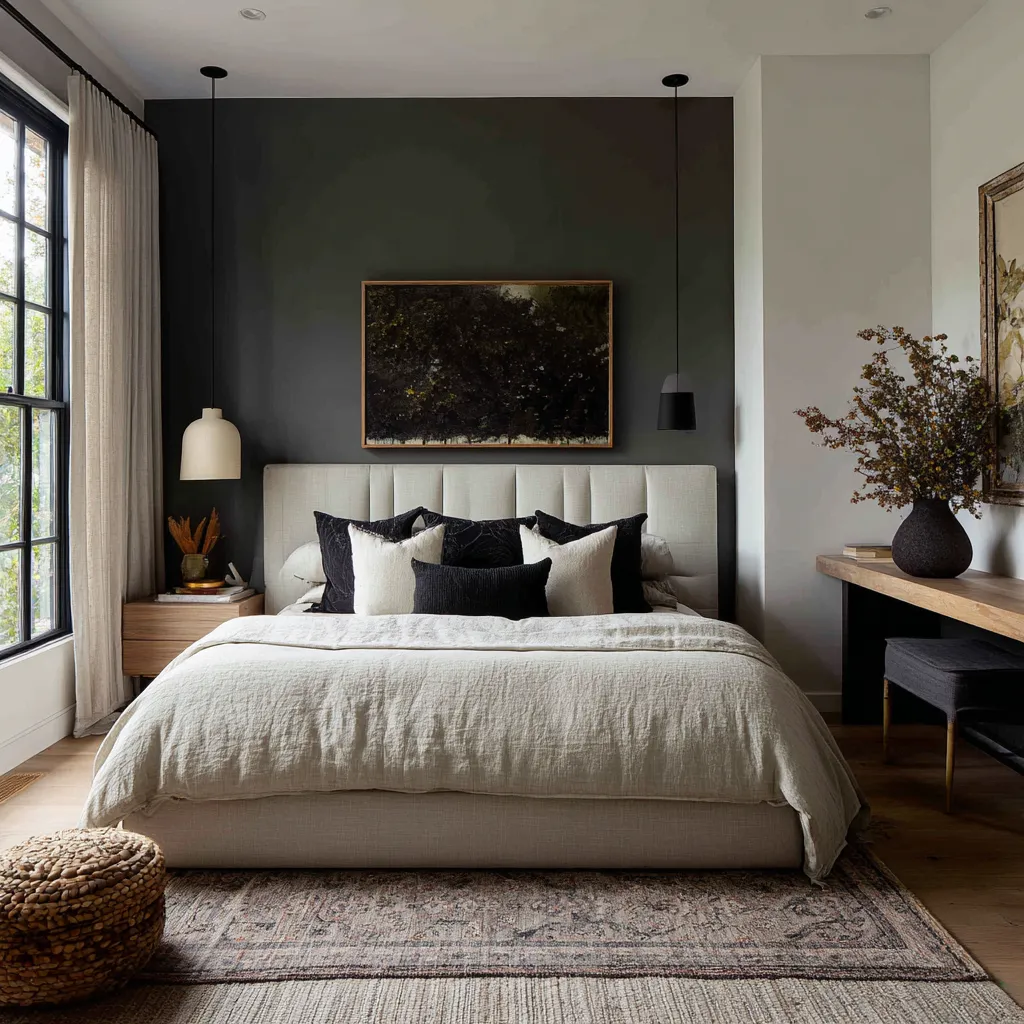
Which Design Elements Create Which Visual Effects
The table below brings together the main ideas in eclectic maximalist bedroom design.
| Design element | What it does visually | Why it helps the room | Typical example |
|---|---|---|---|
| Dark inset wall behind the bed | Pulls the eye inward and gives the bed more weight | Creates intimacy and a chamber-like center without adding furniture bulk | Deep green, charcoal, or indigo painted bed zone behind a pale upholstered bed |
| Portal, alcove, or canopy frame | Gives the sleeping area ceremony and structure | Organizes the room and reduces the need for extra decor | Oak alcove, blackened canopy, house-shaped frame, millwork surround |
| Large mural or scenic wall | Adds atmosphere, narrative, and scale | Can carry the whole room concept with fewer accessories | Branch mural, foggy landscape field, oversized floral scene |
| Pale bed core | Creates visual release and bodily comfort | Keeps the room restful even when the shell is rich | Cream duvet, light headboard, pale bench, soft neutral sheet field |
| Warm pillow band | Adds concentrated heat at the body zone | Makes the room feel intimate without spreading warmth everywhere | Rust, saffron, terracotta, amber, or blush pillows at the head of the bed |
| Bench at the foot of the bed | Extends softness and grounds the foreground | Connects pillow color to the lower half of the room and improves proportion | Boucle bench, leather bench, pale upholstered bench with patterned lumbar |
| Vintage or weathered rug | Introduces pattern and age at floor level | Lets the upper wall stay calmer while the floor carries complexity | Washed blue rug, worn rust-and-charcoal rug, faded floral field |
| Dark drapery block | Adds vertical depth and edge compression | Helps frame the bed and gives the room a more enveloping perimeter | Full-height navy, plum, olive, or charcoal curtains |
| Window seat or side chair | Broadens the room beyond sleep-only use | Makes the room feel lived-in and distributes accent color outward | Built-in seat with cushions, lounge chair in leather or pale fabric |
| Mixed art system | Builds curation, memory, and palette control | Lets the room feel collected without needing many objects | Salon wall, art grid, oversized abstract plus smaller side paintings |
| Plaster, limewash, or mineral wall finish | Adds depth without strong pattern | Creates richness through surface variation instead of ornament | Mottled blush wall, smoky sage plaster, weathered stone-toned finish |
| Woven, carved, or artifact-like inserts | Add cultural and tactile weight | Bring age and texture without crowding the room | Textile panels, carved reliefs, woven pendant, trunk, fiber wall panel |
| Ceiling beams or slopes | Shape volume and compress the bed zone emotionally | Make the room feel more architectural and grounded | Dark beams, pitched roofline, sloped attic wall, woven canopy top |
| Slim pendants instead of table lamps | Add vertical punctuation with less visual bulk | Keep bedside surfaces cleaner and more current in feeling | Amber glass pendants, dark globe pendants, long bronze fixtures |
How Different References Can Live Together
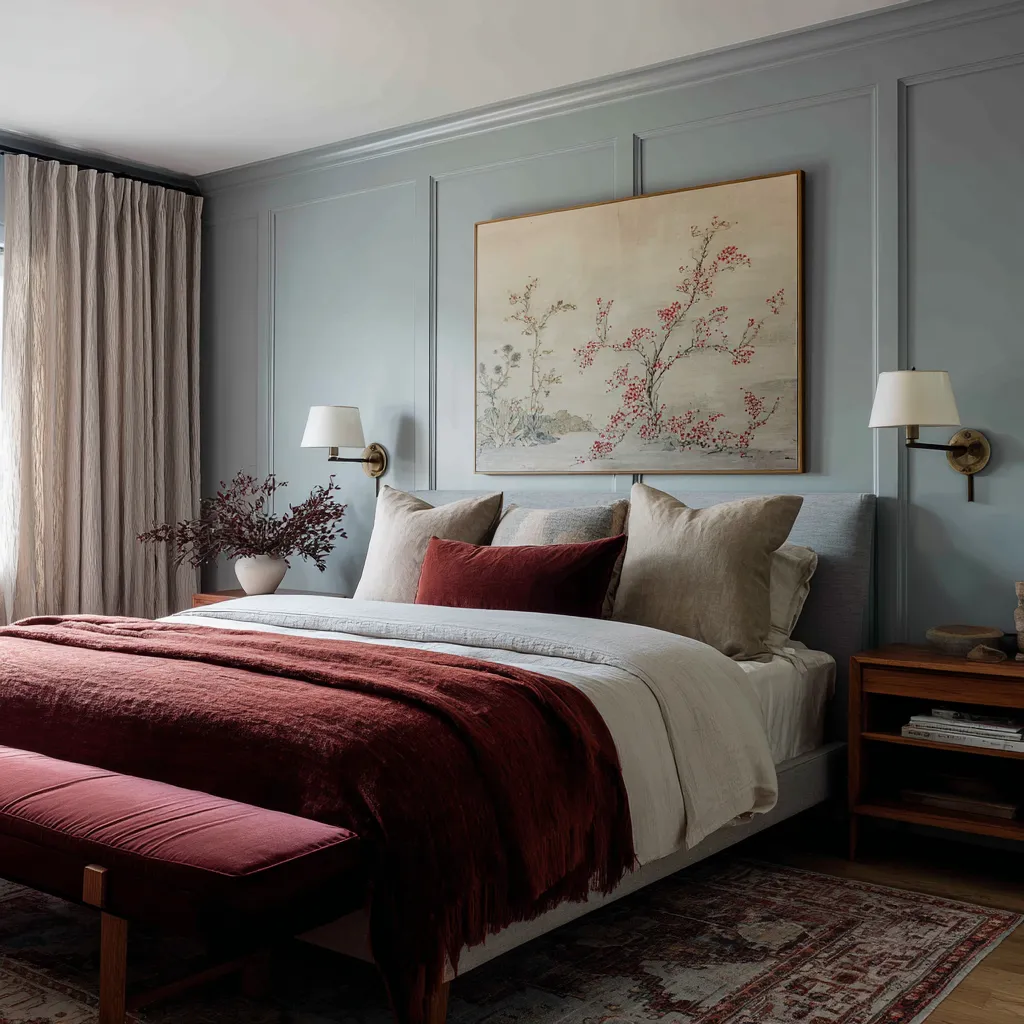
This distinction matters because eclectic maximalist bedroom ideas often borrow from several time periods at once. They may include a classic panel wall, a contemporary low bed, a vintage-style rug, abstract artwork, and artisanal lighting in one composition.
What keeps that mix from breaking apart is scale separation. One language belongs to architecture, another to art, another to textiles, another to small objects.
The references do not all occupy the same level. A botanical wall panel can sit behind a simplified upholstered bed.
A strong abstract painting can modernize a warm wood alcove. A worn rug can ground a room with very clean furniture lines.
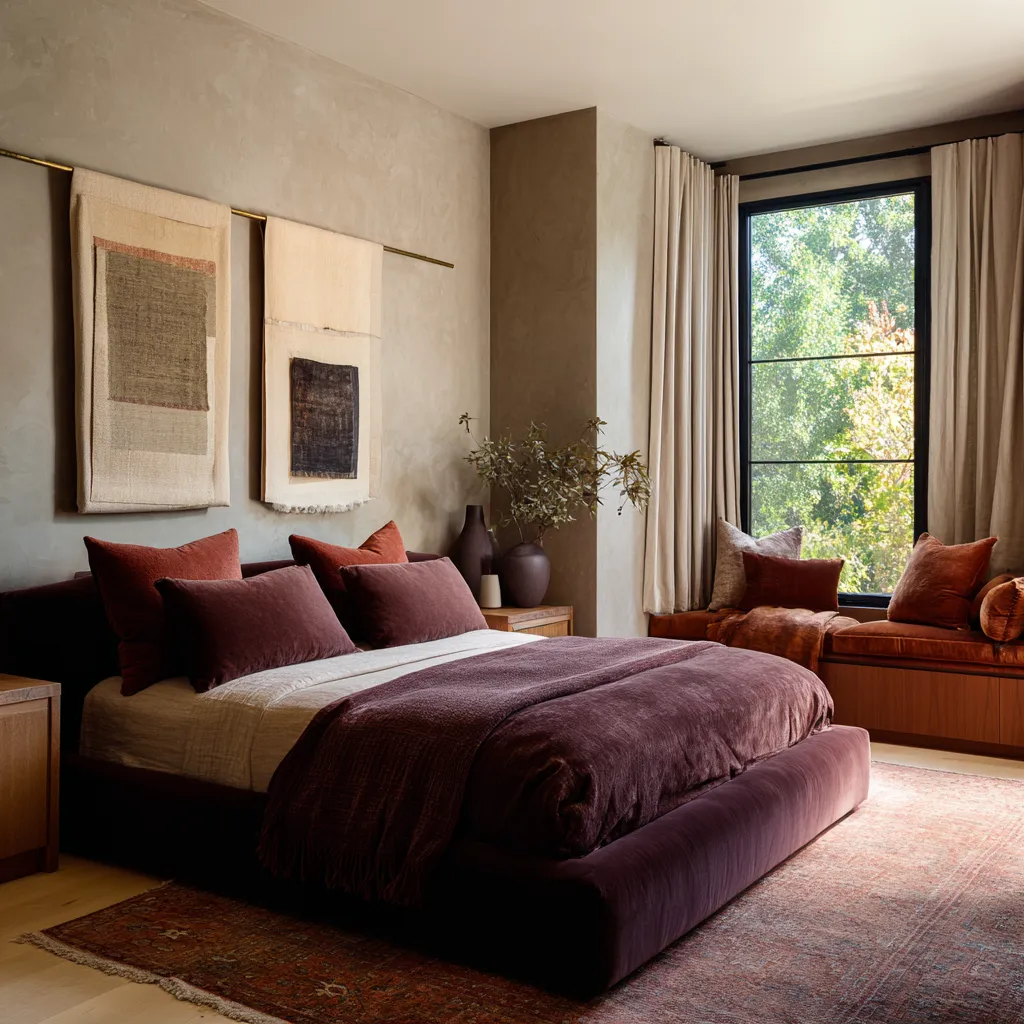
A carved or woven wall insert can add cultural depth to a space with simple case goods. The room stays coherent because the references are distributed through different surfaces and object types instead of fighting in one crowded layer.
A simple way to separate the references
A mixed room often feels more stable when the design languages are assigned clearly:
- Architecture: paneling, portals, canopies, built-ins, beams
- Art: abstract paintings, landscapes, grids, botanical studies
- Textiles: pillows, throws, benches, rugs, drapery
- Artifacts: carved pieces, woven objects, pottery, trunks, small accents
Frontality With Slight Drift
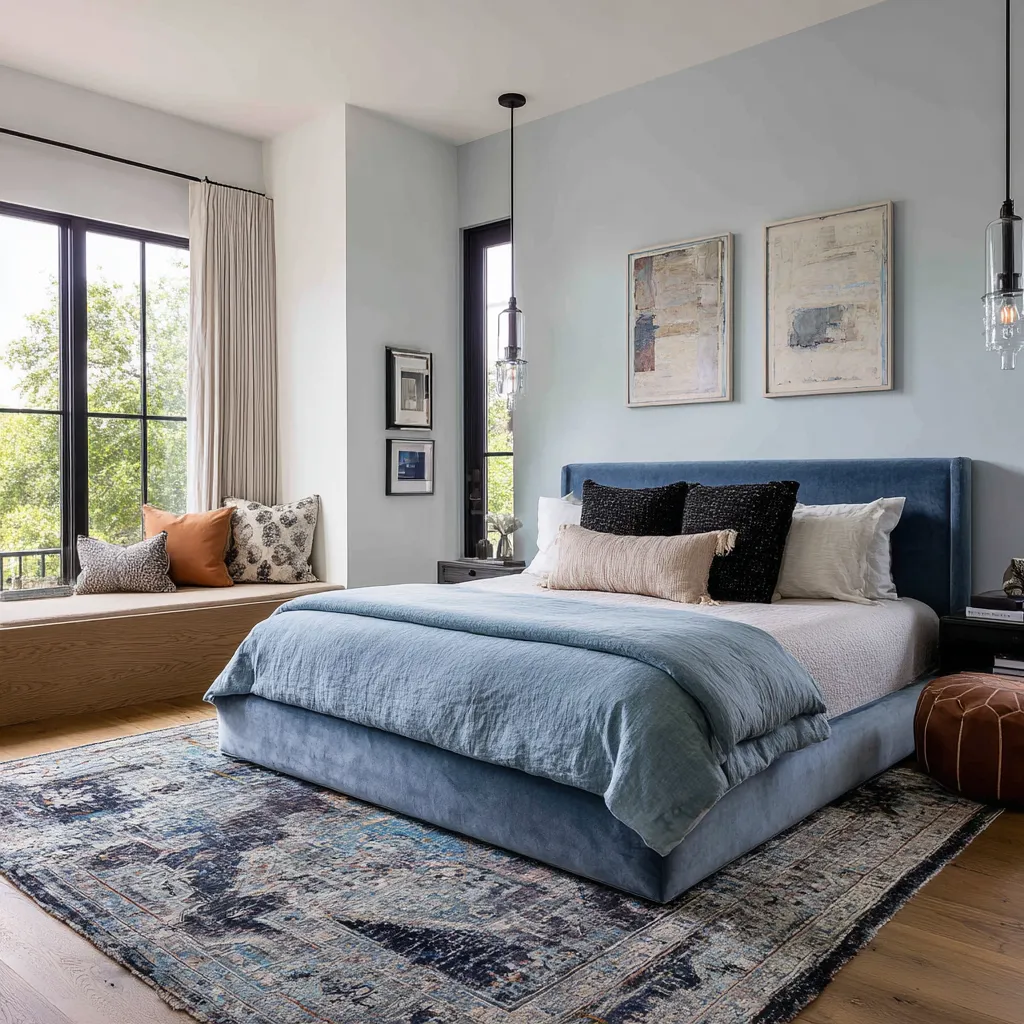
Another hidden strength is the use of frontality with slight drift. The bed is centered.
The composition is readable head-on. But the room avoids stiffness by letting the side conditions differ.
One side may hold a window seat while the other uses a table or shelving. One pendant may be heavier than the other.
One side might be visually denser through flowers or stacked objects, while the other remains more open. A dark drapery mass may compress one edge, while a brighter window opens the other.
This slight imbalance inside an ordered setup is one of the things that makes eclectic rooms feel assembled rather than staged.
Why Secondary Zones Matter
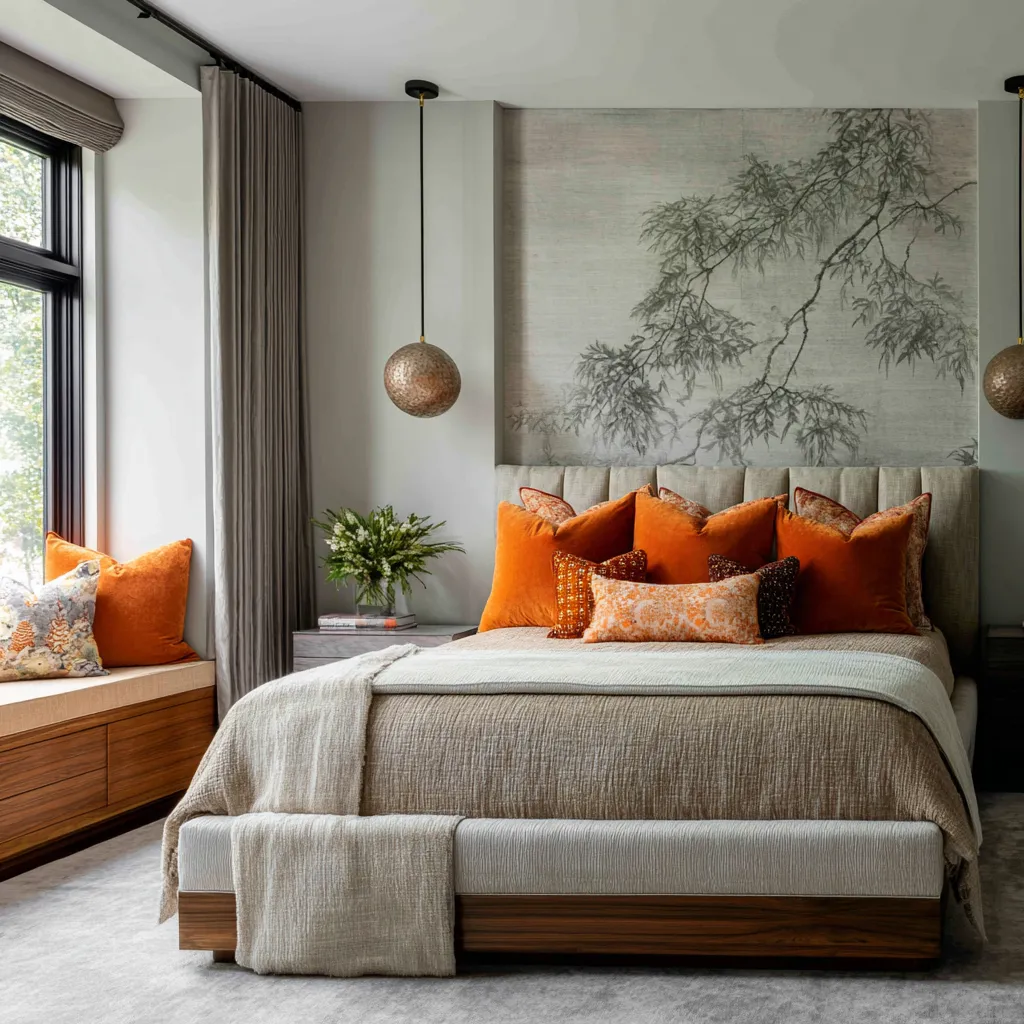
Secondary zones contribute a great deal to that feeling. A bedroom becomes fuller, more lived-in, and more generous once it holds more than a bed and two side tables.
A window seat, a bench with real visual presence, a lounge chair, a small console, or a reading corner broadens the room’s life. It suggests that the bedroom is not only for sleeping but also for sitting, reading, dressing, pausing, or looking out toward daylight.
These zones do not need to be large. Even a built-in cushion bench under a window can extend the composition and carry accent color away from the headboard.
A chair in leather or pale upholstery can create a second soft destination that helps balance a strong bed wall. In eclectic maximalist bedroom designs, these side zones do not raise the decorative pitch dramatically, but they do make the room feel more inhabited.
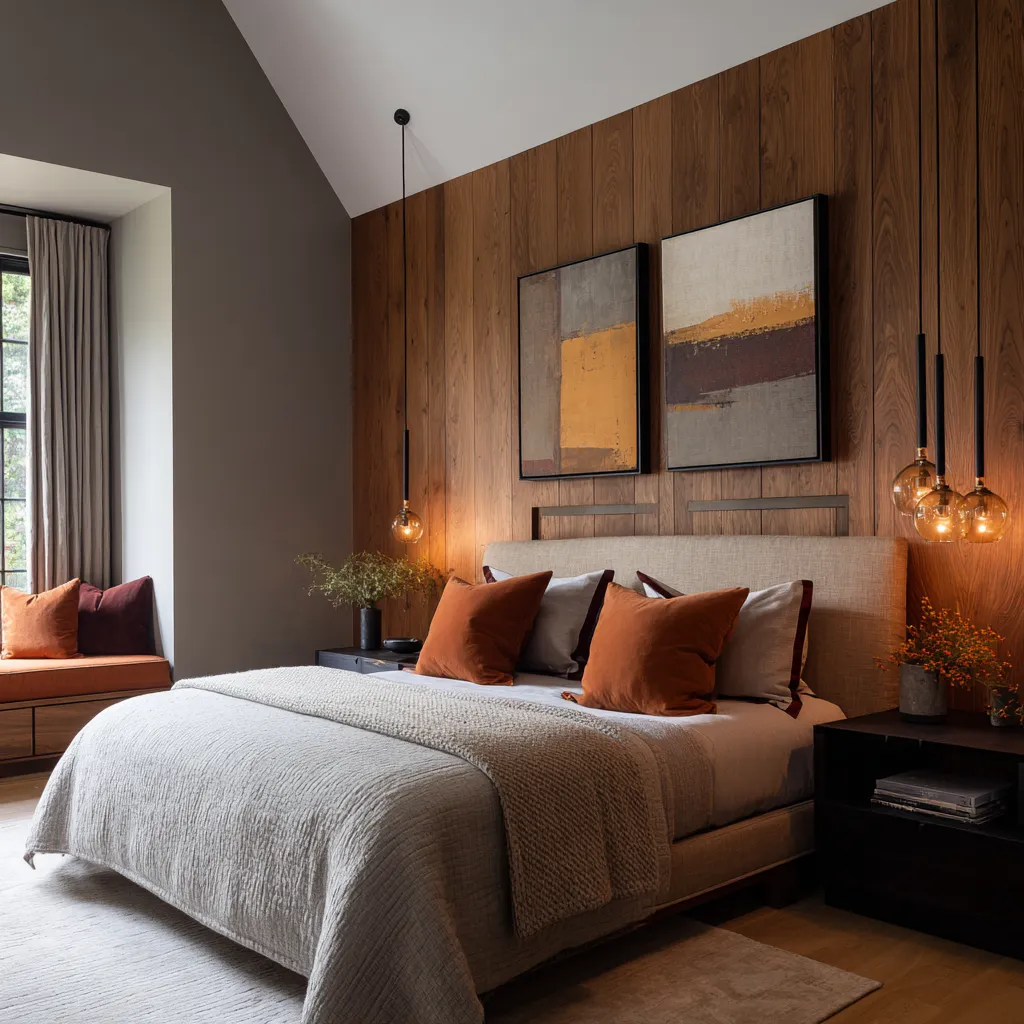
Secondary zones that often work well
- a built-in window seat with two or three layered cushions
- a lounge chair with one strong accent pillow
- a narrow bench at the bed foot
- a low console with art and a vessel
- a reading corner with floor lamp and side table
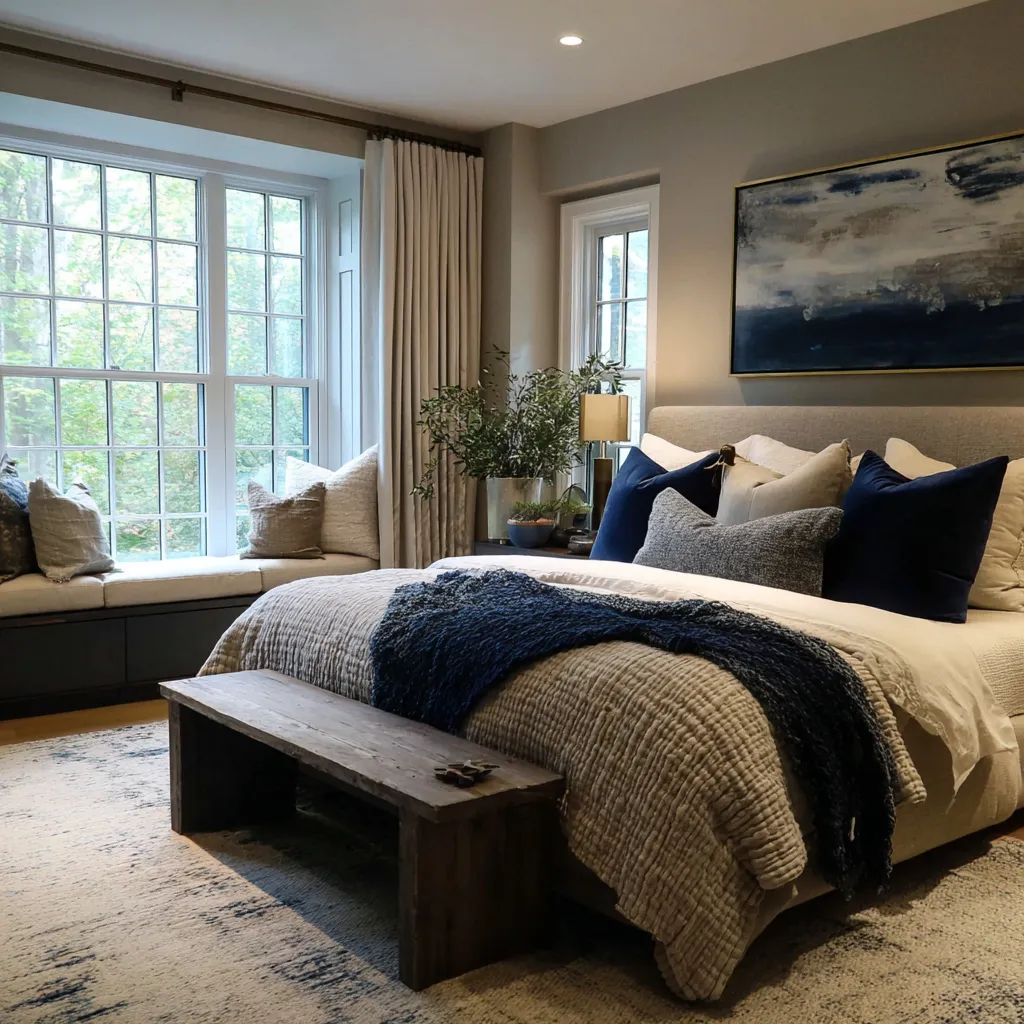
The Bench as a Quiet Hinge
The bench at the foot of the bed deserves special attention. It often looks like a supporting actor, yet it performs several important jobs.
It stabilizes the foreground so the bed does not stop too abruptly. It translates color from the pillows downward.
It extends softness beyond the mattress. It bridges the large upper gesture of the wall with the lower field of the rug.
A bench can also help with proportion. If the bed wall carries a mural, panel system, or large art, the bench gives the eye something to register before moving upward.
It can be pale and textural in a room with strong wall drama, or warmer and denser in a room that needs a grounded lower band.
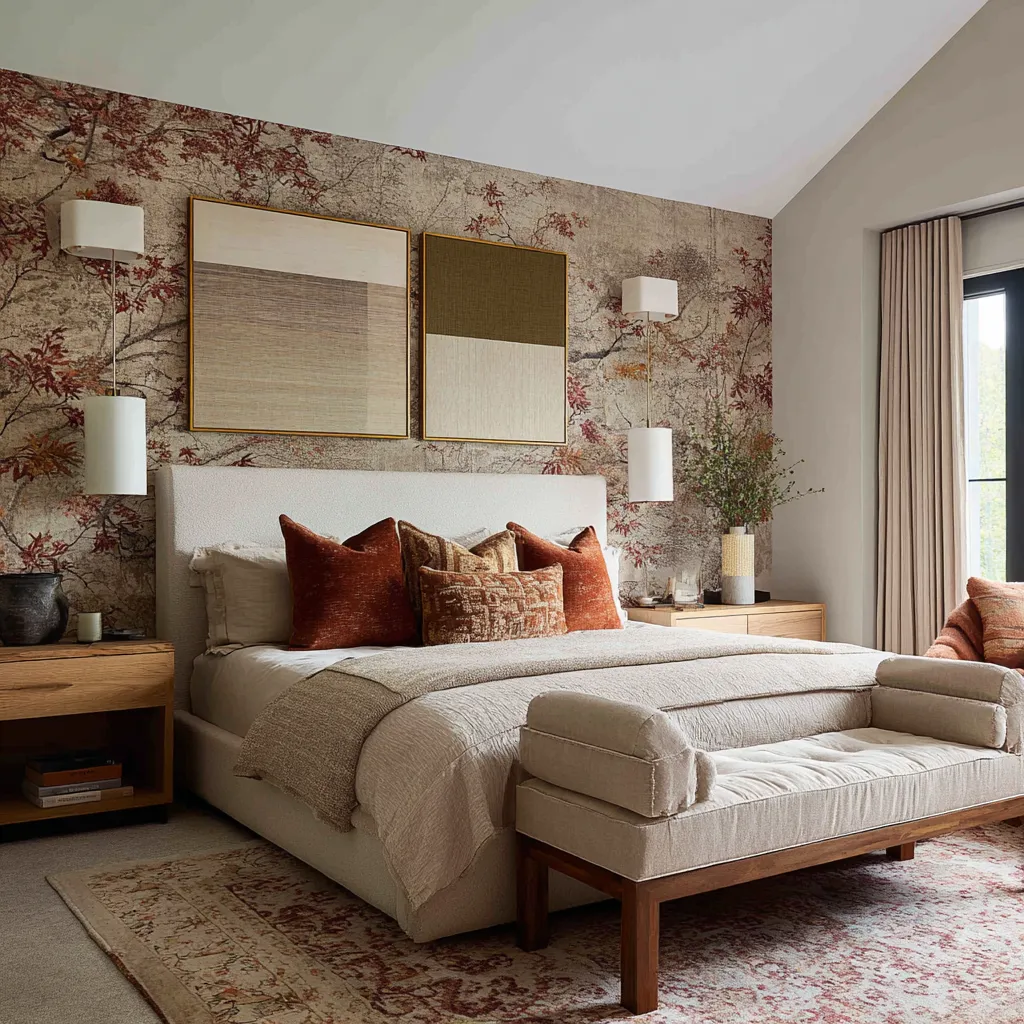
The Ceiling Does More Than People Think
Ceilings and upper structure also deserve more attention than they usually receive in discussions of bedroom style. In many eclectic maximalist bedrooms, the ceiling does not stay passive.
Beams, slopes, dark upper framing, pitched forms, and canopy tops all help shape the emotional scale of the room. A sloped ceiling can compress the headboard zone in a useful way, turning it into a sheltered sleeping chamber.
Exposed beams can strengthen direction and depth. A woven canopy insert can make the bed feel like its own crafted structure rather than a furniture piece placed against a wall.
This upper participation often adds seriousness to the room because the design is no longer working only at eye level; it is shaping the volume itself.
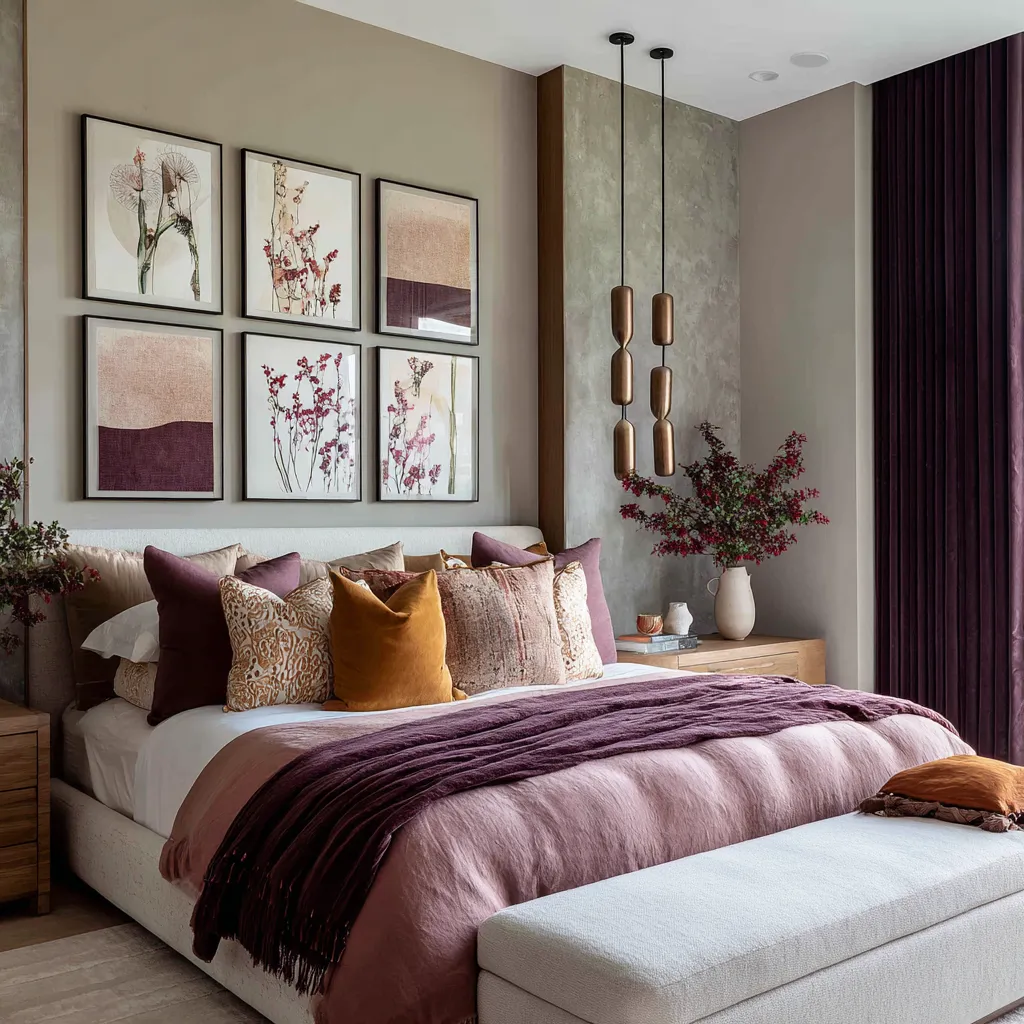
Three ways the ceiling helps
Volume compression
A darker or lower upper zone can make the bed feel held and protected.
Direction
Beams and slopes can pull the eye through the room and add depth.
Bed-zone roofing
Canopies and sloped planes can turn the sleeping area into a smaller room inside the room.
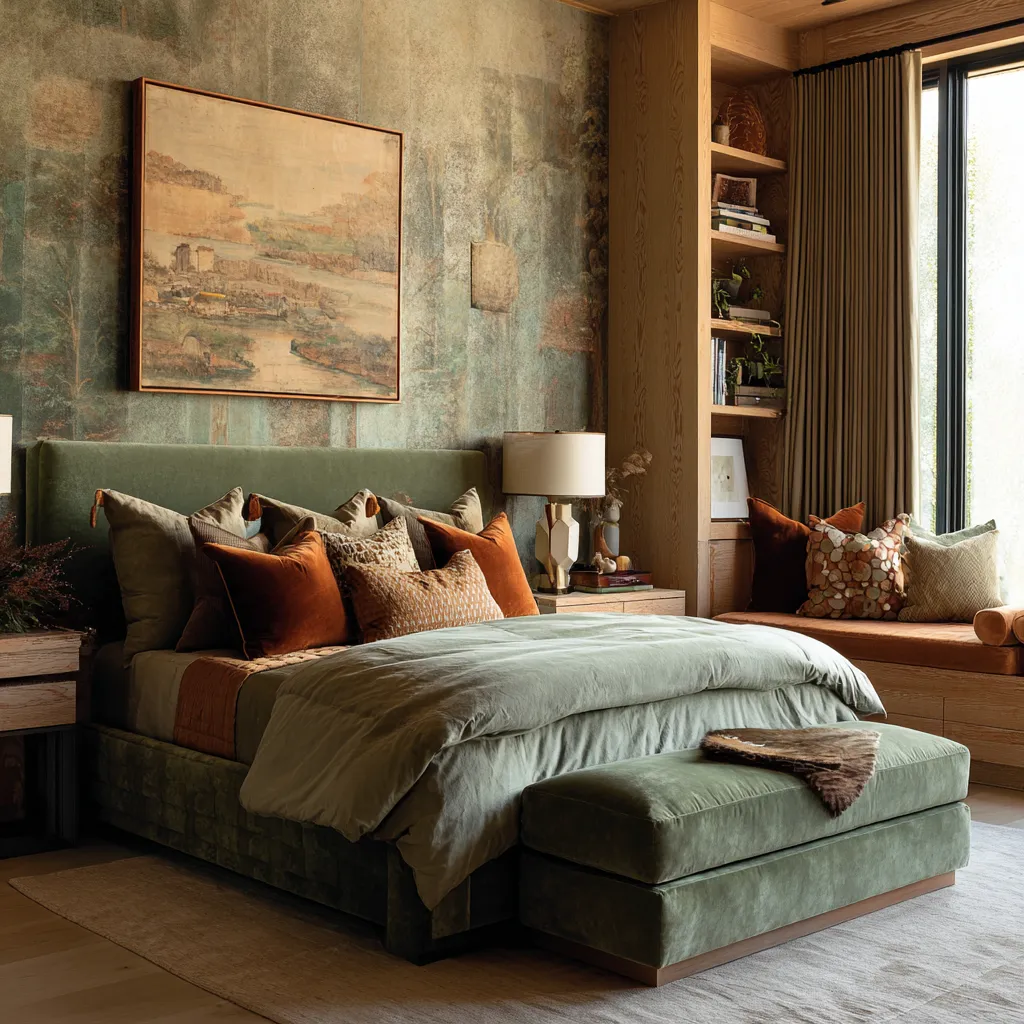
The Many Jobs of Art
Art, too, works in more ways than people often assume. It can extend the wall atmosphere, as in a hazy landscape or abstract horizon that deepens the room without creating a hard focal interruption.
It can balance heavy architecture, especially in rooms with dark portals, strong wood framing, or canopy structures. It can govern the palette by showing which warm and cool notes belong together.
It can inject time-depth through scenic distance, weathered abstraction, or mixed frame groups that suggest selection over time. And it can modernize a room that uses warm wood, plaster, or aged surfaces by laying a cleaner graphic or abstract language over those richer materials.
In many cases, art is not simply decoration. It is the room’s translation device between atmosphere, material, and furniture.
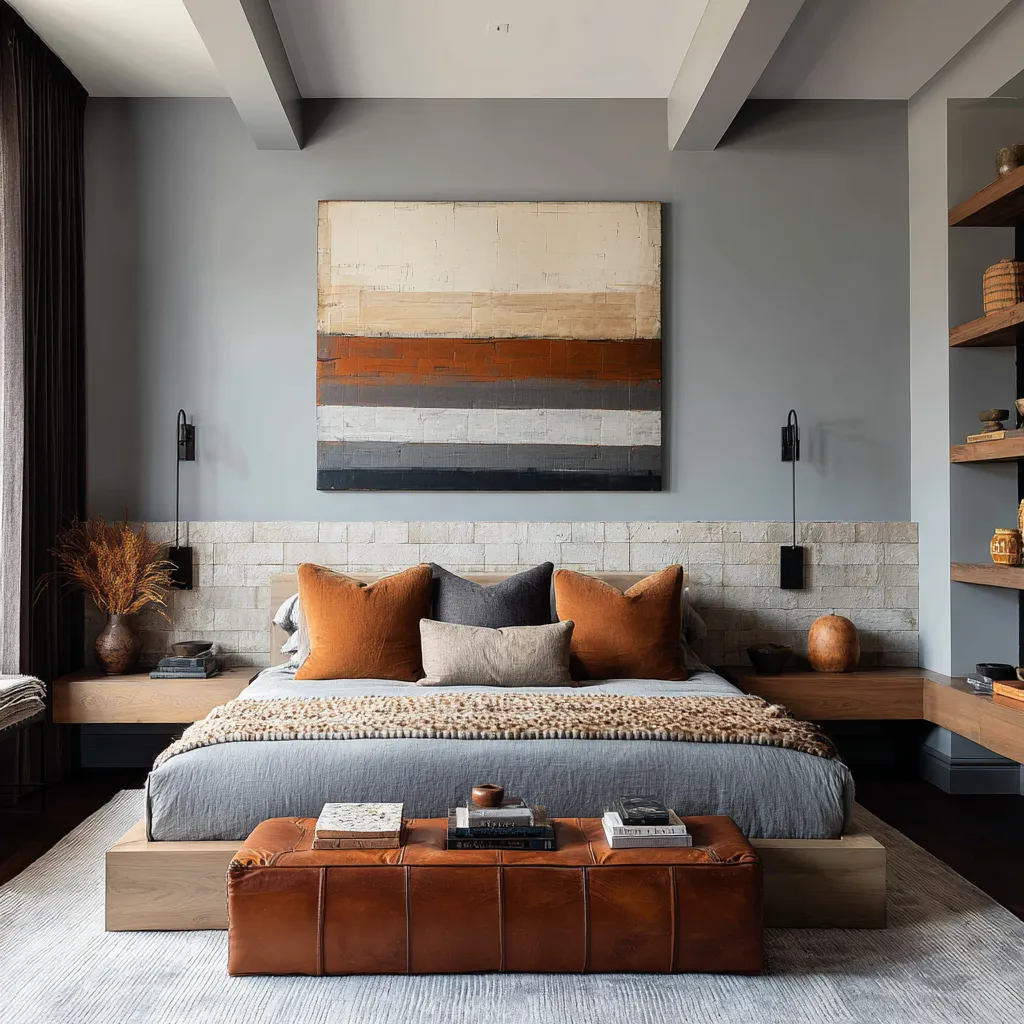
Five useful roles art can play
- Atmospheric extension: deepens the room rather than interrupting it
- Structural counterweight: balances heavy framing or dark walls
- Palette governor: sets the color family for textiles and accents
- Time-depth layer: adds memory, distance, or a collected tone
- Modernizing layer: sharpens rooms built from warm wood, plaster, or aged surfaces
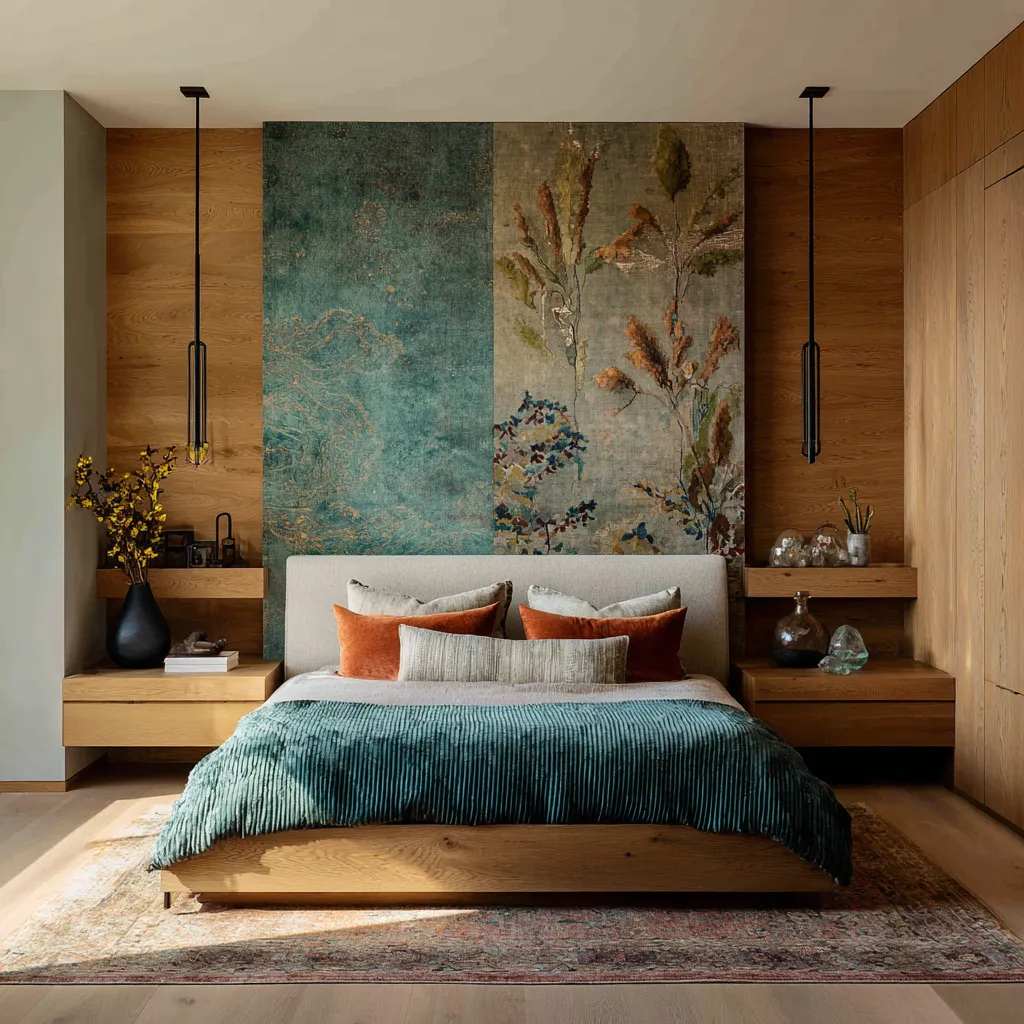
Pattern Placement Is More Important Than Pattern CountPattern needs particular care in this style. The strongest rooms usually place pattern in one or two major locations rather than everywhere.
If the wall is active, the bedding usually broadens and simplifies. If the room uses multiple artworks, the rug may soften.
If the bedding carries more pattern, the walls tend to stay quieter. This does not mean the room must become restrained.
It means frequency has to be managed. The eye can handle richness when it knows where the denser information is stored.
It struggles when every plane competes at the same visual pitch.
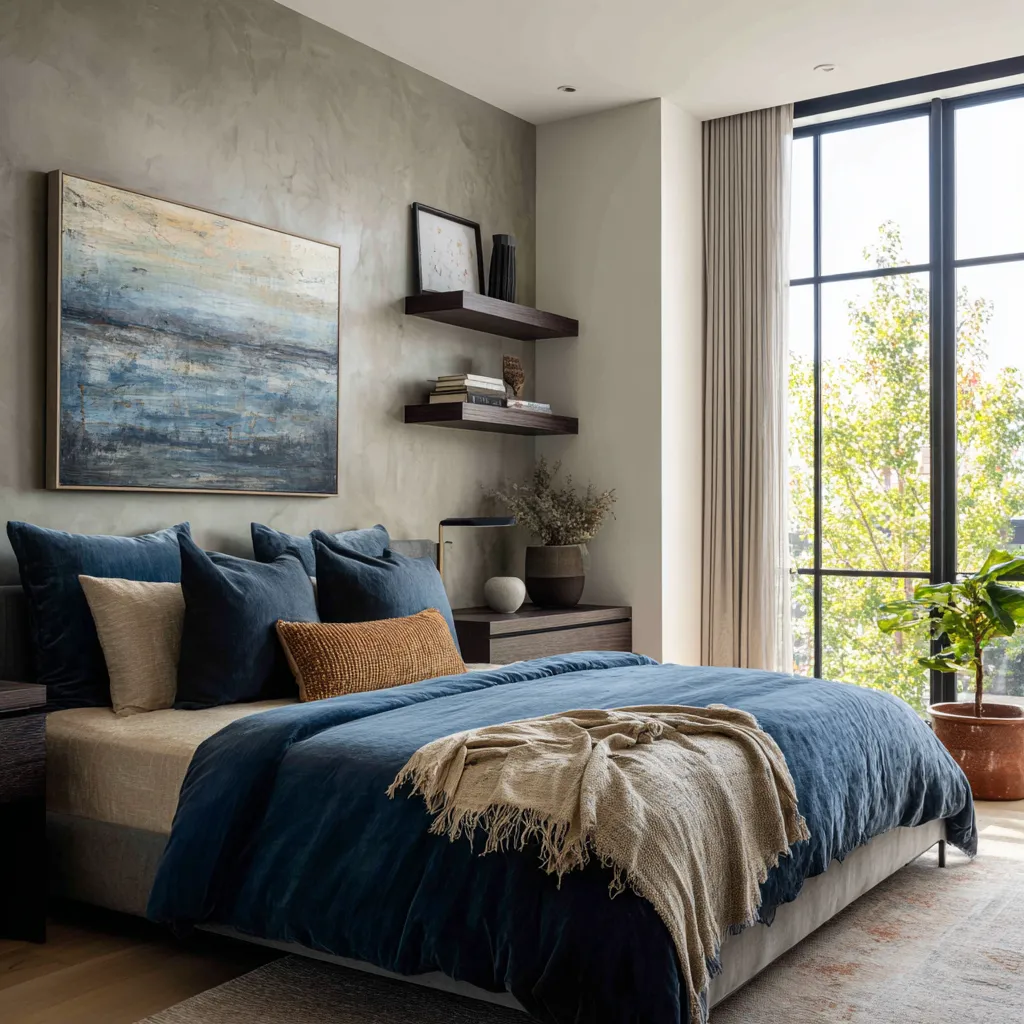
This is why hard-soft alternation is so helpful. Wood beside upholstery, mural behind plain bedding, leather against a soft throw, rigid canopy framing with loose floral branches, geometric art over a faded scenic wall, beams above fabric, dark structure with a pale bed core — these alternations keep the room alive.
If everything in the room is soft, the composition can lose shape. If everything is severe, the room can lose bodily warmth.
Eclectic maximalism often works because those oppositions are placed with care.
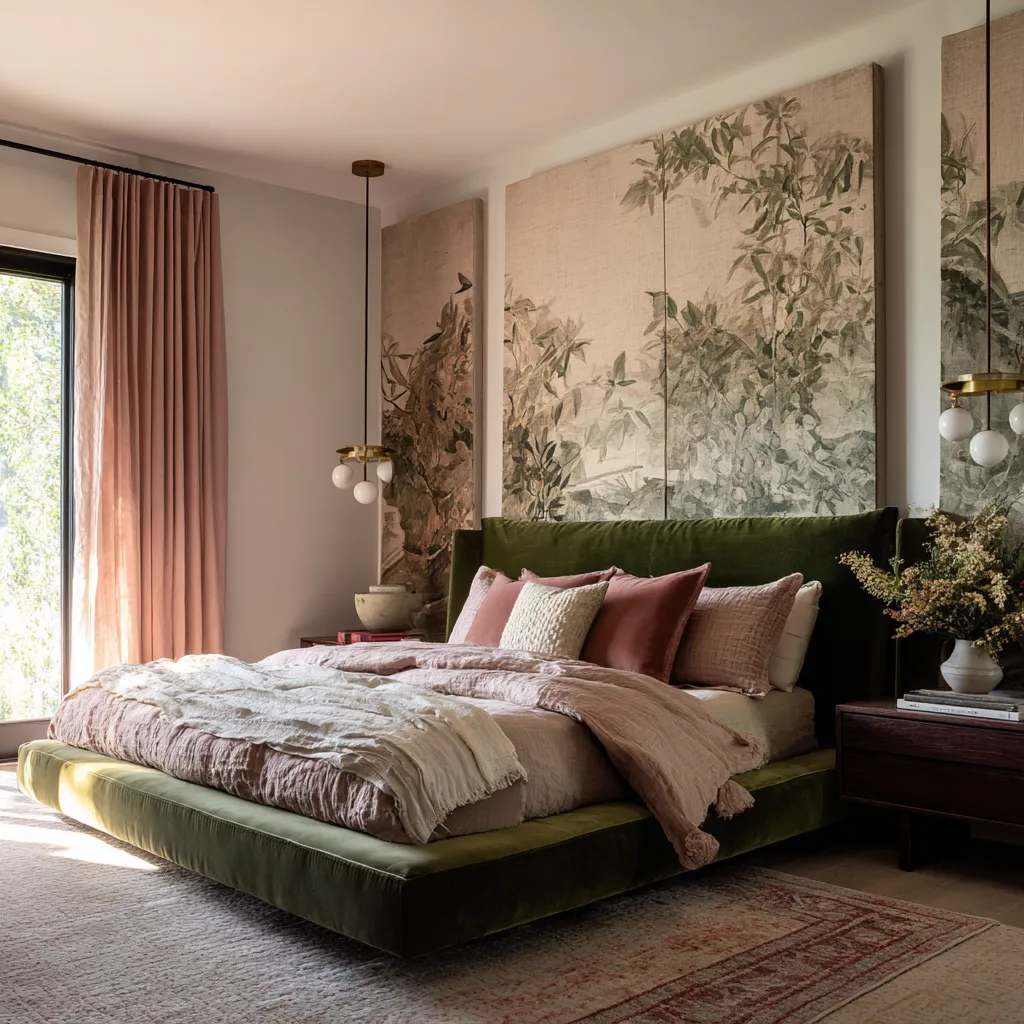
Different Faces of the Style
One of the qualities of the style is that it can move through several subtypes without losing its identity. It can be structural, with canopies, portals, alcoves, and inset fields doing the heavy lifting.
It can be atmospheric, built from murals, scenic walls, plaster finishes, and softened branch or landscape motifs. It can be curated, relying on grouped artworks and a more gallery-like approach to the bed wall.
It can be earthy and tactile, with leather, woven inserts, carved surfaces, trunks, and warm aged materials shaping the mood. It can also stay airy and bright, using layered seating, a strong rug, a bench, and accent compression to create fullness without leaning into darkness.
The style is broader than one stereotype. What connects these branches is not the same palette or the same furniture type.
It is the shared logic of edited abundance, perimeter intensity, and a legible sleeping core.
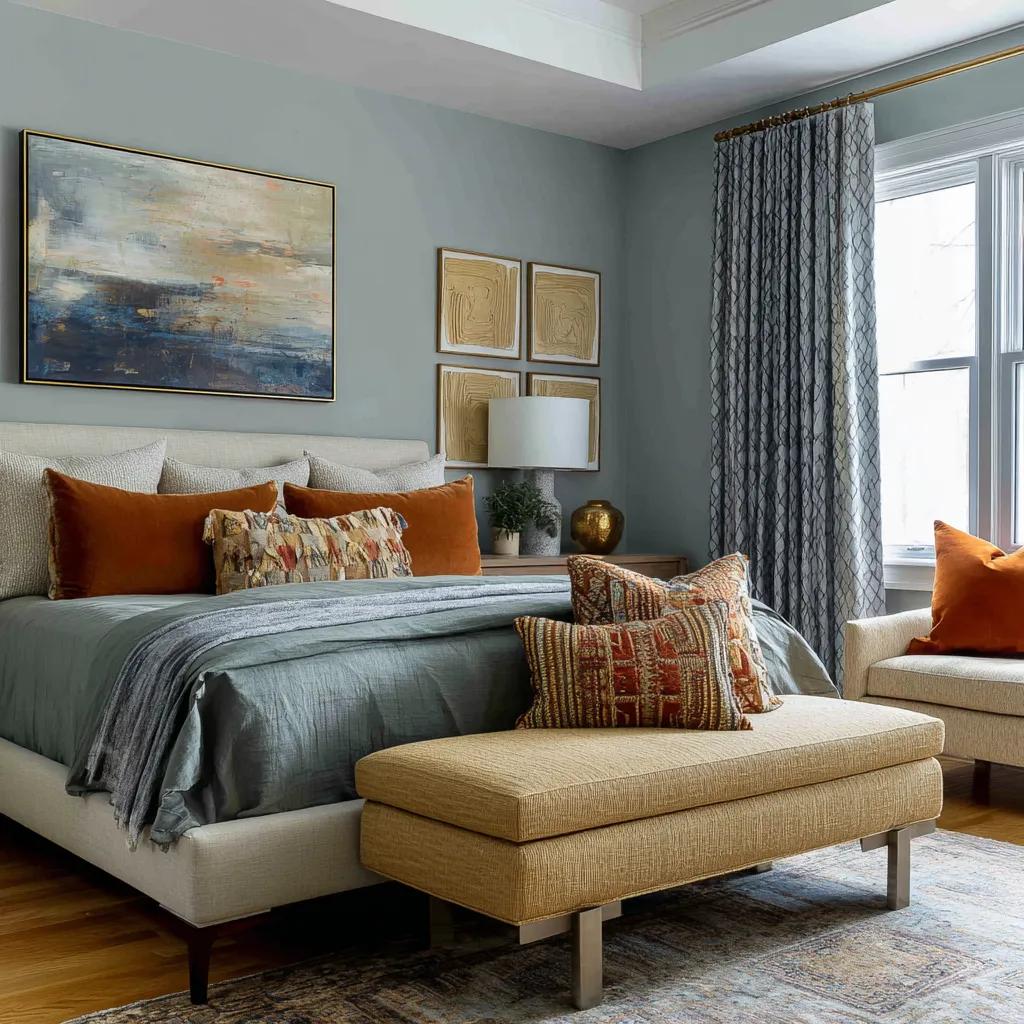
Common subtype directions
Structural-chamber
Portals, alcoves, canopies, inset fields, darker framed bed zones.
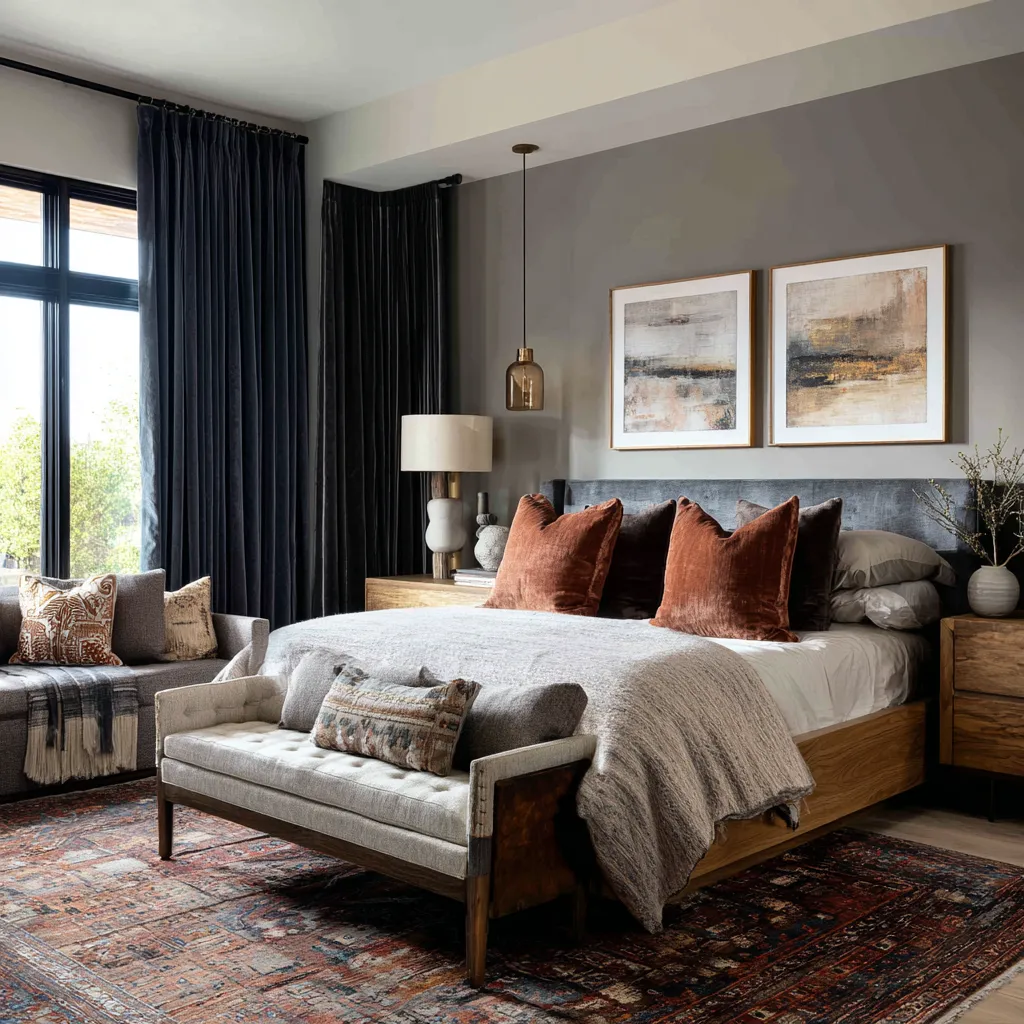
Scenic-atmospheric
Murals, haze, plastered walls, branch motifs, landscape-like surfaces.
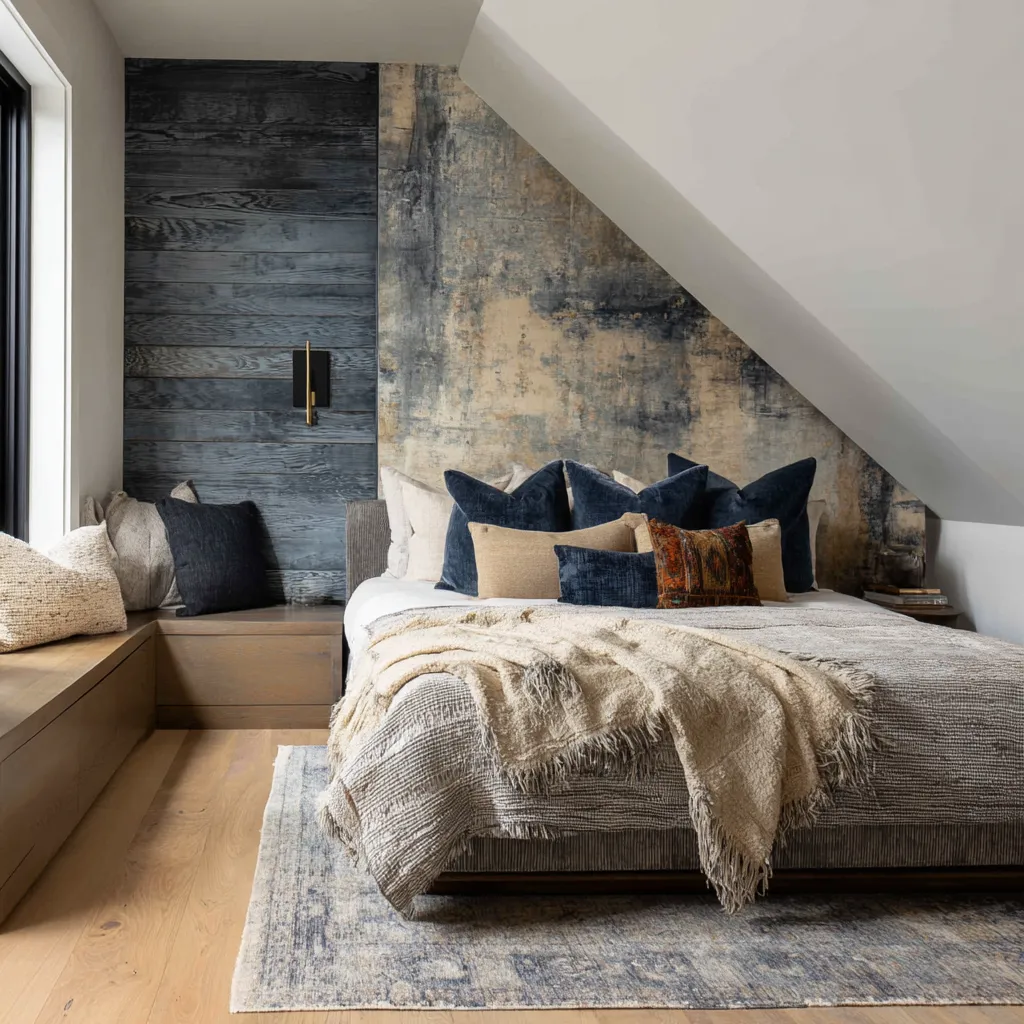
Curated
Gallery walls, art grids, grouped paintings, clear frame logic.
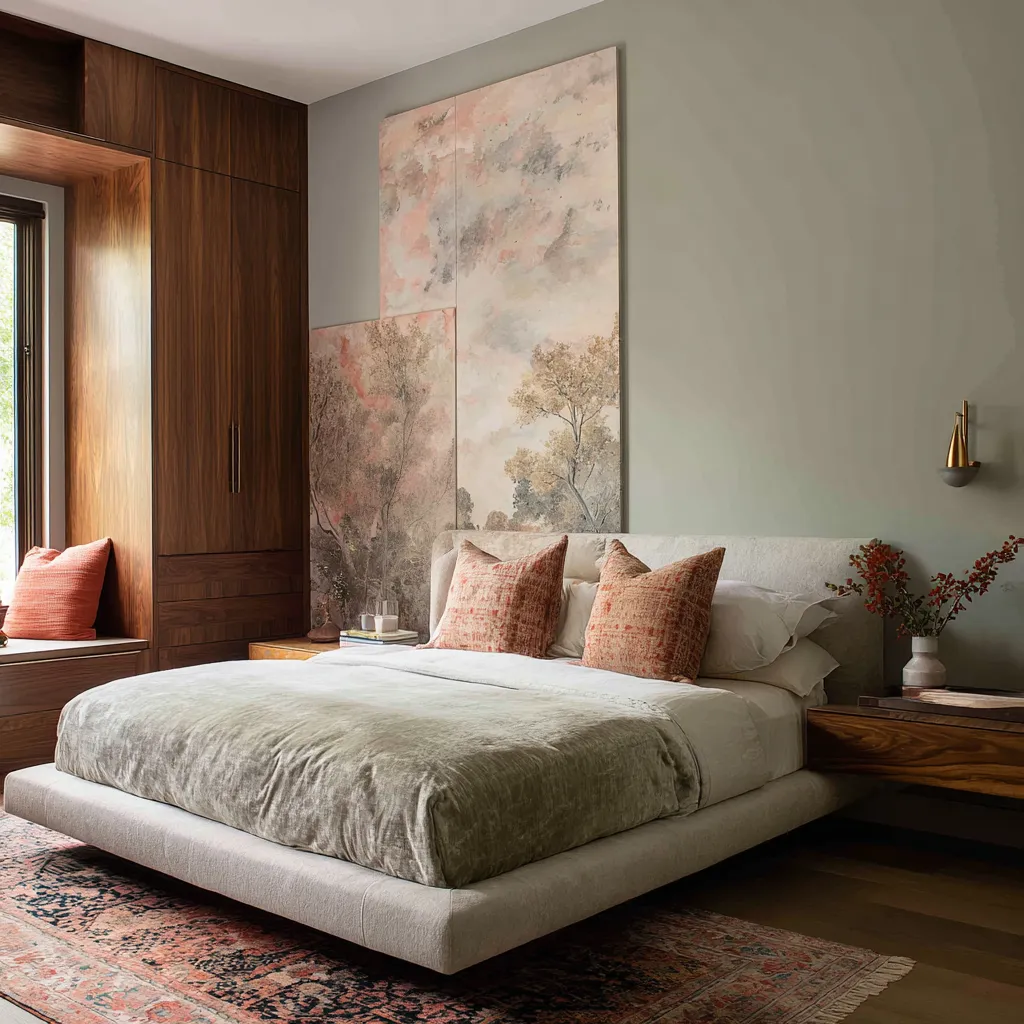
Earthy tactile
Leather, woven surfaces, carved inserts, aged wood, plaster, artifact character.
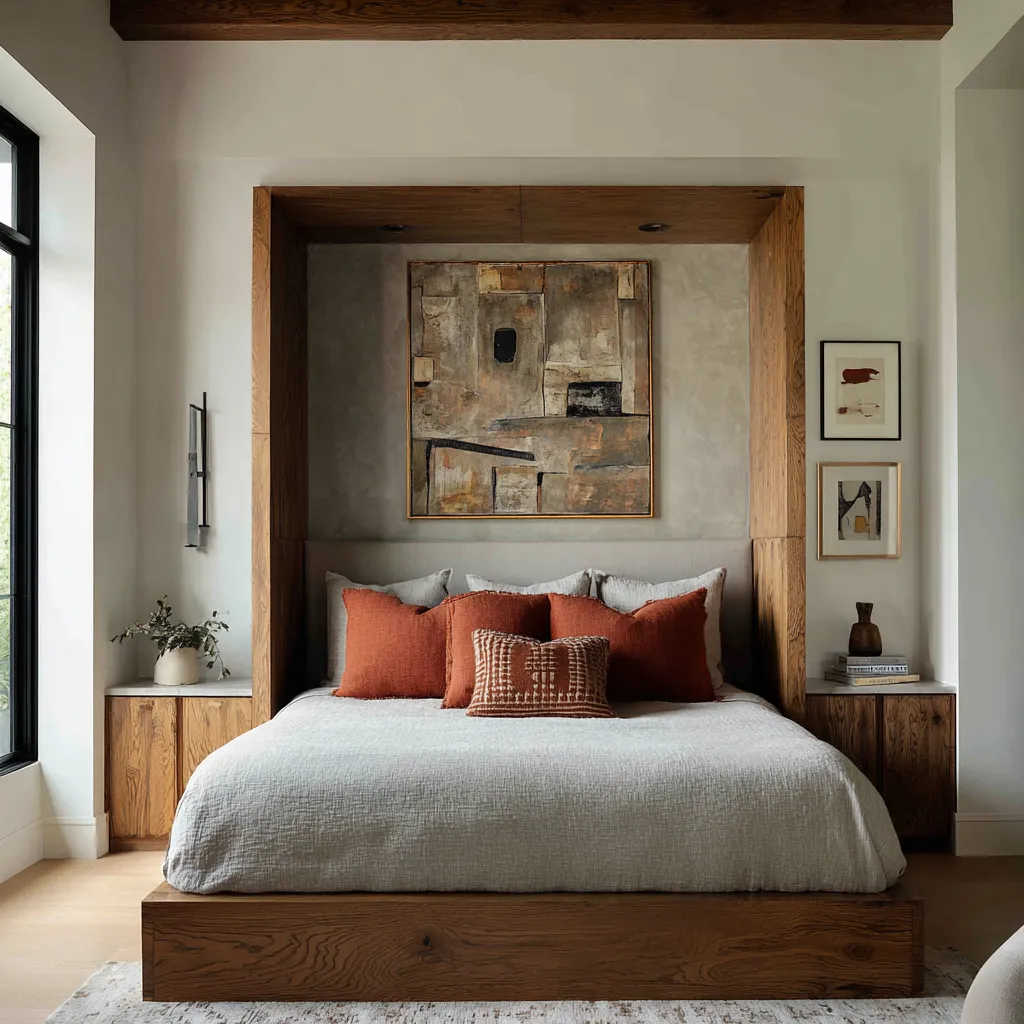
Airy layered
Lighter shells, stronger daylight, window seats, benches, rugs, softer accent spread.
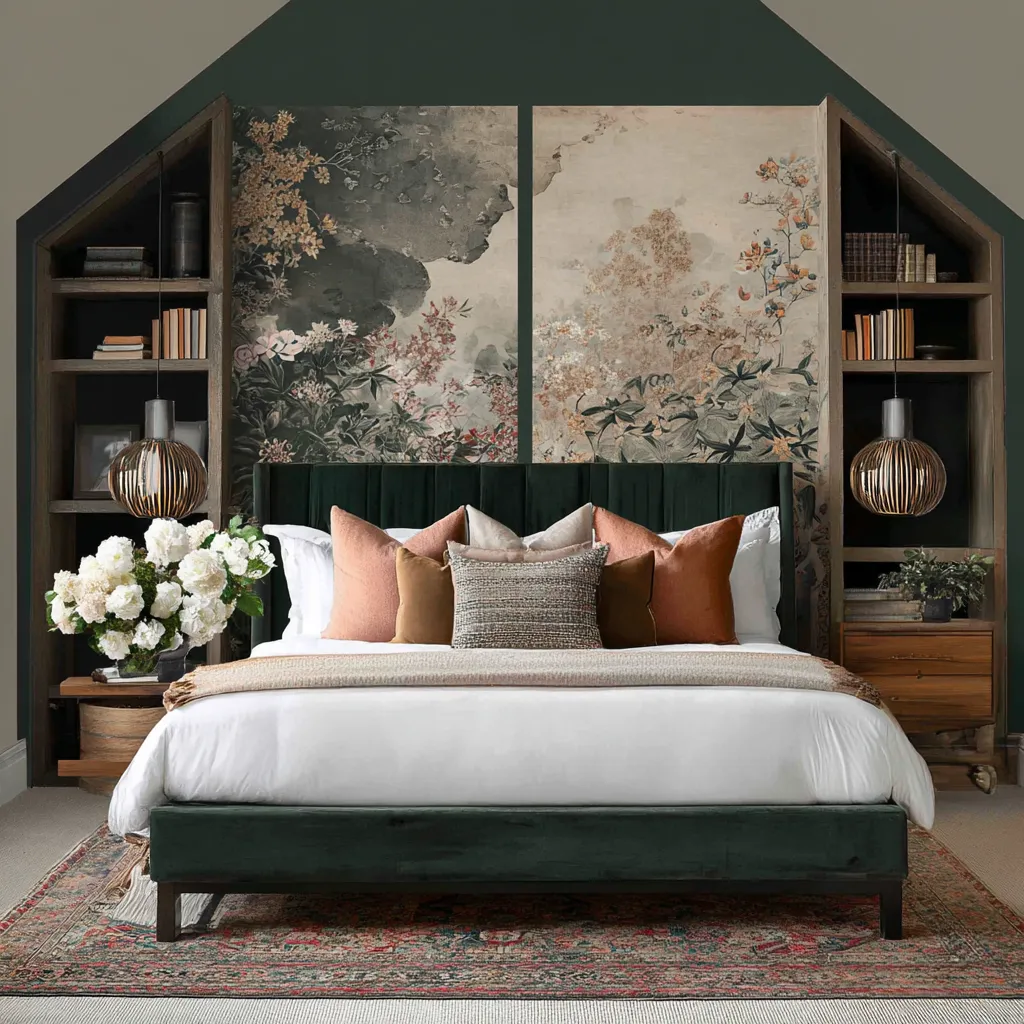
What Keeps the Room Feeling Current
That point is worth holding onto because many people still associate maximalism with visual overload. In bedrooms, that approach usually fails.
A stronger eclectic maximalist bedroom does not ask every object to speak at once. It lets one wall, one frame, one art system, one material field, or one atmospheric surface set the tone.
Then it builds support through palette echoes, tactile layering, and a few carefully placed warm notes. It gives the eye structure, the body softness, and the room a sense of collected life.
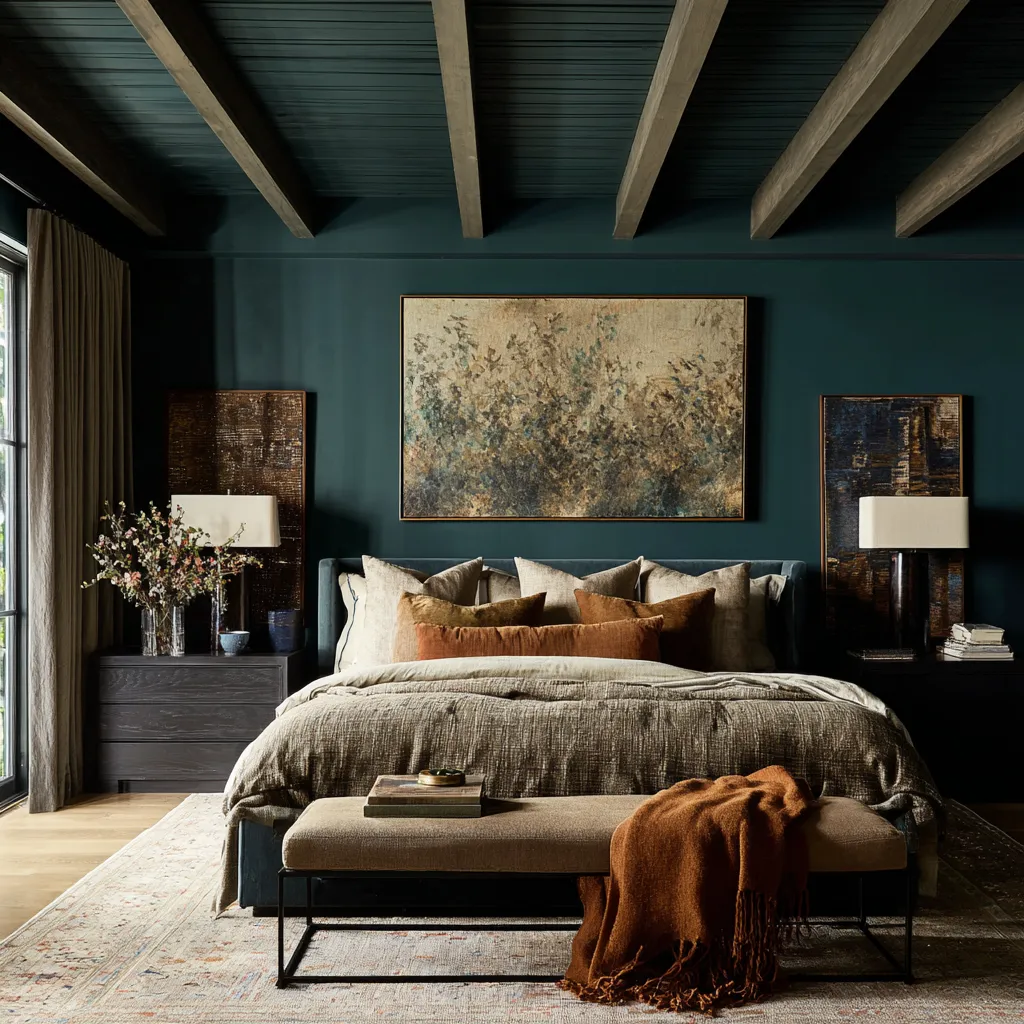
Interior design can stay current through a few recurring strategies:
- simplify silhouettes with low beds and broad upholstered forms
- use larger gestures rather than many small decorative ones
- let materials do the work instead of piling on accessories
- keep the bed core broad and calm even when the perimeter grows richer
- use slim pendants, floating pieces, or cleaner forms to sharpen older-feeling materials
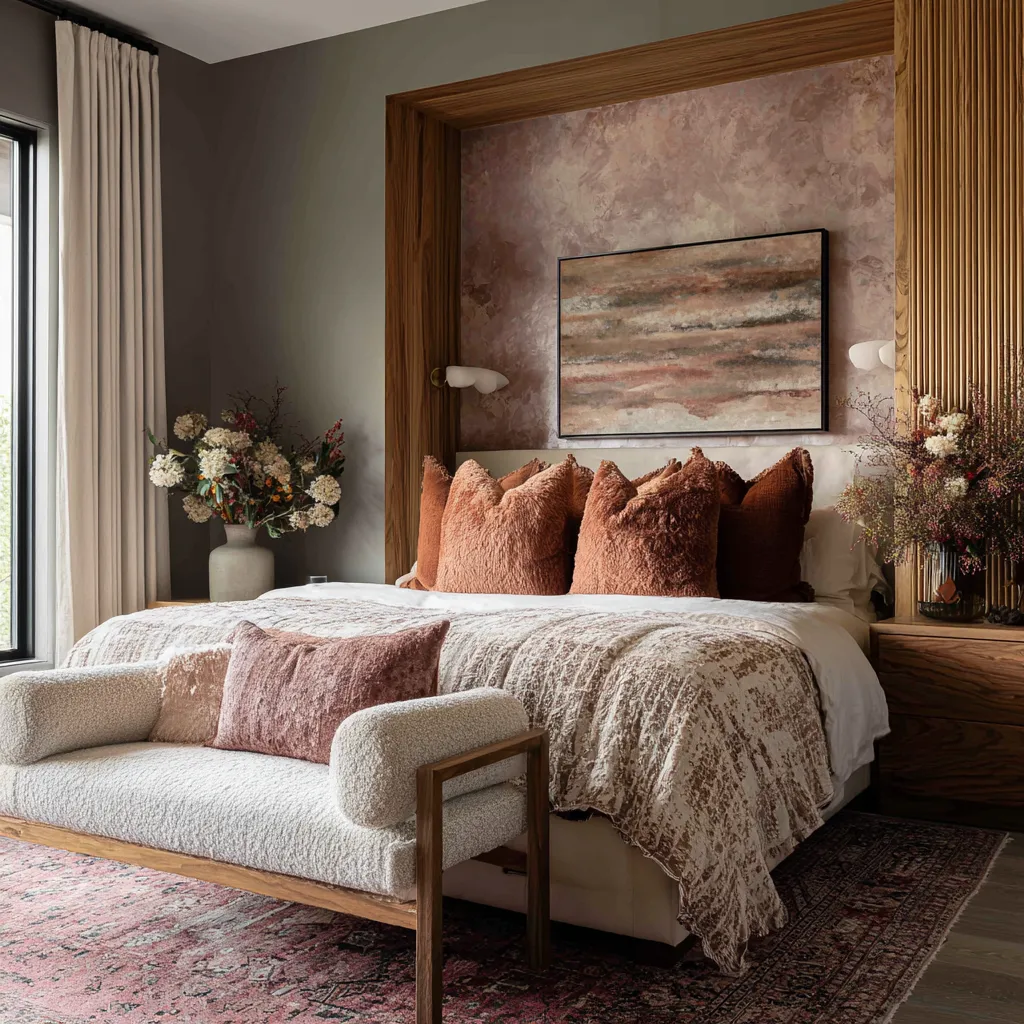
Final Thought
In the end, the style works because it separates drama from contact. The drama belongs to the wall, the frame, the shell, the art, the drapery, the bench, the rug, the secondary zone, the ceiling, or the material skin.
The contact zone — the place where the body meets the room — receives softer bedding, broader upholstery, warmer touch points, and simpler visual rhythm. That division is the hidden discipline inside eclectic maximalist bedroom design.
It is what allows a room to feel lush without becoming crowded, storied without feeling dated, and expressive without giving up rest.
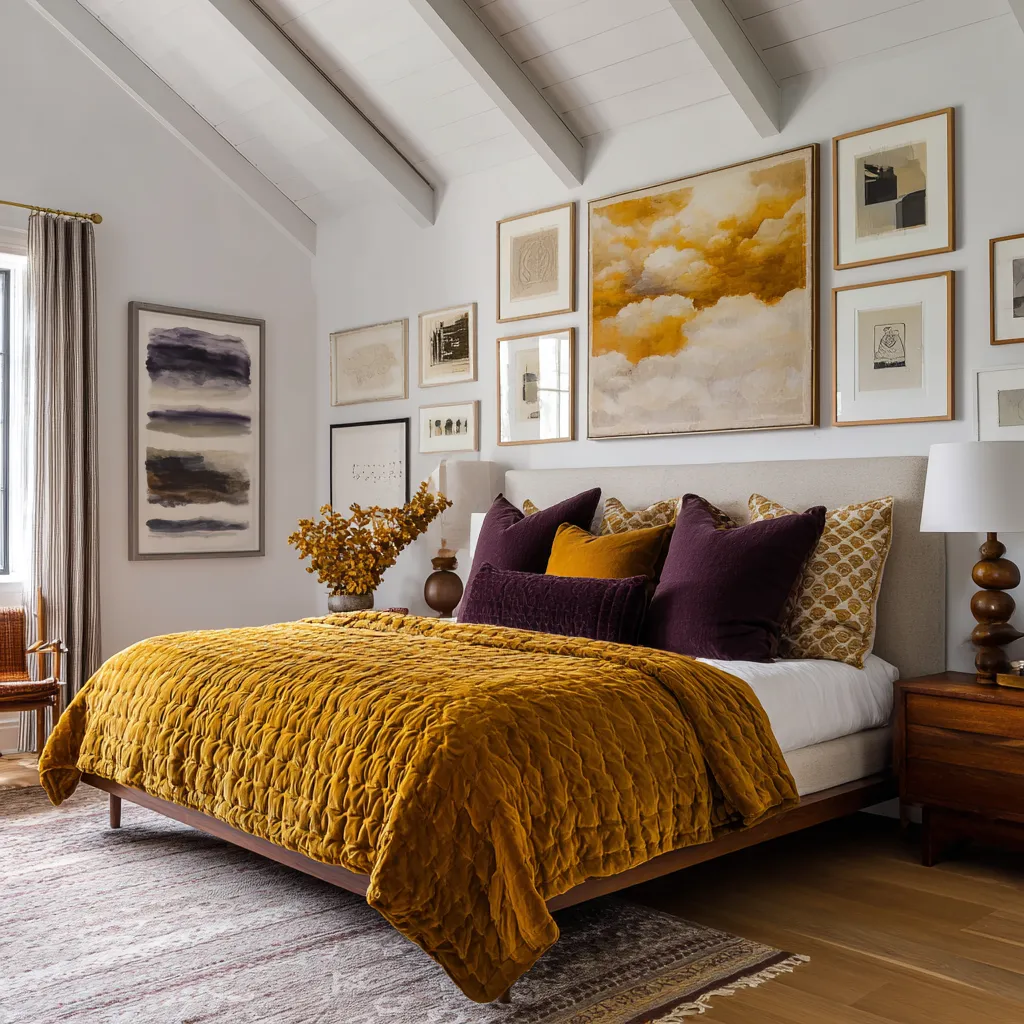
A bedroom like this does not need endless decor. It needs a strong idea, a clear hierarchy, and the confidence to let richness gather where it matters most.