A strong modern coastal entryway design does not usually begin with blue paint, shell decor, striped fabric, or obvious maritime references. It begins earlier than that, at the level of proportion, surface, and air.
The designs can feel coastal before the eye has even named a single object. They feel wide, light-struck, dry rather than glossy, softened rather than polished, and shaped by a kind of quiet exposure to weather.
That is why some entryway ideas can feel close to the shoreline even when there is no sailboat print, no glass buoy, no pile of coral on the console, and no overt beach-house styling at all.
This is the part of coastal design that often gets lost. Many people think coastal style is a matter of symbols.
In current interior ideas, it is far more often a matter of conditions. The entry feels coastal because its materials seem sun-washed, because its lines stretch laterally like a horizon, because its woven textures carry the dryness of reeds, grass, rope, and basketry, because its ceramics feel chalky and softened, and because the room leaves enough open visual space for those material cues to register.
The coast appears not as decoration pasted onto the room, but as a slow effect of light, erosion, air, and restraint.
That is also why the entryway is such an important place for this style. The entry is the house’s threshold.
It does not need to explain everything. It only needs to establish the mood with precision.
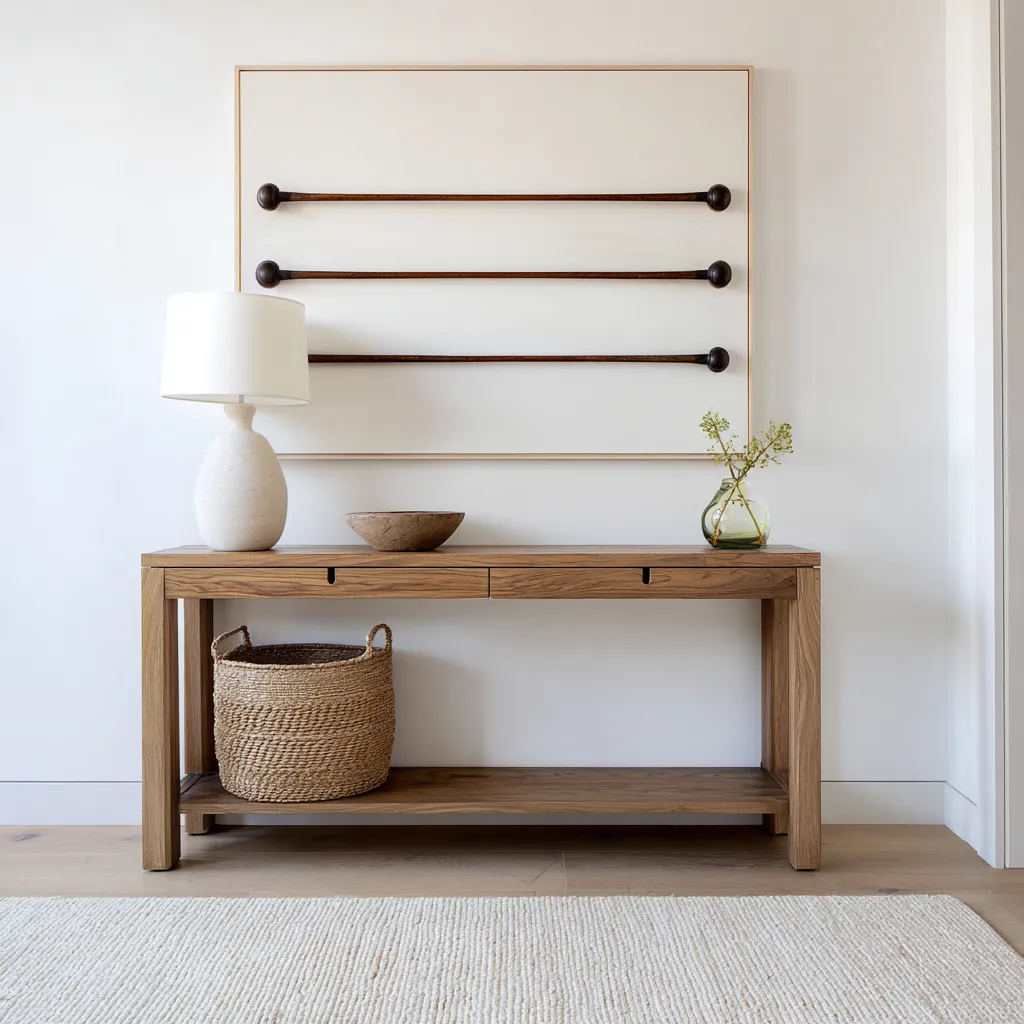
A good modern coastal entryway can set the entire interior in motion with a few controlled moves: a long console, one weathered wall element, a pale woven runner, a rounded lamp base, a low bowl, a basket with real texture, and a dry branch arrangement that introduces line without prettiness. Nothing here needs to shout.
In fact, the more current versions nearly always gain their strength by holding back.
Start with the horizon, not the colors
One of the ways to build a coastal entryway is also one of the least obvious. It is not an object at all.
It is horizontality. A shoreline is a stretched condition.
It is a meeting of land and water that runs laterally across vision. Modern coastal entryways often carry that lateral quality into the room through long consoles, floating shelves, broad bench cushions, narrow rails, extended wall pieces, runner rugs, shallow art bands, and open shelf lines.
Even a reduced entry with almost no decor can begin to feel coastal once it is organized through these long horizontal moves.
This matters because lateral composition communicates something much subtler than a themed decorative piece. A paddle, rope knot, or sailboat model immediately names a subject.
A long console beneath a wide piece of abstract art does something else. It creates spread.
It gives the wall a low visual pull. It stabilizes the room.
It lets the eye move sideways rather than only up and down. In an entryway, especially a narrow one, that kind of organization can be enough to suggest shoreline atmosphere without ever spelling it out.
This is one reason many fresh coastal entryway ideas feel settled even when they are extremely spare. Their visual language is built from bands: the top of a console, the line of a shelf, the lower edge of art, the track of a runner, the beam across a wall, the seat line of a bench, the edge of paneling.
Once those bands are aligned and carefully spaced, the room begins to carry that coastal breadth almost automatically. So before choosing any decor, it is worth asking a more structural question: where is the horizon line in the entry?
Is it the console top, the hook rail, the lower edge of a framed panel, the seat of a built-in bench, or the line created by several mounted objects acting together? Coastal mood often enters through that answer first.
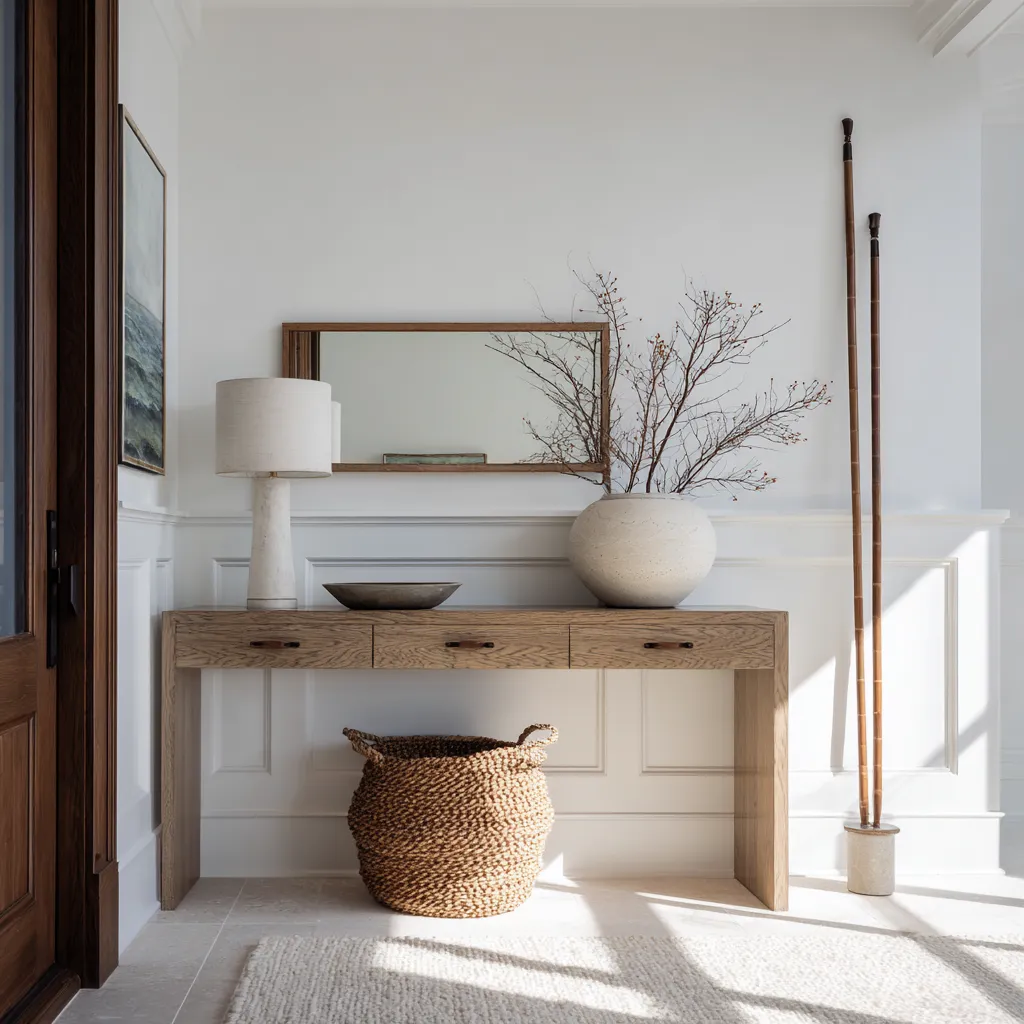
Think in terms of exposure, not just nature
Another major shift in modern coastal design is the move away from generic natural materials and toward materials that feel altered by exposure. Coastal entryway designs do not merely contain wood, fiber, ceramic, or linen.
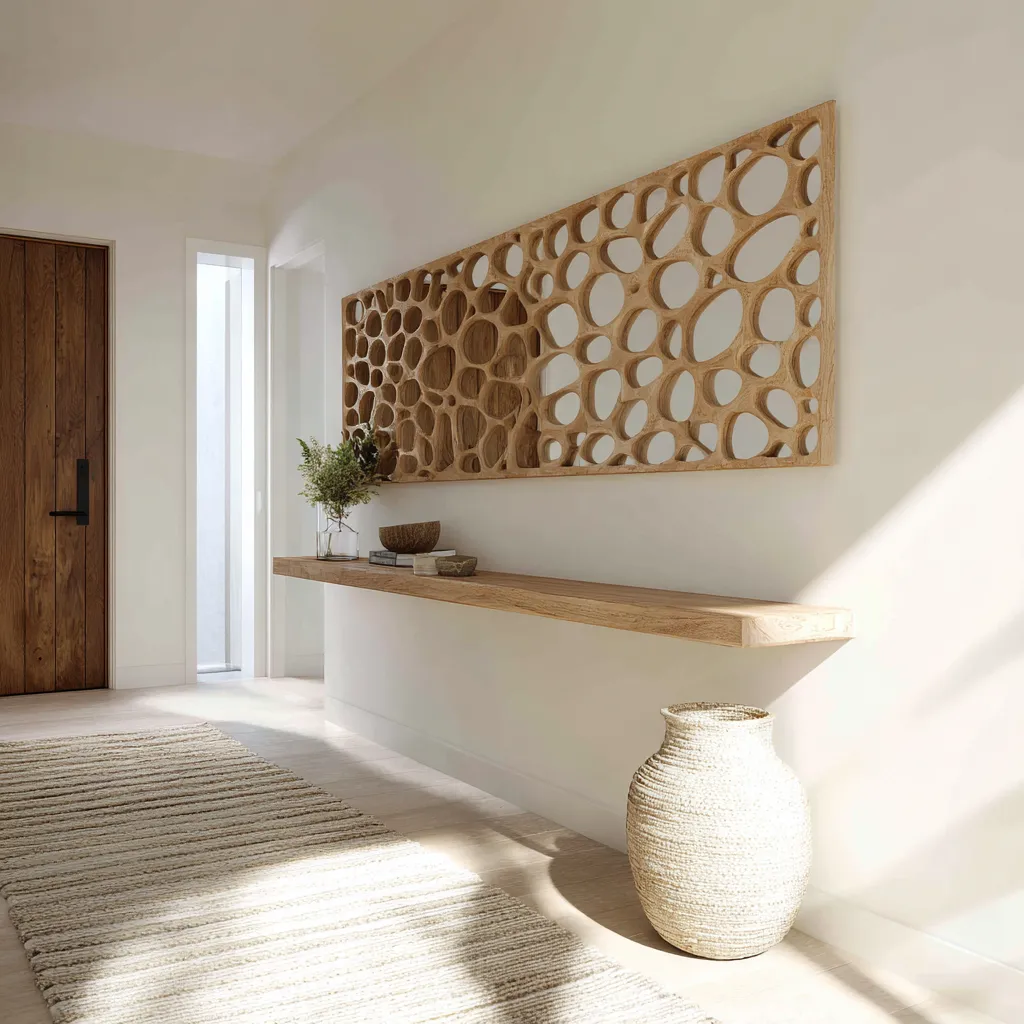
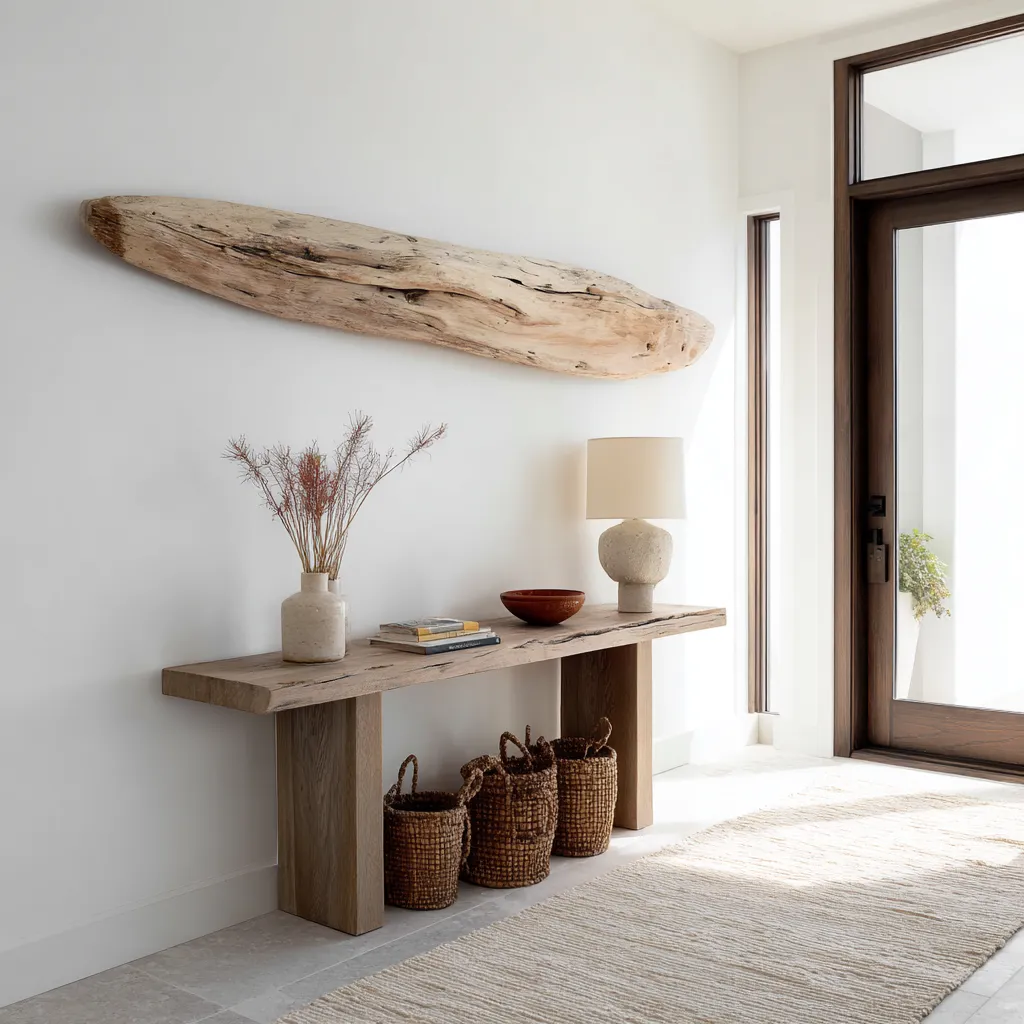
They contain versions of those materials that seem touched by weather, time, dryness, salt air, or repeated use. That can mean driftwood mounted against a bright wall, but it can also mean a pale live-edge slab used as a floating shelf, a panel of vertical rods that suggests reeds or canes, a matte ceramic lamp that feels closer to chalk or clay than to polished glaze, or a basket whose weave feels slightly rough, slightly irregular, and fully tactile.
The distinction is important. Smooth, pristine, untouched natural material can look pleasant in many styles.
Coastal interiors often become more convincing when the material carries signs of having lived through sun, wind, or abrasion.
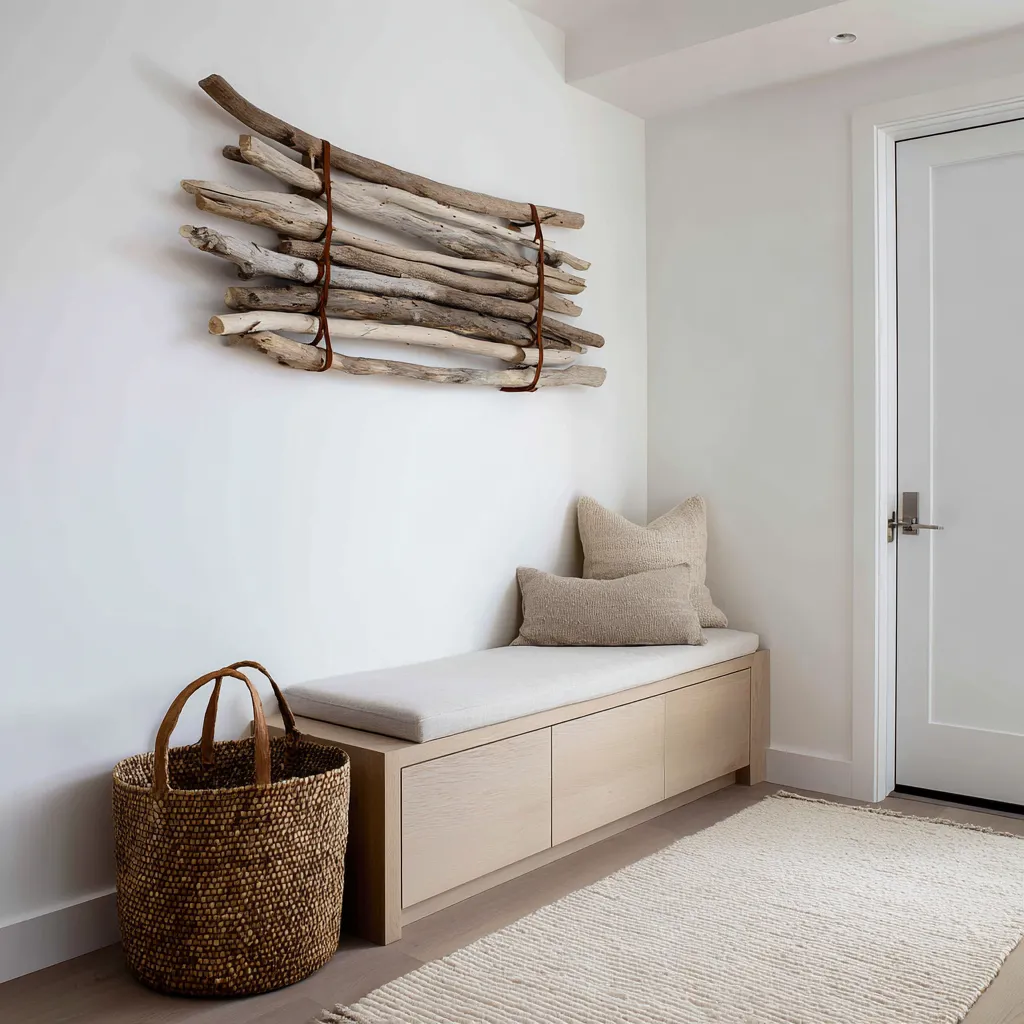
This is why blue can be optional. A room can feel near the shore through bleached oak, straw tones, pale plaster, warm clay, weathered brown, sand-colored textiles, dry stems, and deeper leather or charcoal notes.
These are not the colors of open water. They are the colors of matter after climate has acted on it.
That shift produces a richer result because it moves the style away from decorative shorthand and closer to environmental memory. In practical terms, this means a weathered wood rail above a clean slab console can do more than a whole shelf of overt beach objects.
A basket with serious hand-worked texture can do more than a striped pillow. A perforated wall piece in pale wood can say more about coast than a literal seascape if the rest of the room supports it.
The room begins to feel connected to shoreline life because the materials seem shaped by exposure, not because they are decorated with marine imagery.
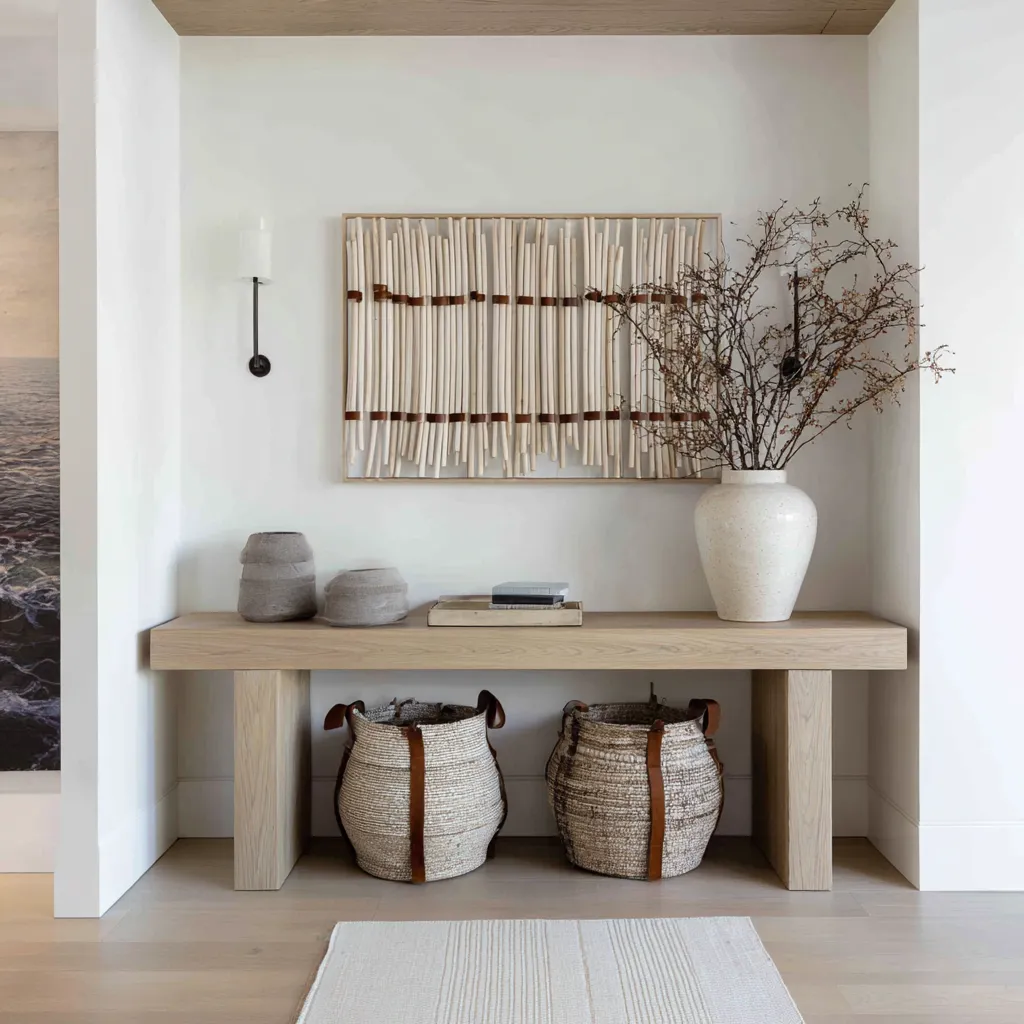
Let the frame stay cleaner as the material gets rougher
This may be the most important design principle in a fresh coastal entryway. If the focal material is irregular, tactile, or visibly time-marked, the room around it usually needs to become simpler.
A driftwood installation works on a broad, bright, nearly blank wall. A live-edge slab becomes stronger when floated against crisp architecture with no visual clutter around it.
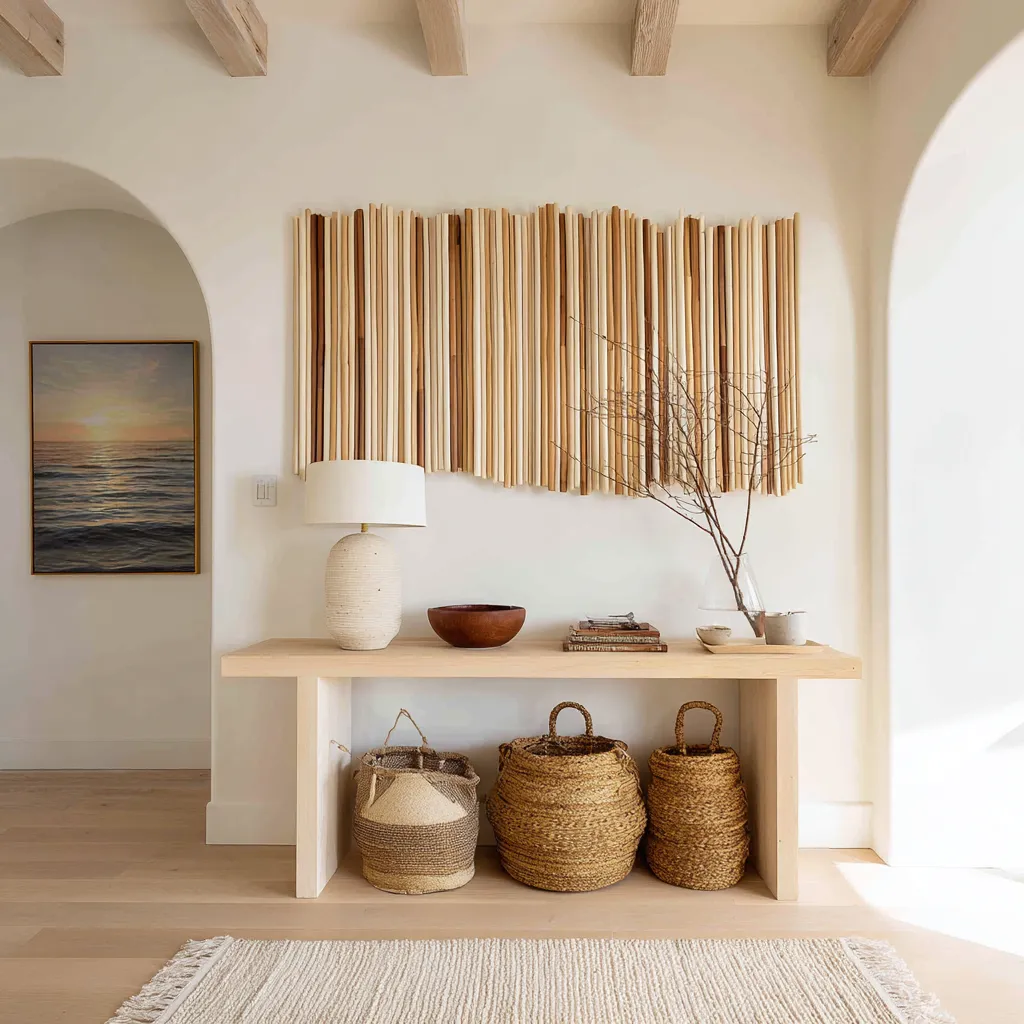
A rope-based wall piece, a row of pale paddles, or a field of wood rods feels current only when the console beneath stays slab-like, the palette stays narrow, the storage remains edited, and the surrounding space is left open enough for the wall gesture to stand on its own.
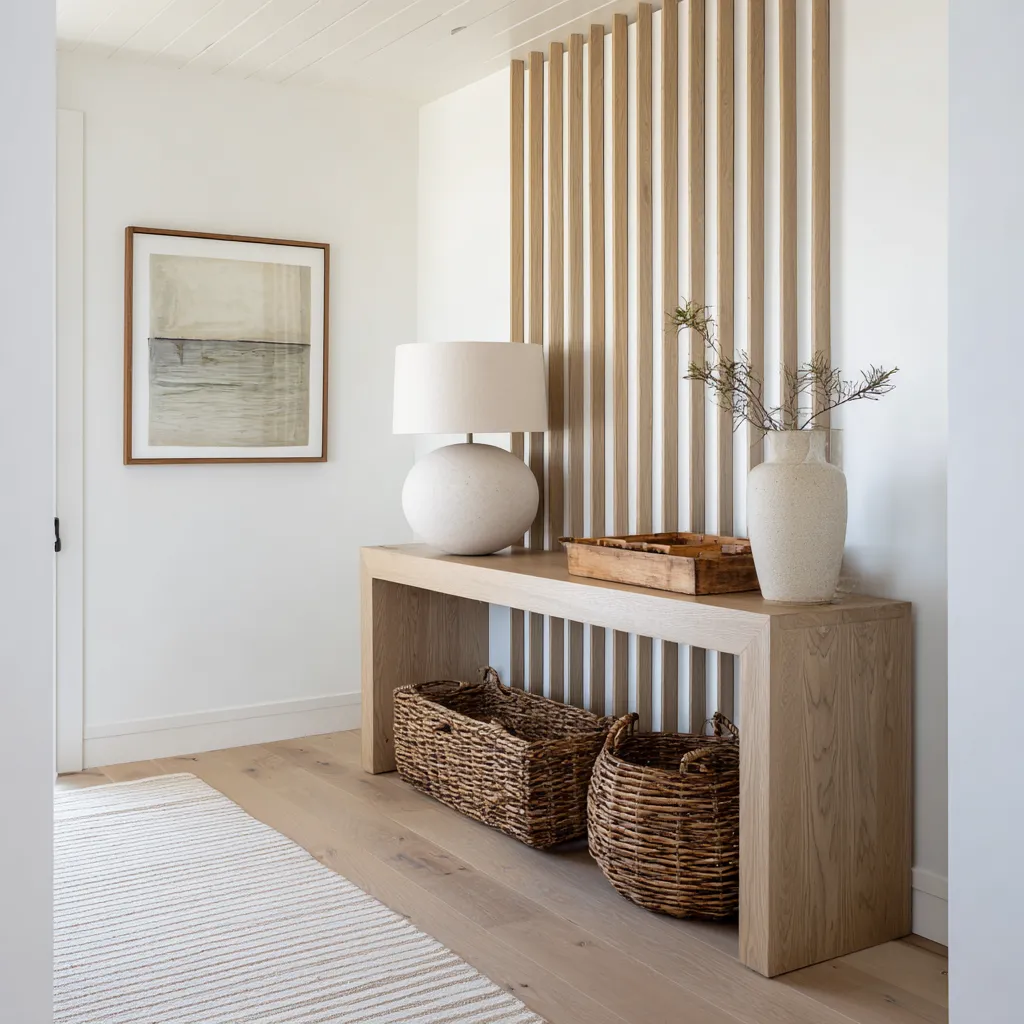
This balancing act is what keeps modern coastal interiors from turning rustic, nostalgic, or overdescribed. The rougher the insertion, the cleaner the frame must be.
That frame may consist of smooth white or off-white walls, low-relief paneling, open undersides beneath furniture, a simple rectilinear bench, a plain runner, and a restrained tabletop composition. Once that formal restraint is in place, one weathered element can have real force.
The opposite is usually less successful. If the room already contains many rustic surfaces, many baskets, many hanging objects, lots of visible storage, patterned textiles, and strongly recognizable coastal symbols, then the entry stops feeling fresh and starts feeling overpacked.
Modern coastal style gains a great deal from editing pressure. It improves when the room refuses to explain itself too fully.
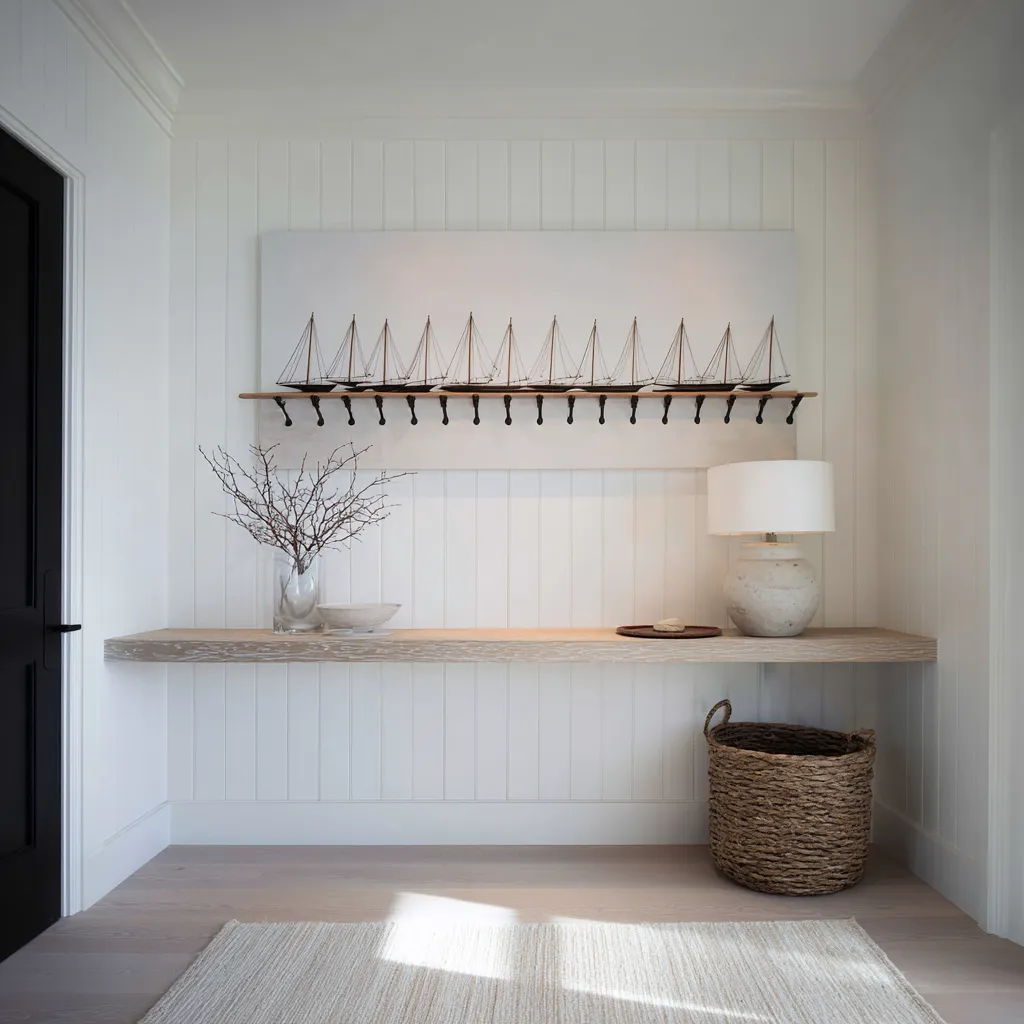
The role of blank wall space
Blank wall space is not absence. In a strong coastal entryway, it acts like visual breathing room.
It gives sunlight a place to land. It keeps tactile materials from becoming noisy.
It allows one installation, one piece of art, or one rail to register clearly. It also does something psychologically important: it keeps the entry from feeling themed.
A common mistake in coastal decorating is the urge to fill the wall because the entry feels too plain. Then the room receives one large art piece, several objects on the console, perhaps a mirror, maybe hooks, maybe another layer of small items, and suddenly the coastal cues begin to compete with one another.
The room starts narrating instead of suggesting.
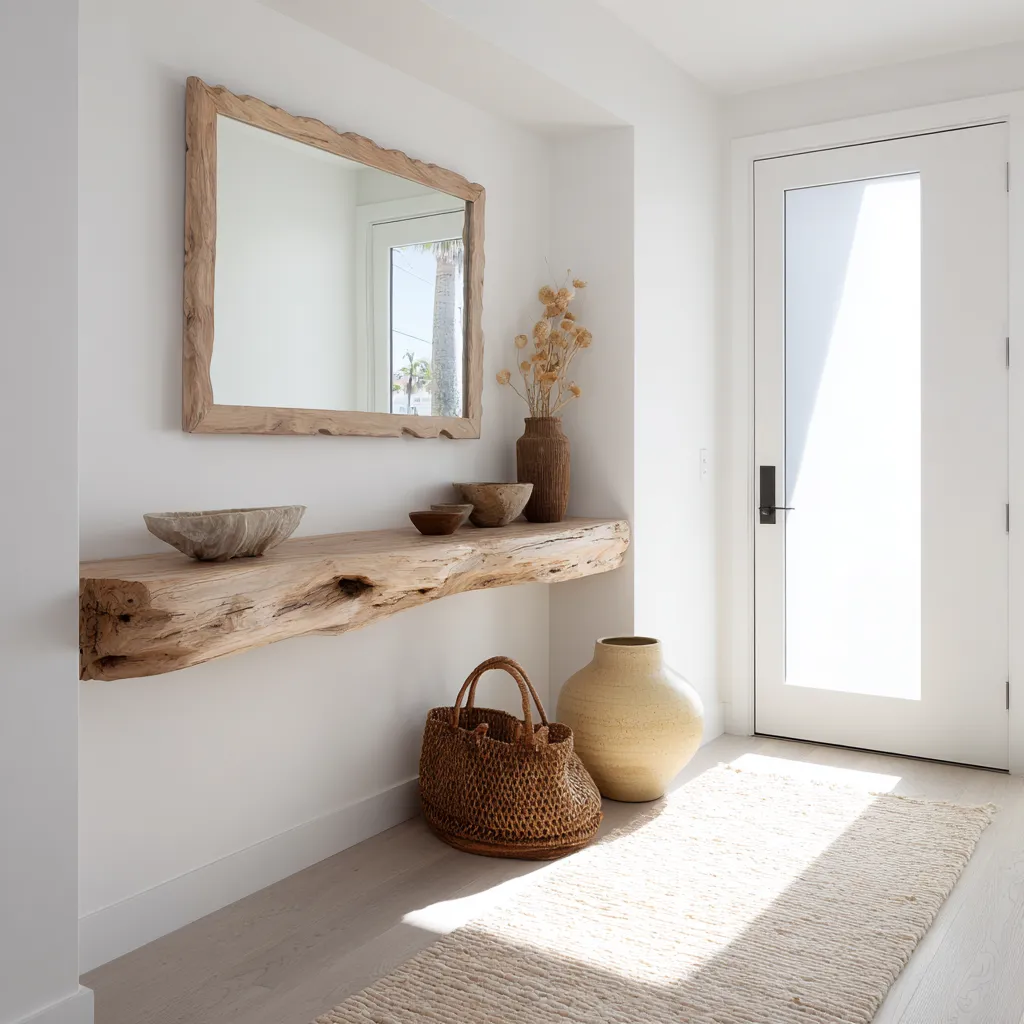
Current coastal entryways usually move in the other direction. They leave more space around the main gesture.
If there is a driftwood piece, it gets a generous field of wall around it. If there is a mounted rail or a row of paddles, the composition is spaced widely enough that each piece reads as part of a larger linear order rather than as a dense collection.
If there is a large abstract panel, the console beneath stays lightly styled and the lower shelf remains partly open. Blank wall turns out to be one of the most effective ways to preserve refinement.
This is useful in homes with very pale finishes. Without enough negative space, all those tactile natural materials can start to crowd one another.
With it, the same room can feel bright, structured, and easy.
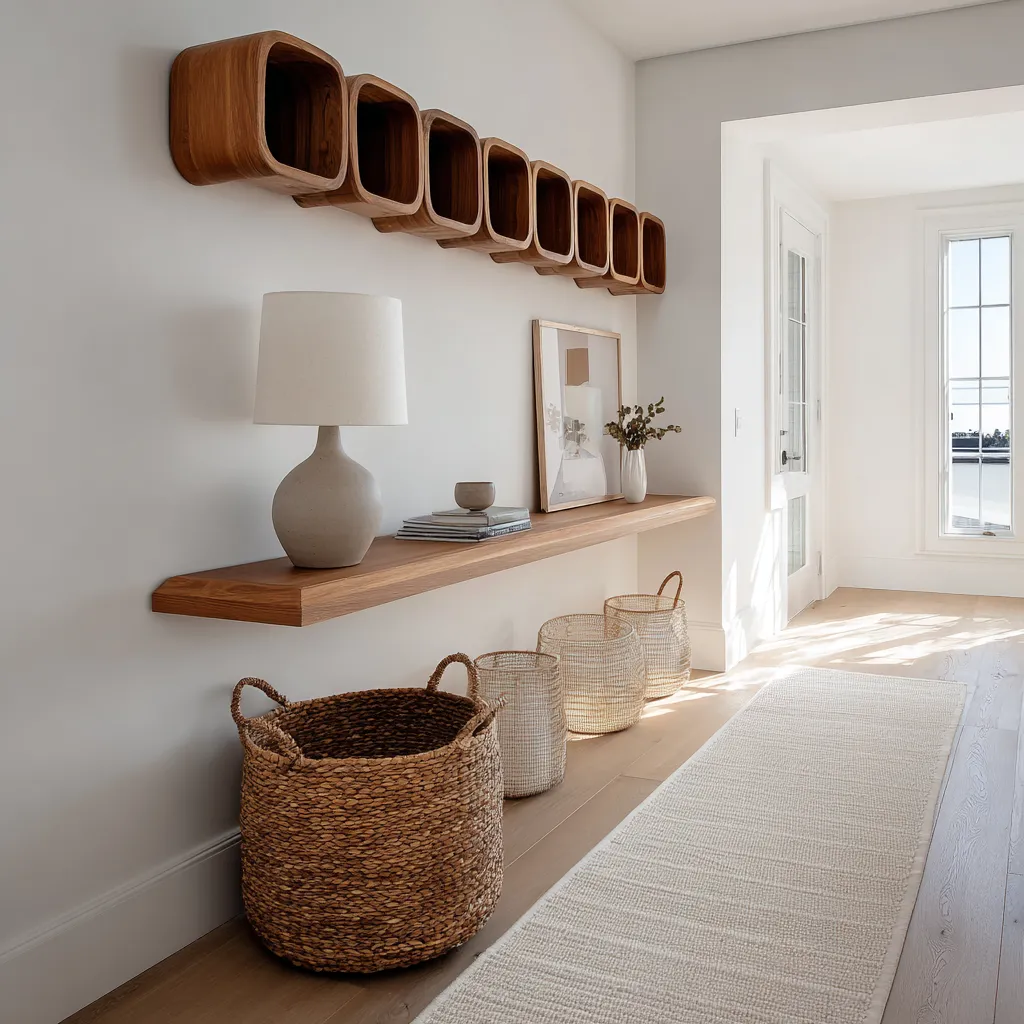
Why woven fiber matters so much
Few materials do as much work in a coastal entryway as woven fiber. A basket under a console, a low box on an open shelf, a floor vessel near a bench, a runner with dry texture underfoot, or a hanging planter in natural fiber all carry more than storage or texture.
They ground the room in a handmade, slightly rough register. They connect the upper decorative zone to the lower bodily zone.
They keep pale painted walls and pale oak furniture from floating into vagueness. What makes woven fiber especially valuable in entryways is its placement.
It often sits low, close to the floor, where it can absorb visual weight and soften the harder geometry of the room. Above the console, the coastal story may be carried conceptually through a wall object, a pale panel, a horizon-like artwork, or a rail.
Below the console, the story often becomes tactile through the basket, the runner, the shallow bowl, or the open shelf with restrained storage. That split is extremely effective.
The upper zone carries the idea. The lower zone carries bodily texture and everyday use.
This is why a single good basket can matter more than several smaller decorative objects. It gives the lower half of the room depth, roughness, and weight.
It also pairs beautifully with pale wood and matte ceramic. Together those three materials create one of the most dependable coastal groupings available: wood for warmth and structure, fiber for dryness and tactility, ceramic for softened mass.
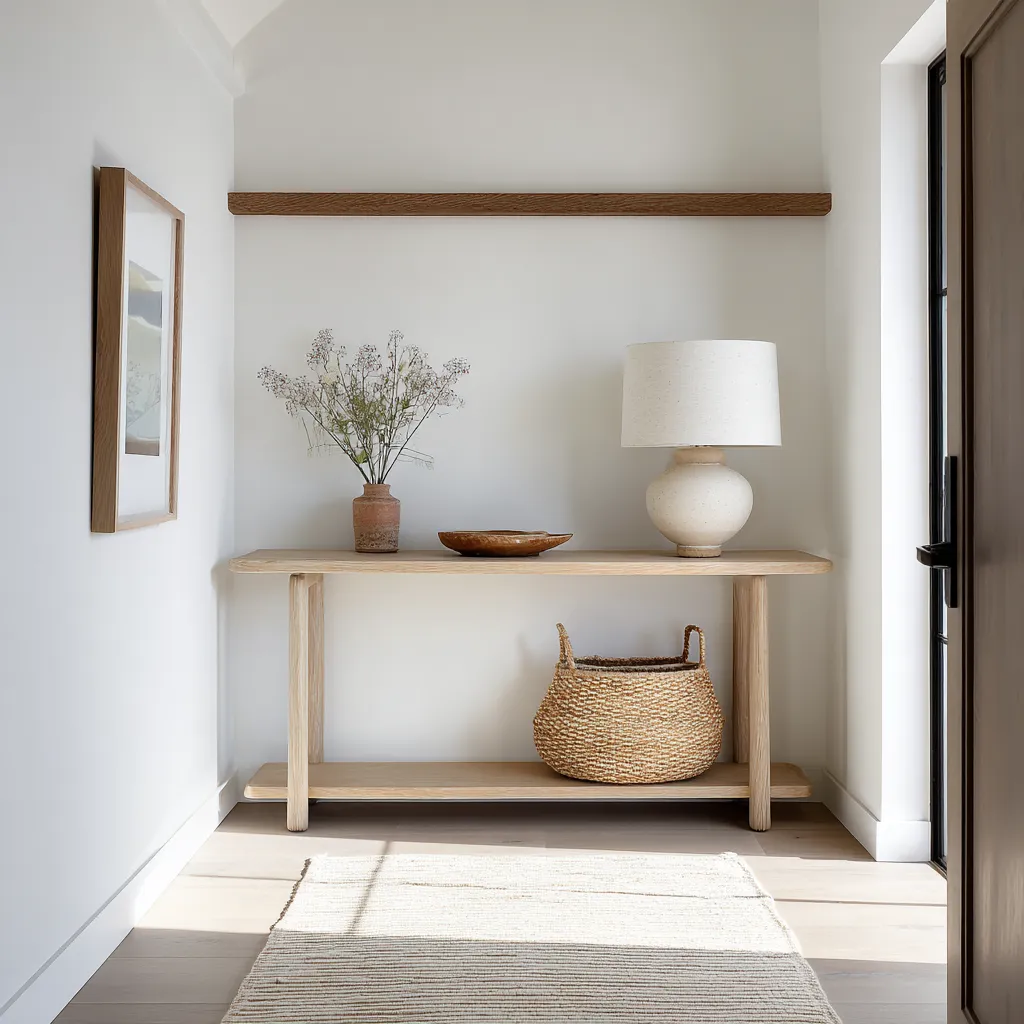
The importance of one rounded mass
Modern coastal entryways often rely on line. There are long consoles, shelf edges, panel grooves, hook rails, slatted inserts, runner rugs, corridor walls, and horizon-like art pieces.
Without a counterbalance, all that linearity can become brittle. That is why so many refined coastal entries benefit from one rounded object with real visual mass.
A lamp with a chalky ceramic base, a broad matte vase, a low shallow bowl, or a pebbled clay vessel helps return the composition to the body. It interrupts the graphic order with something more eroded and full.
It also keeps the room from leaning too hard into pure geometry. This rounded mass should not be ornate.
The point is not decoration. The point is volume, surface, and softness.
A successful piece in this role often feels closer to stone, shell, or hand-formed clay than to polished formal pottery. It helps the room feel weather-softened rather than decorated.
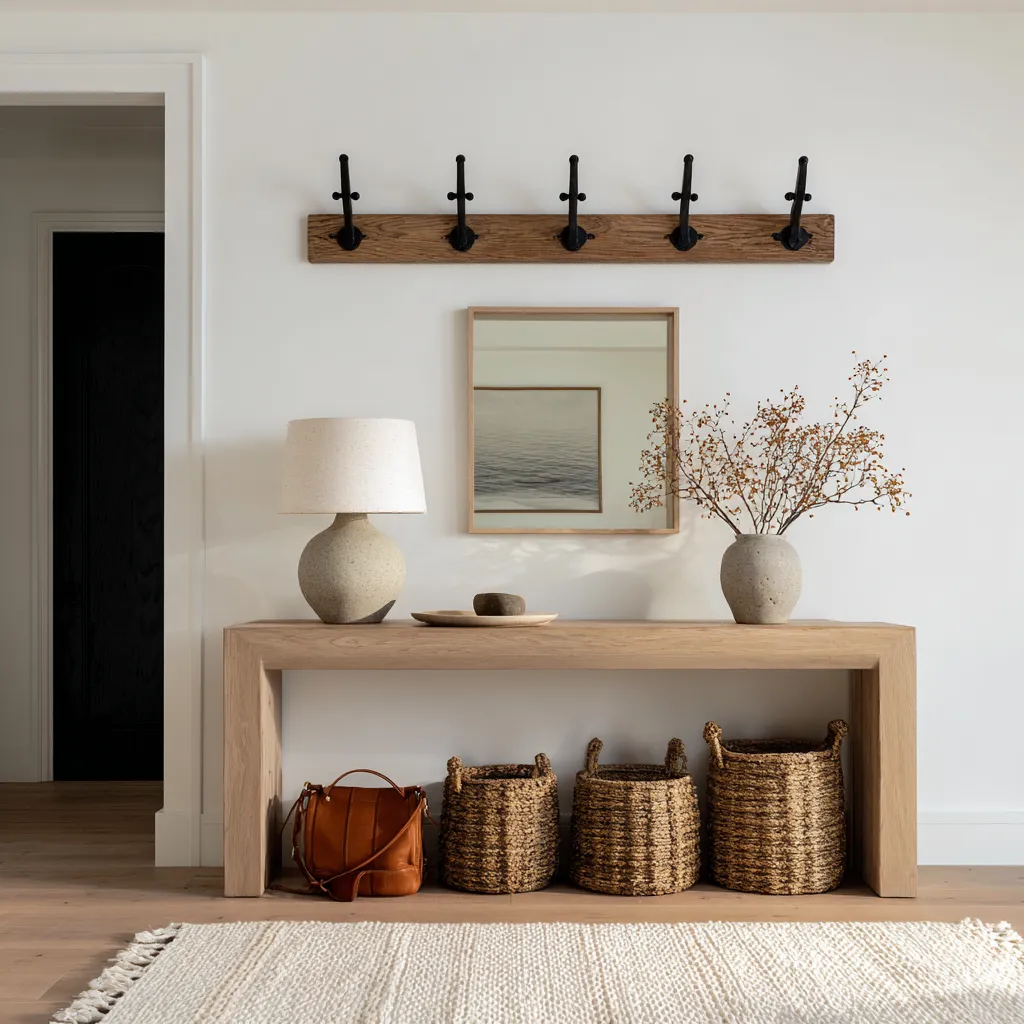
One of the useful coastal formulas is a long linear base paired with one rounded ceramic mass and one sparse vertical branch arrangement. That gives the room three necessary conditions: lateral breadth, softened body, and light upward motion.
Dry stems are often better than flowers
Fresh flowers can be lovely in many entryways, but in this style they often shift the mood too far toward prettiness or sweetness. Modern coastal entryways tend to look stronger with airy branches, dried stems, or sparse greenery that feels wind-shaped, seasonal, and restrained.
This type of branch arrangement does several jobs at once. It lifts the eye without creating heaviness.
It introduces line that is organic rather than rigid. It echoes reeds, dune grass, shoreline shrubs, weathered growth, and dry landscape rather than lush garden fullness.
It also helps a minimal console feel complete without needing more tabletop objects. The branch arrangements in this style usually remain thin and open.
They should not fill the entire wall space above the console. They should simply interrupt the lower horizontal field with a little height and a little irregularity.
If the room already has a strongly linear wall installation, the branches can loosen it. If the room is very pale and quiet, they can keep it from going flat.
Dark accents are not the theme. They are the skeleton.
A pale coastal entryway can easily become too soft if every surface lives within the same light range. This is where dark accents become crucial.
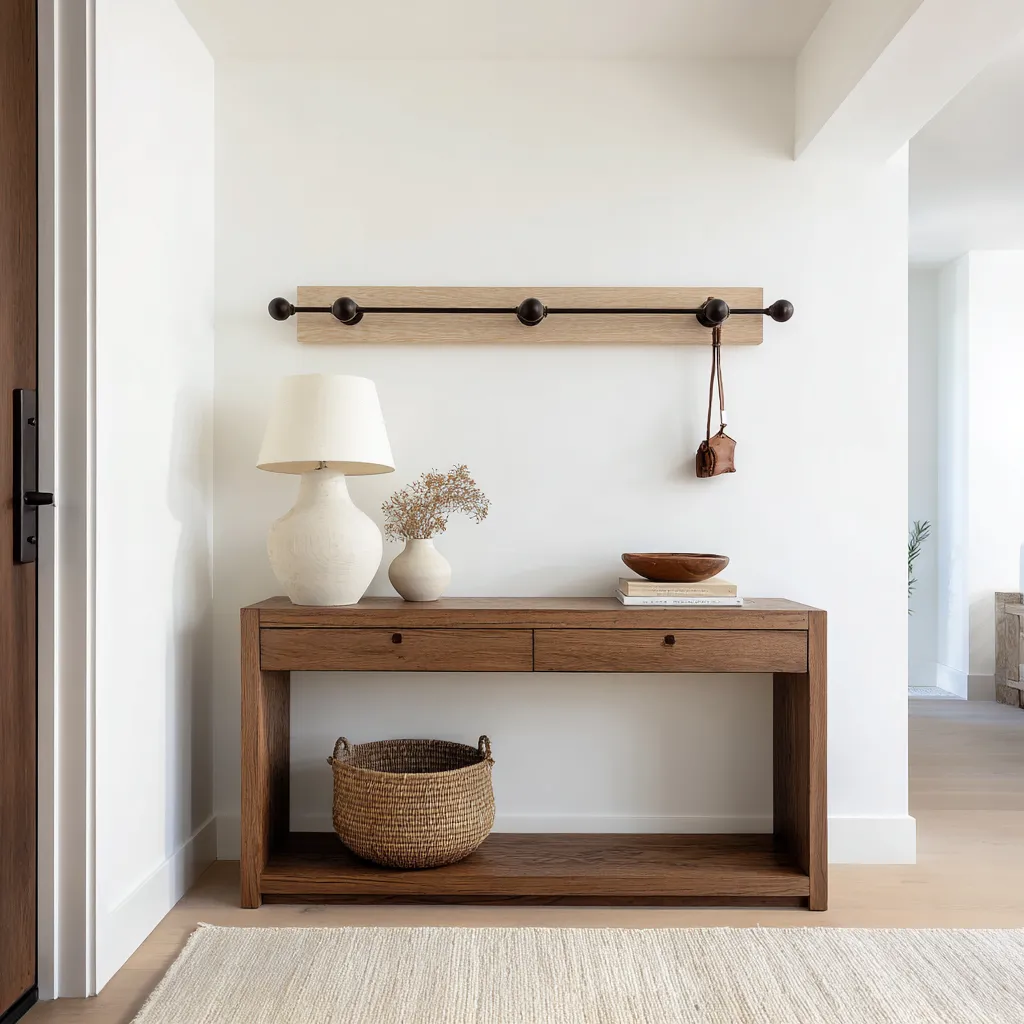
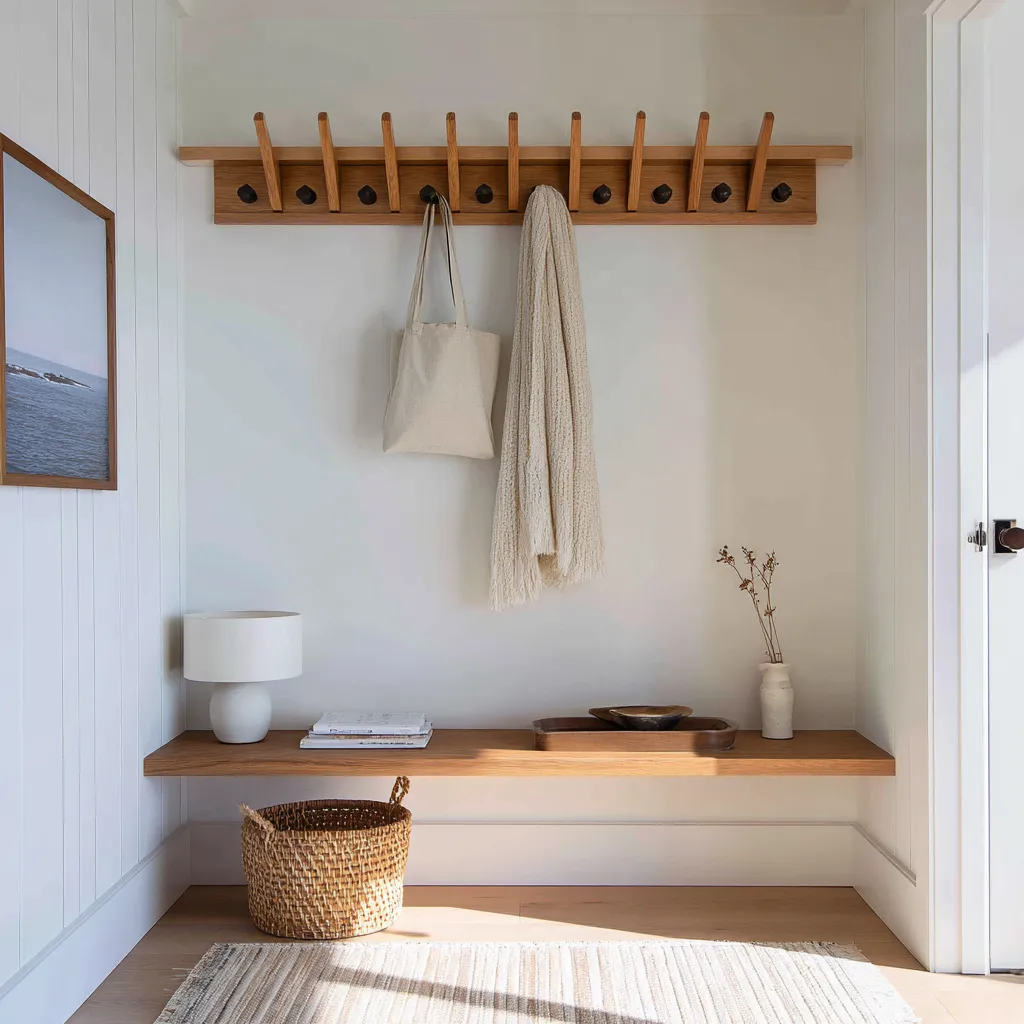
Dark door trim, black or bronze hooks, leather straps, a deeper bowl, a darker vase, a weathered rail, or a slightly richer basket tone can give the room definition. These darker notes do not create the coastal identity by themselves.
Their role is more technical. They act like linework inside a pale composition.
They sharpen the edge of the console. They separate basket from floor.
They keep white wall, cream rug, and chalky ceramic from merging into a single gentle blur. Even a very small dark accent can be enough.
The most successful versions tend to keep these accents limited and strategic. A room does not need many.
It needs just enough contrast to hold the palette together. Leather straps around mounted paddles, dark metal hooks on a pale rail, a charcoal branch silhouette against an off-white wall, or a darker basket beneath a pale bench can all provide this structure.
Without those notes, pale coastal interiors sometimes lose their shape. With them, the whole entry gains a spine.
Architecture can carry the coastal mood before decor ever appears
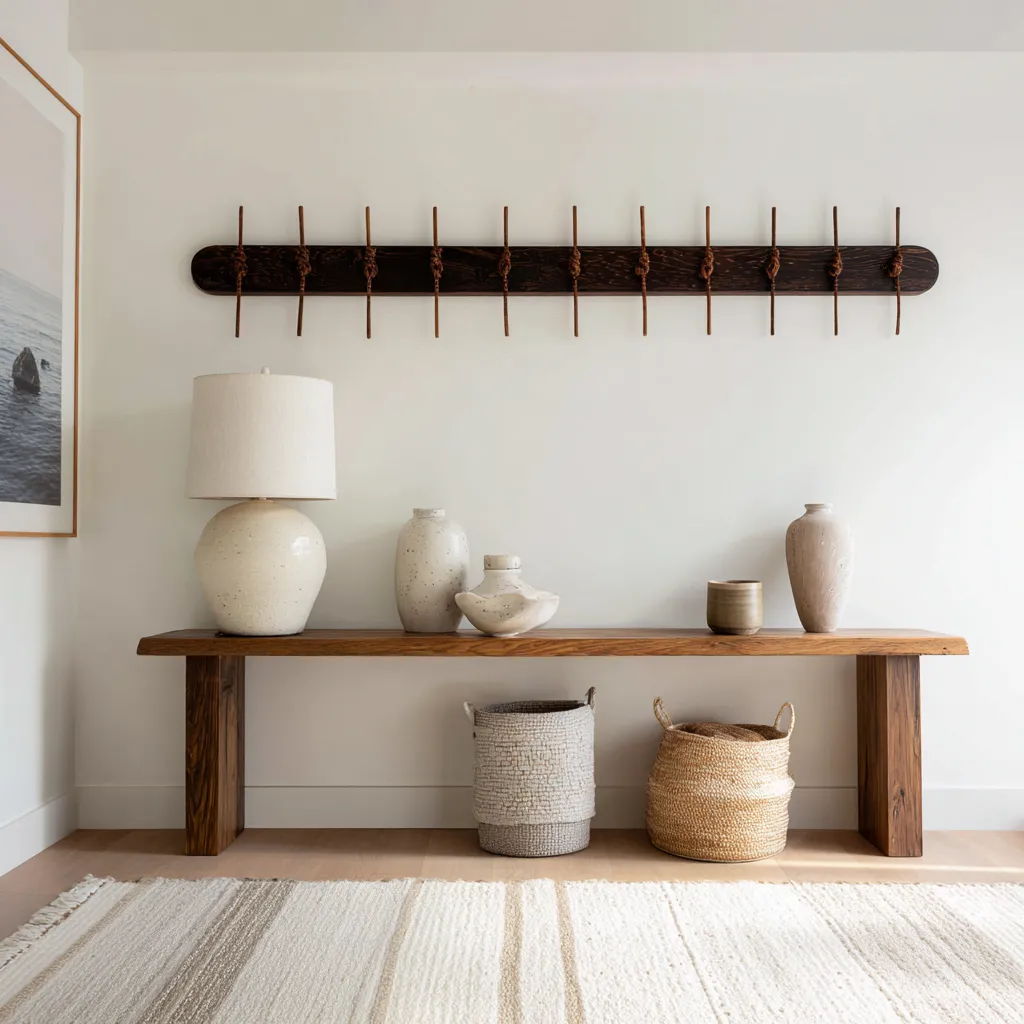
One of the signs of a refined coastal entryway is that the architecture itself is allowed to do some of the work. A recessed wall niche, a run of vertical paneling, a slatted timber insert, a beam line, a built bench pocket, a deep alcove, or a softly articulated wall surface can all establish the right atmosphere before any decorative object enters the room.
This is a particularly mature approach because it lowers the decorative burden. Instead of making the console and wall art carry the entire concept, the room begins with built character.
A paneled wall can catch light in a soft, plank-like way. A slatted zone can suggest fencing, screens, or reeds through rhythm rather than through subject.
A bench niche can establish a sense of shelter and arrival. A low-relief wall surface can keep a pale room from feeling flat.
Once this architectural base exists, the decor can stay spare. This is also why modern coastal entryways do not need large water scenes on the wall.
If the room already has the right light, spacing, material palette, and architectural structure, a seascape becomes optional. The room already knows where it is going.
Water art is useful, but rarely the engine
There is nothing wrong with a shoreline painting or an atmospheric seascape in an entryway. The key is to understand its role correctly.
In current coastal interior design ideas, water art usually works as a supporting cue rather than the main source of the mood. Muted horizon paintings, pale abstracted shore scenes, and washed tonal canvases can quietly confirm the room’s direction.
They can introduce depth, widen the wall story, and bring a sense of distance. But when an entryway depends on art alone to establish coastal feeling, it often becomes thinner.
The entries usually build coastal atmosphere first through materials, composition, and restraint. The art then reinforces what is already present.
This is why the water art in this style is often subdued. It stays low-contrast.
It suggests distance rather than loudly describing it. It often leans on a console or sits slightly off to the side rather than occupying the entire center of the wall.
It contributes atmosphere, but it does not need to carry the whole argument.
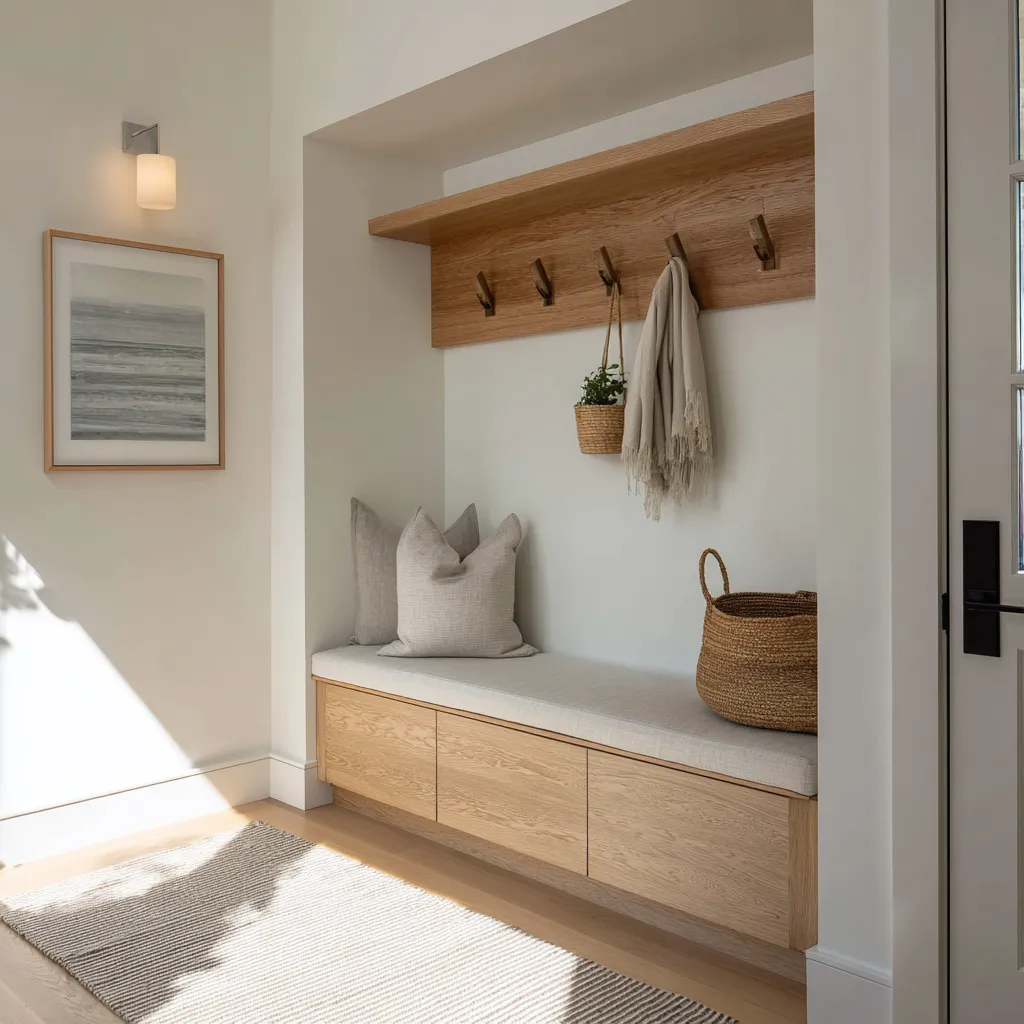
Why direct marine symbols can be risky
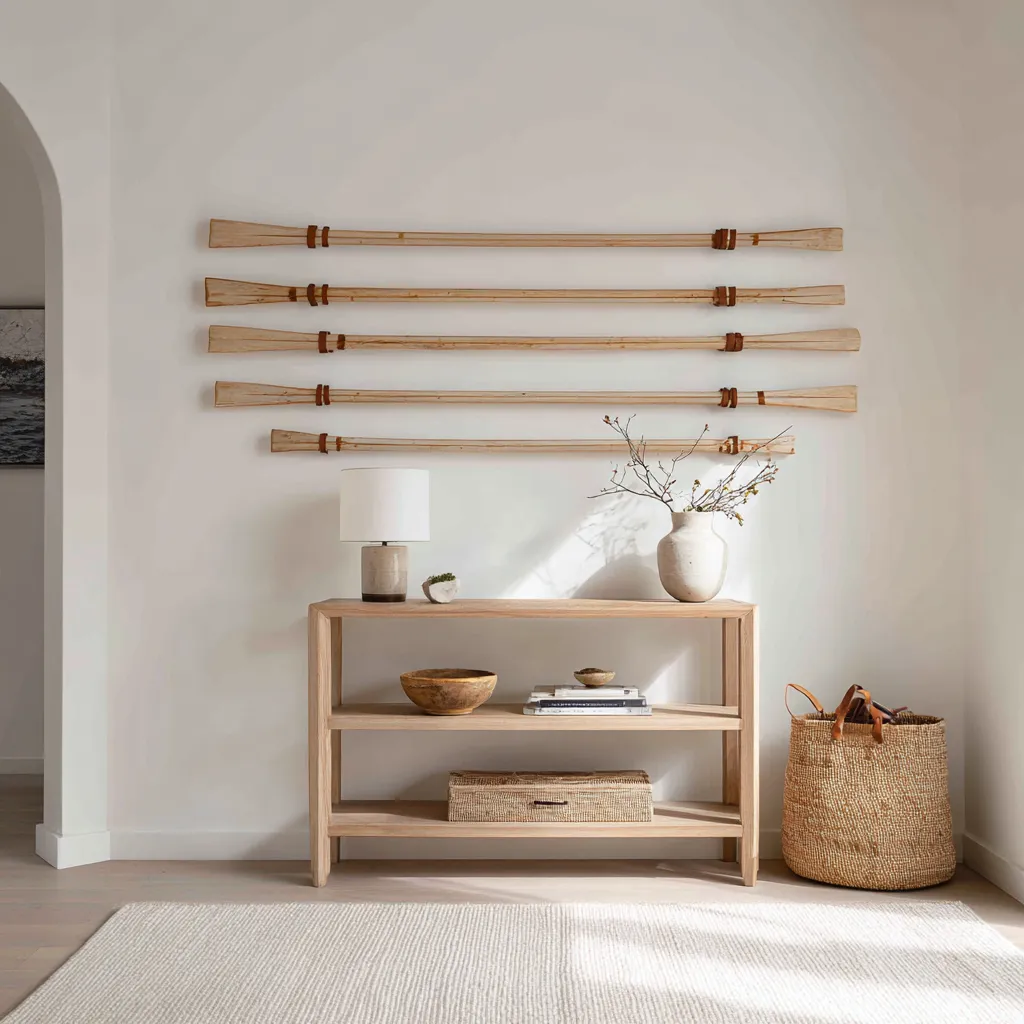
Paddles, oars, sailboats, rope details, and other marine objects can work in a modern coastal entryway, but they demand far more restraint around them than many people expect. The problem is not that these objects are wrong.
The problem is that they are linguistically loud. The moment they appear, they name the subject very quickly.
That can flatten the room if everything else begins to repeat the same message. A row of sailboats, a rope rail, or mounted paddles can still feel refined, but only if the rest of the room becomes quieter: pale wall, very limited tabletop styling, one basket, a restrained runner, one rounded lamp, and little or no additional theme decor.
In that setting, the object family starts acting less like novelty and more like a disciplined wall composition. They can use of direct marine reference often comes from partial abstraction.
A set of paddles aligned as clean horizontal bands can become almost architectural. A rope-based element with strong spacing can feel more like a graphic installation than a themed accessory.
A row of sailboats can work if their repetition creates rhythm and the lower room stays materially restrained. The issue is not the object itself.
It is the amount of explanatory pressure placed on it. In many cases, weathered matter is easier to use than named marine objects.
Driftwood, bleached boards, perforated wood fields, rod installations, slats, reeds, and rough fiber all keep the room closer to material memory than to direct storytelling.
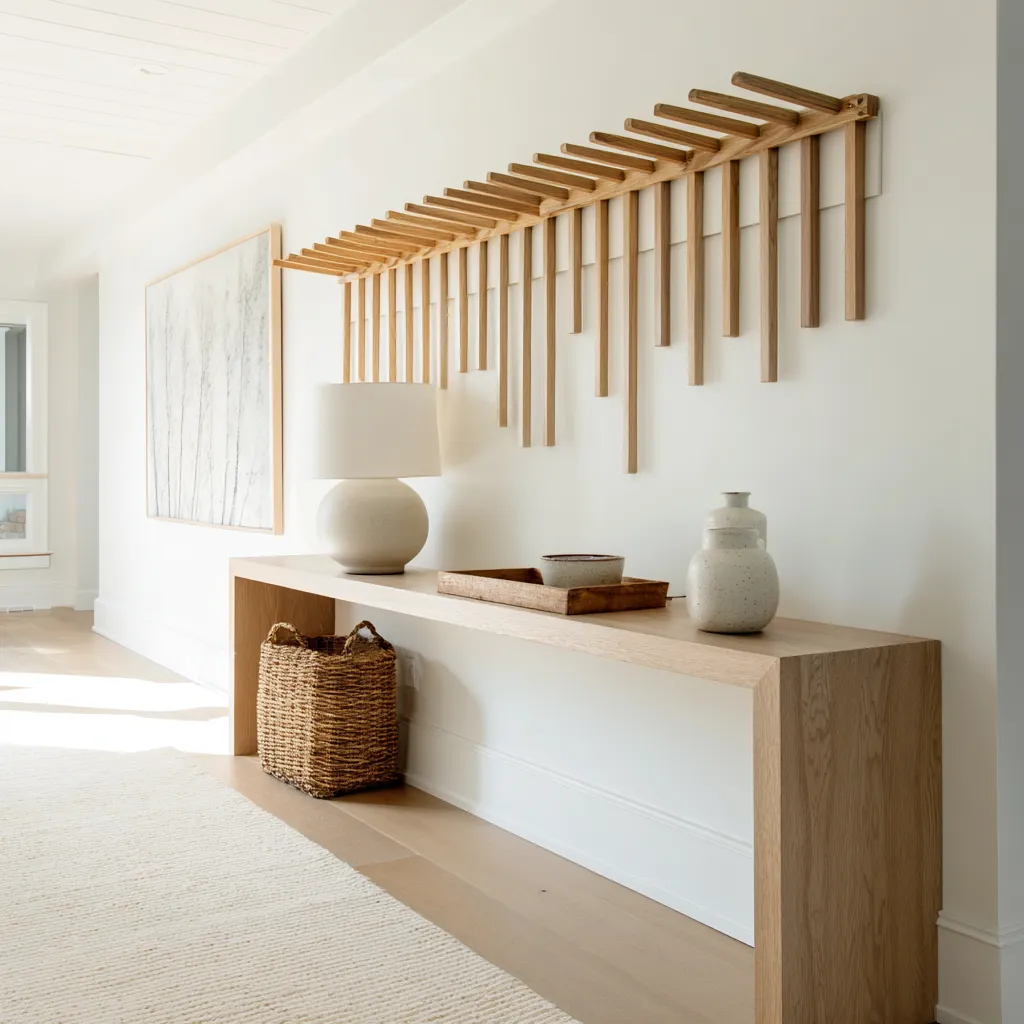
The entryway should feel inhabited, but not loaded
A modern coastal entryway has to perform. People arrive, remove shoes, hang a tote, set down keys, and move through the house.
This practical side can add richness, but it can also drag the room toward generic mudroom styling if it becomes too visible. The difference usually comes down to editing.
A hook rail can look beautiful if only one or two items are actually hung on it. A bench becomes more refined when the cushion runs long and simple and the under-bench area remains mostly open.
A shelf feels current when it holds only a bowl, a book stack, and one vessel rather than a whole sequence of small objects. An open console stays airy when only one portion of the lower shelf is occupied.
A basket by the bench can bring practicality and texture at once, but it should not be multiplied so much that the room starts to look like storage first and composition second. This is a subtle but important point.
Function itself does not weaken the style. Overexposed function does.
The coastal entryway ideas feel lightly in use rather than visibly loaded for everyday life. They suggest habit without showing every part of it.
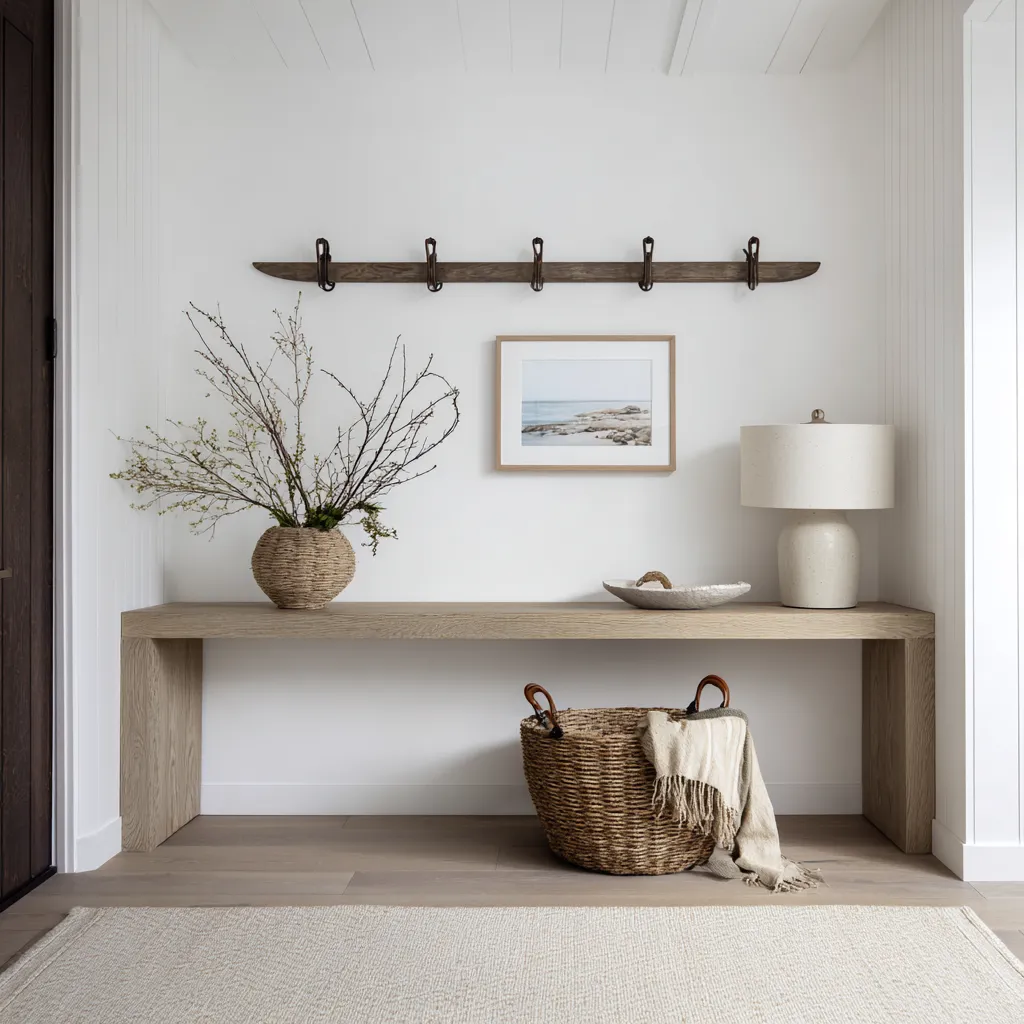
Four strong ways to build the look
A very refined modern coastal entryway can be built through several different routes, but a few approaches tend to work especially well.
- One route is the abstract wall field. This might be a panel of pale rods, a perforated wood installation, a slatted insert, a wide horizon-banded artwork, or a very pared-back line composition. Pair that with a long pale console, one basket, a rounded lamp, sparse branches, and a broad field of open wall. This creates an especially mature version of coastal style because the mood enters through formal language rather than through named objects.
- Another route is the single weathered artifact. This could be driftwood, a reclaimed rail, a live-edge slab shelf, or one large exposure-marked object mounted against a clean wall. The room then stays almost severe in its restraint: quiet palette, simple geometry, minimal accessories, generous spacing. The artifact carries the weathered coastal note; the room around it preserves freshness.
- A third route is the edited functional niche. A built-in bench, hook rail, narrow shelf, cushion, pale wood, and a few carefully chosen textiles can create an entry that feels useful and welcoming without turning into a mudroom statement. The key is underfilling. A woven planter, one tote, one throw, one basket, one quiet art piece, and plenty of open wall often produce a far better result than a fully activated storage wall.
- A fourth route is architecture-led coastal design. Paneling, slatted walls, beam lines, deep recesses, alcoves, and light-struck niches can establish the mood before decor is added. Once that architectural layer exists, the decorative pieces can stay very few. This often produces one of the most lasting interpretations because the coast is built into the room’s surface rhythm and proportion rather than attached afterward.
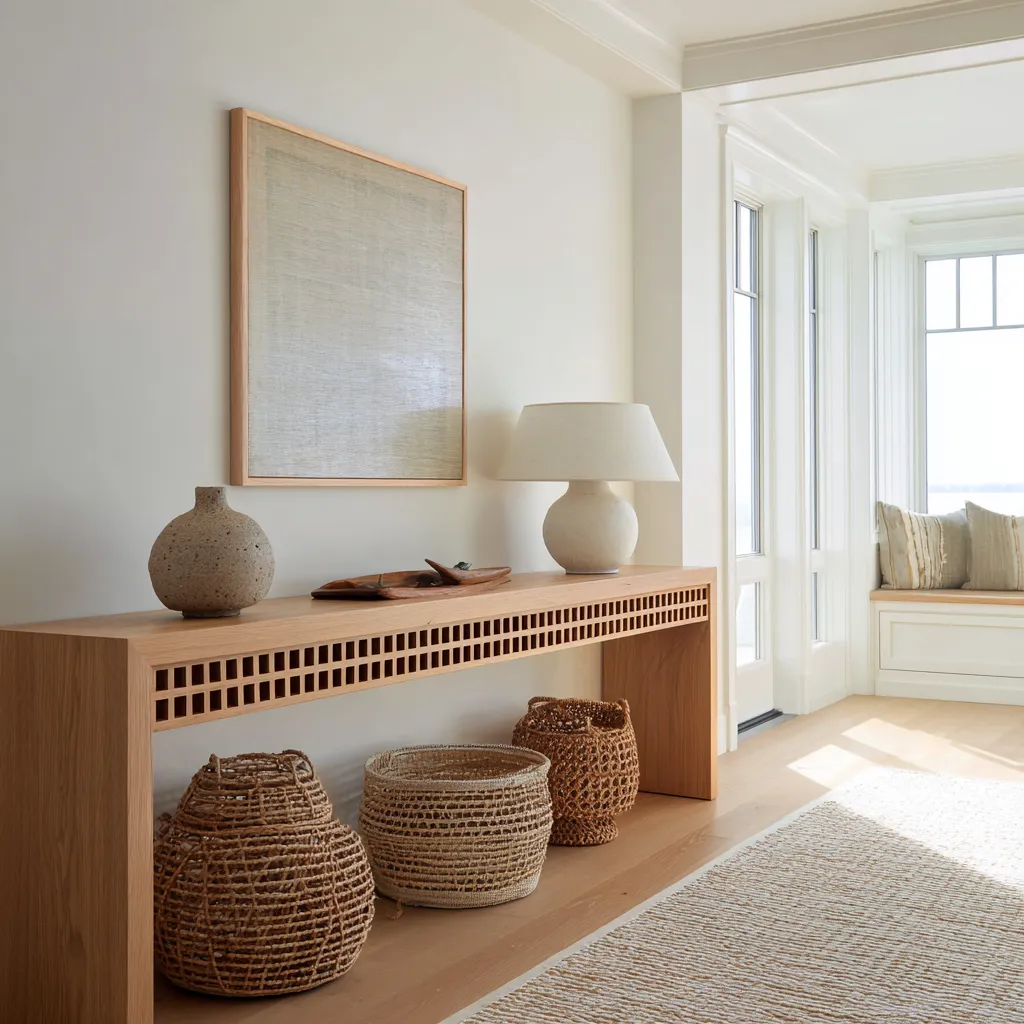
What the modern coastal palette really looks like
A lot of coastal decorating still defaults to obvious blue and white. In a current entryway, the palette is often far more nuanced.
It tends to revolve around chalk, plaster white, sand, pale oak, straw, clay, warm cream, drifted brown, leather, and a small amount of charcoal or black. These colors feel dry, sun-marked, and tactile.
They belong to grasses, washed wood, pottery, stone, basketry, faded fabric, and shadow. This kind of palette is useful because it allows the room to feel coastal without feeling cold.
It also works especially well with natural light. Pale neutral fields brighten, but the warmer undertones keep them from going sterile.
The few darker accents then give the composition enough structure. Blue can still appear, but it often works better in diluted form: a faint blue-grey in art, a silvery horizon tone, or a slightly cooled glass vase.
When strong marine color dominates the entry, the room can tip too easily toward theme. When the palette stays mostly in dry littoral neutrals, the result often feels more grown, more layered, and more closely tied to material.
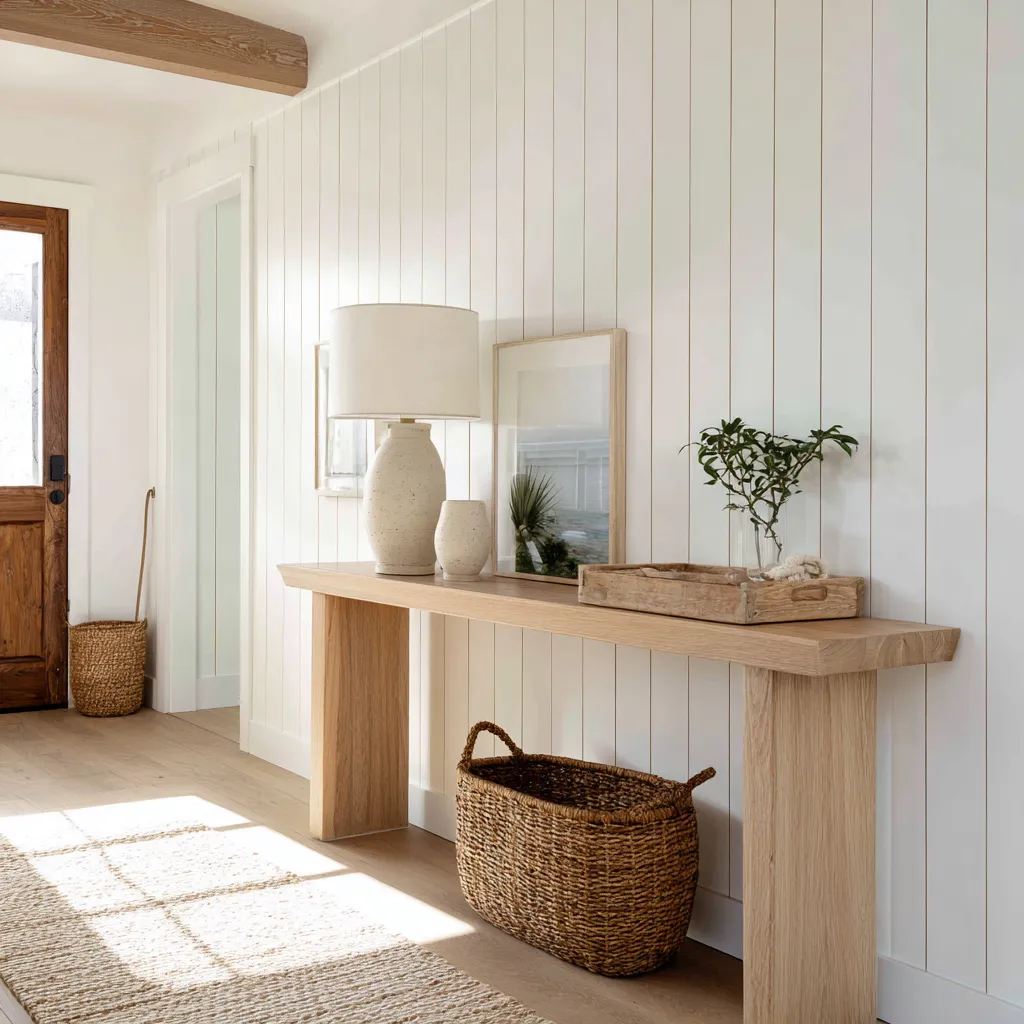
Styling the console from top to bottom
In many coastal entryways, the console is the entire room’s control center. It is worth thinking about it in stacked layers rather than as a surface to accessorize.
At the top is usually the conceptual layer: wall art, mounted driftwood, a rail, paddles, a slatted insert, or a broad abstract panel. This is where the room announces its main direction, but it should do so with restraint.
At the console surface comes the mass-and-line layer: one rounded lamp or vessel, one low bowl or tray, and one sparse branch arrangement. These pieces should be chosen for form and surface more than for decorative detail.
Their spacing matters as much as their material. Below the console is the grounding layer: basket, low storage, books, or one open lower shelf element.
This is where texture settles close to the floor and keeps the room from feeling top-heavy. At the floor is the field layer: runner, rug, stone, or wood floor softened by something woven and pale.
This final layer should usually stay quiet so it supports movement rather than competing with the wall. Thinking in layers tends to produce a much better coastal entryway than thinking in isolated accessories.
It also helps avoid clutter, because each layer only needs one or two strong notes.
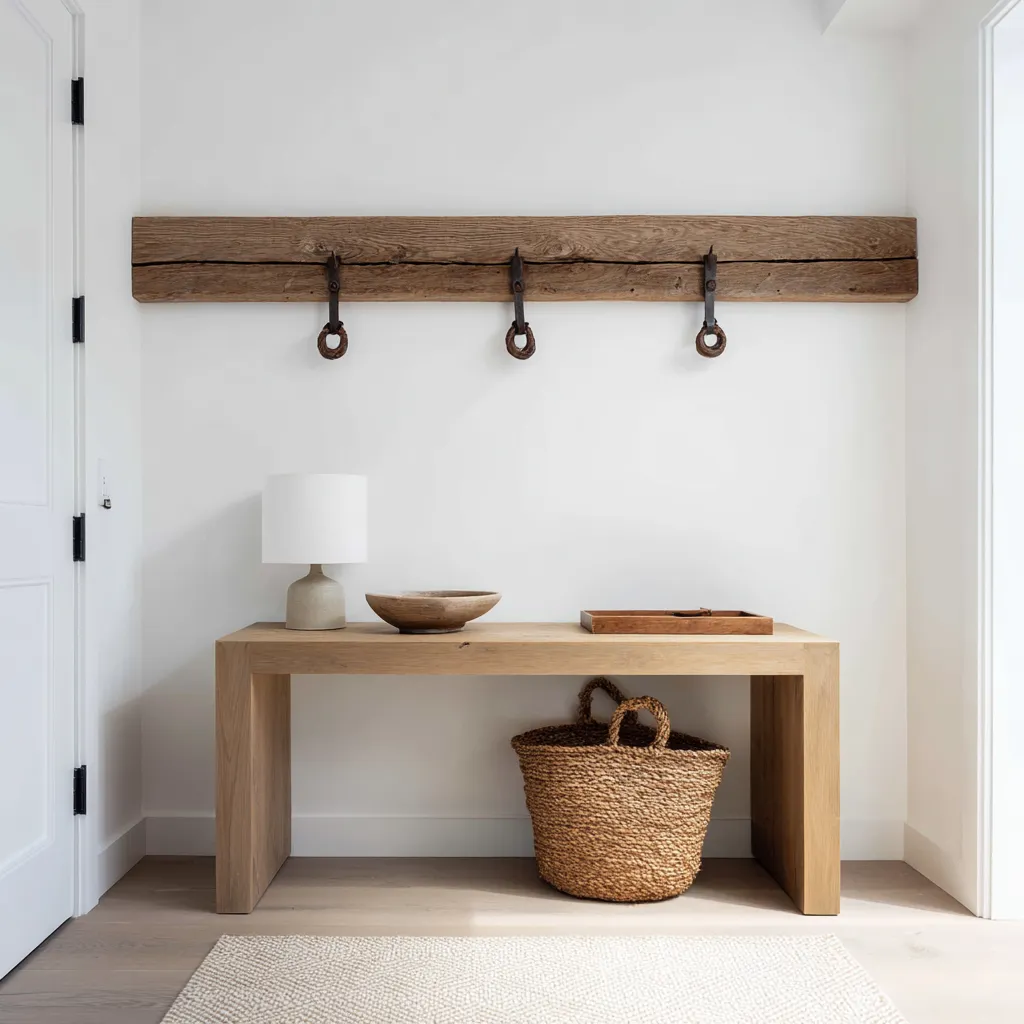
What to avoid if you want the room to stay current
The main risks are fairly consistent.
- The first is stacking too many coastal cues in the same room. If the wall art, console styling, basket choices, textiles, and shelf objects all state the same marine idea directly, the entry loses depth very quickly.
- The second risk is replacing material implication with decorative explanation. A room built from weathered wood, pale oak, rough fiber, dry stems, and a chalky lamp already carries a great deal of coastal feeling. Once shells, signs, anchors, overt slogans, and multiple themed motifs are added, the room usually becomes weaker, not stronger.
- Another risk is overfilling practical pieces. Hooks crowded with coats, open shelves packed with storage, too many visible baskets, too many small tabletop objects, and several accent textiles can turn a refined coastal threshold into a busy domestic drop zone.
- There is also the problem of excessive softness. If a pale coastal room contains no dark accents and too little textural contrast, it can flatten. The answer is not strong color. Often it is only one deeper basket, one dark trim note, a leather detail, or darker hook hardware.
- Finally, there is the issue of proportion. Small coastal objects on a large blank wall can feel timid and decorative. Large, disciplined gestures usually work better: one substantial wall installation, one long console, one wide runner, one serious basket, one well-scaled rounded lamp.
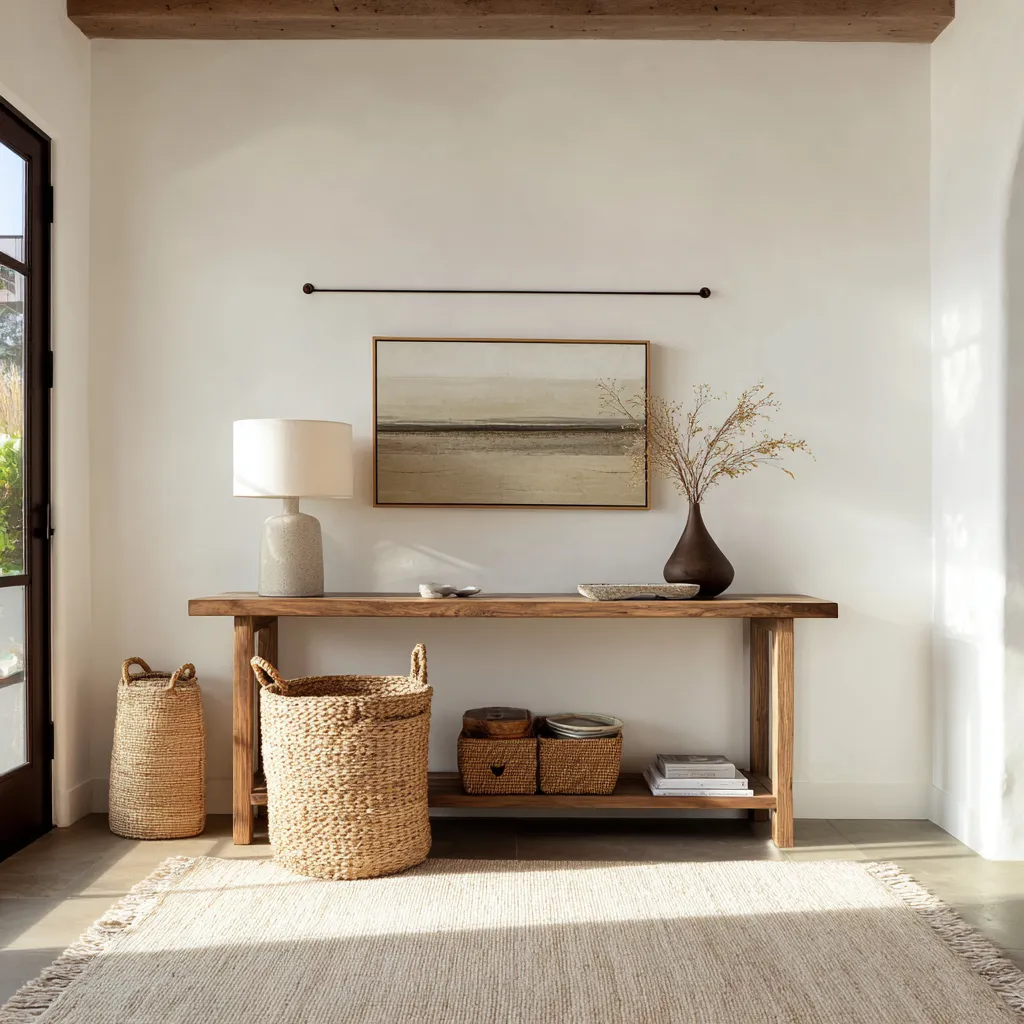
Convincing modern coastal style
The convincing version of modern coastal style in an entryway is often the one that feels least interested in proving itself. It does not insist on marine imagery.
It does not pile on blue. It does not over-style every surface.
It lets the coast enter through weathered matter, lateral spread, pale light, dry texture, soft-mass ceramics, and disciplined spacing. A driftwood piece against a bright wall.
A slatted field behind a simple console. A pale bench tucked into a niche with only one throw and one basket.
A runner that feels like woven sand. A rounded lamp base that offsets all the lines in the room.
A few dry stems that bring outdoor memory without floral sweetness. A dark hook or leather strap that gives the palette a little skeletal definition.
These are small moves, but together they make an entryway feel connected to shoreline life in a way that is current, grounded, and easy to live with.
That is the real strength of modern coastal entryway design. It can hold atmosphere without relying on display.
It can feel open and sunlit while still being warm. It can reference the shore without turning into scenery.
And it can make the threshold of the home feel composed, tactile, and quietly alive before the rest of the house even begins.