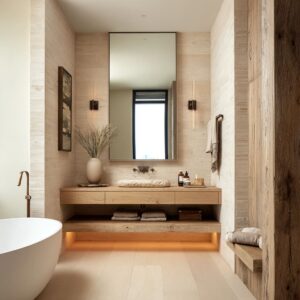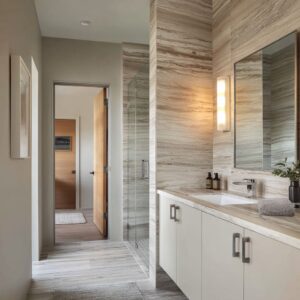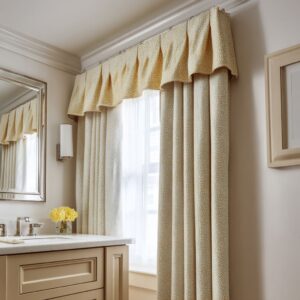
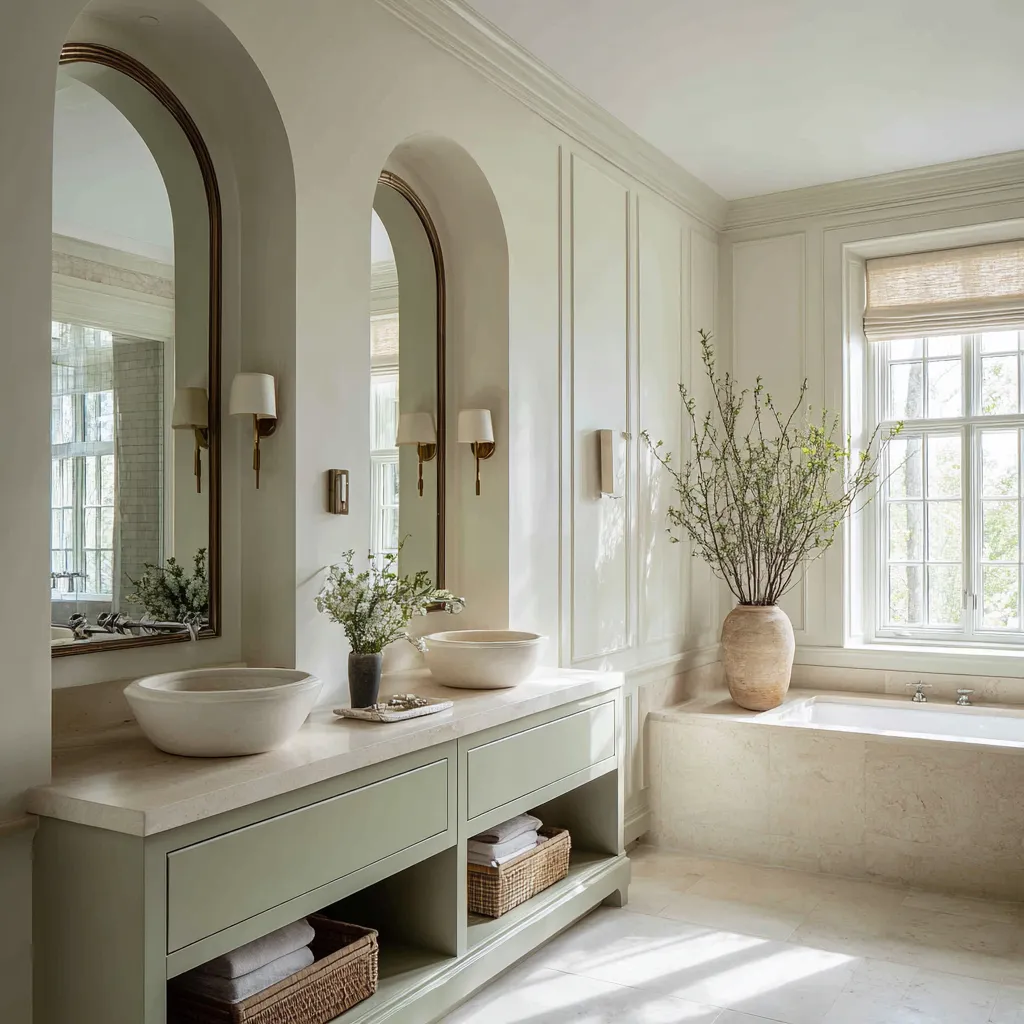
A modern English country bathroom is often explained through ingredients. People name the tub, the brass taps, the paneling, the painted vanity, the Roman shade, the arched mirror, the pale stone floor.
All of those parts can matter. None of them explains the look on its own.
The deeper logic sits elsewhere. The bathroom designs that carry this style convincingly do not begin by asking which fittings look country and which fittings look current.
They begin by making the bathroom look feel like a room in the house. Once that is established, the fixtures can become simpler, leaner, and more edited without losing warmth or character.
That shift changes the whole way the style should be understood. Modern English country bathroom design is not a decorative blend of old and new.
It is a spatial approach. The shell carries memory, proportion, and permanence.
The bathroom elements then enter that shell in a reduced, disciplined way. The result is a room that feels grounded in house architecture while still belonging fully to the present.
Modern English country bathroom designs do not need busy wallpaper, antique clutter, heavy fabric, or a performance of rustic life. Their country quality comes from wall depth, window authority, fitted planning, material weight, and a careful amount of domestic softness.
Their contemporary side comes from restraint, fixture editing, and the refusal to crowd the room with too many signals at once.
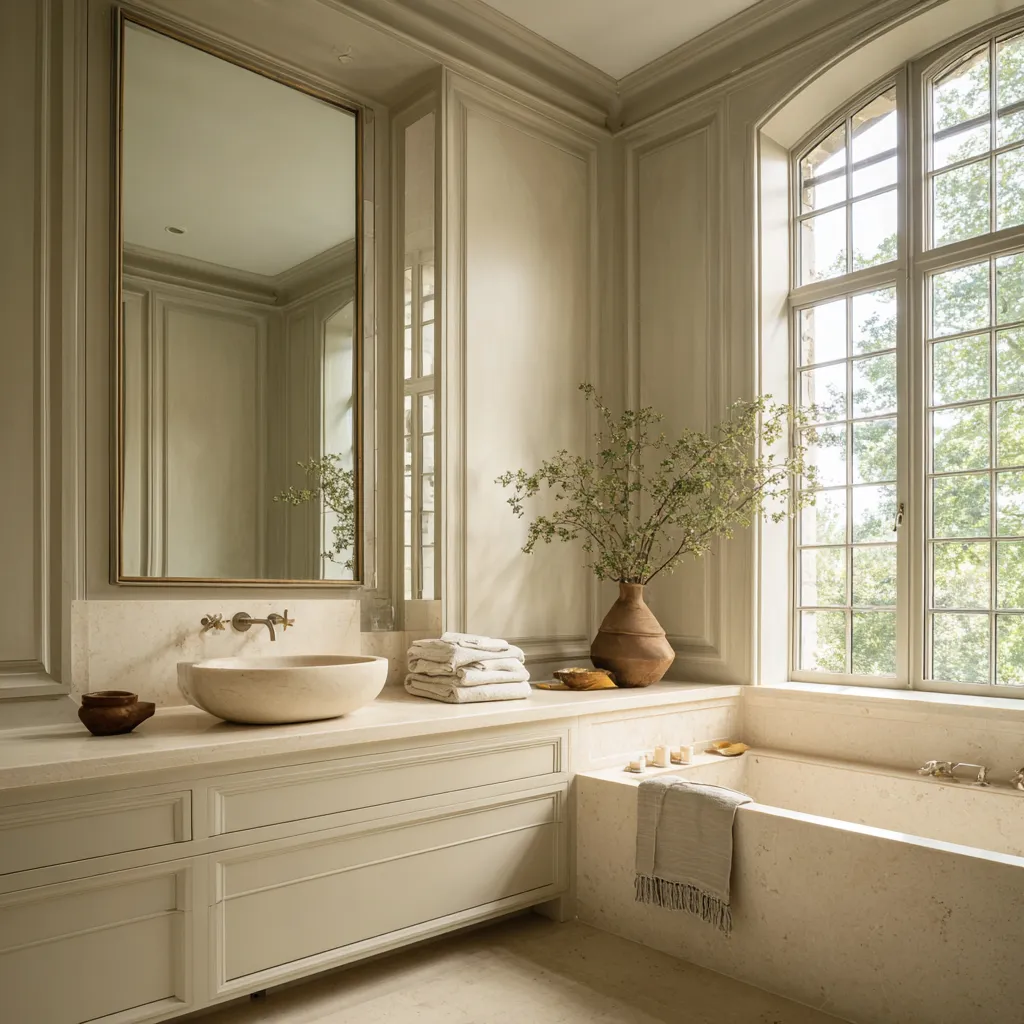
The starting point is not the sink or tub. It is the shell.
One of the mistakes in bathroom design is treating the room as an empty container and the bath elements as the event. In a strong modern English country bathroom, that relationship is reversed.
The shell already has enough structure, presence, and order to make the room feel settled before the basin, tub, or mirror is even considered.
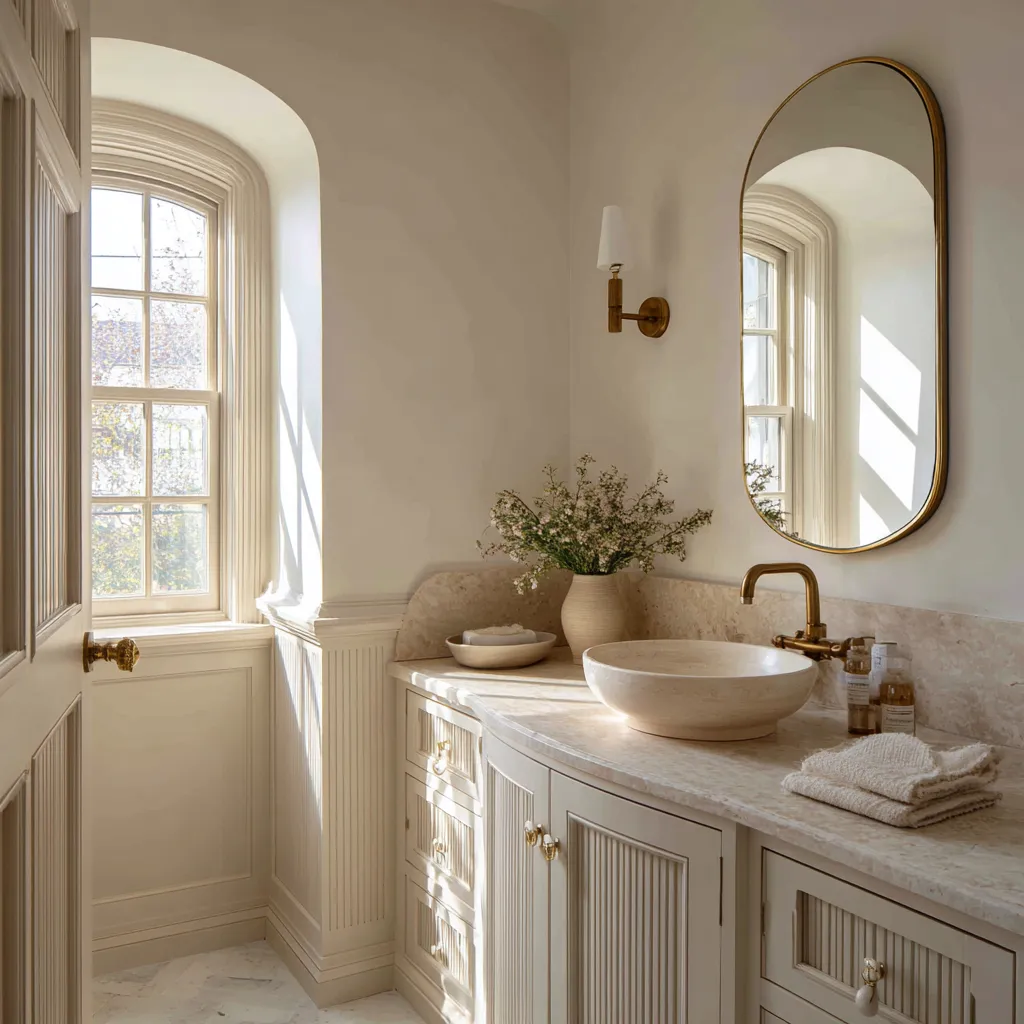
This is why windows matter so much. Not simply because natural light is pleasant, but because the window often does more style work than the fittings.
A tall divided-light opening, a deep reveal, a thick sill, a bay form, a shaped head, or a well-framed wall opening can hold a remarkable amount of English country character. These are not minor details.
They tell you that the room belongs to a house with thickness, age, and architectural substance. They create the sense that daylight is arriving through built structure rather than through a flat cutout in drywall.
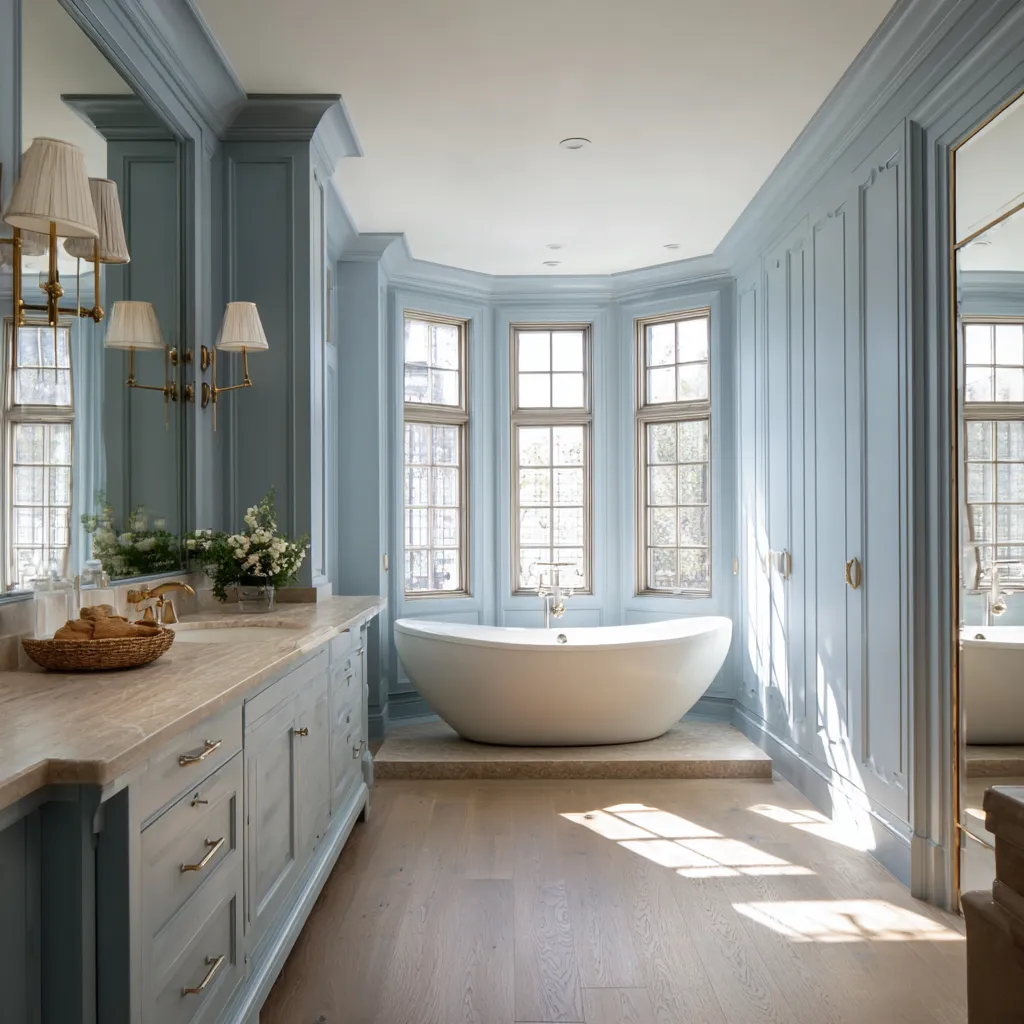
The same is true of paneling, plaster depth, molding, and framed wall zones. A bathroom can feel richly country even with very few overt references if the wall itself has gravity.
Lower wall paneling gives the room a bodily scale. Full-height boarding or full-room paneling can create immersion.
Limewashed or plastered upper walls soften light and prevent the room from feeling sharp-edged or sterile. A framed alcove around the bath or a recessed wall for mirrors can give the room hierarchy without adding clutter.
This is where many current bathrooms miss the mark. They apply country-style objects to a generic room shell.
The result may be pleasant, but it rarely feels fully persuasive. The room has to carry part of the atmosphere on its own.
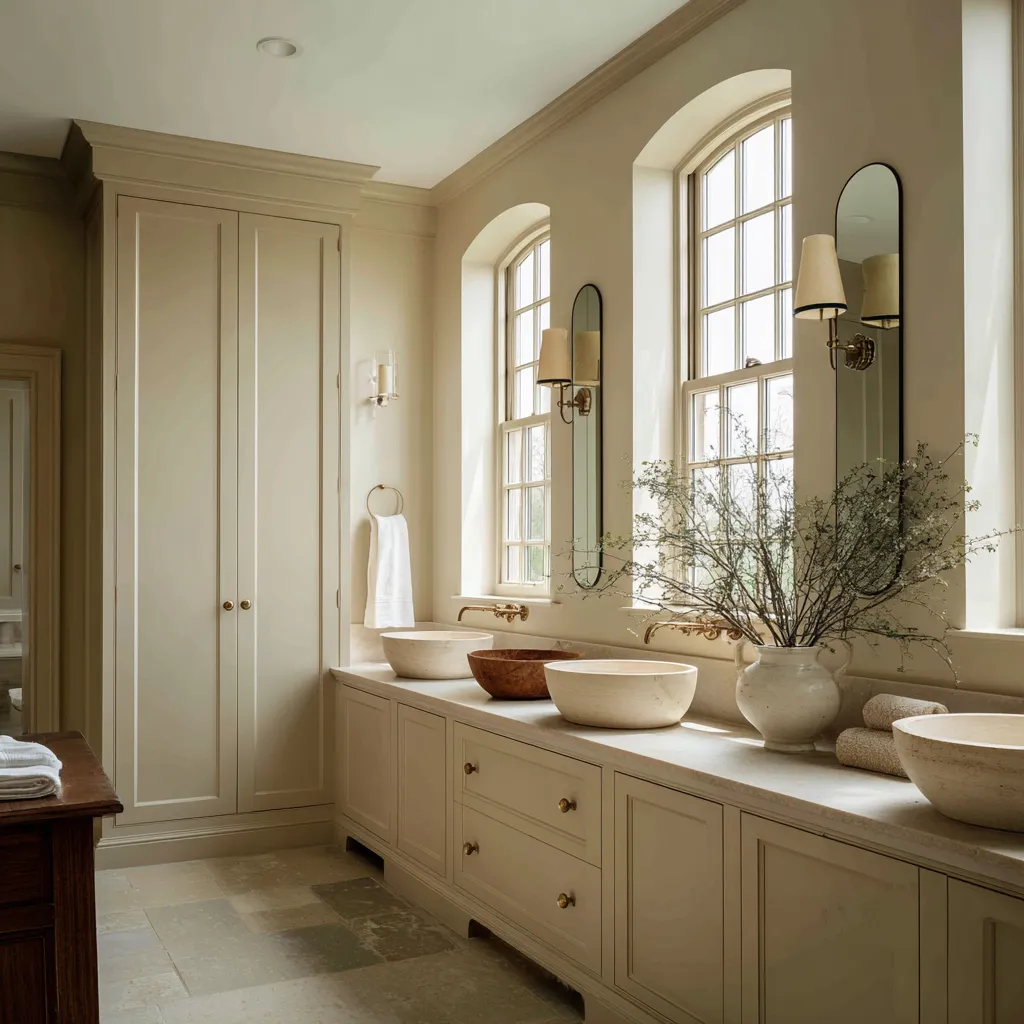
A strong English country bathroom usually has a destination
Another important trait is planning. The interior designs are often organized around a focal end point.
That may be a tub under a window, a vanity aligned with an arched opening, a built-in bath in a recessed alcove, or a window bench that stabilizes the far wall. What matters is that the space is not scattered into equal fragments.
This kind of planning is especially useful in long or narrow bathrooms. Without a visual destination, a narrow room can start feeling like circulation space with plumbing attached.
But once the far end is given weight, the entire room becomes more composed. The eye moves forward with purpose.
The room gains a sense of arrival. That is one reason tubs often work so well at the far end of the space.
Not because the tub itself is inherently superior there, but because it can function as an end-stop. Set it beneath a strong window, on a plinth, inside a bay, or within a framed alcove, and the whole room immediately gains order.
It feels arranged rather than merely equipped.
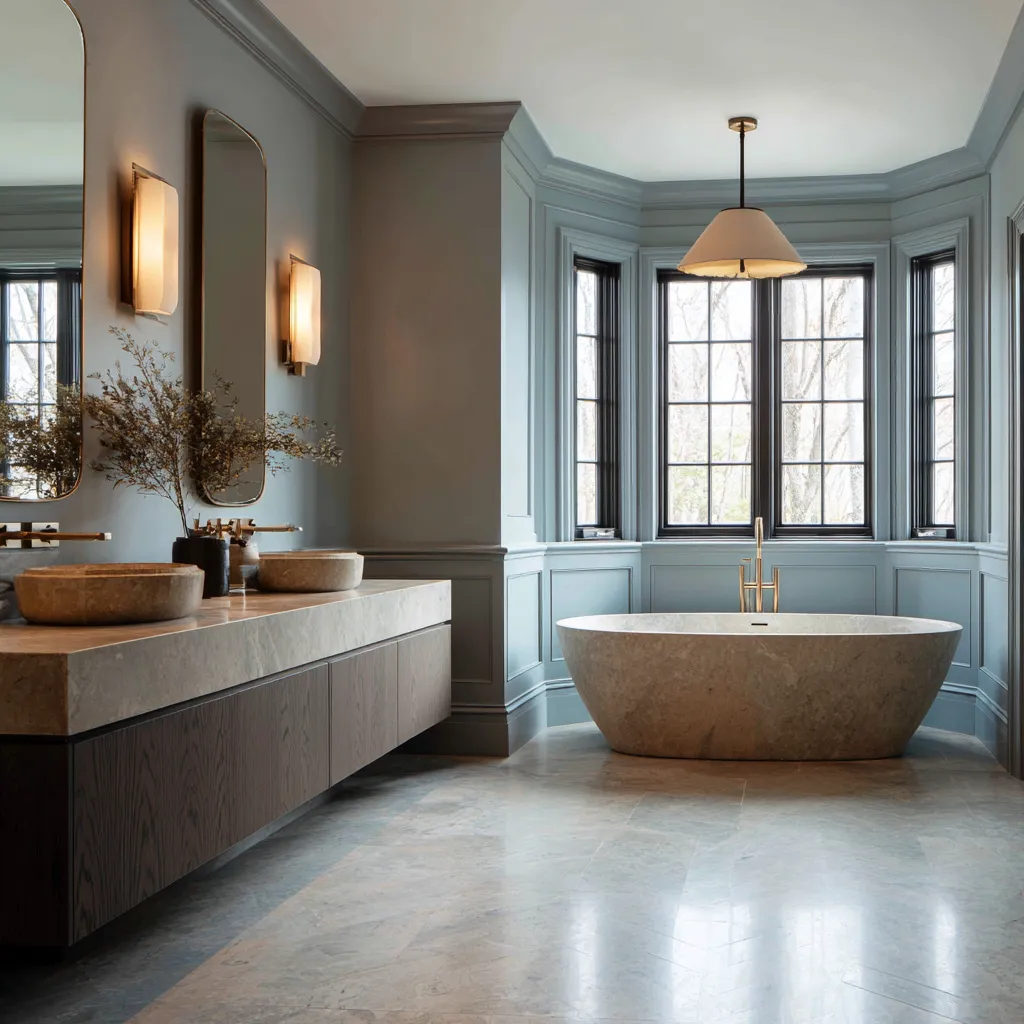
This point also corrects a common assumption about tub choice. Modern English country bathroom ideas do not rely on one tub type.
A freestanding bath can work beautifully. So can a built-in tub.
The decisive factor is not the object category. It is whether the room holds the bath properly.
A freestanding tub without architectural backing can feel loose and showroom-like. A built-in tub without spatial emphasis can feel bland.
Either one becomes convincing once the shell supports it through window placement, recess depth, platforming, or a clear axial view. So the question is not which tub is more country.
The question is whether the bathing zone feels embedded into the room’s structure.
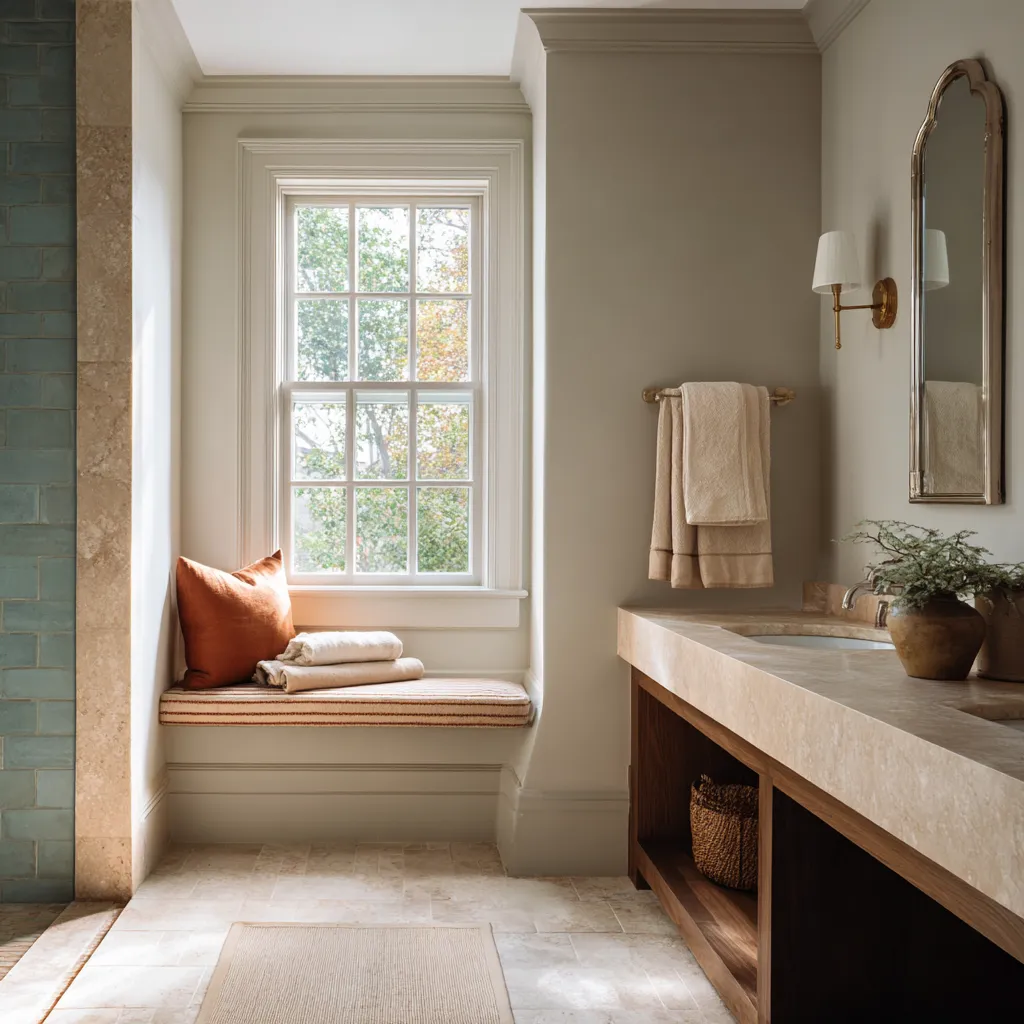
The style becomes current through editing, not through erasing tradition
Many people assume that making English country style feel modern requires stripping away its house character. In practice, the opposite is often true.
The English country bathroom design ideas that feel current usually keep the country shell intact and then edit the insertions. That editing happens at the level of fixture language.
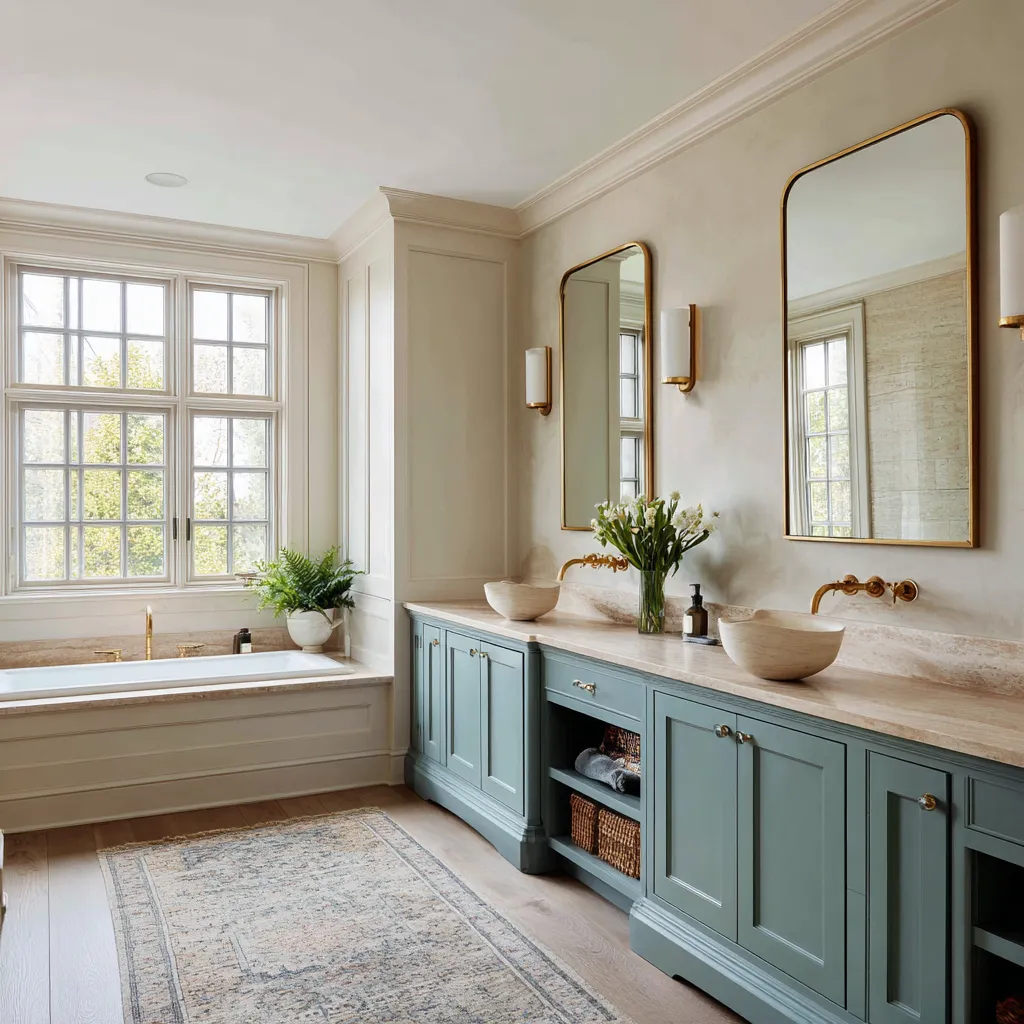
Wall-mounted taps are a good example. They reduce clutter on the countertop, make the basin area feel more architectural, and give the room a sense of permanence.
Vessel basins often play a similar role. They sit on the counter as objects with soft mass and presence, but they can remain restrained if their shape and finish are handled carefully.
Slimmer mirror frames, simplified vanity fronts, and lighter visual lines all help move the room into the present. This is an important distinction.
The contemporary side of the style does not come from flattening the bathroom into generic minimalism. It comes from choosing bathroom elements that are pared back enough to let the shell remain visible.
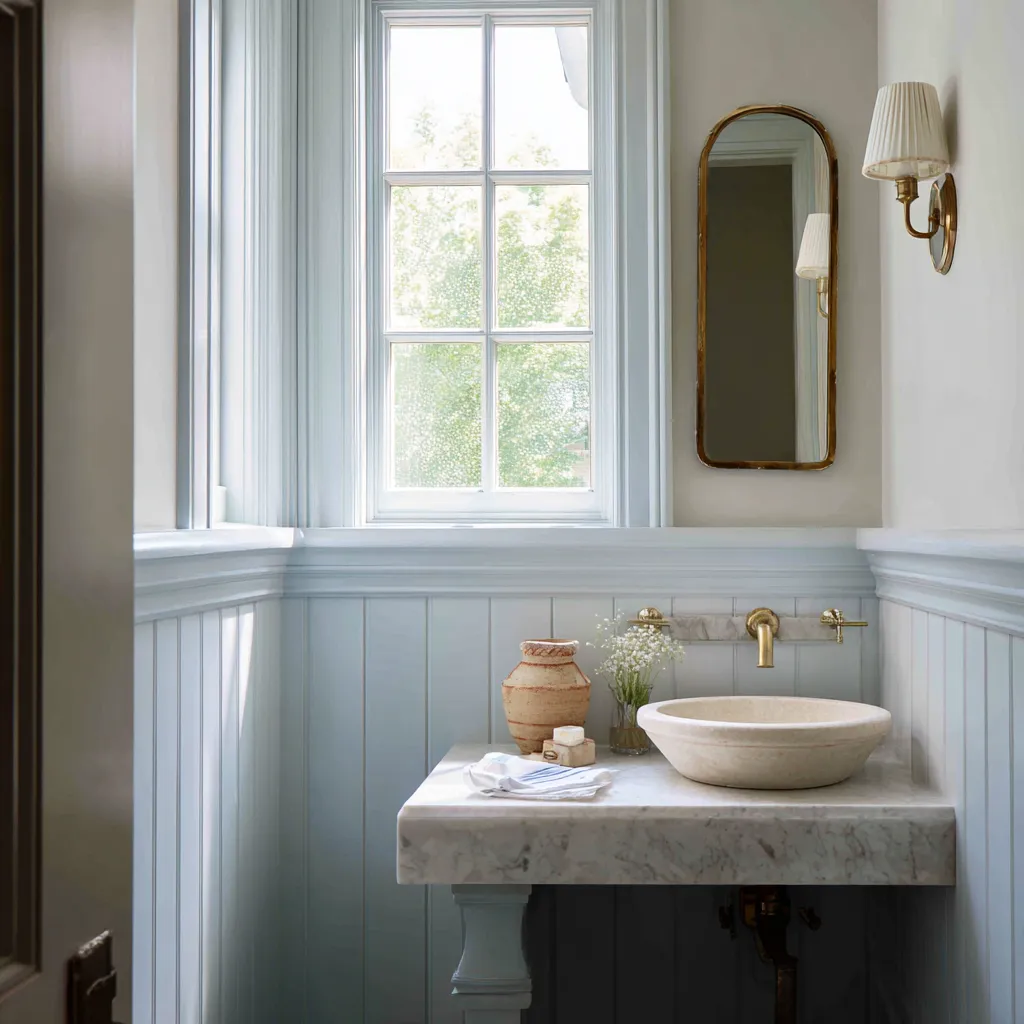
That is why the vanities often sit in an interesting middle zone. They may still have panel-front doors, framed drawers, or furniture logic, but the detailing is reduced.
The profiles are cleaner. The cabinet division is broad rather than fussy.
In some cases the vanity floats or appears visually lighter, but only because the room around it is strong enough to support that move. The country reference remains.
It is simply tightened.
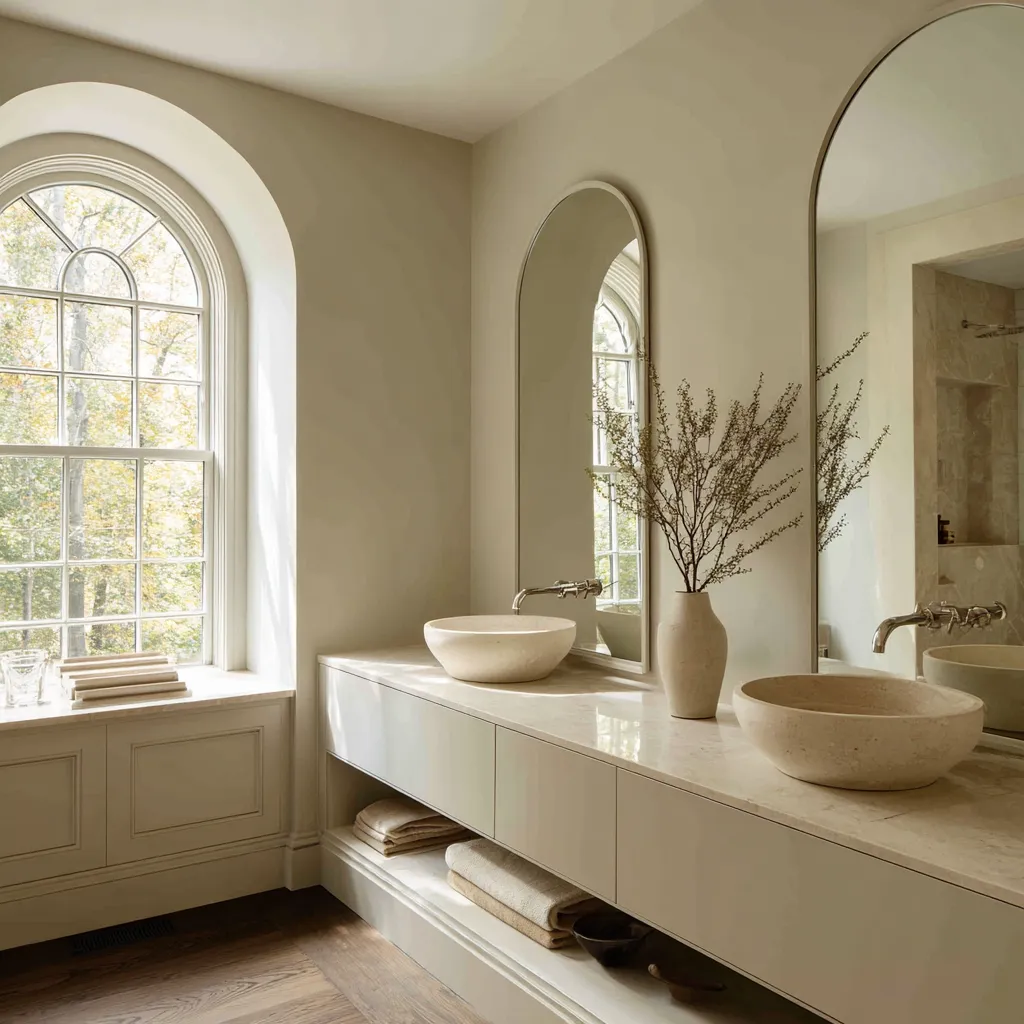
The same applies to mirrors. Arched or rounded mirrors can help modern English country bathrooms greatly, but not because arches are a magical sign of the style.
Their value is more specific. They soften the harder lines of panel grids, mullions, cabinetry, and stone edges.
They relieve severity. They introduce vertical grace into rooms that might otherwise become too rectilinear.
They are support elements, not the backbone of the design. That difference matters, because many bathrooms become formulaic by relying too heavily on arch motifs.
The elegant modern English country designs are not the ones with the most curves. They are the ones where shape softness is used in the right amount against a strong structural base.
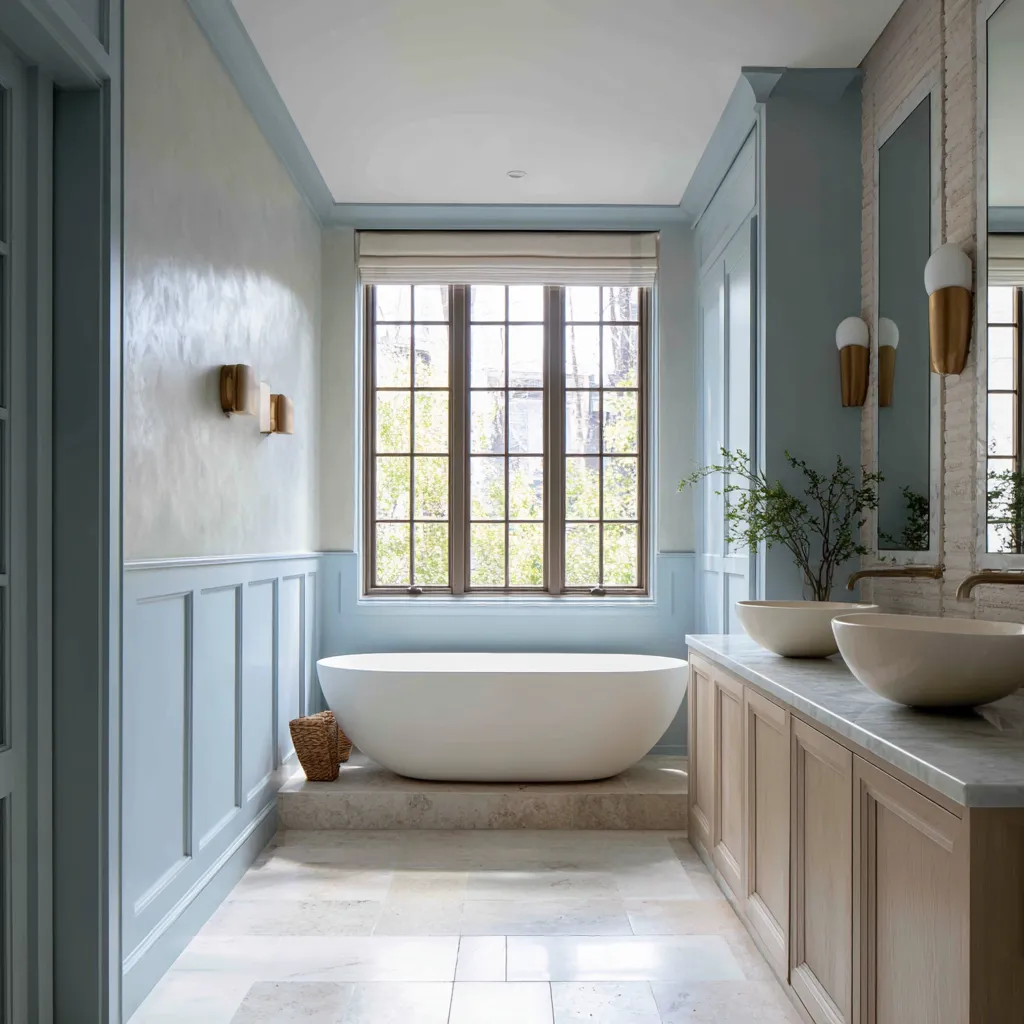
Luxury here is built through weight, spacing, and hierarchy
Another misunderstanding is the idea that luxury in this style comes from decorative richness. The more persuasive version of luxury in modern English country bathrooms often comes from mass and allowance.
Mass means thick stone tops, deep ledges, wall depth, monolithic basins, substantial tub surrounds, properly scaled mirrors, and cabinetry that feels anchored rather than flimsy. It does not require heaviness everywhere.
It requires enough weighted elements to give the room seriousness.
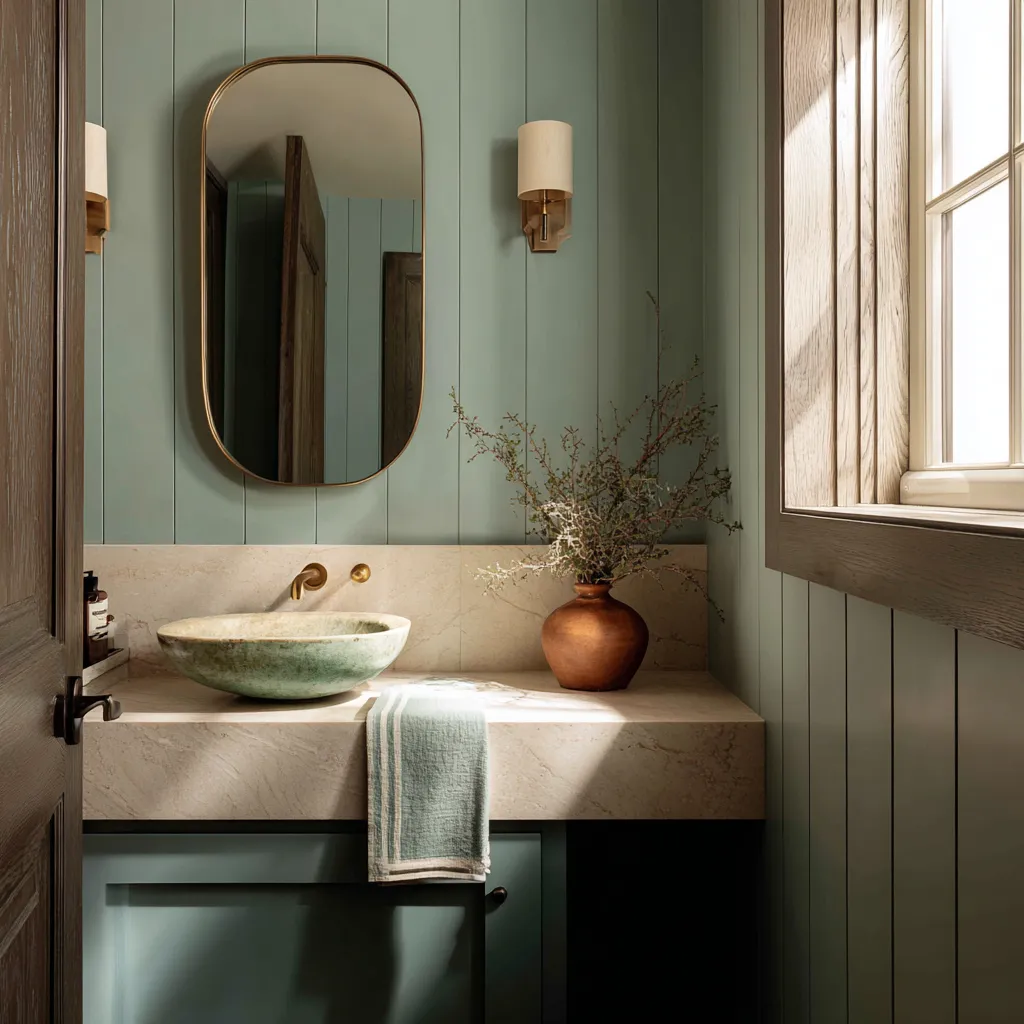
Allowance is just as important. By allowance, I mean visible breathing room around the parts that matter.
Empty counter around the basin. Open floor area between vanity and tub.
Space around the mirror rather than squeezing fittings too tightly. A window wall allowed to remain legible instead of being buried under cabinetry or decorative overlays.
This is where many bathrooms lose their chance at refinement. They may have expensive materials, but the room feels overfilled.
Every wall carries a function, every surface carries objects, every corner carries a storage answer. Nothing is allowed to stand on its own.
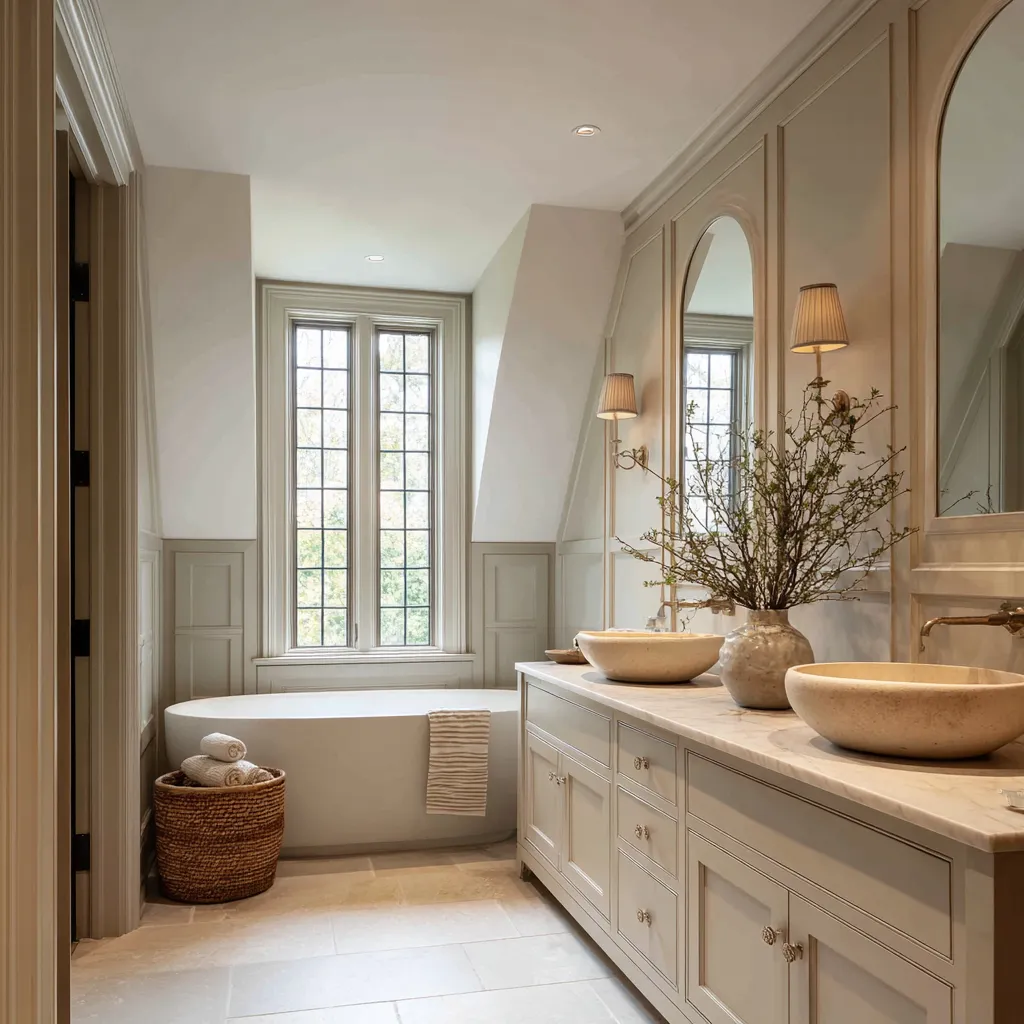
The more sophisticated English country bathrooms resist that urge. They understand that one well-scaled stone top can do more for the room than several smaller decorative gestures.
One strong wall opening can carry more atmosphere than a collection of accessories. One decisive vanity can do more than multiple little moments competing for notice.
Luxury in this language is not decorative noise. It is confidence in proportion.
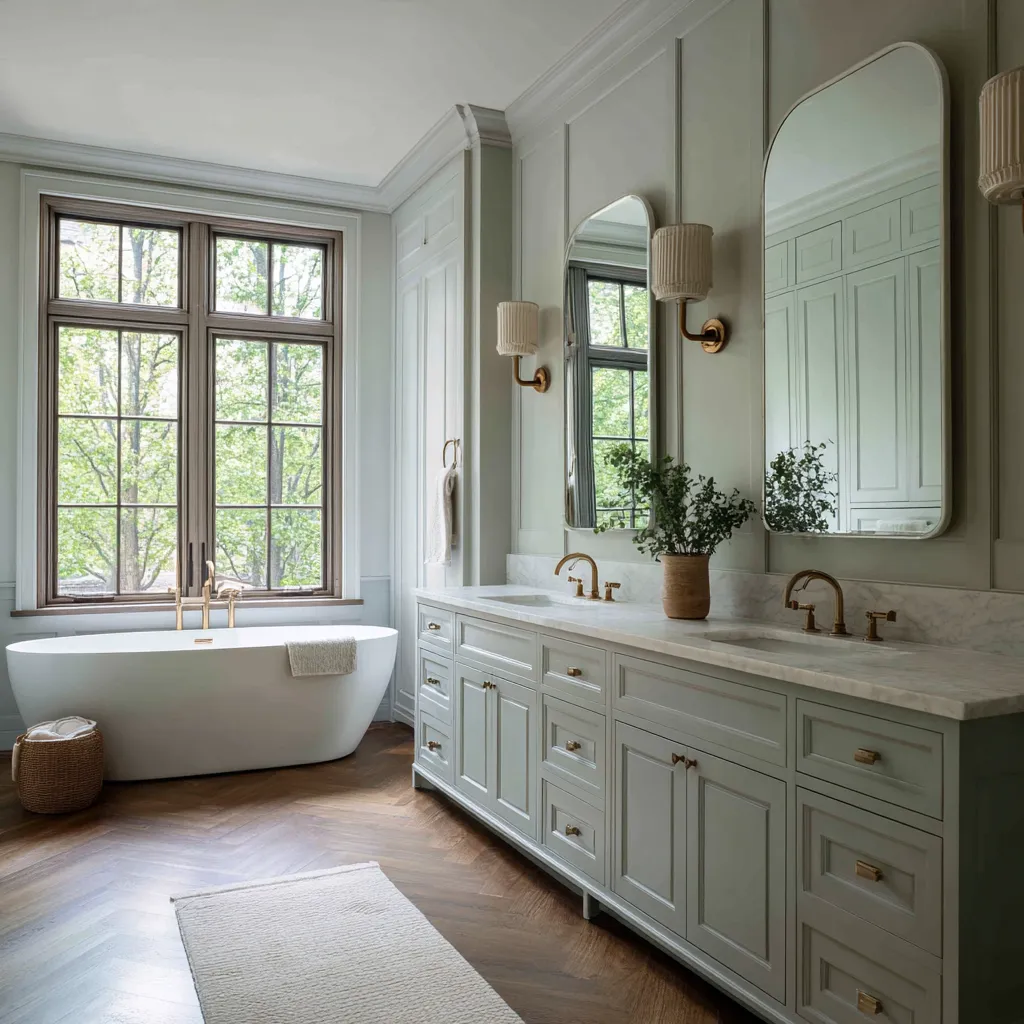
The domestic layer matters, but only in the right dose
A bathroom in this style should feel connected to the rest of the home. That is part of its appeal.
Wood floors, shaded sconces, rugs, benches, visible folded towels, baskets, Roman shades, and a little softness around the edges all help the room feel house-linked rather than clinically sealed off. But this domestic layer has to be handled with care.
Too little, and the room can feel cold, staged, or hotel-like. Too much, and it begins to lose sharpness.
Open shelves full of visible storage, too many baskets, too many textiles, or too much furnished softness can shift the room away from refined English country and toward a more casual family-bath mood. This is one of the interesting tensions in the style.
Domesticity helps the bathroom feel inhabited. It also has the power to blur the architecture if pushed too far.
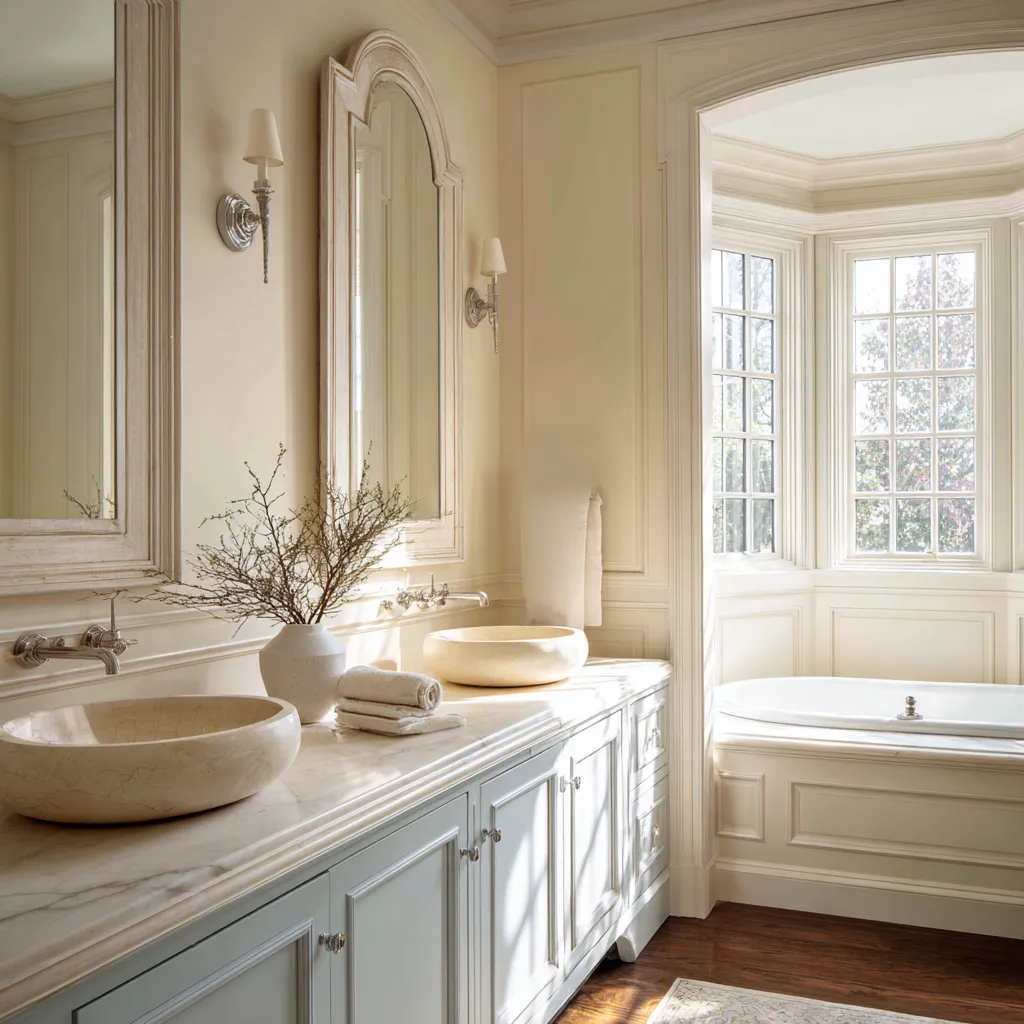
The interior designs usually choose a few well-judged domestic notes rather than spreading them everywhere. A pair of shaded sconces can do a great deal.
So can a Roman shade, one basket, a folded towel stack, or a single branch arrangement. These elements should warm the room, not take control of it.
That is also why visible storage is such a delicate issue. Open shelves and baskets can make a vanity feel more relaxed and useful, but they also lower the degree of visual discipline very quickly.
In a bathroom where the goal is a highly polished contemporary English country result, concealed storage often helps more than visible storage. Open elements work when they are few, broad, and deliberately styled rather than densely packed.
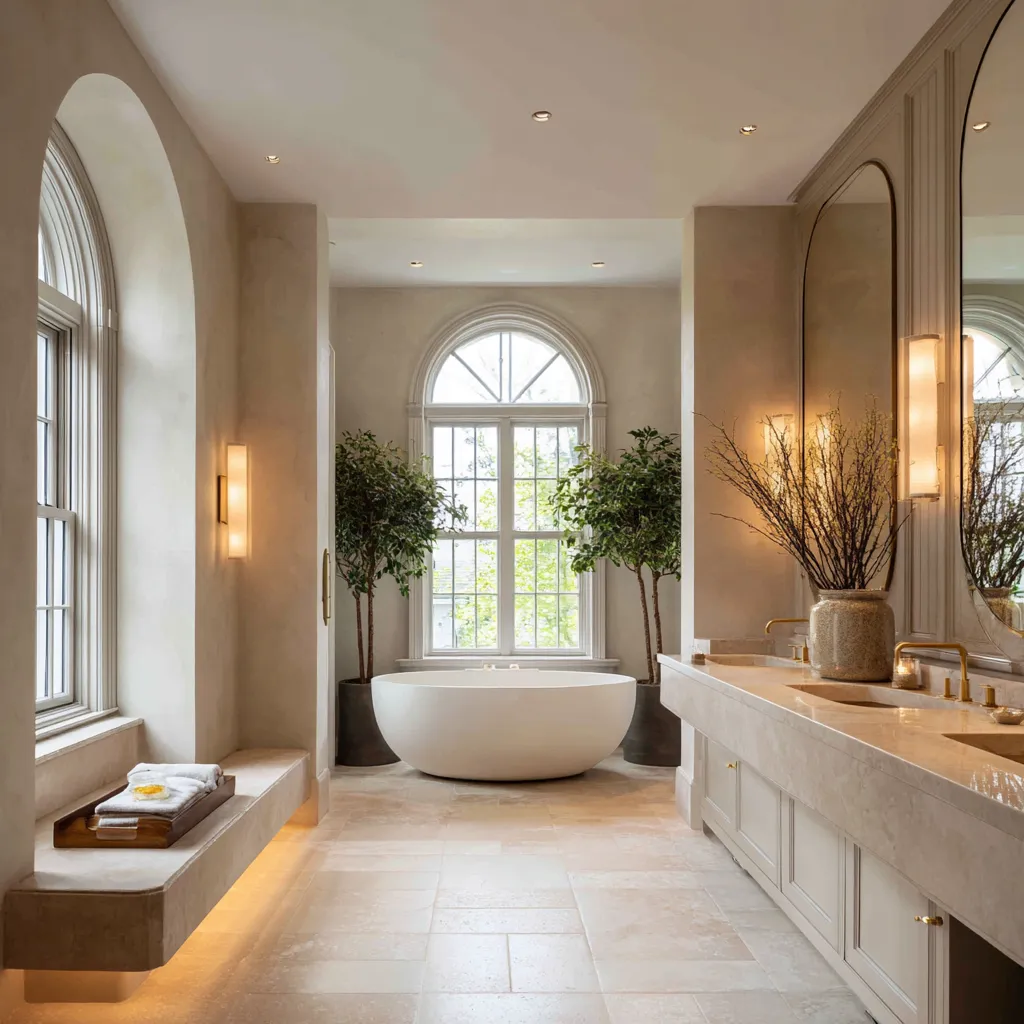
Color works well when it behaves like atmosphere
Color in modern English country bathroom ideas is rarely at its best when it behaves like a sharp accent. The stronger palettes are usually close in value and softened in tone.
Pale blue-grey, softened sage, chalky cream, warm stone beige, greige plaster, washed timber, muted green, and restrained brass tend to work better than high-contrast schemes. This does not mean the rooms are flat.
In fact, the opposite is true. When the palette stays close in value, texture becomes more legible.
Stone, plaster, paint, timber, linen, woven fiber, ceramic, and metal each reflect light differently. That staggered material response gives the room richness without visual commotion.
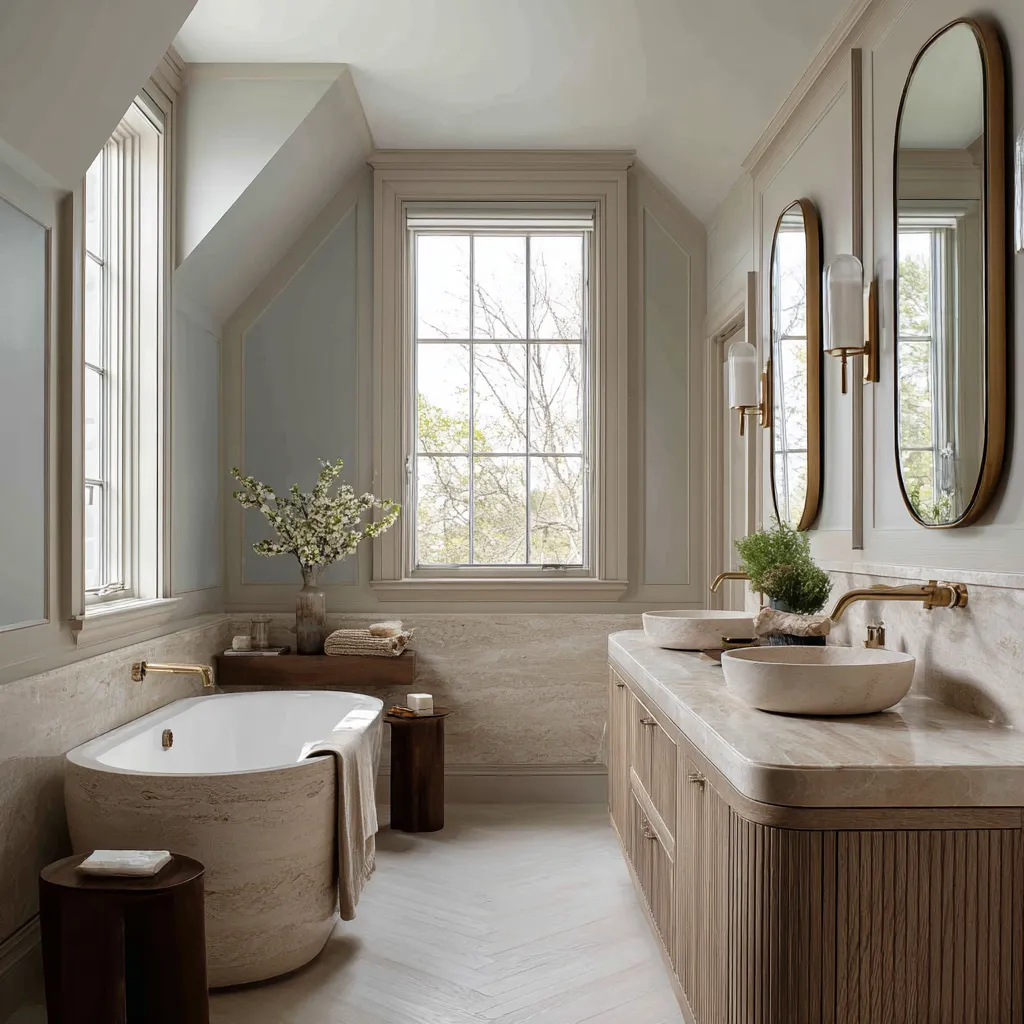
This is one reason pale schemes can feel so substantial in these bathrooms. If the shell has panel structure, good openings, and material shifts, a pale room can still feel layered and full.
It does not need dramatic dark accents to stay alive. At the same time, darker schemes can work exceptionally well, but only under certain conditions.
A deeper green, blue-grey, or moody timber-based palette will not rescue a weak room. Dark color needs architectural seriousness beneath it.
If the paneling is thin, the window weak, the vanity flimsy, or the planning loose, darker paint often makes that weakness more visible. But in a room with strong shell articulation, good window framing, and enough stone or timber weight, deeper color can produce a rich cocooning effect that still feels fully English country.
So darker palettes are not the main story. Structural conviction is.
Once that is in place, the color can move lighter or moodier with far less risk.
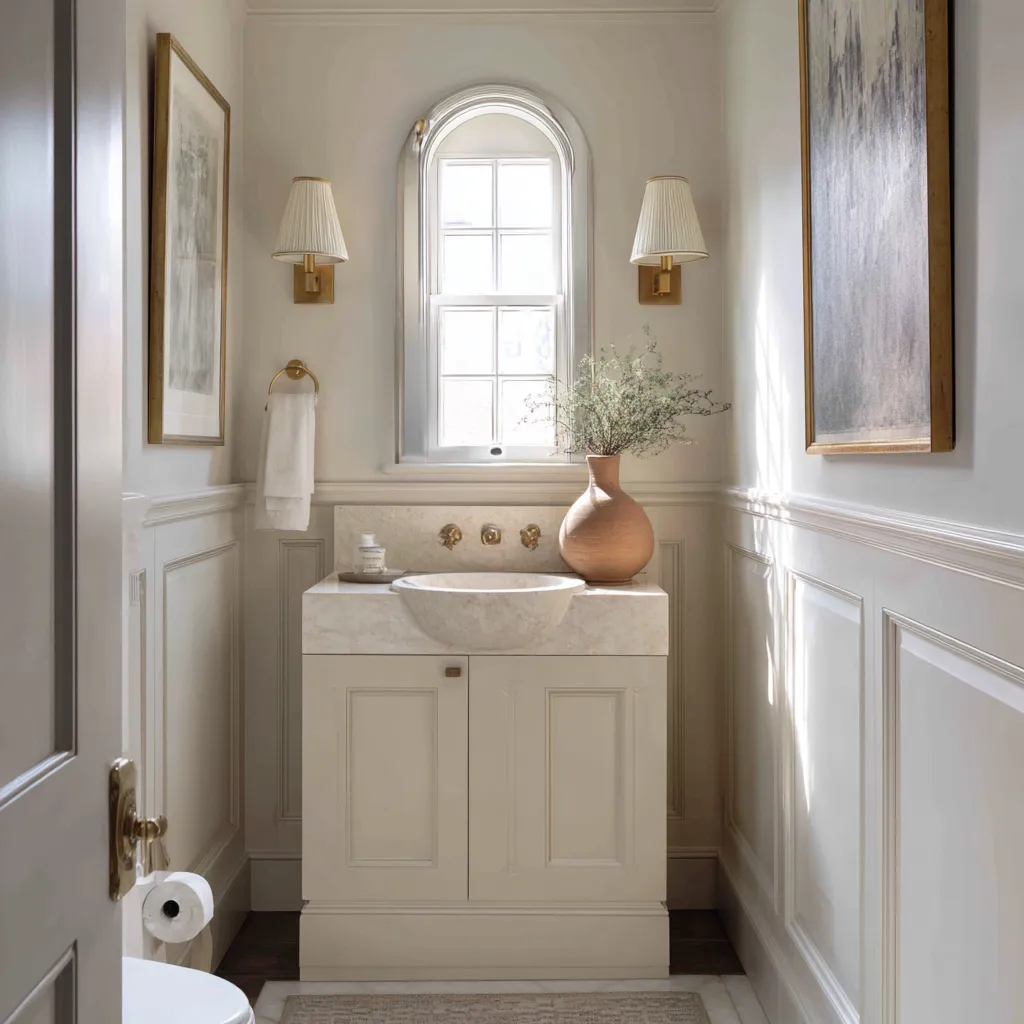
Small bathrooms often reveal the style more clearly than large ones
There is a useful lesson in compact rooms. A small modern English country bathroom often has less room for stylistic confusion.
Every line has to earn its place. Every major choice becomes more visible.
Because of that, the style can appear in a more concentrated form. A small bathroom does not need fewer ideas in the sense of emptiness.
It needs fewer but heavier ideas. One deep-set window.
One decisive mirror. One strong vanity.
One meaningful stone gesture. One shaped opening or one stretch of paneling that gives the room identity.
And then restraint.
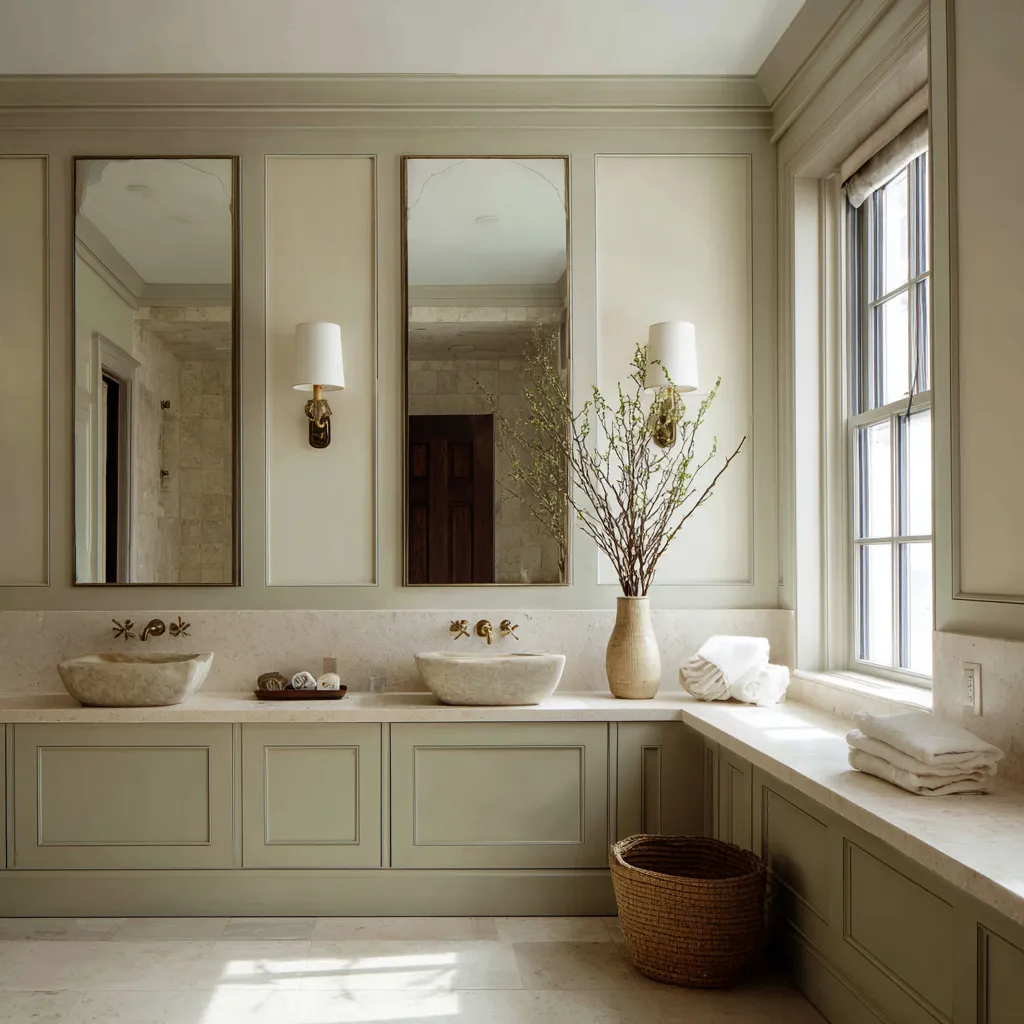
That formula often works better than trying to miniaturize every possible country feature. In tight spaces, too many little references can make the room feel restless or compressed.
A compact room becomes far more persuasive when it relies on concentration. One good reveal may matter more than added decoration.
One tall mirror may matter more than extra fittings. One thick top may matter more than multiple small materials.
This is also why curved or softened edges can be especially effective in smaller bathrooms. A rounded vanity corner, an oval mirror, an arched niche, or a softened basin can relieve the mechanical quality that tight plans often develop.
These moves do not need to be numerous. They simply need to arrive where the room design most needs release from rigidity.
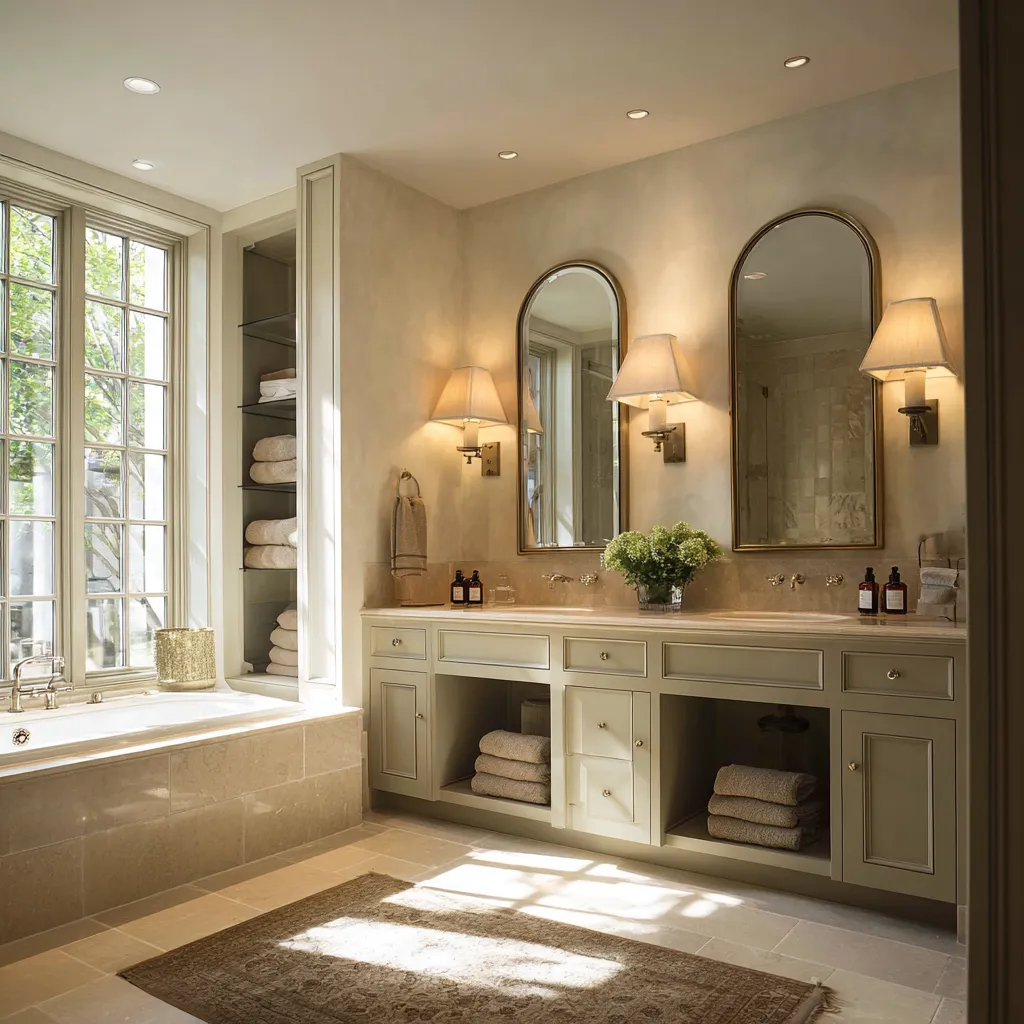
Storage should belong to the architecture, not interrupt it
Practicality matters in bathrooms, and English country style should never require the room to stop being useful. But storage has a visual role as well as a functional one.
The storage often behaves like part of the room’s built structure. Tall cabinets painted to match the wall.
Fitted vanity runs that feel integrated rather than separate. Low built-in zones beneath windows that stabilize the composition.
Recessed niches that belong to the wall rather than protruding into the room. These solutions help the bathroom remain orderly without turning storage into visual clutter.
This is especially important in family-oriented bathrooms or larger primary baths where the temptation is to solve every need with visible cabinetry and shelving. The better solution is usually concentration.
Let storage gather into one strong integrated zone rather than distributing itself everywhere. That protects the room’s atmosphere and keeps the main architectural moments visible.
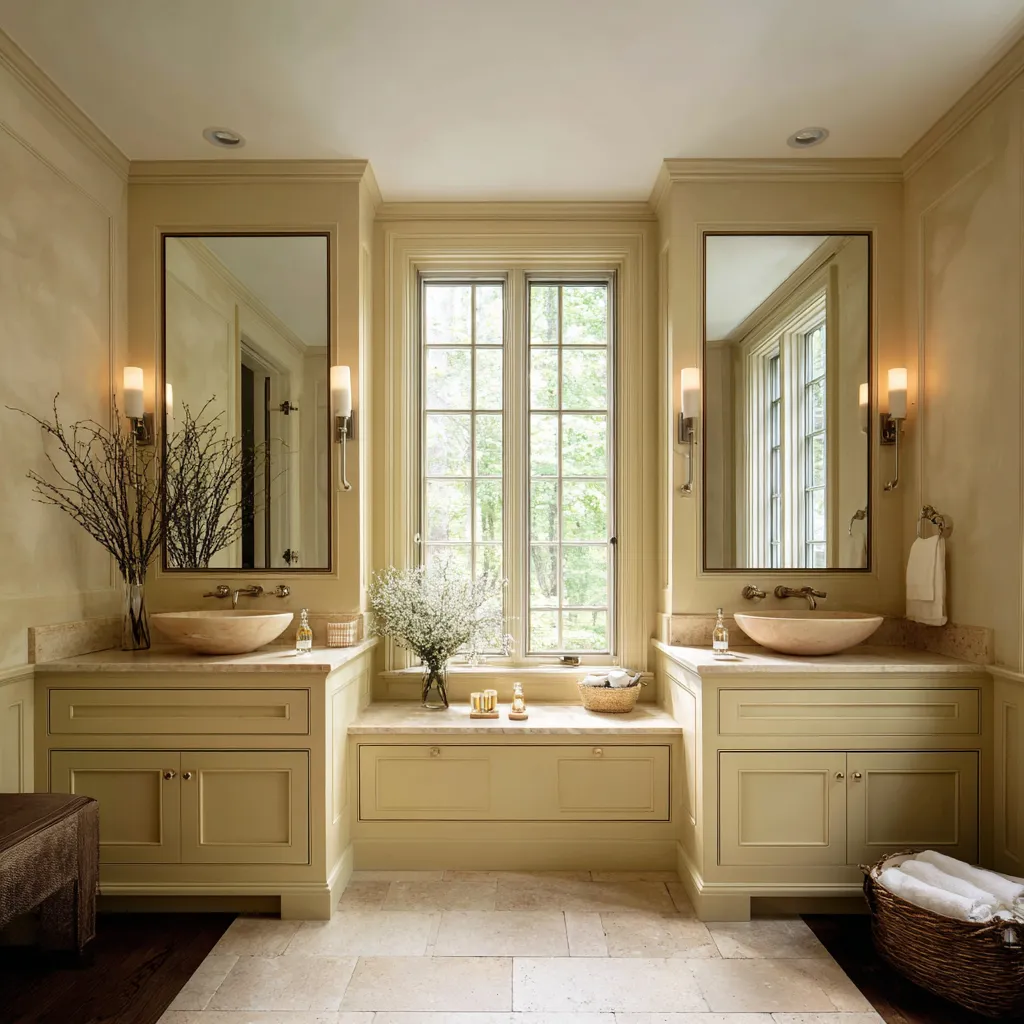
A tall cabinet can be extremely useful in this language, but it works when it feels like part of the wall rather than an extra wardrobe parked beside the vanity. A long sink run can feel generous rather than overwhelming if its divisions are disciplined and its mirror rhythm is vertical enough to counter the horizontal spread.
In other words, the more practical the room becomes, the more important compositional control becomes.
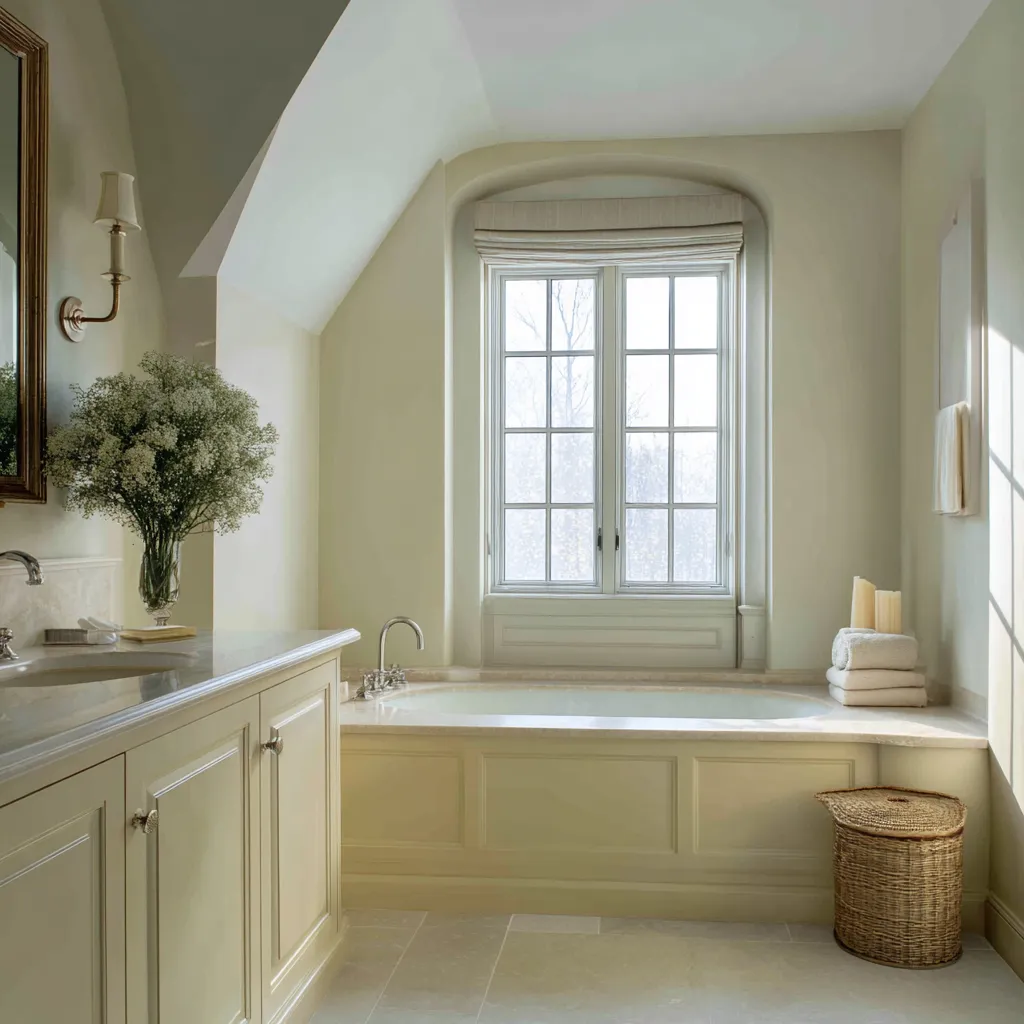
The bathroom should feel attached to the life of the house
Perhaps a valuable way to understand modern English country bathroom design is to stop thinking of it as an isolated wet room with a decorative style applied to it. The interior design examples feel attached to the life of the house.
That attachment can come through many things:
- a wood floor that relates to nearby rooms,
- a bench or seat that makes the window inhabitable,
- shaded lighting that feels borrowed from a dressing room,
- paneling that carries house structure into the bath,
- a Roman shade that gives softness without covering the window’s form,
- a tub that feels set into the architecture rather than displayed for effect.
What matters is that the room still belongs to the domestic world around it. It should not feel like a design island.
This is why modern English country bathrooms often feel so satisfying. They do not ask the user to leave the house atmosphere behind in order to enter a bathroom identity.
They allow bathing, washing, dressing, and storage to happen within a room that still feels house-rooted. That quality is subtle, but it is central.
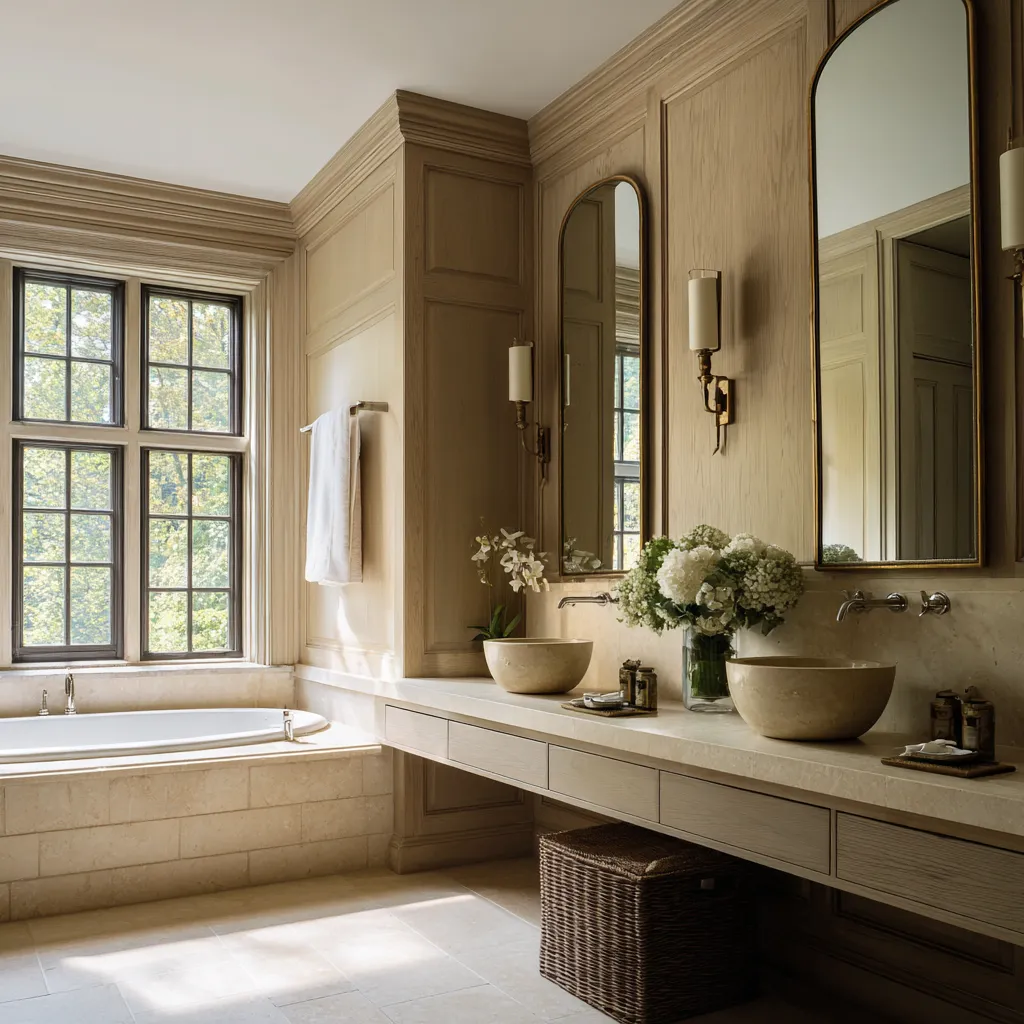
What actually creates the stylish contemporary English country look
If all of this is reduced to one practical principle, it is this: the room should carry the older memory and the fixtures should carry the present-day discipline. That means:
- the shell holds the depth, structure, and permanence
- the insertions stay edited
- the materials have enough weight to create seriousness
- the palette remains restrained enough for light and texture to matter
- domestic warmth enters carefully, not everywhere at once
- storage serves the room without becoming the room
Once those relationships are in place, the style begins to look far less like a catalog of country references and far more like an architectural language.
That is why the strongest modern English country bathrooms feel both settled and fresh. They do not split the difference between old and new in an obvious way.
They let the house lead, then allow the bath elements to become clearer, simpler, and more exact. The result is not a themed room.
It is a room with memory, weight, and present-day precision. And that is what gives modern English country bathroom design its particular depth.