Green maximalist bedrooms are often misunderstood. Many people imagine them as leaf-covered walls, dark paint everywhere, heavy fabrics, and an almost greenhouse-like intensity.
That version exists, but it is only one branch of the style. The green maximalist bedroom ideas can go far more varied.
Some rely on murals. Some rely on architecture.
Some build richness through repeated pale green notes placed in several zones. Others barely use botanical imagery at all and instead build the whole mood through stone, plaster, wood, upholstery, and close tonal layering.
That is why green maximalism is such an interesting category for bedrooms. It can feel fresh, moody, airy, cocooned, formal, plush, scenic, or highly architectural while still keeping a clear identity.
The common thread is not a single type of wallpaper or one standard shade of green. The common thread is the way green is asked to carry abundance.
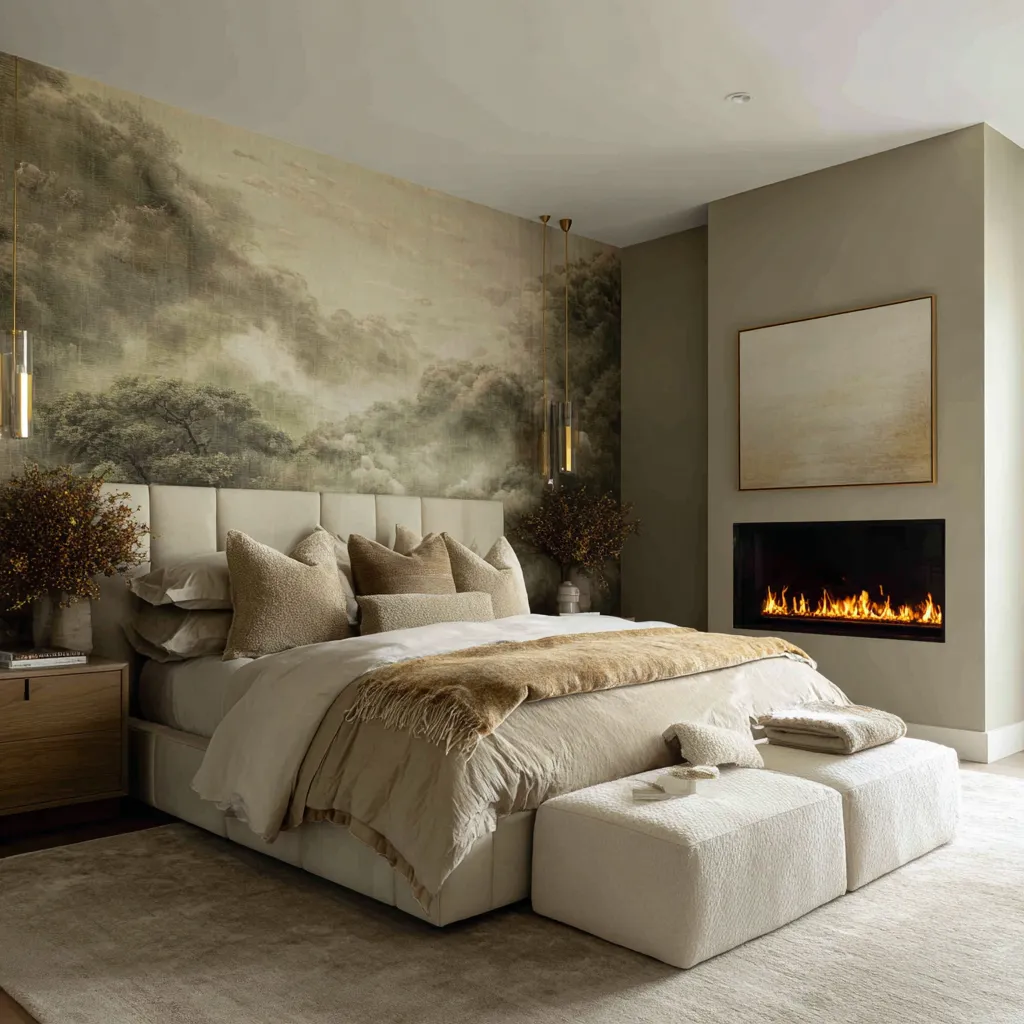
Green does not simply appear. It organizes.
It may shape the shell, hold the wall behind the bed, settle into cabinetry, move through drapery and art, or sink into mineral surfaces and tactile textiles. Once you start looking at green this way, the style becomes far richer and far more flexible.
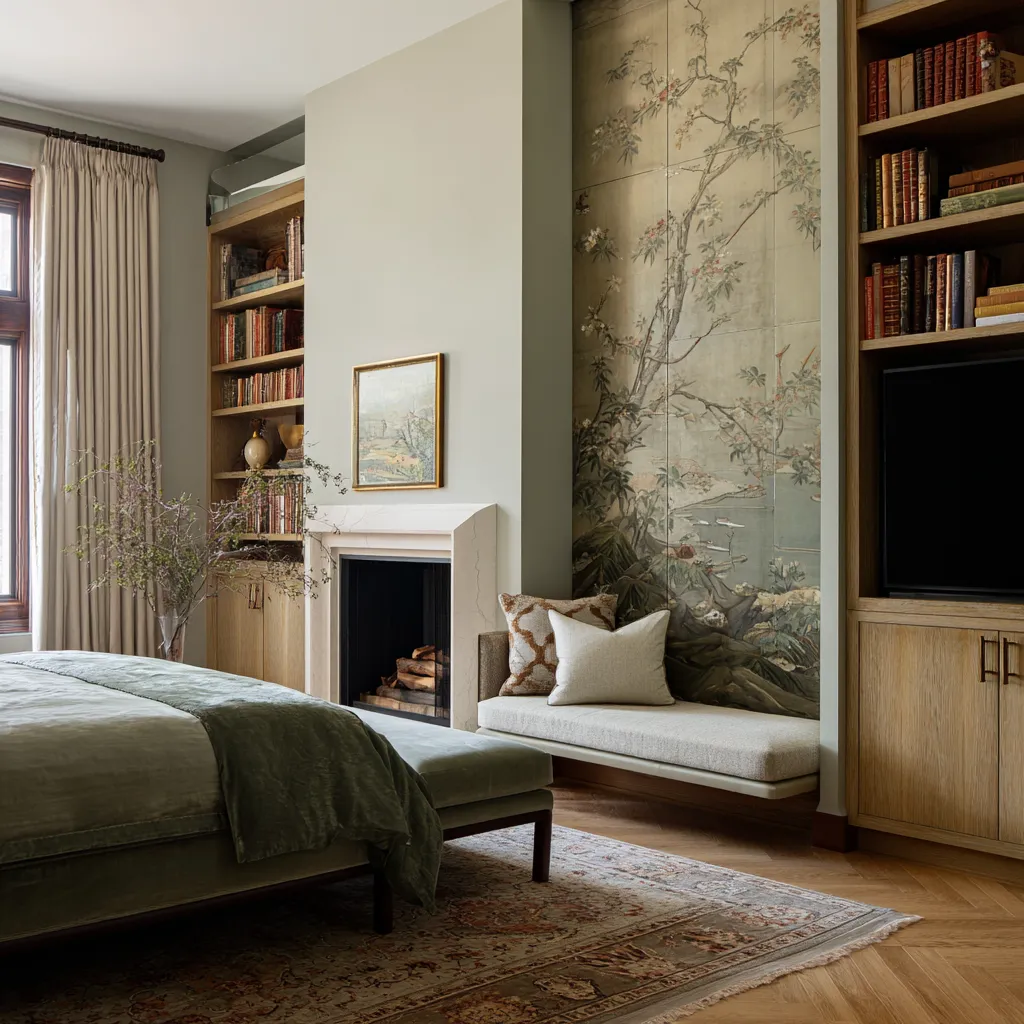
The foundation of green maximalism
Green maximalist bedroom ideas are usually defined by the systems that hold richness together. The drivers acan be texture, framing, layered mass, warm material balance, and the repeated placement of green through different parts of the room.
This changes the usual conversation. Instead of asking whether the bedroom needs wallpaper, the better question is: where does the room keep its visual abundance?
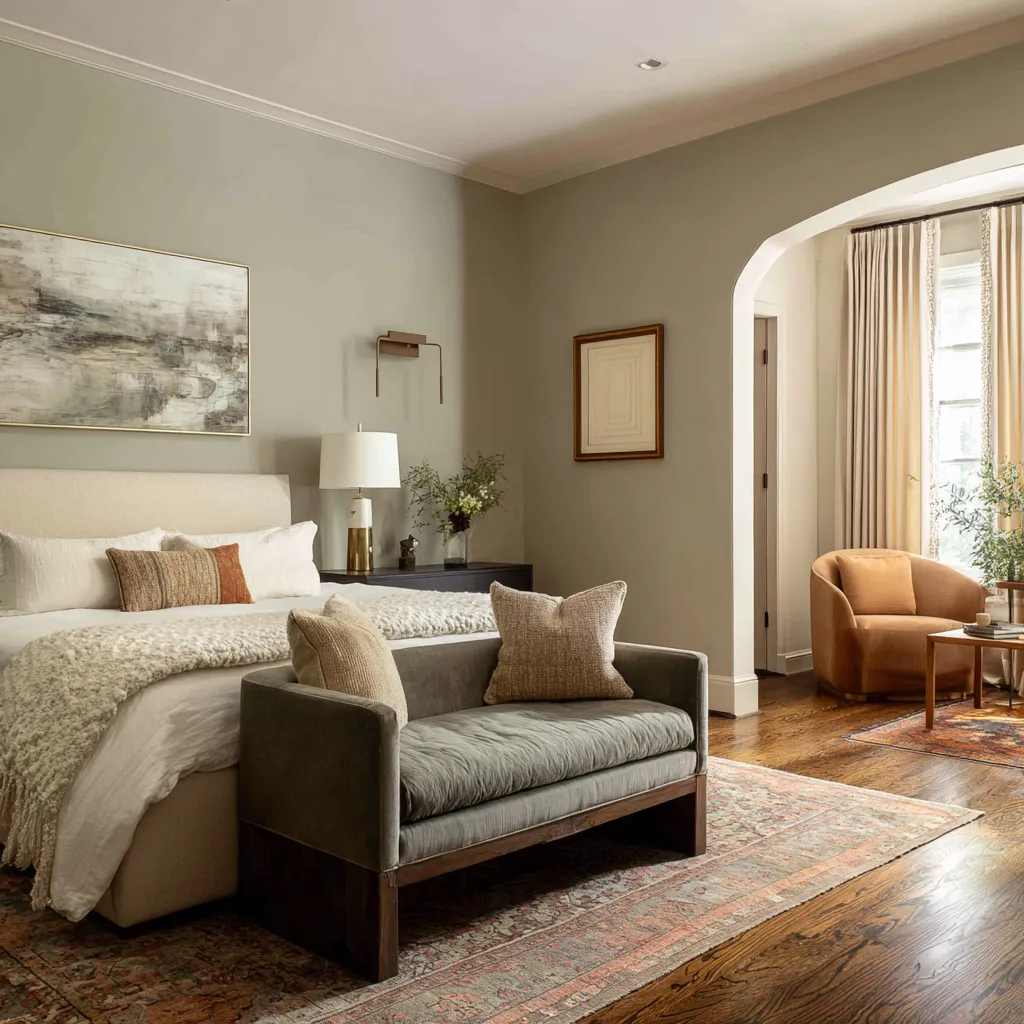
In some bedrooms, abundance sits in the wall image. In others, it sits in the architecture.
In others, it sits in repeated soft echoes of green placed through textiles, art, and secondary furniture. In another group, abundance sits in material depth itself: veined stone, plaster-like surfaces, brushed fabrics, bouclé, nubby coverlets, wood grain, and the shift between matte and reflective finishes.
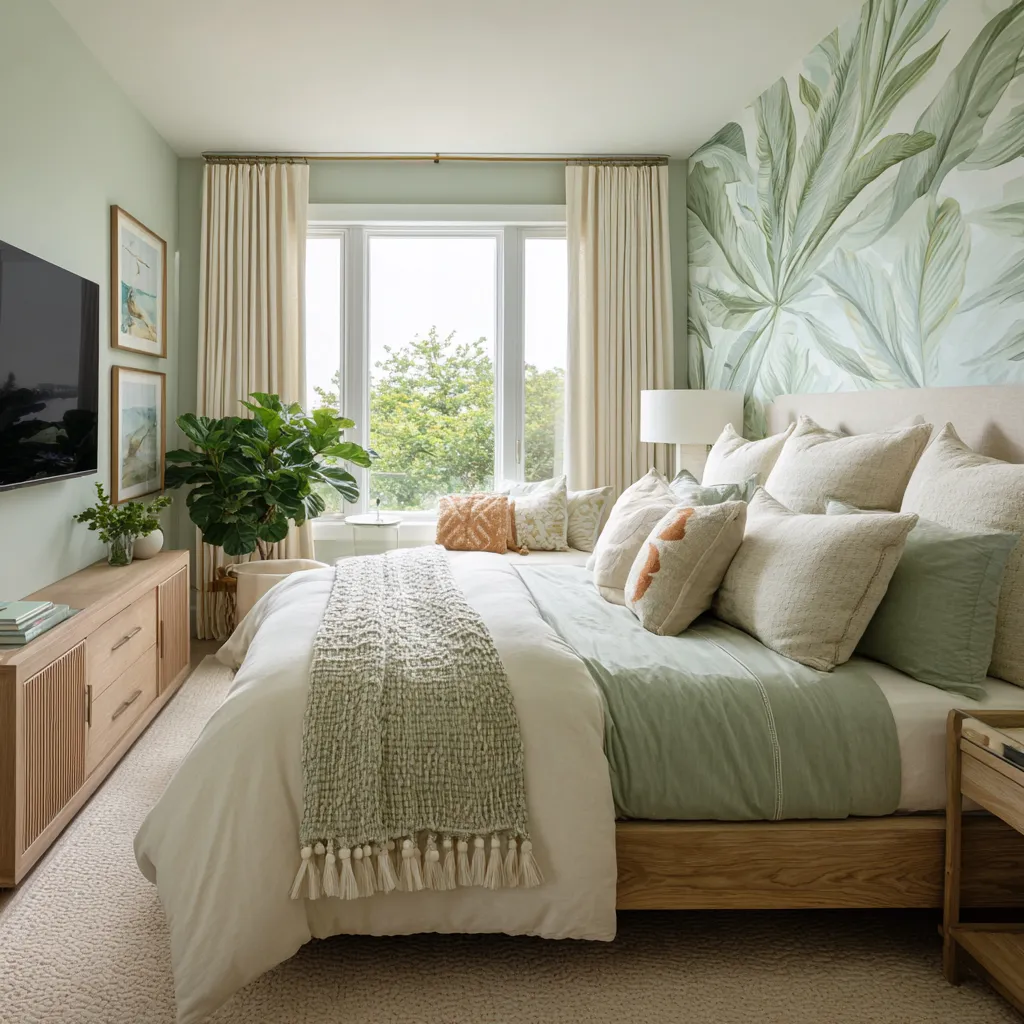
That distinction matters because different rooms need different carriers. An interior design with strong millwork and deep framing may need only a modest green wall treatment.
A room with a broad mural can keep the rest of the shell much simpler. A suite-like bedroom with a sitting area may work better when green is spread through several registers instead of condensed into one dramatic wall.
Green maximalism works when the room chooses its main carrier clearly.
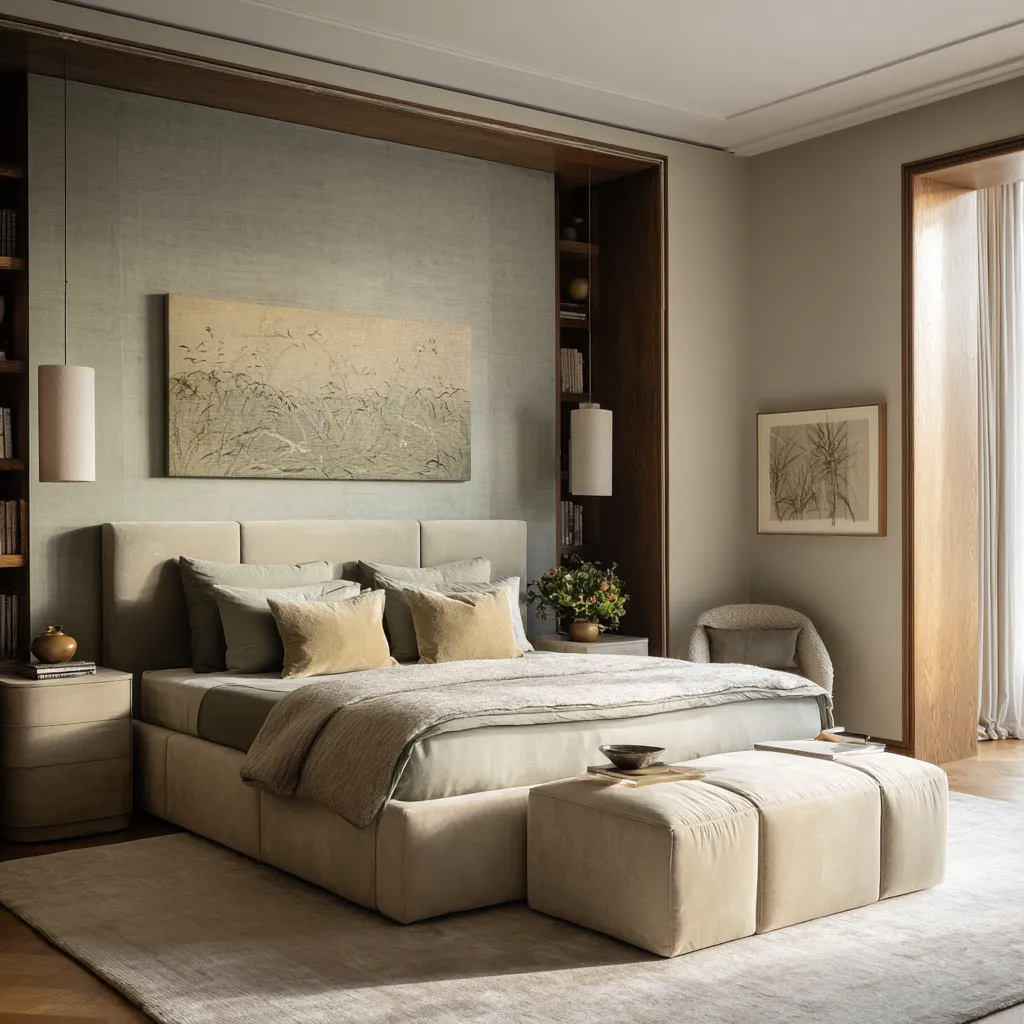
Four main ways green maximalist bedrooms create richness
1. The mural-led room
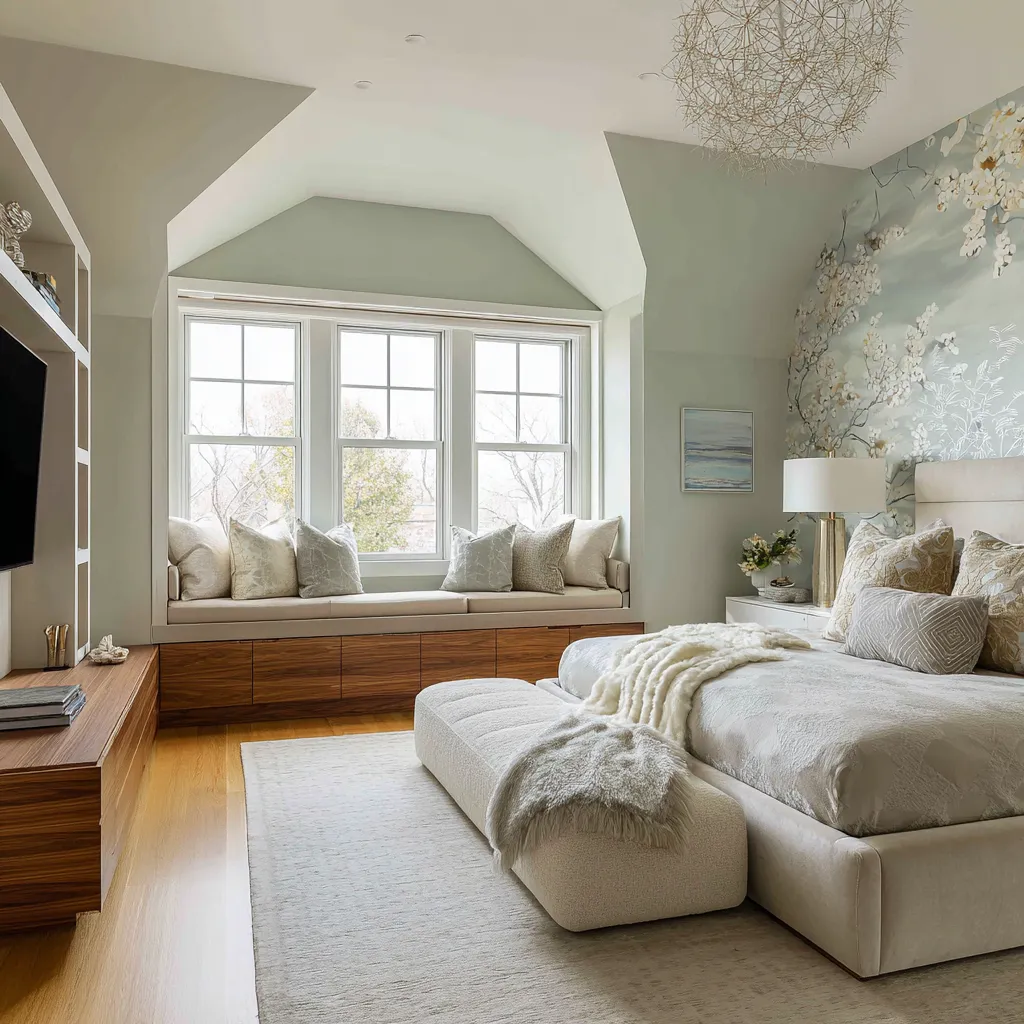
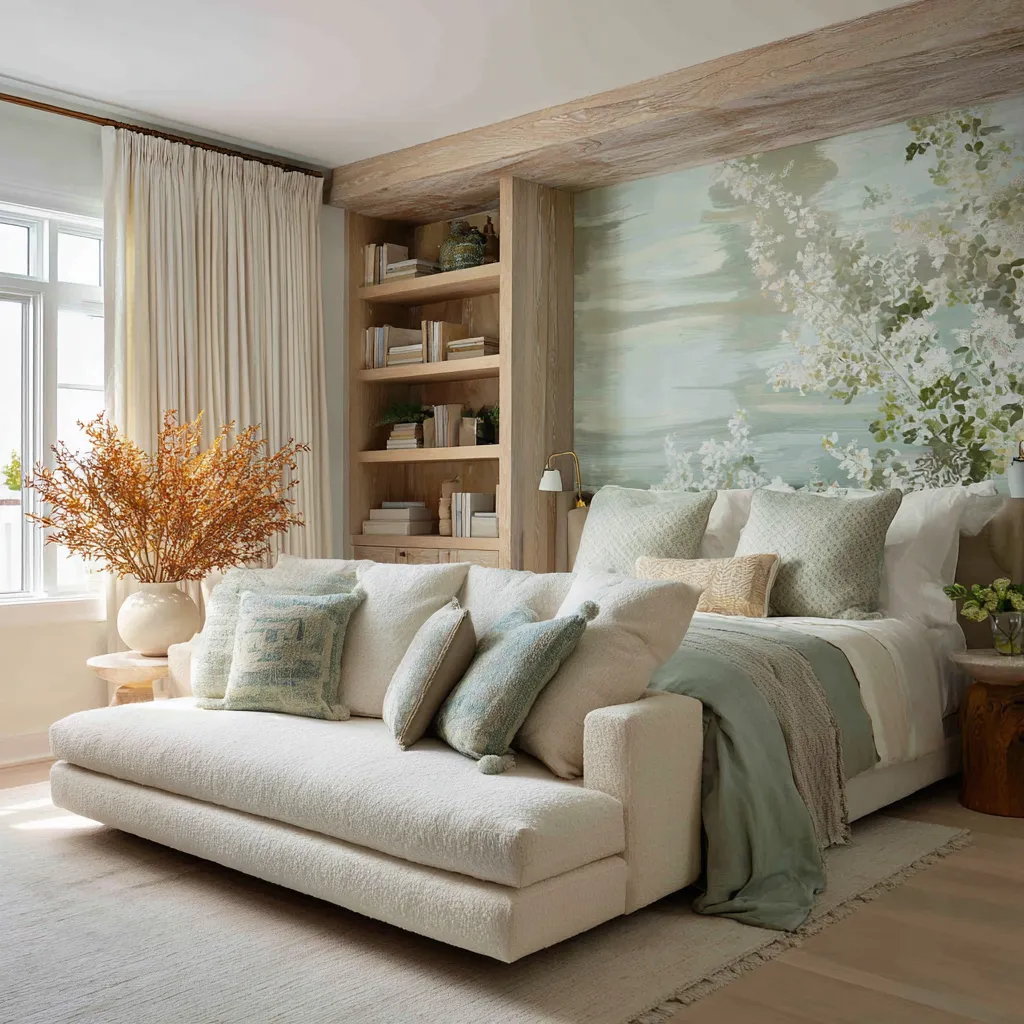
This is the version people can think of first: the panoramic botanical wall, the scenic wall behind the bed, the blossom mural, the large watery landscape, the pale foliage spread that gives the room a distinct atmosphere at once.
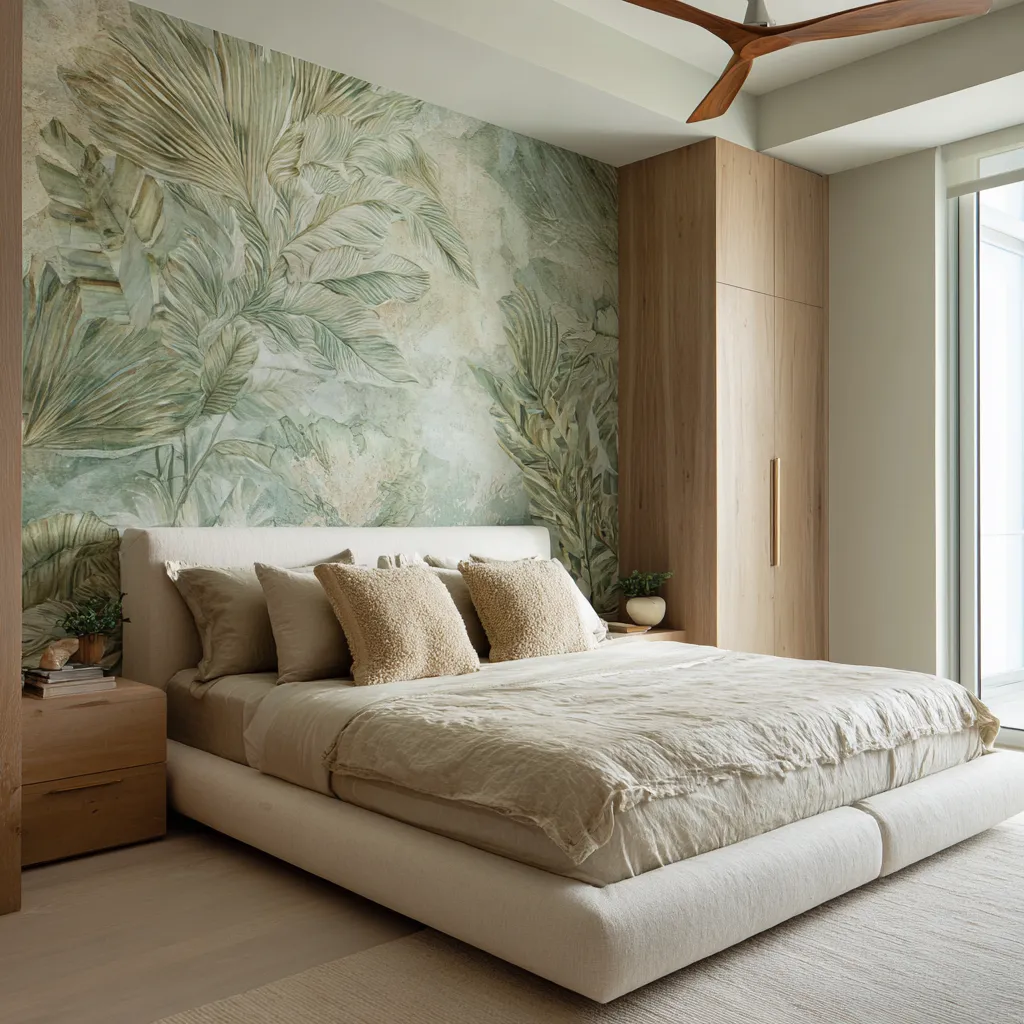
What makes this route effective is not simply size. It is concentration.
One wall becomes the emotional center, and the rest of the room steps back enough to support it. The bed often stays pale.
The bedding usually remains in cream, oatmeal, sand, parchment, or soft taupe. Side walls are often quieter.
Foreground clutter is reduced. Daylight becomes especially important.
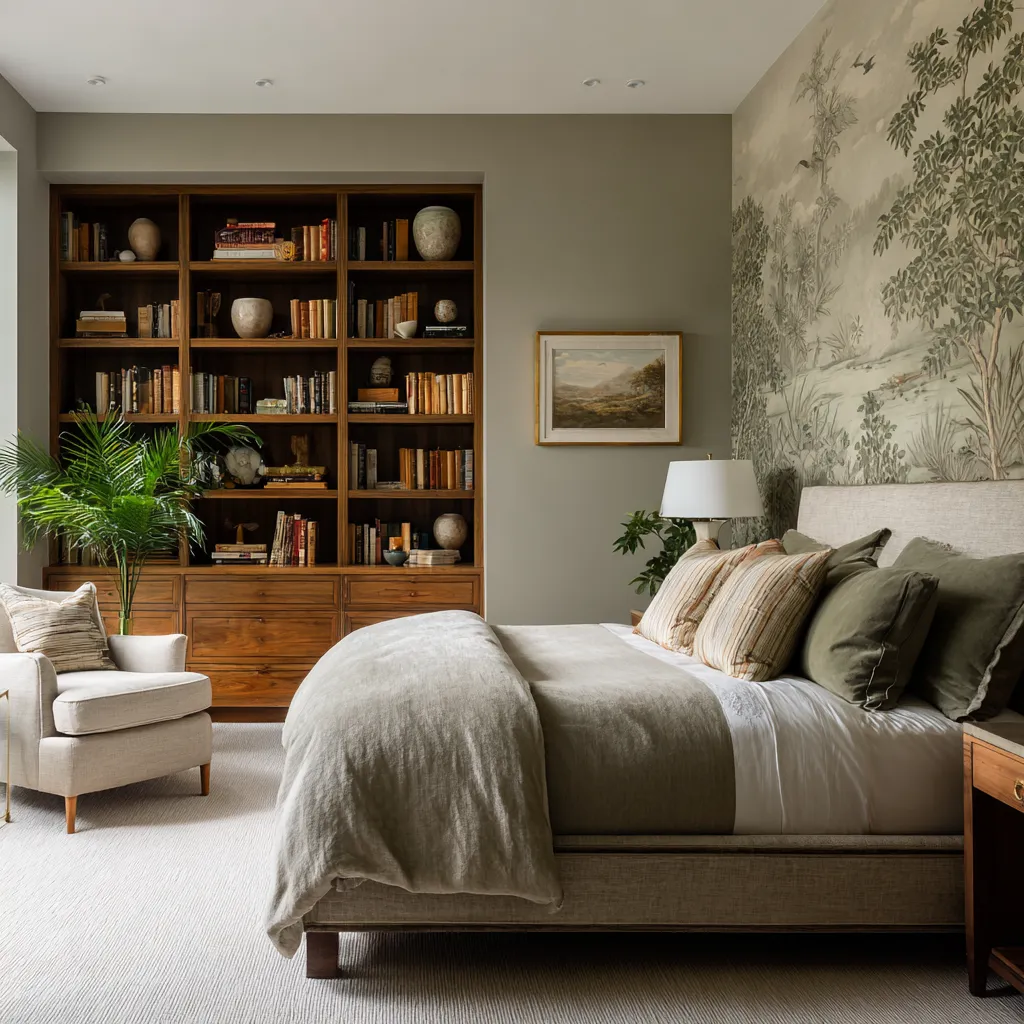
A large mural does not automatically make a bedroom heavy. That only happens when the room also darkens the shell too much, compresses the value range, reduces light, and fills the foreground with too many competing pieces.
A mural can remain airy if the room keeps broad pale relief zones, bright windows, light bedding masses, and edited adjacent surfaces. This is why some of the freshest green maximalist bedrooms are mural-led rather than architecture-led.
The mural carries the story, while the furniture stays broad, pale, and legible.
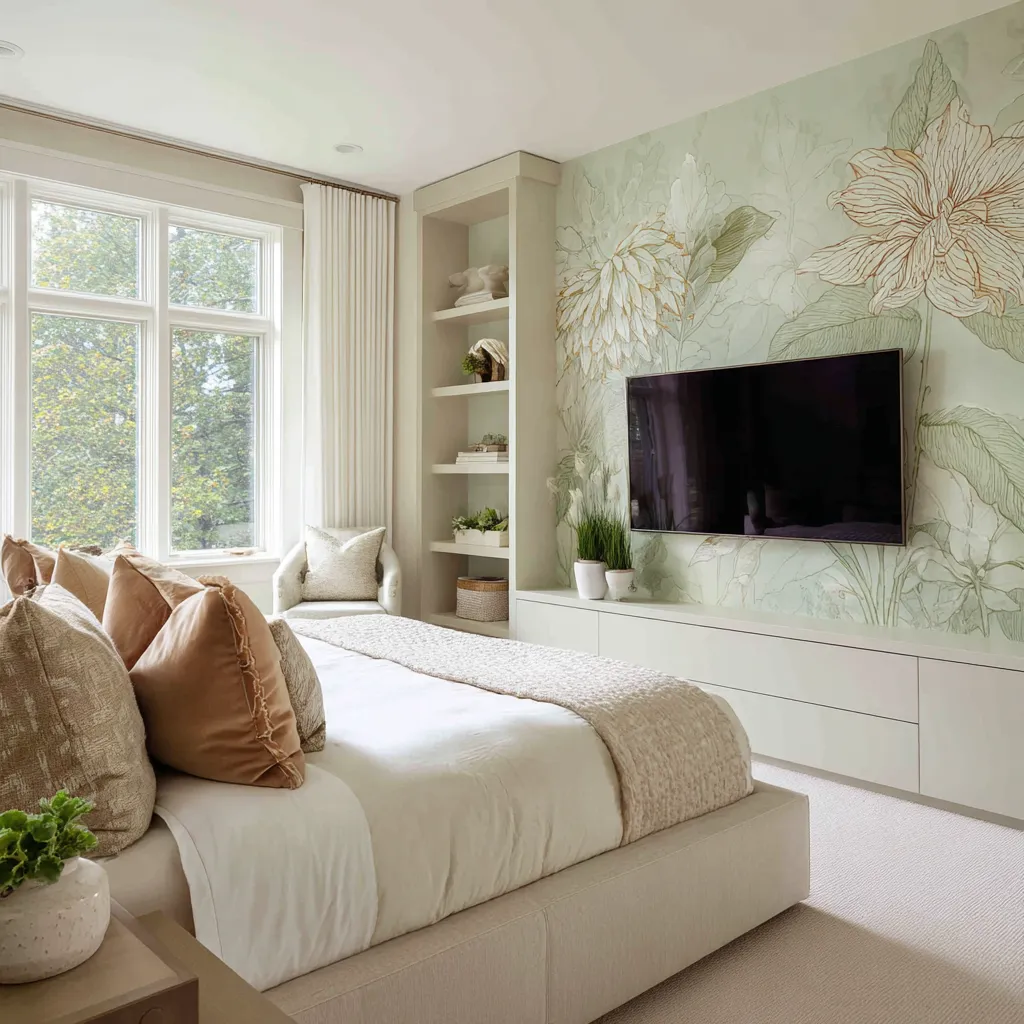
There is also a major difference between types of mural rooms. Some are clearly botanical, with foliage, branches, blossoms, or scenic garden language.
Others are more atmospheric, using watery haze, sea-glass fields, clouded landscape forms, or broad painterly motion. The first group often feels fresher and more literal.
The second often feels softer and more immersive, especially when paired with plush bedding and a close tonal palette.
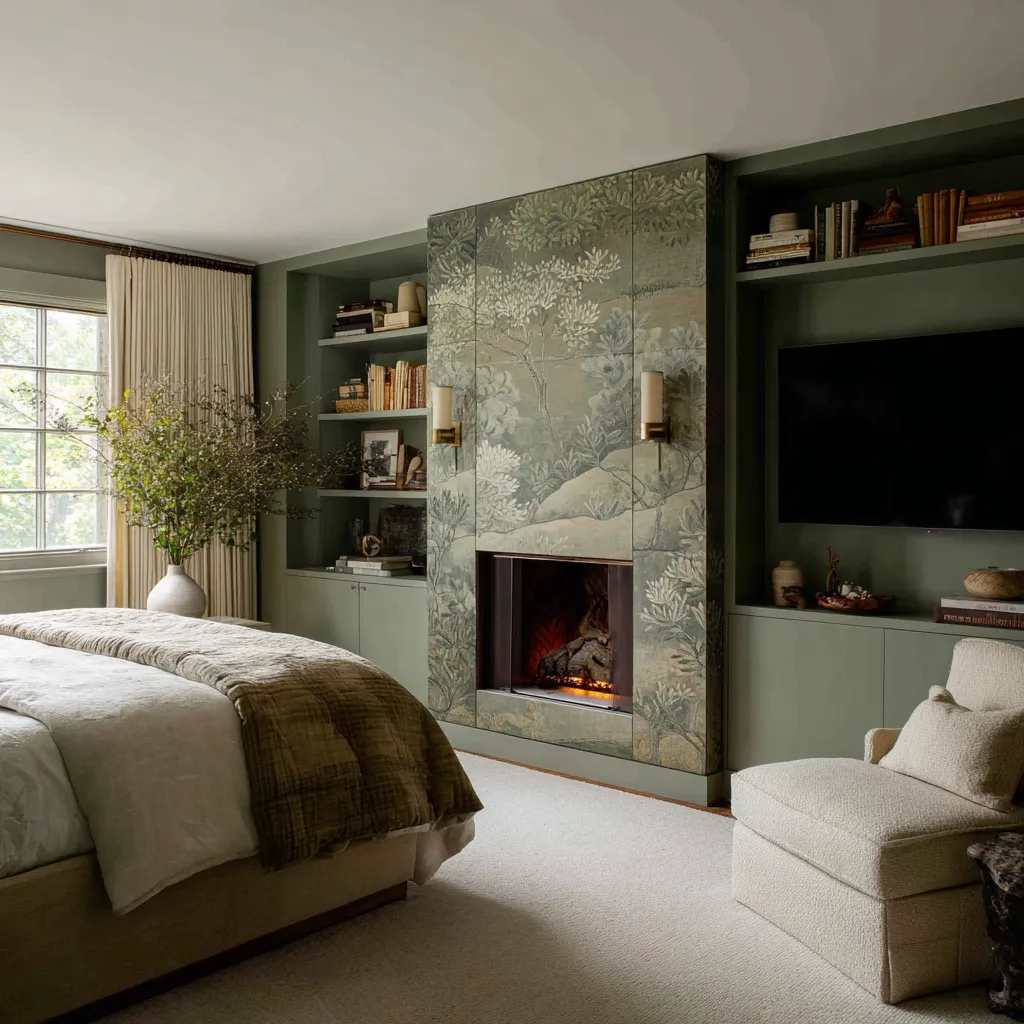
2. The architecture-led room
This branch is often less obvious, but it is one of the richest. Here, the room becomes full because it is shaped.
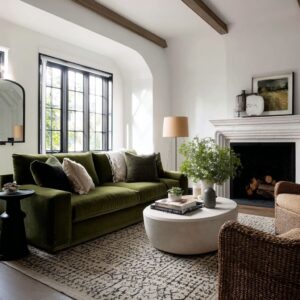
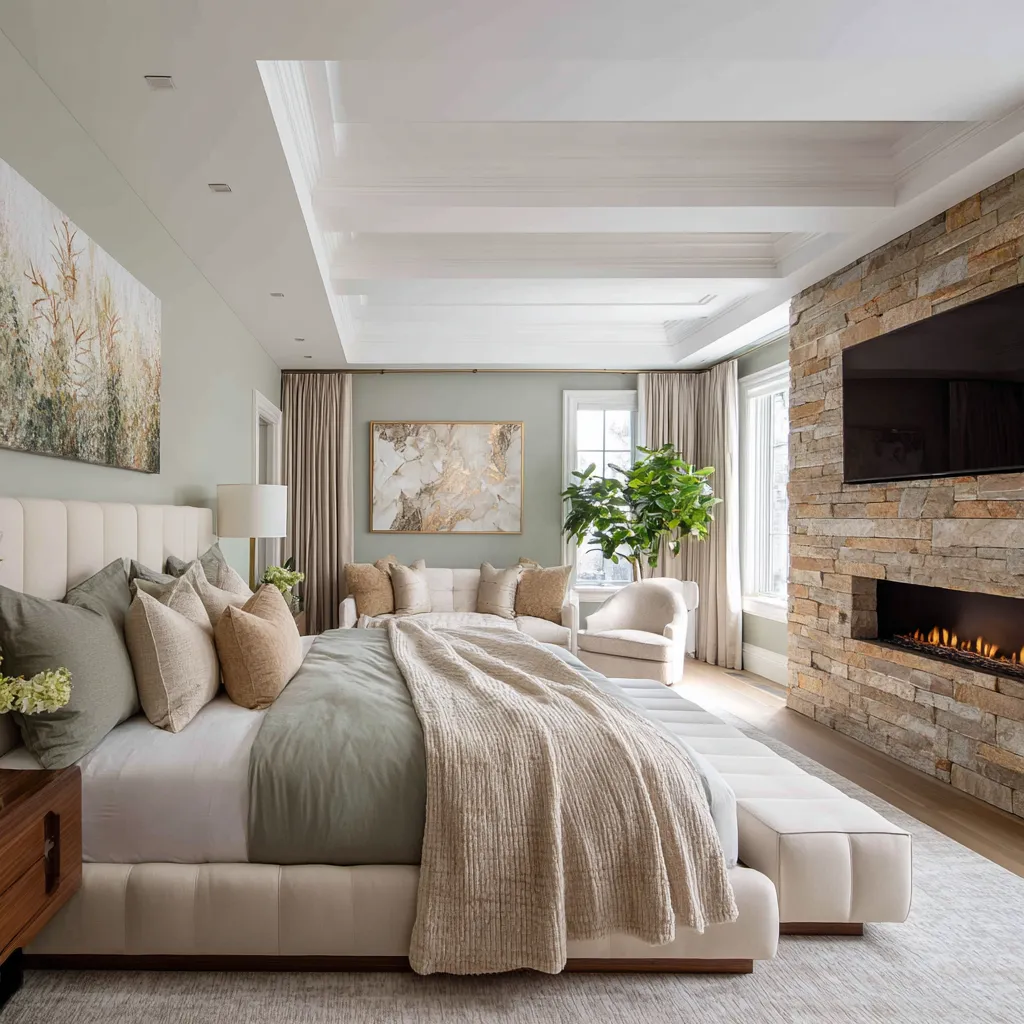
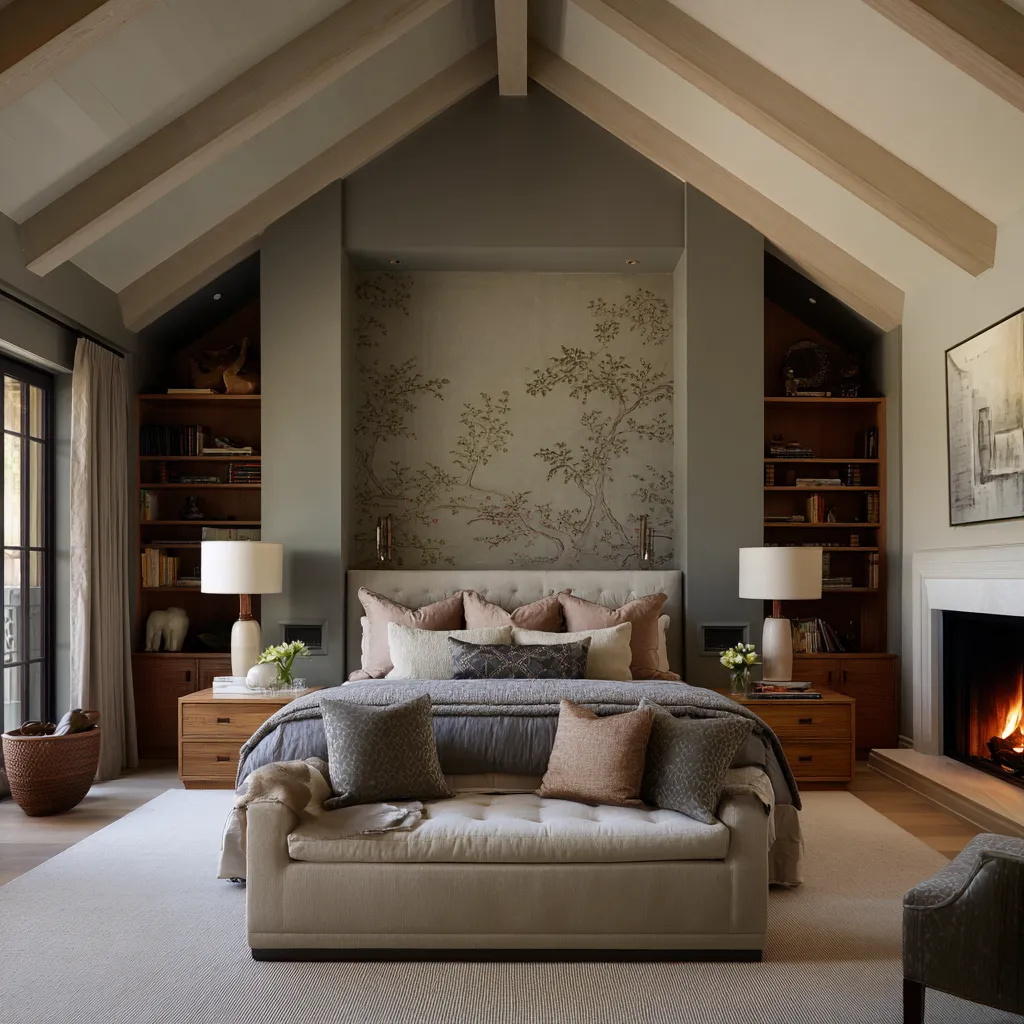
Green enters through the shell, the millwork, or the framed bed zone rather than through one all-dominant image wall. Think of recessed bed walls, wardrobe planes, shelving pockets, library alcoves, fireplace walls, window seats, bay niches, bed-within-a-frame compositions, and cabinetry painted in grey-green, olive-grey, celadon, or soft sage.
In this type of room, richness comes from thickness. The room feels designed into the walls rather than decorated onto them.
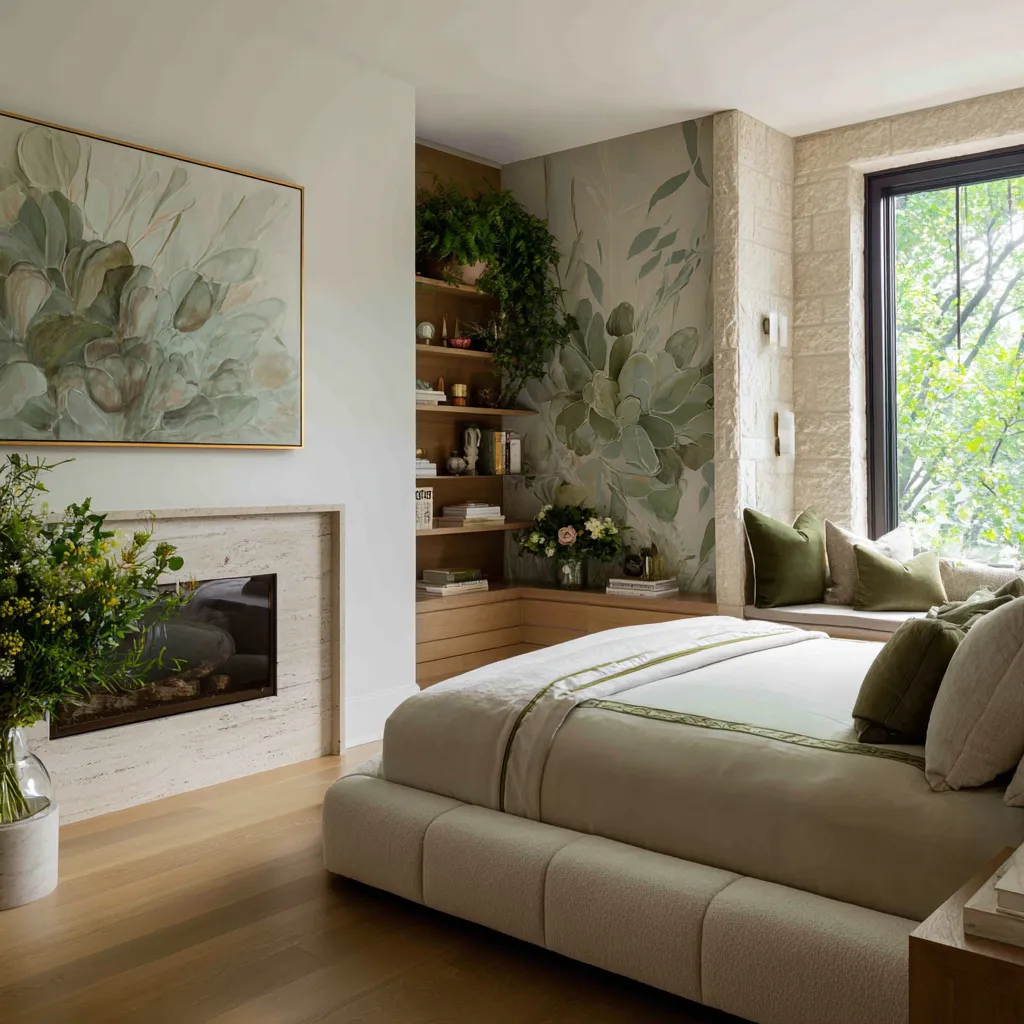
This is also the branch where warm wood becomes especially important. Once green moves out of the accessory layer and into the architecture, wood acts as a regulating force.
It stops the room from feeling clinical, cold, or too mineral. It gives pale greens body.
It makes darker greens habitable. It absorbs the harshness of black television screens.
It introduces a sense of use and memory that keeps a strongly shaped room from feeling too severe.
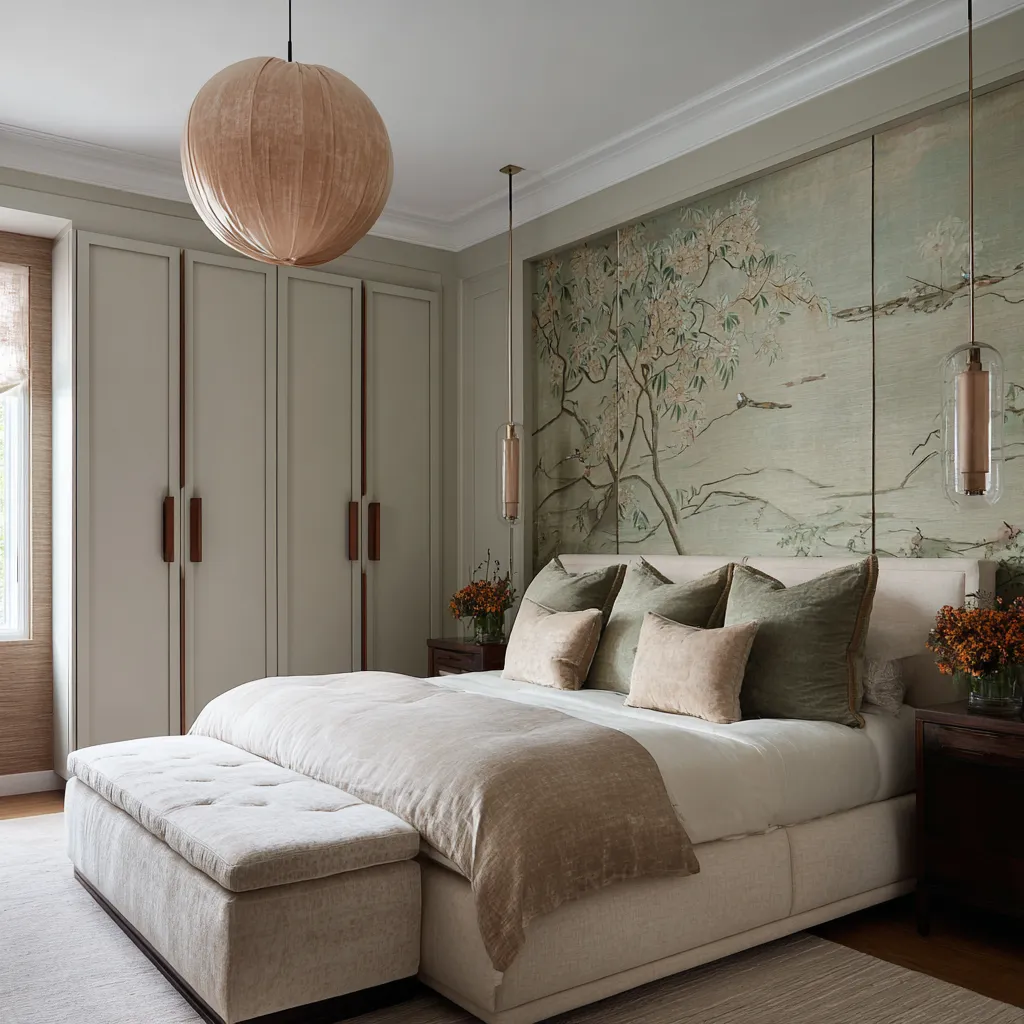
Architecture-led green bedroom ideas often feel deeper and more layered in plan than mural-led ones. They are especially good at creating a bedroom that feels like part sleeping room, part private retreat.
Fireplace walls, shelving, benches, and adjacent seating areas all help this kind of green bedroom feel complete without needing visual noise on every wall.
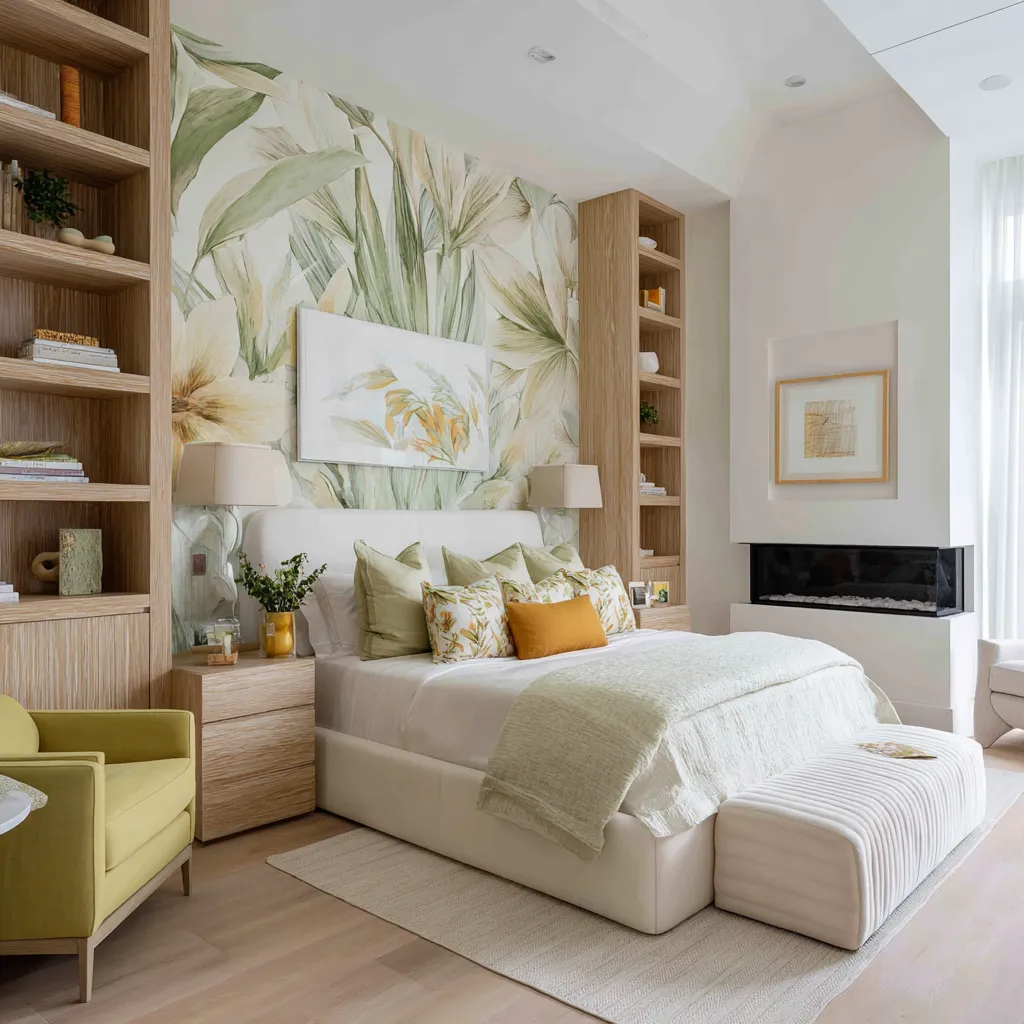
3. The distributed room
This direction is for people who like green but do not want a strong feature wall. In this kind of bedroom, green is repeated through several lighter touches rather than concentrated into one dominant event.
The wall color may be pale sage or sea-glass. The drapery may hold a fuller green field.
The artwork may repeat that same family. The bench or chair upholstery may echo it.
Pillows may bring a slightly deeper note forward. A window seat may carry another version.
The room stays coherent because the color returns in several places, not because one wall commands everything.
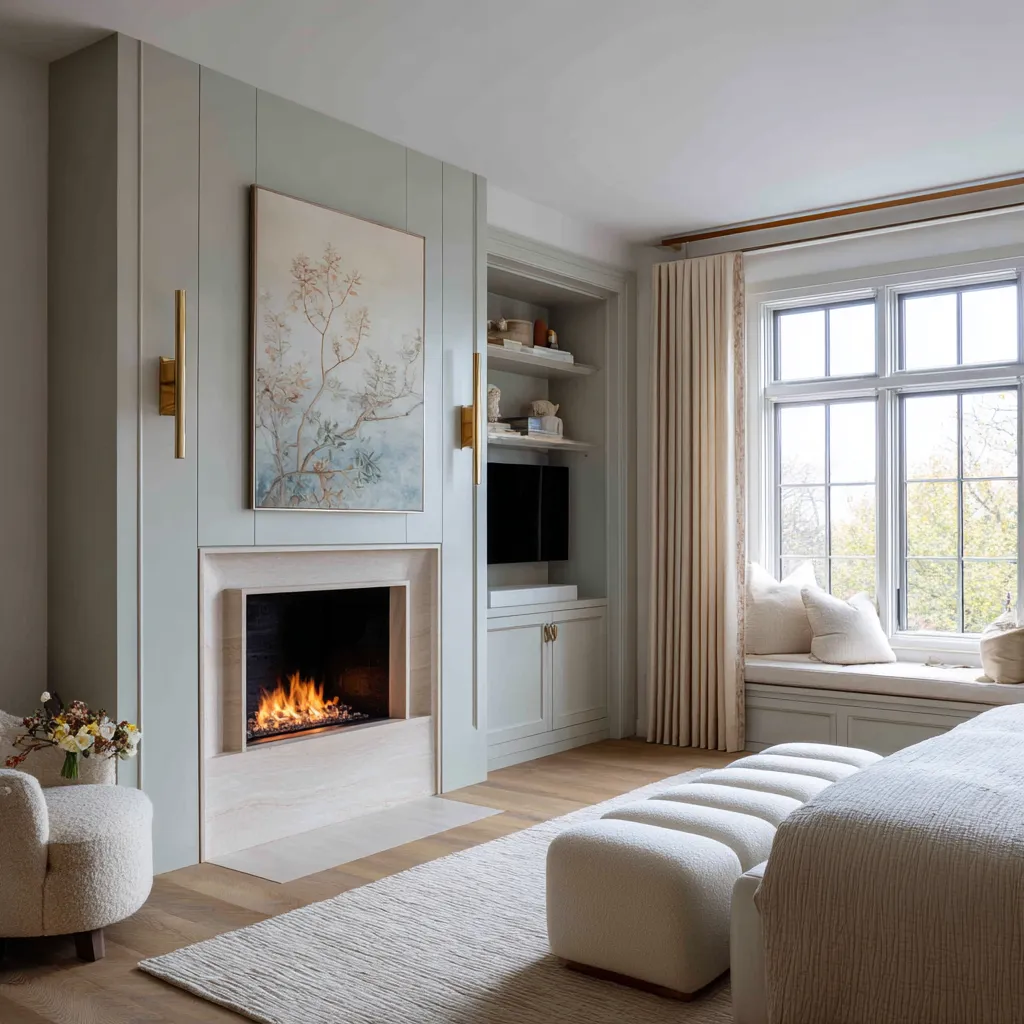
This is often the most convincing route for a large master suite. A single headboard wall can feel too isolated in a long room with a sitting area, windows at one end, and multiple zones of use.
Distributed green solves that problem. It lets the color move through the full length of the room and tie sleeping, lounging, reading, and dressing areas into one atmosphere.
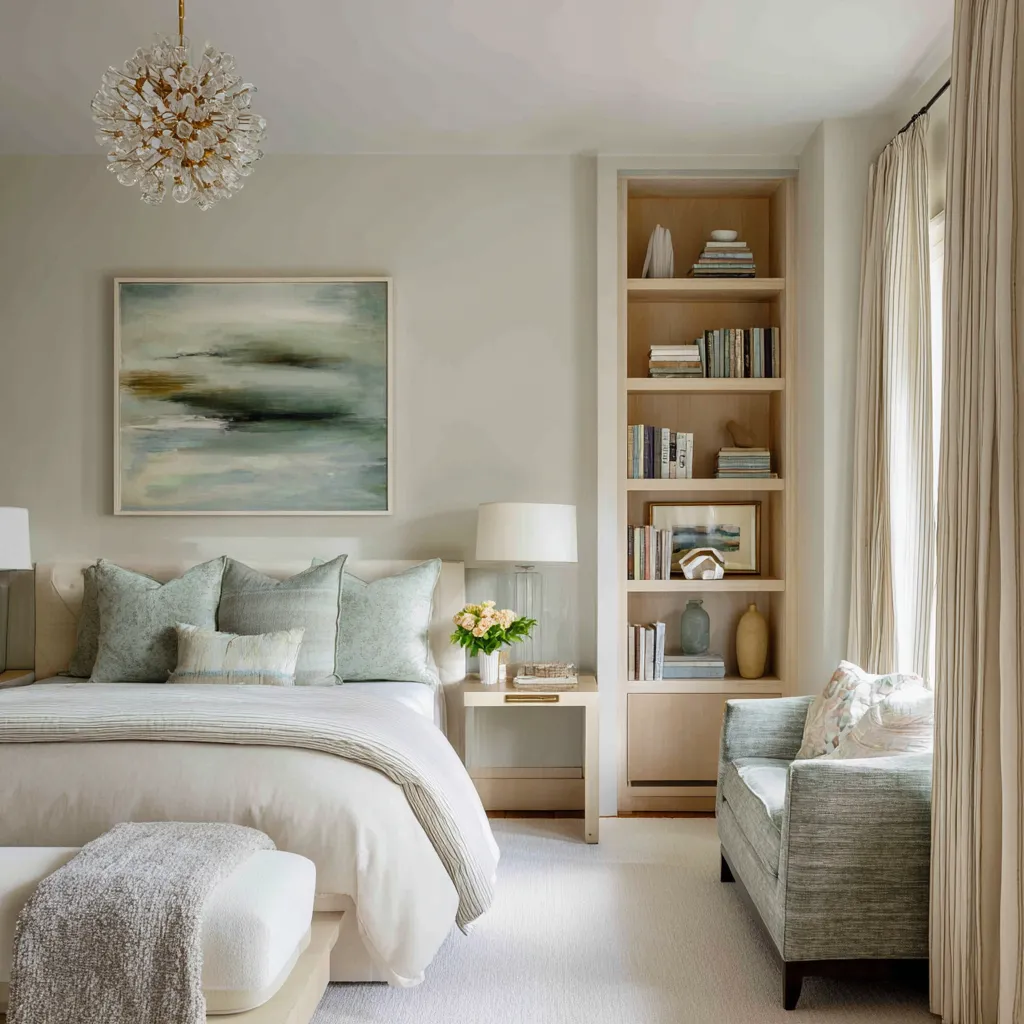
This kind of room often feels especially open. Because the green is spread rather than piled up, the eye moves gently through the space.
Ceiling treatment, drapery, art, seating, bedding, and shell color all cooperate. None of them needs to perform alone.
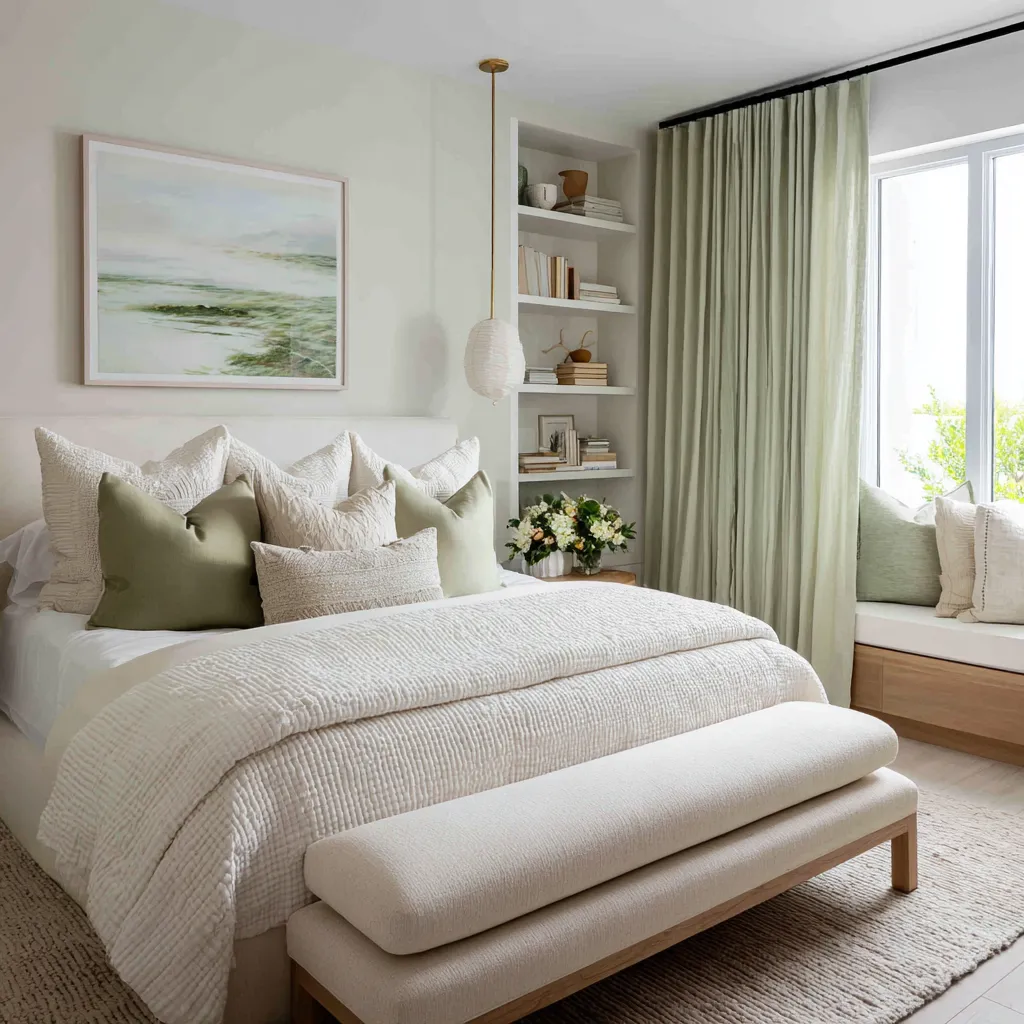
4. The material-led room
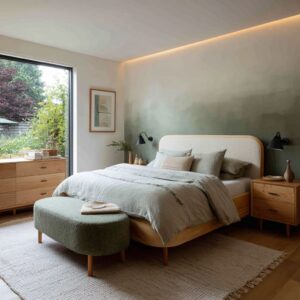
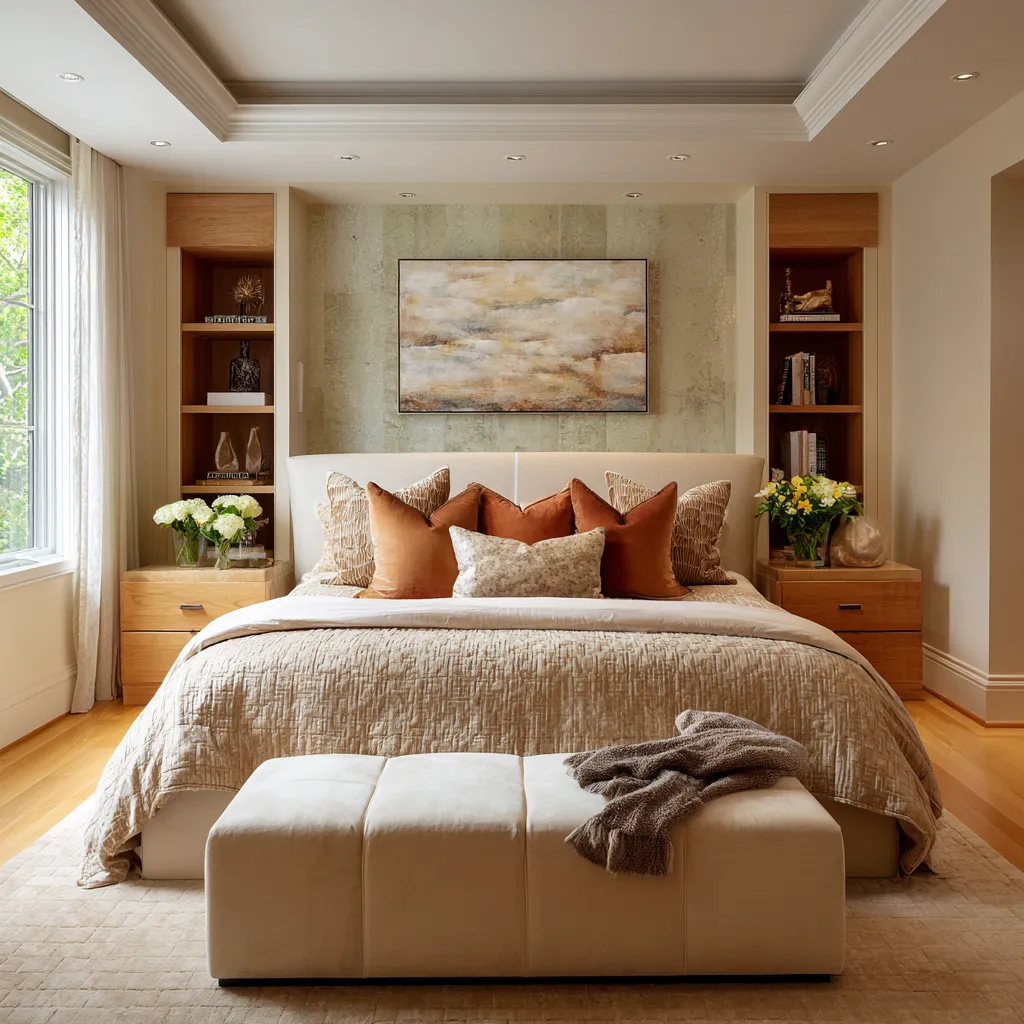
This branch is extremely important because it shows that green maximalism does not depend on florals at all. A bedroom can feel richly green through geology, mist, tactility, and close-value surface layering.
Here, the room may use a mineral statement wall, a veined stone fireplace wall, a plaster-toned green shell, a clouded landscape-like surface, or a broad misted backdrop where the green is mixed with taupe, grey, sand, and pale brown. Botanical language fades, and material depth takes over.
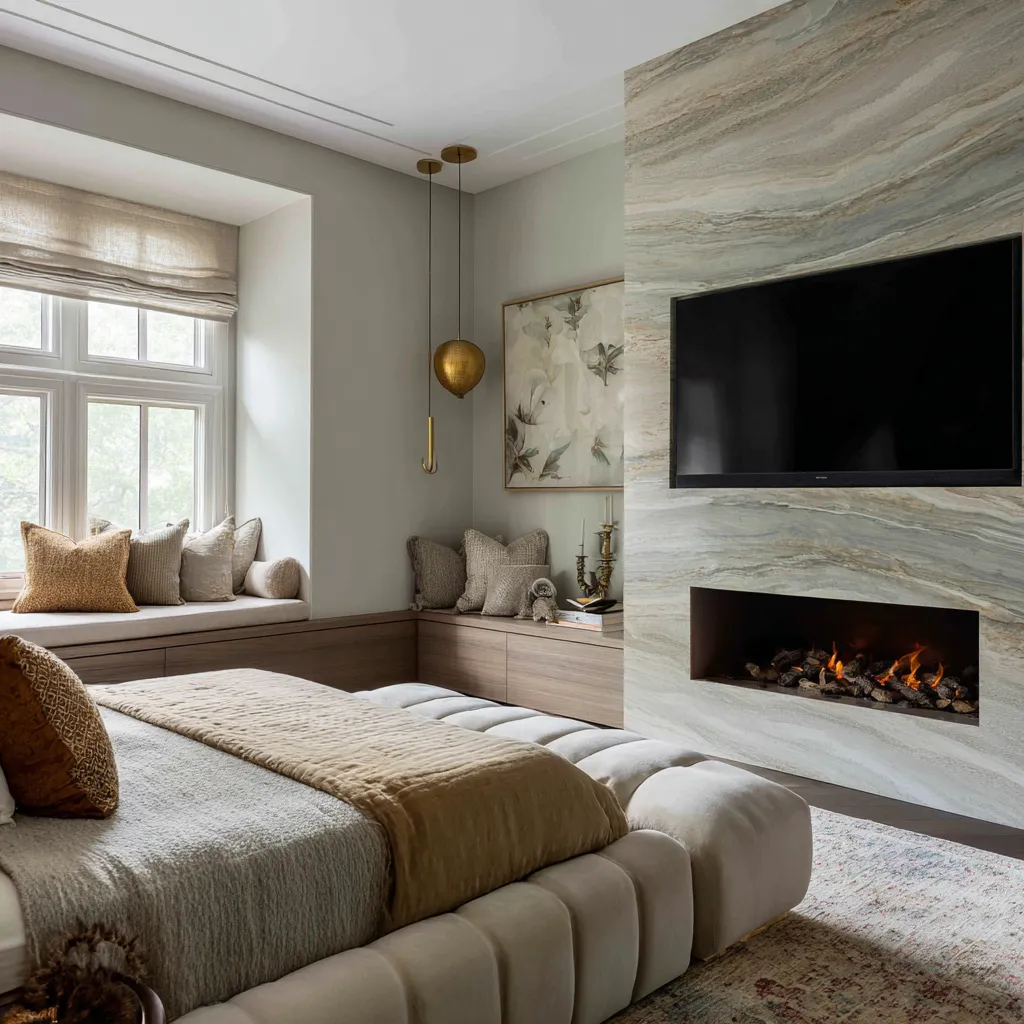
These designs often feel plush, sculptural, and inward. They are less about illustrated nature and more about atmosphere and touch.
Upholstery becomes central. So do fur-like throws, bouclé, thick coverlets, channel-tufted benches, dry matte wall surfaces, and the contrast between soft absorbent fabrics and more polished or lightly reflective materials.
This is a very different emotional direction from the airy botanical room. It is gentler in image, denser in feel, and often more dependent on close tonal relationships than on obvious contrast.
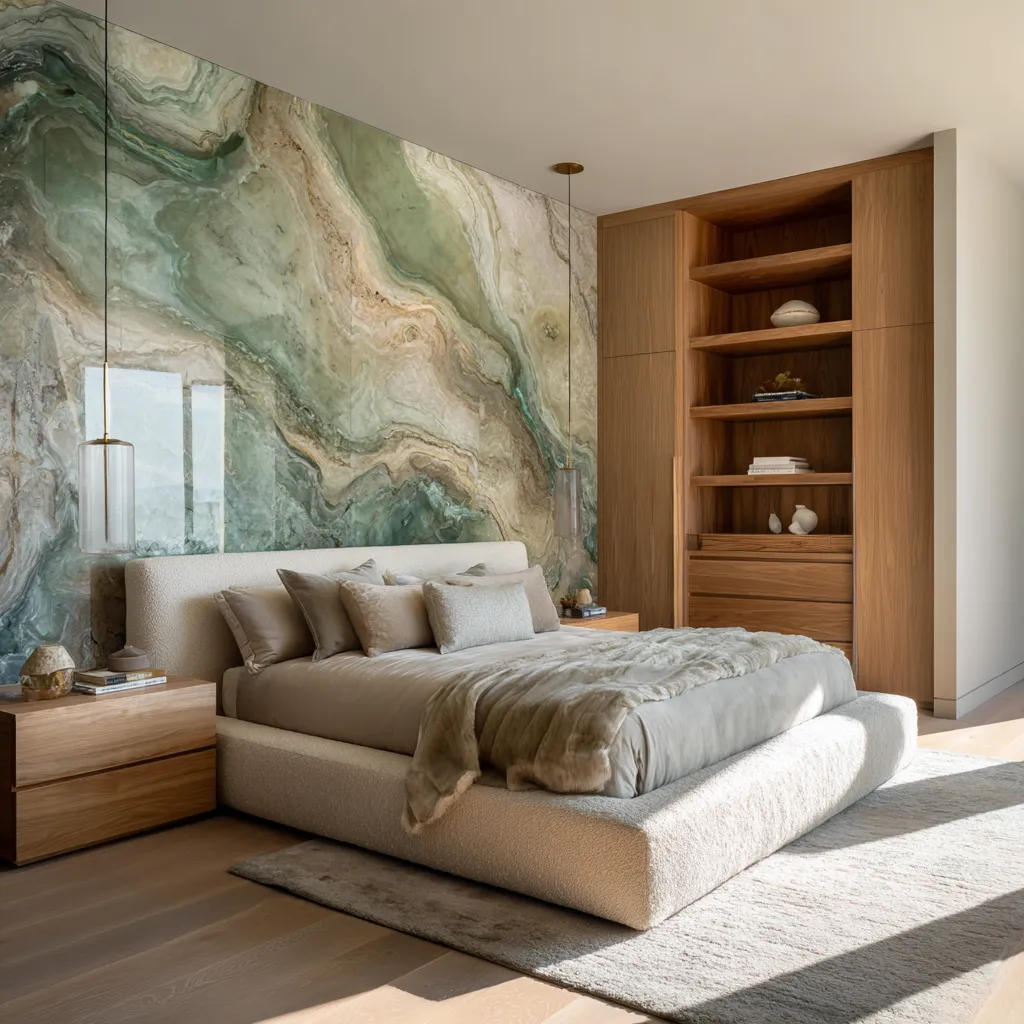
Green does not need to be dark to feel substantial
One of the lessons in green bedroom design is that pale green can still organize a room powerfully. A bedroom does not need forest green walls or saturated olive millwork to feel full.
Pale sage, sea-glass, celadon, pistachio, eucalyptus-grey, and soft mineral green can all carry presence when they are distributed with care.
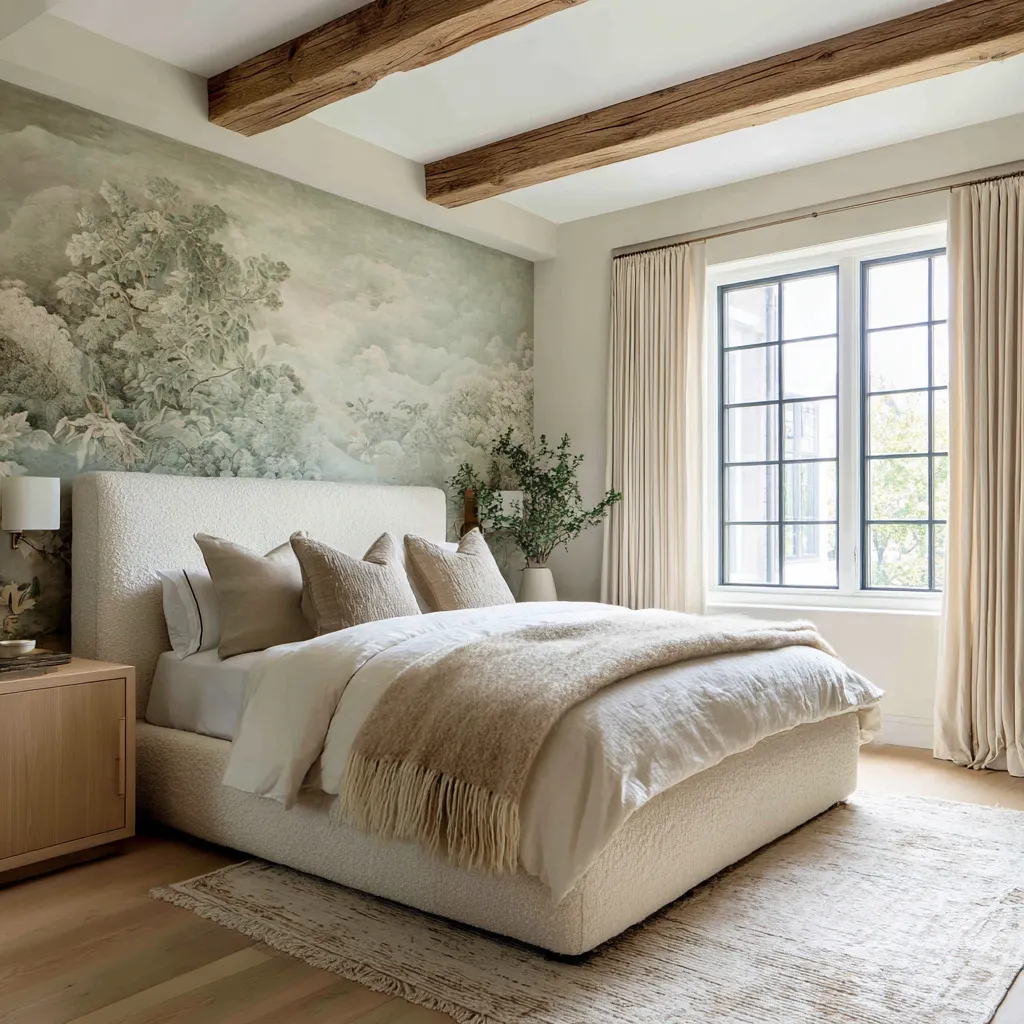
What matters is not only hue strength but placement, repetition, and contrast structure. A pale green room becomes convincing when:
- the values are repeated in a few different materials
- the bed remains broad enough to hold its shape against the palette
- wood or warm neutrals prevent the room from drifting into cool monotony
- textures are distinct enough to give the pale scheme depth
- daylight activates the color rather than flattening it
A pale green bedroom becomes weak only when everything sits in one thin register with too little warmth, too little texture, and too little contrast between surfaces.
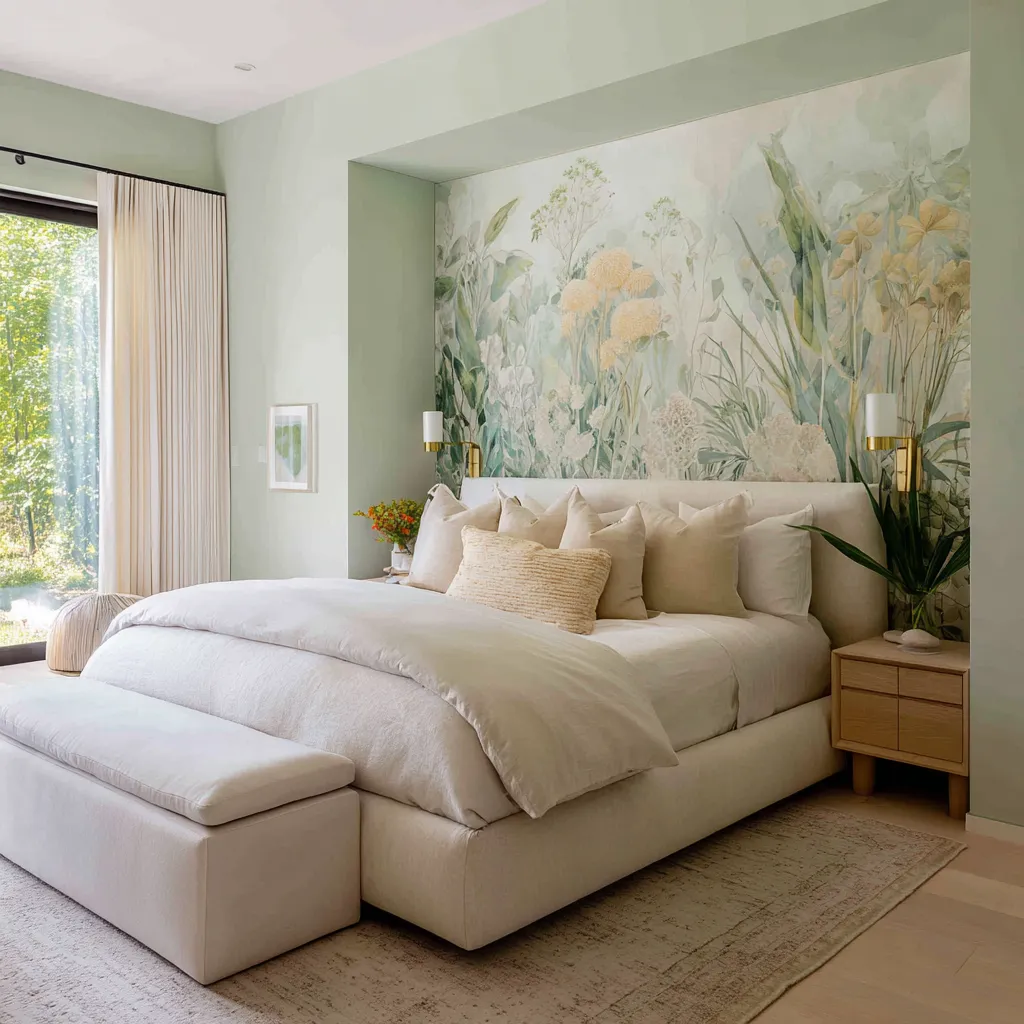
Why some green bedrooms stay open and others feel compressed
The risk in green bedrooms is often not mural scale. It is enclosing shell density.
When green covers too much of the room at too similar a value, the space can shrink visually. This is especially true when the ceiling is involved, the bedding is also dark, the wood is heavy, and the daylight is limited.
The result can feel pressed inward.
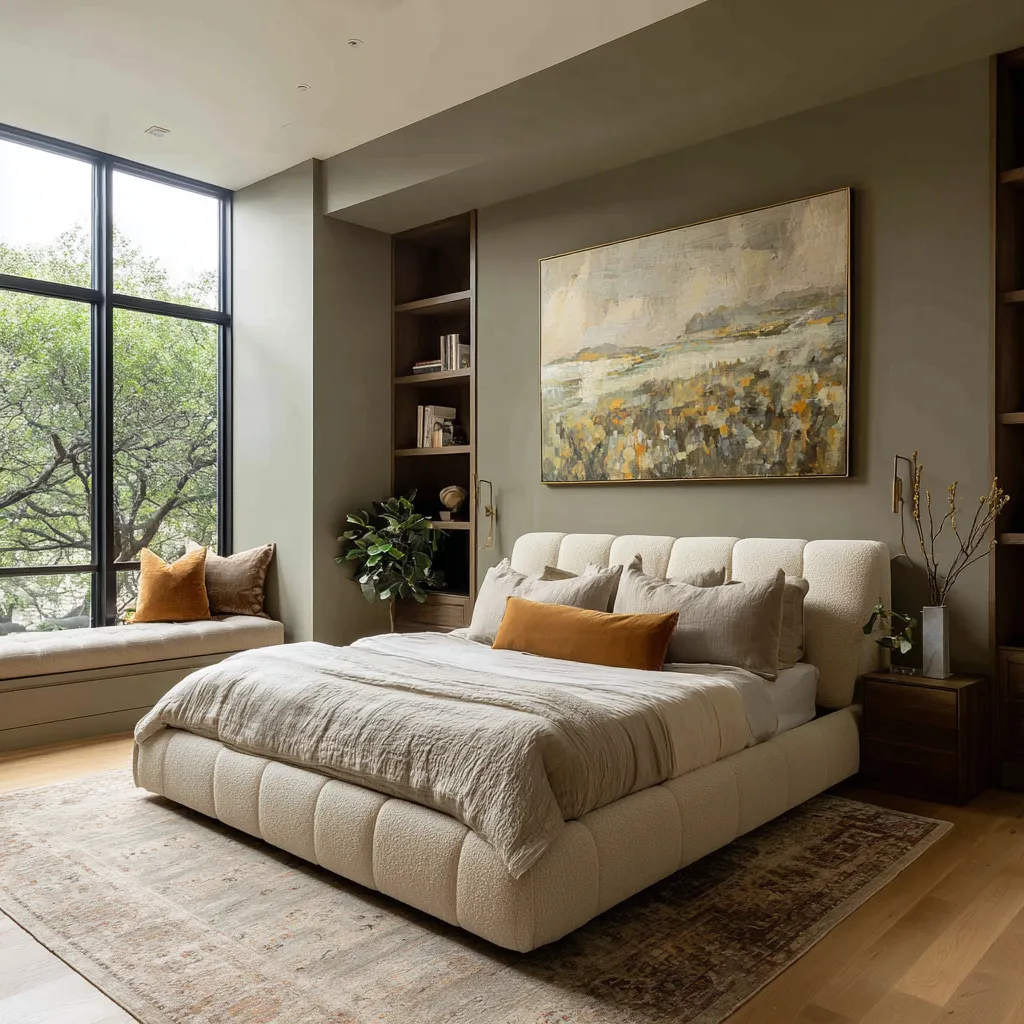
But darker shell-green can still work beautifully if the room gives the eye relief. Some of the most successful darker green bedrooms use at least one of these balancing devices:
- warm wood around the bed or in shelving
- a bright bay or side window
- pale upholstery and bedding
- lighter inset zones within the darker shell
- openings, alcoves, or shelving voids that break up the mass
- firelight or warm lamps that add local warmth
- cream or stone surfaces that stop the palette from becoming one continuous block
This is the deeper rule: darker green needs a counter-system. It can be light, wood, softness, or architectural breathing space.
Without that counter-system, the room can become visually dense in an unhelpful way.
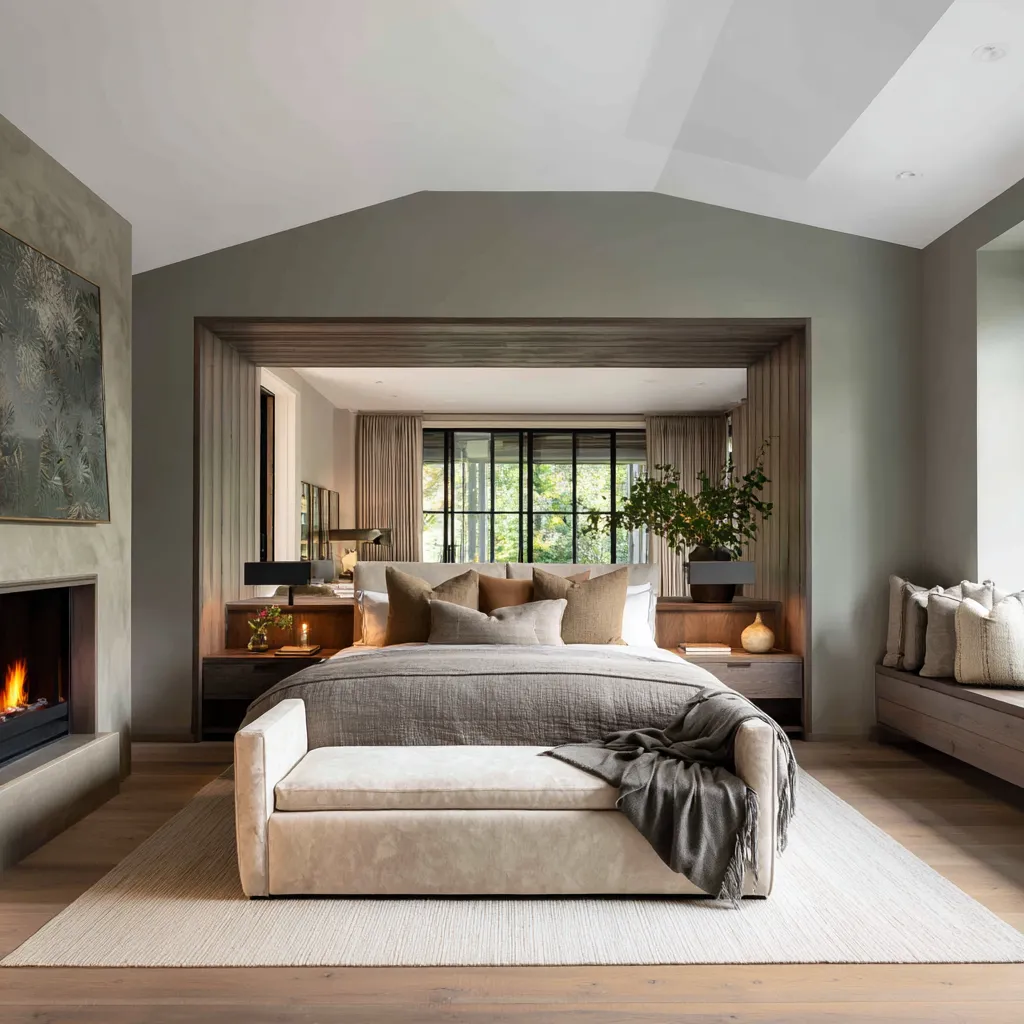
Warm wood as a tool
Green and wood are often discussed as a natural pairing, but in a sophisticated bedroom design ideas the role of wood is more precise than that. Wood is not there only because it looks good with green.
It changes the performance of green.
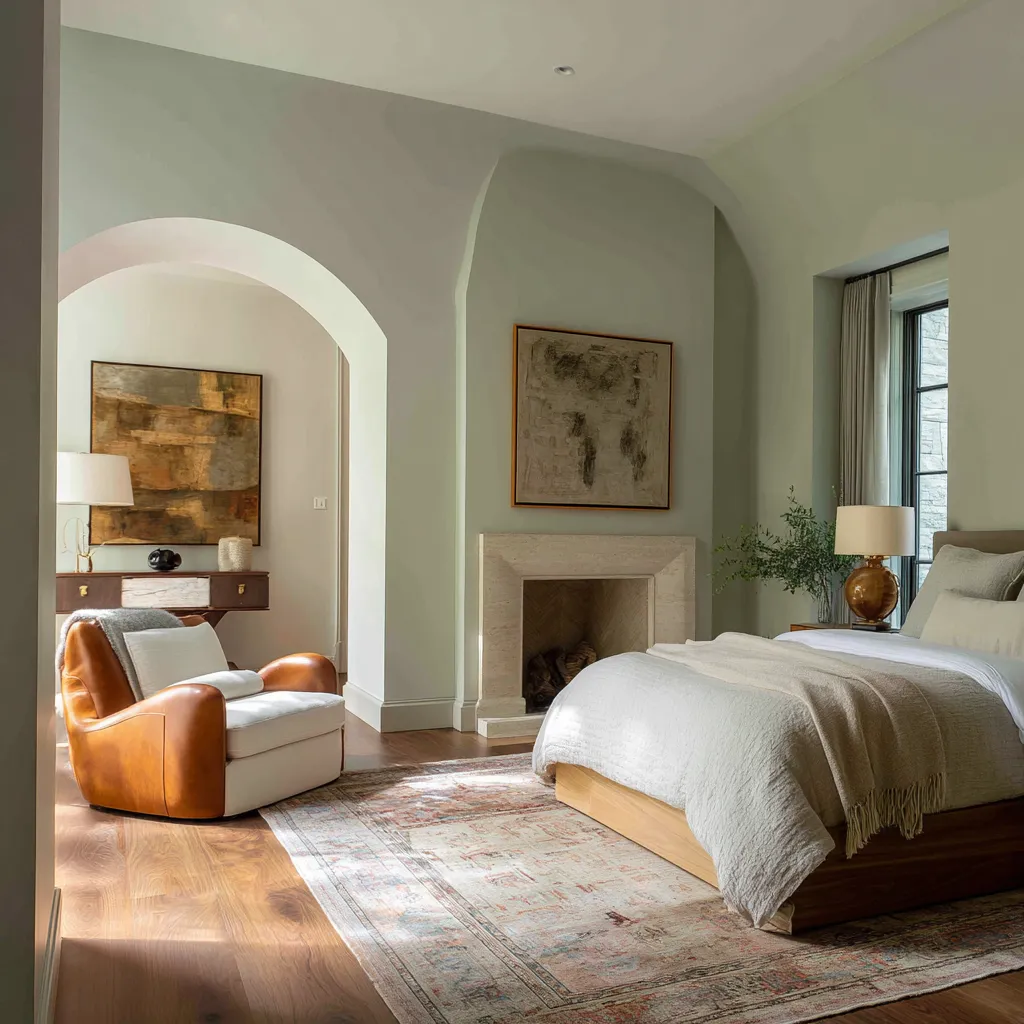
Warm oak, walnut, honeyed wood, and medium-toned timber do several things:
- They keep pale greens from turning chilly.
- They keep architectural greens from feeling too sharp.
- They give built-ins and wardrobes body and weight.
- They create a bridge between wall color and upholstery.
- They soften the interruption of black television screens.
- They make a room with strong framing feel inhabited rather than stage-set.
This is why so many of the architecture-led green bedrooms feel settled rather than sterile. The wood is doing compositional work.
It is not decoration applied at the end. It is part of the stabilizing structure.
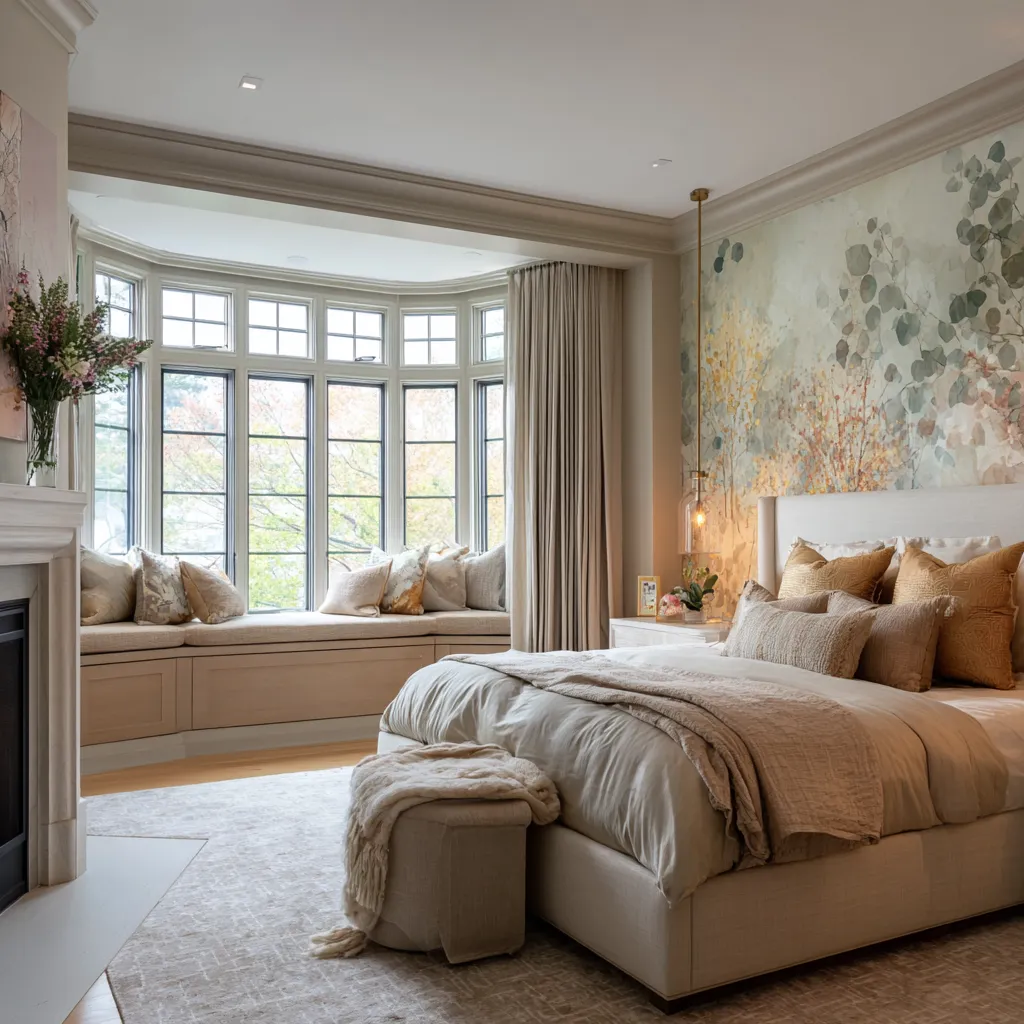
Botanical green and mineral green are two separate design worlds
This is one of the important distinctions inside green maximalist bedroom design.
Botanical green
Botanical rooms usually rely on:
- foliage or blossom imagery
- scenic or mural-led storytelling
- brighter daylight
- lighter bedding masses
- fresher airier values
- small warm accents used carefully
They tend to feel more expansive, decorative, and open. Their richness comes from image, not just matter.
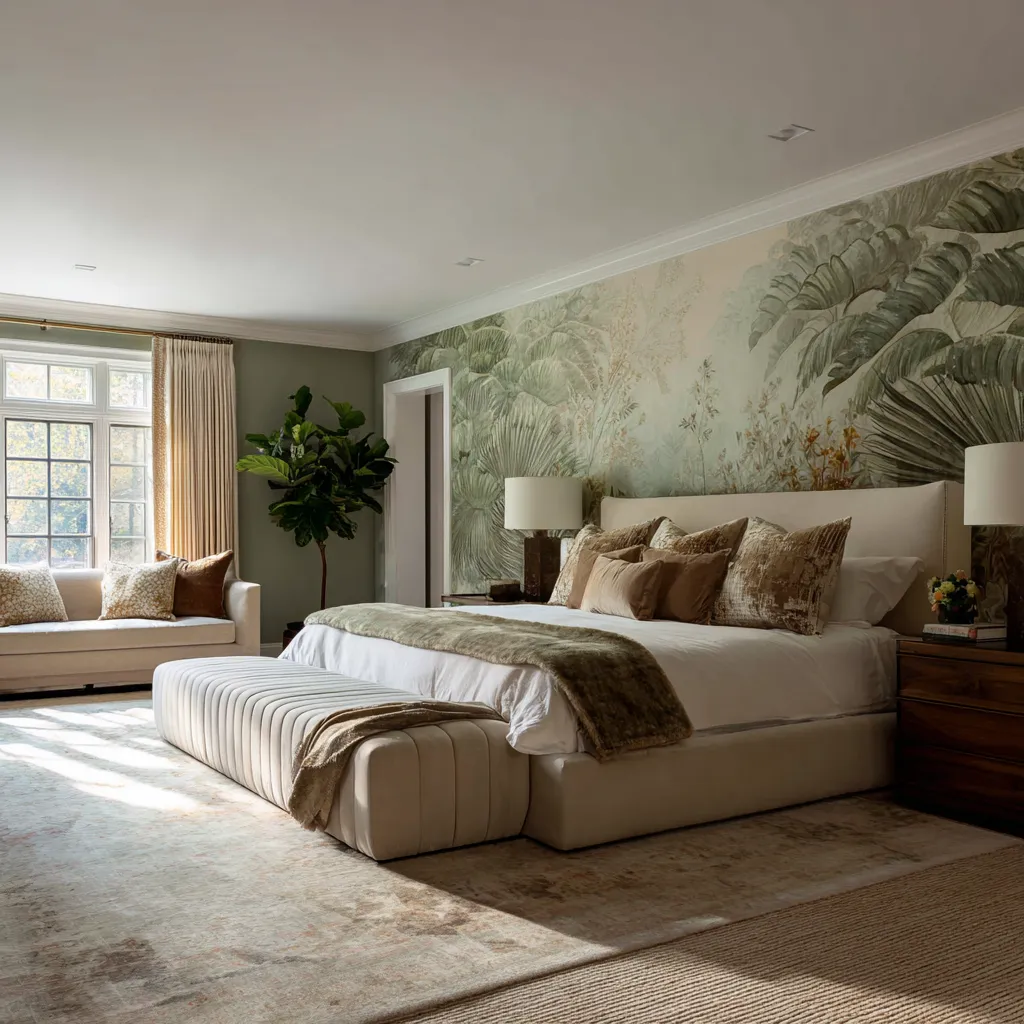
Mineral green
Mineral or tactile rooms usually rely on:
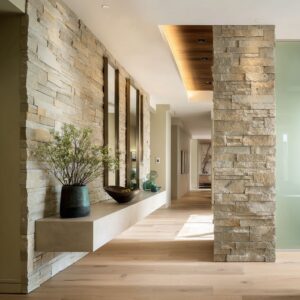
- veined or plaster-like surfaces
- clouded, misted, or geological wall treatments
- upholstery mass
- close-value tonal layering
- heavier tactile richness
- simpler furniture outlines
- a narrower, more compressed palette
They tend to feel more inward, plush, and materially dense. Their richness comes from surface depth and soft compression rather than overt image.
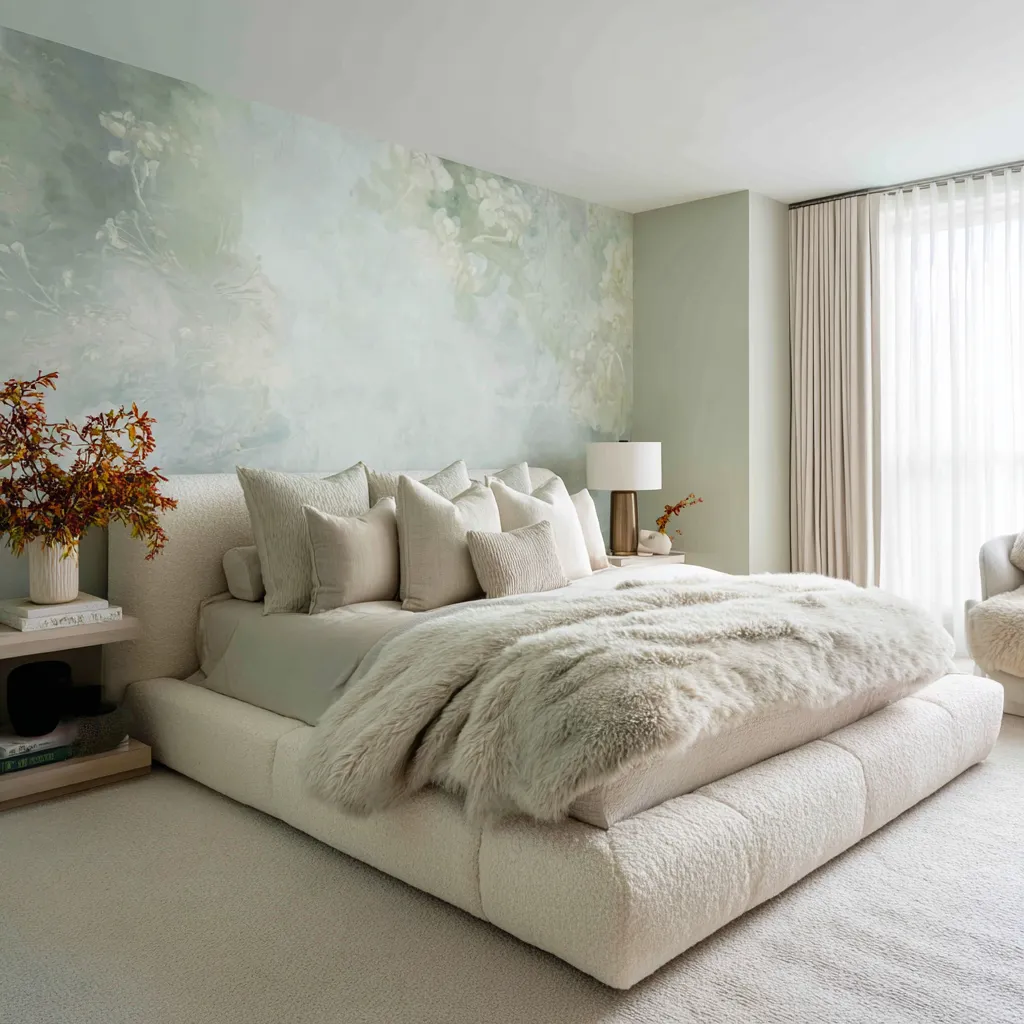
Both belong fully inside green maximalism, but they ask for different design decisions. Advice that helps one can hurt the other.
A botanical room usually benefits from lighter support and clearer relief zones. A mineral room often benefits from stronger material contrast and thicker tactile layering.
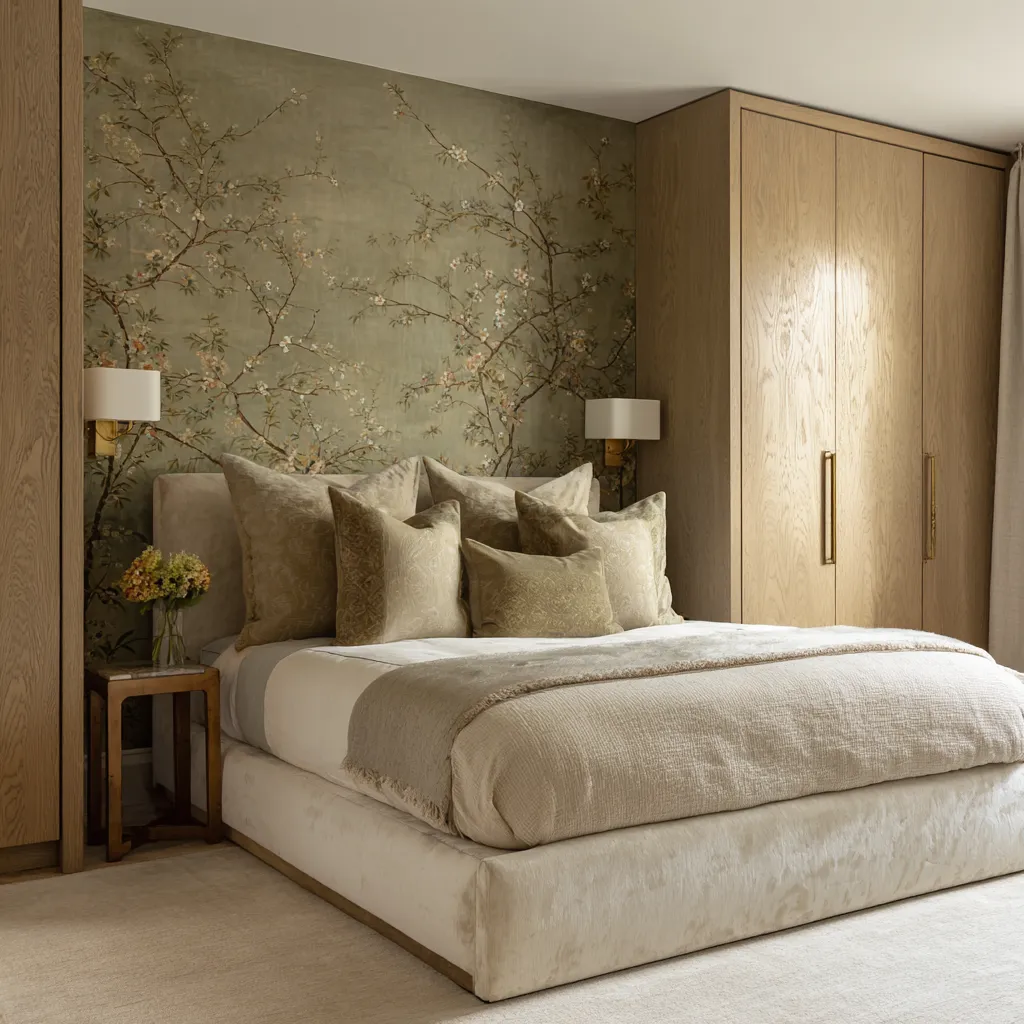
Warm accents are small, but they change everything
One of the quiet strengths of many pale green bedroom ideas is the use of a very limited warm note. Rust, terracotta, mustard, blush-peach, orange-brown branches, dusty pink-beige, and clay-toned pillows often appear in small amounts, yet they shift the whole room.
These accents are effective because pale green can sometimes flatten into a cool wash if everything around it stays equally soft and cool. A concentrated warm note adds friction.
It gives the palette a small pulse of contrast without breaking the mood.
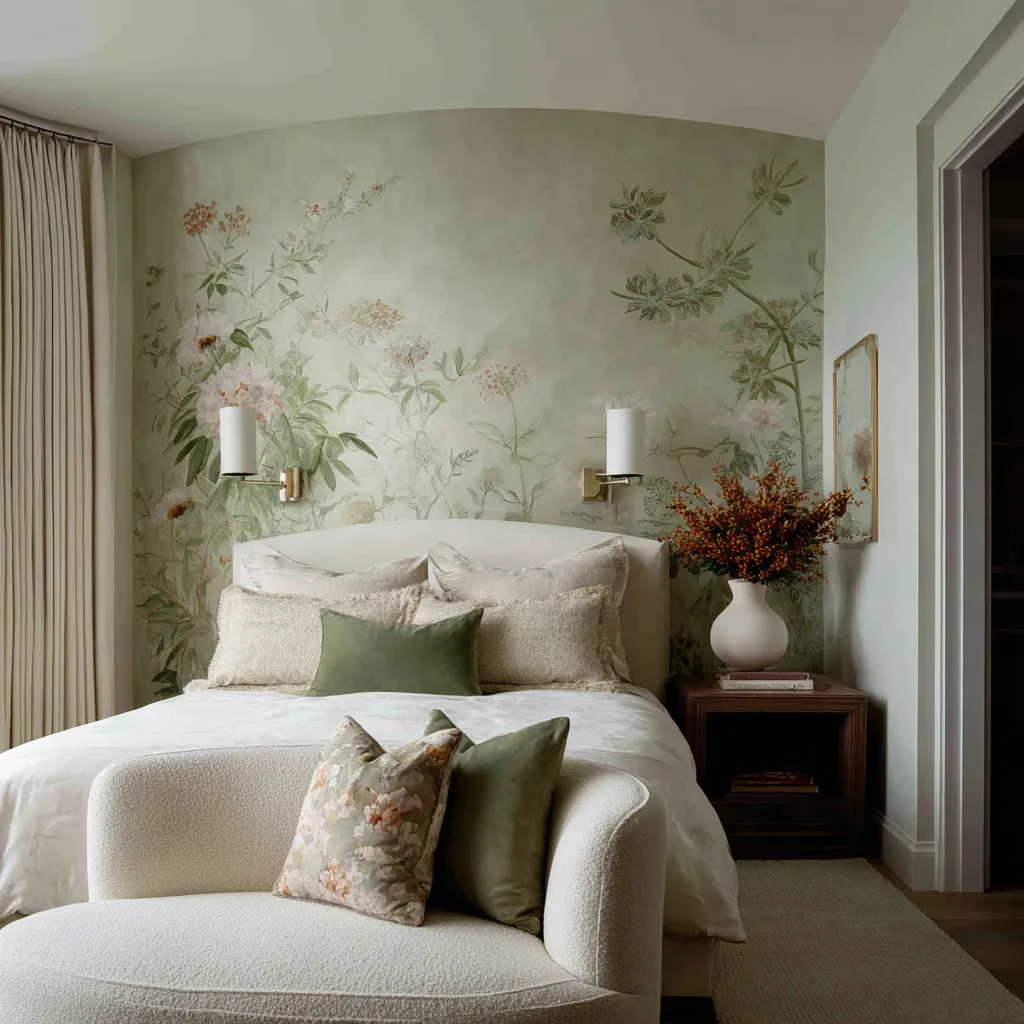
In good green bedroom designs, these warmer elements usually stay controlled. They may appear in:
- one lumbar pillow
- a throw at the foot of the bed
- branches in a vase
- a floral arrangement
- a pendant or ceiling shade
- wood handles or brass details
- one patterned cushion that introduces clay, blush, or amber tones
The key is proportion. These warm notes work best as correctives, not as competing themes.
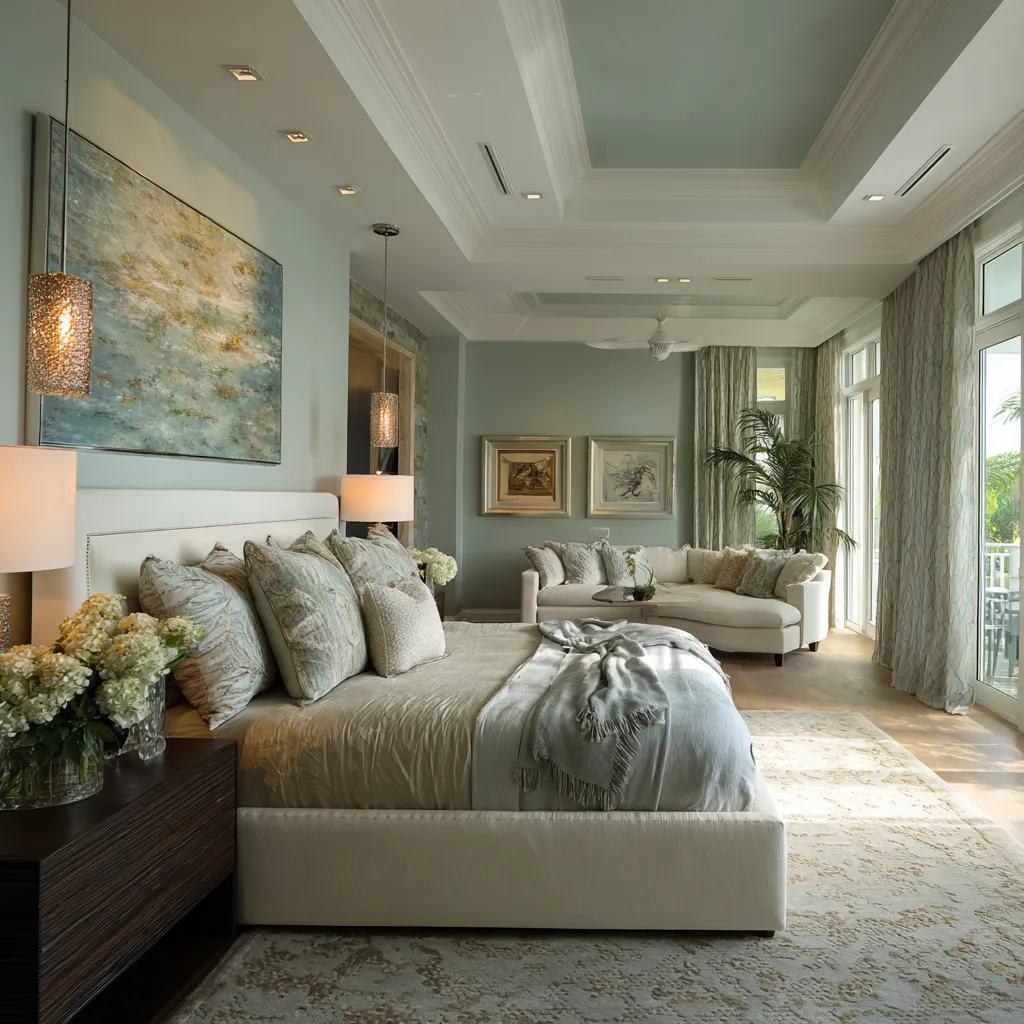
Suite-like richness comes from shaped space
A bedroom starts to feel like a suite when it contains several believable zones. The bed is still central, but it is not the only place where the room lives.
There may be a sofa, a reading chair, a window seat, shelving, a fireplace wall, or a lounge corner. In this kind of room, green works best when it is carried by structure and repetition.
A single dramatic wall may still be beautiful, but it will not by itself make the room feel spatially layered. That effect comes from shaped zones and linked color placement.
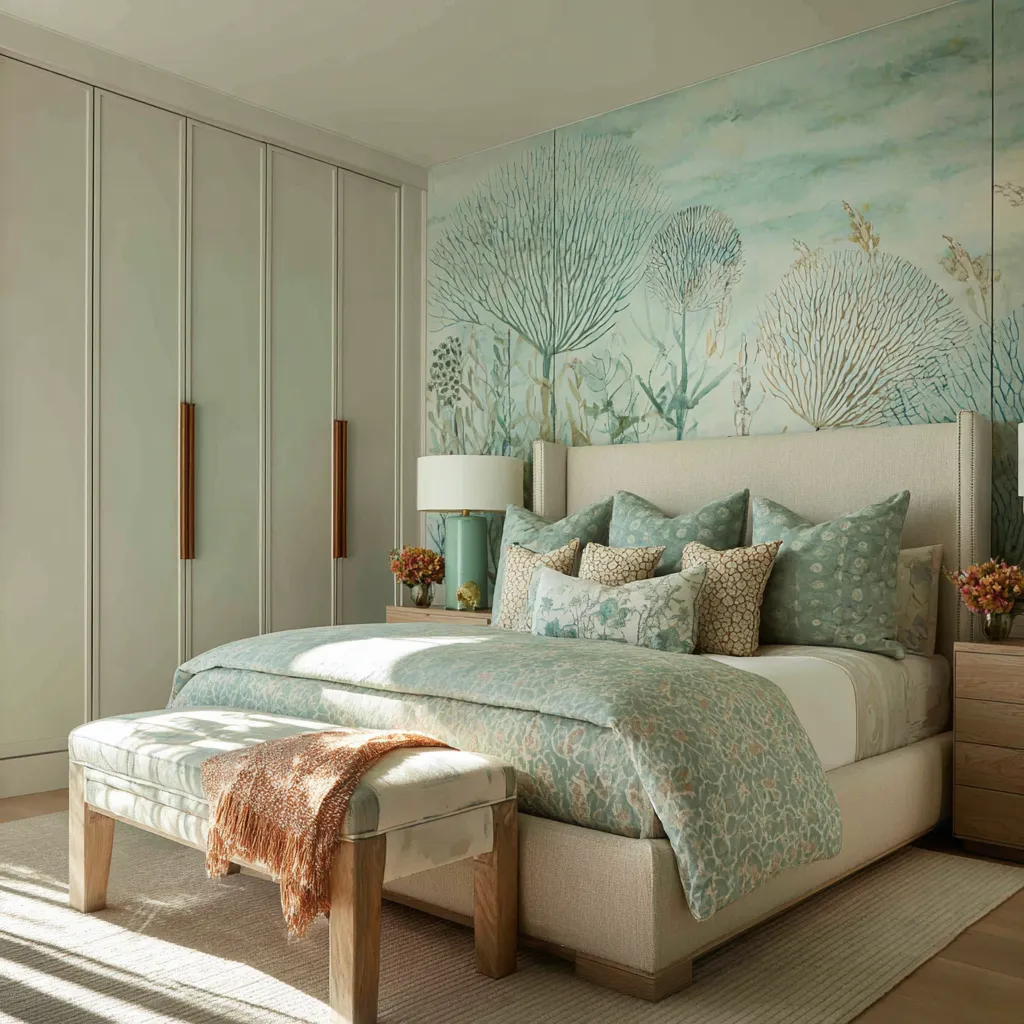
A suite-like green bedroom often includes:
- a bed zone with a broad pale mass
- a second seating zone
- shelving or cabinetry that thickens the perimeter
- drapery that helps connect the full length of the room
- art or upholstery that repeats green away from the headboard wall
- a ceiling or shell treatment that helps unify the volume
The architecture and the color distribution help the interior design operate as a layered private interior rather than as a decorated backdrop.
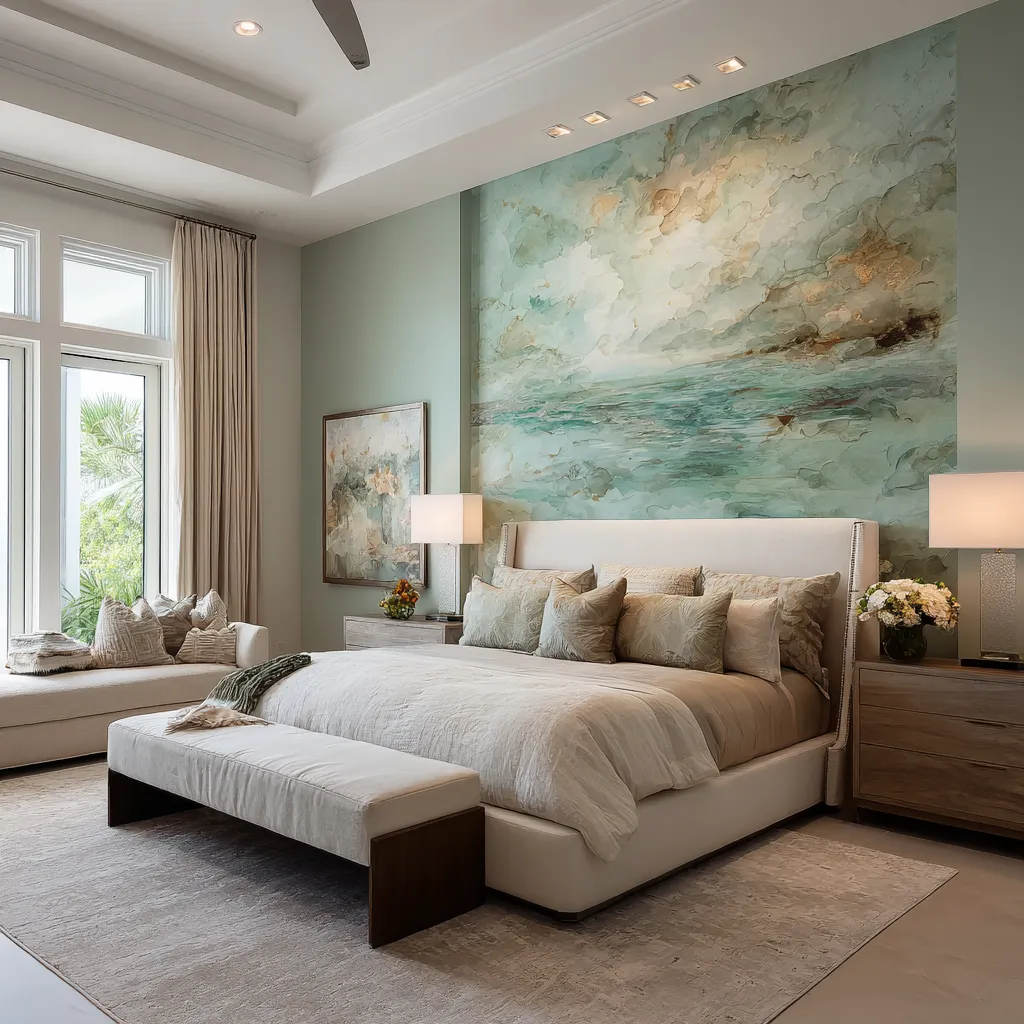
Compact rooms need concentration, not over-coverage
Green maximalism can work very well in smaller or awkward rooms, but only if the decoration is placed strategically. Sloped ceilings, narrow layouts, built-in windows, and tight floor plans usually benefit from concentrated rather than evenly spread intensity.
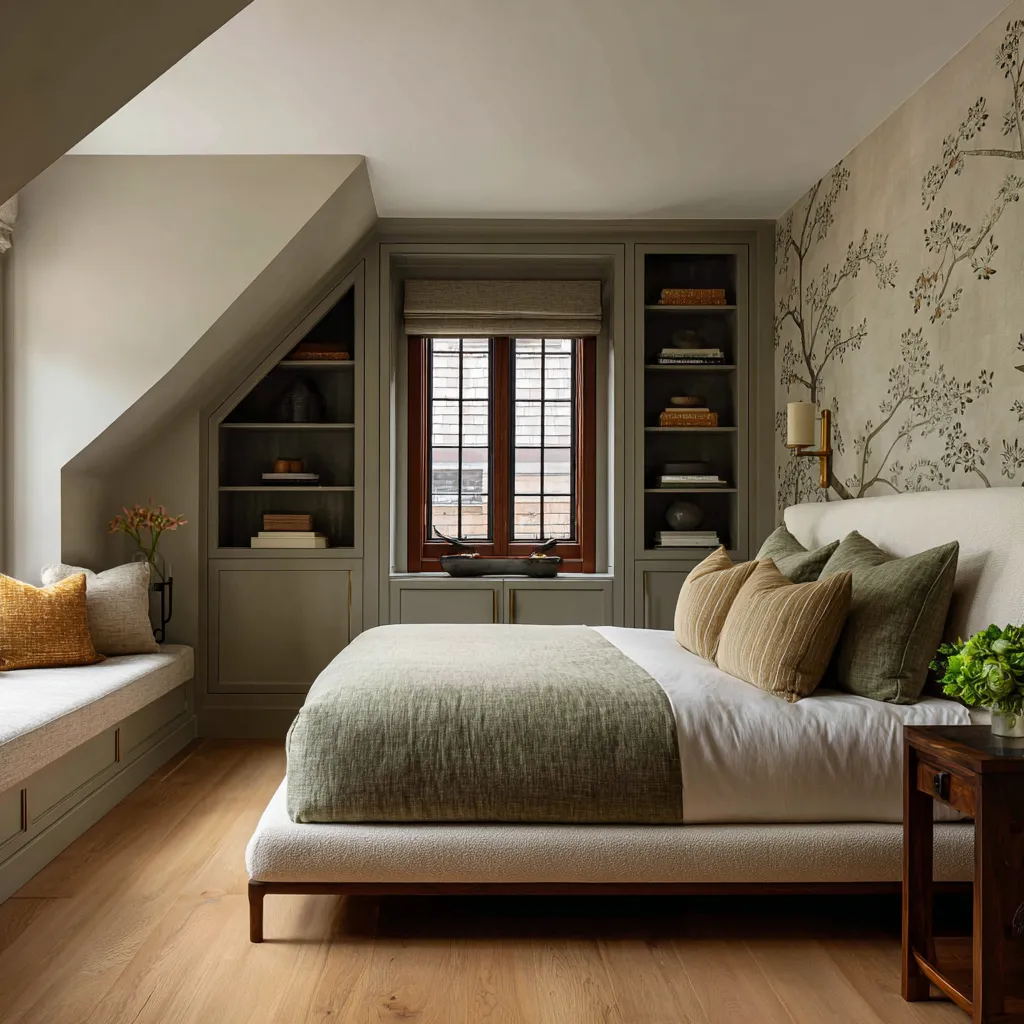
In a compact green bedroom, the most effective moves are often:
- keep one wall or one side of the room as the main decorative event
- paint built-ins into the green story
- keep the floor more open
- turn difficult geometry into useful seating or storage
- let the bed remain simple if the wall is active
- use warm wood or brass to prevent the palette from feeling thin
- avoid piling heavy pattern on every vertical surface
This kind of editing helps the room feel deliberate instead of crowded. In small layouts, maximalism usually works best vertically and architecturally, not through sheer quantity of objects.
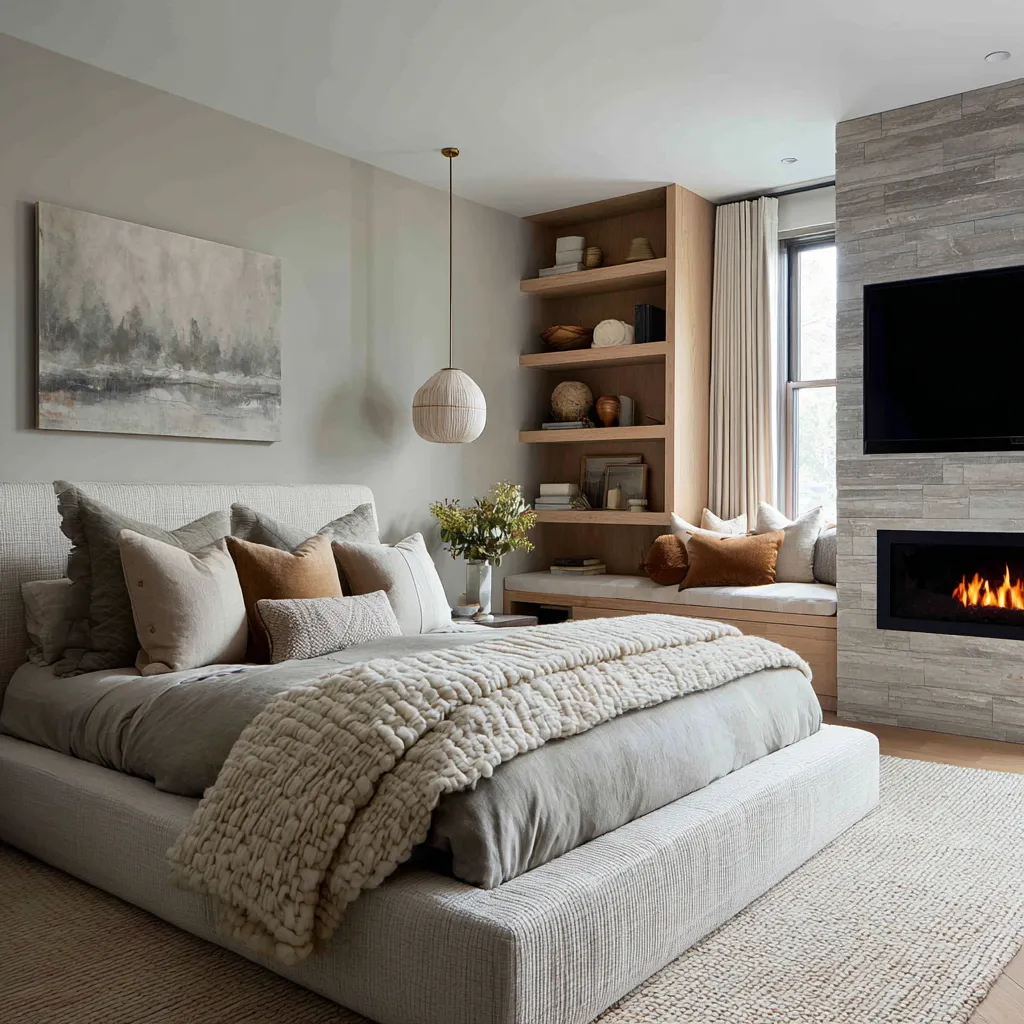
Interesting designs are often hybrids
Advanced green maximalist bedroom ideas are rarely the ones that push every variable at once. They are often the ones that combine two strong systems and let a third remain restrained.
For example:
- a scenic panel wall combined with formal wardrobe architecture
- a pale botanical mural combined with oak shelving and one mustard accent
- a mineral wall combined with plush upholstery and simple outlines
- distributed sea-glass green combined with suite-like zoning
- dark millwork combined with cream bedding and firelight
- an airy mural combined with rust branches and pale side walls
These ideas feel layered because they balance different kinds of abundance. They do not force wall drama, heavy shell color, strong wood mass, dense object count, and low light to compete all at once.
They let one system lead and another support. That controlled exchange is one of the clearest signs of a strong room.
How to think about a green maximalist bedroom before choosing finishes
Before choosing paint, wallpaper, or bedding, it helps to decide what role green is going to play. Ask first:
- Will green be the room’s image?
- Will it be the shell?
- Will it live in millwork?
- Will it repeat through soft furnishings?
- Will it appear as a mineral surface?
- Will it be pale and airy or dense and tactile?
Once that is clear, the rest of the room becomes easier to organize.
- If the wall is the main event, the bed should probably stay broad and pale.
- If the shell is green, warm wood should likely come forward.
- If the room is pale and airy, one warm accent may be needed.
- If the room is tactile and mineral, image density may need to stay low.
- If the room is large and suite-like, green should probably return in several zones.
- If the room is small, concentration is usually safer than full-room coverage.
These are the choices that shape the strongest interiors.
What makes green maximalism feel modern
A current green maximalist bedroom design usually avoids one common mistake: it does not try to prove richness through constant visual pressure. Instead, it relies on scale, discipline, and a clear hierarchy.
That often means:
- one dominant event rather than many equally loud ones
- pale bedding against active walls
- integrated millwork instead of scattered furniture
- warm wood used with purpose
- texture carrying part of the richness
- enough open floor and pale relief to let the eye rest
- a clear relationship between decorative force and architectural force
In other words, fullness comes from composition, not from overload.
Closing thought
Green maximalist bedroom design is when green is treated as a structural idea rather than a decorative afterthought. The room does not become memorable simply because it contains green.
It becomes memorable because green is given a clear job. It may hold the wall behind the bed.
It may settle into the shell. It may move quietly from drapery to artwork to window seat to pillows.
It may enter through stone and plaster rather than foliage. It may live inside oak-framed millwork.
It may stay pale and airy or drift into a richer mineral hush.
A useful way to think about this style, then, is not as one fixed look but as a family of design systems. Once you know where the room keeps its abundance, you can decide how green should behave within it.
That is where the strongest bedrooms begin.