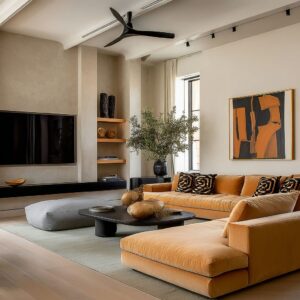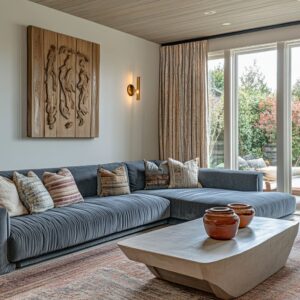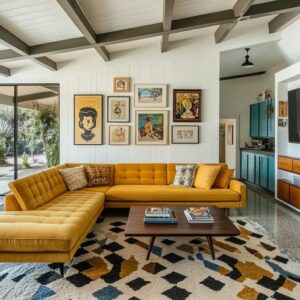
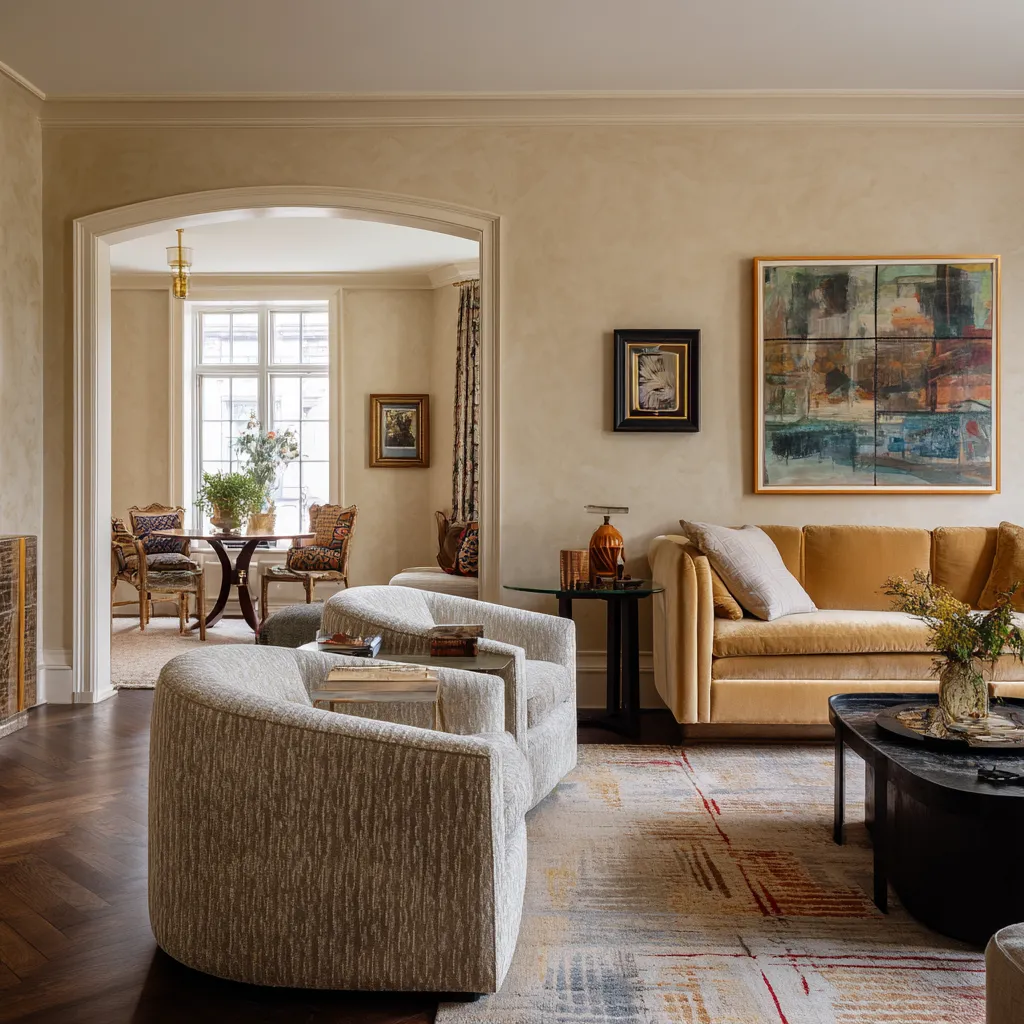
A cozy maximalist living room succeeds through a very specific balance. It gives the eye enough to enjoy, but it also gives the body a clear place to settle.
It feels layered, expressive, and deeply furnished, yet it does not dissolve into noise. That balance is the whole point.
A room can be rich without being restless, and it can be comfortable without becoming visually dull. Many people misunderstand this kind of interior because they reduce it to one visible trait.
Some think maximalism means many objects. Others think coziness comes from dark paint, thick throws, or candle-like mood alone.
In practice, the living rooms that hold attention and support long use do something far more structured. They build comfort close to the body, and they build richness through the wider room.
Those two systems have to support one another.
That is why some living rooms look generous but feel tiring, while others look simple but feel emotionally complete. Cozy maximalism depends on how the room is organized, how its surfaces relate, where softness is placed, how the center is handled, and whether the shell carries any real character.
Once those things are in place, the room can become full, warm, and memorable without needing decorative excess.
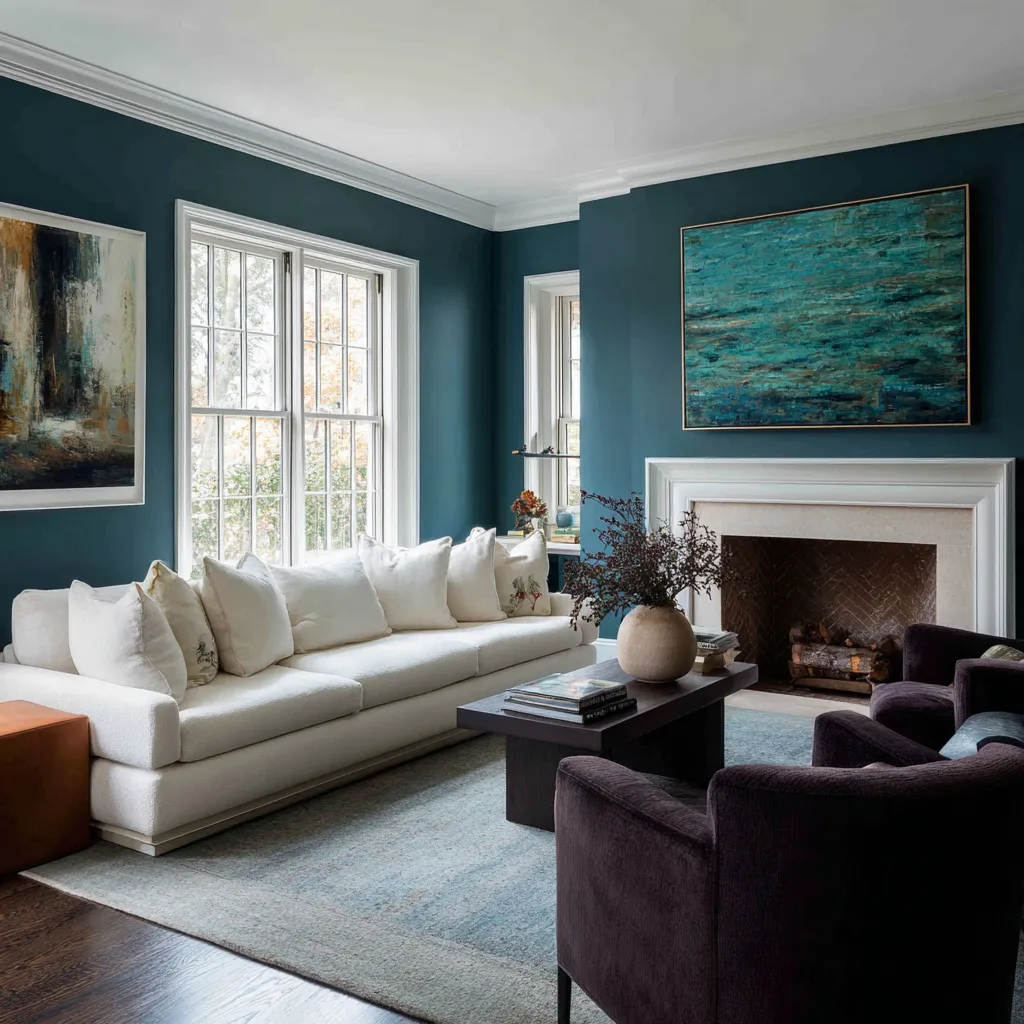
Cozy and maximalist are linked, but they are not the same thing
The first idea to understand is that coziness and maximalist richness come from different parts of the room. Coziness is built near the body.
It comes from seat depth, tactile upholstery, a rug that gives the furniture a soft landing, rounded support at the back and arms, a center that is easy to reach, and a seating plan that brings people together rather than pushing them apart. Cozy rooms do not simply look soft from a distance.
They support staying, reading, talking, leaning back, curling up, and using the room through changing parts of the day.
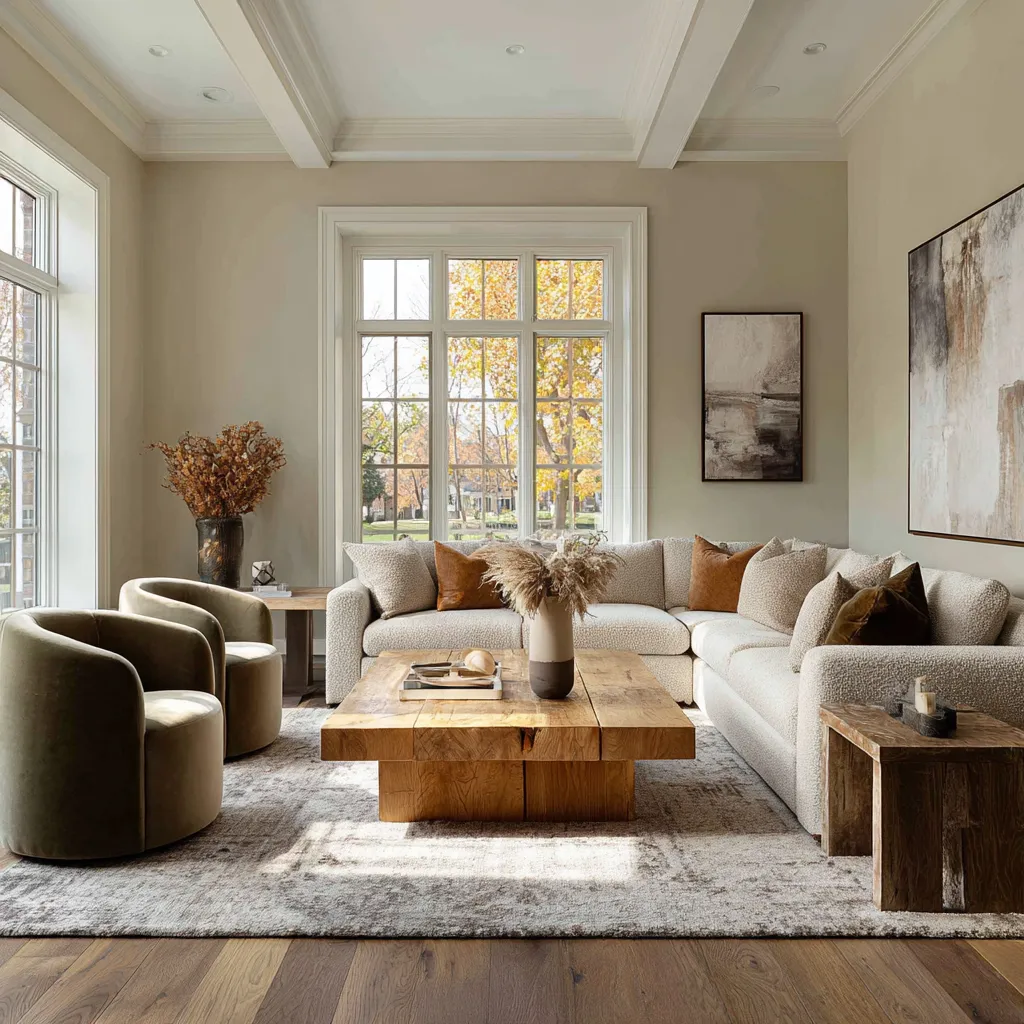
Maximalist richness is built at the scale of the whole interior. It comes from the shell, tonal layering, furniture mass, artwork, books, florals, grouped objects, architectural depth, and the way one zone leads into another.
It is the room-wide atmosphere of fullness, not merely the presence of accessories. A living room design can therefore succeed in one dimension and fail in the other.
It can be physically pleasant but visually thin. It can also be visually rich but bodily cold.
The most persuasive cozy maximalist rooms avoid that split. They make comfort and richness cooperate.
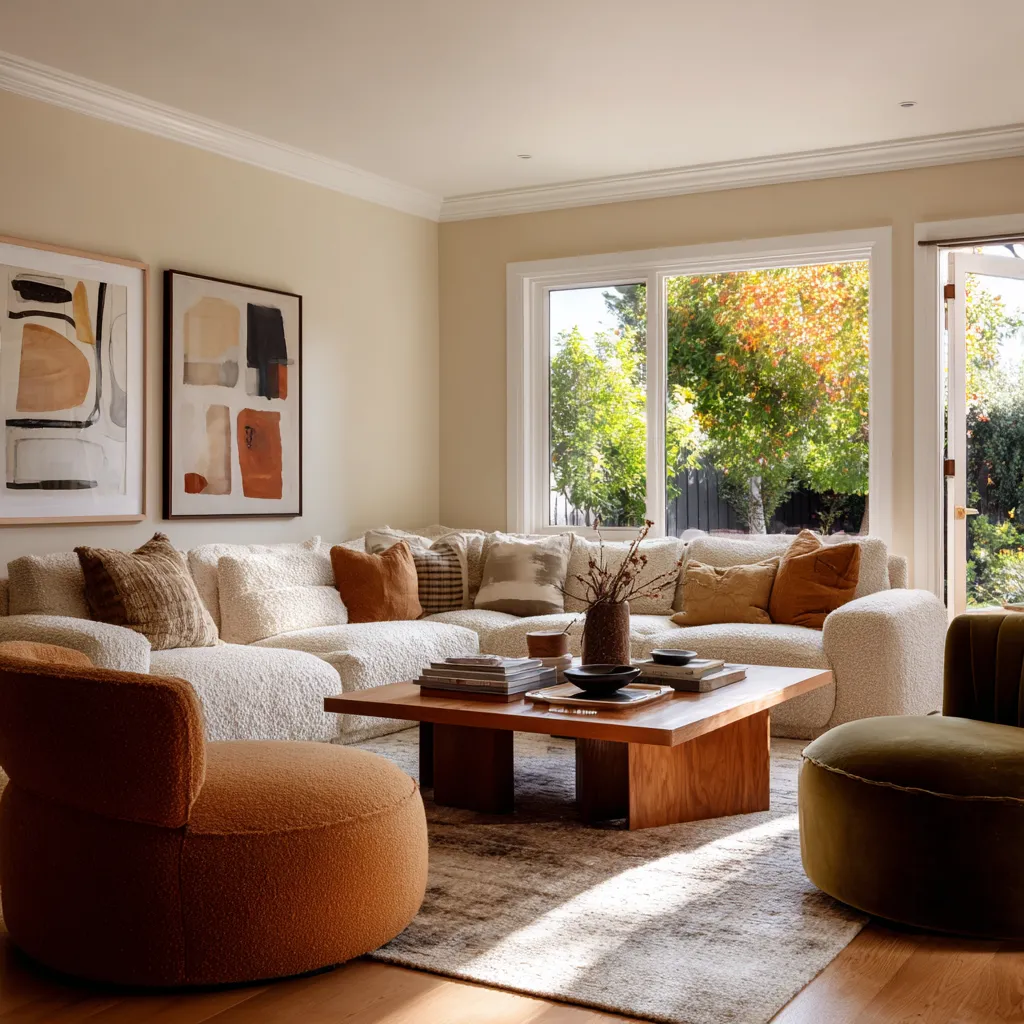
The body must feel held before the eye can enjoy the room for long
One of the lessons in strong cozy maximalist interior ideas is that comfort has to be built first in practical, physical ways. The body needs real support.
That means seats with enough depth to relax into, upholstery with visible thickness, pillows that create a softened back line, and tables or ottomans placed close enough to serve daily use. This is why oversized sectionals work so well in many of these rooms.
They do not function only as furniture. They become an interior landscape of their own.
A large sofa with substantial arms and tactile upholstery makes the room feel inhabited before any smaller styling has even begun. It establishes bodily generosity.
That generosity then allows stronger color, deeper shell tones, heavier materials, or denser object groupings elsewhere in the room.
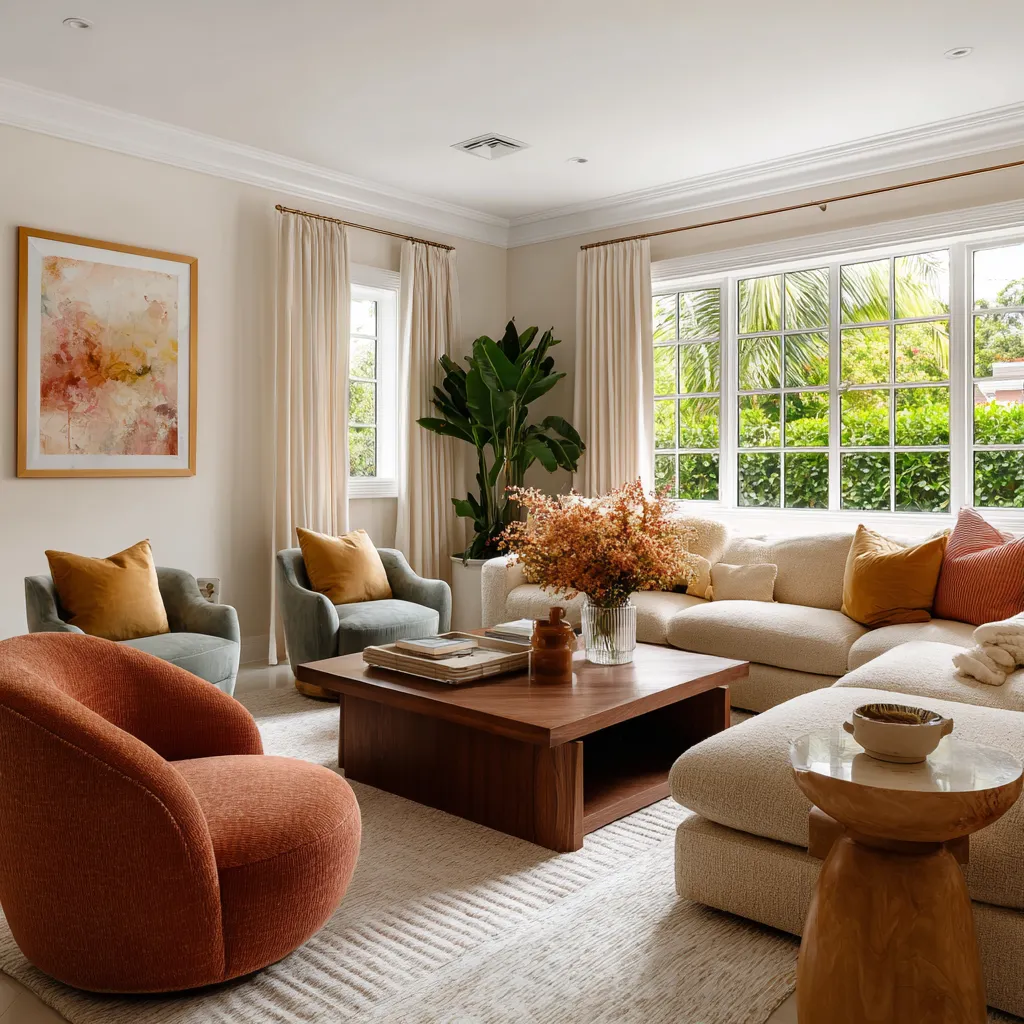
Rounded lounge chairs do important work too. They soften a room in a very direct way.
A curved back or barrel form reduces visual tension while also giving the seated person a greater sense of support. This shape change may seem minor on paper, yet it changes the emotional tone of a room quickly.
Straight-lined furniture can be handsome, but once the shell becomes darker, taller, or more architecturally forceful, curved seating often prevents the room from slipping into hardness. The rug matters just as much.
In stylish cozy maximalist living room ideas, the rug is not there to shout. It is there to gather, soften, and settle.
A faded pattern, soft tonal field, or thick neutral ground helps the furniture feel anchored. It also buffers stronger materials such as stone, wood, brick, plaster, or dark painted walls.
Underfoot softness is one of the least glamorous but most important contributors to real coziness.
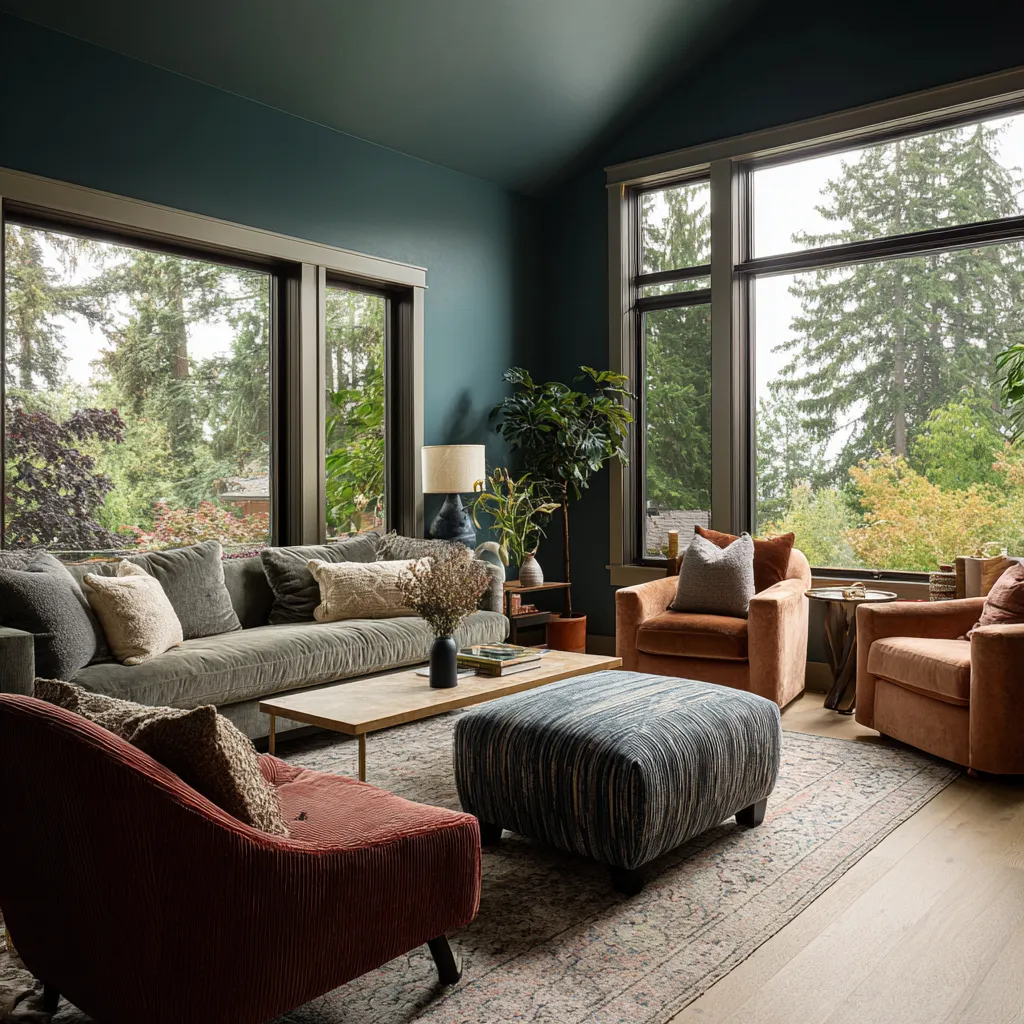
Richness comes from a few systems, not decorative scatter
A great many rooms can fail because they chase fullness through small-item multiplication. They add object after object, hoping the room will somehow become layered.
What usually happens instead is fragmentation. The eye has many things to process, but the room still lacks depth.
Strong cozy maximalist interior design ideas take another route. They rely on larger moves.
They use a major sofa rather than several underscaled pieces. They let wall color carry atmosphere.
They choose a serious coffee table or upholstered ottoman for the center. They use one substantial artwork or one concentrated gallery grouping instead of weak filler scattered evenly.
They allow shelves, beams, arches, paneling, plaster, brick, or stone to contribute to the room’s identity. They repeat related tones so the room grows thicker without becoming confused.
This kind of richness feels stable because it is built from structure. The room does not have to work hard to prove its personality.
Its atmosphere is already present in the shell, furniture mass, and material relationships. That is the difference between a room that feels full and a room that simply feels occupied.
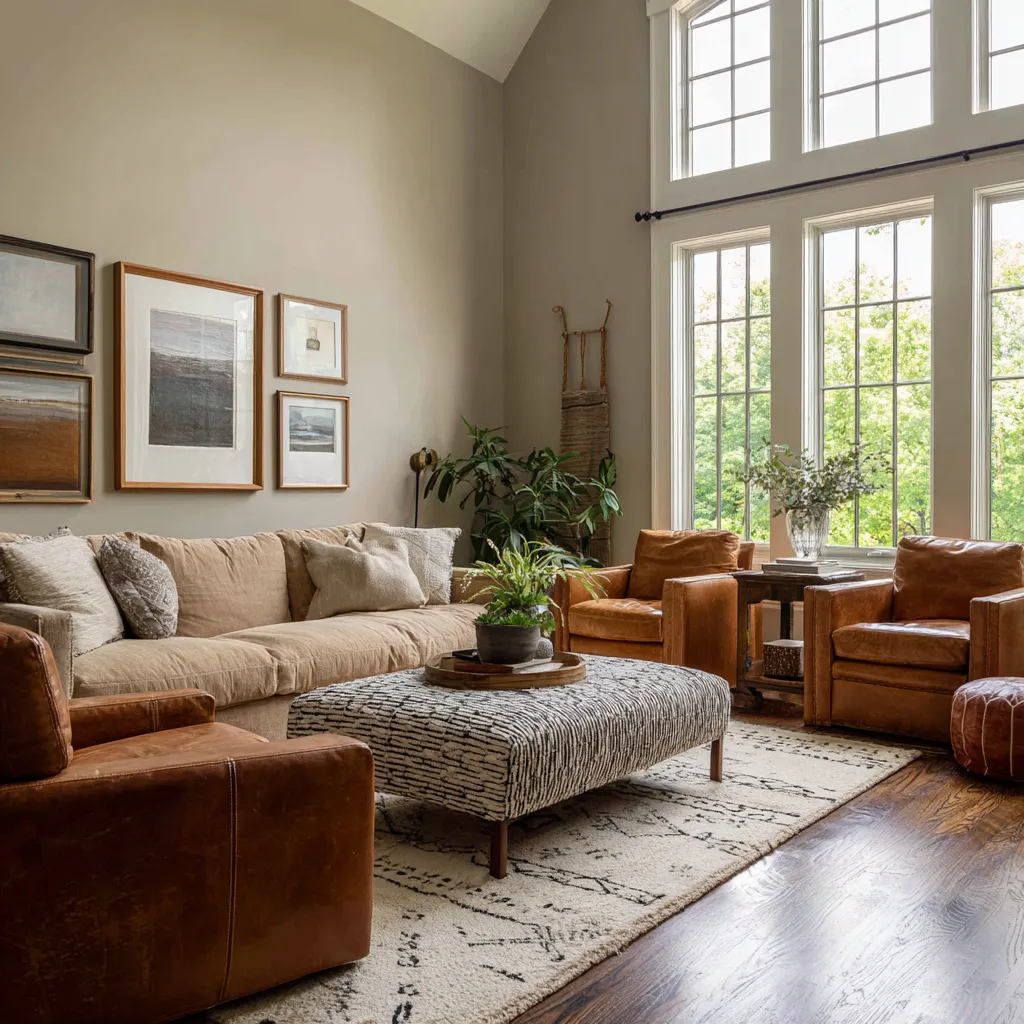
Relief is one of the hidden foundations of the style
One of the overlooked design needs in cozy maximalist living rooms is relief. Fullness only works when something in the room remains broad, readable, and quiet enough for the eye to rest.
That relief may come from a pale sofa against darker walls. It may come from a broad pale rug beneath richly textured seating.
It may come from a white mantel inside a saturated room, a blank plaster section beside patterned upholstery, or a calm table shape placed within a room full of tactile surfaces. In brighter interiors, relief often comes from the shell itself if the walls stay soft and consistent while the furnishings carry the density.
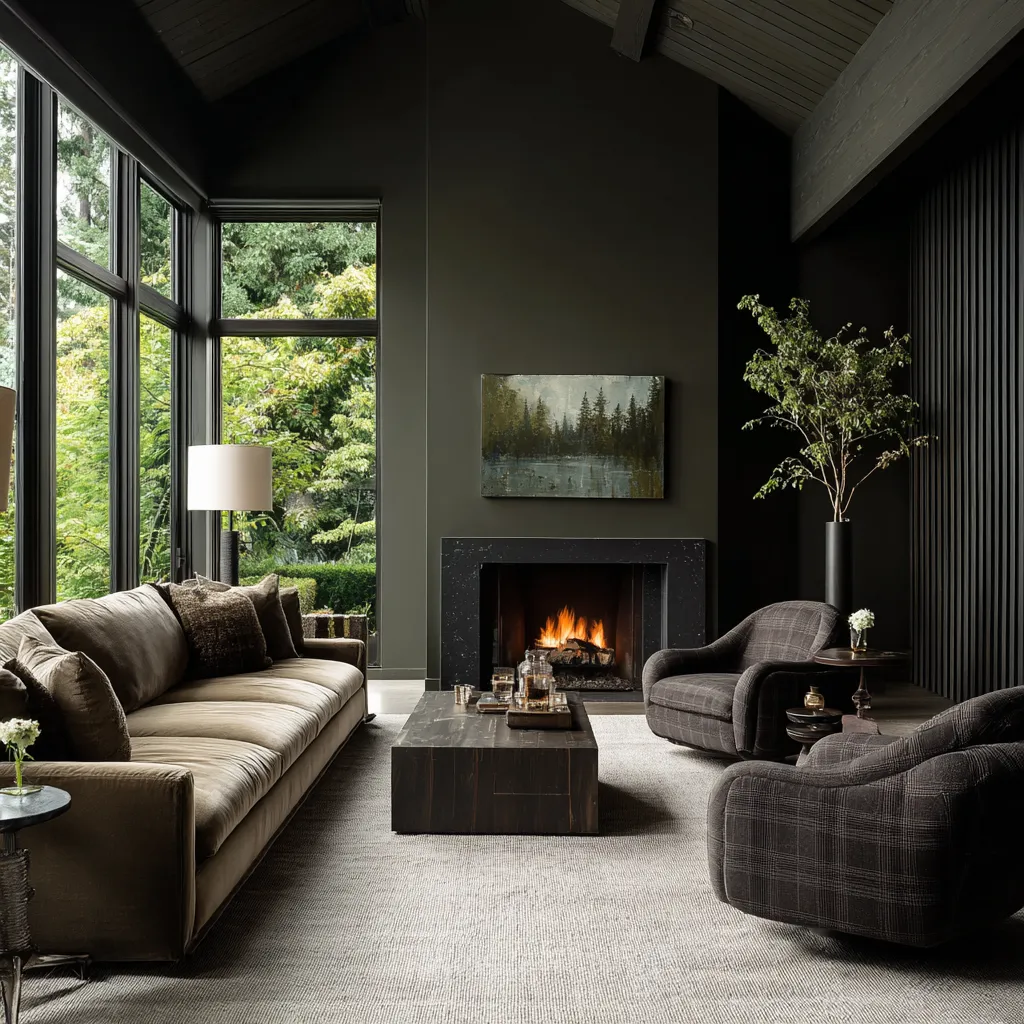
Without relief, the room loses hierarchy. Everything asks for equal attention, and the result becomes tiring.
With relief, richness becomes legible. The room breathes.
This is one of the reasons some dark rooms feel inviting while others feel heavy. The successful ones always provide contrast and rest: white trim, pale upholstery, a lighter rug, a broad calm wall plane, or strong window openings that cut into the deeper field.
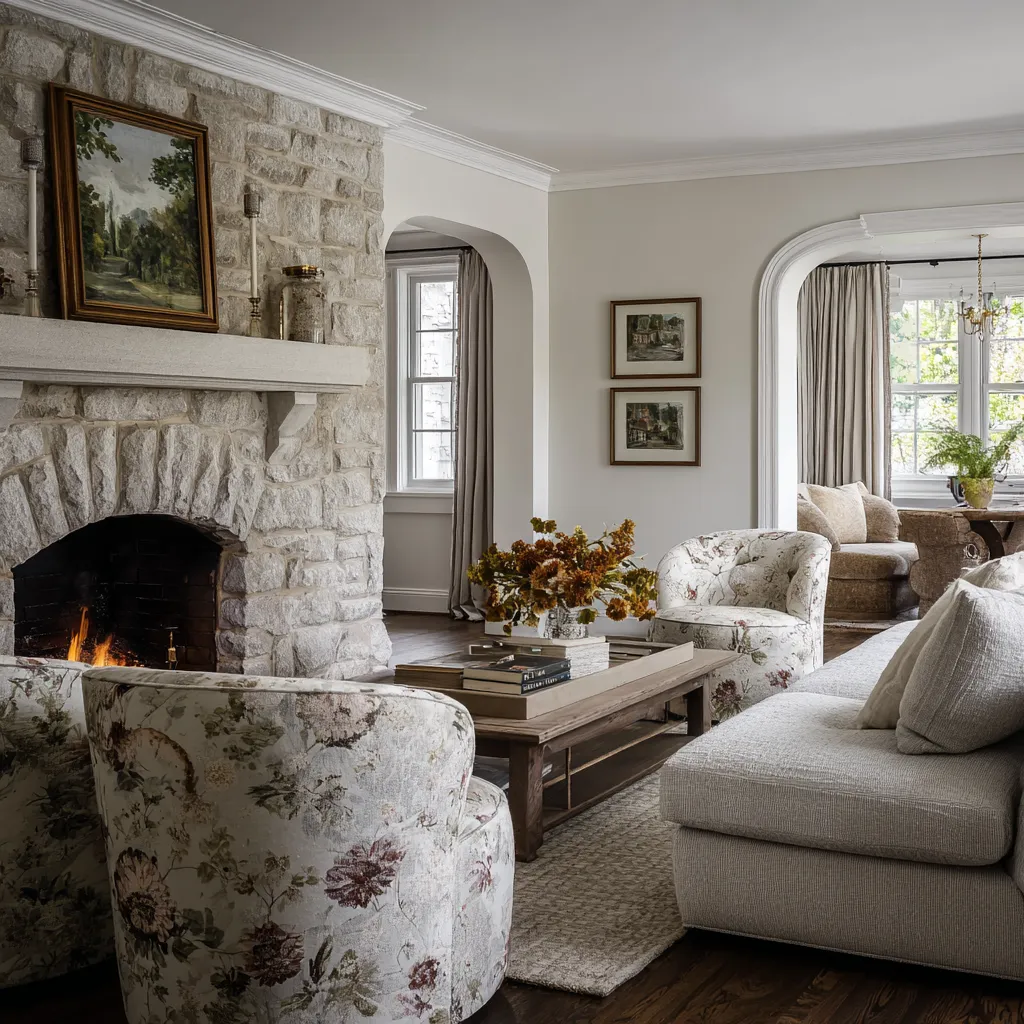
The same principle applies in floral and pattern-led rooms. A patterned chair can be wonderful if it sits beside a quieter sofa.
Built-ins can feel warm and layered if another wall or seating mass remains calmer. Relief is not a decorative afterthought.
It is structural.
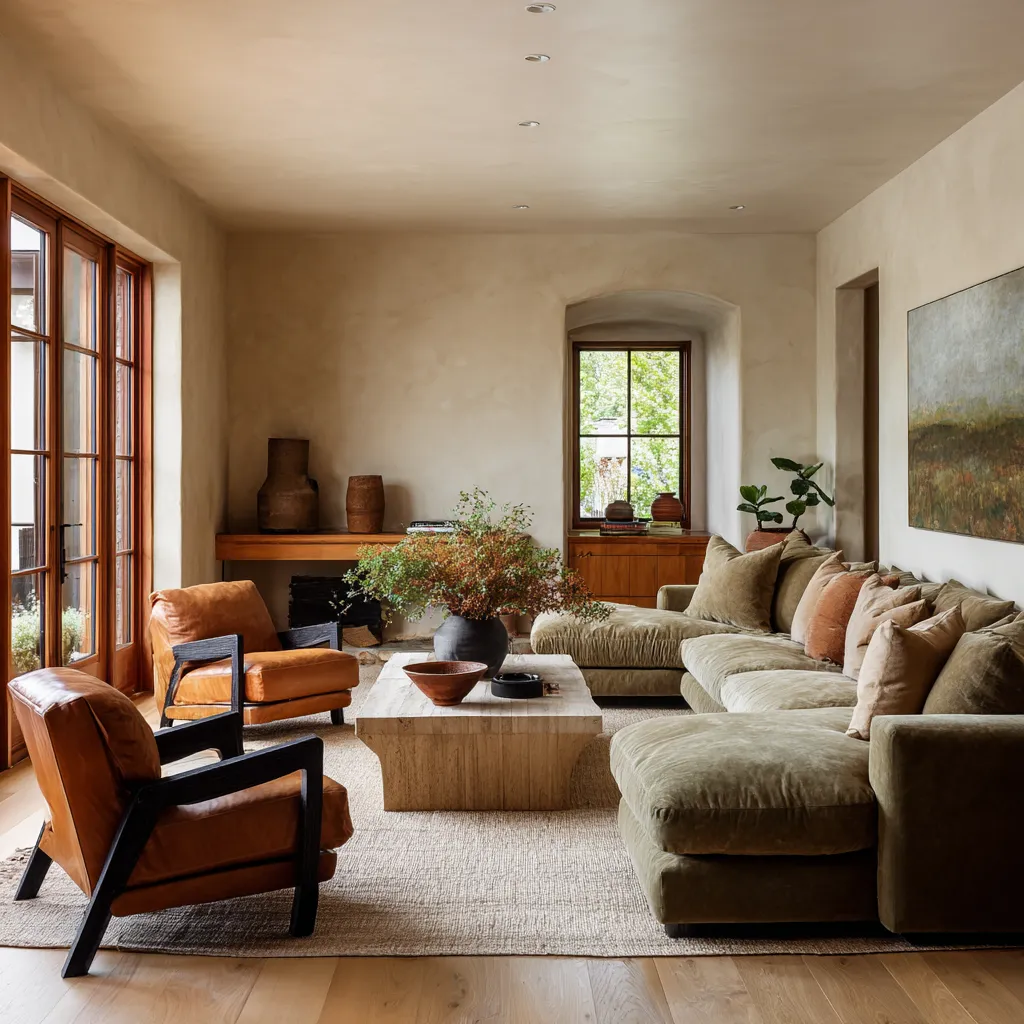
Dark shells create instant enclosure, but they must be corrected
Dark walls often help a living room feel cozy quickly because they reduce emotional distance. The perimeter comes inward.
The room feels more held. Depth on the walls can also increase maximalist richness by giving the shell its own visual charge rather than leaving it neutral.
But dark paint alone is not enough. In fact, without correction it can create compression instead of comfort.
A dark shell works well when paired with some form of pale or luminous counterforce: a cream sofa, a lighter rug, bright trim, a white fireplace surround, a broad artwork with softened values, or windows with crisp framing. This contrast keeps the room from becoming visually airless.
The darkness stays atmospheric rather than oppressive. Dark living rooms often benefit from large furniture rather than many scattered pieces.
Bigger forms stand up to the shell and keep the room from breaking into too many small events. A long pale sofa, a pair of rounded lounge chairs, one substantial table, and a hearth or artwork can produce a powerful room with relatively little clutter.
That kind of room still feels maximalist because the scale, tone, and material contrast are doing the work. In other words, dark cozy maximalism is usually less about many accessories and more about tonal commitment, sculptural furniture, and a carefully managed balance between density and relief.
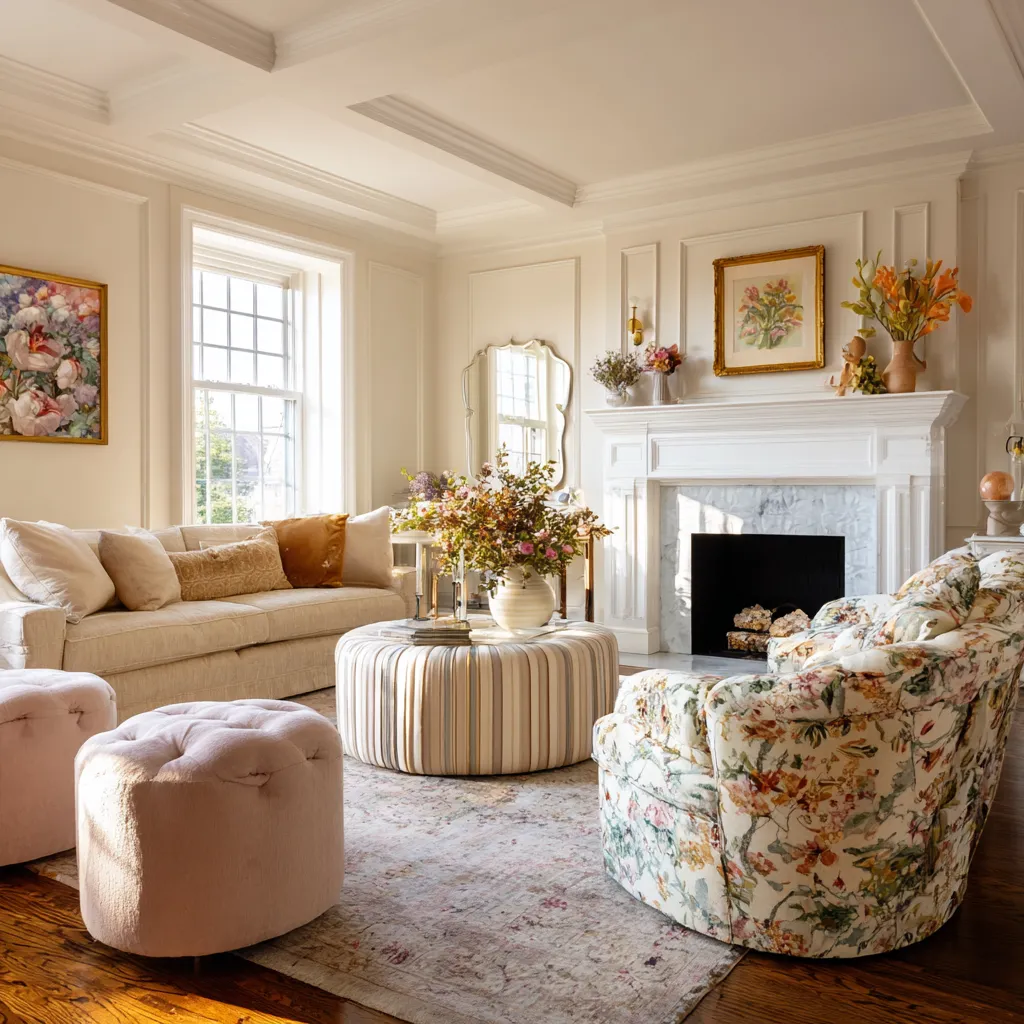
Bright rooms can be deeply cozy too, but they need compensation
A bright living room does not fail because of light. It fails only when light is left unsupported.
If the room is pale, open, or sun-filled, it needs stronger body-scale and center-zone devices to keep it from feeling thin. This is where upholstery abundance becomes crucial.
A large textured sectional, multiple rounded chairs, a thick rug, full drapery, and a weighted center table or ottoman can give a bright room enough softness and social gravity to feel deeply inviting. Warm tonal clusters also matter.
Rust, clay, tobacco, muted rose, olive, honeyed wood, or dusty blue repeated in a few concentrated spots can thicken the emotional field without sacrificing brightness.
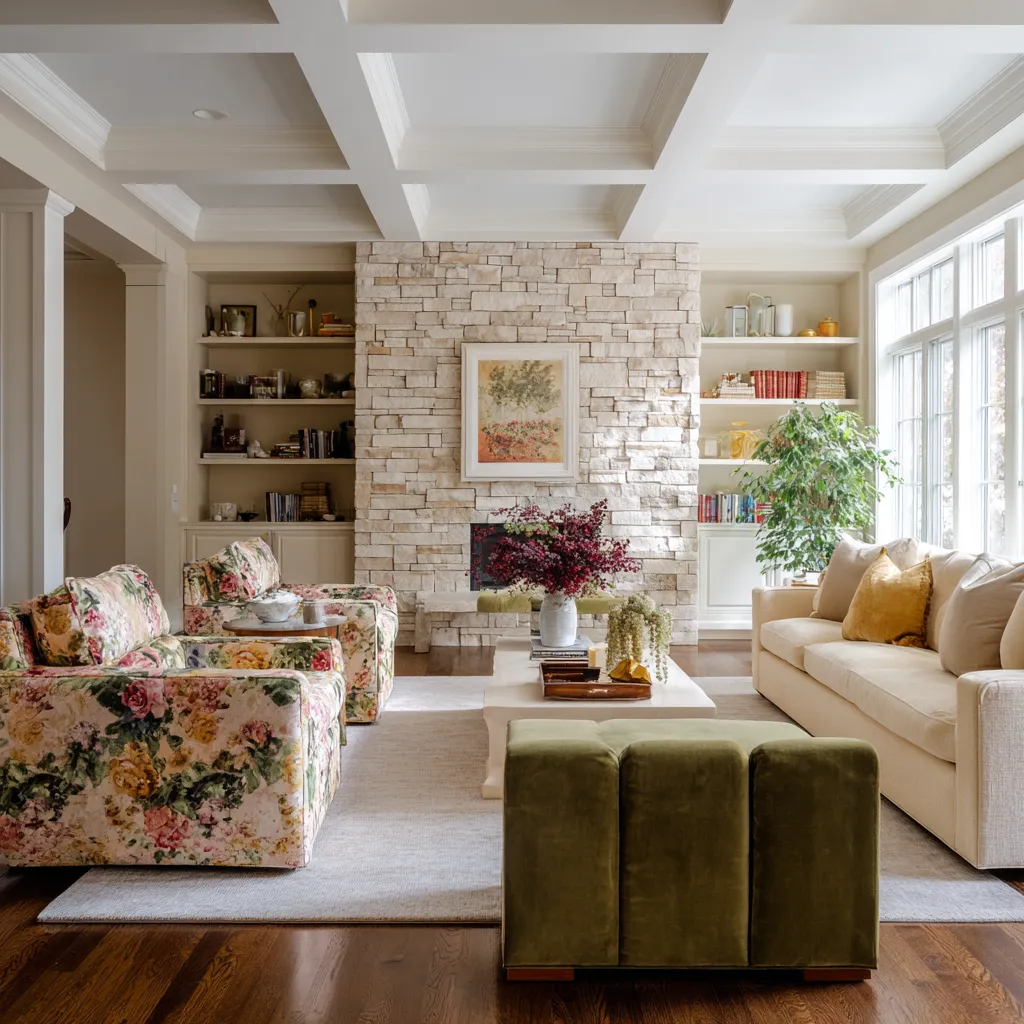
Bright rooms often depend on center weight in a way dark rooms do not. In a dark room, the shell already contributes enclosure.
In a pale room, the center may need to do more of that labor. A serious wood table, an upholstered ottoman, a padded bench, or a large floral arrangement can help the seating group feel socially complete.
Drapery is especially useful here. Curtains soften the perimeter and turn a bright opening into part of the comfort system rather than a break in it.
Ceiling articulation can help as well. Coffers, beams, or any division that reduces the scale overhead often make a bright room feel less open-ended and more habitable.
So brightness is not the enemy of coziness. Thinness is the enemy.
A bright room becomes cozy when the shell is softened, the seating grows generous, and the center develops enough presence to hold the group together.
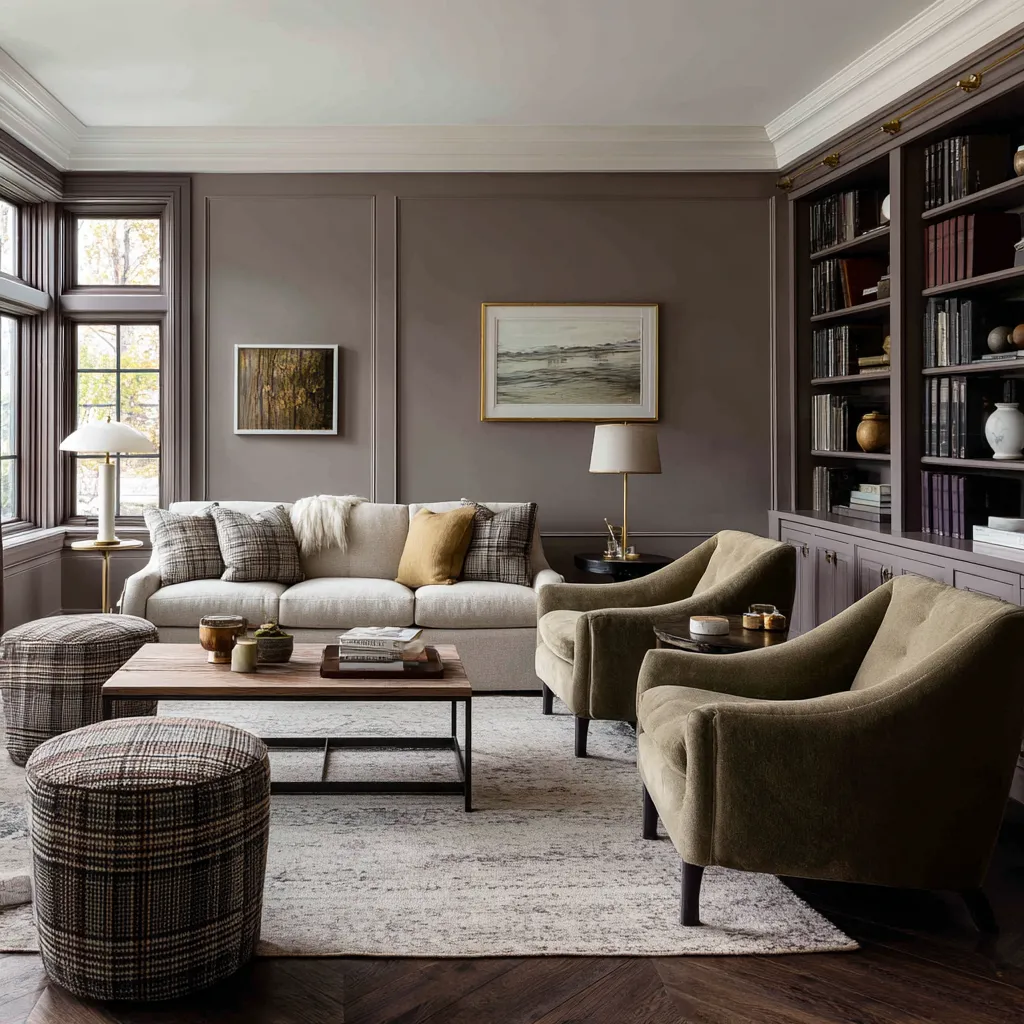
The center of the room controls the social temperature
The center is one of the most powerful parts of a cozy maximalist living room. It determines whether the room feels easy to use, too formal, too sparse, or properly settled.
A weak center often makes the whole room feel under-furnished even when the perimeter is strong. A hard, thin, underscaled coffee table can leave a generous seating arrangement feeling oddly empty.
A large room with a small table may still look attractive in photographs, but in use it often lacks social gravity.
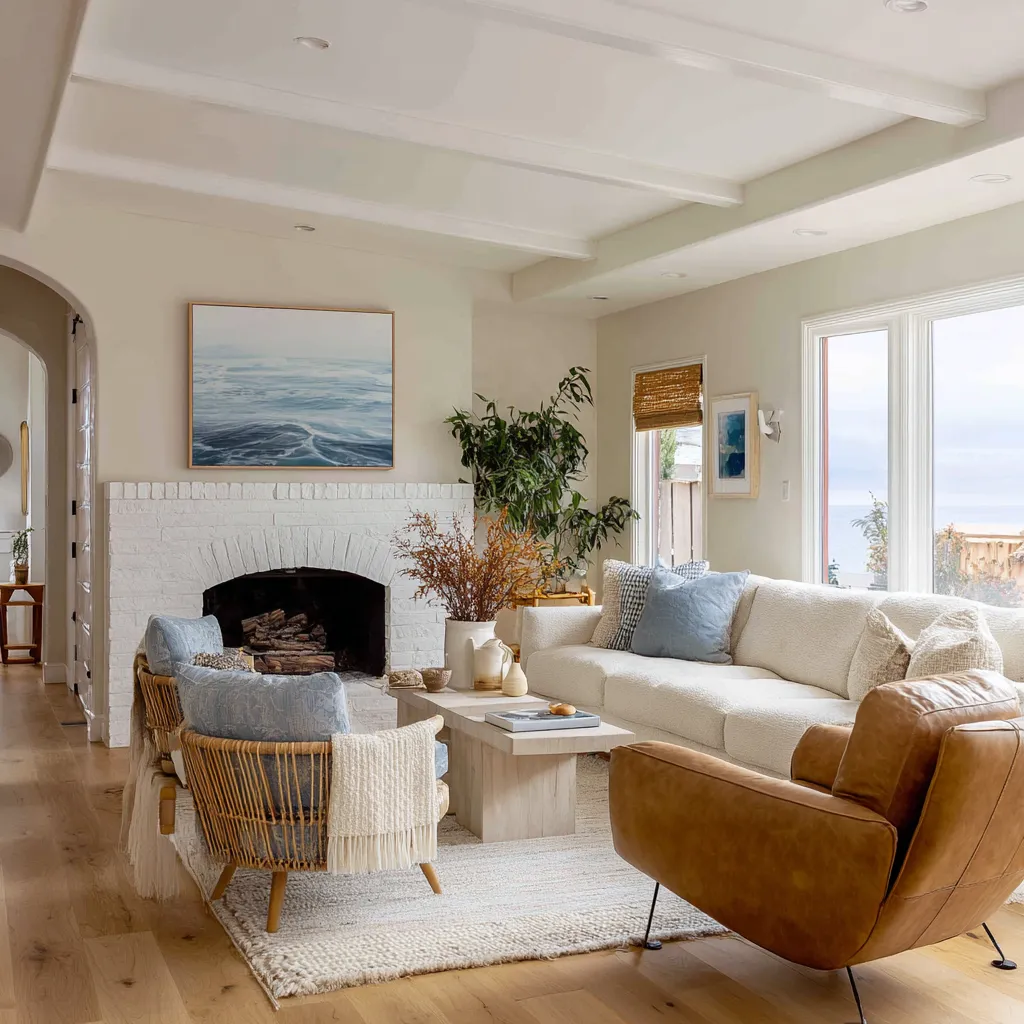
Strong cozy maximalist centers take several forms. A broad wood coffee table creates warmth, weight, and a practical gathering surface.
It works especially well in bright contemporary rooms where the shell is simple and the seating needs grounding. An upholstered ottoman softens the room at the exact place where people gather.
It is useful in taller or brighter rooms because it turns the center into part of the comfort field instead of a hard interruption. Pattern on the ottoman can also give the room rhythm if the rest of the furniture is more restrained.
A stone or plaster-like cylindrical table can add solidity inside a soft decorative room, provided its tone remains quiet and its shape stays rounded enough to preserve softness. Heavier center styling can work too, but concentration matters.
Books, bowls, trays, branches, and flowers tend to succeed when grouped on one substantial center piece rather than distributed thinly across every available surface. Grouped abundance gives the room a real social core.
Scattered abundance often weakens it.
Pattern is helpful, but it is not the foundation
Pattern is one of the most misunderstood elements in cozy maximalism. It can add memory, softness, rhythm, and domestic identity, but it does not create coziness by itself.
Rooms with a lot of pattern can still feel hard, exposed, or visually agitated if the deeper comfort structure is missing. Pattern works when it is assigned a clear role.
- Floral upholstery brings softness, botanical memory, and a lived-in domestic tone. It often suits barrel chairs, upholstered club chairs, or rooms with paneled or classic shells because it introduces cultural content without requiring a larger color explosion.
- Plaid adds seasonal warmth and textile depth. It is especially persuasive in library-like interiors, rooms with books, paneled walls, or rooms leaning into country-house or autumnal atmosphere. Plaid at the ottoman or pillow level can ground a room emotionally without taking over the whole space.
- Stripe is useful at the center. On an ottoman, bench, or cushion, it can organize the room’s middle and give the eye a clean directional rhythm.
- Faded rug pattern is perhaps the most reliable form of pattern in cozy maximalist interiors. It gives history underfoot, softens stronger furniture masses, and adds visual layering without raising tension too much.
The key is not to let pattern carry jobs that belong to other parts of the room. Pattern cannot replace seat depth.
It cannot replace relief. It cannot replace shell character.
It works once those elements are already present.
Materials often do more than accessories
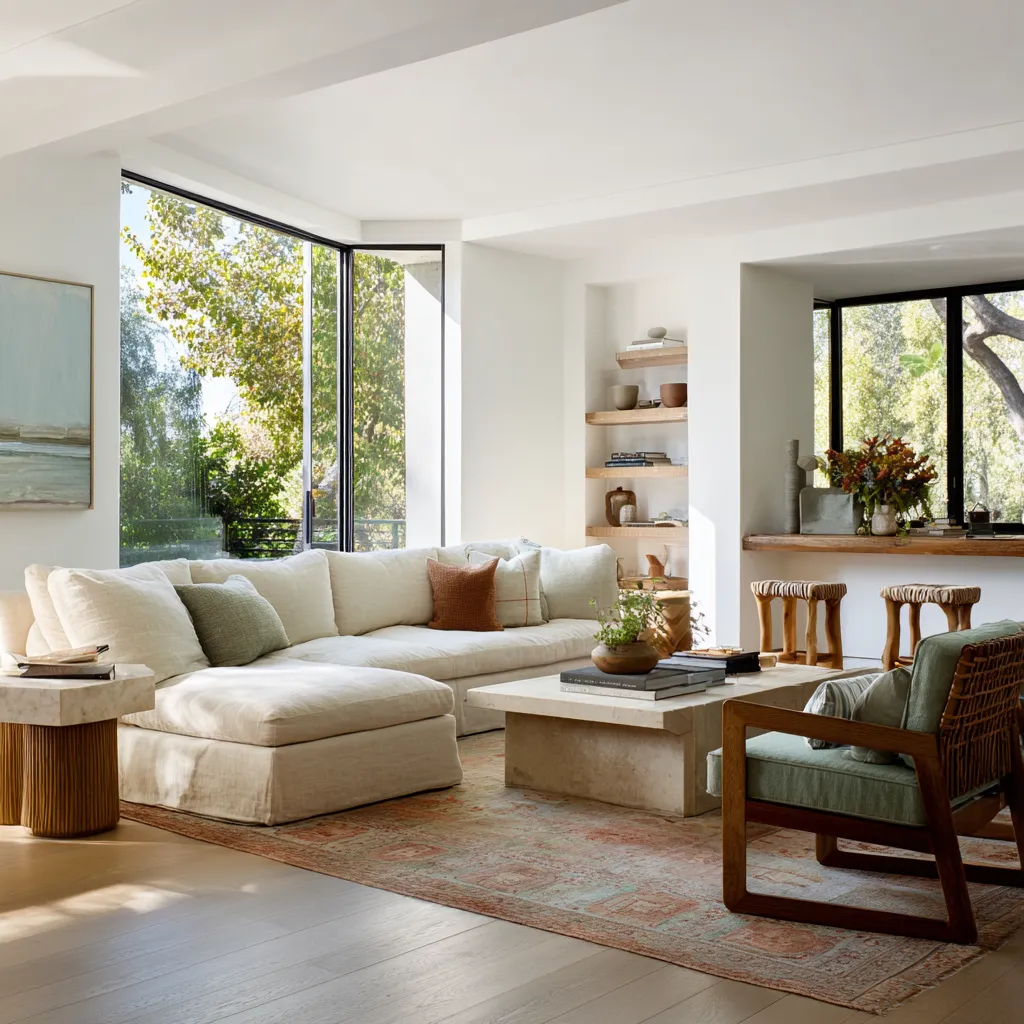
In rich-looking cozy maximalist living room ideas, materials carry a larger share of the effect than objects do. Stone, plaster, leather, wood, brick, boucle, velvet, woven fibers, old beams, paneling, and aged rugs each bring a different tactile language.
Once several of those languages are present and coordinated, the room begins to feel full even before shelves or tabletops are heavily styled. This is why some design ideas with very moderate accessory counts still feel layered.
A stone fireplace, plaster walls, leather chairs, a thick textured sectional, a wood mantel, a faded rug, and a ceramic grouping already create a large amount of sensory information. The room is rich because the surfaces themselves are active.
Material contrast is especially effective when it is controlled by a related palette. Warm woods, clay tones, off-whites, olive, mushroom, charcoal, dusty blue, and muted rose can create tremendous depth if repeated intelligently.
A room does not need a wide rainbow of color to feel full. It needs a dense family of related tones that can move from wall to upholstery to rug to art to accessory without breaking apart.
That is one reason earth-toned cozy maximalist rooms often feel grounded. Their richness comes less from chromatic variety and more from tonal repetition combined with tactile difference.
Books and flowers add life, but they do different jobs
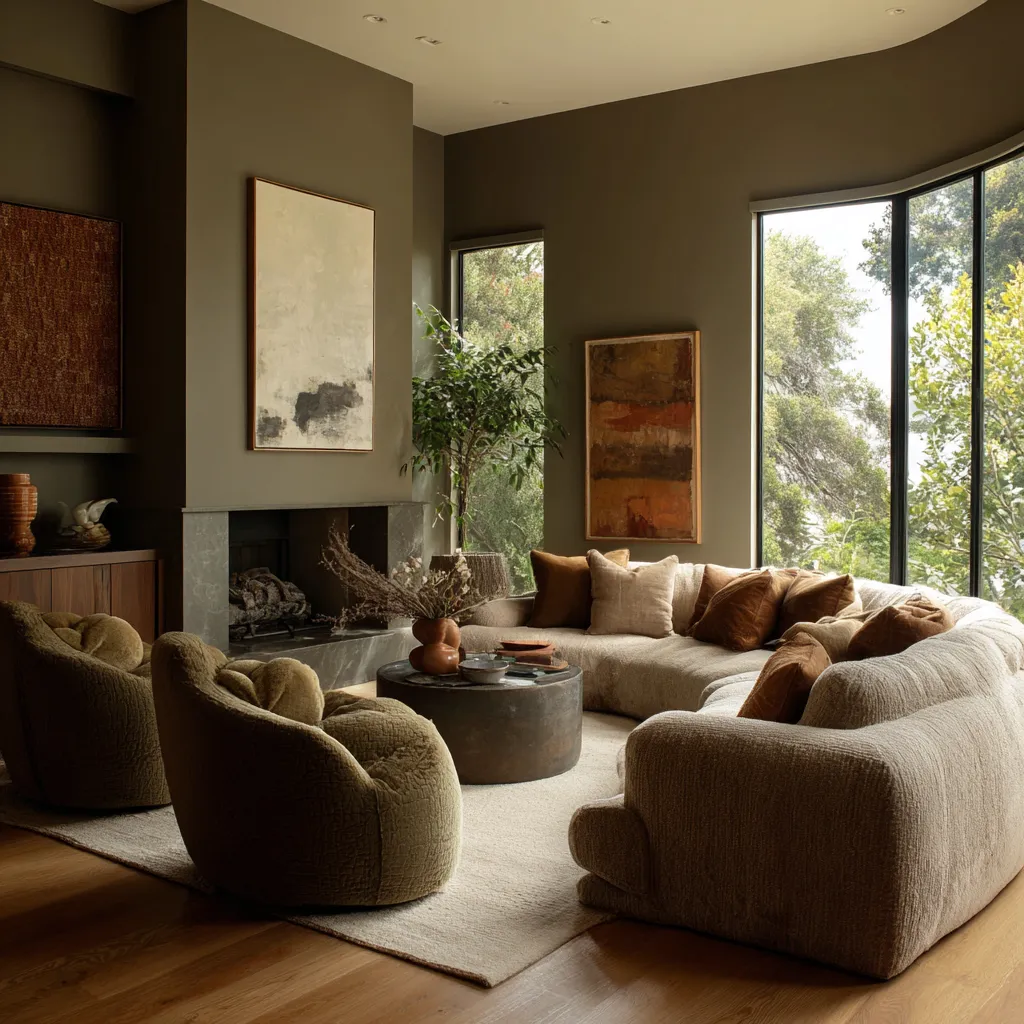
Books and flowers are two of the most effective ways to make a living room feel inhabited, yet they contribute very different kinds of life. Books create narrative density.
They imply time, memory, routine, return, conversation, reading, and a room that holds more than visual styling. Shelves with books also add vertical rhythm and a kind of quiet density that works particularly well with paneled walls, built-ins, darker shells, and muted textile schemes.
A room with books often feels mentally inhabited as well as physically used. Flowers create another kind of richness.
They bring season, tenderness, color concentration, and a sense of recent attention. A bouquet on the center table, stems on the mantel, or a generous arrangement near a window can shift the whole emotional tone of the room.
Flowers suggest care and short-term renewal. They make the space feel refreshed within an older, slower interior setting.
In cozy maximalist room ideas, books and flowers do not substitute for one another. Books thicken the room’s memory.
Flowers freshen its present tense. Some rooms benefit from one more than the other, depending on whether the desired mood is library-like, garden-like, urban, rustic, or formally decorative.
Architectural character lowers the burden on decor
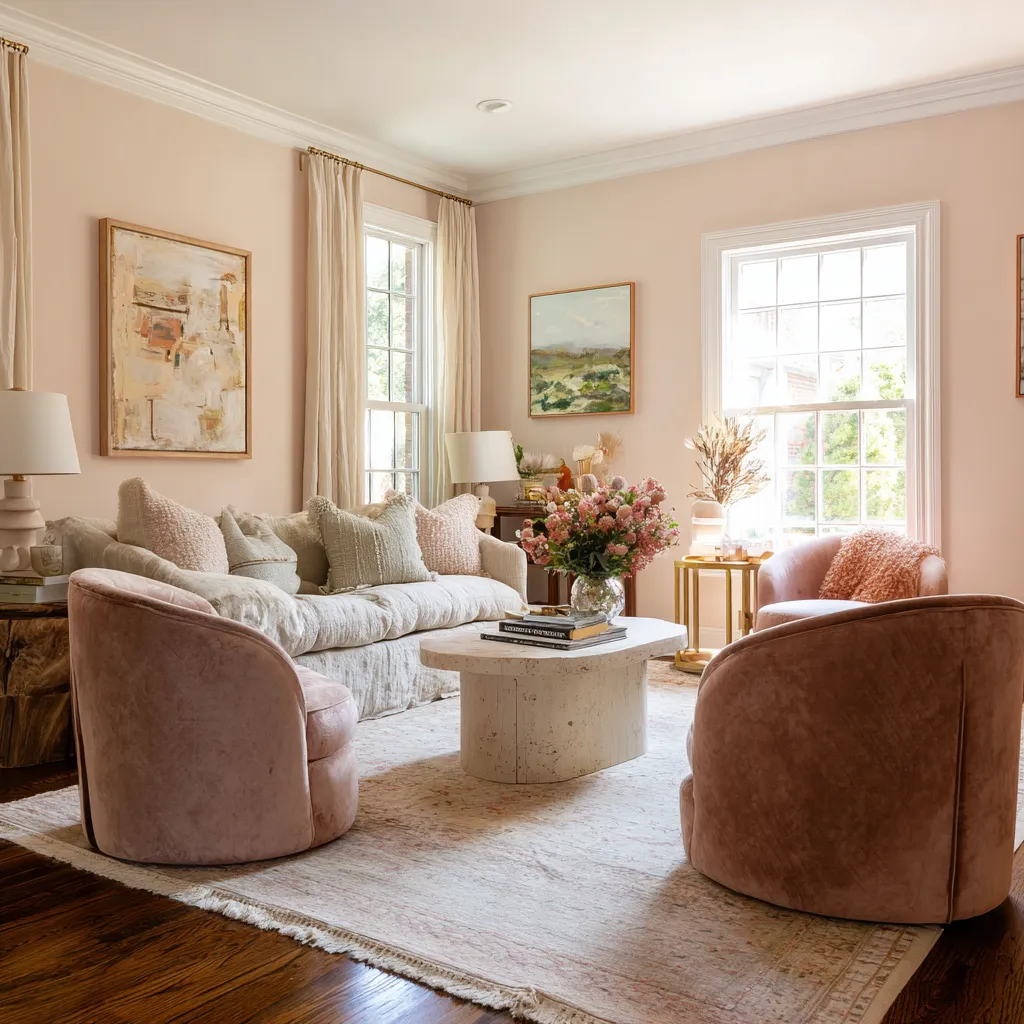
A room with a strong shell usually needs less small styling. This is one of the most practical and useful truths in cozy maximalist design.
If the room already has beams, arches, plaster texture, paneling, a hearth wall, built-ins, deep window reveals, coffered ceilings, or a dramatic shell color, the room begins with identity. It does not need endless extra objects to prove that it is interesting.
In fact, too much accessory load may weaken the room by blurring what the architecture is already saying. This is why older-house or character-heavy interiors often feel richer with moderate styling than plain drywall rooms do with heavy styling.
Architecture can contribute continuity, memory, contour, and mood before a single decorative object enters the scene. This also explains why open-plan or highly contemporary rooms often need other forms of layering to compensate.
In a simpler shell, warmth may need to come from wood, background shelves, adjacent use zones, rugs with age, stronger center pieces, or more substantial seating masses. The shell and the decor are not competing systems.
The shell should reduce how hard the decor has to work.
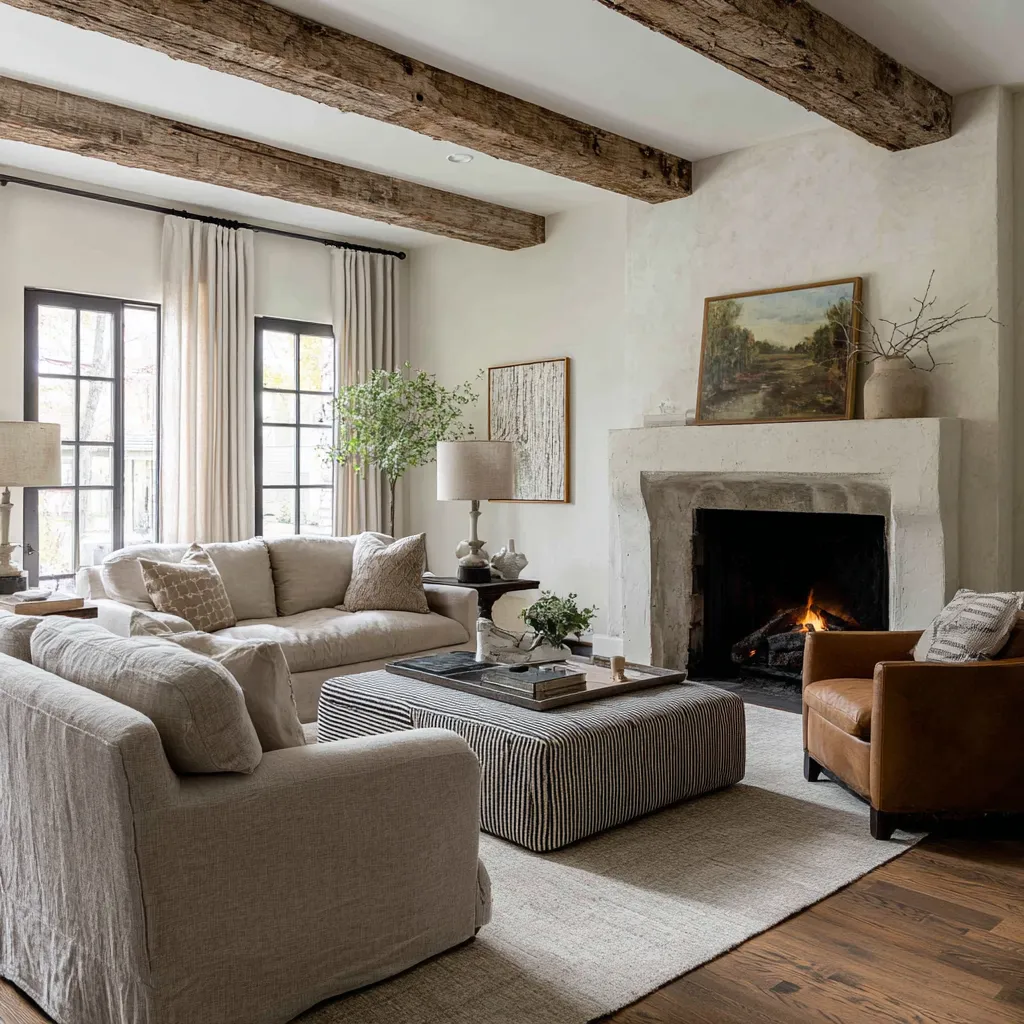
Tall rooms need density in the lower band
A tall living room can easily become emotionally distant. Height may look impressive, but it often weakens intimacy if the design tries to distribute equal energy from floor to ceiling.
A better method is to thicken the lower band of occupation. This means low, broad furniture with real mass; rugs large enough to gather the whole arrangement; art grouped closer to seated eye level instead of climbing endlessly upward; major ottomans or tables that hold the center; and walls corrected with warmth, darkness, or contour so the room does not feel too airy above the furniture.
This approach allows the room to keep its height while shifting emotional gravity back toward the people using it. The room remains spacious, but the part that matters most becomes settled and inhabited.
This principle also helps with double-height windows. The goal is not to compete with the height everywhere.
The goal is to keep daily life concentrated where people actually sit, reach, and look from. The upper volume can remain calmer.
That restraint often makes the room feel richer, not emptier.
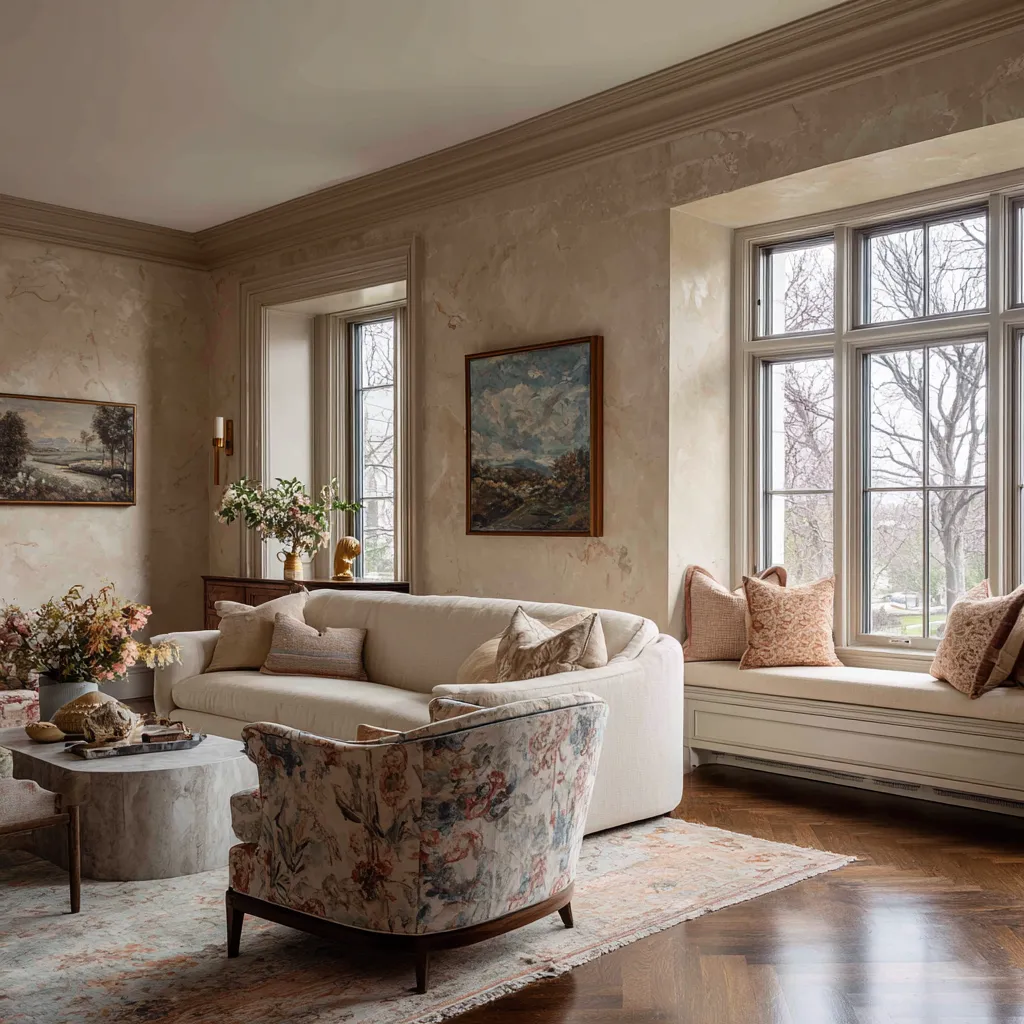
Adjoining zones add domestic depth, but they do not replace enclosure
Arches, connected sitting areas, open-plan background shelves, bar stools, nearby dining nooks, and glimpses into secondary spaces can all deepen a living room. They give it narrative life.
They suggest that the room belongs to a whole house rather than operating as a single staged scene. This kind of adjacency strengthens maximalist richness because it adds visual sequence.
One furnished room leads into another. One activity zone supports the next.
The interior feels layered in use, not only layered in styling. But adjacency does not automatically make a room cozier.
In fact, connected space can reduce pure cocooning if the main seating group is not strong enough. That is why broad seating, a good rug, a serious center, and some shell correction remain important in open-plan or multi-zone rooms.
The living room still needs its own emotional core. The successful connected rooms allow background life to expand the atmosphere without letting the main social field dissolve.
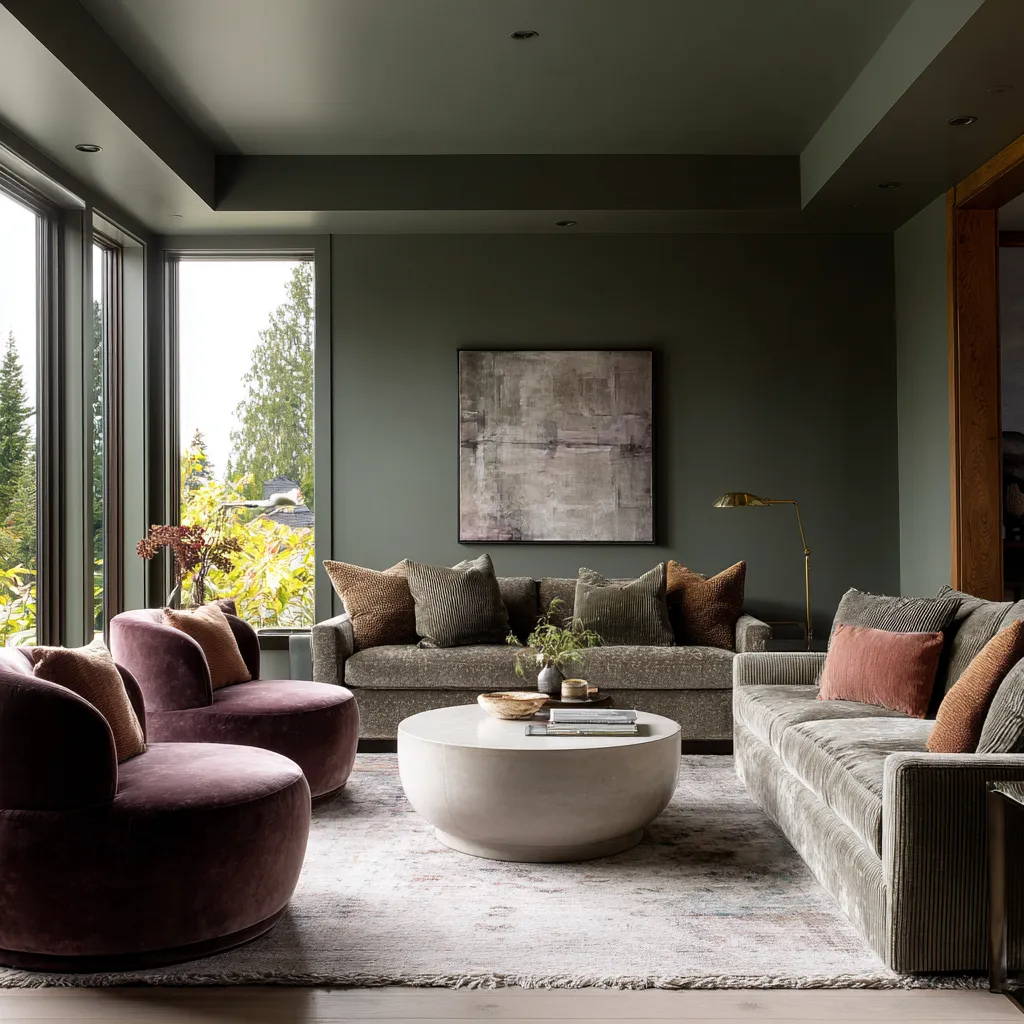
Different versions of cozy maximalism can all work
There is no single correct formula for the style. Several distinct versions can succeed.
- A dark cocoon room uses deep shell color, pale relief, tactile seating, edited object load, and one major anchor such as a hearth or large artwork. Its richness comes from tonal compression and sculptural mass.
- A bright abundant room depends on pale architecture, generous upholstered seating, curved forms, warm clustered accents, and a center with enough weight to keep the space from floating. Its richness comes from bodily softness and social density.
- A house-memory room relies on plaster, beams, brick, stone, arches, paneling, or connected rooms together with broad upholstered relief and grouped objects. Its richness comes from domestic continuity and surface history.
- A patterned domestic room uses one quiet large sofa, one or two patterned statement seats, books or flowers, and a pale rug that holds the whole field together. Its richness comes from cultural memory and concentrated decorative zones.
Each version uses a different engine, but all of them depend on the same deeper logic: comfort locally, richness globally, and relief structurally.
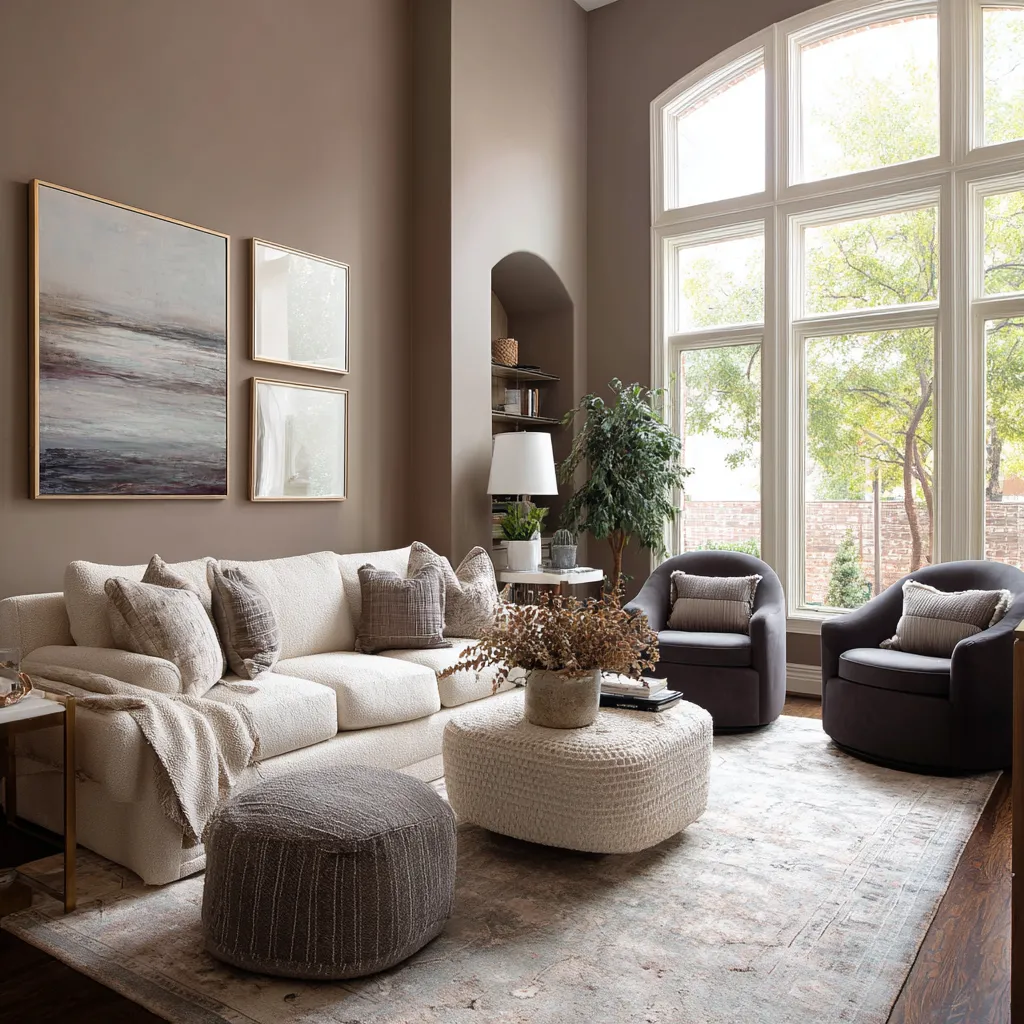
Common mistakes that weaken the style
A cozy maximalist living room tends to lose force when it makes one of several predictable mistakes.
- One is chasing fullness through too many small accessories before the sofa, rug, shell, and center are resolved. This creates surface activity without real depth.
- Another is using dark paint without enough contrast or calm support. The room then becomes heavy instead of sheltering.
- A third is relying on pattern to create comfort. Pattern can add identity, but it cannot replace tactile seating or good room structure.
- Another frequent problem is an under-scaled center table. A strong seating group with a weak center often feels unfinished no matter how nice the surrounding furniture is.
- Tall rooms often fail when all the effort goes into filling height instead of building density near the floor. Bright rooms fail when they keep too much visual thinness at the perimeter and center. Character-heavy rooms fail when they over-style surfaces that were already rich enough.
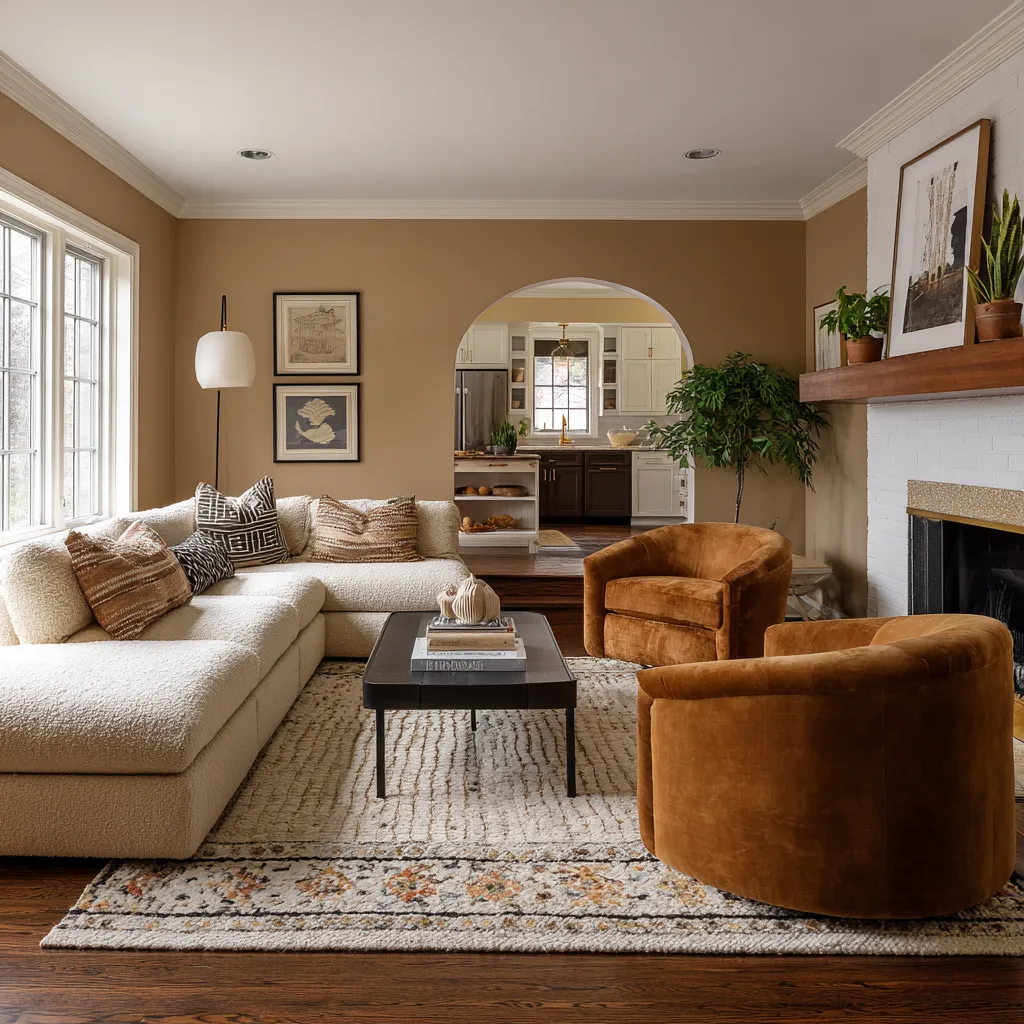
How to build the room in the right order
The most reliable approach is to build from the body outward.
- Start with the main seating. Get the depth, upholstery texture, and general scale right before thinking about smaller pieces. Then establish the rug, making sure it truly gathers the arrangement rather than floating beneath only part of it.
- Next, solve the center. Decide whether the room needs a wood table, upholstered ottoman, stone cylinder, bench, or another form of central weight. Make sure it can support both practical use and visual completion.
- After that, address the shell. This may mean deepening wall color, adding drapery, emphasizing a fireplace, exposing beams, leaning into plaster or paneling, or correcting a simple room through art and material contrast.
- Only once those larger systems are working should books, flowers, tabletop objects, smaller art, and secondary accessories take their place. By then they will feel purposeful rather than compensatory.
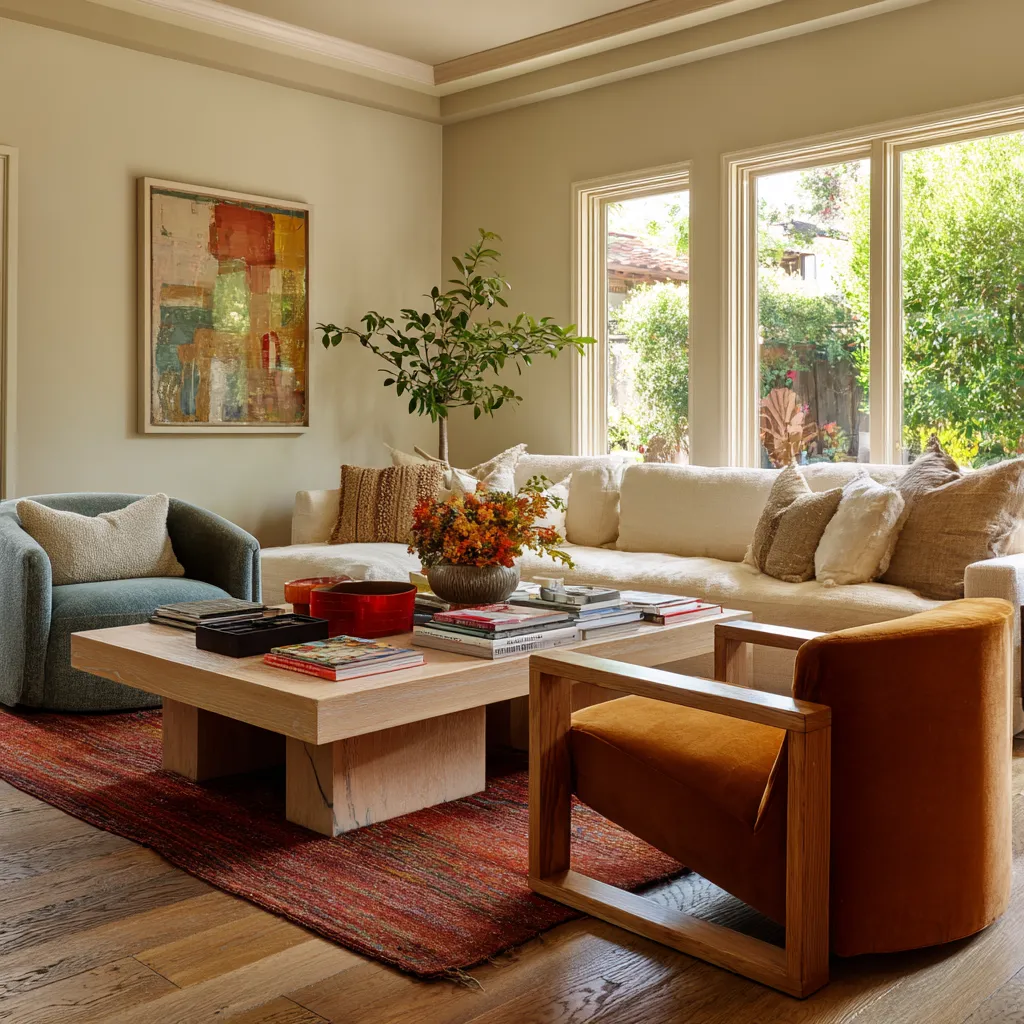
A cozy maximalist living room should feel both fed and settled
That may be the simplest way to define the goal. The eye should feel fed by richness, contrast, texture, color concentration, memory, and atmosphere.
The body should feel settled through depth, support, softness, warmth, and an easy social layout. If one side overwhelms the other, the room loses its force.
Too much richness without bodily ease becomes tiring. Too much softness without room-wide depth becomes bland.
The style works because it lets those two states meet.
That meeting point is where the room becomes deeply usable and visually satisfying at the same time. It feels generous without chaos, layered without confusion, expressive without strain, and comfortable enough to keep people there well after first impressions have passed.
A cozy maximalist living room does not merely present personality. It offers shelter with character.
It makes the room feel lived in, but still composed. It gives warmth shape, and it gives fullness order.