Modern farmhouse shabby chic living room ideas work well when they hold three qualities in balance. They need the grounded character of farmhouse interiors, the tenderness of shabby chic, and the cleaner composition of present-day design.
If one side takes over, the design shifts too far. Too much rustic weight can make the space feel old-world and heavy.
Too much sweetness can push it toward cottage styling. Too much simplification can strip away the warmth that gives this look its appeal.
Modern farmhouse shabby chic designs should sit in the middle. They feel settled, welcoming, and gently romantic, but they also feel practical and visually calm.
They usually have some sign of age in the shell, softness in the seating, a restrained decorative layer, and a palette built from softened neutrals with a few warm undertones. They do not depend on clutter, and they do not need a large number of vintage objects to feel expressive.
Instead, they build character through material memory, cloth, muted color, and a few carefully placed gestures that humanize the room.
What defines the style now
A current modern farmhouse shabby chic living room ideas are usually less decorative than older versions of the look. It tends to trade overt ornament for quieter signals.
Floral print may appear on one chair instead of on every textile. A romantic note may come through a cluster of blush flowers, a curved firebox, or a skirted sofa rather than through layers of ruffles and painted antiques.
Farmhouse character often comes through beams, a brick or stone hearth, a reclaimed mantel, a weathered coffee table, or woven storage rather than through an overload of rustic props.
That shift matters. It gives a country-chic living room design a breathing space.
It also makes the style easier to live with, because the room feels warm without feeling staged. The overall effect is soft and familiar, but also disciplined enough for a present-day home.
Start with visible structure
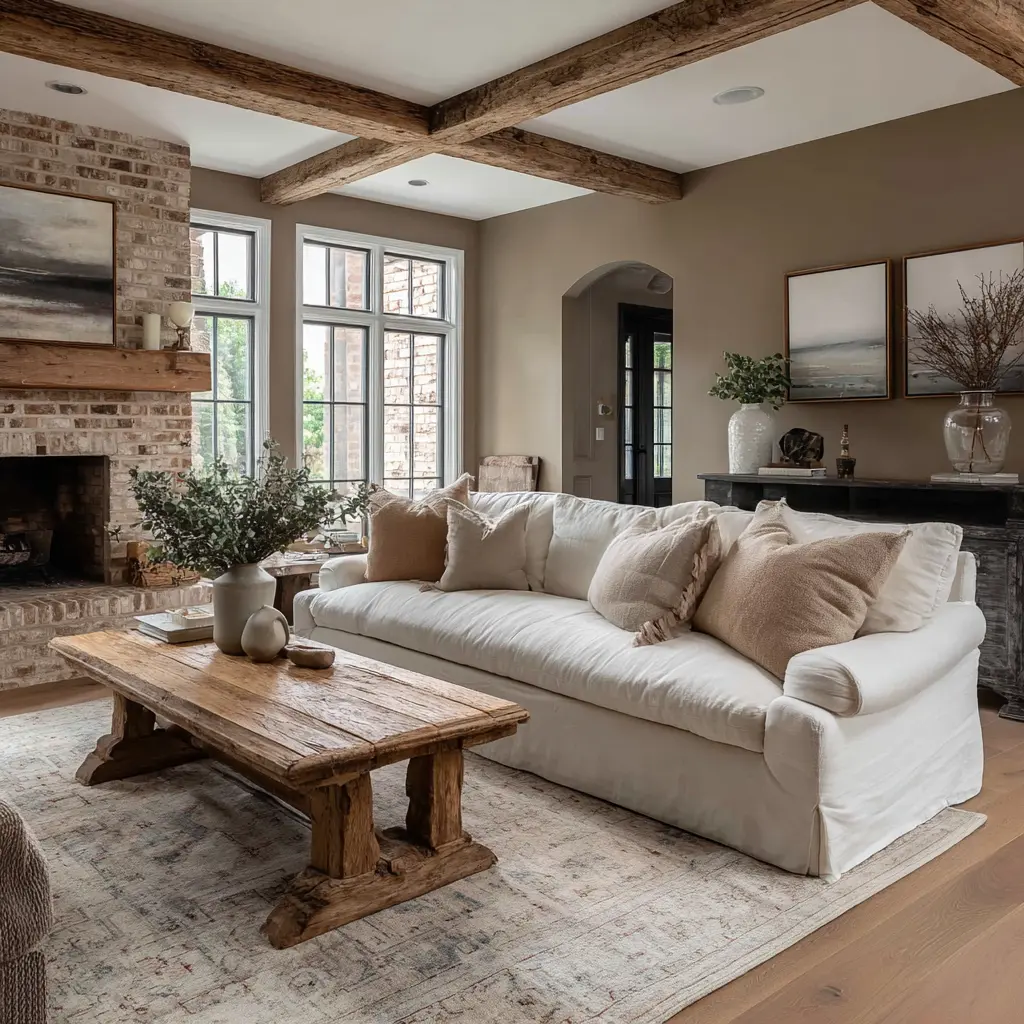
For this style to feel rooted, the design usually needs one strong structural marker. That may be exposed beams, a substantial chimney breast, a pale stone fireplace, a whitewashed brick hearth, or a thick timber mantel.
These features give the interior design memory. They suggest that the space has inherited material depth, even if the furnishings are fresh and simplified.
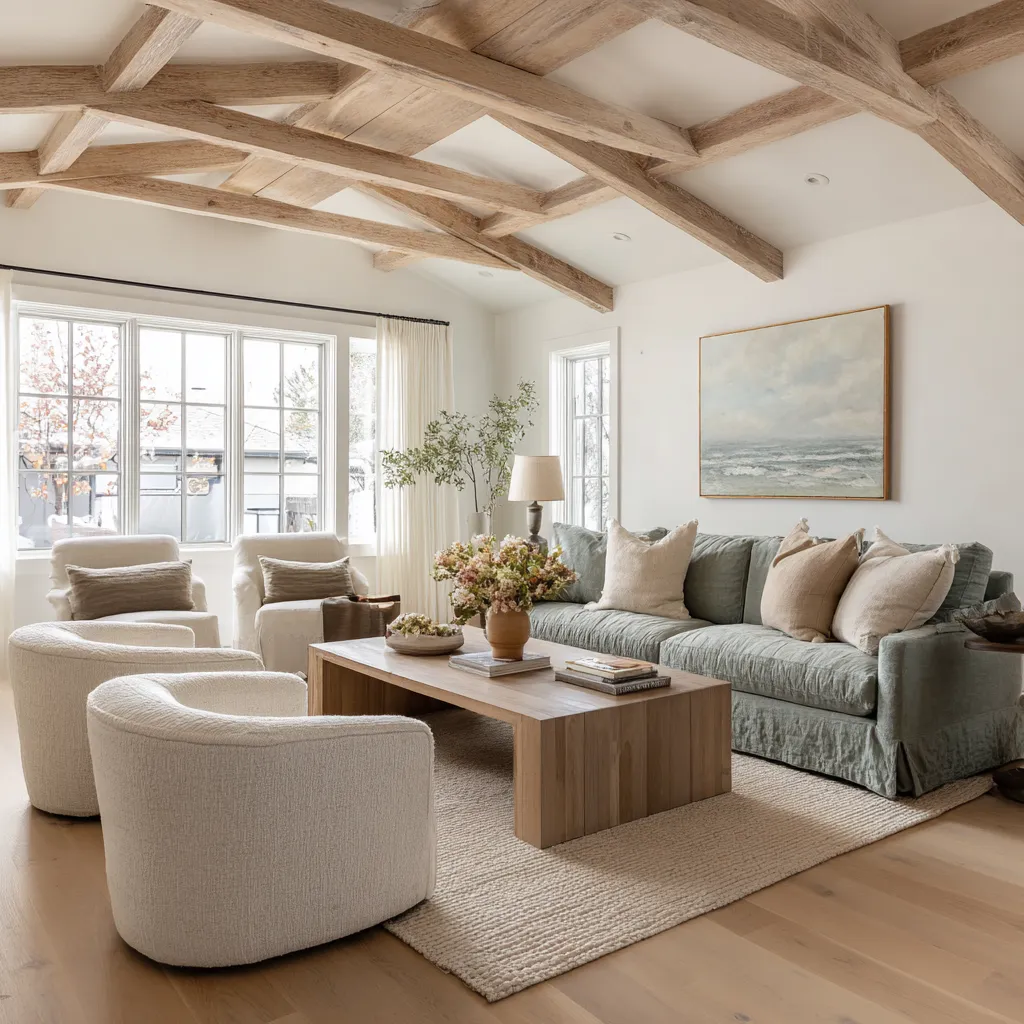
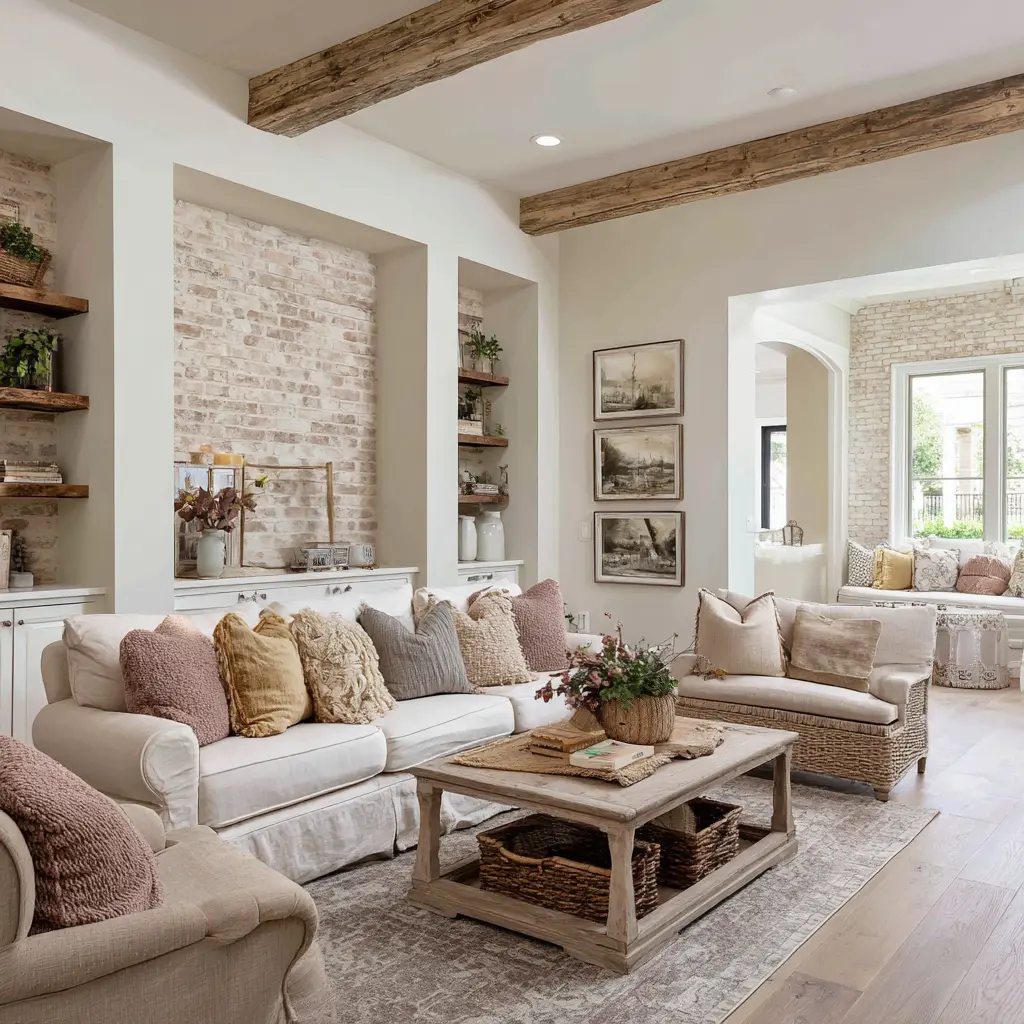
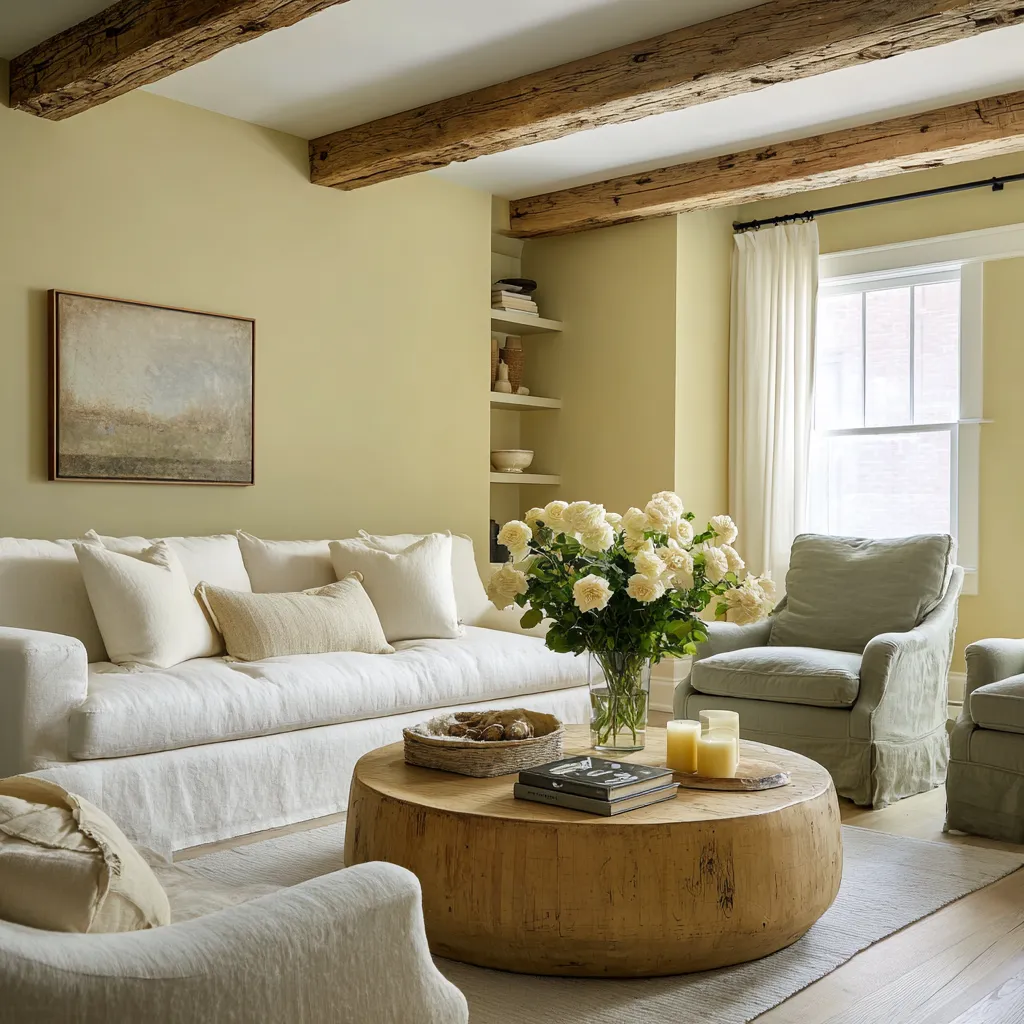
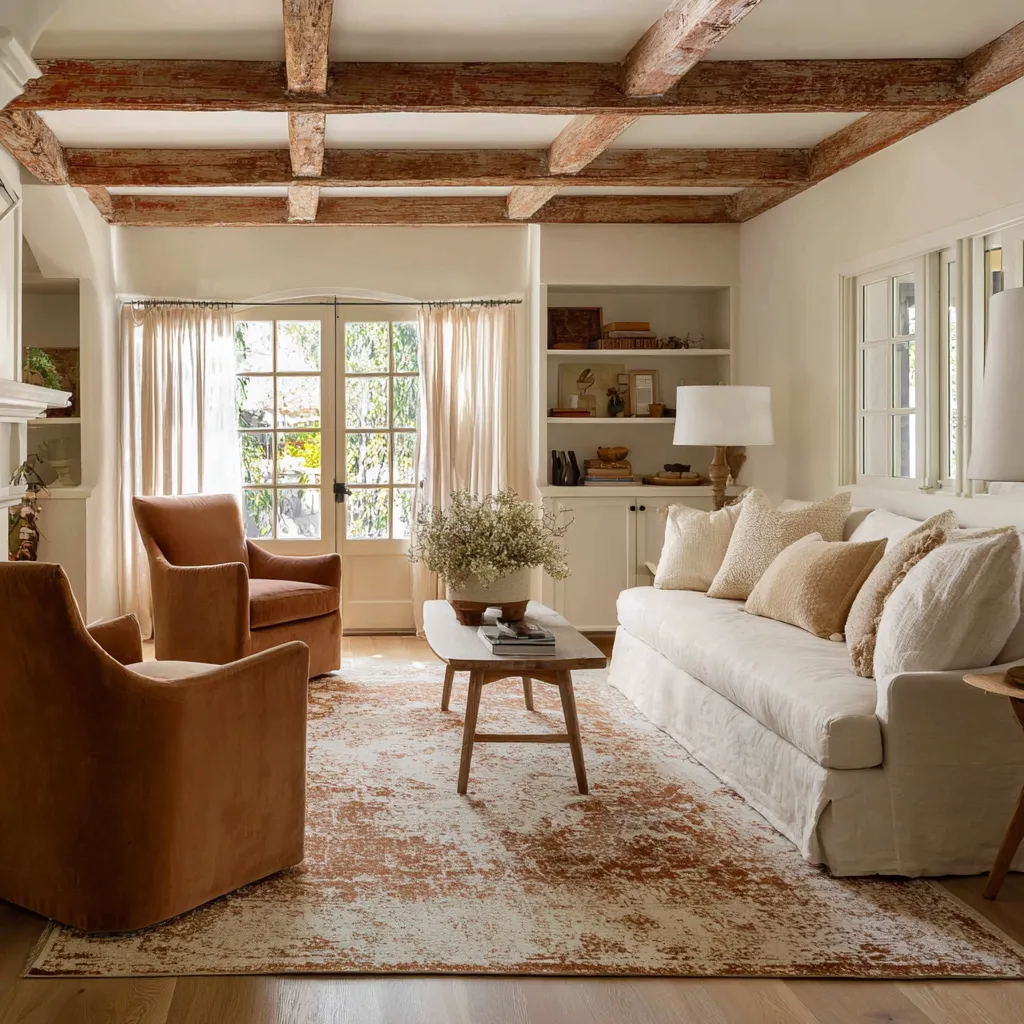
Beams are especially useful because they introduce age from above. Dark reclaimed beams create a heavier farmhouse mood and pair well with stone, warm taupe walls, and deeper contrast.
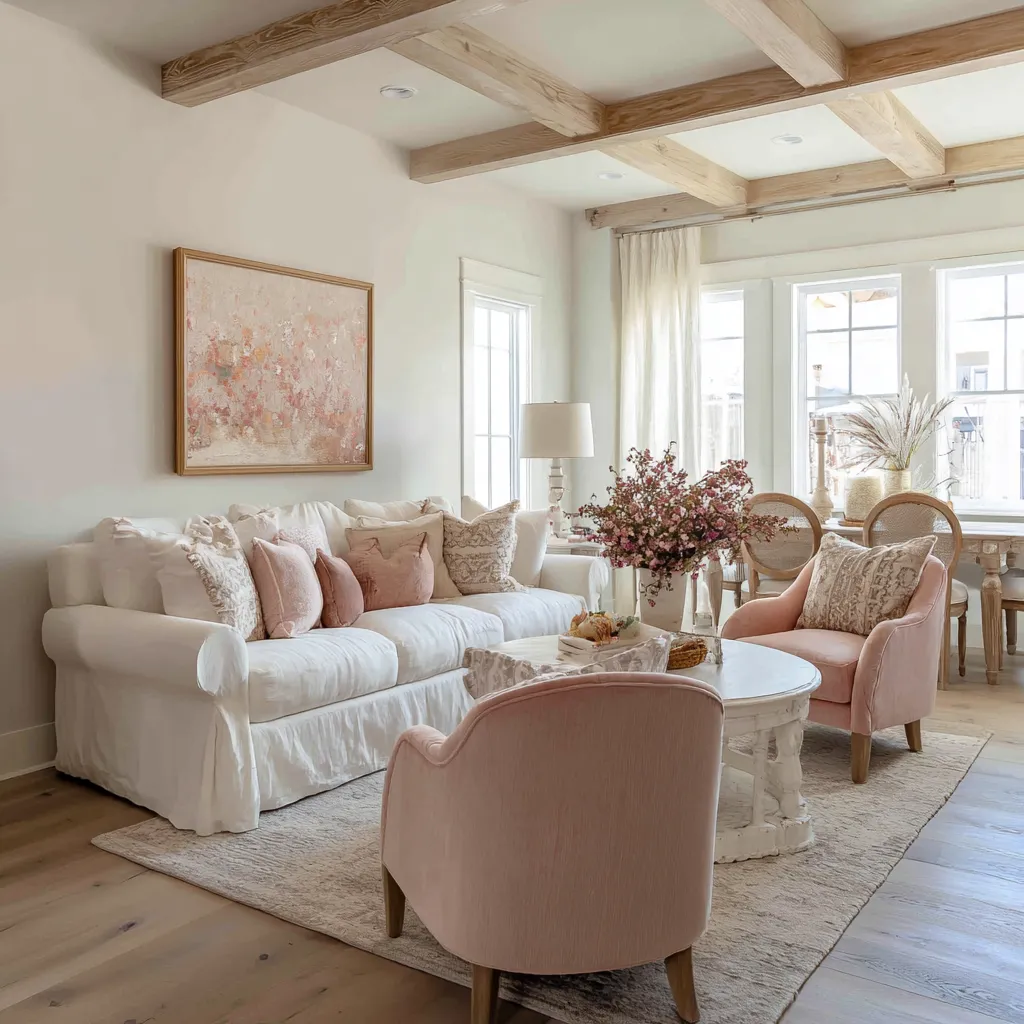
Lighter or whitewashed beams keep the space more airy and work well with blush, cream, and faded wood. The choice between dark and pale beams changes the emotional temperature of the whole room.
Darker timber brings gravity. Lighter timber keeps the shell soft.
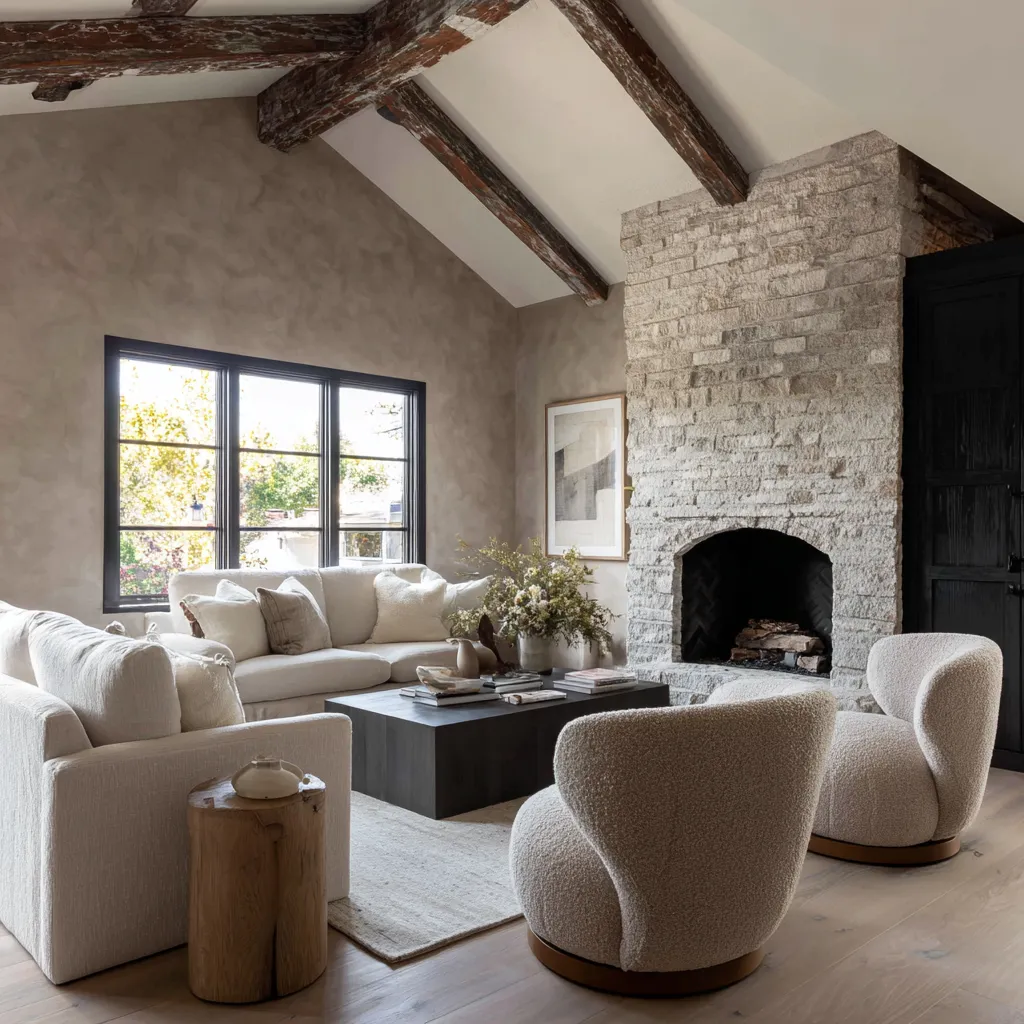
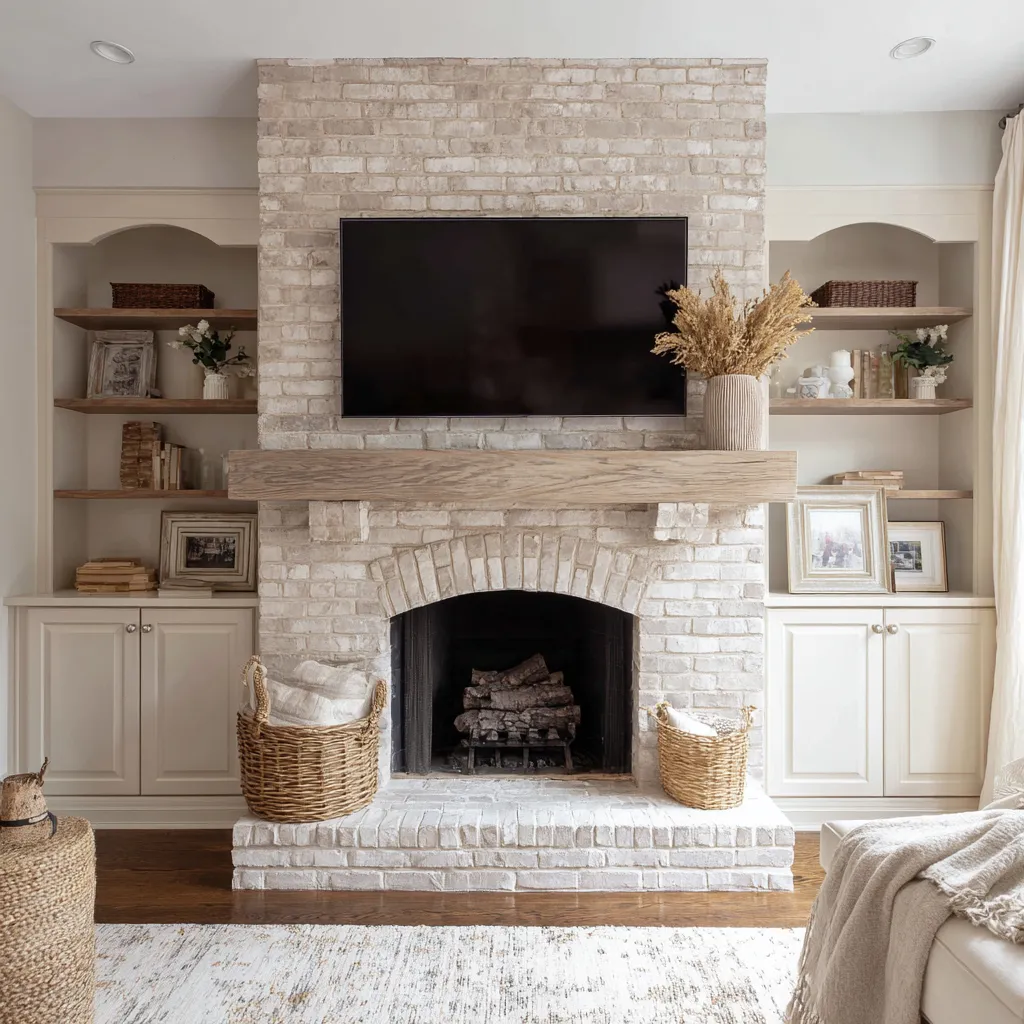
A fireplace also plays a major role in this style. A hearth gives the design a natural center and allows the farmhouse side to show up through masonry, timber, and built form rather than through decorative accessories.
Pale stone, washed brick, limewashed plaster, and old-looking wood mantels all work well here because they carry history without making the room feel gloomy.
Softness is what makes farmhouse livable
One of the lessons from modern farmhouse shabby chic design ideas is that softness is the bridge that keeps rustic structure from turning hard. Heavy beams, stone, brick, and reclaimed wood need cloth around them.
Without that cloth layer, the room starts to feel dry, strict, or overly architectural.
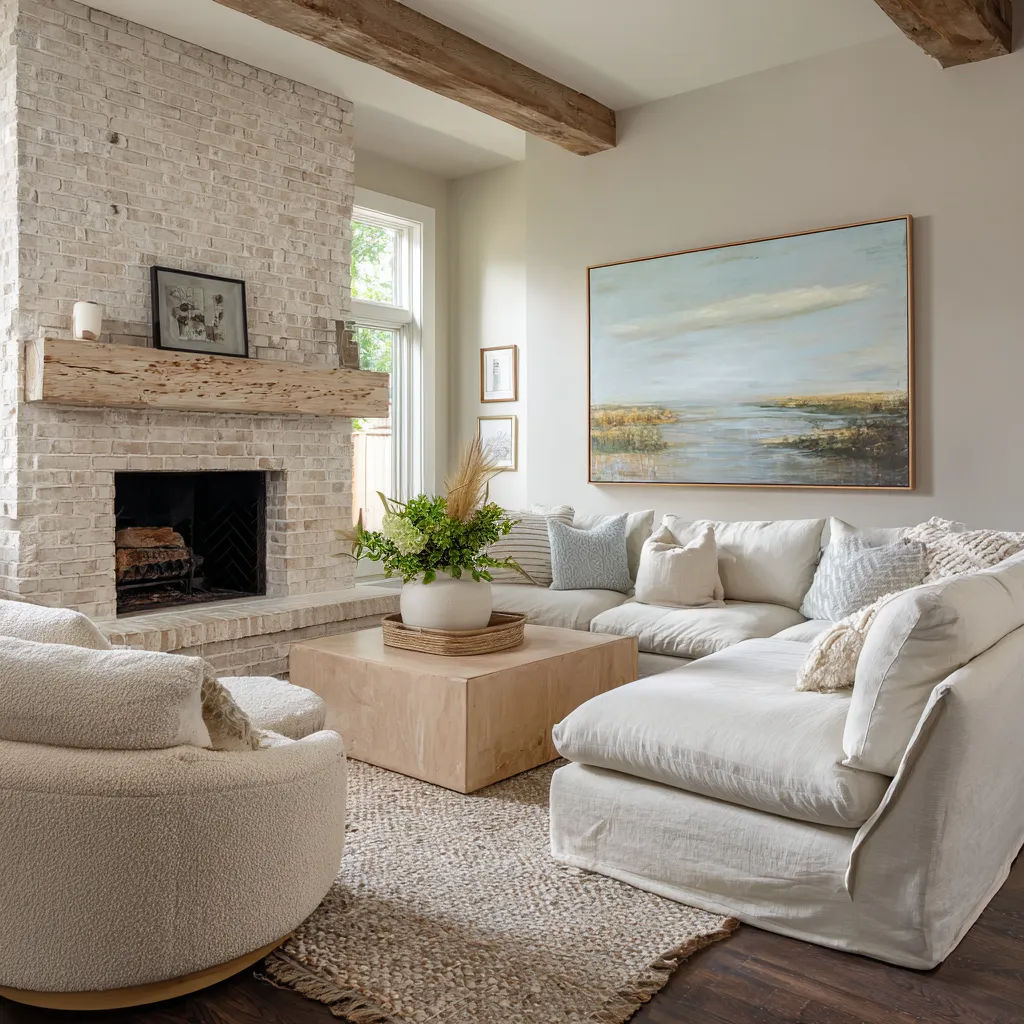
That softness can appear through a large slipcovered sofa, skirted armchairs, a bouclé accent chair, an upholstered ottoman, or a washed low-contrast rug. It also can come through drapery, layered pillows, rounded furniture edges, and fabrics that absorb light rather than reflect it.
Linen-look upholstery, nubby weaves, faded velvets, brushed cotton, and tactile neutrals all help.
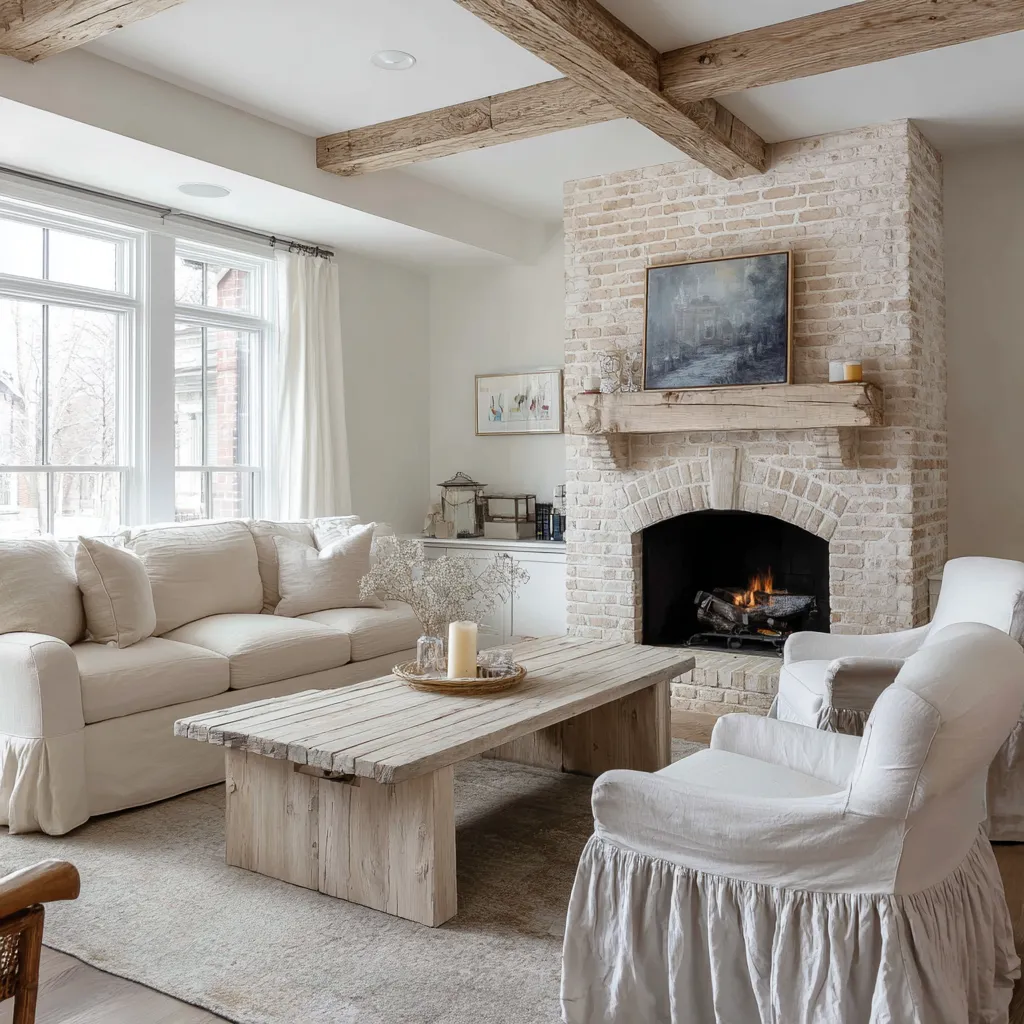
A good approach is to create one major field of softness in the seating zone. That may be a long slipcovered sectional in cream or oatmeal, or a pair of facing sofas with relaxed cushions and low visual contrast.
Once that base is established, the farmhouse shell starts to feel warmer and easier.
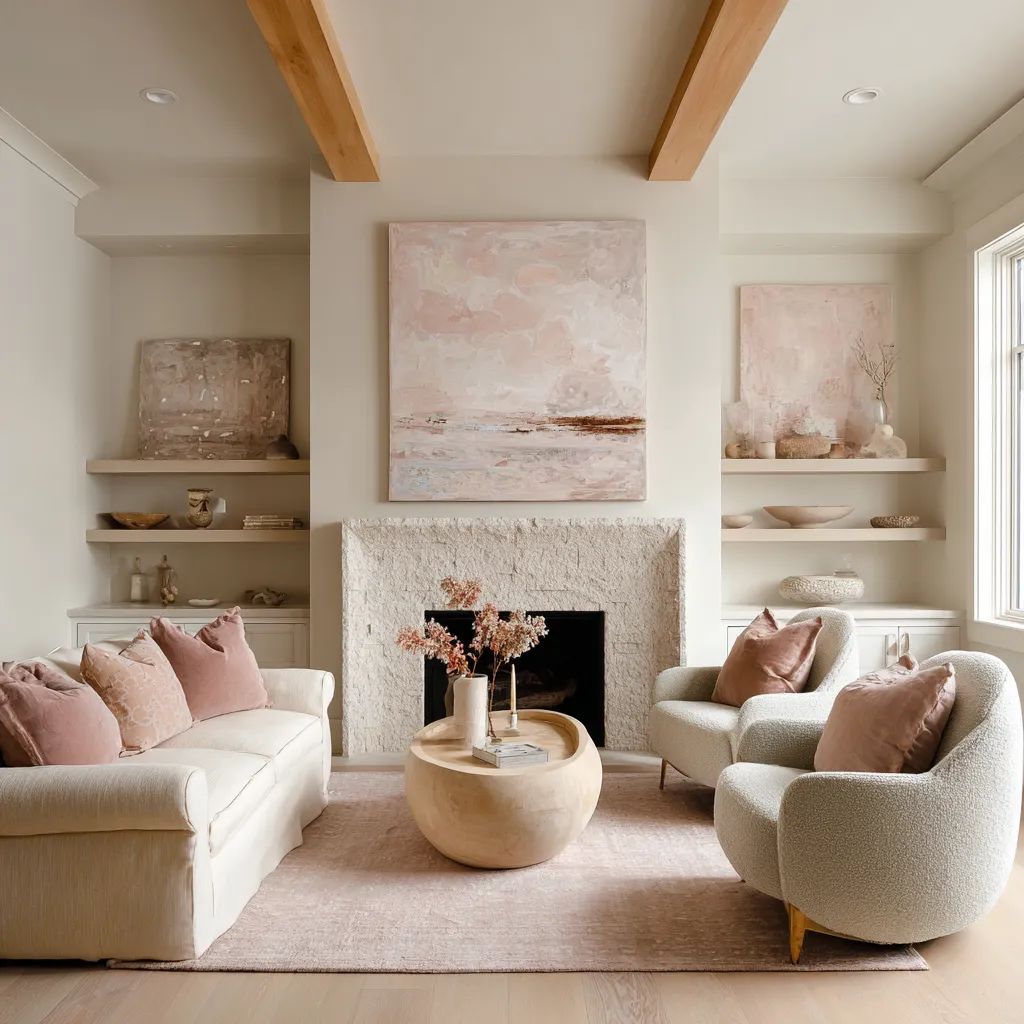
Age and softness are not the same thing
This style becomes much clearer once you separate age from softness. Weathered wood, old brick, visible grain, worn paint, and reclaimed surfaces give the room farmhouse depth.
They do not automatically create shabby chic. The softer side appears only when those aged elements are joined by fabric, warmth, curve, flowers, or gentle color.
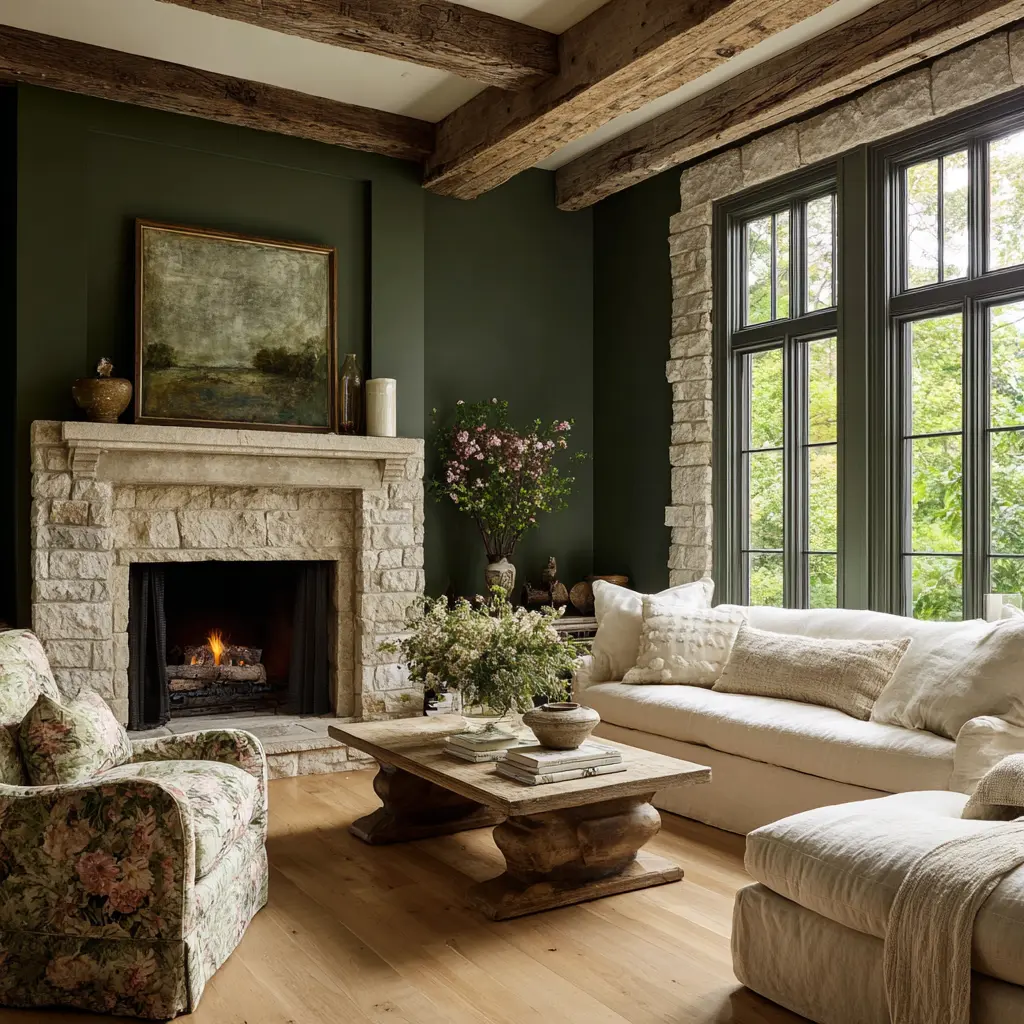
That distinction helps with decorating choices. A room with old timber, stone, and an aged trunk may still feel plainly farmhouse if the seating is too stark and the palette is too cold.
The same room can shift into modern farmhouse shabby chic with the addition of slipcovered upholstery, a faded rug, blush or clay pillows, a floral arrangement, and one or two curved details.
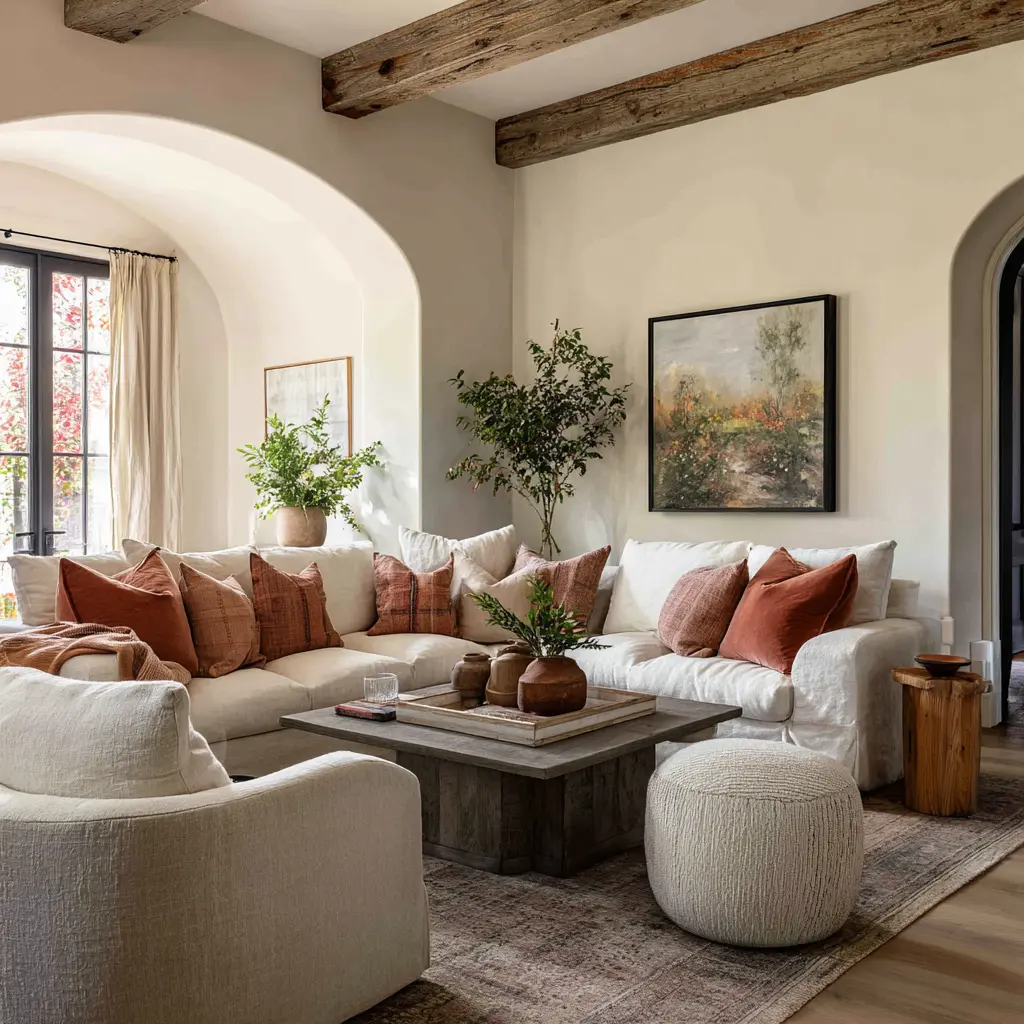
Keep the palette close in value, but not lifeless
Many beautiful versions of this look depend on close tonal layering. Cream, chalky white, warm beige, oat, pale wood, soft greige, dusty clay, muted blush, and washed green can sit together very comfortably.
The palette often feels calm because most of the colors are near each other in depth. Contrast is used selectively rather than aggressively.
That does not mean the interior design should be all one note. The nice designs still should include tonal shifts.
A whitewashed fireplace can sit against cream walls. Pale oak can warm up a plaster-like surround.
A weathered dark table can anchor a pale sofa. A black firebox, iron window frame, or dark chandelier can sharpen an otherwise soft room.
These darker notes matter because they keep the palette from floating away.
Warmth is especially useful here. Blush, cinnamon, dusty rose, clay, terracotta, peach-beige, and warm oat give the interior design emotional warmth without pushing it into overly sweet territory.
They work especially well in pillows, rugs, art, florals, and smaller upholstered pieces. A little warmth often does more for this style than a lot of white.
Use florals in a focused way
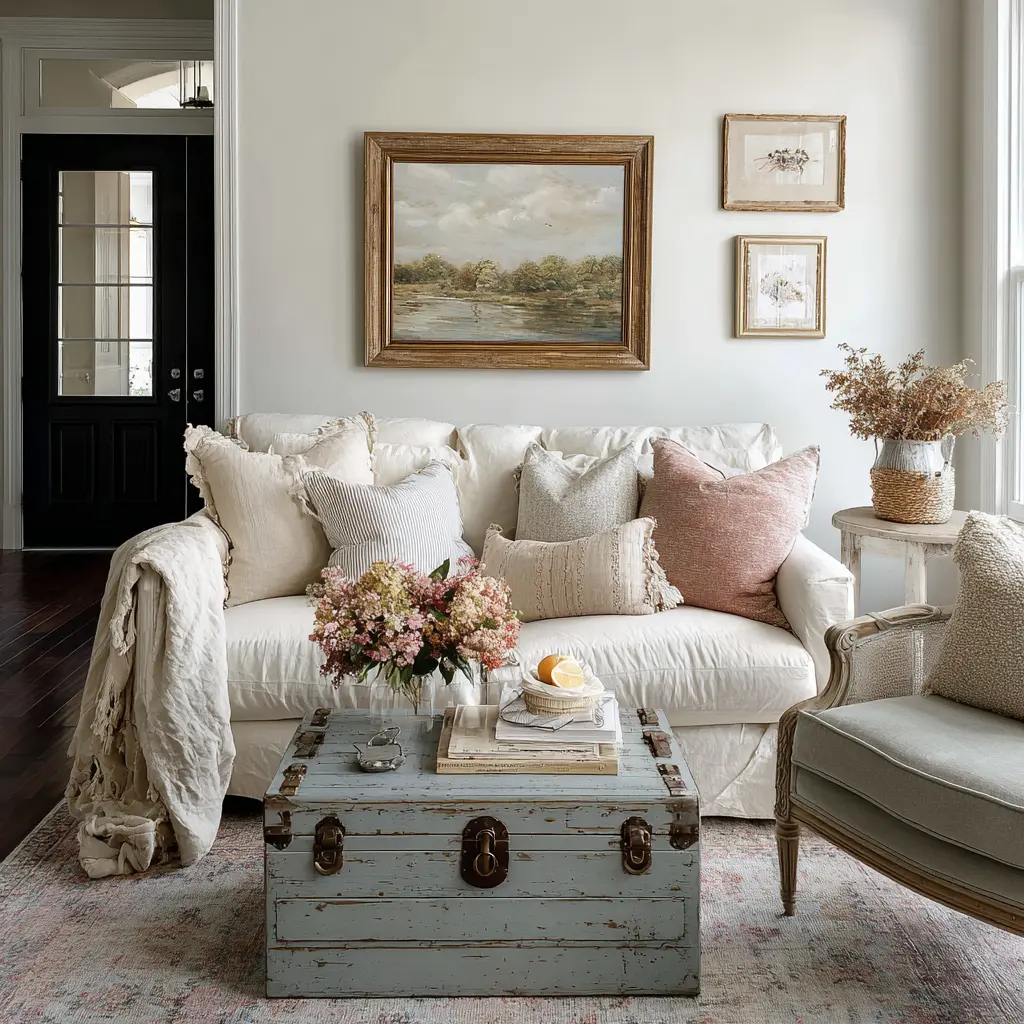
Modern country shabby chic living room ideas tend to handle florals with restraint. Instead of spreading floral pattern everywhere, they often place it in one concentrated location.
That might be a single floral chair, a floral ottoman, a painterly botanical pillow cluster, or one generous bouquet on the coffee table. This approach keeps the room romantic without making it busy.
The placement matters as much as the pattern itself. A single floral armchair can soften a room with dark beams and a stone hearth.
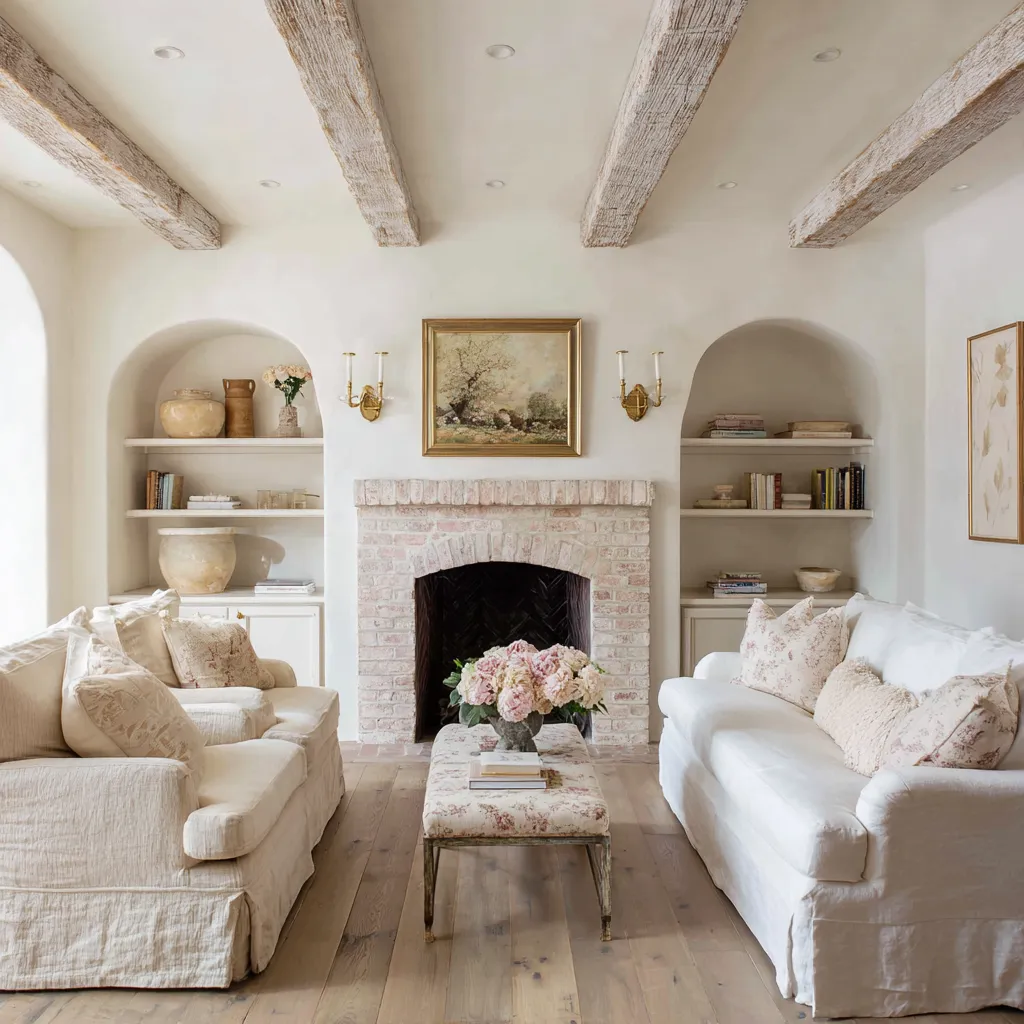
A floral ottoman in the middle of a symmetrical layout can give the room a romantic center while the sofas remain plain. A cloud-like arrangement of pale pink or white flowers can soften a heavy reclaimed table or a brick fireplace without introducing visual noise.
Warm florals tend to work well in this style. Dusty rose, faded blush, soft apricot, creamy hydrangea tones, and muted greenery feel more grounded than icy pink or bright floral mixes.
They sit naturally with aged wood, pale masonry, and woven texture.
Curves help the room feel gentler
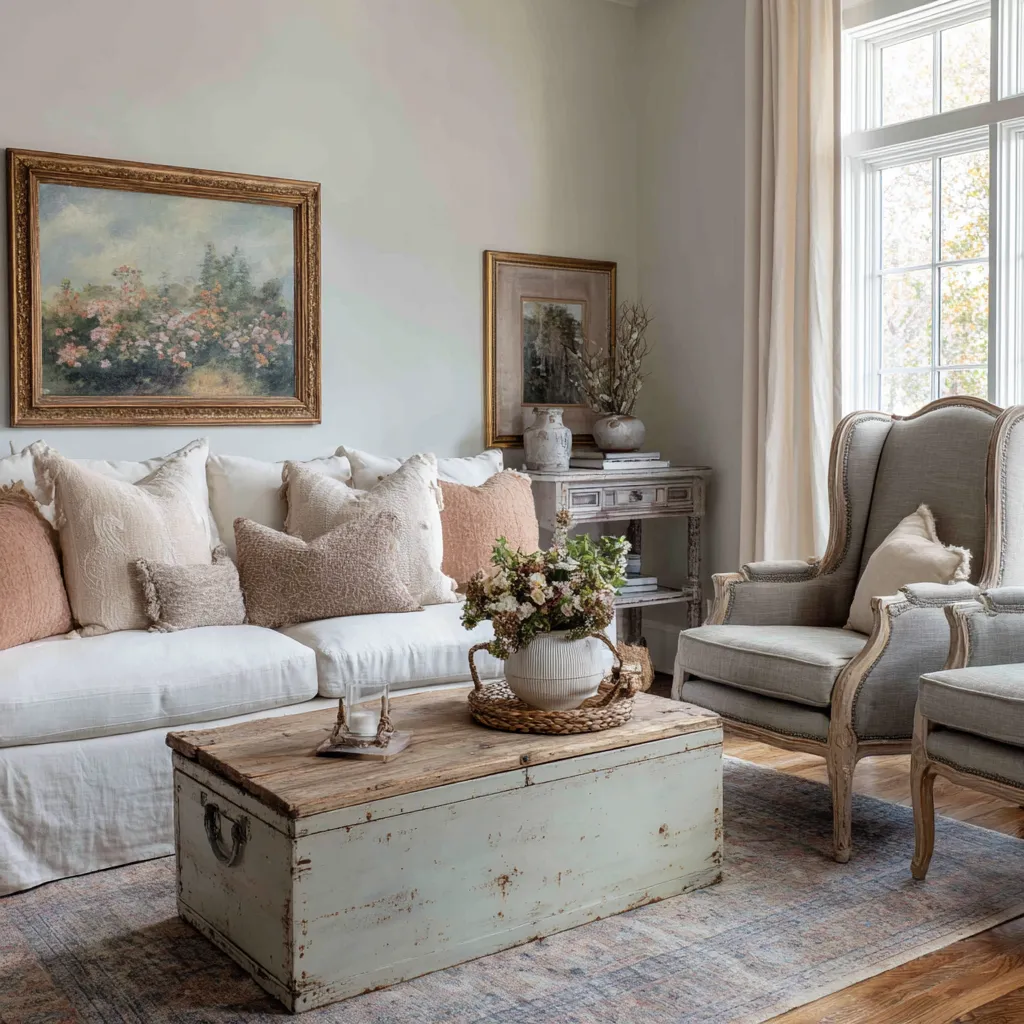
Curved forms are one of the ways to soften farmhouse structure without adding a lot of decoration. Arched fireboxes, arched niches, arched mirrors, rounded ottomans, barrel chairs, and even gentle curve in sofa arms can shift the atmosphere of a room very quickly.
An arched firebox, for example, gives a hearth a softer and older character than a simple black rectangle. Arched built-ins or recessed niches can make a fireplace wall feel more personal and less standard.
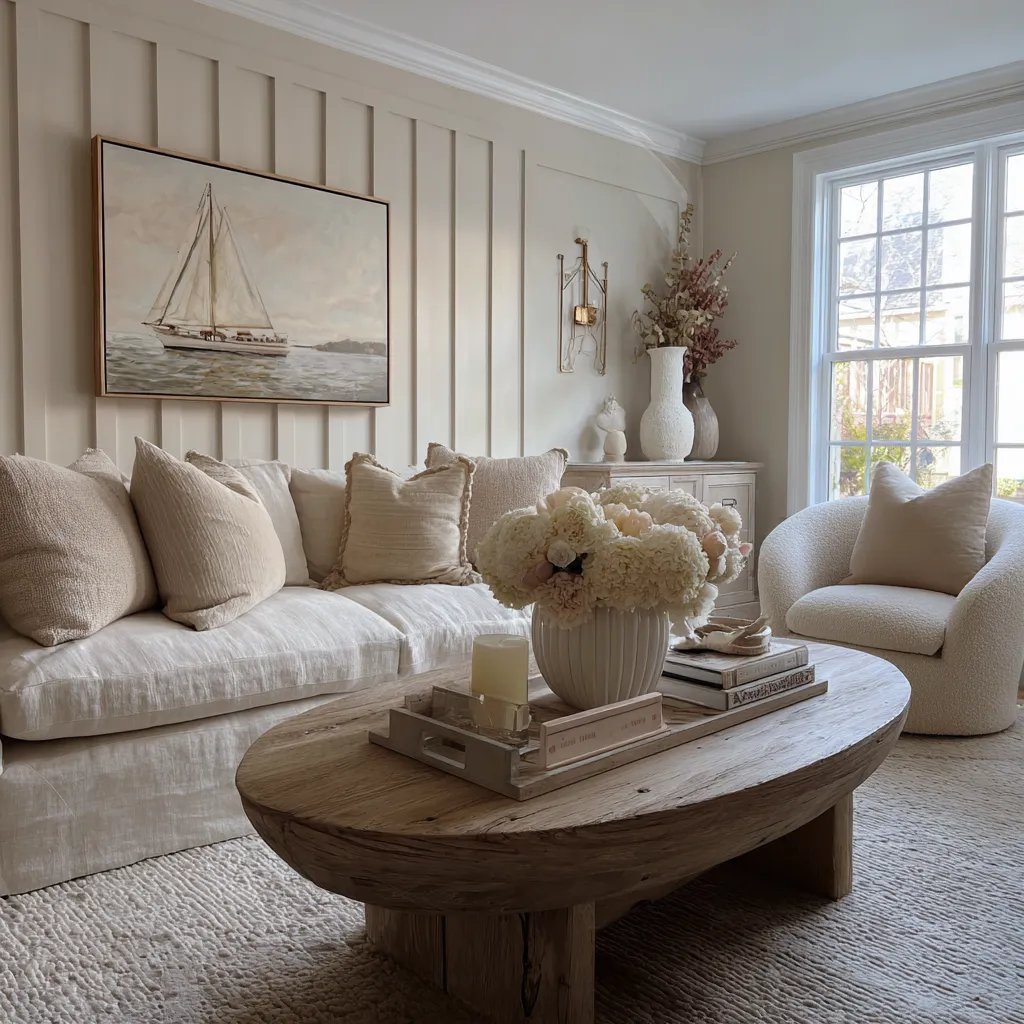
Rounded chairs balance the linear force of beams, mullions, brick courses, and plank floors. A large round or oval coffee table can also keep a seating arrangement from feeling too rigid.
This is one reason interior designs with soft curves often feel easier and more welcoming than rooms built only from straight lines. The curves do quiet emotional work.
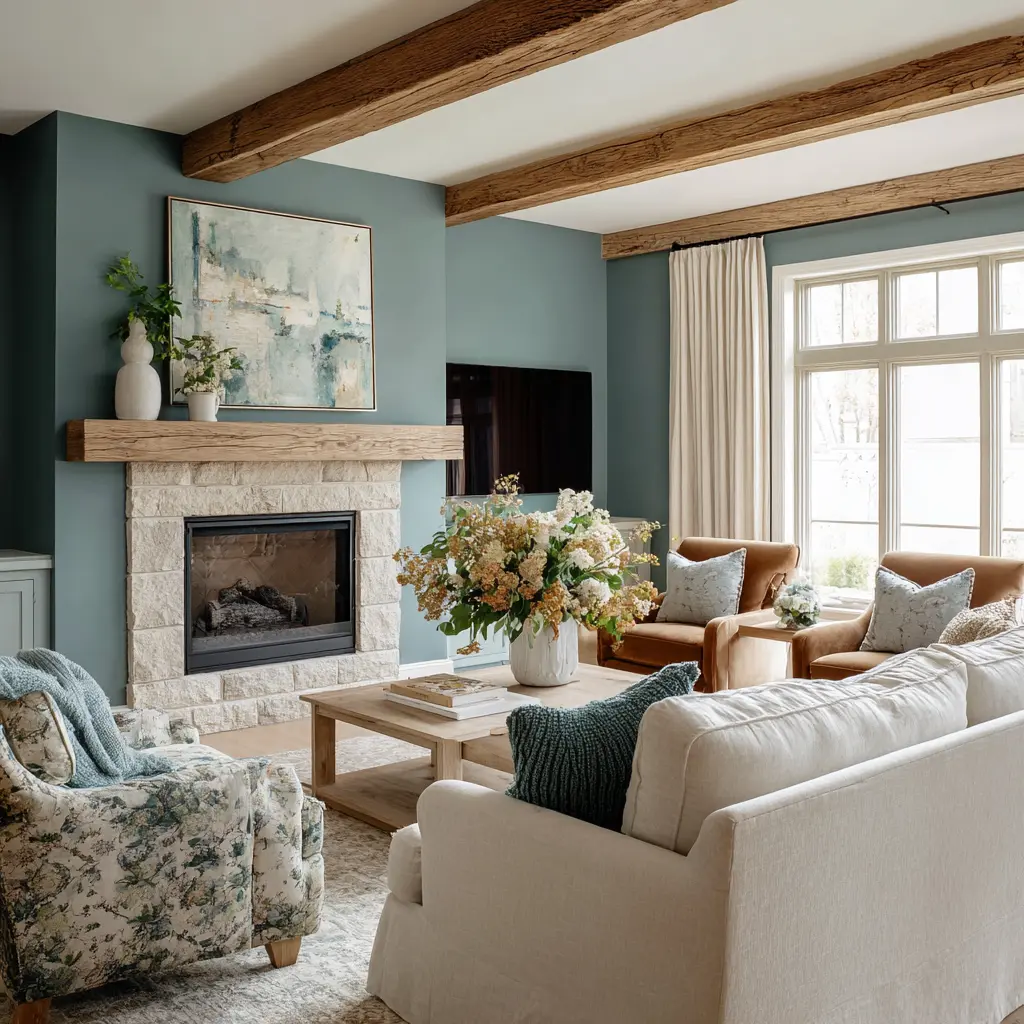
The fireplace is an effective anchor
A fireplace-centered room is one of the easiest ways to build this style well, because the hearth naturally combines permanence and comfort. The key is to let the fireplace carry enough material character that the room does not have to depend on a large amount of decor.
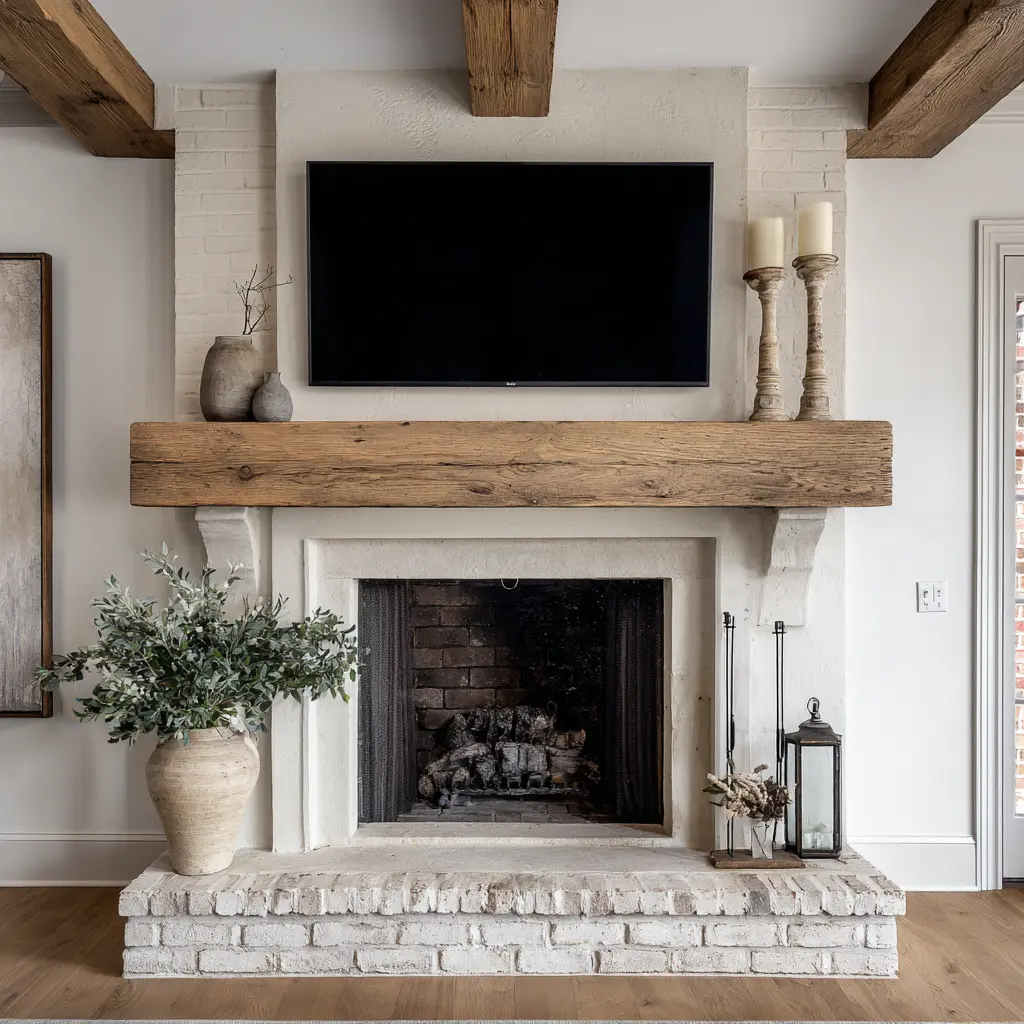
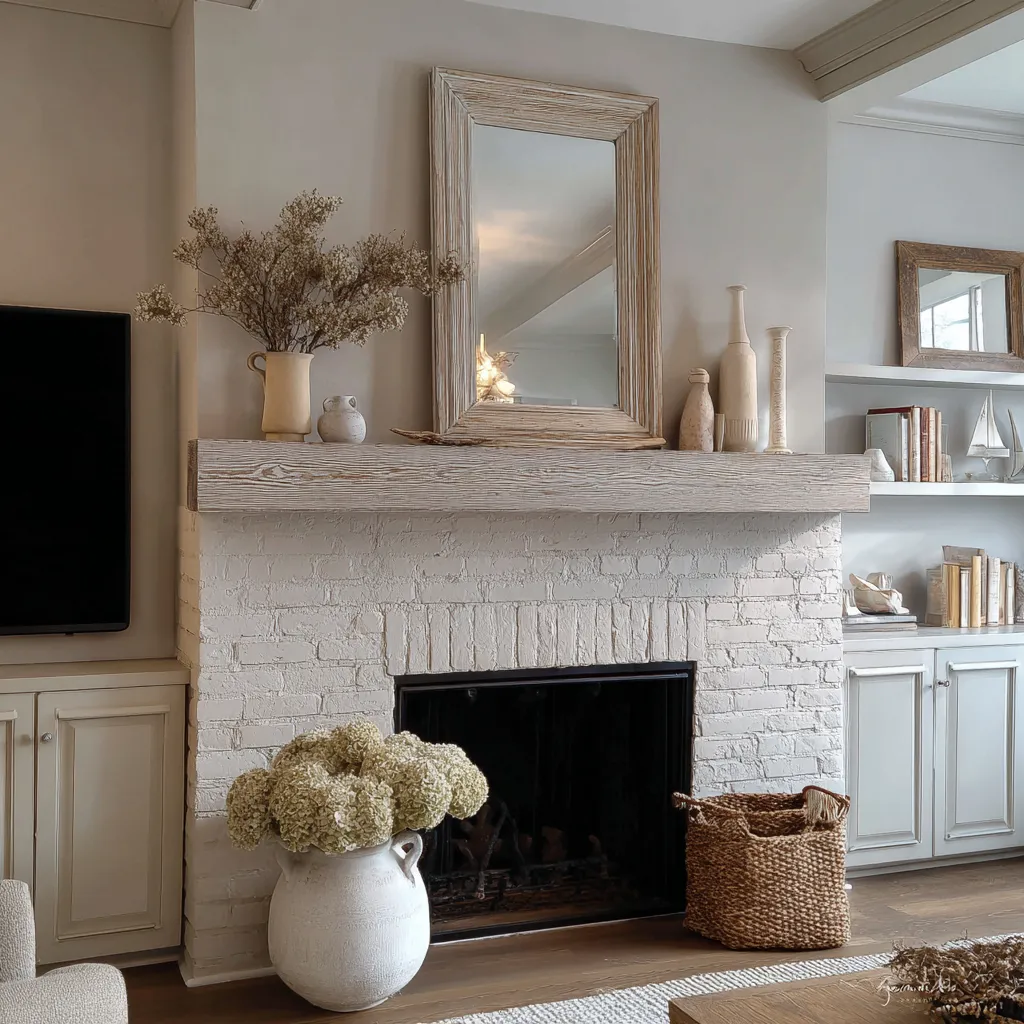
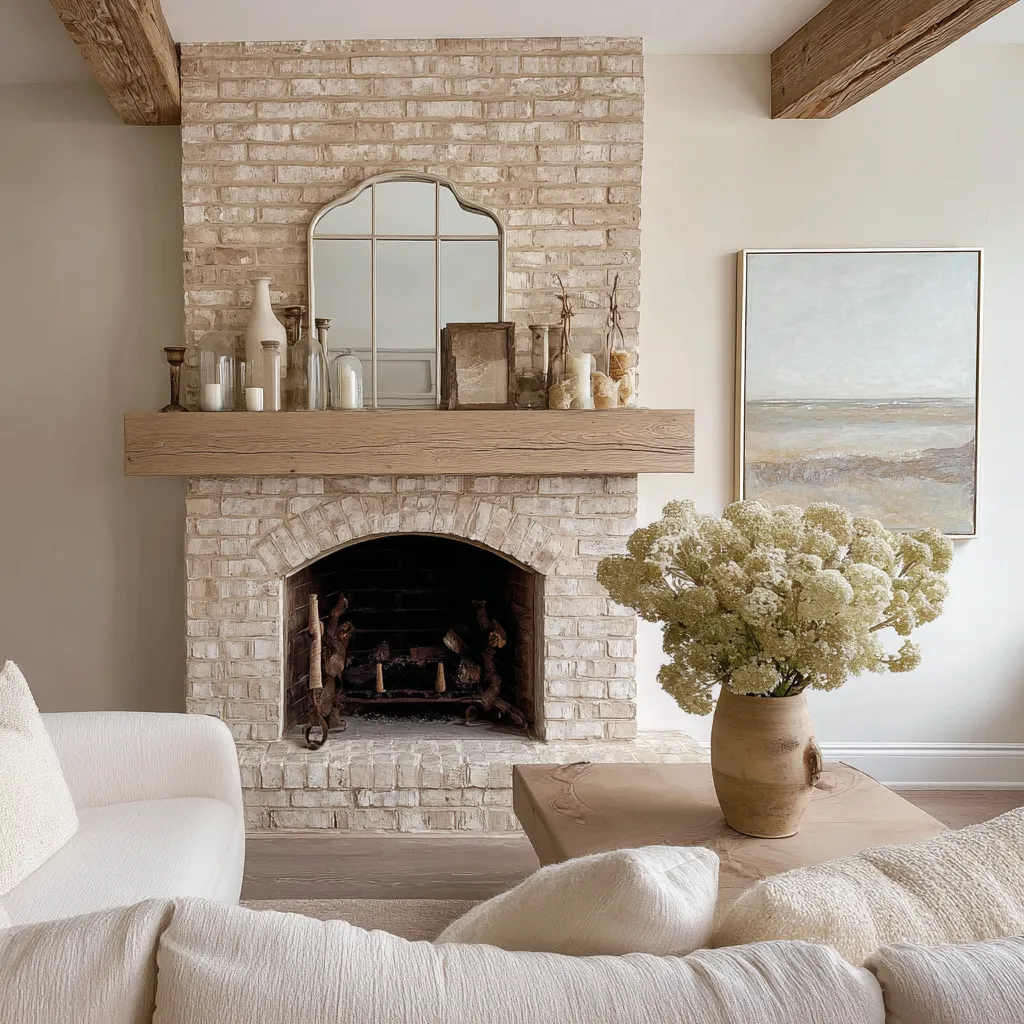
Pale brick with a dark recessed firebox is a particularly good combination. It keeps the wall bright while still giving it depth.
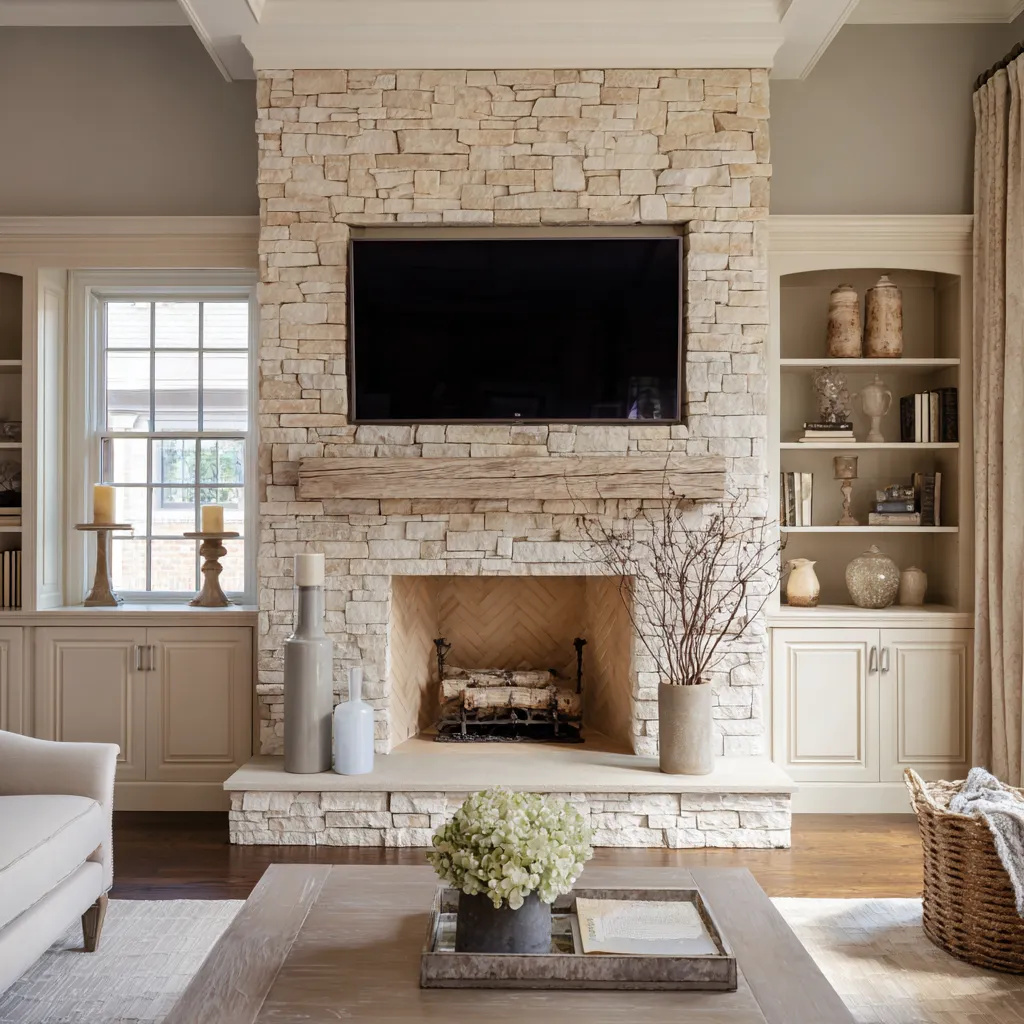
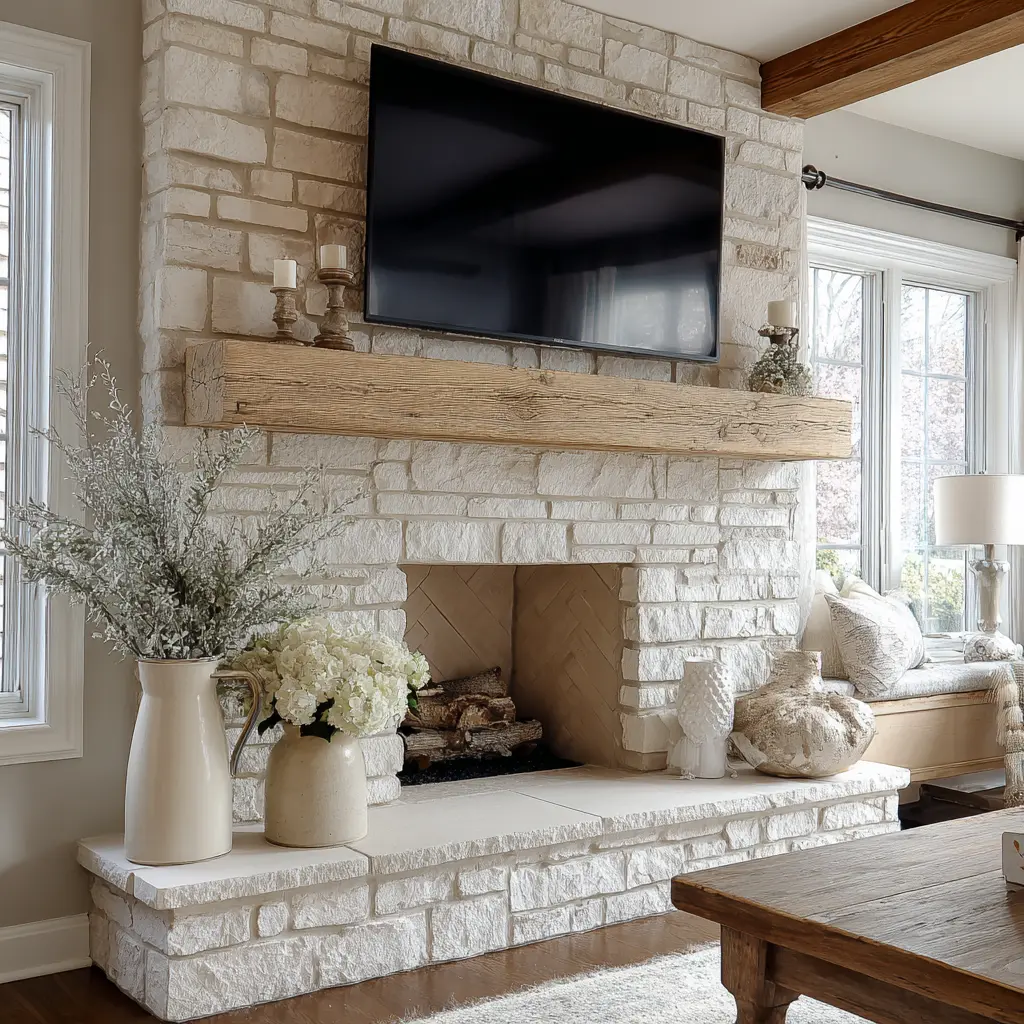
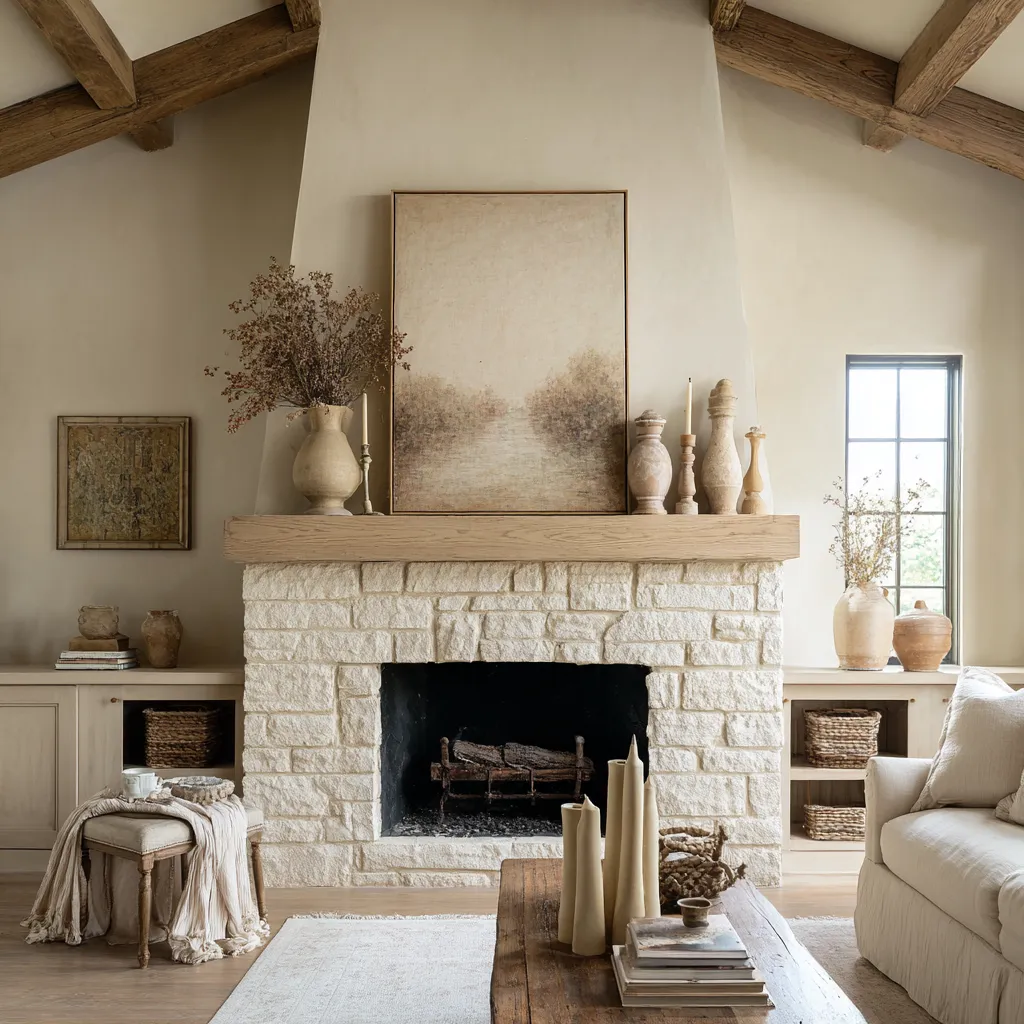
Whitewashed stone, creamy limestone, limewashed brick, and rough plaster also work well. A thick timber mantel adds warmth between the hard fireplace materials and the softer room around it.
Once the fireplace has enough presence, the styling can stay restrained. A leaning painting, a muted mirror, a few pottery vessels, a branch arrangement, or a pair of candleholders is often enough.
The point is not to fill the mantel. The point is to keep the room feeling inhabited and balanced.
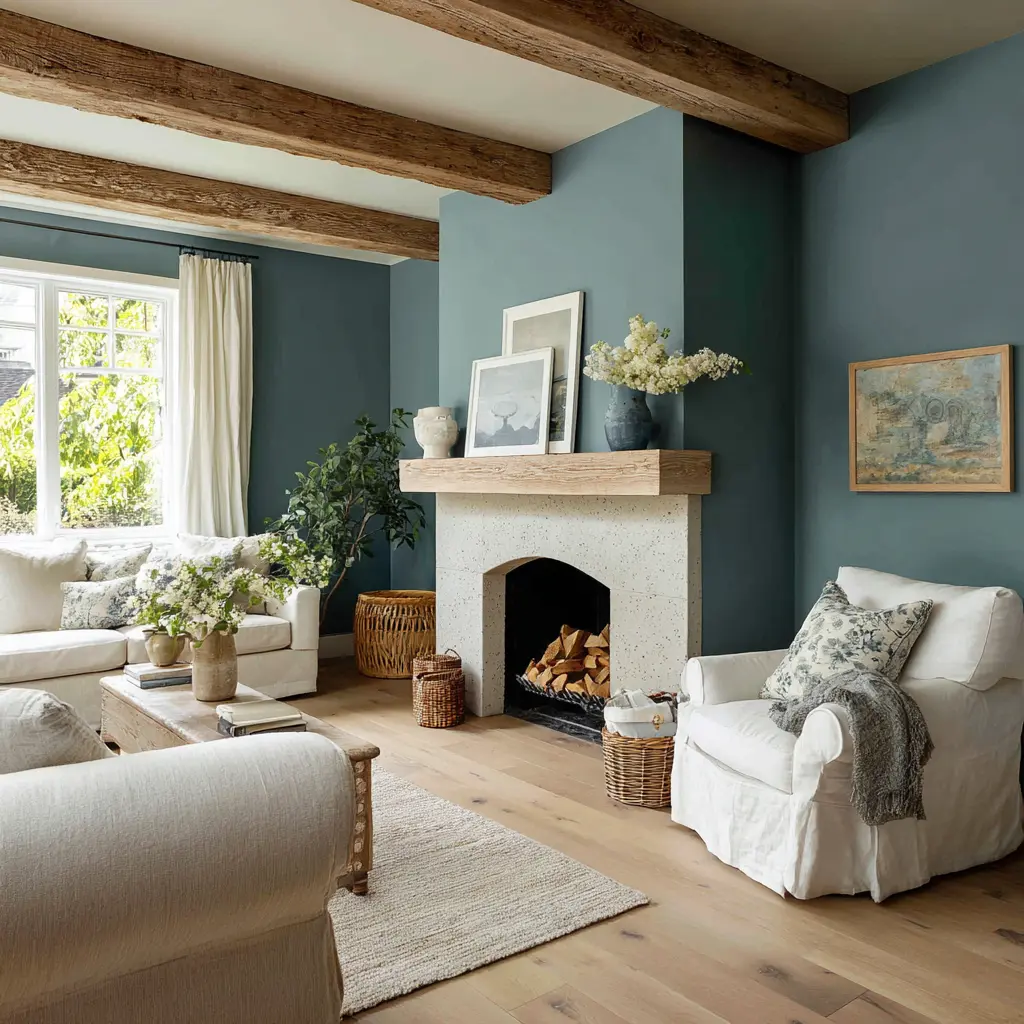
Built-ins make the style feel settled
Built-in shelving and cabinetry are very useful in modern farmhouse shabby chic living rooms because they join practicality and atmosphere. They give the room a sense of permanence, help distribute objects more calmly, and make the wall feel complete.
They also allow the decorative layer to stay edited, because storage and display have dedicated places.
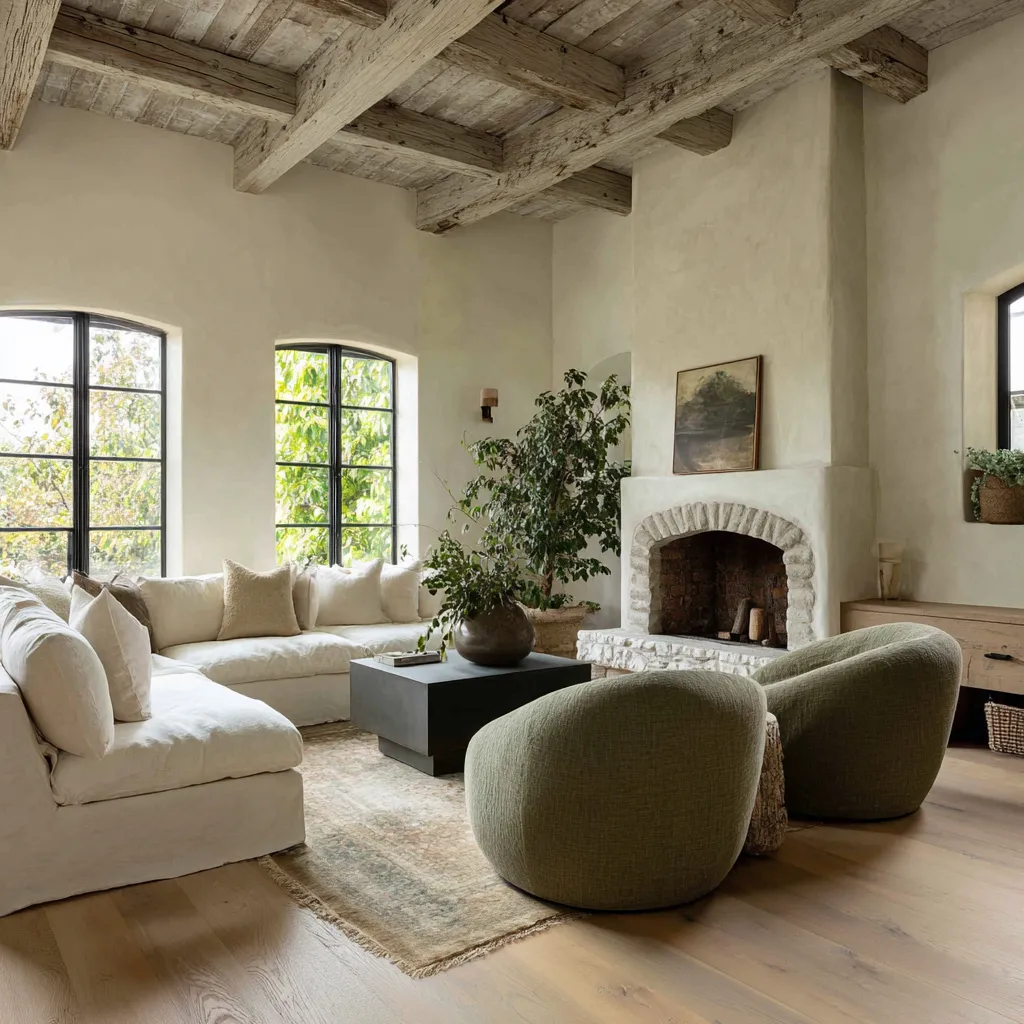
Effective built-ins in this style are usually pale, quiet, and not overworked. Soft greige, off-white, chalky taupe, pale oak, or washed wood tones all work well.
Paneled cabinet fronts, fluted details, open shelves, and baskets can add character without heaviness. Styling should stay breathable.
Books, framed sketches, matte pottery, a few baskets, dried stems, and the occasional piece of art usually do enough. Negative space is important.
If every shelf is filled, the room starts to lose the calm that keeps this style current.
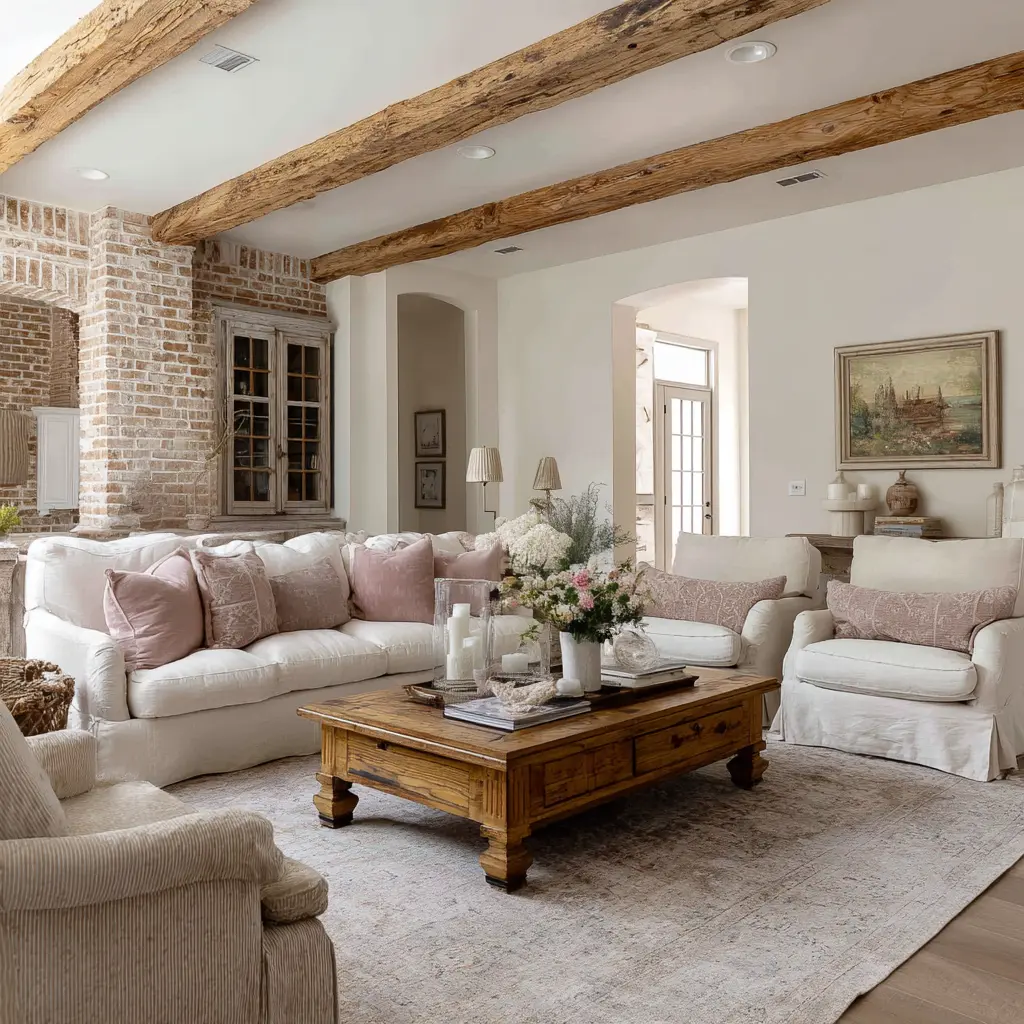
How to handle a TV wall without losing warmth
A media wall is one of the easiest places for this style to fall apart. A large black screen can flatten a soft room very quickly, especially if it sits on a blank wall with no architectural support.
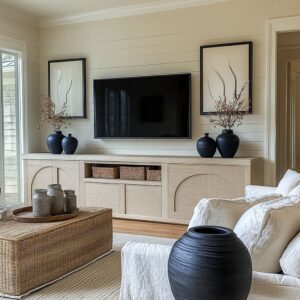
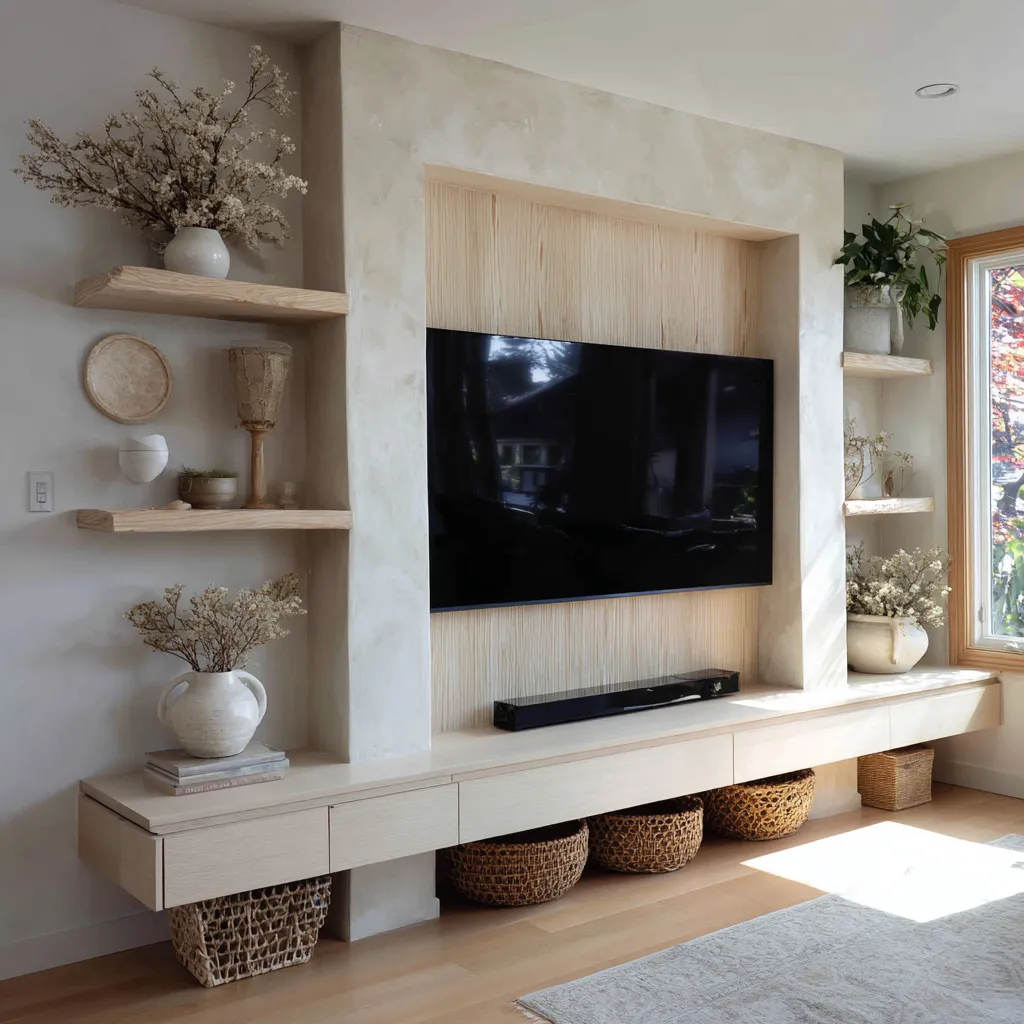
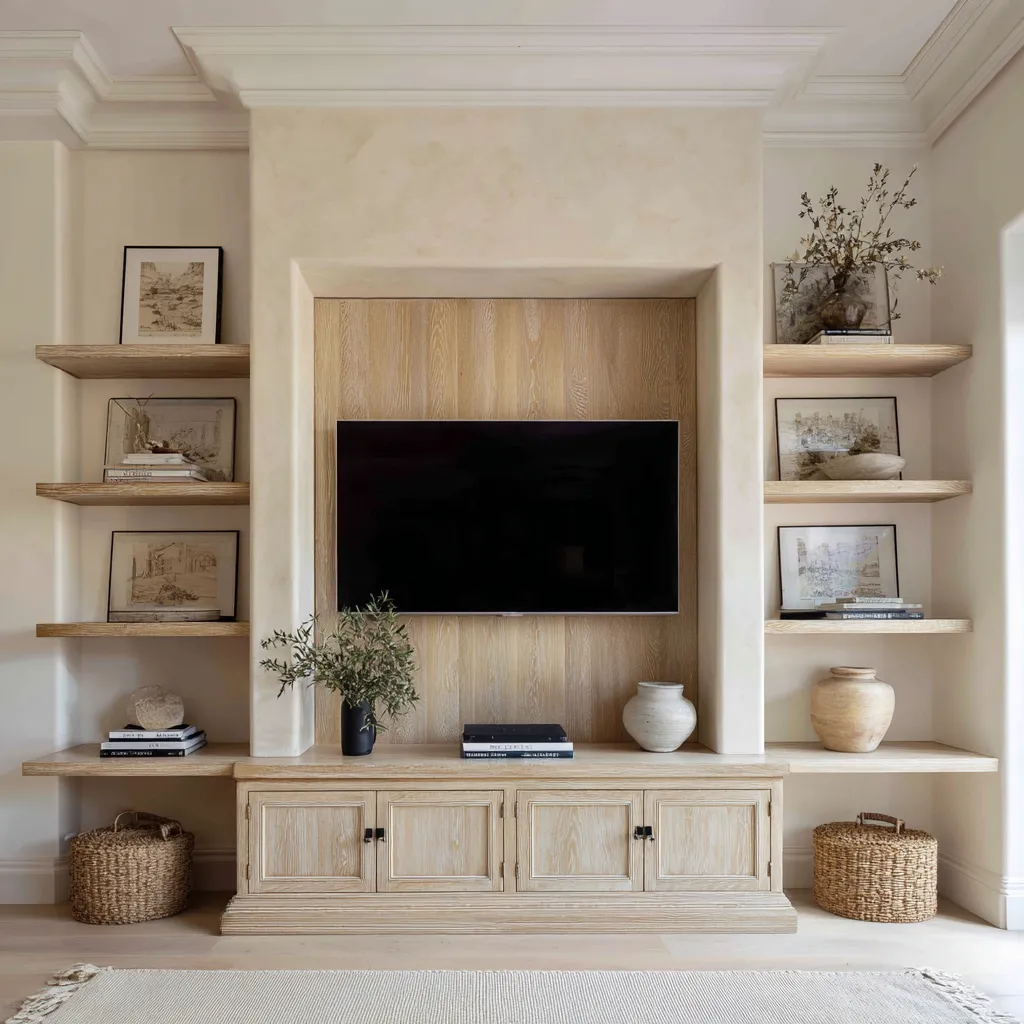
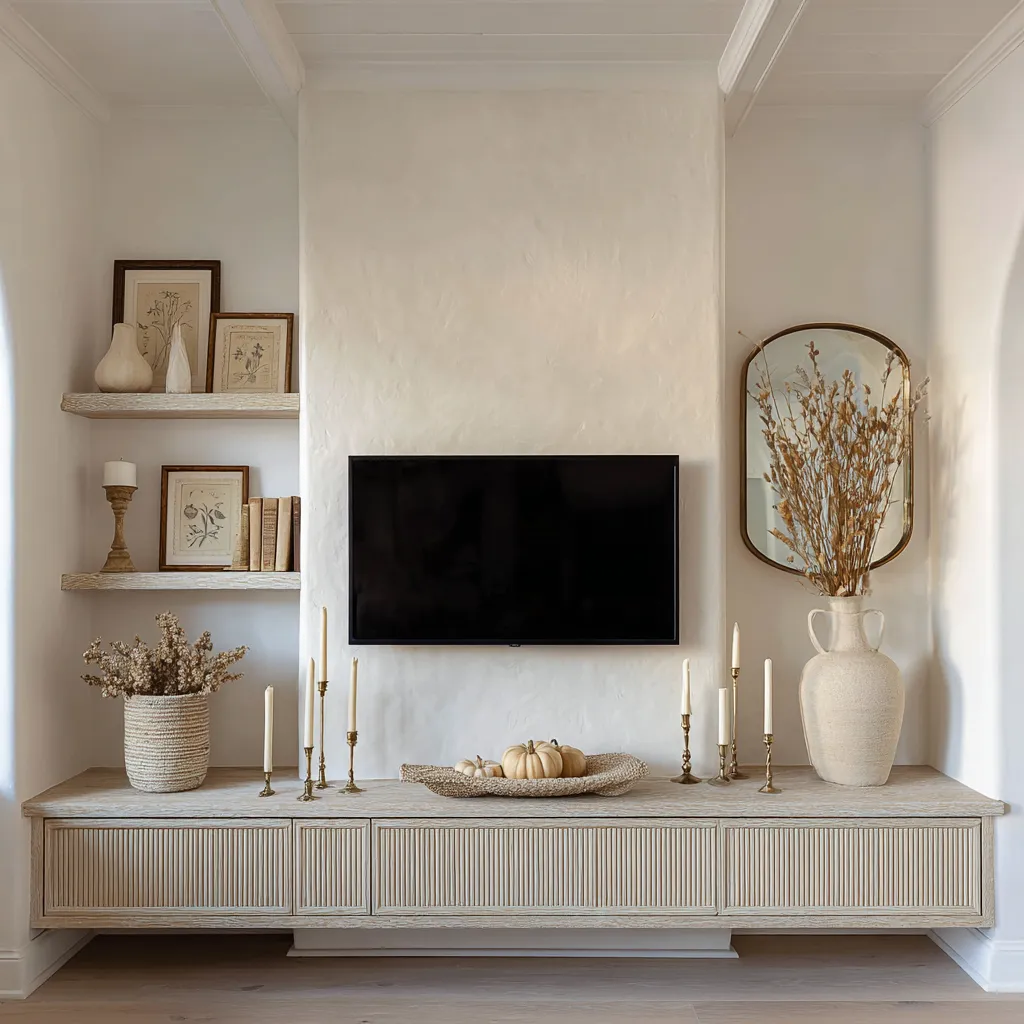
If the television is central, the room usually needs another system to absorb its hardness. That system often includes a plaster-like recess, built-in shelving, pale oak or blond wood backing, fluting, low cabinets, baskets, matte pottery, and careful spacing between objects.
In other words, the romantic softness that would normally come from upholstery or florals has to be replaced by material richness and architectural framing.
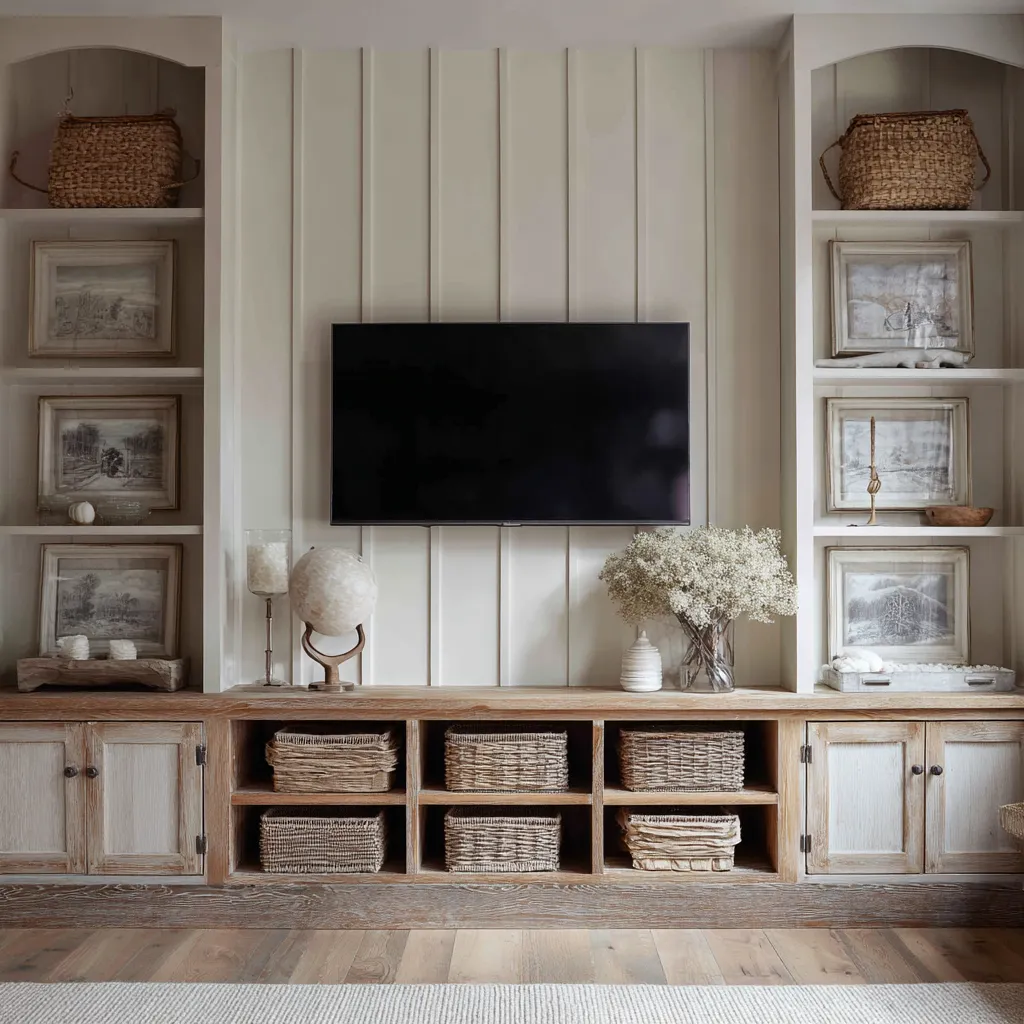
A good TV wall in this style does not try to hide the television with unnecessary tricks. Instead, it gives the screen context.
A thick plaster surround can turn the wall into something that feels carved and substantial. Pale wood inside the niche can warm the black screen.
Fluted cabinetry can add shadow and rhythm. Baskets can ground the lower portion.
Open shelves with a few botanical prints, books, and ceramics can soften the composition without crowding it. The room then feels domestic again, even though the wall is clearly media-centered.
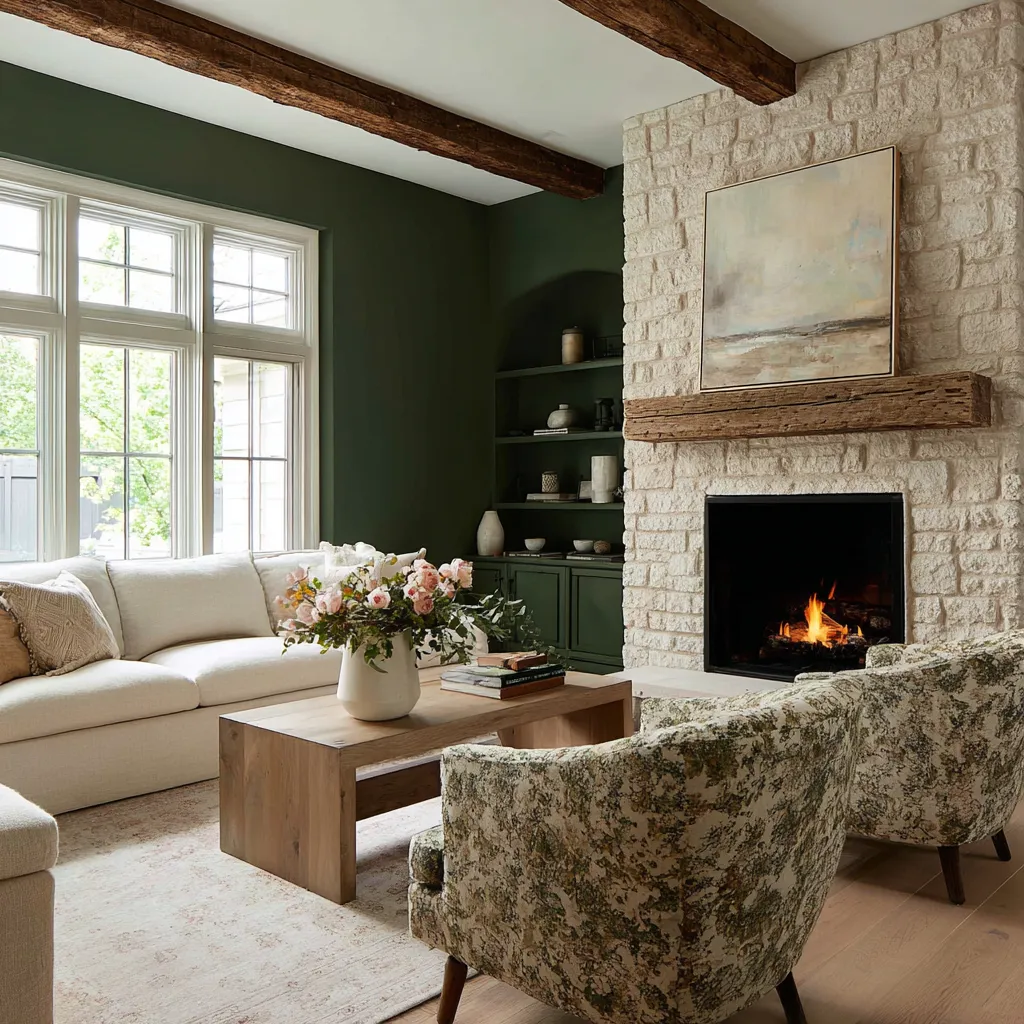
The coffee table should balance the room, not compete with it
Coffee tables do a surprising amount of work in modern farmhouse shabby chic living rooms. Their form often tells you whether the room is leaning rustic, romantic, or current.
A heavy reclaimed wood table adds farmhouse gravity and works well in rooms with beams, stone, and darker wall color. A pale painted or distressed round table pushes the room toward a softer shabby chic mood.
A plain block-style table in warm wood helps a cleaner room feel grounded without adding decorative weight. An upholstered ottoman can make a symmetrical layout feel more intimate and cloth-led.
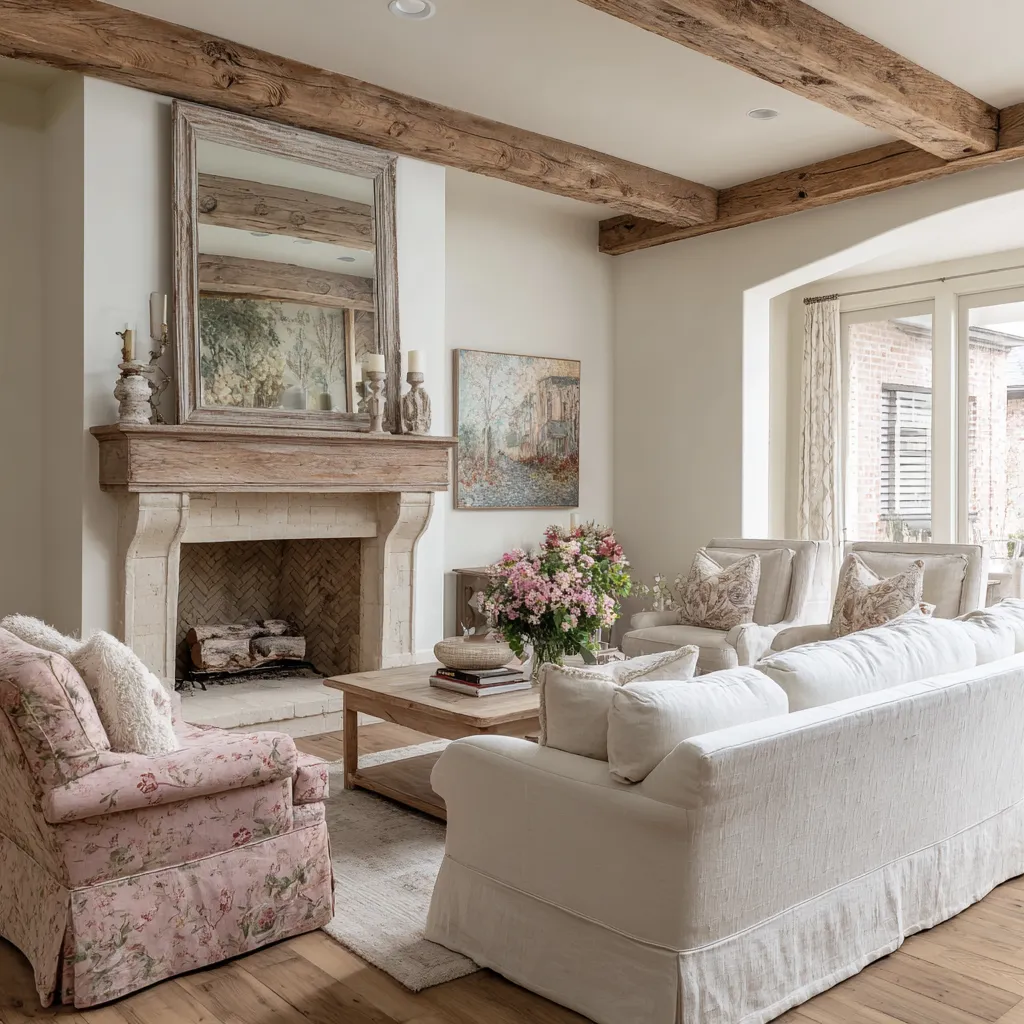
The table usually works when it counters what is happening around it. If the room already has many hard edges, a rounder table can soften the center.
If the room is full of soft pale seating, a darker or heavier table can keep the composition from feeling airy in the middle. If the room has a bold fireplace or strong ceiling beams, a simpler table often works better than a highly expressive one.
Let the rug carry age softly
The rug is often where the time-softened quality of shabby chic can appear without making the room feel decorated in an obvious way. Faded patterns, low contrast, washed terracotta tones, dusty rose traces, soft blue-gray, and muted beige all work well.
The rug does not need to shout. In fact, it usually works better when it feels settled into the room rather than newly announced.
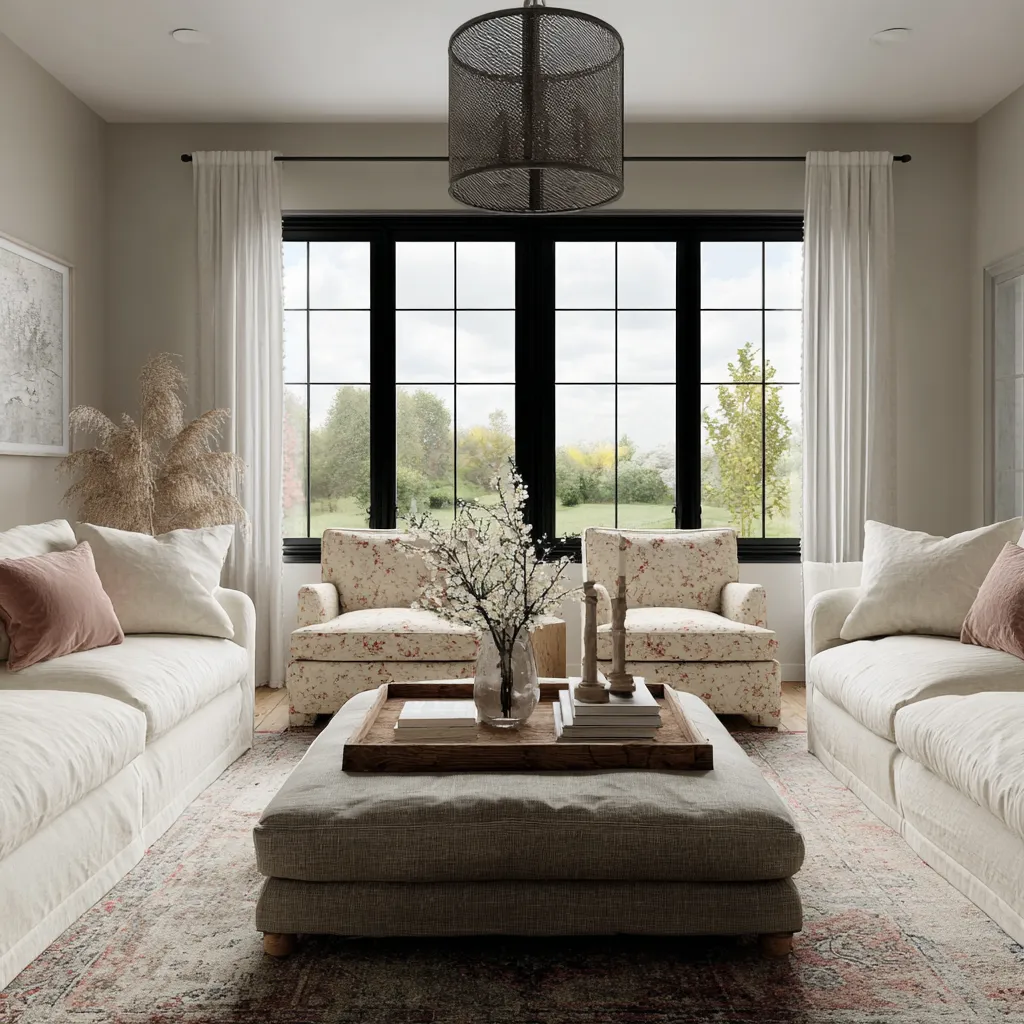
A faded rug can tie together old wood, blush florals, cream upholstery, and black accents without asking for much attention. It can also soften a darker room with beams and masonry, or warm up a very pale room that might otherwise feel thin.
Natural woven rugs can also work, especially in rooms leaning more farmhouse. Jute, jute-like blends, and quiet natural-fiber weaves help keep the floor grounded.
They are especially effective in rooms where color is already present in pillows, art, or flowers.
Symmetry can keep romantic rooms under control
Many of the softer and more openly romantic versions of this style become much stronger when they use symmetry. Two sofas facing each other, matching sconces around a fireplace, balanced built-ins, paired chairs, and centered mantel arrangements can stop a blush or floral palette from feeling too loose.
That does not mean the design should become formal. It means the architecture and layout provide steadiness while the fabrics and accents provide softness.
This combination is very effective in country shabby chic living rooms because the style always has two competing energies: structure and tenderness. Symmetry helps structure win just enough.
Warm accents do the emotional work
One of the ways to make this style feel richer is to bring in warmth through a few concentrated accents rather than through strong wall color everywhere. Cinnamon chairs, clay pillows, terracotta traces in a rug, dusty rose artwork, muted peach florals, warm wood frames, and soft brass lighting can shift the mood of a room dramatically.
These accents help the softer side feel grounded and livable. They also pair beautifully with cream upholstery and pale masonry.
A little warmth does the job that stronger ornament once did. Instead of relying on many decorative objects, the room feels romantic because the color temperature is gently warm.
Texture should do much of the visual work
Modern farmhouse shabby chic interiors often become richer through touch rather than through strong contrast or dense ornament. A design solution may layer rough plaster, limewashed brick, visible beam grain, washed oak, woven baskets, linen upholstery, bouclé chairs, matte ceramics, dried branches, and a faded rug, all inside a narrow palette.
That mixture keeps the room interesting even if the colors stay pale. This is one reason glossy finishes usually feel wrong in this style.
They interrupt the atmosphere. Matte and softly textured materials absorb light and make the room feel calmer, warmer, and more settled.
A few signs of daily life make the room better
This style tends to feel more natural when it includes small evidence of living. That may be a stool beside the hearth with a draped throw, baskets holding folded textiles, stacked books on a coffee table, a tray with cups, a lamp on a sideboard, or a slightly loose branch arrangement rather than a formal bouquet.
These touches make the room feel used and personal. The key is to keep these moments selective.
Too many of them create clutter. A few well-placed signs of habit make the room feel believable.
Common mistakes that weaken the look
- One mistake is making the room too rustic without adding enough softness. Heavy beams, dark wood, stone, and rough furniture can easily turn into a harder farmhouse interior if the seating, drapery, and textiles are not soft enough.
- Another mistake is making the room too sweet without enough structural memory. Pale florals, blush pillows, soft fabrics, and pretty accessories can drift into cottage styling if the room lacks beams, masonry, a reclaimed mantel, built-ins, or another feature that gives it weight.
- A third mistake is over-editing. A room can absolutely be clean and current, but if it becomes too rectilinear, too sparse, and too technology-centered, the shabby chic side fades quickly. In that case the room starts to feel like pale contemporary millwork with a few rustic accessories rather than a real hybrid.
- A fourth mistake is spreading romanticity everywhere instead of concentrating it. One floral chair often works better than a floral chair, floral curtains, floral rug, and floral pillows all at once. One strong bouquet often works better than several small arrangements scattered around the room.
The most dependable version of the style
A stable version of modern farmhouse shabby chic living room design usually includes:
- visible age somewhere in the shell
- generous softness in the main seating
- a restrained romantic note
- warm muted color
- edited but not severe styling
- one or two major anchors instead of many decorative signals
That combination gives the room depth without heaviness, tenderness without fuss, and present-day clarity without sterility.
Final thoughts
Modern farmhouse shabby chic living room design works well because it lets a room feel grounded and gentle at the same time. The farmhouse side gives structure, history, and material honesty.
The shabby chic side brings softness, warmth, and a lightly romantic mood. Present-day editing keeps the whole composition from slipping into excess.
The result, at its best, is a living room that feels calm, familiar, and deeply usable. It welcomes pale masonry, weathered wood, baskets, linen, bouclé, faded florals, blush tones, and soft curves, but it asks each of them to do their part with restraint.
That balance is what keeps the style fresh. It does not need a crowded mantel, a room full of antiques, or a perfectly rustic shell.
It needs a few meaningful anchors, plenty of cloth, a softened palette, and a clear sense of what should stay quiet.