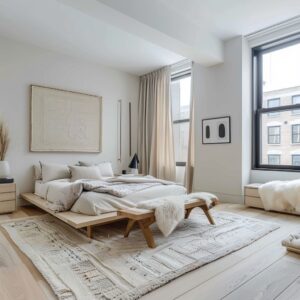

Warm Scandinavian living rooms are often misunderstood as pale rooms with soft sofas, light wood, and a few cozy accessories. That surface reading misses the real mechanism.
A room does not feel warm simply because it uses cream upholstery or a beige rug. It feels warm when the whole interior turns pale space into something tactile, grounded, and physically sheltering.
That difference matters. Many rooms borrow the visible ingredients of warm Scandinavian design yet still feel thin, flat, or slightly chilly.
They may have the right color family on paper, but they do not hold warmth in the walls, in the edges of light, in the furniture arrangement, or in the contrast structure.
The interiors in this style can create warmth through distribution. The shell, the seating, the wood, the shadow, and the daylight all take part.
This is why warm Scandinavian design can produce very different kinds of comfort. Some rooms feel cocooning and mineral, almost carved out of plaster and soft wool.
Others stay brighter and more breathable, with honeyed daylight and gentle oak shaping the atmosphere. Both can belong to the same style.
The difference lies in how the room builds its warmth, not only in which objects it contains.

Warmth is not driven mainly by cream
Cream is essential, but it is not the whole answer. In many warm Scandinavian rooms, cream, oat, buttercream, ivory, and warm off-white function as the base field.
They soften light, quiet visual noise, and allow wood and earth tones to register clearly. They also keep the room from becoming heavy once darker woods or clay accents appear.
But cream alone rarely creates a fully persuasive warm interior. A cream sofa can still feel cool if it sits in a sharp white shell, next to graphic black lines, with little textural variation and no darker anchor to give the room gravity.
Pale upholstery becomes effective only when it is supported by other warming devices. It needs a mineral envelope that warms shadow, wood that adds structural heat, and a seating composition that feels gathered rather than dispersed.
So cream is the entry condition. It opens the door to warmth.
It does not finish the work.

What actually drives warmth
Warm Scandinavian living room ideas tend to rely on the same set of forces, even when their mood differs.
1) Texture layering
Texture is usually the warmth driver in the room. Not softness alone, but layered softness.
The interiors can combine several tactile categories rather than repeating one note. A strong room might contain:
- thick boucle or coarse woven upholstery for bodily softness
- a flatter woven rug for quiet grounding
- chalky plaster or stone for dry mineral depth
- smooth walnut or oak for structure
- dried branches, basketry, or straw-like material for fibrous dryness

This mixture matters because rooms weaken when every surface belongs to the same tactile family. If everything is plush, the room loses hierarchy and turns visually blurry.
If everything is dry and hard, the room becomes firmer and cooler. Warmth becomes richer when the eye moves between nubby, matte, grained, fibrous, and smooth surfaces.

2) A gathered seating field
Warm Scandinavian interiors often feel close to the body, even in large volumes. That effect usually comes from the furniture plan.
The seating is not scattered around the perimeter. It is pulled into a socially short distance.
Sectionals turn inward. Chairs hold the edge of the rug rather than floating far away.
Coffee tables stay within reach from several seats. The rug is large enough to bind the main pieces into one shared zone.
This gathered arrangement does two things at once. It raises warmth, and it reduces emotional spread.
A room can be generous in scale without feeling exposed when the sitting zone is shaped as one protected field.

3) A mineral shell
Warm Scandinavian rooms often carry their warmth in the shell rather than only in the furnishings. Pale plaster, limewash, chalky stone, textured chimney masses, and softly mottled wall finishes perform a task that plain paint often cannot.
They warm the shadow. That is a major distinction.
In colder pale interiors, indirect light can turn the wall surface flat and gray. In warmer Scandinavian rooms, pale mineral surfaces keep even the dimmer parts of the room creamy, earthy, or softly mushroom-toned.
The space feels carved and settled rather than bright and empty. This is one reason plaster-heavy rooms usually feel warmer all day long, not only when the sun is strong.

4) A shadow register
A warm room usually needs one deeper note. Without it, the palette can become sweet, weightless, or vague.
That deeper note may appear as:
- a dark firebox
- a walnut coffee table
- shelving recesses
- a cognac chair
- a darker mantel
- one middle-value armchair in cinnamon or camel
This kind of darkness helps because it gives pale surfaces something to stand against. It adds maturity, shape, and visual depth.
But the type of dark matters. Deep walnut, firebox shadow, or one darker textile piece can strengthen warmth.
Graphic black linework repeated too forcefully often does the opposite. There is a major difference between grounded darkness and outlining darkness.

5) Warm light edges
Many warm Scandinavian rooms protect their atmosphere at the window edge. That is one of the least obvious but useful design lessons in the style.
Warm wood trim, amber-toned framing, soft beige drapery, deep reveals, benches, and cushioned window seats all help daylight arrive through a warm boundary. That changes the emotional temperature of brightness itself.
Instead of feeling clinical or exposed, the light feels filtered and companionable. The room stays open, but not sterile.
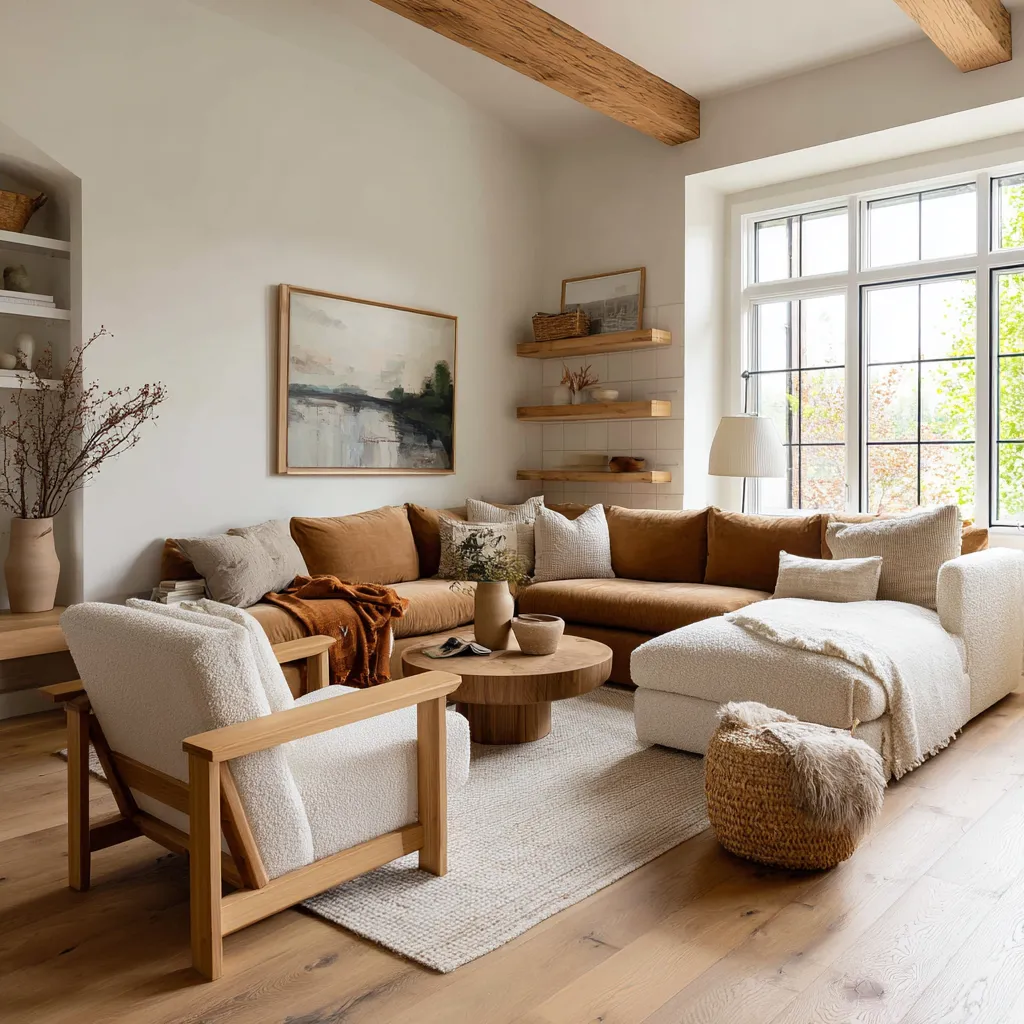
Which color families do which jobs
Warm Scandinavian design is not built from one warm neutral repeated at different scales. Each color family has a specific role.
The designs understand that distinction.

Cream, buttercream, ivory, oat, buttermilk
These tones are the soft field of the room. They hold daylight gently and make large upholstered forms feel comfortable and generous.
They also protect the interior from becoming too heavy once deeper woods and clay notes appear. What they do well:
- soften reflected light
- create bodily warmth in sofas and chairs
- allow darker notes to feel intentional rather than harsh
- maintain visual ease in large volumes
What they do poorly on their own:
- create depth
- prevent flatness
- carry the whole room without textural support
A cream room without mineral texture, shadow, or a middle register can feel washed out.

Pale clay-beige, mushroom cream, chalky stone, plaster beige
These tones often do the real architectural warming. They are less about softness and more about atmosphere.
Their role is to:
- warm shadow
- keep pale walls from going cool in indirect light
- make the shell feel permanent and tactile
- shift the room from merely pale to physically grounded
These colors turn the room from a decorated container into an inhabited envelope. They are especially valuable on walls, fireplaces, alcoves, and built-in seating ledges.

Honey oak, amber oak, chestnut trim
Lighter warm woods protect airiness. They are especially effective at windows, floorboards, trims, and chair frames.
What they contribute:
- friendliness at the light edge
- brightness without chill
- a softer relation between outdoors and indoors
- warmth that stays lifted rather than heavy
Honeyed wood is one of the ways to make a bright room feel welcoming.

Walnut, deeper brown wood, darker timber
Darker warm wood has a different job. It adds gravity and maturity.
It works well in:
- coffee tables
- mantels
- shelving recesses
- threshold millwork
- darker floors
- one or two concentrated furniture pieces
Walnut deepens the room and anchors pale textiles. It is especially useful when the room needs more structure or when the shell is light enough to risk feeling too airy.
So wood is not one category. Lighter warm wood preserves openness.
Darker warm wood builds depth.

Camel, cinnamon, butterscotch, cognac, caramel
These are some of the efficient warmth tones in the whole style. They tend to work at touch level rather than in large upper fields.
Their job is to:
- ground pale seating
- add emotional heat at body height
- create a middle register between cream and dark wood
- make the room feel more settled and adult
A cognac leather sling chair, camel pillows, one cinnamon ottoman, or a butterscotch woven chair can do a surprising amount of work. These tones often achieve more than many small neutral accessories because they create a clear warmth band inside the seating field.

Rust, terracotta, burnt clay
These tones do not usually define the whole room. They act as pulses.
When muted and used in moderation, they deepen the atmosphere and add a seasonal charge. They work when:
- dusty rather than bright
- repeated in a few related places
- supported by cream, plaster, oak, or walnut
- placed in pillows, chairs, ceramics, dried botanicals, or throws
They are useful for shifting a room from soft-neutral warmth toward earthy warmth. But they work when restrained.
Too much rust can pull the room away from Scandinavian reserve and toward a louder decorative mood.

Black, graphite, hard dark line
Darkness has two very different forms in warm Scandinavian living rooms. Helpful darkness:
- firebox cavities
- deep shelving recesses
- one dark table
- a dark mantel
- walnut depth
Harmful darkness:
- repeated black window outlining
- heavy black metal
- hard black furniture edges scattered around the room
- too many sharp dark lines competing with the soft field
The first type gives the room depth. The second can cap the room’s warmth and steer it toward sharper contemporary minimalism.

Dusty blue
Warm Scandinavian design can accept a cool accent, but only under narrow conditions. Dusty blue works when it stays pale, subdued, and secondary.
It should remain in textile form, surrounded by beige light, cream upholstery, and wood. In that role, it offers:
- relief from monotony
- a softer, lighter emotional note
- a branch of the style that feels a bit more springlike or coastal
It does not usually function as a core warmth tool. It is an exception that can succeed when the larger room remains firmly warm.

Which variables raise warmth
Several recurring variables consistently strengthen warmth in this style.
Texture layering
The room needs tactile range, not only softness. Boucle, plaster, wood grain, woven rugs, leather, stone, dried stems, and matte ceramics give warmth body and variation.
Mineral surfaces
A pale plaster wall or chalky fireplace often does more for warmth than another throw blanket. These surfaces warm the shell and hold shadow gently.
Social gathering
A room becomes warmer when seating is arranged as one shared field. Warmth is spatial as well as material.
Body-level clay and camel
A few measured notes in pillows, chairs, ottomans, or hearth styling often transform a pale room from merely soft to fully warm.
Warm wood at the edge
Window trim, chair frames, mantels, tables, shelves, and floorboards distribute warmth through structure rather than decoration.

Which variables raise depth
Depth is related to warmth, but it is not the same thing. Some rooms feel warm and soft but not especially mature.
Others feel warm and deeply settled. Depth tends to rise with:
Dark anchors
A room gains seriousness when it has one or two concentrated shadow zones.
Rustic memory
Beams, aged timber, built-ins, books, hand-thrown pottery, dry craft textures, and slight signs of age all add rootedness. Used lightly, they make the room feel lived-in rather than staged.
Mineral mass
Plaster, stone, and textured chimney walls give the room a stronger architectural memory.
Middle-to-dark value range
A room that stays only in cream and pale oak can feel gentle but somewhat thin. A room with a middle register often feels fuller and older in a good sense.
Depth is what makes a room feel settled, not simply cozy.

Which variables protect airiness
Warmth and airiness can support each other, but they are not identical. Some rooms gain warmth by becoming denser.
Others stay warm by handling light skillfully. Airiness tends to survive when the room uses:
Warm window-edge filtering
Wood-framed glazing, warm drapery, deep reveals, and built-in window seating keep brightness soft and friendly.
Honey or amber wood rather than too much dark walnut
Lighter woods preserve lift better.
Limited dark anchoring
One or two deep notes are enough. Too many can thicken the room too much.
A pale central field
Large rugs, broad cream sectionals, and uncluttered wall space help the room stay open.
Clear circulation
A room can be gathered without feeling blocked. That balance keeps the space breathable.

Which variables quietly damage the effect
Several moves tend to weaken warm Scandinavian rooms, even when the palette seems correct.
Too much graphic black
This is one of the ways to cool the room. Black can work in small amounts, but repeated outlining often undercuts warmth.
Over-cream
Cream sofa, cream rug, pale wall, and no darker register can leave the room flat and sweet rather than rich.
Texture repetition
If everything is plush and similar, the room loses hierarchy. The atmosphere becomes mushy instead of layered.
Under-grounded daylight
A bright room with pale surfaces but too little wood or clay can feel airy yet emotionally thin.
Too much rustic mass
Beams, brown wood, and craft texture can deepen a room, but if they multiply too far without a pale central field, the room loses its Scandinavian lightness.

Curves: useful, but not in the way people often assume
Rounded sofas, arched windows, curved ottomans, softened fireplace openings, and bench niches appear often in warm Scandinavian living rooms. These elements do contribute, but their main contribution is not raw warmth.
Curves improve cohesion. They reduce edge aggression, soften large pale masses, and help low-contrast palettes feel intentional.
They also make the room feel more companionable and physically forgiving. That matters greatly in a style that often relies on restrained color and broad surfaces.
So curves may not heat the room on their own, but they help the whole composition hold together.
There is not one warm Scandinavian formula
Warm Scandinavian living rooms do not all work the same way. At least four distinct branches appear again and again.
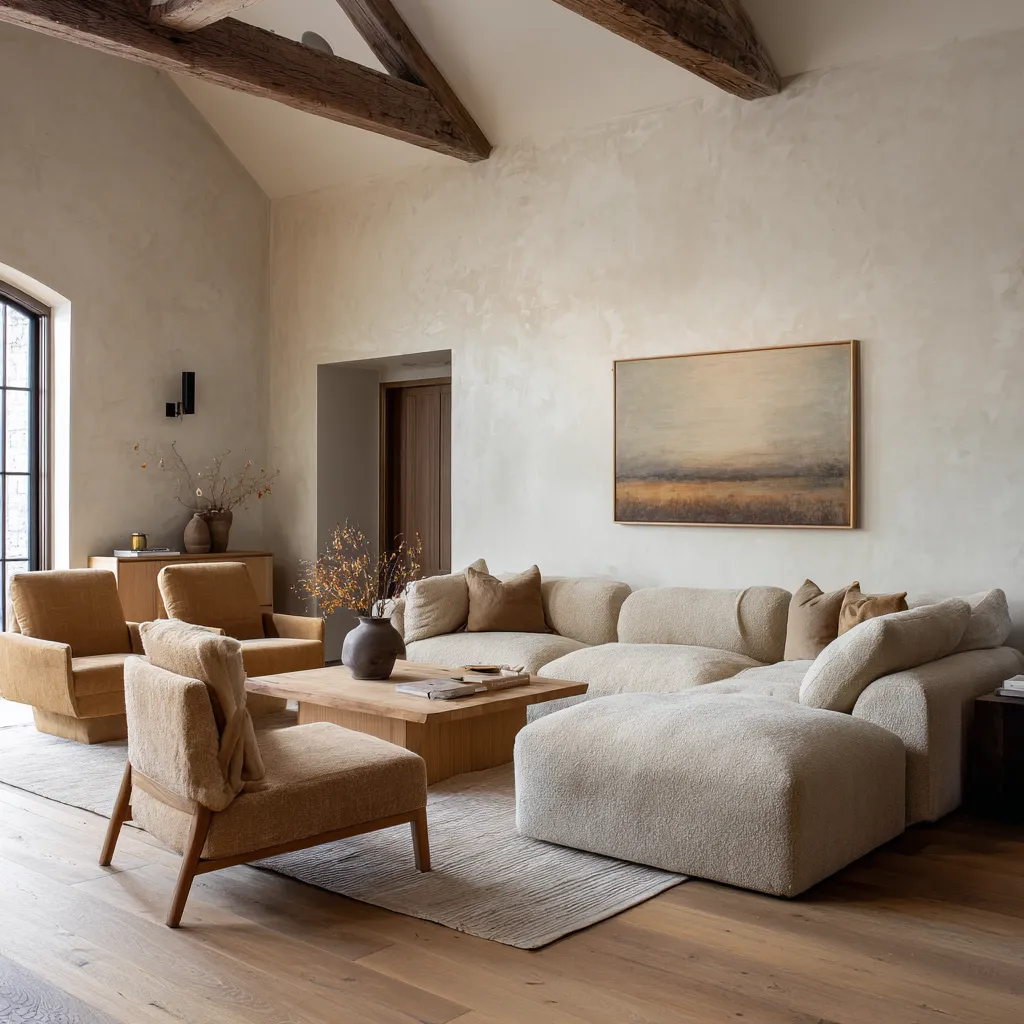
1) Mineral cocoon warmth
This branch is built from pale plaster, chalky stone, thick cream seating, deep rug texture, muted clay accents, and very little graphic black. Its effect:
- rich all-day warmth
- high cohesion
- strong bodily comfort
- a carved, sheltering feeling
This is one of the persuasive versions of the style.
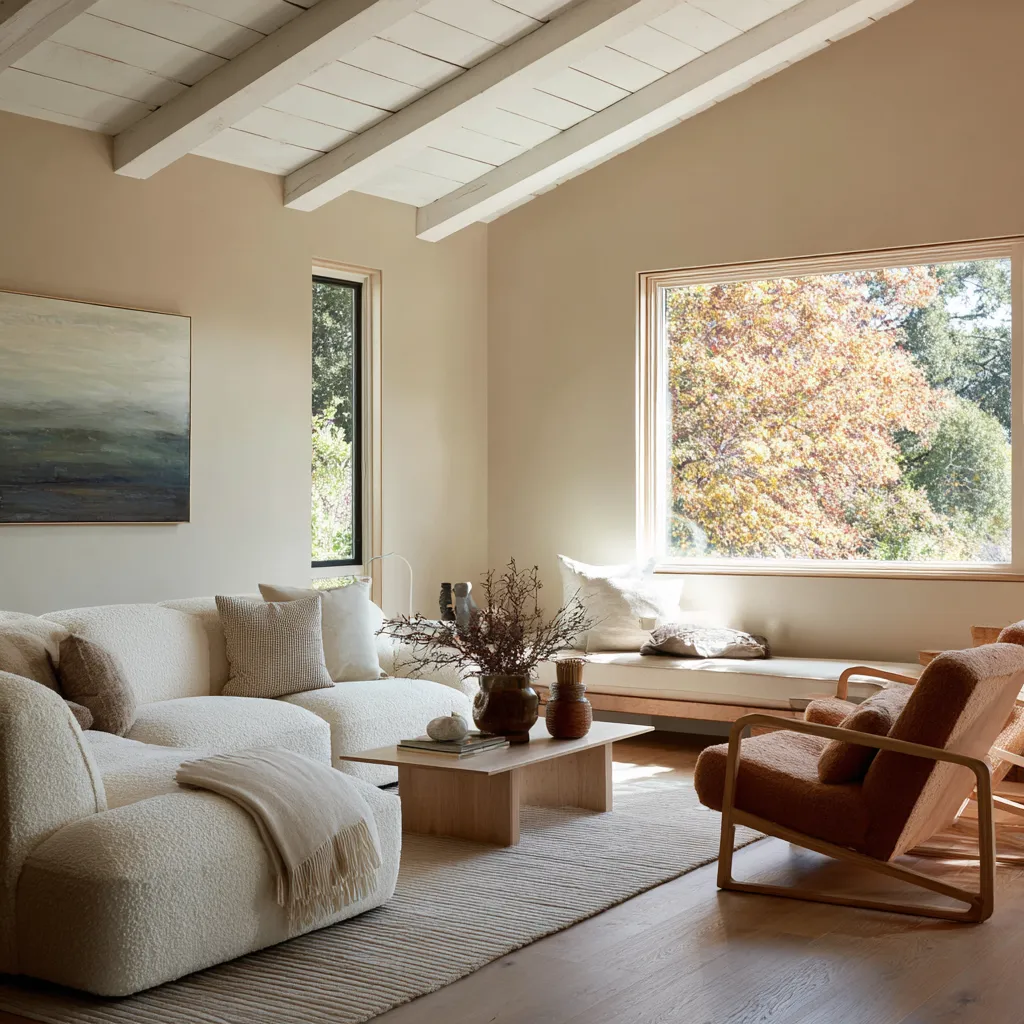
2) Sunlit oak warmth
This branch stays brighter and more breathable. It relies on cream upholstery, honeyed light, warm wood around windows, pale floors, and fewer dark anchors.
Its effect:
- openness
- soft daylight
- domestic comfort
- a lighter, friendlier mood

It proves that warmth does not always require density.
3) Mature contrast warmth
This version uses a pale tactile center framed by darker floors, shelving depth, walnut tables, or deeper trim. It keeps the center soft and the perimeter grounded.
Its effect:
- maturity
- stronger structure
- warmth through contrast rather than only through softness
This branch can feel especially strong in larger or more architectural rooms.
4) Earth-season warmth
This branch introduces muted rust, terracotta, cinnamon, and dried botanicals into a cream-and-wood base. It stays edited, not loud.
Its effect:
- autumnal fullness
- stronger emotional heat
- a slightly deeper seasonal mood
This can be very successful when the earth tones stay dusty and limited.
How to think about the style as a whole
Warm Scandinavian living room design creates warmth by building a field of softness, minerality, structure, shadow, and filtered light.
- The shell matters.
- The rug matters.
- The window edge matters.
- The level where the body sits matters.
- The small dark core matters.
- The difference between walnut and black matters.
- The difference between plaster beige and plain paint matters.
- The difference between one camel chair and five tiny neutral accessories matters.
That is why interior designs in this style often feel simple at first glance yet become richer the longer you look. Their warmth is distributed, not announced.
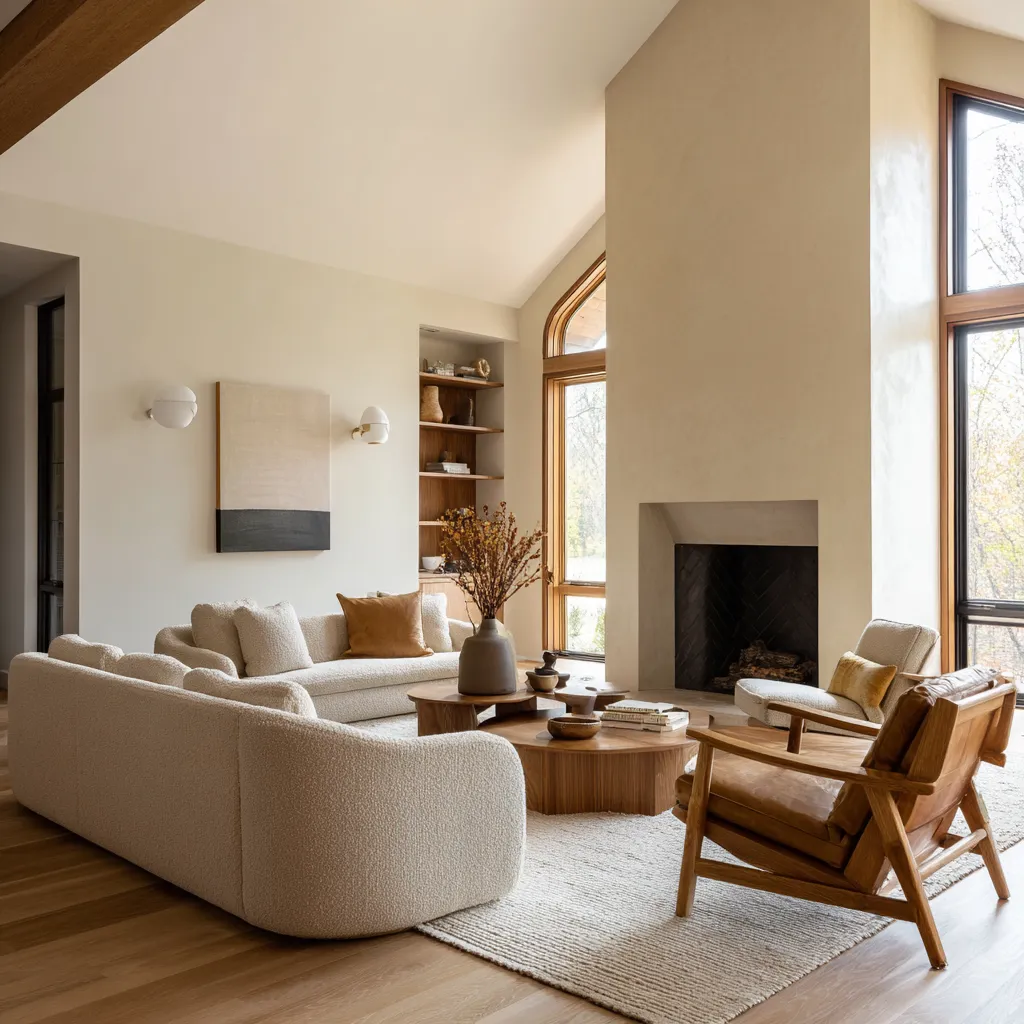
A convincing warm Scandinavian living room usually succeeds when it carries warmth through at least four layers at once:
- a pale shell with warm undertone
- thick, tactile body-contact surfaces
- wood that adds structural heat
- one darker register that grounds the room
- daylight softened at the edge
Once those layers begin working together, the room stops being merely pale and starts feeling inhabitable in a deeper way. It becomes soft without vagueness, open without chill, and restrained without emotional distance.
That balance is what gives warm Scandinavian design its lasting power.