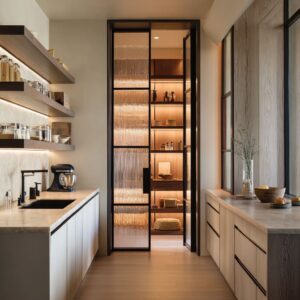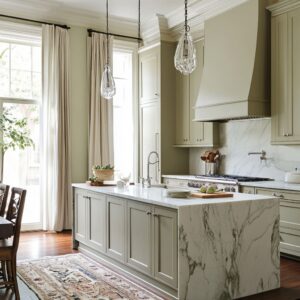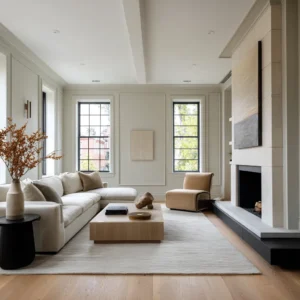
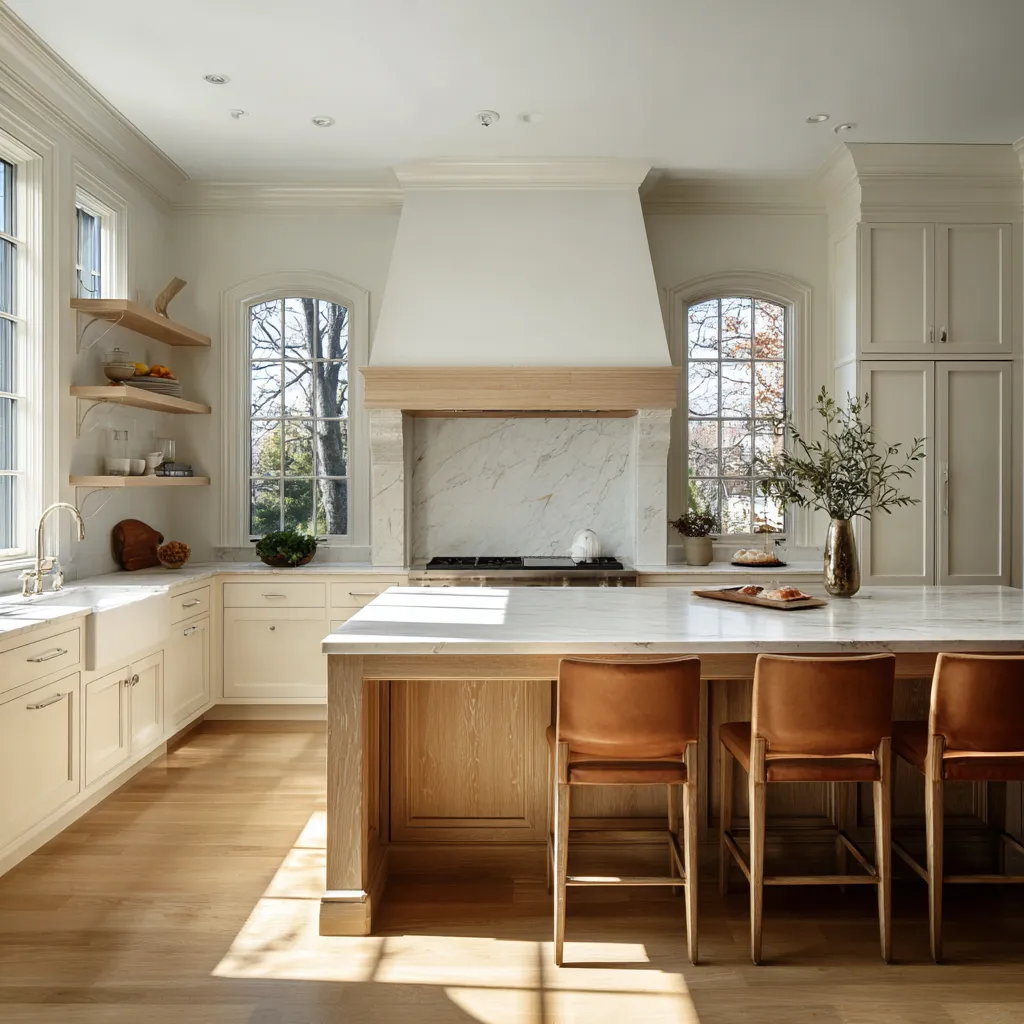
A strong modern Georgian kitchen does not begin with decoration. It keeps the original architectural discipline visible, then places modern elements inside that framework with care.
That means the cornice still matters. Window rhythm still matters.
The wall with the hood still needs to hold the room together. The island still needs to sit where the room wants a central object, not where trend photos say it should go.
That is what makes modern Georgian kitchens look polished without looking forced. They should not chase novelty through many disconnected details.
They work because proportion, wall hierarchy, tone, surface depth, and material warmth are all moving in the same direction. Some are pale and restrained.
Some use deeper stone, darker outlines, or one block of color. Some lean softer and more domestic.
Others carry a more stately air. But beneath those differences, the same design logic keeps appearing: preserve the architecture, strengthen the center, and bring life through tactile materials.
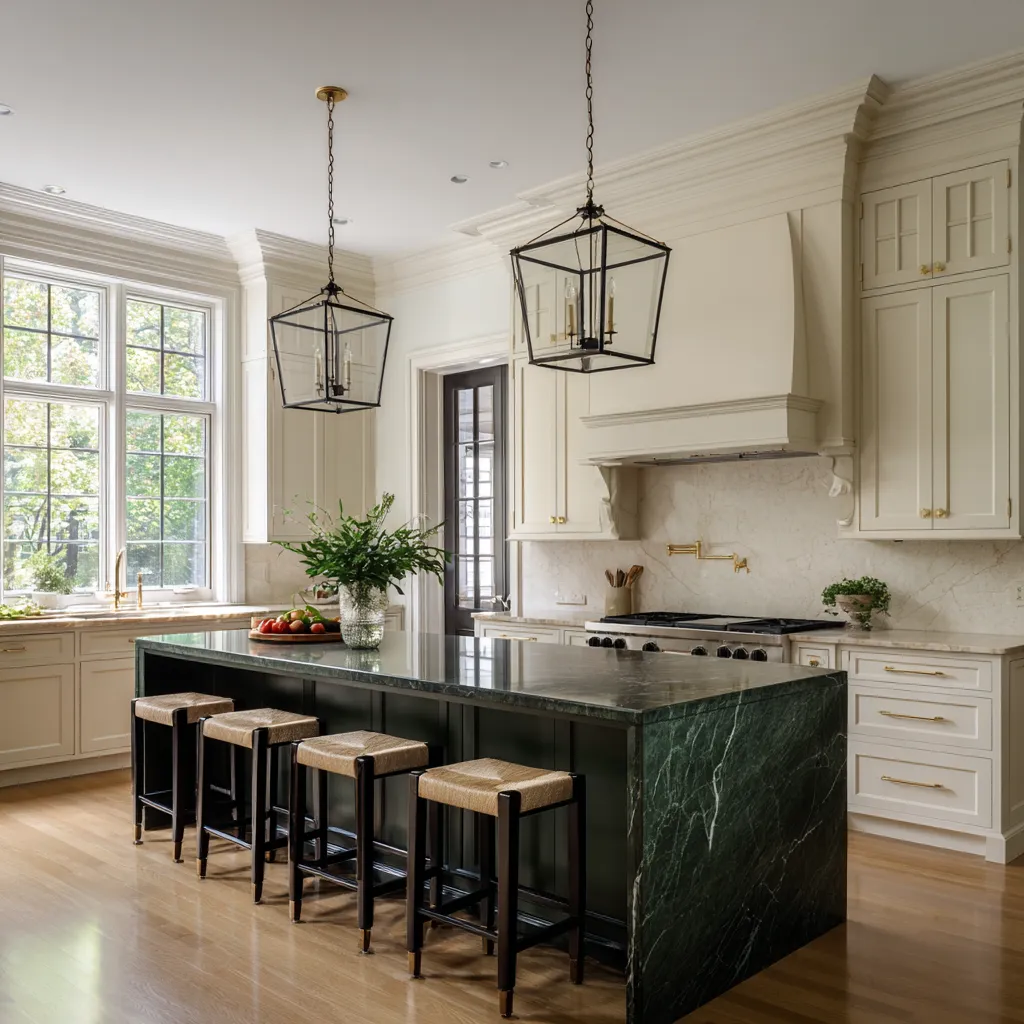
Start with the Georgian shell
A Georgian kitchen loses its identity very quickly when the architectural shell is treated as a blank box. The rooms that hold onto their character keep the envelope legible.
You still sense the ceiling line. You still notice the rhythm of openings.
Windows have proper height and stance. The hood wall is not just a technical zone for appliances.
It works like an organizing wall, almost the way a fireplace wall organizes a formal sitting room.
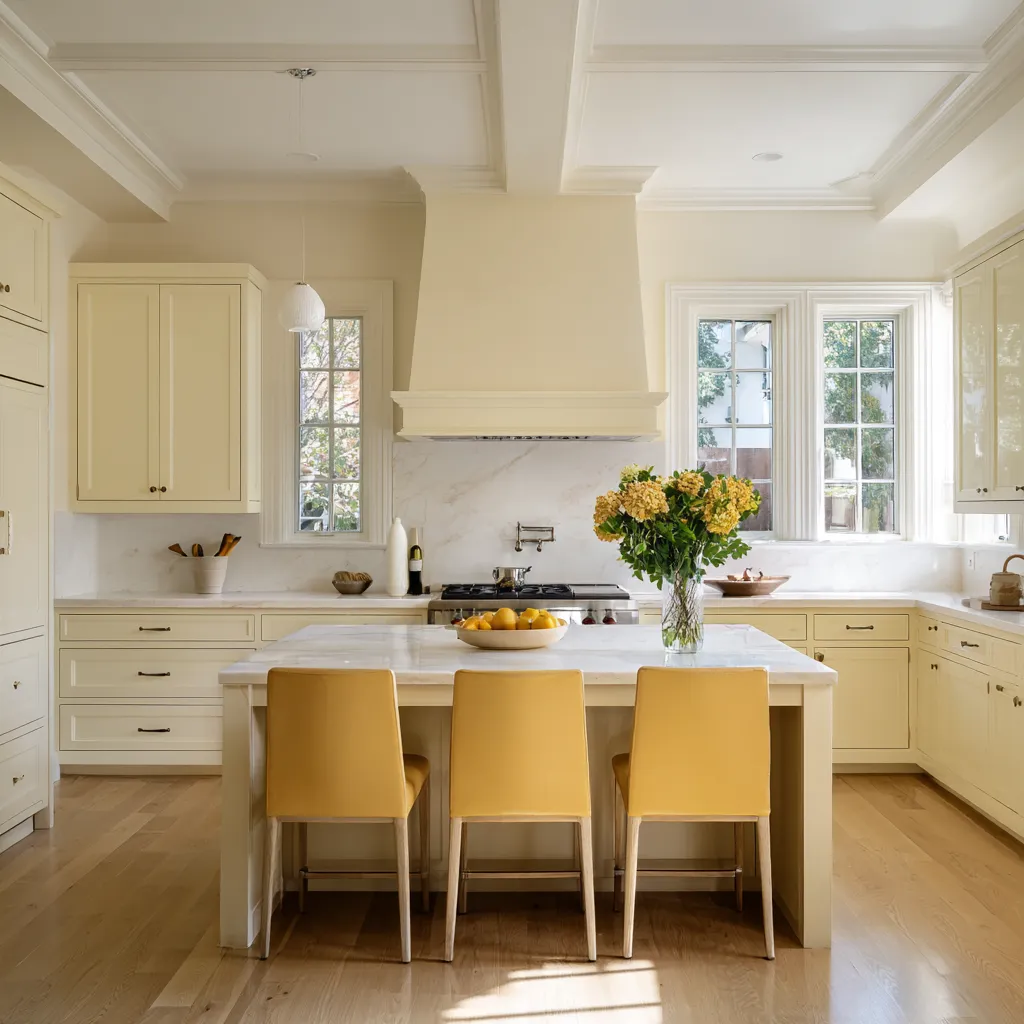
That distinction matters. In a good modern Georgian kitchen, the room is not built from cabinets outward.
It is built from architecture inward. Cabinetry, stone, seating, and lighting are inserted into a room that already has order.
That is why pale painted cabinetry often works so well here. It does not fight the wall plane.
It lets the shell keep control.
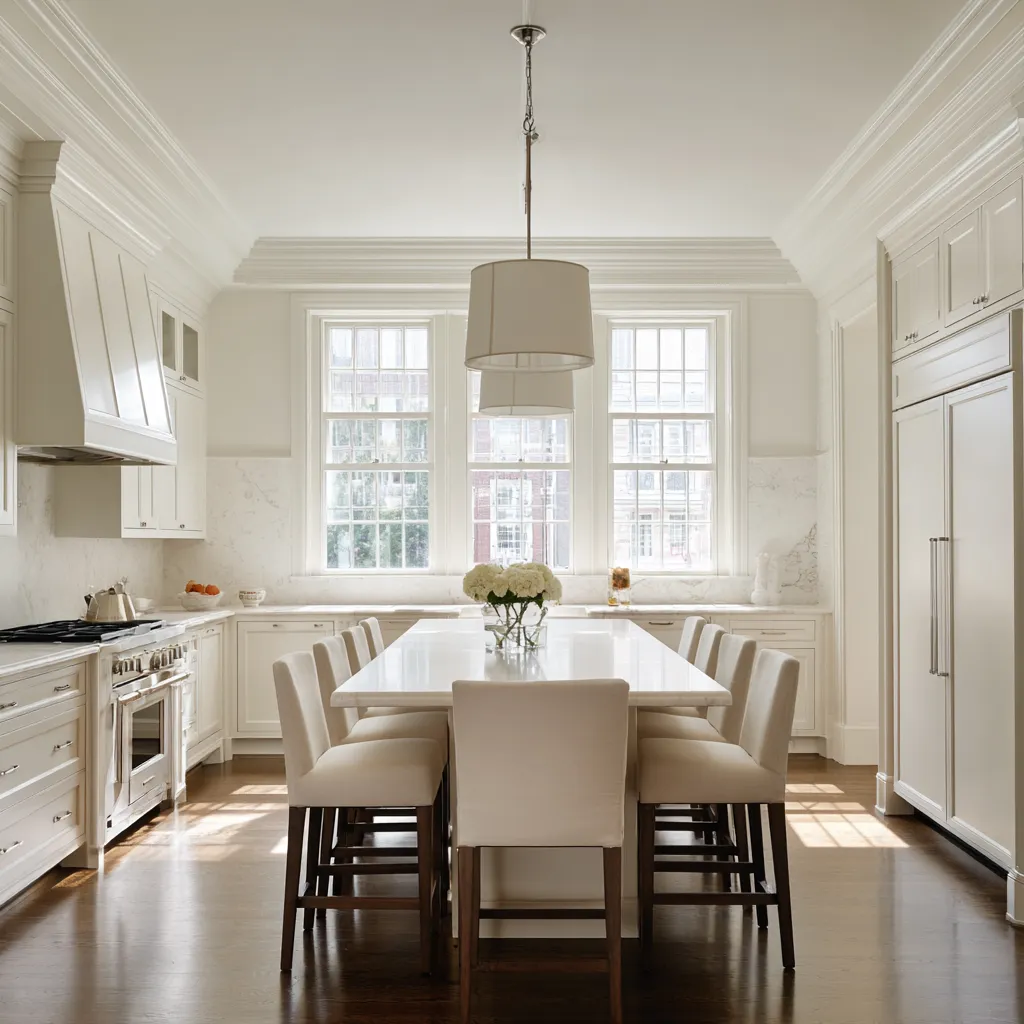
Usually, heavy ornament is not required. A kitchen design can keep its Georgian backbone even when the millwork becomes simpler, cabinet faces become flatter, and the overall finish language becomes more current.
What cannot be lost is the sense of proportion and hierarchy. Once those disappear, the space stops feeling Georgian and becomes a generic contemporary kitchen placed inside an older envelope.
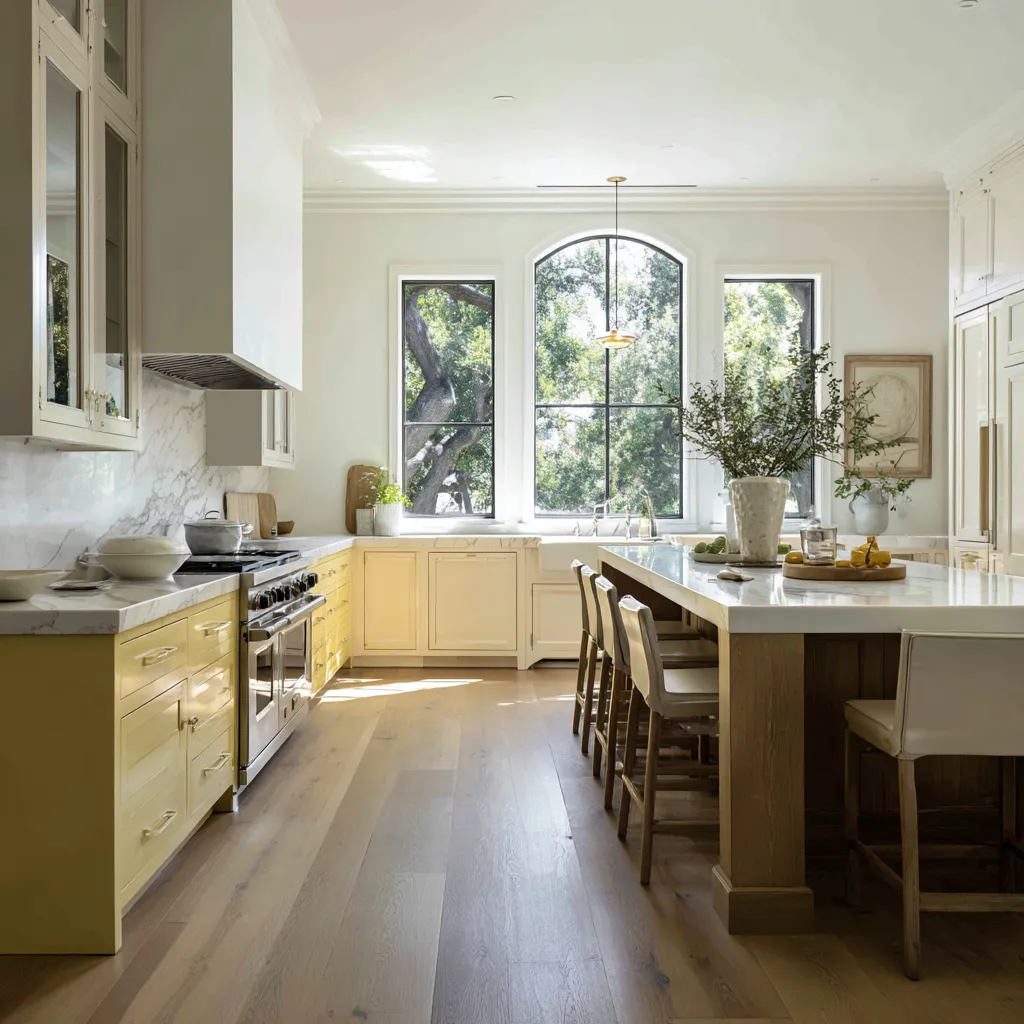
Core design moves in modern Georgian kitchens
| Design move | What it means in practice | What it adds to the room | What can go wrong | Better way to handle it |
|---|---|---|---|---|
| Georgian shell articulation | Keep cornice, window rhythm, symmetry, casing depth, and wall hierarchy visible | Gives the room structure, order, and a sense of permanence | If the shell is flattened by overly plain renovations, the kitchen loses its Georgian identity | Keep the architecture legible even if cabinetry becomes simpler |
| Strong hood wall | Treat the range wall like the room’s anchor, almost like a fireplace wall | Adds center, authority, and formal balance | If the hood is too small or visually weak, the room can feel scattered | Give the hood real width, height, and visual weight, even in a simple form |
| Tight tonal palette | Use close-value colors such as cream, putty, pale taupe, soft stone, and warm white | Makes the room feel settled and connected | If every surface is too similar in finish and texture, the room can feel thin | Keep tones close, but vary material texture, grain, and relief |
| Social island | Make the island feel like furniture and a gathering piece, not only a work surface | Turns the kitchen into the center of daily life | If the island is too bulky or crowded with seating, it can feel clumsy | Keep the island substantial but breathable, with seating that stays visually light |
| Material warmth | Use oak, leather, woven seats, ribbed wood, brushed metal, and warm mineral surfaces | Brings comfort and domestic feeling | If warmth is forced only through paint color, the room may still feel cold | Use tactile materials first, then decide whether color is needed |
| Minimal modern forms | Use flatter cabinet faces, slab elements, cleaner junctions, and less ornamental clutter | Keeps the room current and calm | If reduction removes too much texture and shell presence, the room can feel generic | Pair cleaner forms with one grounding element such as timber, stone, or strong cornice |
| Controlled contrast | Add dark frames, darker flooring, or one darker central object | Sharpens silhouettes and gives the room definition | Too much contrast can make the kitchen feel hard and less relaxed | Limit strong contrast to one clear system |
| Curved softening | Use arches, globe pendants, rounded stools, shaped hood lines, or softened openings | Makes the room feel more welcoming and less rigid | Too many softened forms can reduce the room’s formal gravity | Use curves in selected areas, not on every element |
| Tactile depth | Add woven seating, fluted wood, honed stone, paneled relief, visible grain, or masonry texture | Stops pale kitchens from feeling flat | If every surface is smooth, the room can feel polished but emotionally distant | Mix polished and dry textures so the room feels lived in |
| Mineral weight | Use a heavier backsplash, stone wall, masonry treatment, or a more geological countertop surface | Gives seriousness and lasting visual depth | Too much heavy stone can make the kitchen feel overly solemn | Balance mineral surfaces with daylight, pale cabinetry, and softer seating |
.
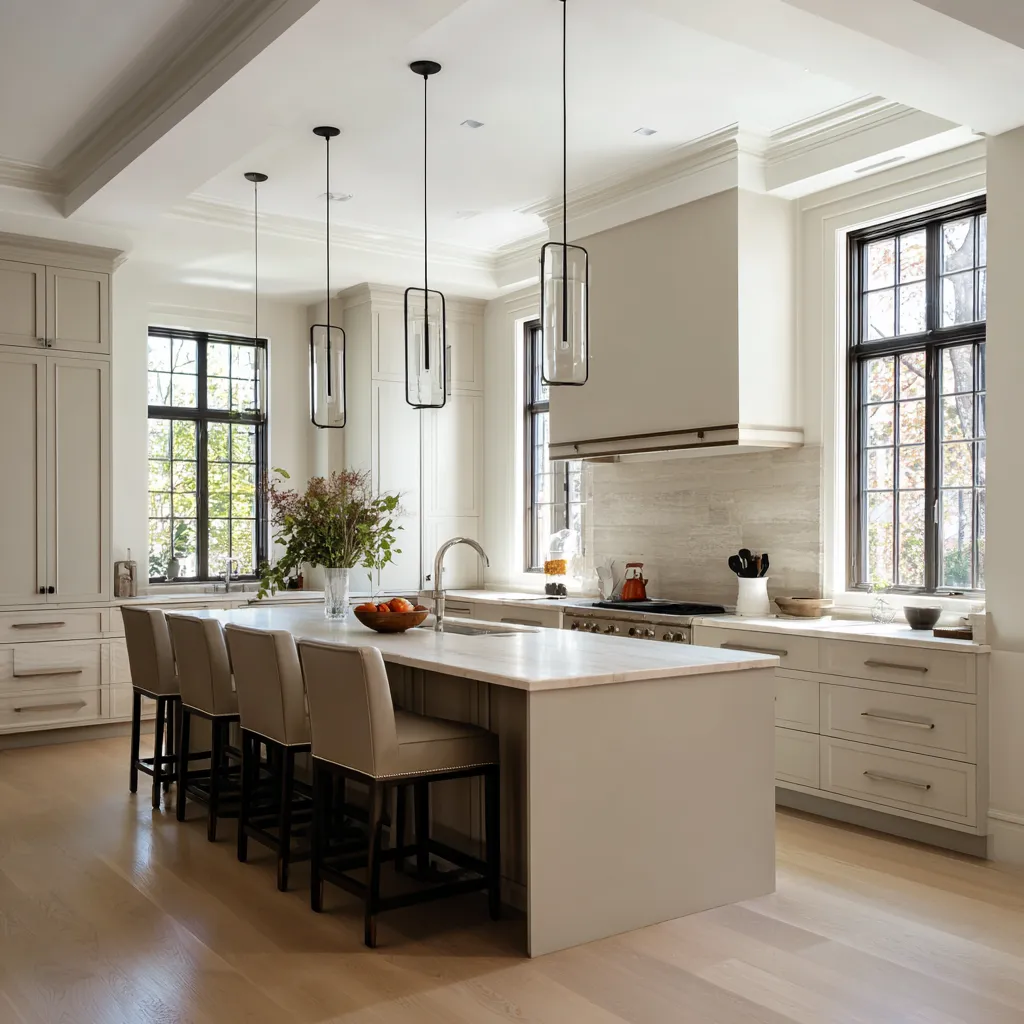
The hood wall is the design anchor
One of the main design ideas for modern Georgian kitchens is to treat the range wall as the main architectural center. In older Georgian rooms, one wall often carried greater weight than the others.
It might hold a chimney breast, a mantel, or a centered opening with strong symmetry. In the kitchen, the hood can take over that role.
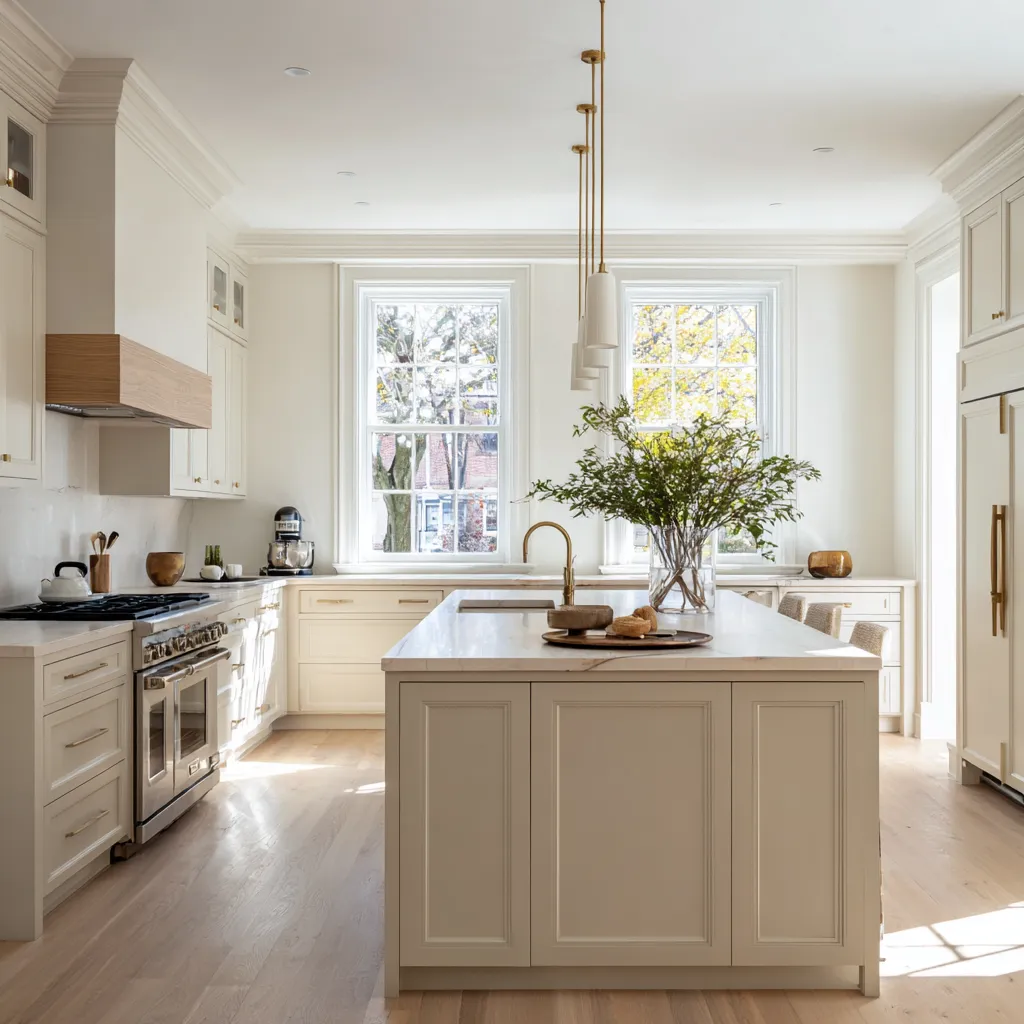
That does not mean the hood needs ornament piled onto it. Quite the opposite.
It can be broad, simple hood forms with very little decoration. The power comes from mass, placement, and framing.
A wide hood set on axis, flanked by cabinetry, windows, or columns, immediately gives the room authority. It turns the working wall into a formal composition instead of a broken collection of practical elements.
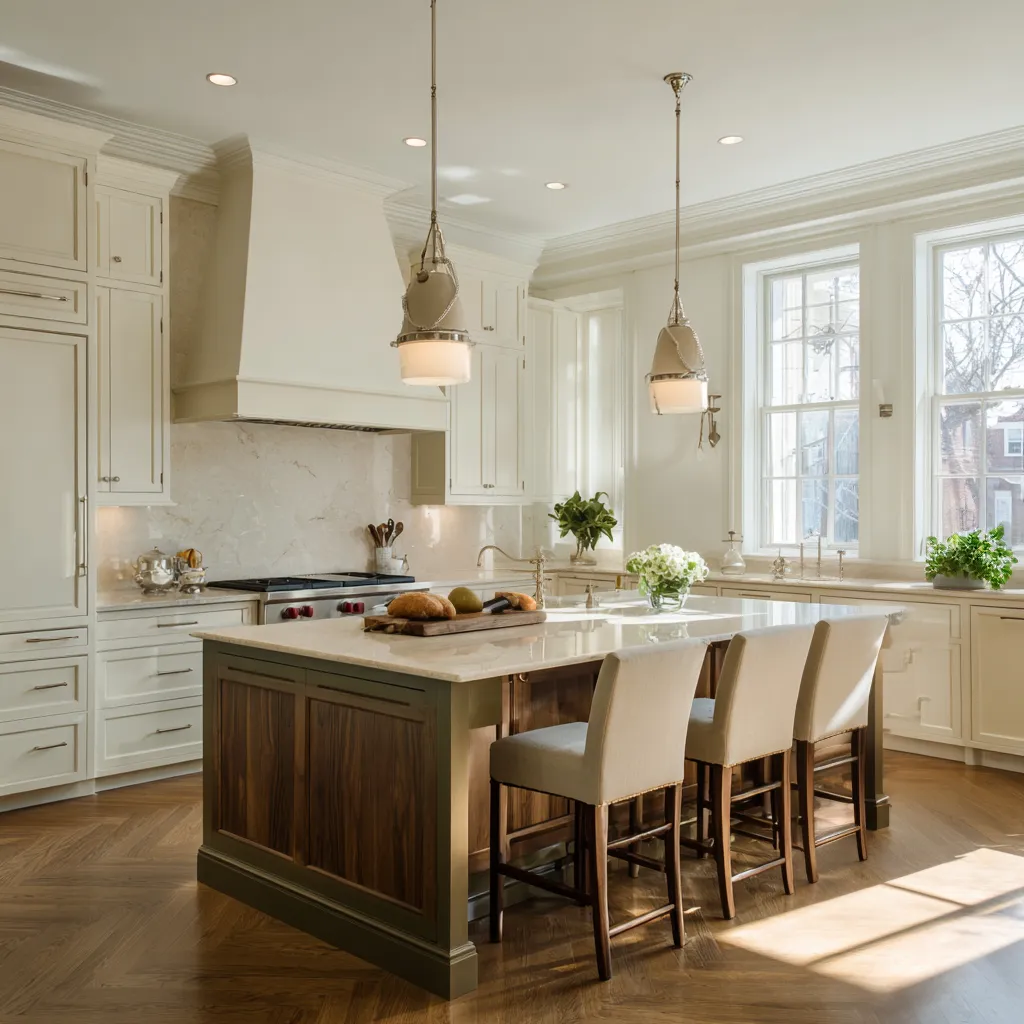
This keeps a Georgian kitchen design refined while making it current. Rather than copying period detail literally, the design keeps the old logic of centered wall importance.
A hood can be squared, tapered, softly shaped, timber-faced, pale and merged into the wall, or more stone-led. The exact form can shift.
The deeper principle stays the same: one wall must organize the room.
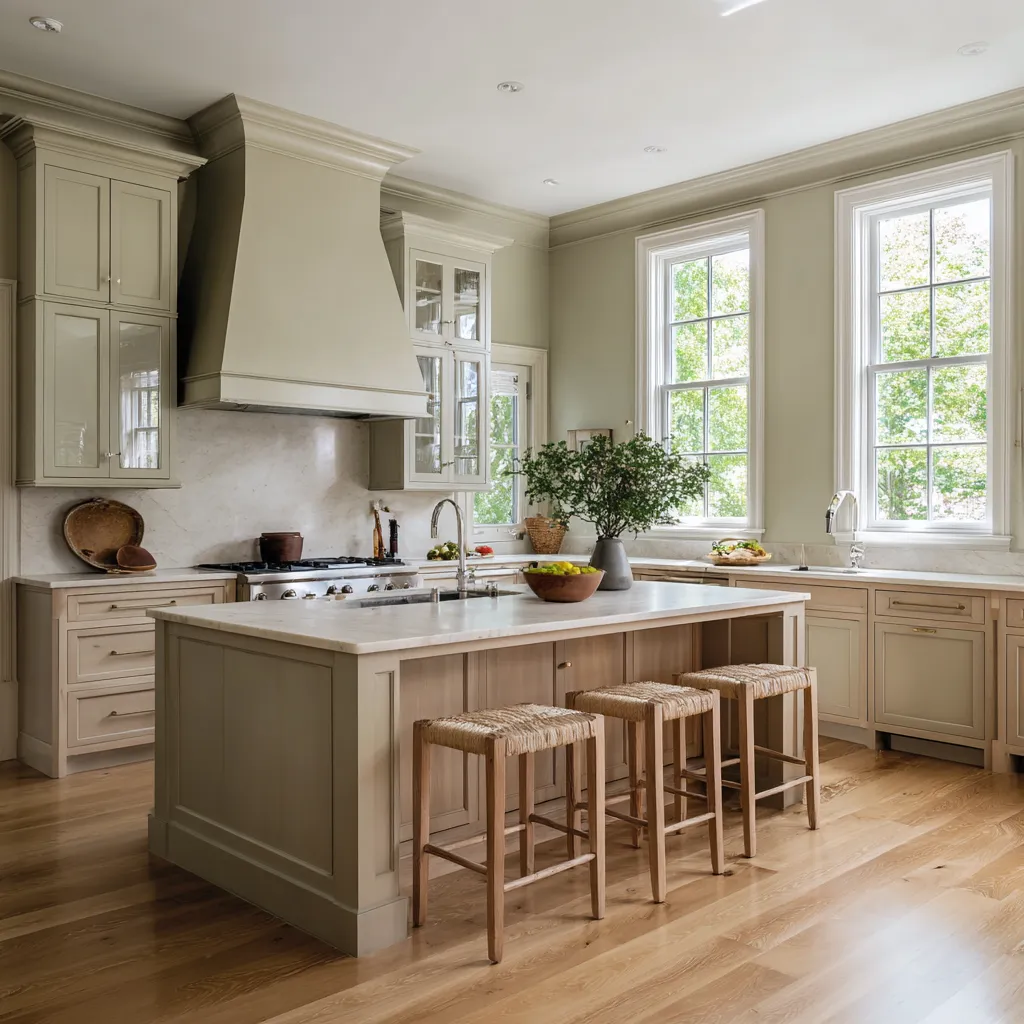
Palette: close range of colors
Modern Georgian kitchens can rely on compressed tone. Instead of bouncing between many strong colors, they can stay within a close range of creams, ivories, taupes, soft greiges, pale mineral whites, warm putty notes, and blond oak.
This is one reason they look settled. The room is held together by small value shifts rather than by abrupt contrast.
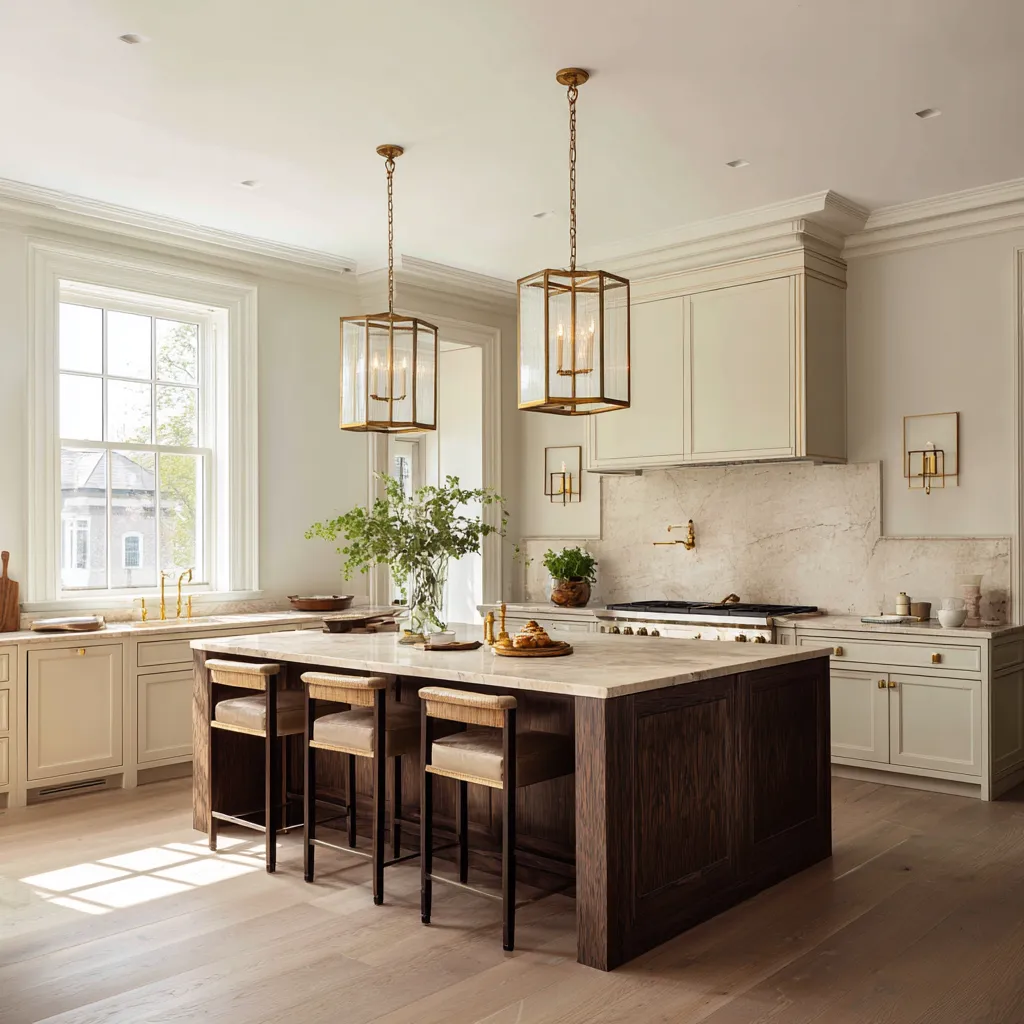
A close palette also suits Georgian architecture well because it lets shadow do more work. Moldings, panel edges, cornices, and window reveals become visible through relief rather than through dramatic color change.
That creates a more polished result than painting every architectural feature in high contrast.
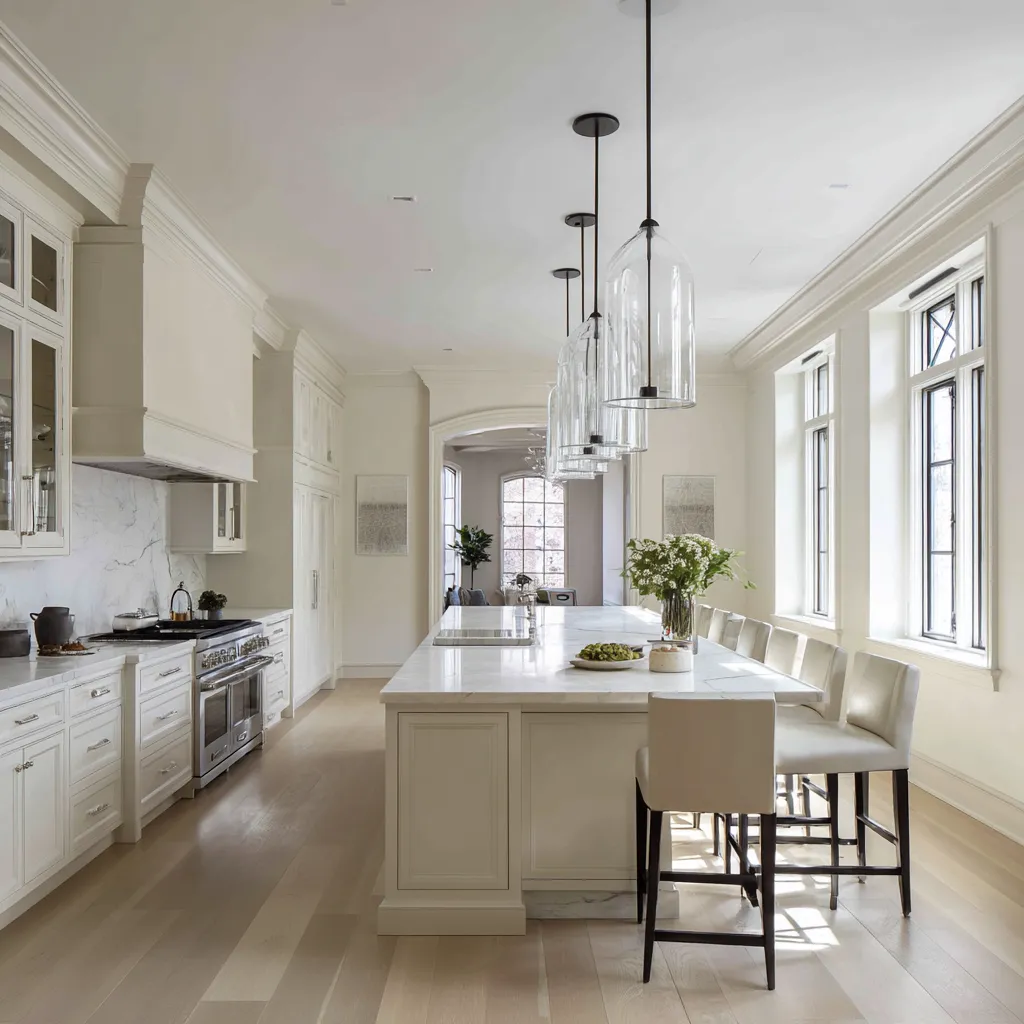
This does not mean the room must be flat. It only means the main field should stay coherent.
Once the tonal base is steady, other moves become more powerful. A darker floor can ground the lower half of the room.
A deep stone island can become a major center. Black-framed windows can sharpen the perimeter.
A muted colored island can hold attention without creating chaos. In other words, restraint in the main palette gives later decisions more force.
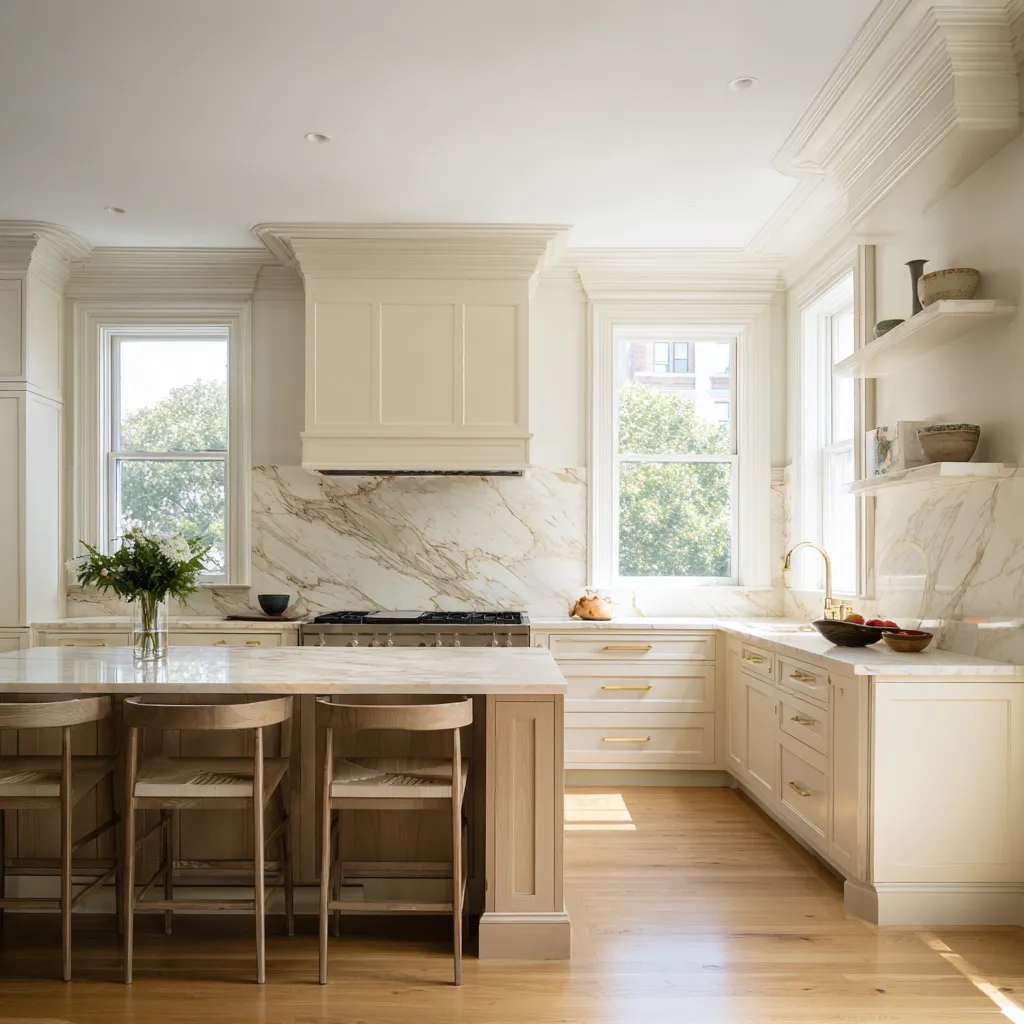
Warmth comes from material contact
Hospitality can be built through material presence before it is built through bright color. A design can stay almost entirely pale and still feel deeply welcoming if it includes the right tactile notes.
Timber brings the center forward. Woven stools stop the room from feeling too polished.
Leather seating adds depth and a lived-in quality. Ribbed wood, honed stone, brushed metal, and softly figured mineral surfaces all help the room feel inhabited.
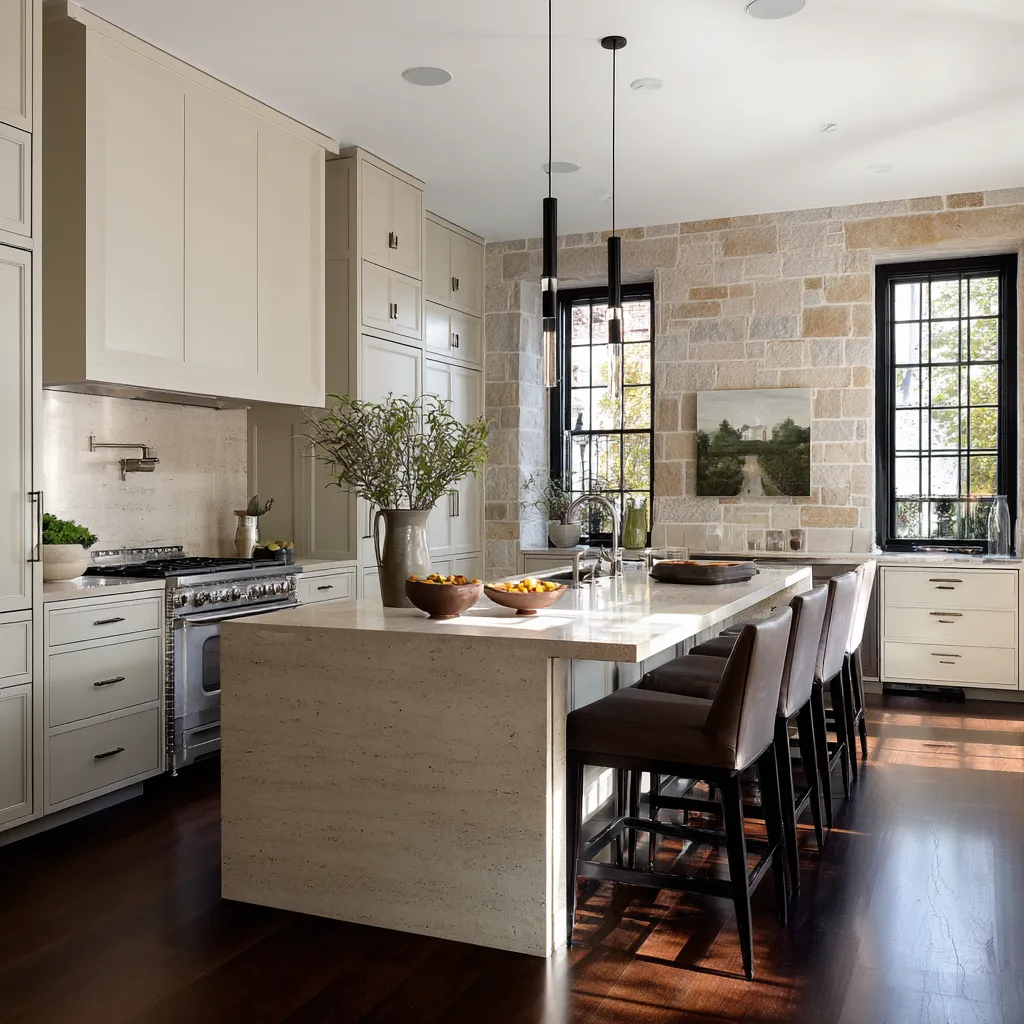
This is why some pale kitchens feel generous and domestic while others feel cold. The difference is not always color.
It is often the surface mix. A creamy kitchen with flat painted cabinetry, glossy stone, and nothing fibrous or warm can feel distant.
That same kitchen becomes far more inviting once a timber island base, woven seating, a matte floor, or a softly textured backsplash enters the composition.
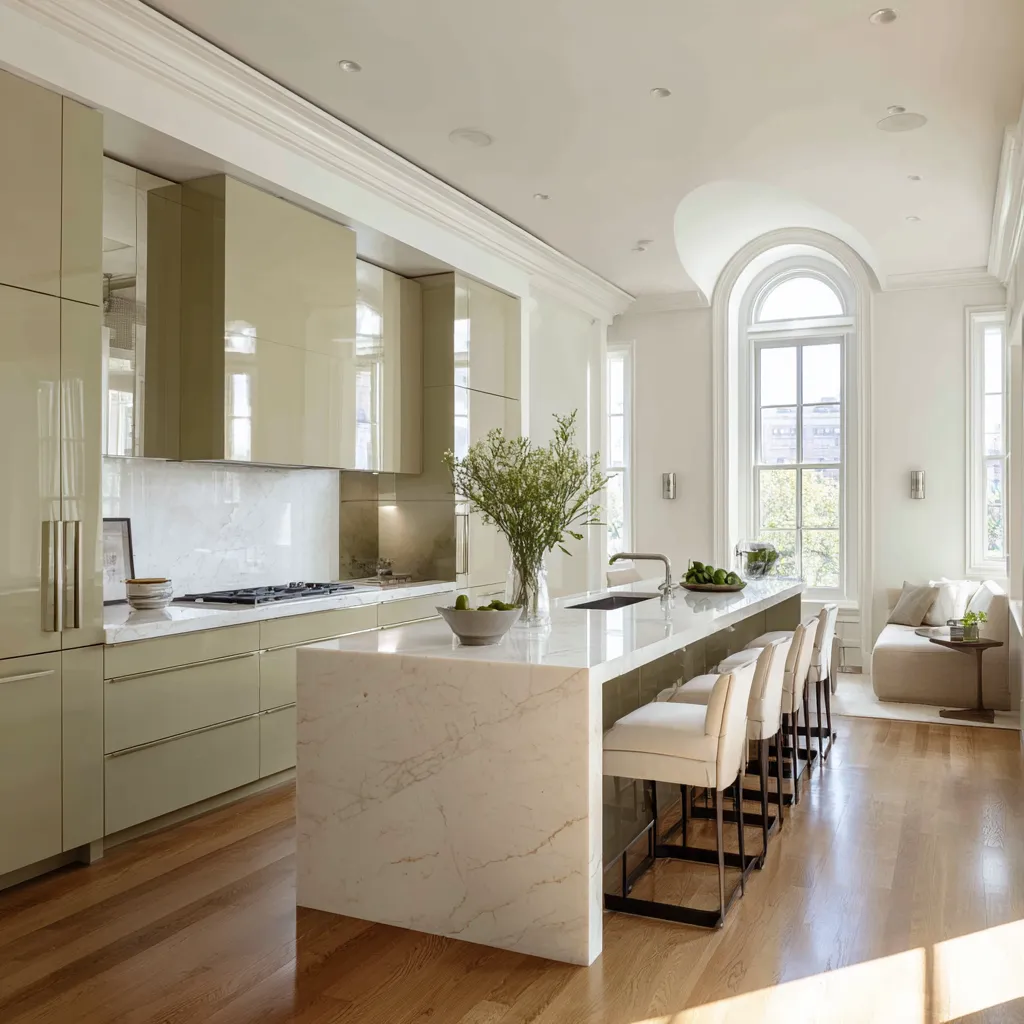
In Georgian interiors, this material warmth is especially important because the architecture already brings discipline. Without softer natural elements, the room can become too formal.
With them, the space holds both order and comfort at the same time.
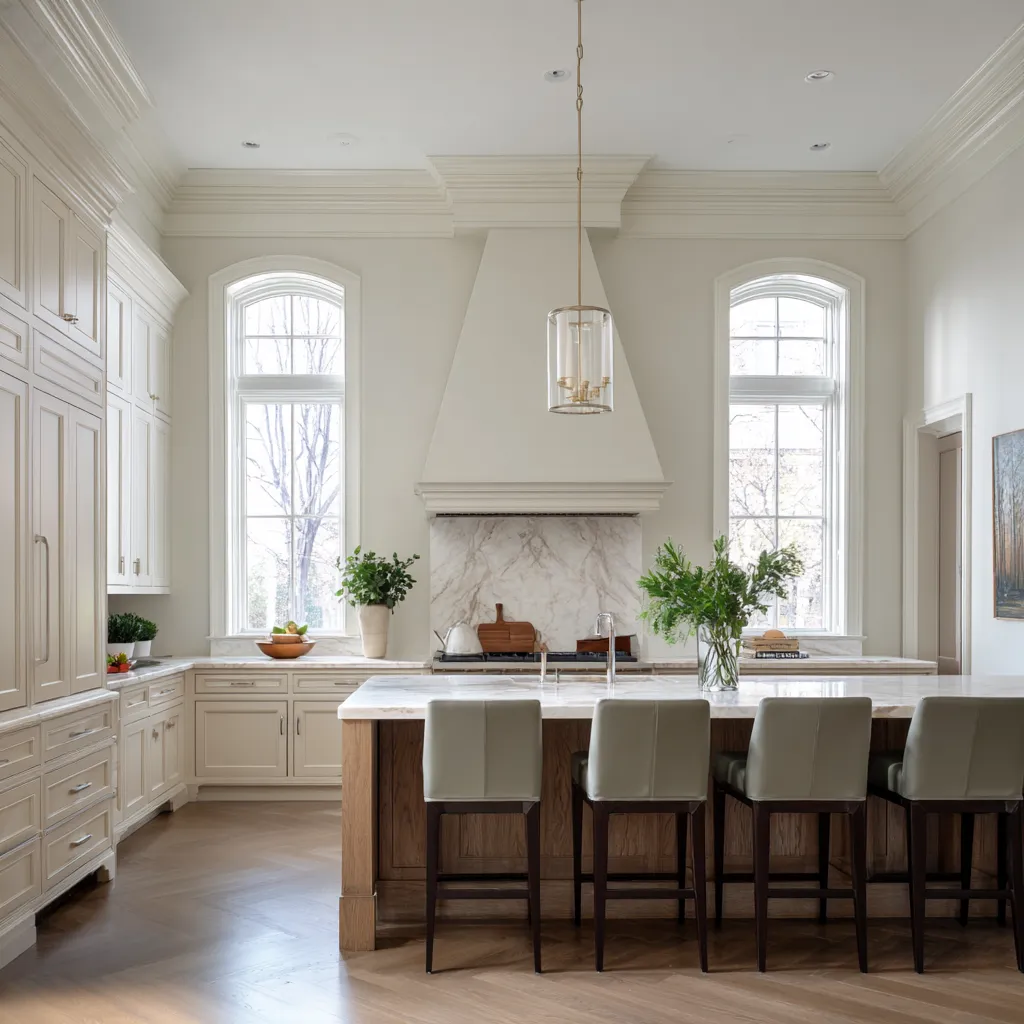
The island should behave like furniture
In modern kitchens, the island has become a social center. That is one of the biggest shifts in how kitchens operate today.
Older Georgian rooms were often organized around central furniture pieces placed inside strong architectural envelopes. In current kitchen setups, the island plays that role.
It is not simply a prep counter. It often functions like a table, a gathering point, a place for breakfast, work, conversation, and daily spillover.
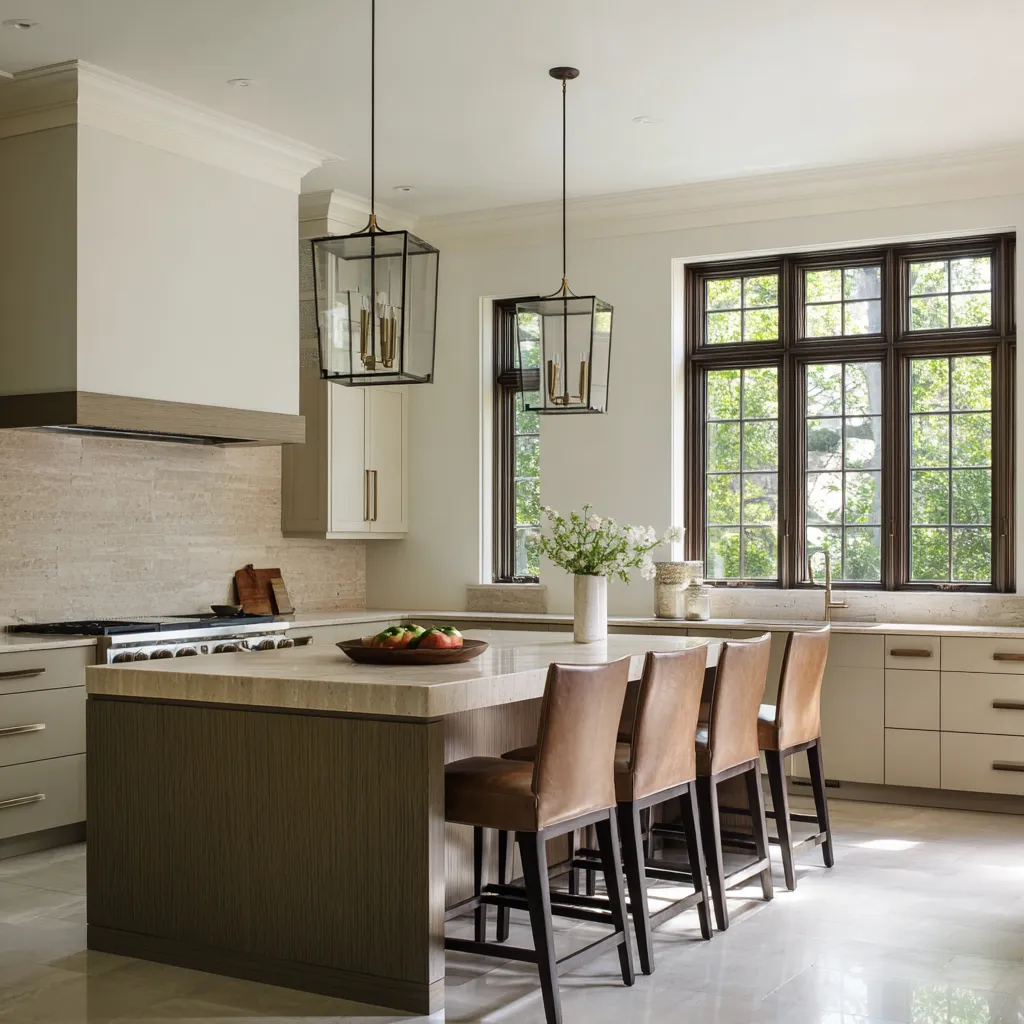
The island’s size should suit the room. Their placement supports the main axis.
Their material treatment gives them enough gravity to stand at the center. They can be timber based, almost like grand worktables capped with stone.
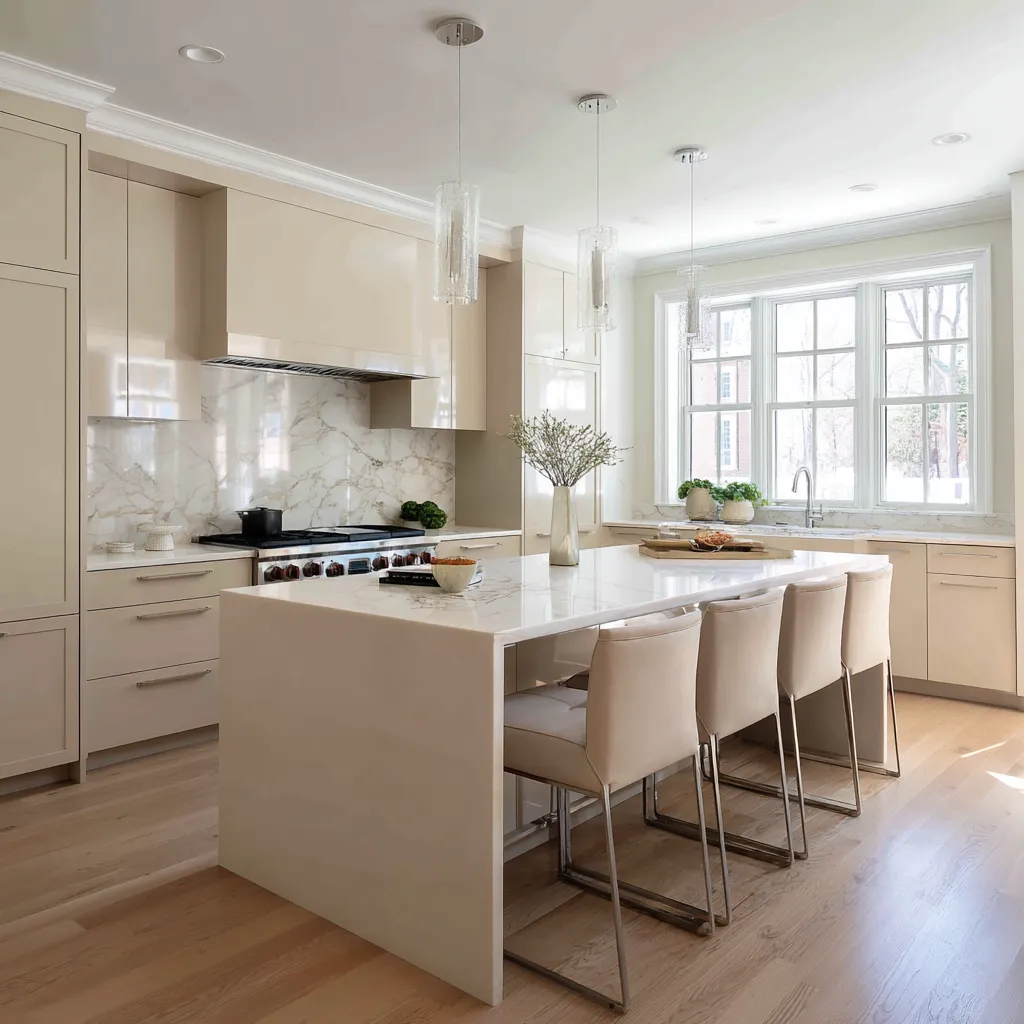
Pale and monolithic are also options. Some can use slab ends for a more current edge.
Others can carry one concentrated color field. Important, that they still feel like they belong to the room’s architecture.
This furniture-like quality matters. In a Georgian setting, the island should not look accidental or overly technical.
It should feel as though the room wanted one large object at its center, and this is the right one.
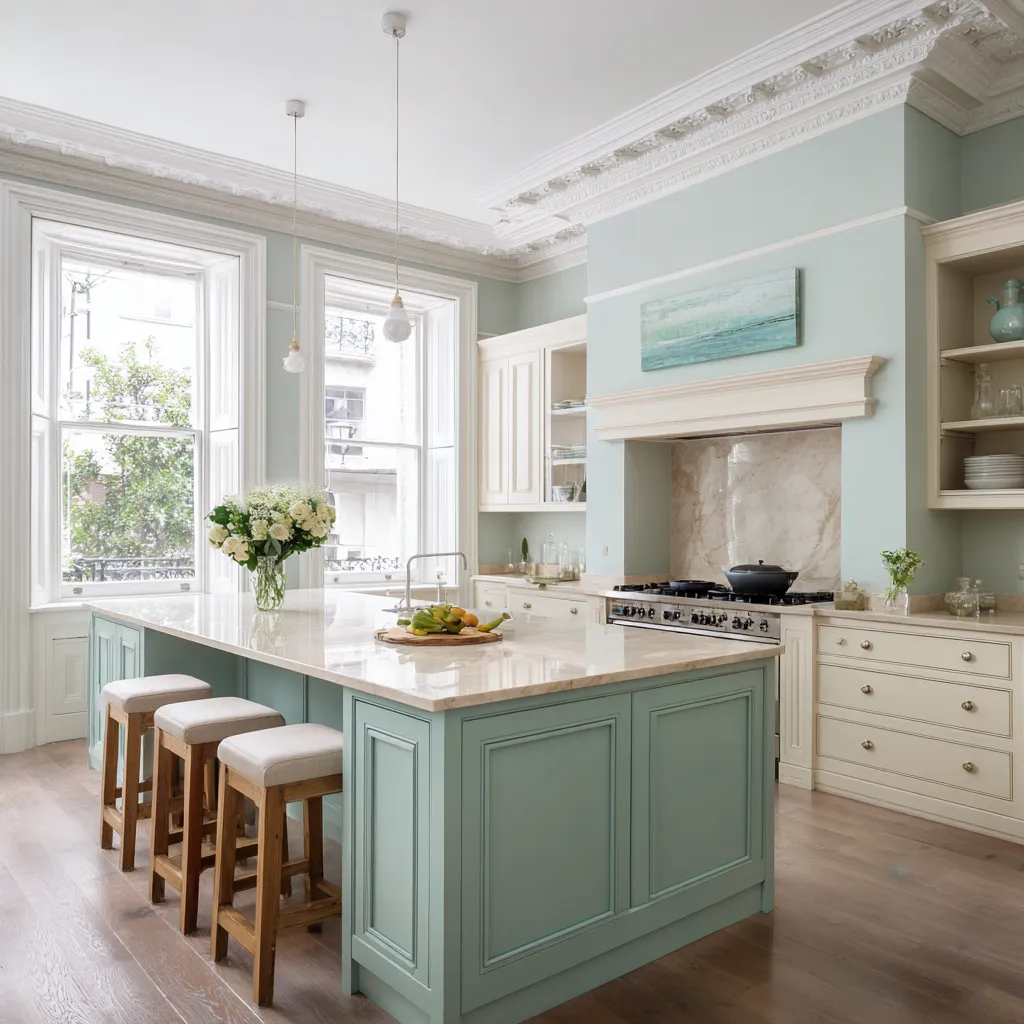
Minimalism works only when something else carries depth
A reduced kitchen can work beautifully inside a Georgian shelarchitecturel, but only if the room keeps enough thickness elsewhere. Flat-front cabinetry, slab forms, waterfall stone, concealed storage, and pared-back detailing can all suit this style.
The problem starts when reduction becomes removal of everything that gives the room body.
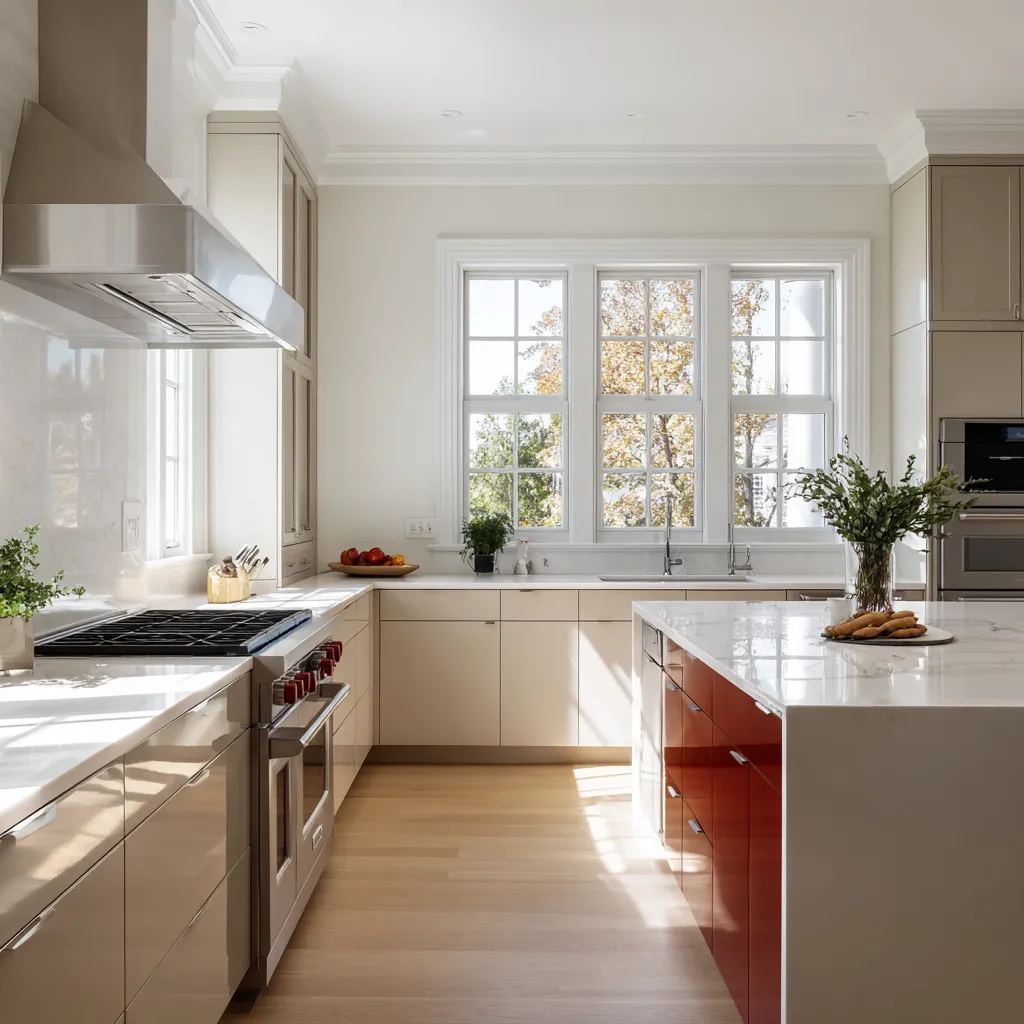
A minimalist Georgian kitchen still needs some kind of ballast. It might be a pronounced cornice, a strong hood mass, darker timber, a richer stone, textured flooring, or a masonry wall with real surface depth.
Without that counterweight, the room risks losing both warmth and architectural seriousness. Restrained kitchens usually hold onto one or two grounding elements.
A pale smooth cabinet wall can work if the floor has depth. A broad blank hood can work if the room has strong windows and good proportions.
A very reduced island can work if the stone has weight and the stools add material softness. The balance matters far more than the label.
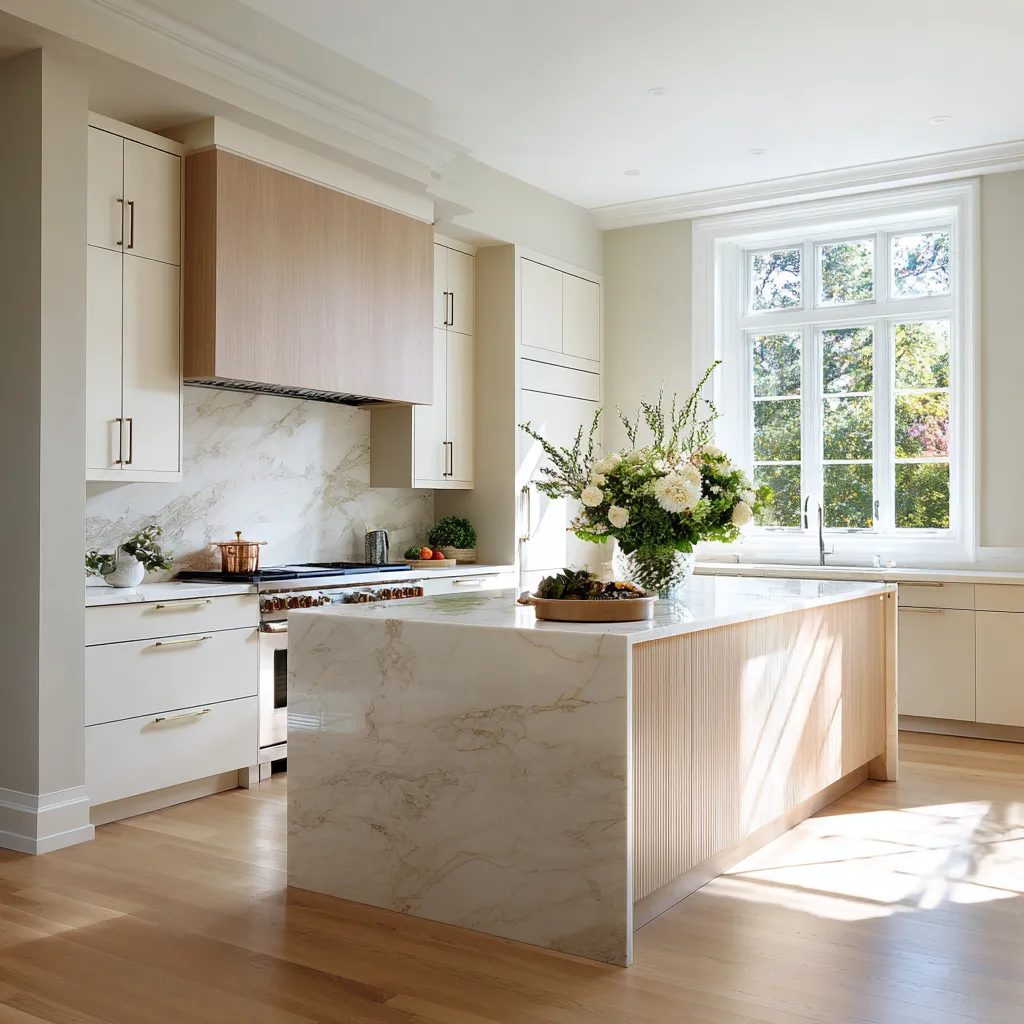
Choose one update path: dark outlines or one block of color
Modern Georgian kitchens often update the old framework in one of two ways.
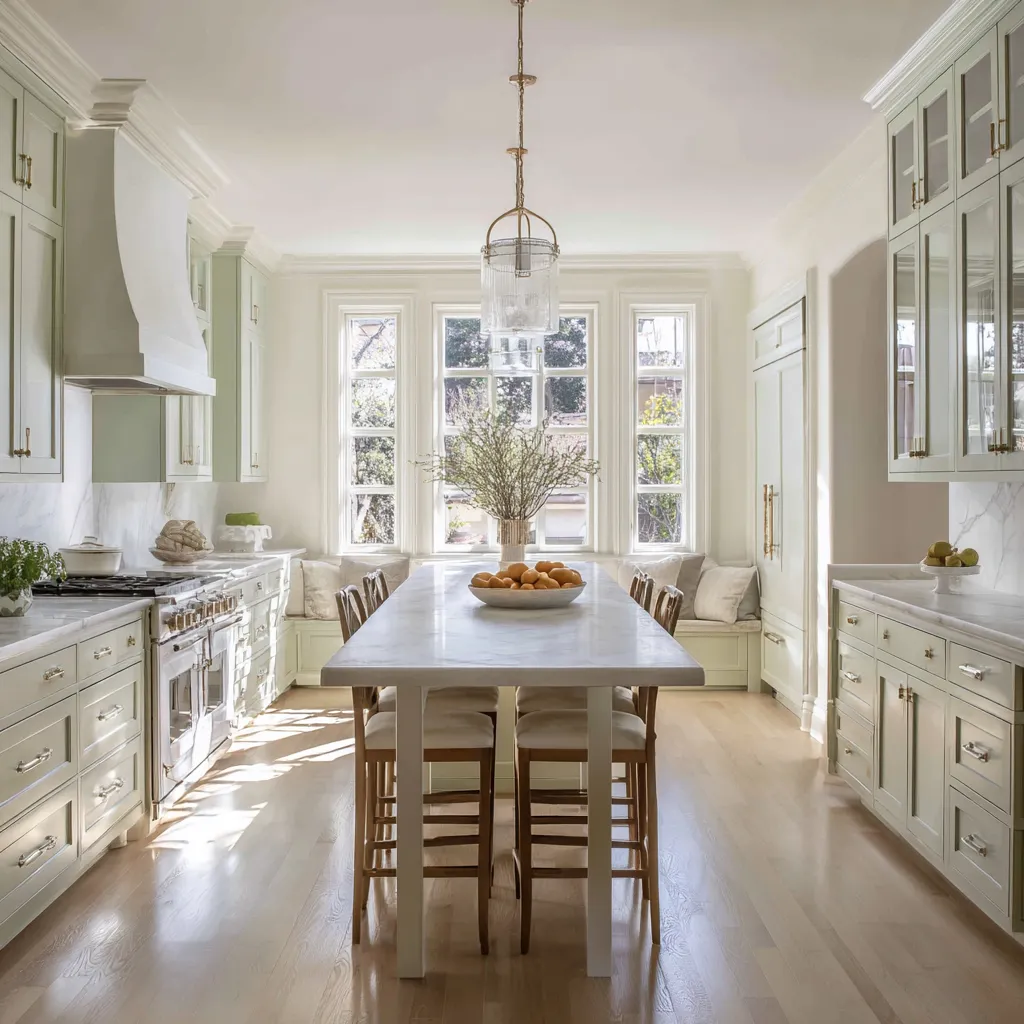
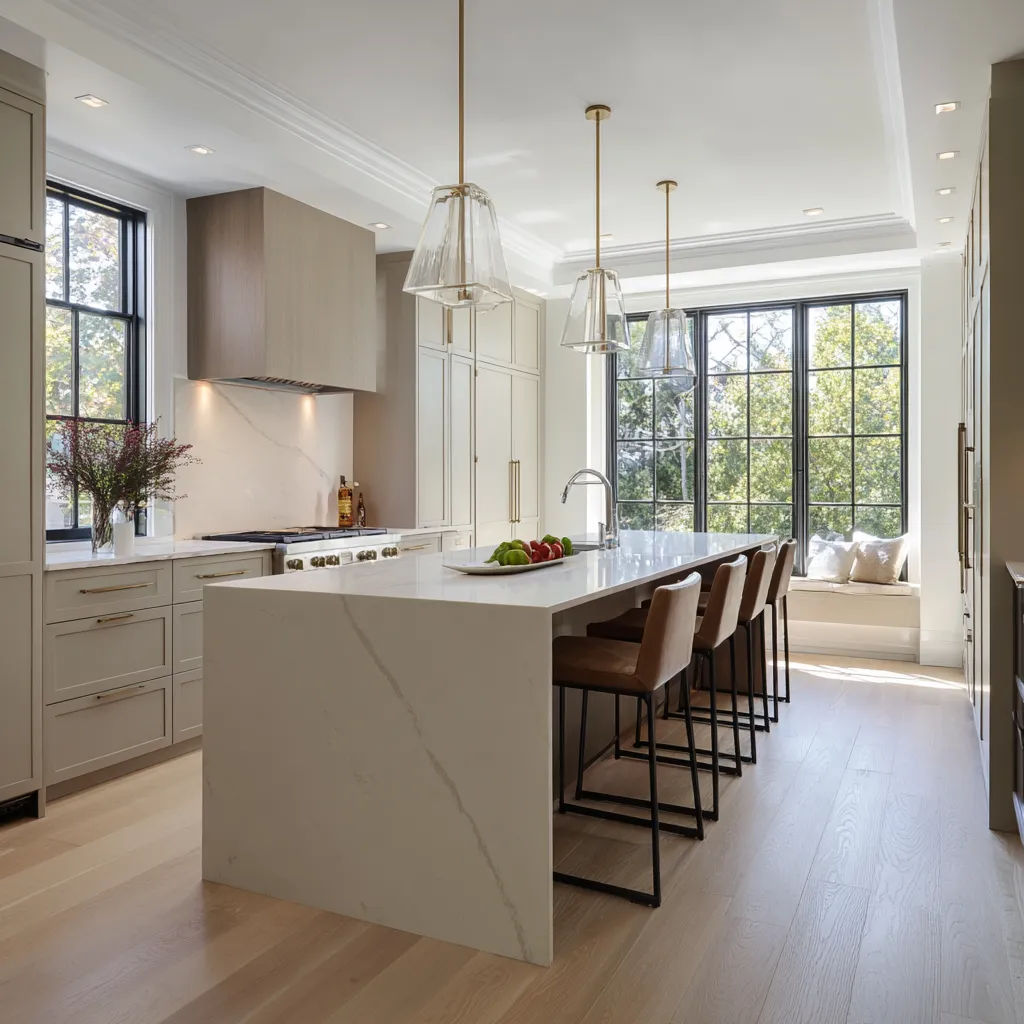
The first path uses dark outline and graphic definition. Black-framed windows, dark floors, slender dark pendants, lantern structures, or darker stool bases create a crisp edge inside a pale room.
This approach gives the kitchen more architecture in a visual sense. It sharpens openings, strengthens silhouettes, and gives the room a more tailored linework.
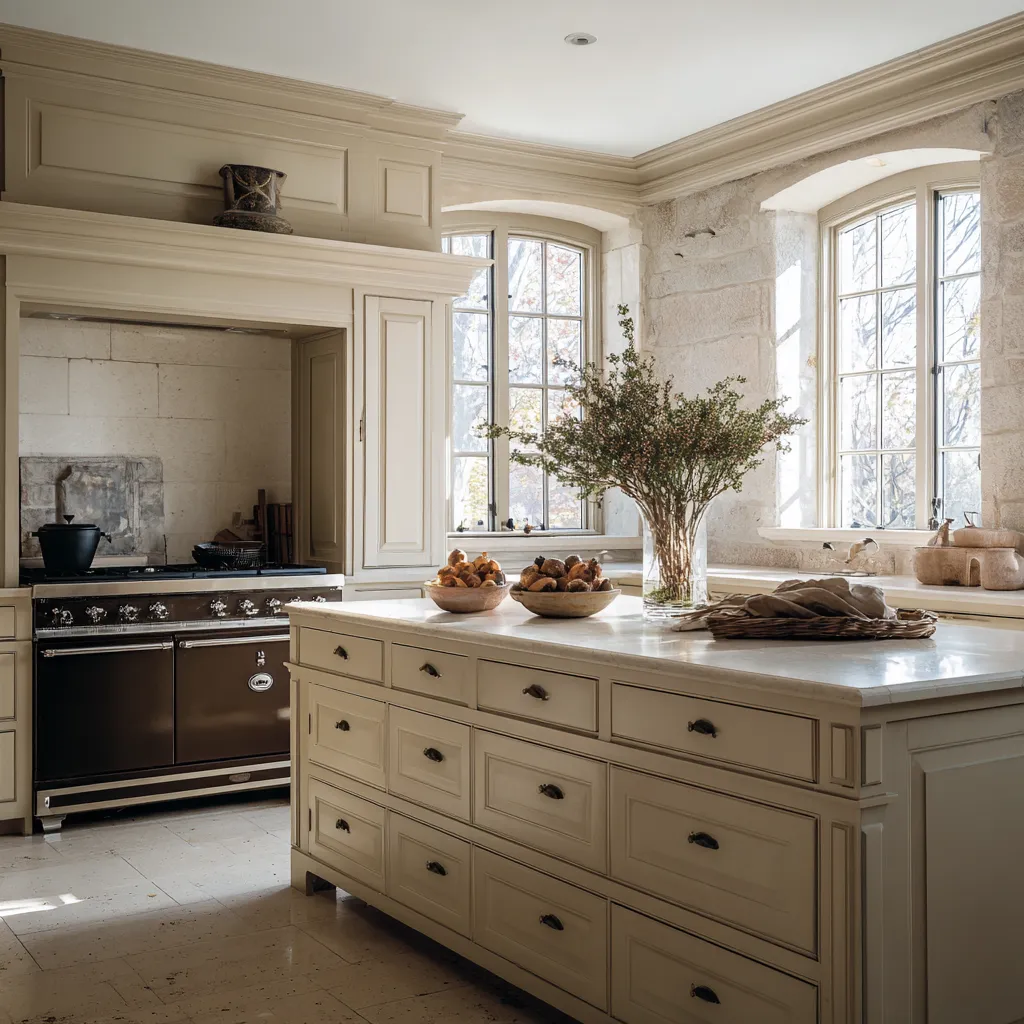
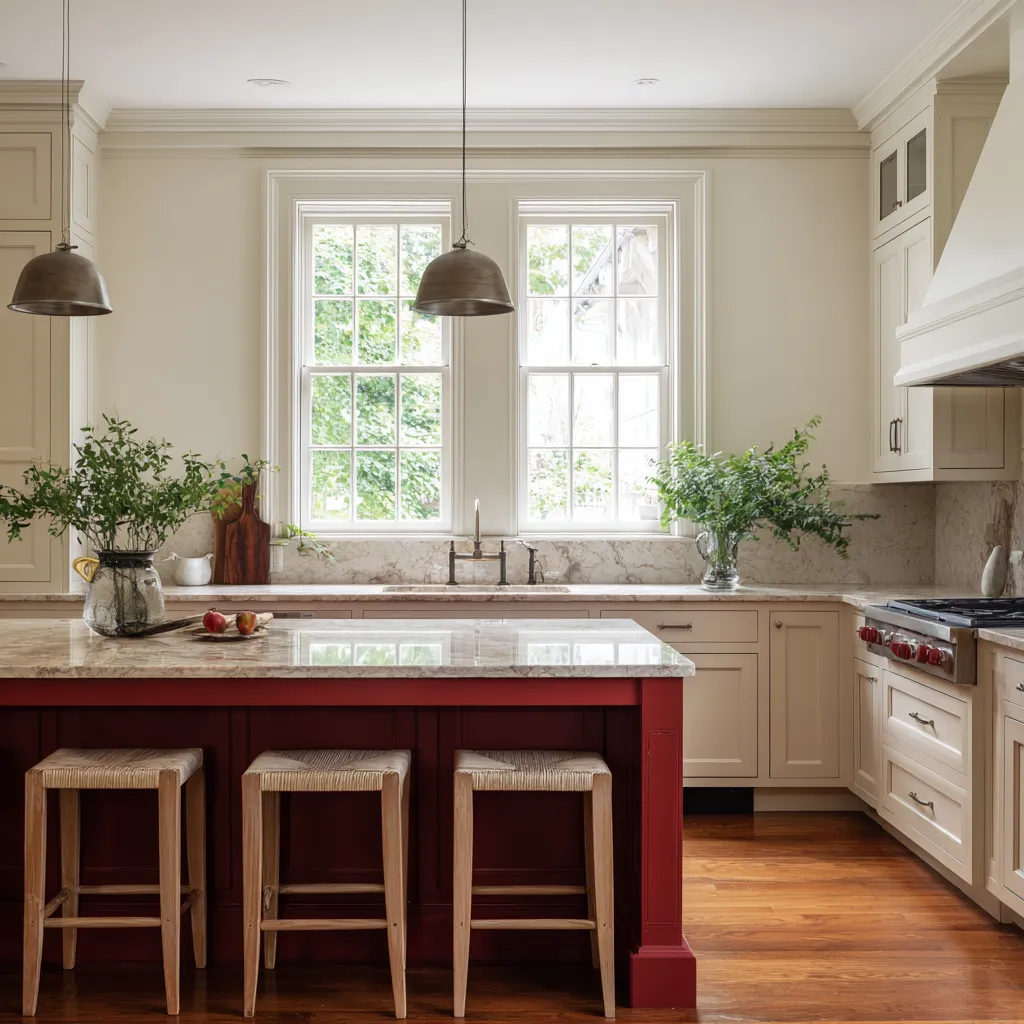
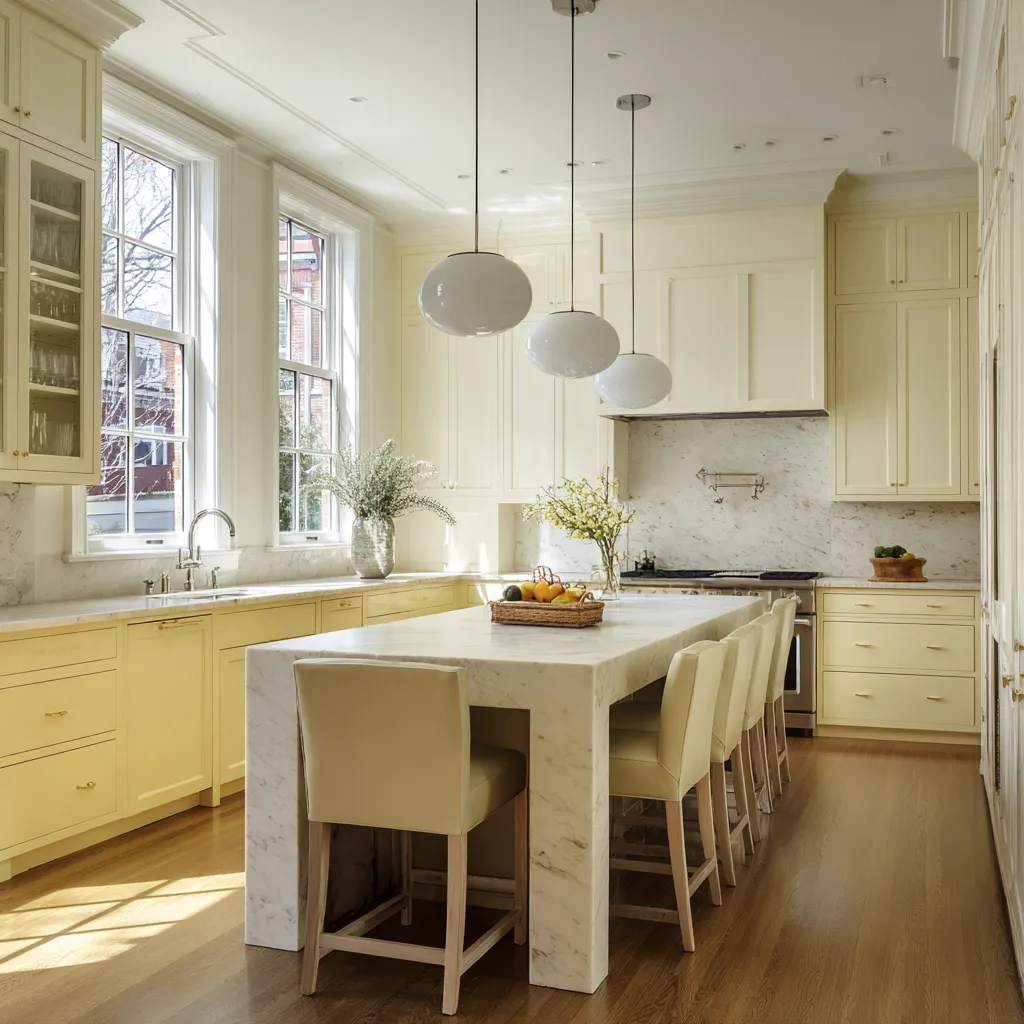
The second path uses one concentrated field of color. A blue island, an oxblood island, a muted yellow lower run, a teal hood wall, or a soft mauve cabinet envelope can all work well if the color is placed as one composed mass.
This is very different from scattering many colorful accessories around the room. The color needs weight and location.
It should behave like part of the room’s structure.
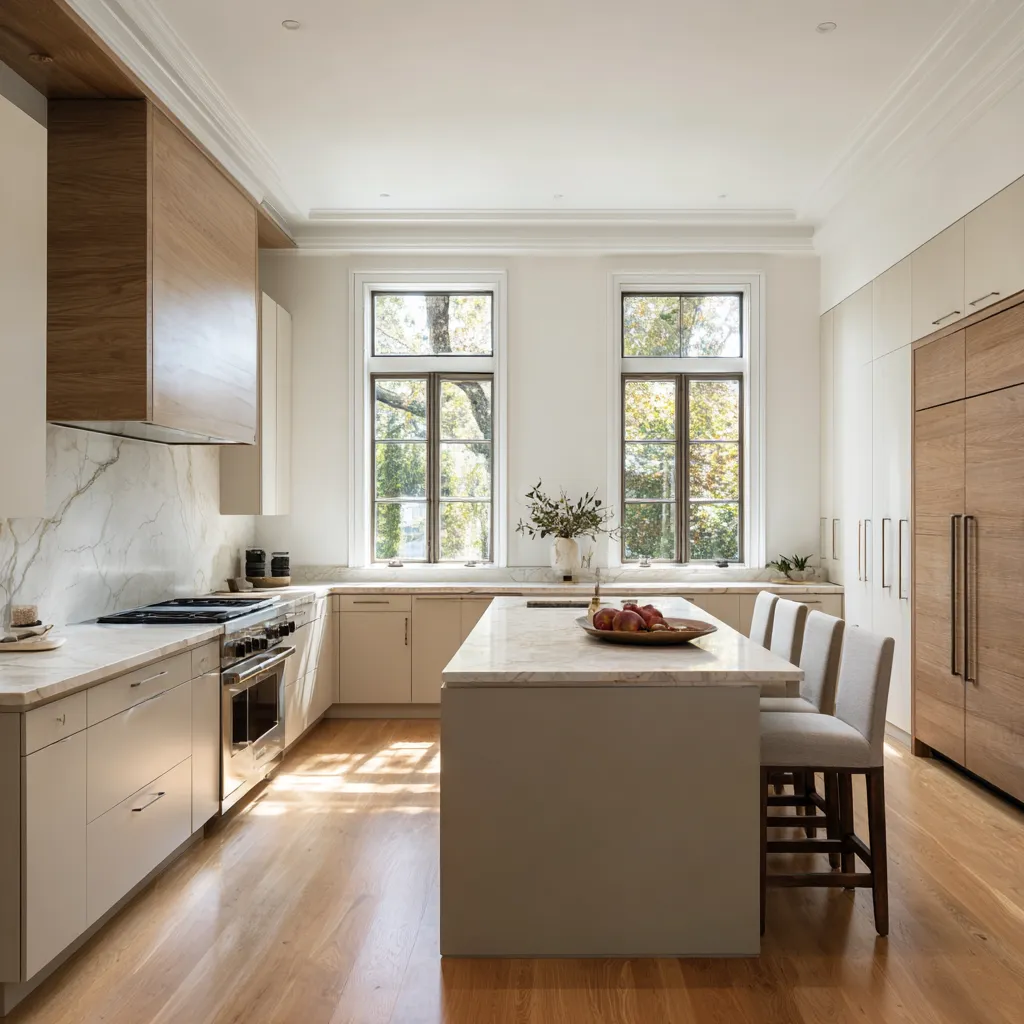
What usually works less well is pushing both systems hard at the same time. A kitchen with strong black outline, strong floor contrast, and a heavy colored block can become too insistent unless the architecture is very controlled.
The polished kitchen design concepts typically choose one main route and let the other play a smaller part.
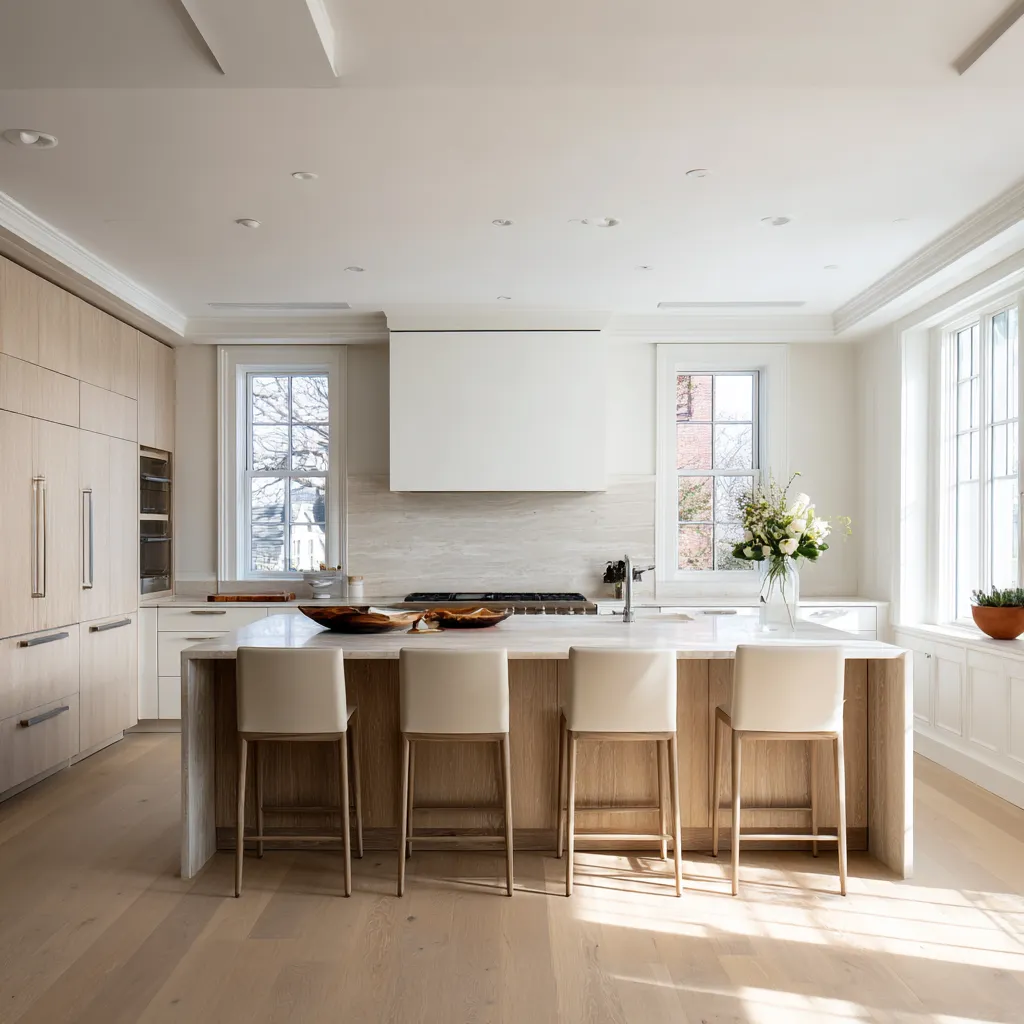
Color as architecture
Color can be very effective in a Georgian kitchen design, but the best use is moderate and concentrated. That means one painted island, one lower cabinet run, one chimney-like wall field, or one coordinated pair such as island and sink base.
It does not usually mean many different accents spread around the room. This works because Georgian designs respond well to clear mass.
A single colored block has compositional dignity. It becomes part of the room’s structure.
It can anchor the center, deepen one wall, or tie the island to another element. A field of soft blue or green can look especially strong when set inside pale architecture because the surrounding shell remains calm.
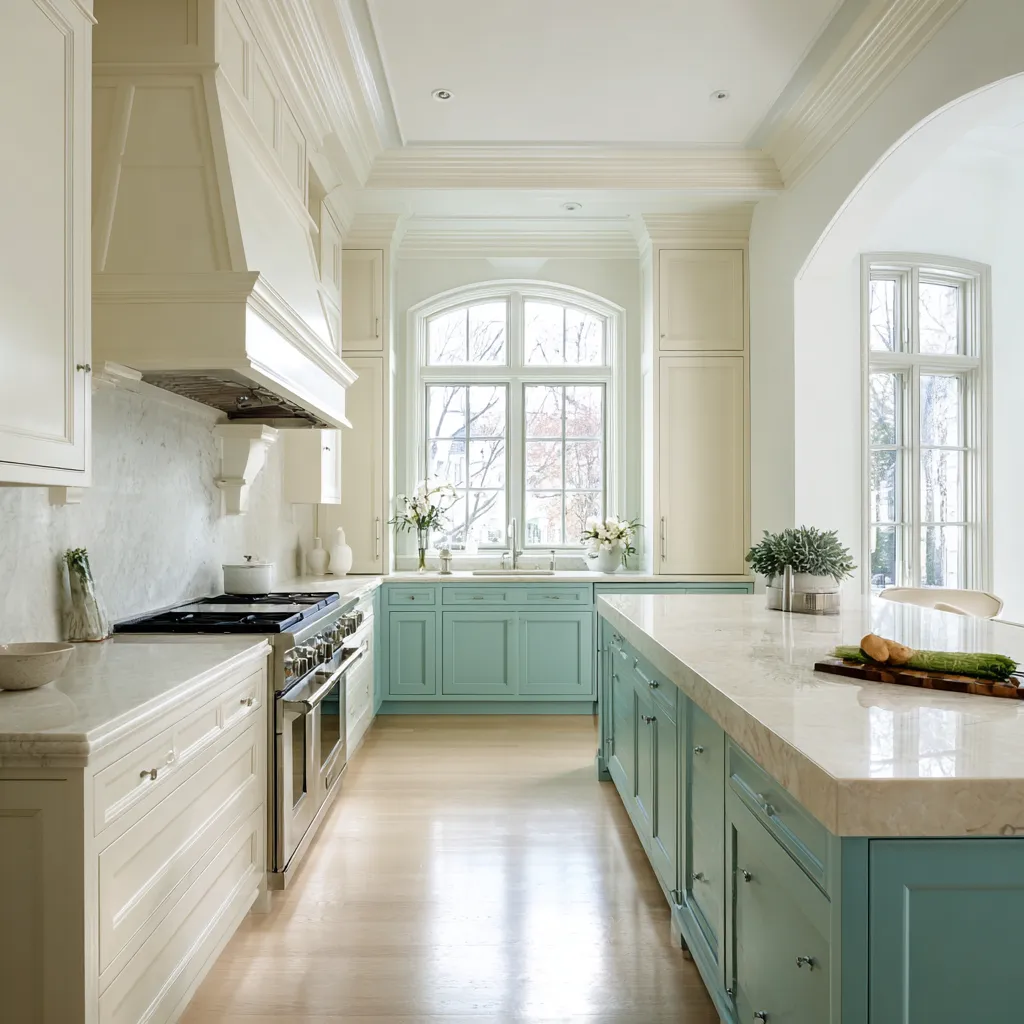
The exact color family can shift depending on the mood you want. Soft greens and blue-greens often feel domestic and fresh.
Oxblood or deeper red-browns give more gravity. Muted yellow brings warmth and daylight response.
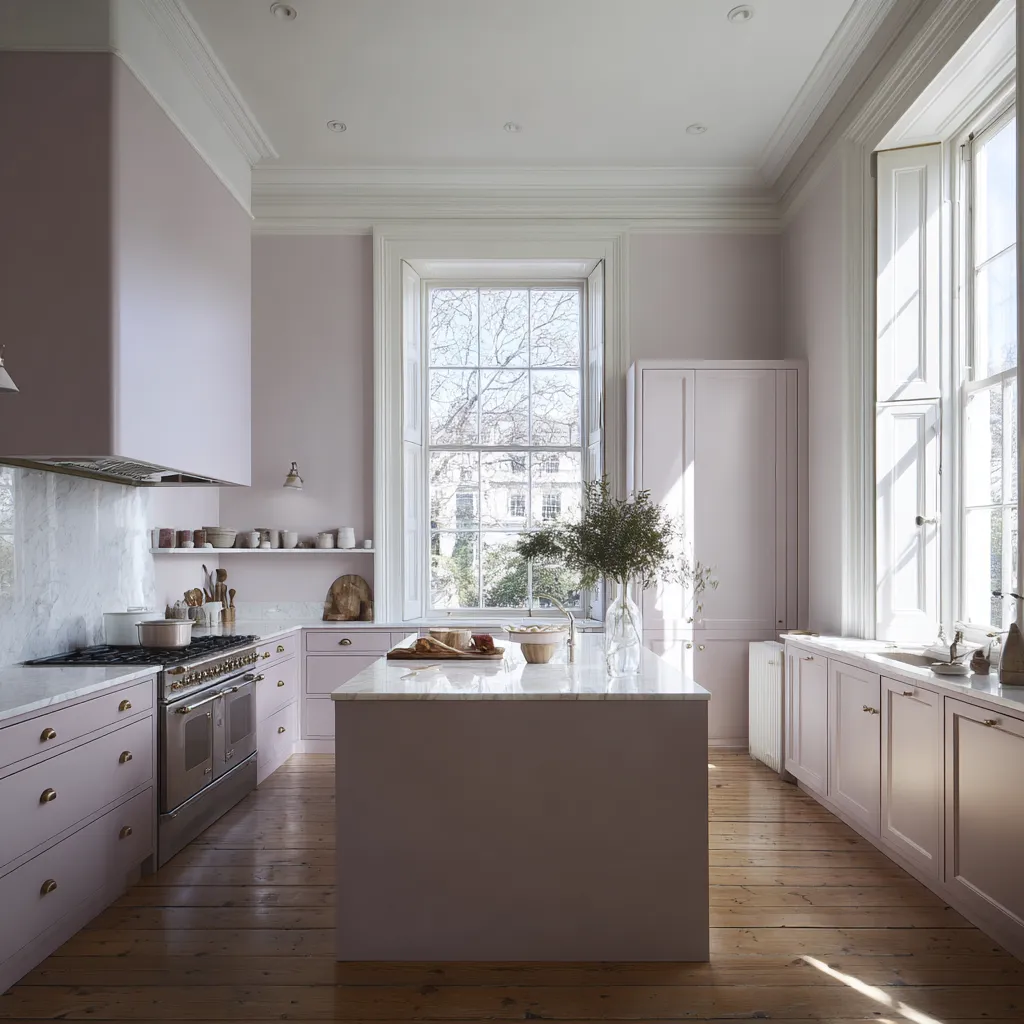
Mauve-lilac can feel airy and unusual if the room has enough height and crisp stone to support it. The key is discipline.
Color should be placed with intent and given breathing room around it.
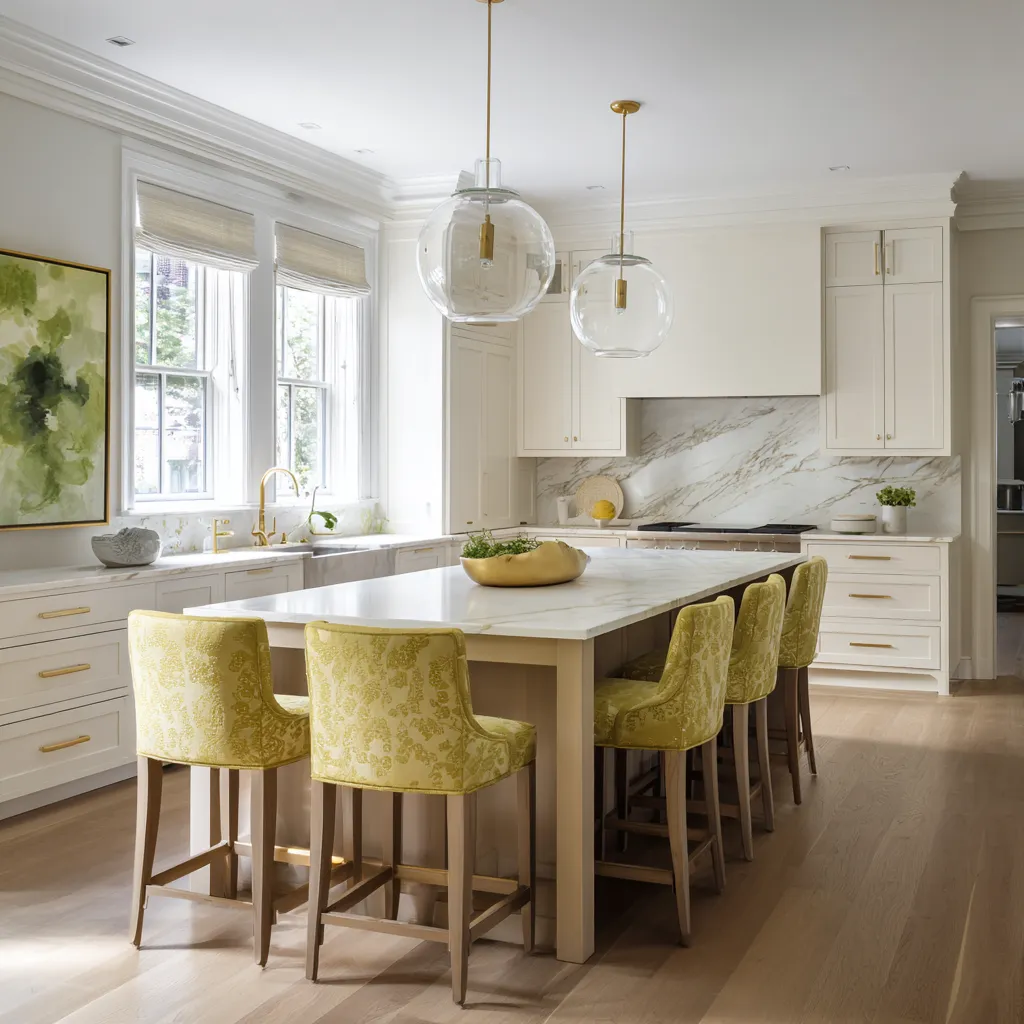
Quick color guidance for modern Georgian kitchens
| Color route | How to use it well | What it pairs with | Effect on the room |
|---|---|---|---|
| Cream and warm white | Use on most of the shell and cabinetry | Oak floor, pale stone, brushed metal | Clean, classic, flexible |
| Putty, taupe, pale greige | Use for cabinetry when white feels too sharp | Travertine-like stone, bronze, leather | Softer and more grounded |
| Muted blue-grey | Use on a single island or lower run | Warm stone, oak, woven seating | Calm color with structure |
| Soft green | Use as a cabinet field or a controlled island color | Brass, pale marble, warm timber | Domestic and fresh |
| Oxblood or red-brown | Use only on one central object such as the island | Aged metal, dark floor, pale shell | Richer and more grounded |
| Muted yellow | Use on lower cabinetry or select central pieces | Honey-toned floor, pale stone, soft cream walls | Light-filled and cheerful |
| Dusty mauve or lilac | Use only in rooms with strong height and clear stone contrast | White stone, warm wood floor, very limited styling | Gentle, unusual, airy |
.
Curves soften the room and make it more social
Arches, globe pendants, rounded stools, softened hood profiles, and curved openings all help a Georgian kitchen design become friendlier. They reduce some of the strictness that can come from heavy symmetry and strong wall order.
This is especially useful if the kitchen is meant to feel like the heart of the house rather than a more ceremonious room.
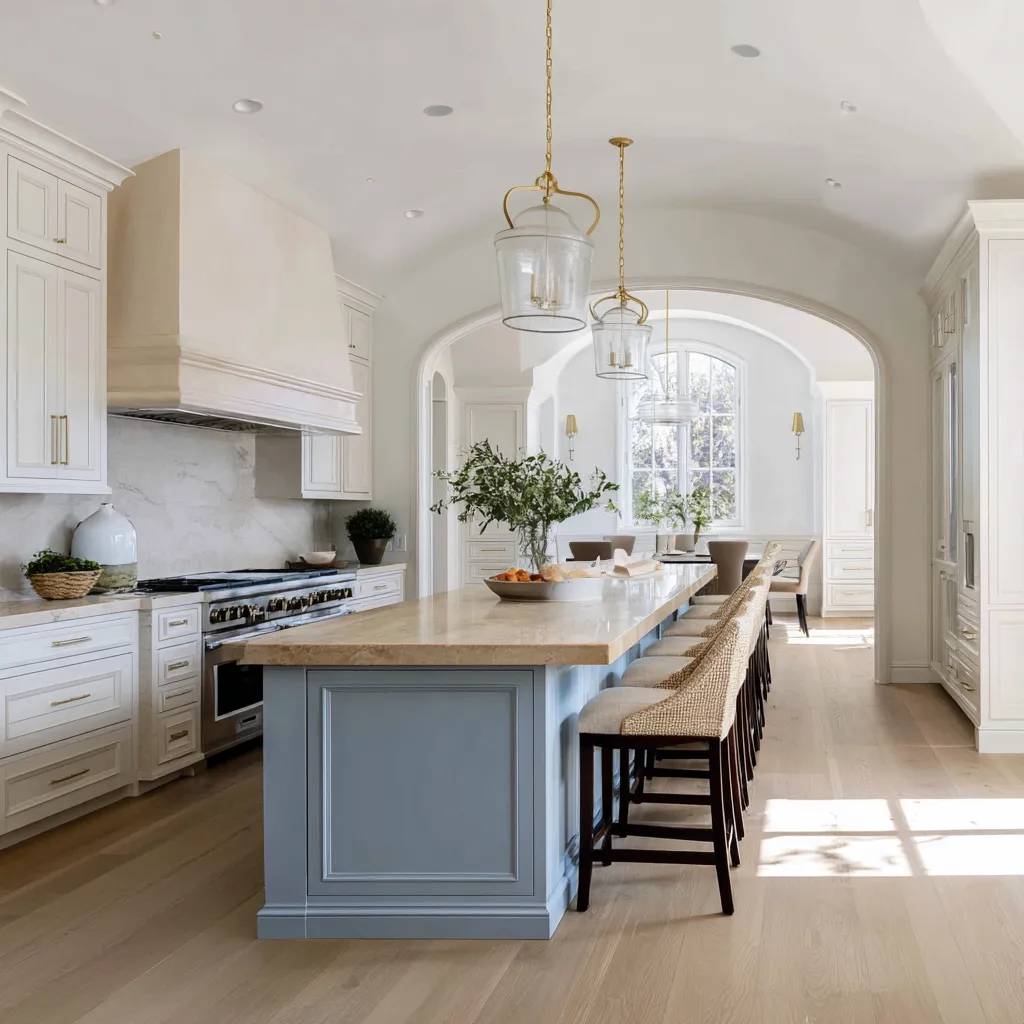
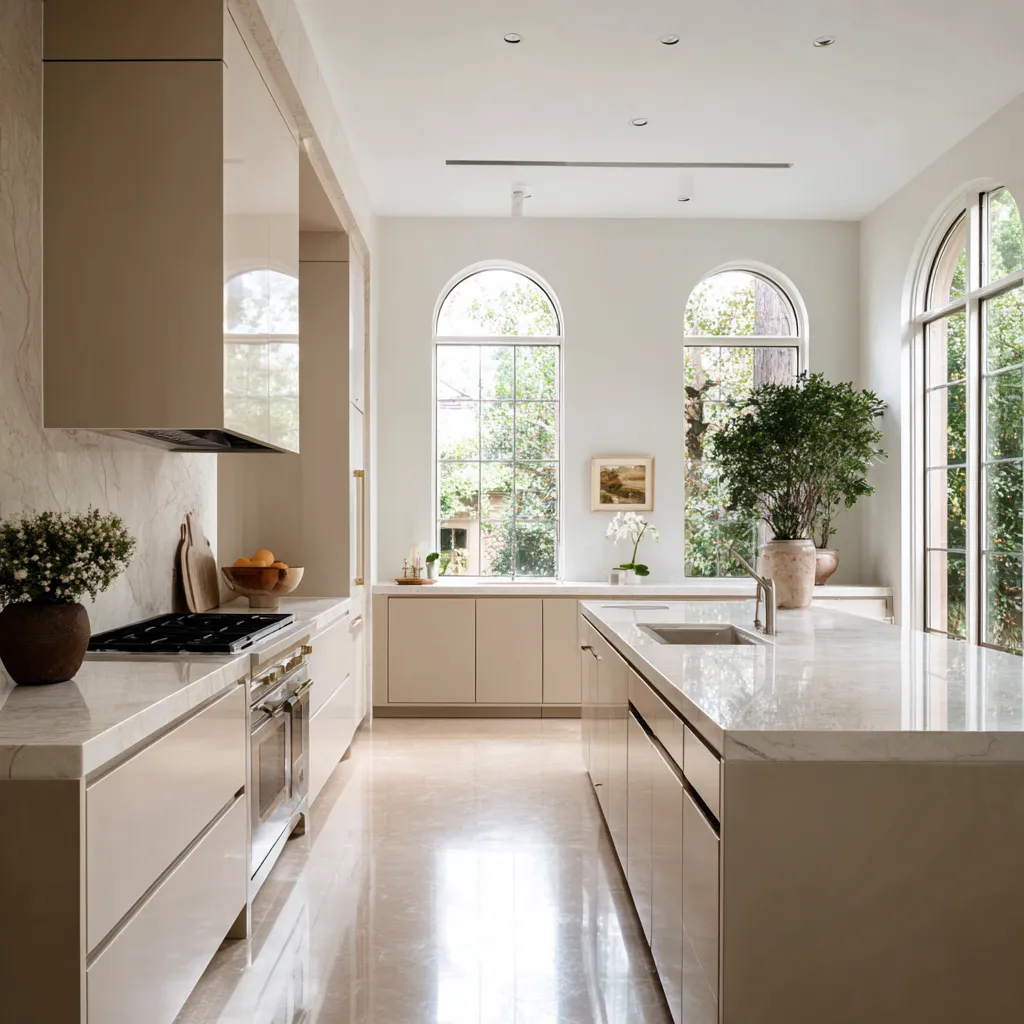
A tall arched window at the far end of a kitchen can make the whole room feel more welcoming. Globe pendants can soften a rectilinear shell.
A shaped hood can introduce form without relying on ornament. Curved or upholstered seating turns the island into a place people want to stay, not just pass by.
Still, curves should be used with awareness. They increase hospitality, but they slightly reduce severity.
If your goal is a more stately, formal Georgian kitchen, stronger verticals, firmer hood geometry, darker outline, and less softening may be the better path. If your goal is a bright family-centered room, curved forms can make all the difference.
Texture is what stops pale kitchens from becoming thin
Modern Georgian kitchen ideas are often quite light in palette. That puts extra pressure on texture.
Without it, the room can start to look generic. Texture gives pale rooms shape, memory, and visual staying power.
There are many ways to build that depth. Ribbed timber on an island face can add a fine-grained vertical cadence.
Woven stools can interrupt polished stone and painted cabinetry with a drier, handmade note. Honed marble or travertine-like stone can give the backsplash and counters a softer, older surface character than a high-gloss slab.
Deep window reveals, timber bands on a hood, subtle paneling, and visible grain all help a pale room keep substance.
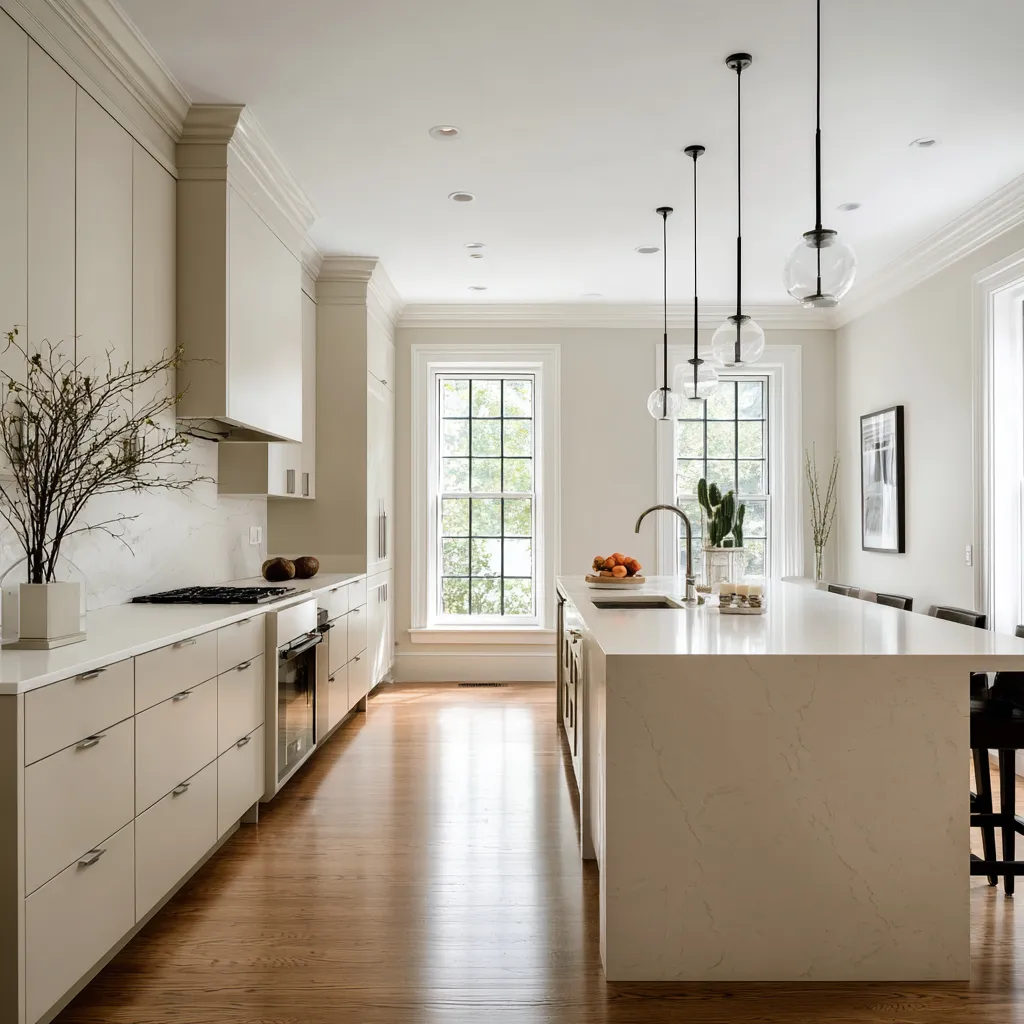
This is also where masonry or heavier mineral treatment can be especially effective. A stone wall, a hearth-like range alcove, or a more geological backsplash can turn a pale Georgian kitchen from merely pretty into something with real presence.
Think in terms of procession, not only layout
Visually, kitchens are not defined first by the island or the cabinetry. They are defined by the way the room pulls you through it.
Long views matter. Repetition matters.
An island aligned with windows, an arch beyond the main room, a bench at the far end, or a pendant sequence running down the length of the island can all strengthen the sense of procession.
This suits Georgian planning naturally. These houses often rely on well-aligned openings and carefully proportioned movement from one room to the next.
A kitchen can keep that quality even with contemporary furniture and finishes. A long marble worktable-like island beside a window wall, repeated glass pendants, and a clear sightline toward an arched opening can make the room feel composed without adding any extra ornament.
This kind of spatial pull is especially useful in longer kitchens. Instead of treating the room as one static box, it turns the length into an asset.
Four strong directions for a modern Georgian kitchen
Although every room is different, there are 4 broad directions:
- The first is the pale processional kitchen: long, airy, spare, and highly ordered, with transparent pendants, close tone, and strong sightlines.
- The second is the balanced Georgian core: pale cabinetry, a centered hood, moderate texture, a warm island, and very little overt color. This is often the most dependable route because it keeps the style clear without becoming severe.
- The third is the material-gravity kitchen: darker windows, more stone presence, stronger hood mass, deeper island centers, and greater tactile density. This route gives the room more authority.
- The fourth is the chromatic domestic kitchen: one composed color block, more woven or upholstered seating, occasional arches or benches, and a more welcoming, everyday mood. This direction often feels especially suited to family life because it combines formality with softness.
None of these directions is automatically better. The right one depends on how much ceremony, warmth, contrast, and sociability the room needs.
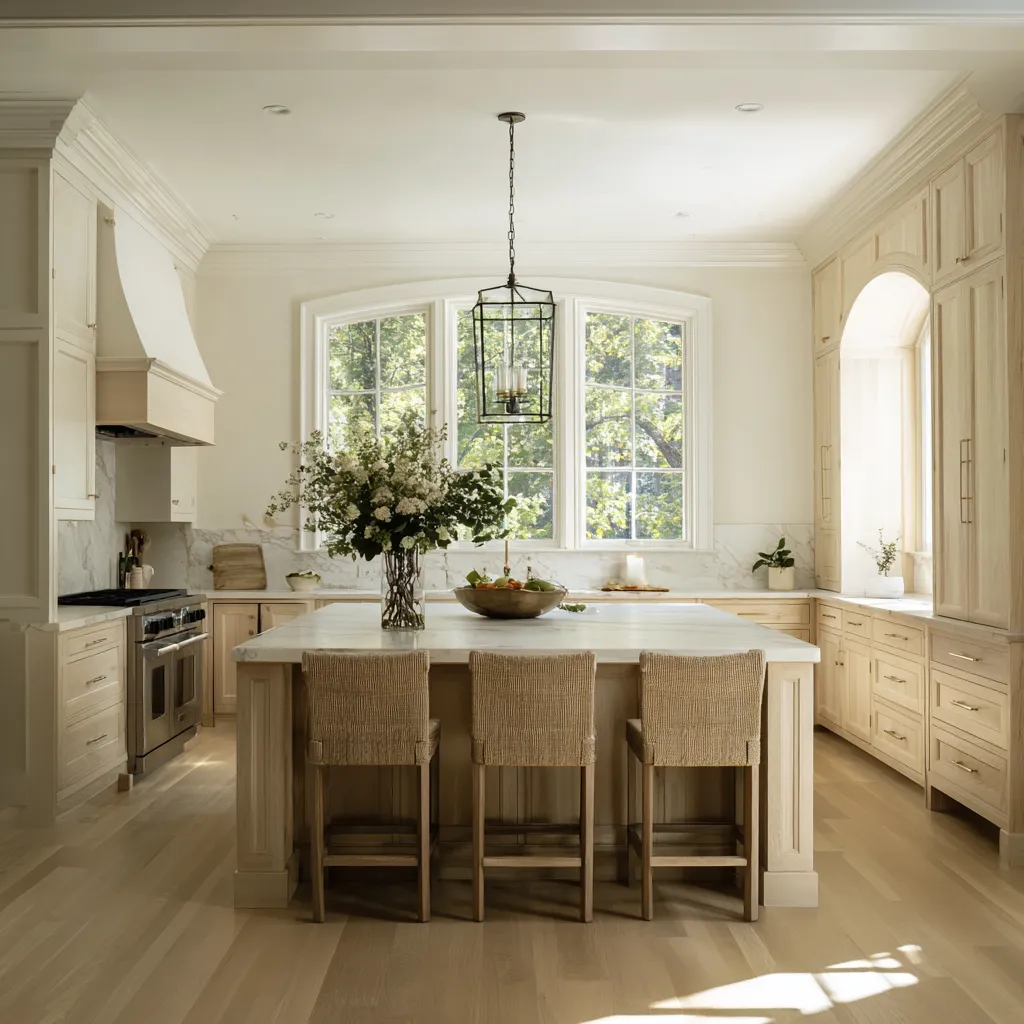
What makes the room hold together
Elegant modern Georgian kitchen designs are not trying to prove how old they are or how current they are. They keep both sides in balance.
The architecture stays legible. The center of the room stays strong.
Warmth arrives through real materials. Color, if used, is concentrated and composed.
Minimal cabinet language is supported by enough texture or shell depth. Curves are added when the room needs ease, not simply for trend value.
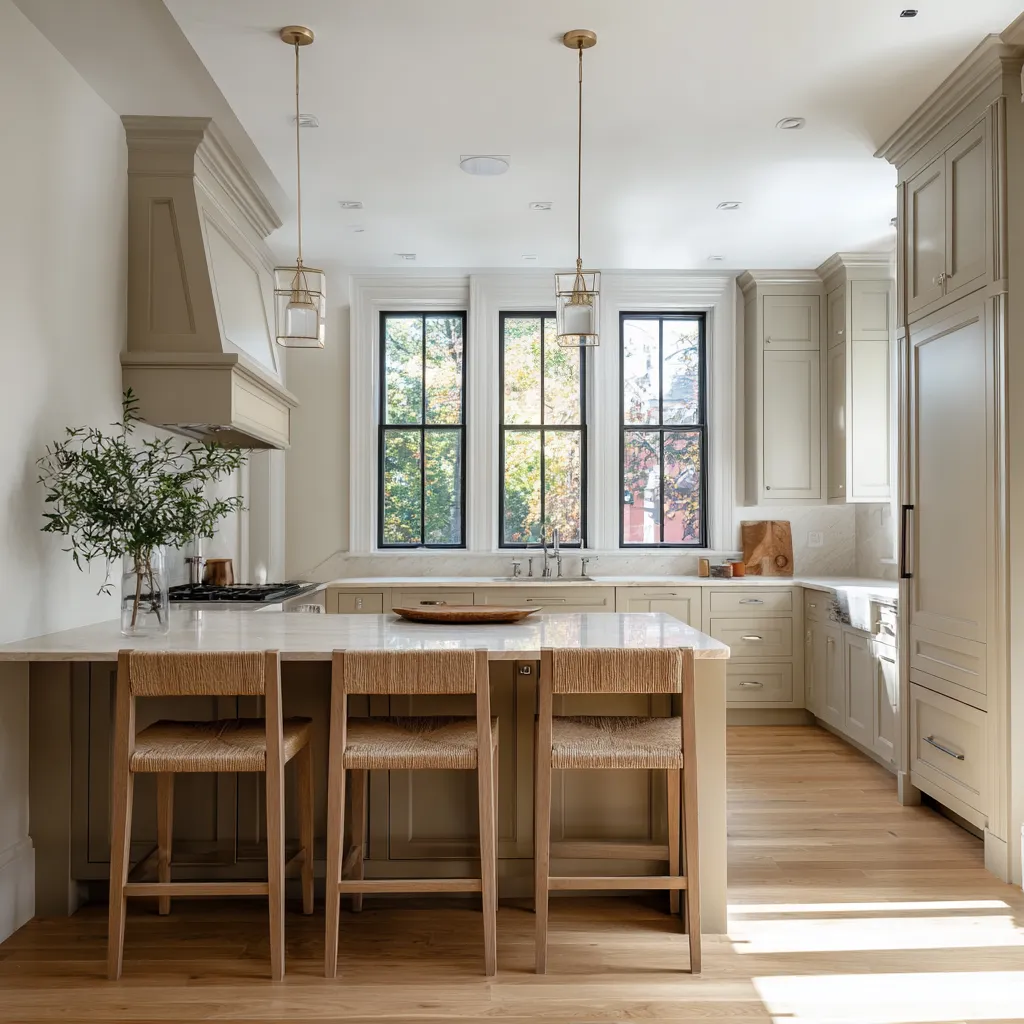
Their beauty does not come from one dramatic move alone. It comes from the way many measured decisions support one another.
The cornice supports the hood. The hood supports the wall hierarchy.
The island supports the social life of the room. Timber, stone, woven surfaces, and metal keep the room grounded.
Once that framework is secure, the design can move in several directions and still remain true to its Georgian base.
A modern Georgian kitchen looks most polished when it treats history as structure rather than costume. Keep the shell in charge, let the center wall carry weight, bring warmth through tactile materials, and make every modern move answer the architecture already in the room.