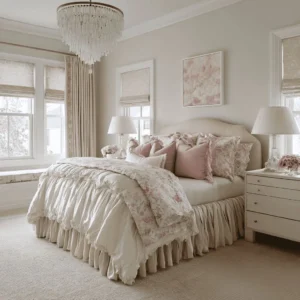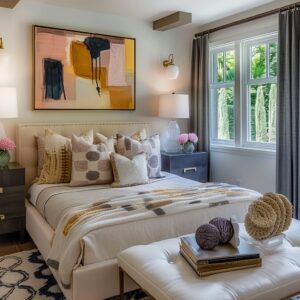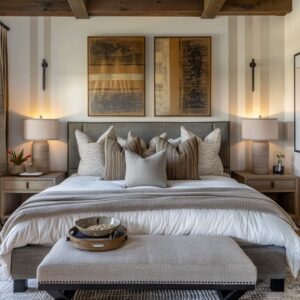
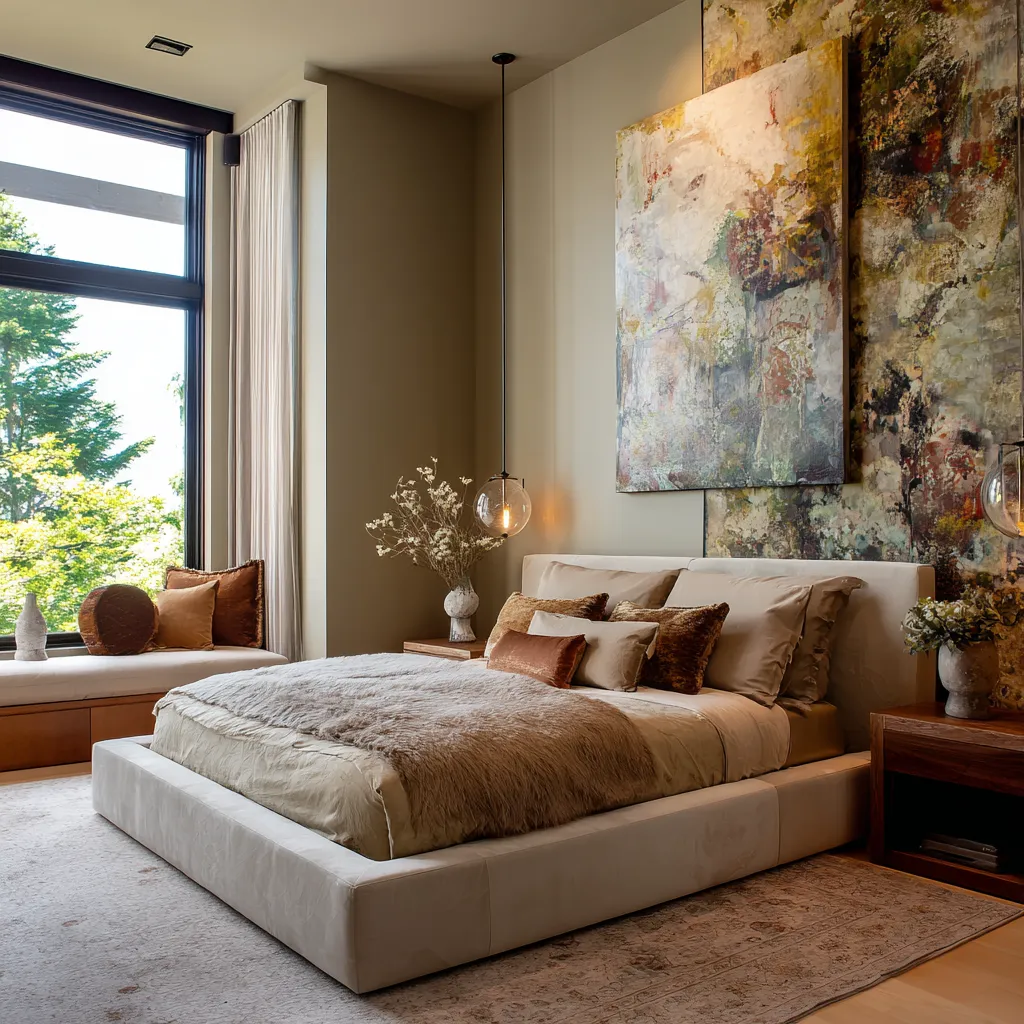
Modern maximalist bedroom design has changed. The room no longer depends on endless objects, crowded furniture layouts, or pattern spread over every surface to feel full.
Bedroom designs in this style now feel rich because their major moves are large, clear, and deeply integrated into the room itself. The space feels substantial through architecture, upholstery, texture, scale, and a few concentrated decorative decisions that are given enough room to register properly.
That shift matters because many people still imagine maximalism as a decorating method driven mainly by quantity. In current bedroom design, that approach often weakens the room.
It can flatten the hierarchy, break the sense of rest a bedroom needs, and make every element compete at the same volume. The current form of maximalism works differently.
It builds intensity through selected dominant fields: a mural wall, a giant artwork, a fireplace mass, a bay-window bench, a long media wall, a thick upholstered bed platform, a full drapery run, or a painterly rug large enough to act like a visual plane. Richness comes from where emphasis is placed, how strongly it is framed, and how the shell supports it.
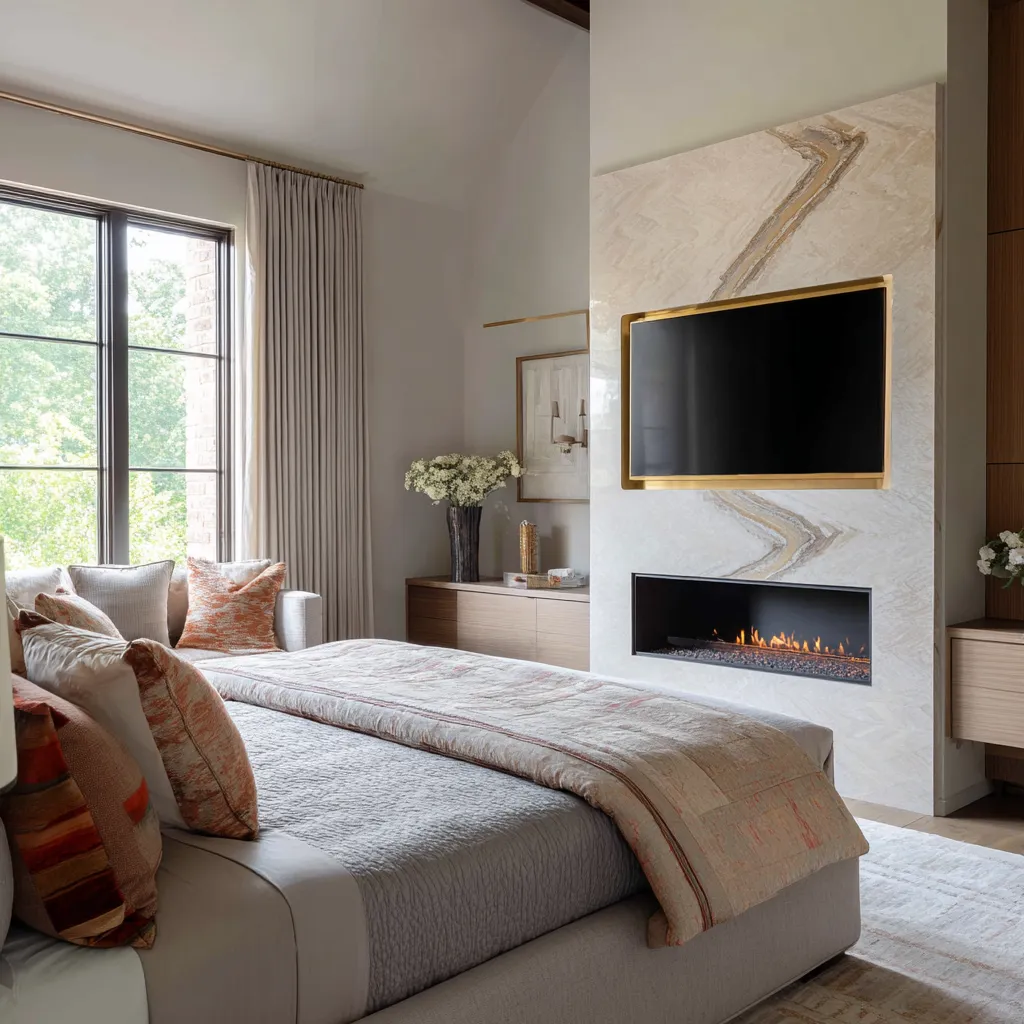
A stylish modern maximalist bedroom design therefore feels full, but not unfocused. It feels layered, but still legible.
It offers comfort, but also shape. It carries softness, yet still has enough graphic edge or architectural gravity to keep the room from becoming vague.
Persuasive maximalist bedroom design ideas do not scatter decorative energy evenly. They compress it into a few important areas, then support those areas with quieter surfaces and strong spatial order.
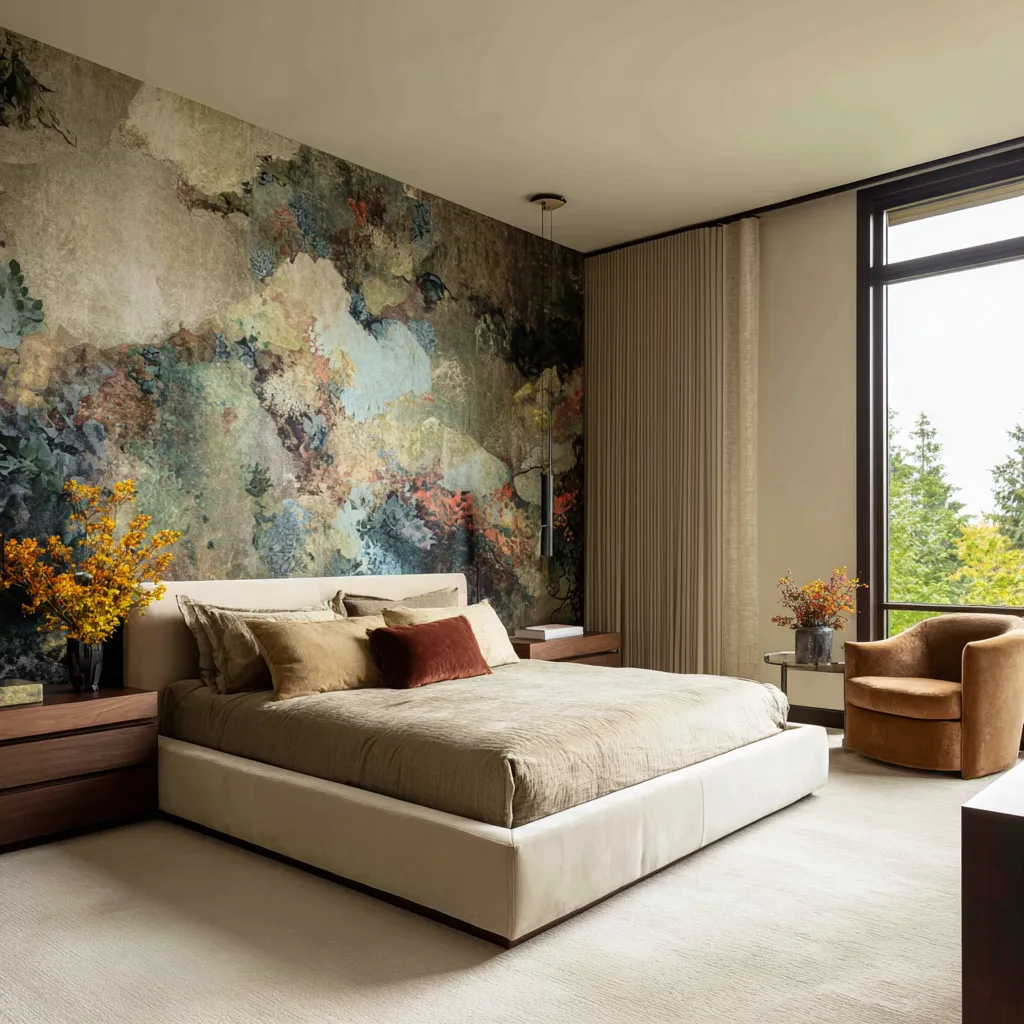
Modern maximalism starts with the shell
One of the differences between dated maximalist bedrooms and current ones is the role of the room envelope. The newer approach does not treat walls, ceiling planes, windows, alcoves, and built-ins as passive background waiting for decoration.
The shell carries part of the richness from the beginning.
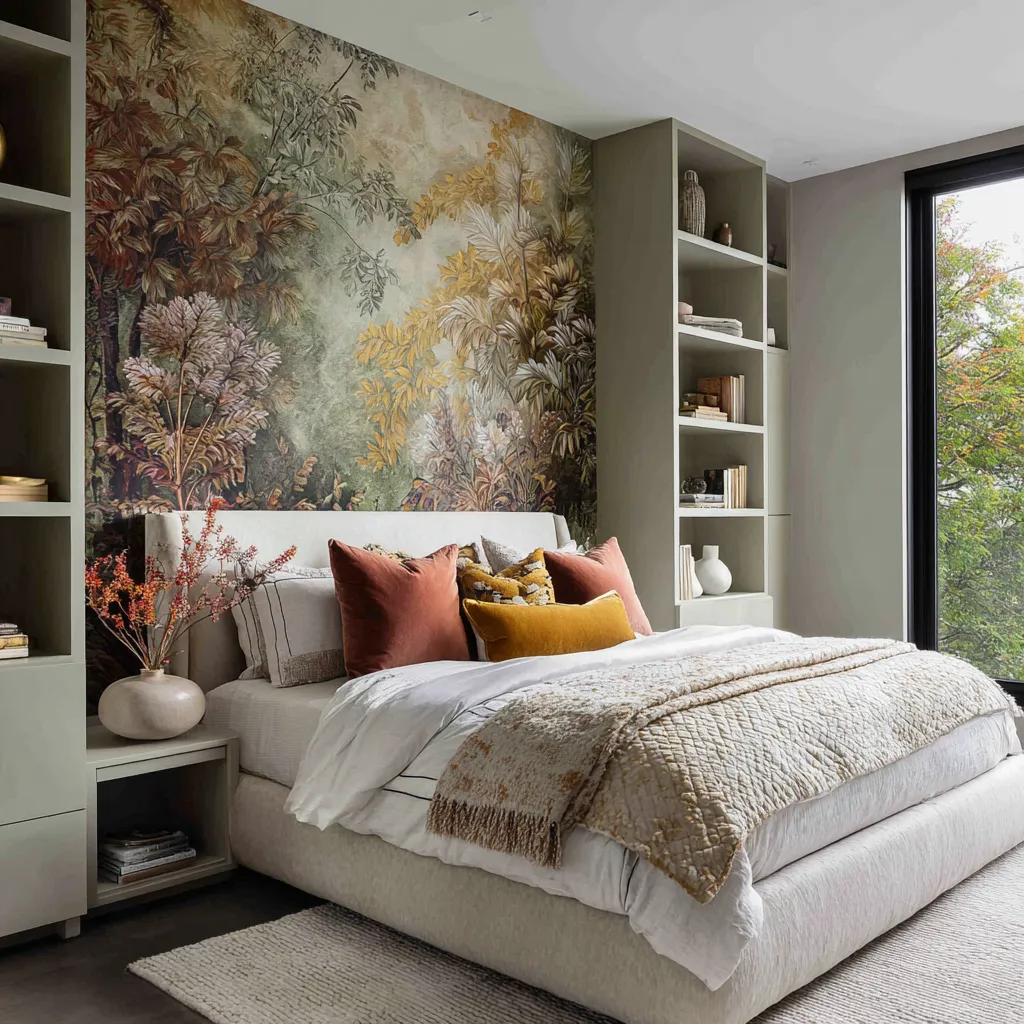
That can happen in several ways. A wall may be panelized so that a painterly finish gains architectural structure.
A fireplace wall may become a tall stone volume rather than a small decorative insert. A window may deepen into a seat alcove, turning daylight into a usable part of the room.
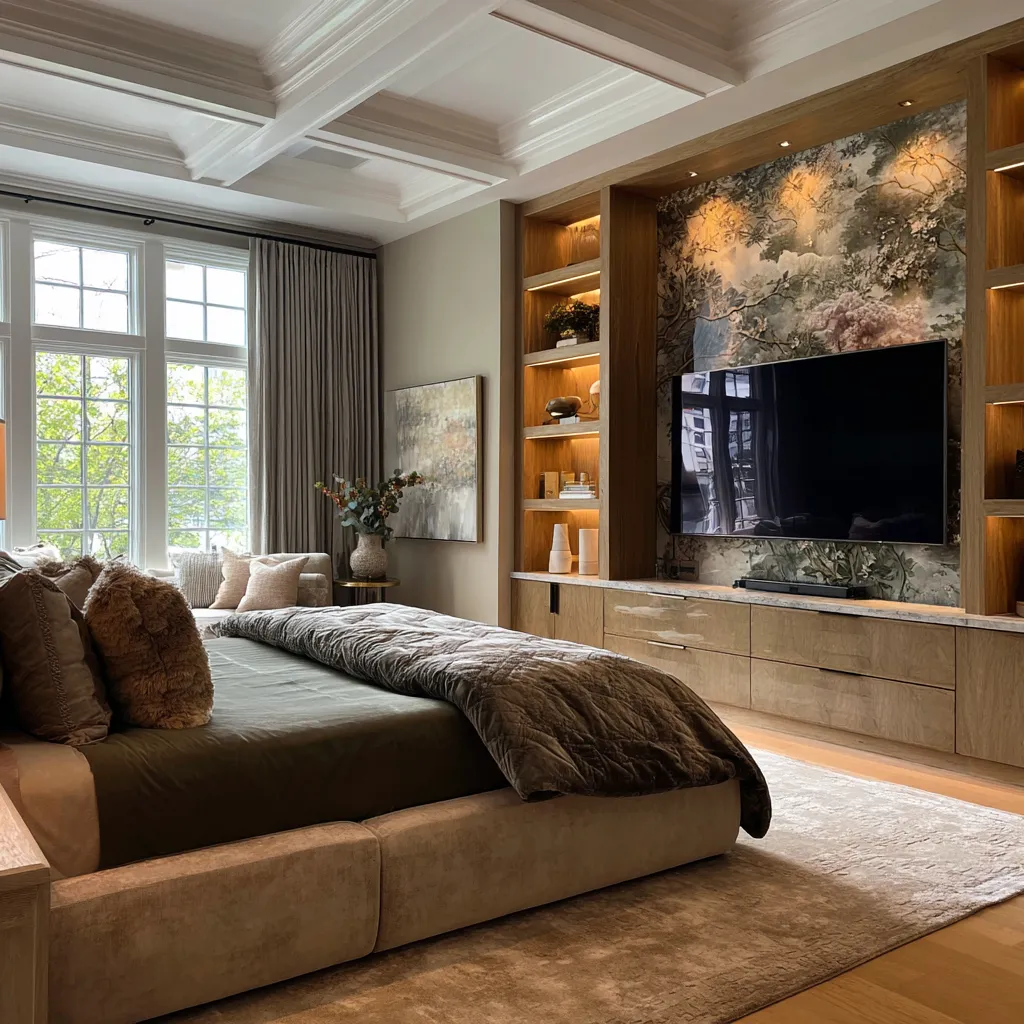
A wardrobe run may act as a broad quiet plane that stabilizes a floral wall opposite it. A media wall may absorb television, art, shelving, and storage into one organized field.
A ceiling may introduce coffer lines or a soft curve that changes the way the room holds its furnishings below.
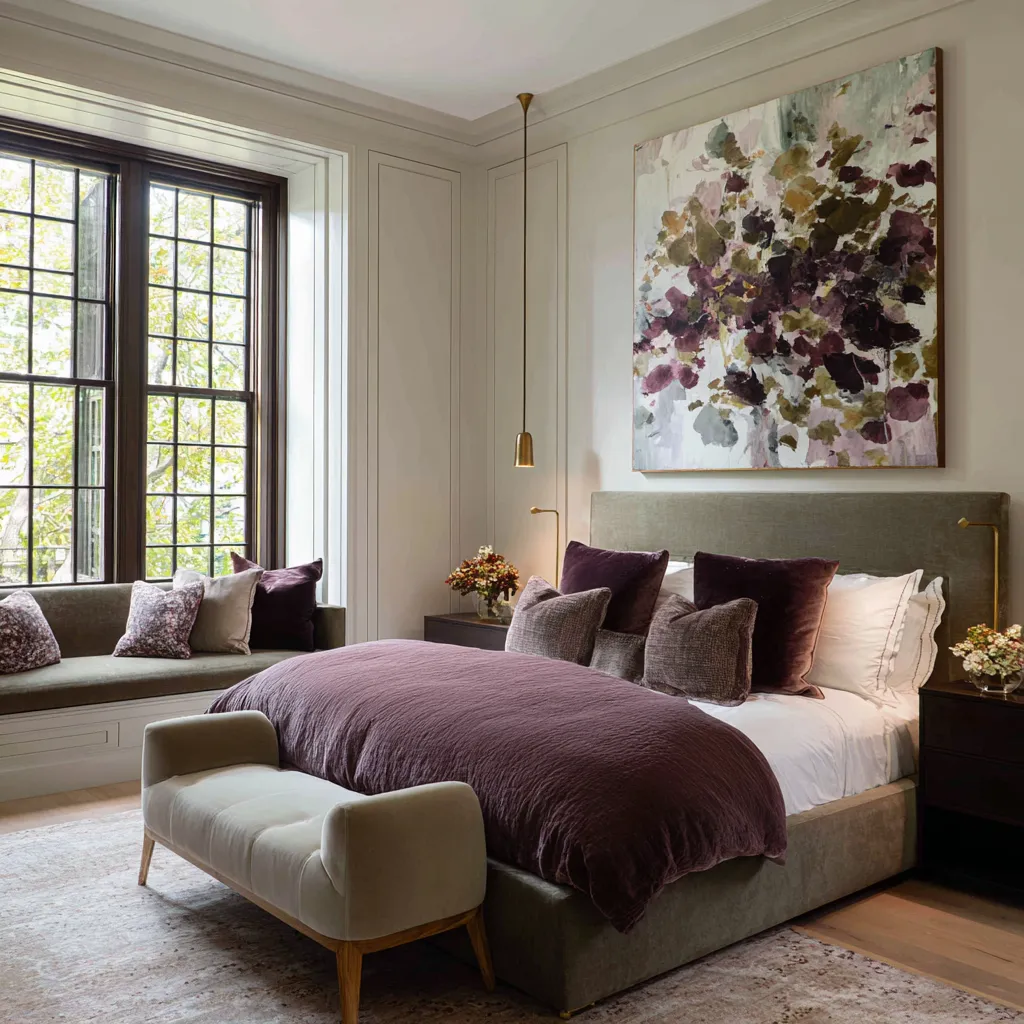
This is where modern maximalist bedrooms become spatial rather than merely decorative. Once the shell begins to carry weight, the room stops feeling like furniture and textiles placed inside a box.
It starts feeling made. That shift is one of the clearest marks of a current interior.
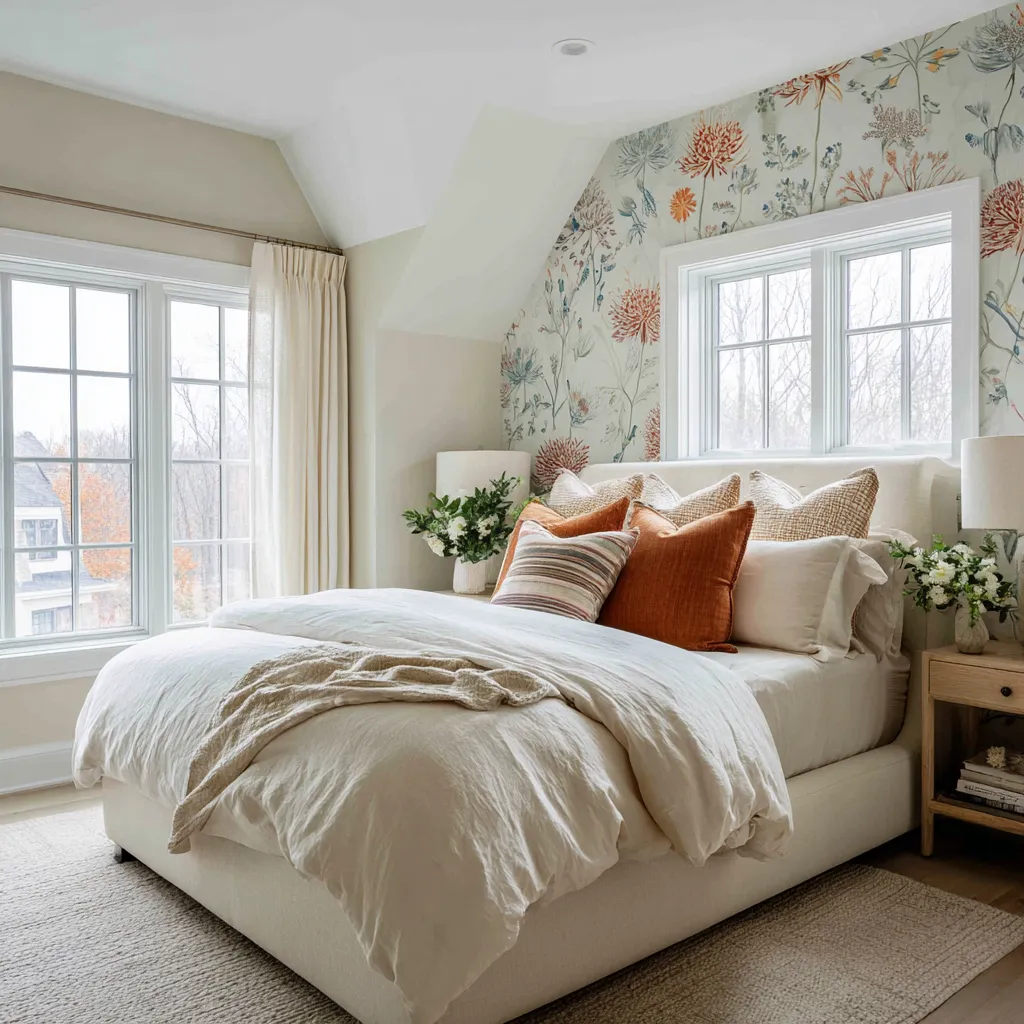
This is also why copycat versions of the style often fall short. Someone may repeat the rust pillow, the plum throw, or the oversized floral art, but if the room has no architectural structure behind those moves, the result can feel thin.
In current maximalism, color and accent sit on top of a deeper framework. The shell is doing real work.
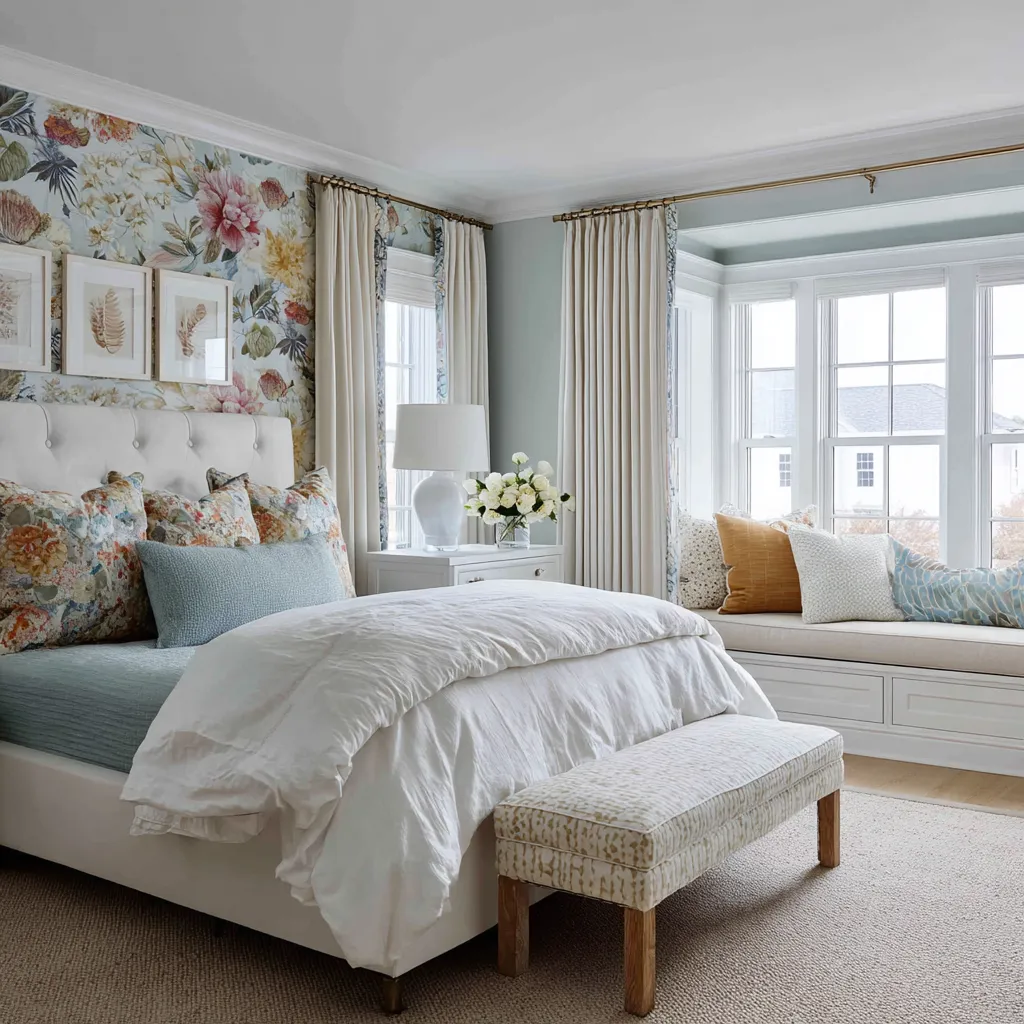
The bedroom should feel like a private suite, not a single-function zone
Another major direction in current maximalist bedroom design is the move away from the bed as the only destination. The interior becomes much richer when it includes more than one inhabitable zone.
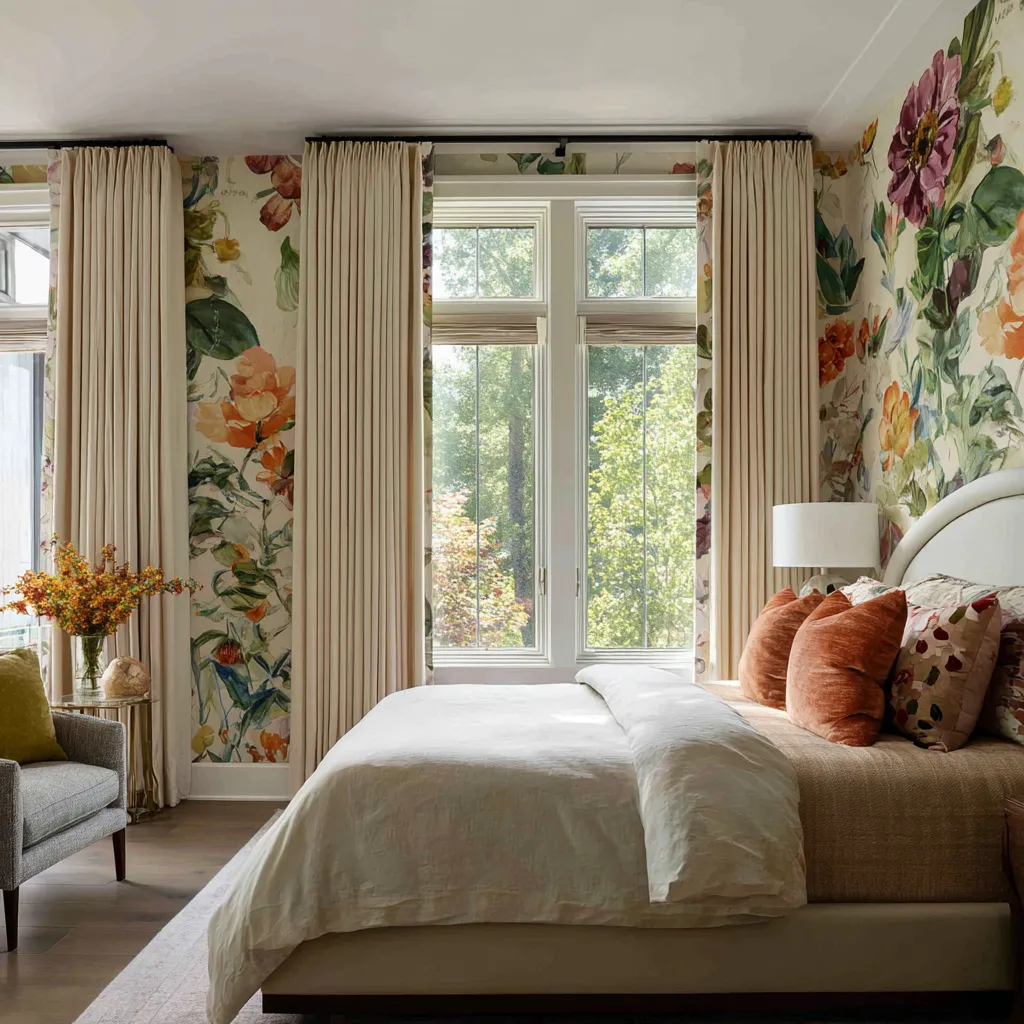
This does not require an enormous footprint, but it does require thought. A window bench can change the entire emotional range of a room because it creates a second place to occupy.
A small loveseat at the foot of the bed can turn the center of the room into a lounge rather than a circulation strip. A fireplace wall can create a focus separate from the headboard wall.
A media-storage composition can give the far end of the room a second anchor. A built-in ledge, library wall, or deep sill can make the perimeter usable rather than leftover.
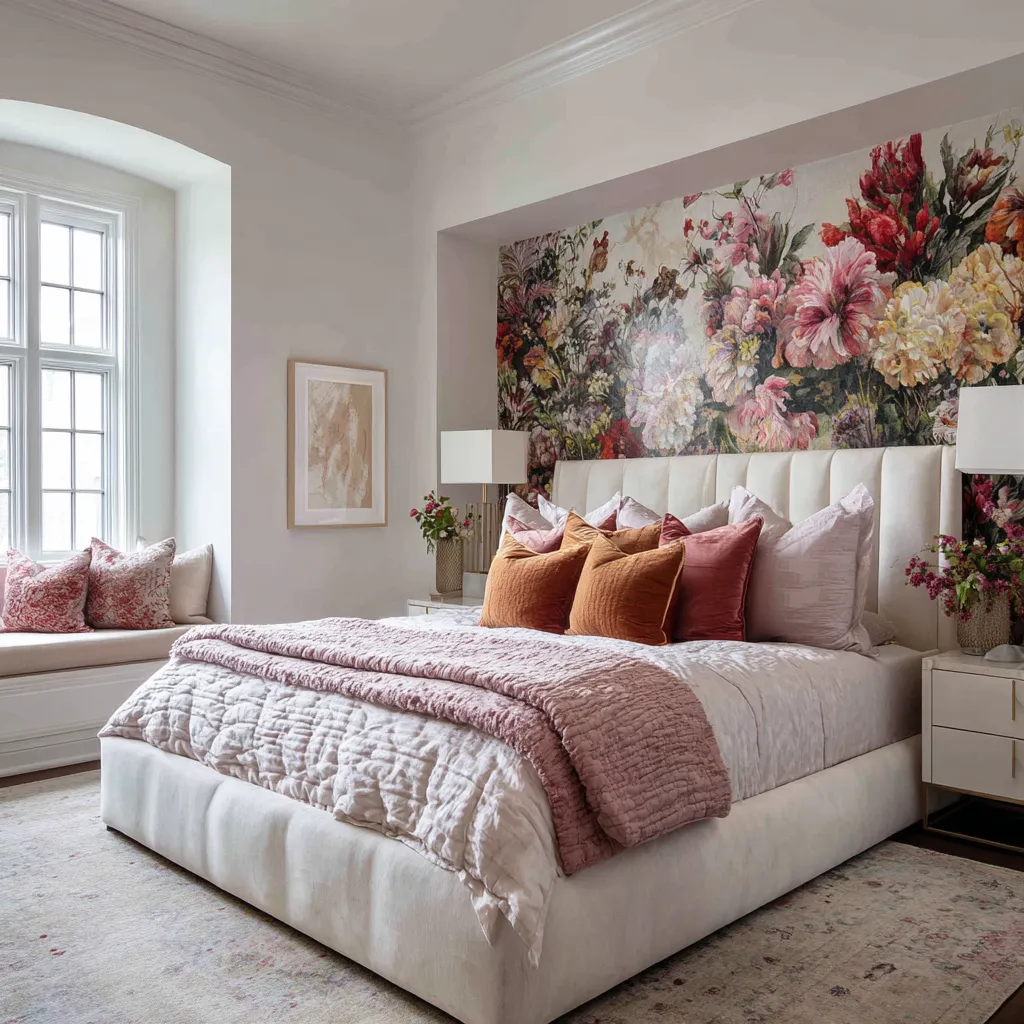
This kind of spatial subdivision is important in maximalist bedrooms because it spreads richness through the plan. Instead of forcing all decorative and emotional intensity onto the bed wall, the room begins to unfold in parts.
There is the sleeping zone, the seat zone, the window zone, the storage zone, the fire or media zone. Each one contributes something slightly different.
The room feels inhabited in layers.
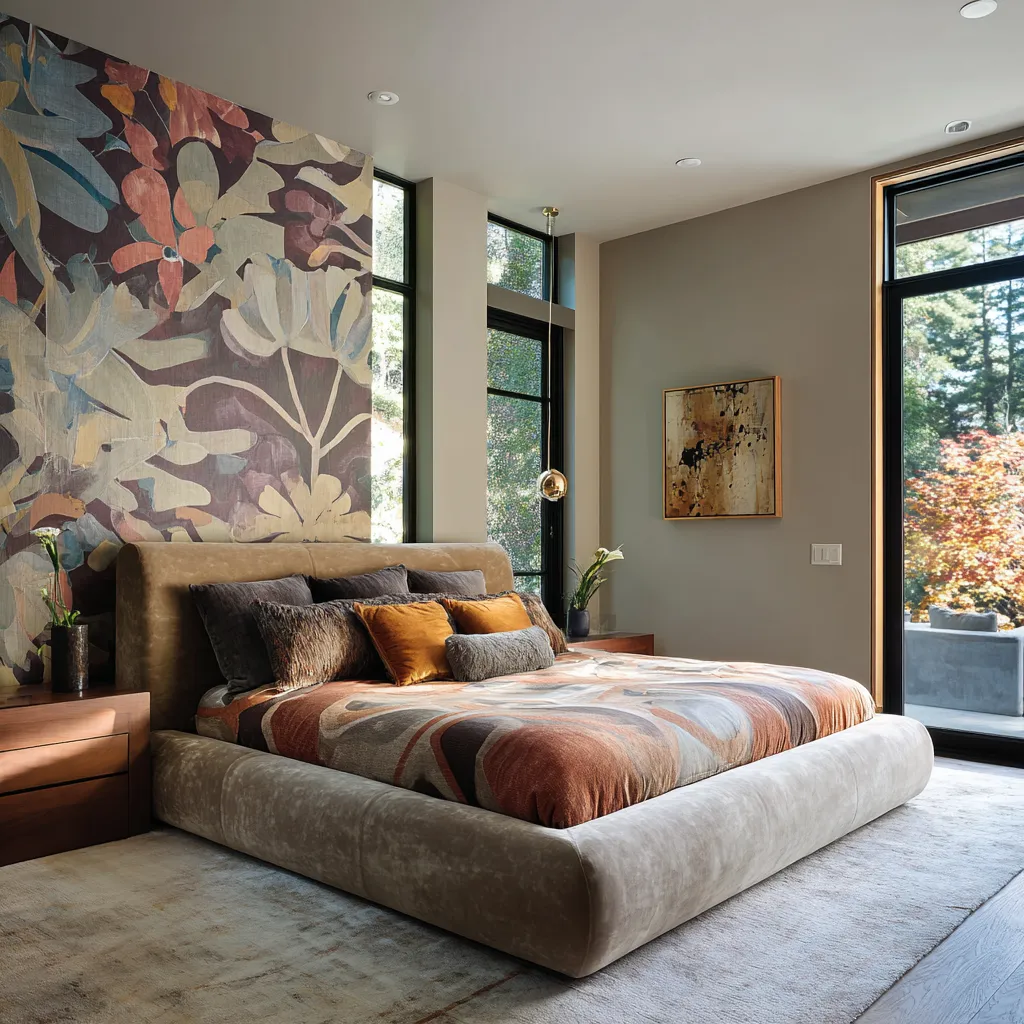
That is one reason high-end maximalist bedroom design ideas often feel so complete. Their luxury does not come only from expensive fabric or dramatic art.
It comes from the sense that the room supports different forms of living. You can sleep there, sit there, read there, watch firelight there, lean into the view there, dress there, pause there.
Once those uses are present, the bedroom gains a depth that pure styling alone rarely achieves.
Openness does not require stripping the room bare
Many people worry that a maximalist bedroom must feel closed in. That happens far less from pattern quantity than from darkness, visual compression, and lack of open breathing fields.
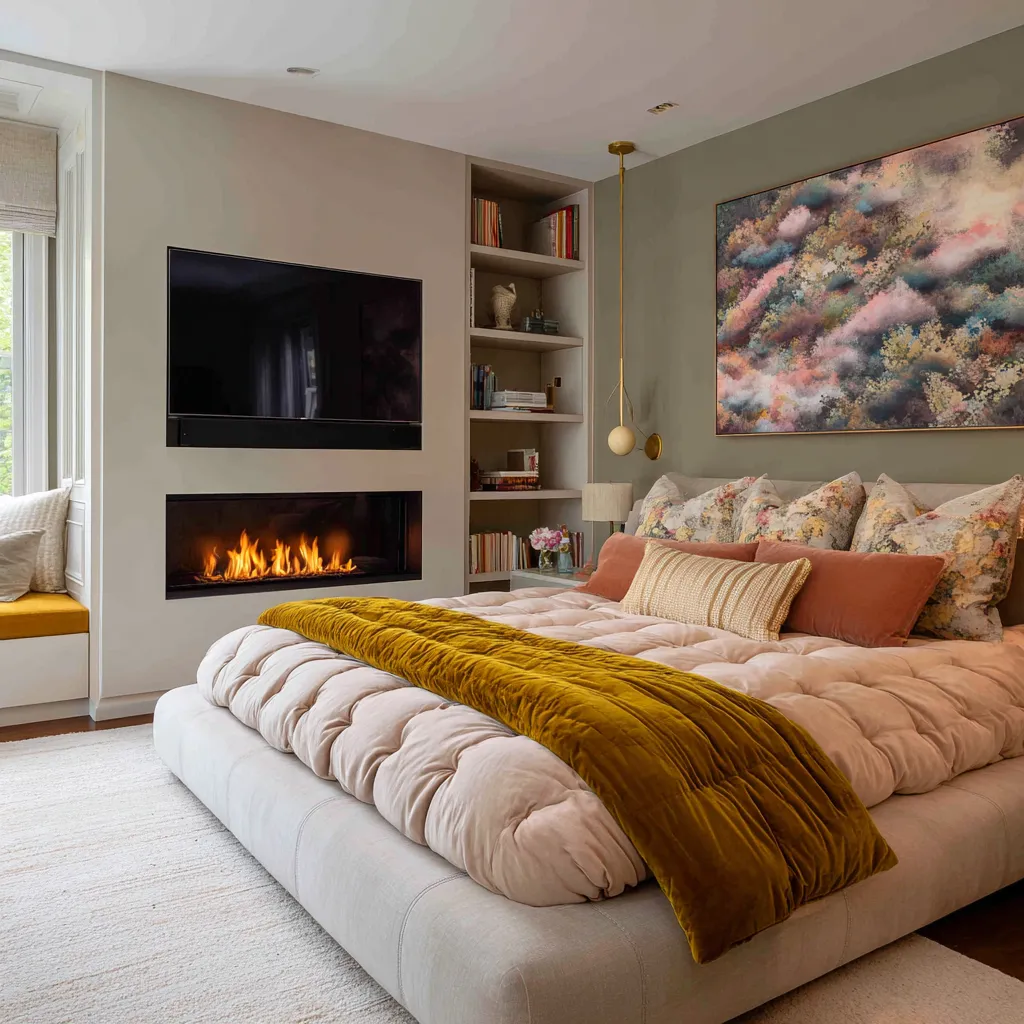
A bedroom can hold a mural wall, deep textile layering, and generous upholstery and still remain spacious if the shell is bright enough. Light-reflective walls, pale ceiling planes, cream bedding fields, broad neutral carpet, light drapery, and generous daylight do far more for openness than reducing every decorative choice to the minimum.
A room feels breathable when it has luminous surfaces that allow the stronger gestures to stand out clearly.
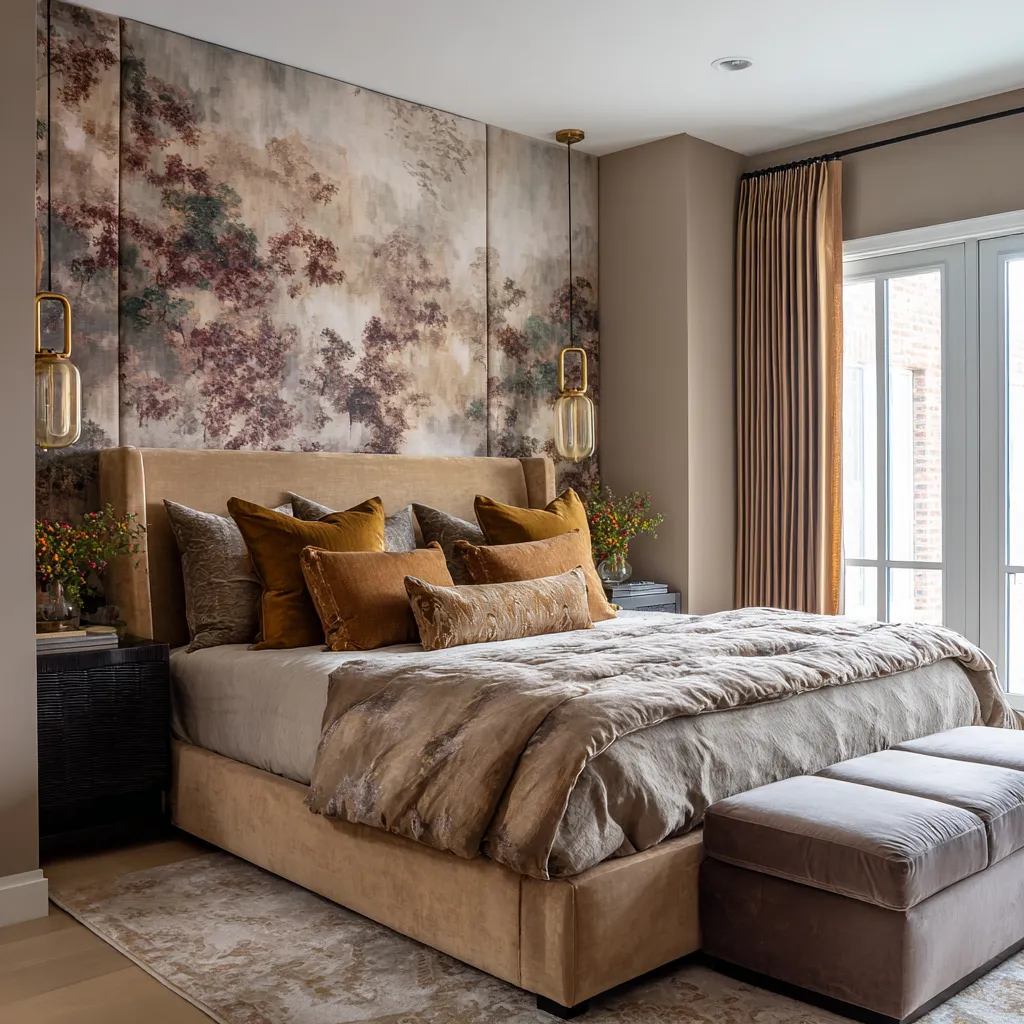
This is why pale maximalist bedrooms often feel so current. Their richness sits inside brightness rather than fighting against it.
A large artwork appears stronger against a broad pale wall. Floral drapery feels lighter when the center of the window remains open and bright.
Rust or plum pillows feel more concentrated when they sit on white bedding. A textured plaster wall feels deeper when daylight moves over its surface instead of disappearing into a dark envelope.
The lesson here is not that maximalist bedrooms should always be pale. It is that openness comes from broad light fields and visual release.
If a room needs to stay airy, secure that condition first. After that, the larger decorative moves can arrive without suffocating the space.
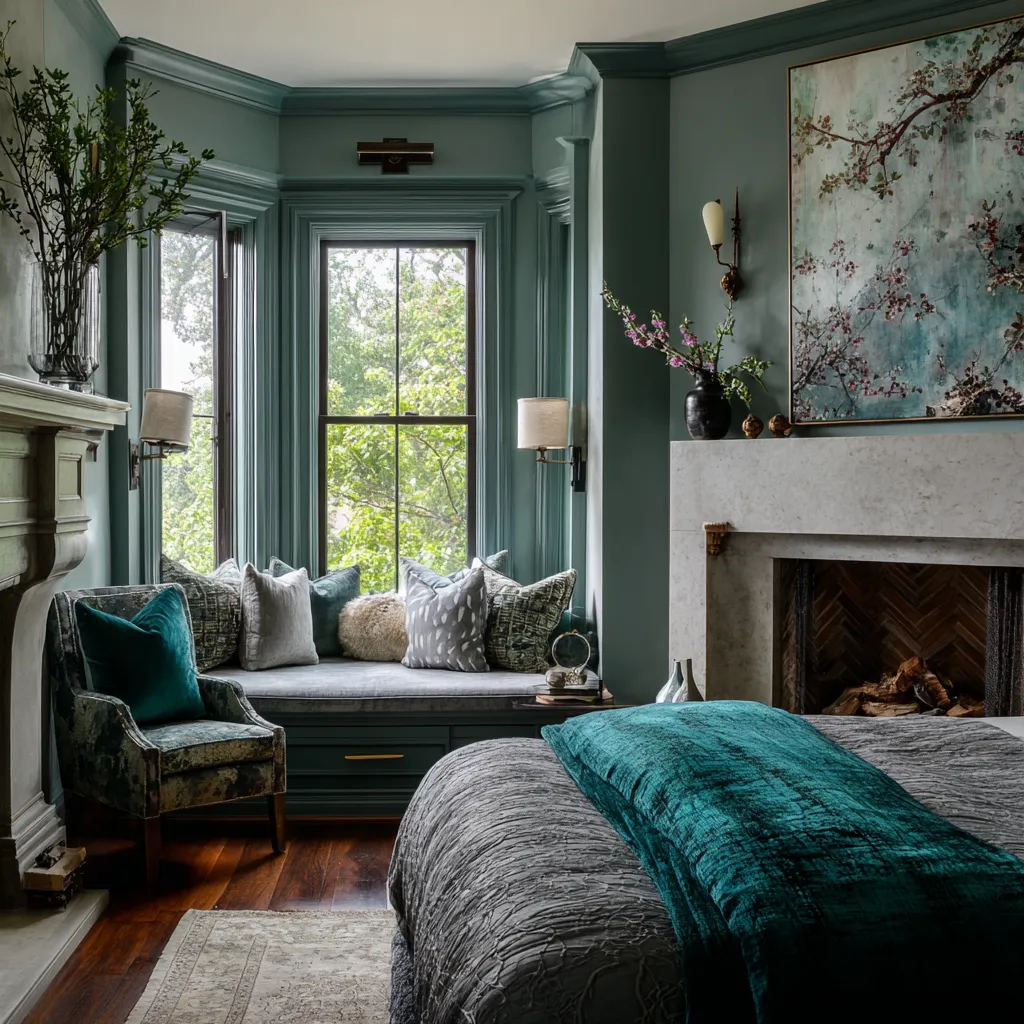
Richness comes from texture sooner than from pattern
One of the useful distinctions in modern maximalist bedrooms is the difference between motif density and tactile density. Pattern can add personality, mood, and atmosphere, but it does not automatically make a room feel richer.
Texture often does more. A bedroom gains depth when it layers surfaces that behave differently in light and touch: bouclé against plaster, velvet against matte linen, stone against brushed fabric, soft rug against warm wood, cloudy wall finish against clean glass, smooth leather against nubby upholstery, polished metal against deep drapery folds.
These shifts create variation even when the palette stays narrow.
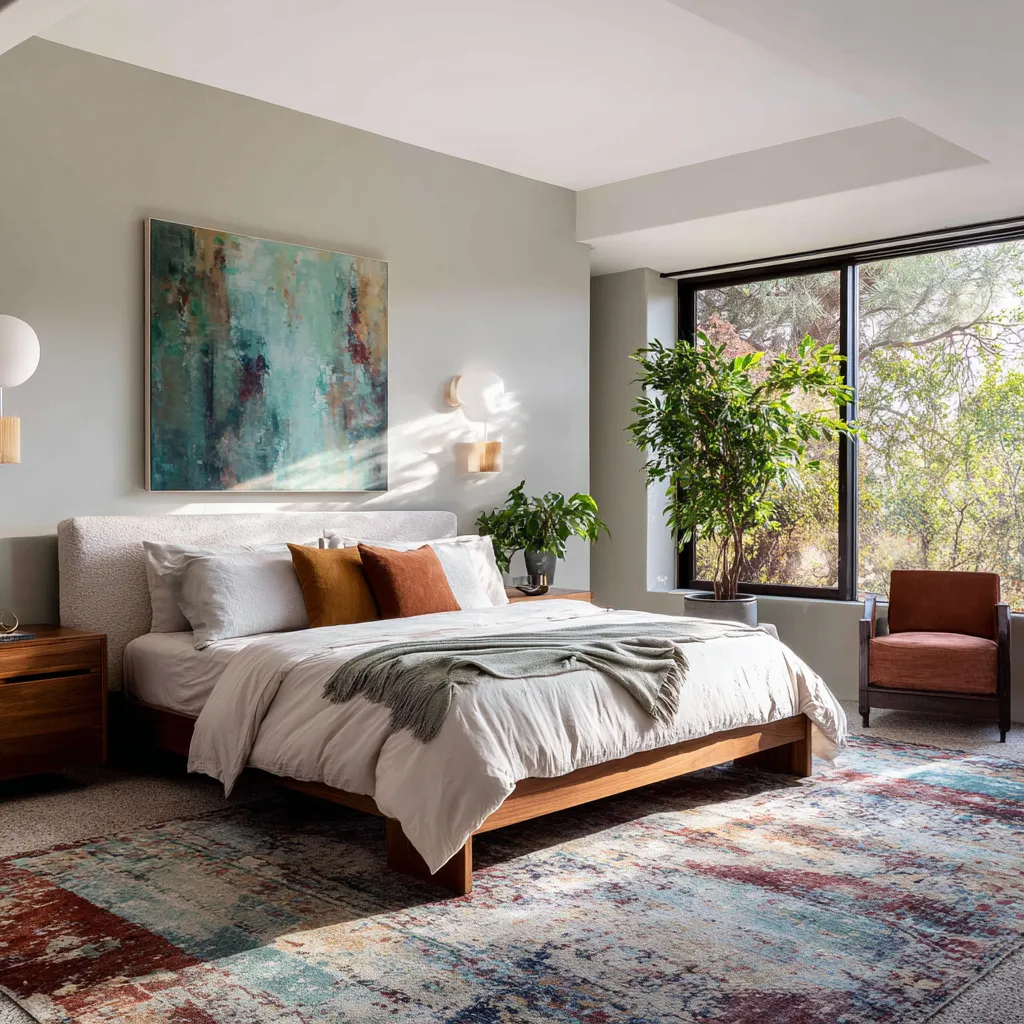
That is why some of the modern maximalist bedroom designs can avoid to be pattern-heavy. Their fullness comes from the physical character of surfaces.
A thick upholstered bed base can carry more weight than an ornate printed duvet. A hand-worked wall finish can add more atmosphere than a second or third patterned fabric.
A large painterly rug can support an entire scheme without the need for several smaller visual events on top of it.
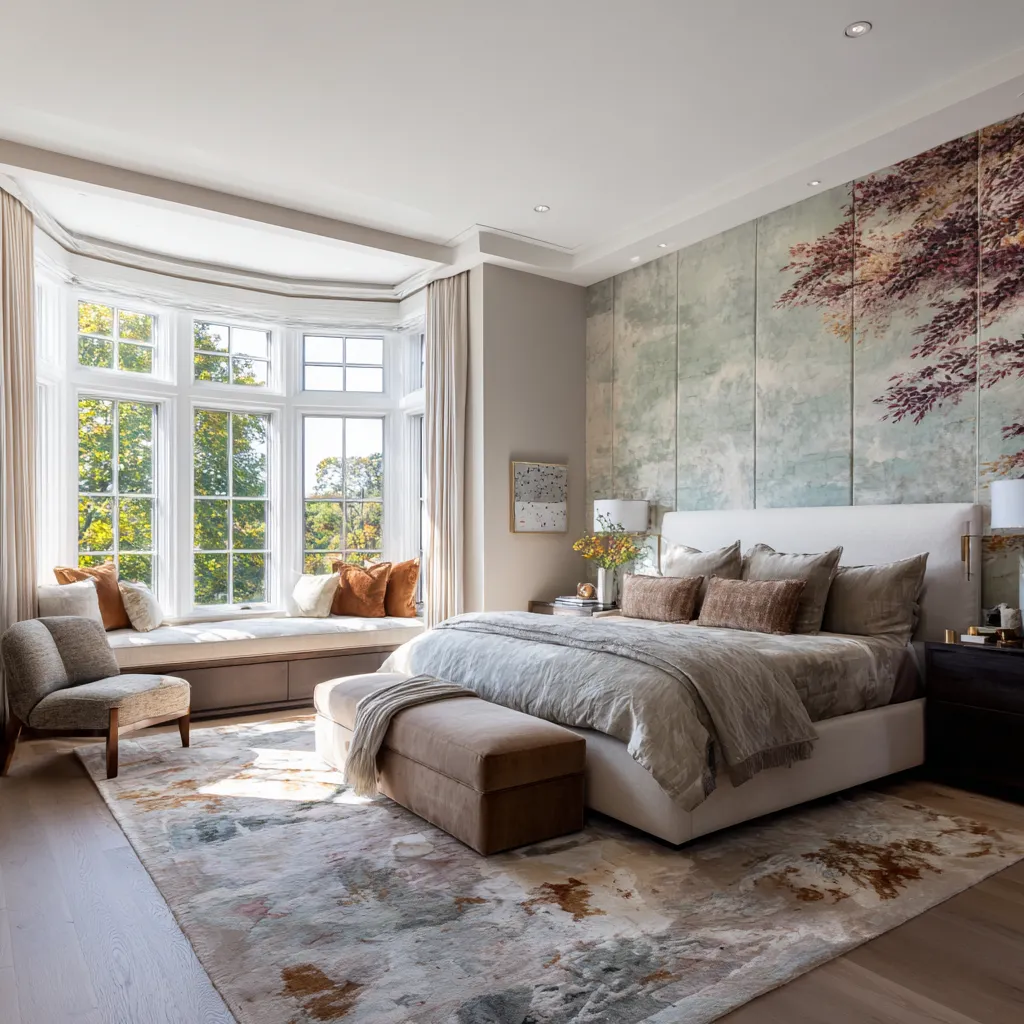
Texture is important in bedroom designs because it suits the purpose of the room. Pattern pushes outward.
Texture sinks inward. A bedroom usually benefits from that inward pull.
It can feel lush, developed, and emotionally warm without becoming restless.
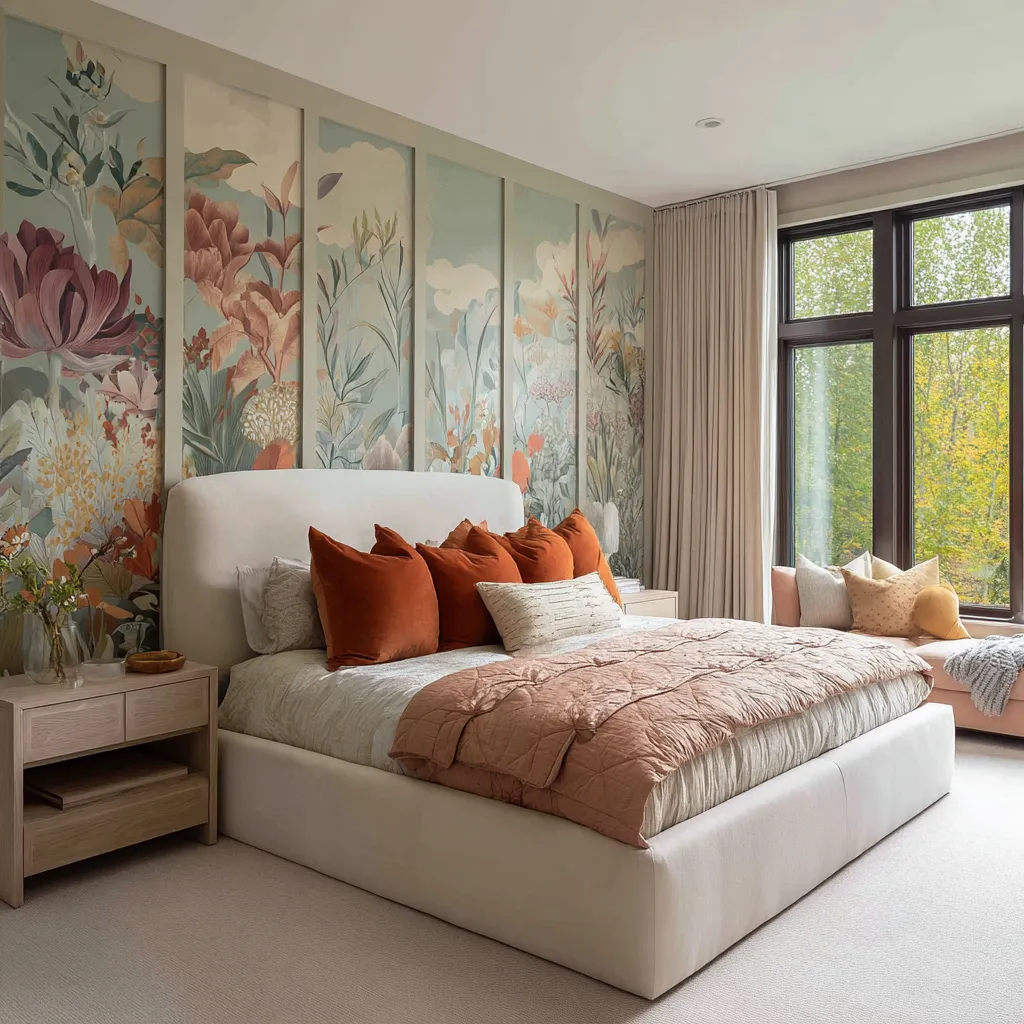
Large gestures matter more than many small ones
A defining feature of current maximalist bedroom ideas is their dependence on magnitude. The style gains force through a few oversized moves rather than a high count of minor accessories.
This can take many forms. One giant abstract artwork above the bed can do the work that once belonged to a gallery wall, wallpaper, and decorative headboard combined.
A whole floral niche behind the bed can carry the room’s atmosphere without requiring patterned drapery and patterned bedding at the same time. A thick upholstered platform bed can supply the feeling of abundance through one large soft volume.
Full-height drapery can create richness through vertical fabric mass even when the cloth itself remains plain. A mural wall, a long bench, a dramatic fireplace, or a painterly rug large enough to act like a floor artwork can all become the major gesture that defines the room.
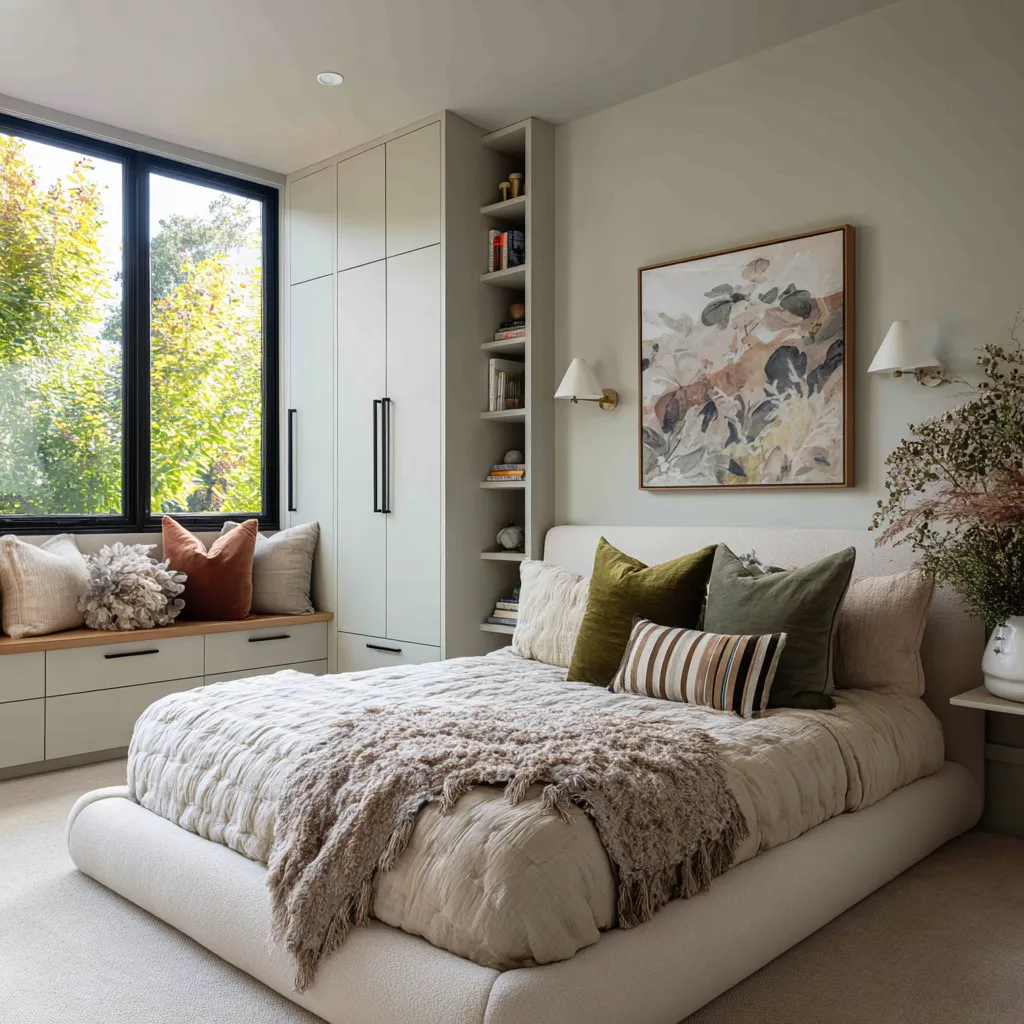
This is one reason modern maximalism feels more edited than older versions. The room is not weak in expression.
It is selective in where expression becomes large. It prefers one strong move with room around it to several medium moves crowded together.
That principle also keeps the bedroom restful. Large gestures are easier to read.
They do not ask the eye to keep sorting dozens of equal signals. The room can still feel full, but the fullness is organized.
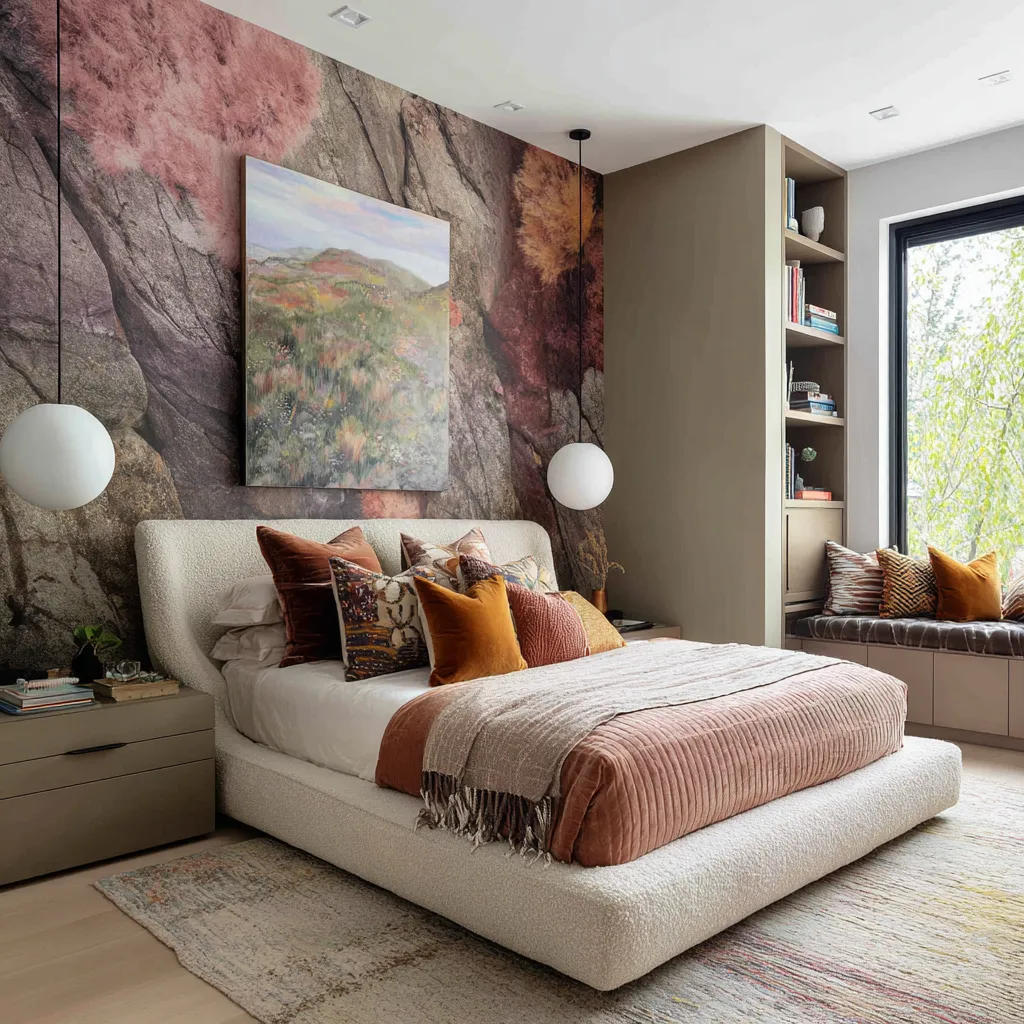
There are two major routes: floral atmosphere and art-led concentration
Modern maximalist bedroom design does not have a single visual formula. Two distinct branches appear again and again, and they should be treated differently.
- The first is floral or botanical maximalism. This branch uses mural walls, painterly blossoms, leafy surfaces, floral drapery, or nature-driven pattern to build atmosphere. Its strength lies in immersion, but it works best when that immersion is bounded. A niche wall, a single headboard plane, drapery edges, or one bench upholstery field can hold the floral content in place. When the entire room is given over to the same floral energy without enough quiet counterweight, the space can lose hierarchy.
- The second branch is art-led maximalism. This route depends less on repeated motif and more on oversized abstract art, painterly rugs, thick upholstered beds, concentrated pillow groupings, and open wall area around the main statement. It often feels sharper and more architectural. The imagery is usually less literal and the room depends more heavily on material contrast and composition.
These two directions are both valid, but they should not be merged carelessly. A floral immersive wall and a major oversized abstract artwork usually compete unless one of them is clearly secondary.
A room tends to be stronger when it chooses one visual language as the leader and lets the other layers support it.
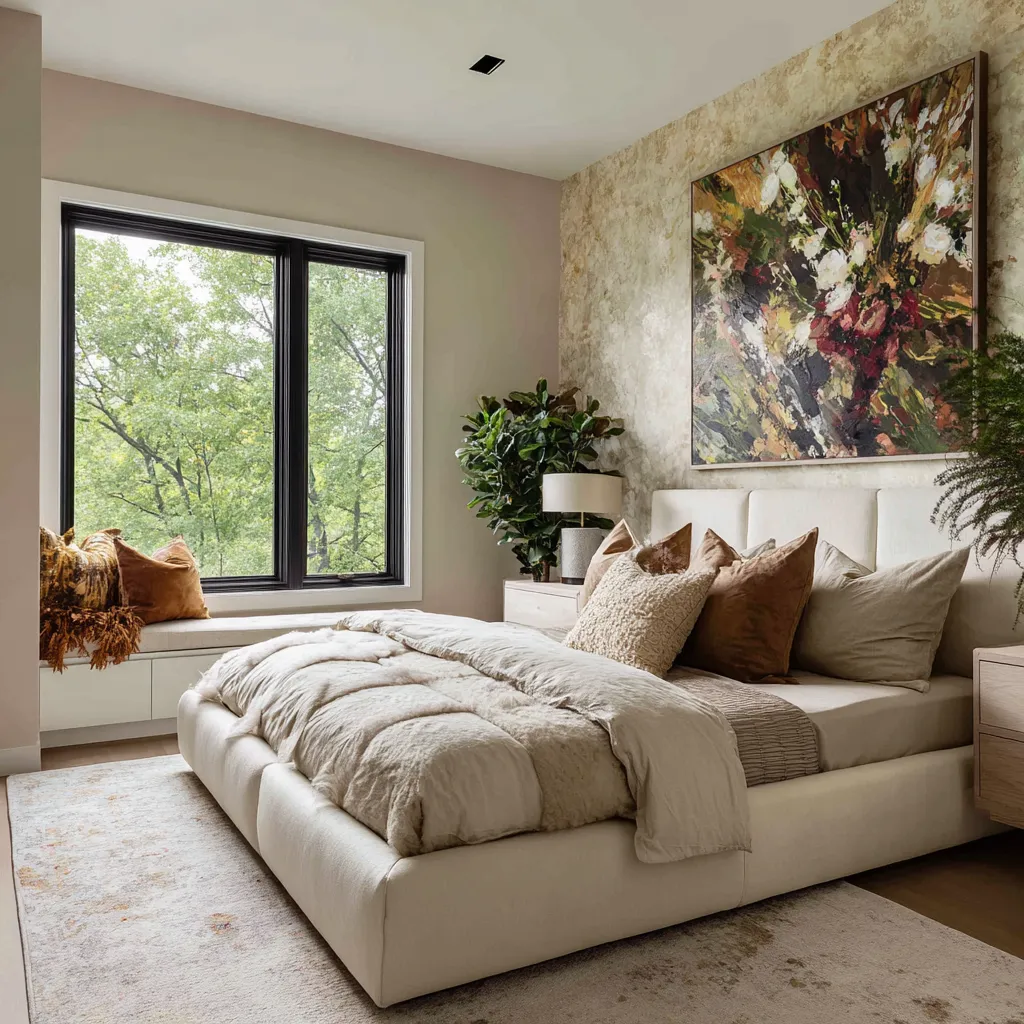
The bed should be soft, broad, and clear in form
The bed is the emotional center of a maximalist bedroom, but it does not need to be the most decorated piece. In fact, many of the strongest rooms do the opposite.
They simplify the bed form so the surrounding richness can stay legible. A thick upholstered headboard, a broad padded platform, rounded corners, a low plinth-like base, or a generously upholstered bench aligned with the bed can all make the sleeping zone feel luxurious without relying on carved detail, ornate trim, or several conflicting textiles.
The mass of the bed matters. Its softness matters.
Its proportion matters. But its line should usually remain clear.
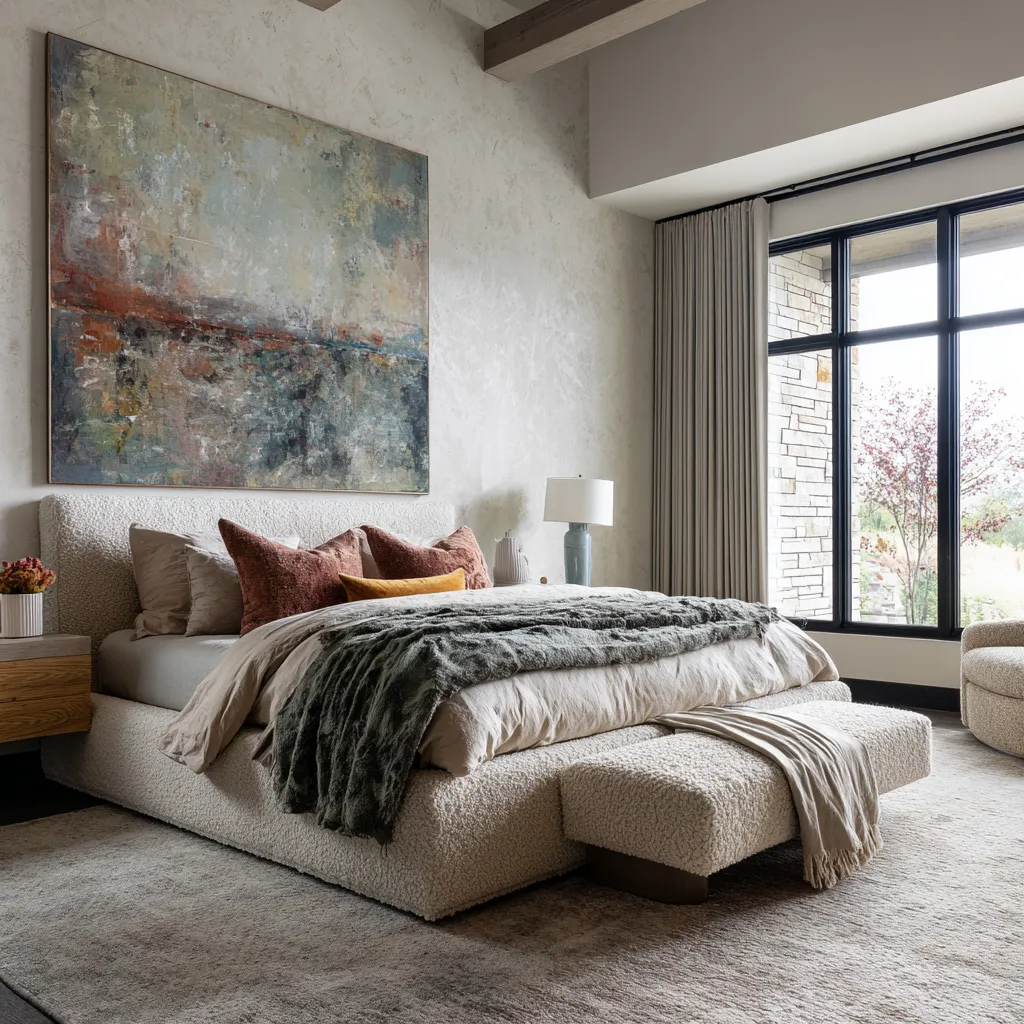
This becomes important when the room already contains a mural wall, major art, fireplace mass, heavy drapery, or integrated storage. A highly decorated bed can fracture the center of the room.
A simpler bed acts as a stabilizing body within a richer environment.
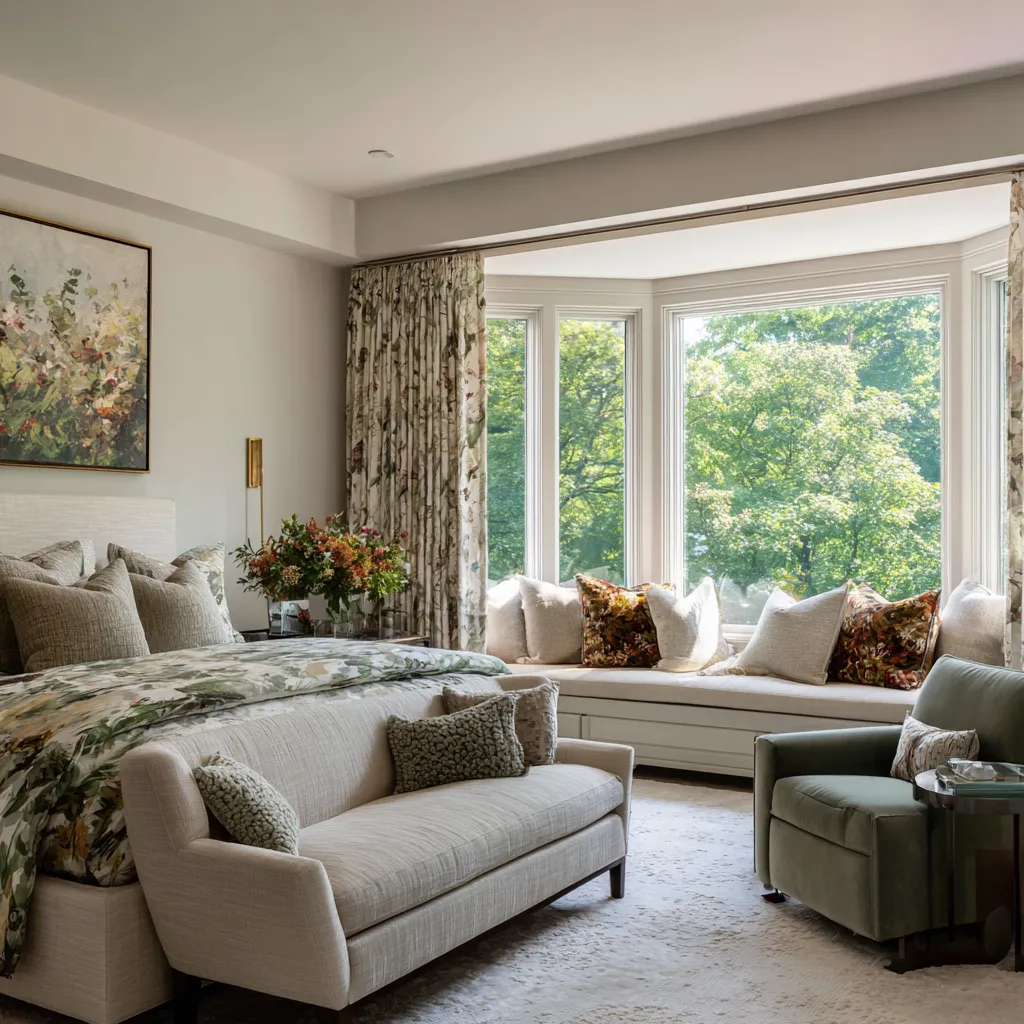
The same principle applies to bedding. White or cream bedding fields are not a failure of maximalism.
They often make maximalism possible. A broad light duvet can create the visual pause necessary between a painted wall and patterned pillows.
It can stop a floral room from becoming sugary and keep an art-led room from becoming too dense. The bed remains lush through depth of linen, layering of pillows, and tactile variation, but its central field stays readable.
Accent color works better when concentrated
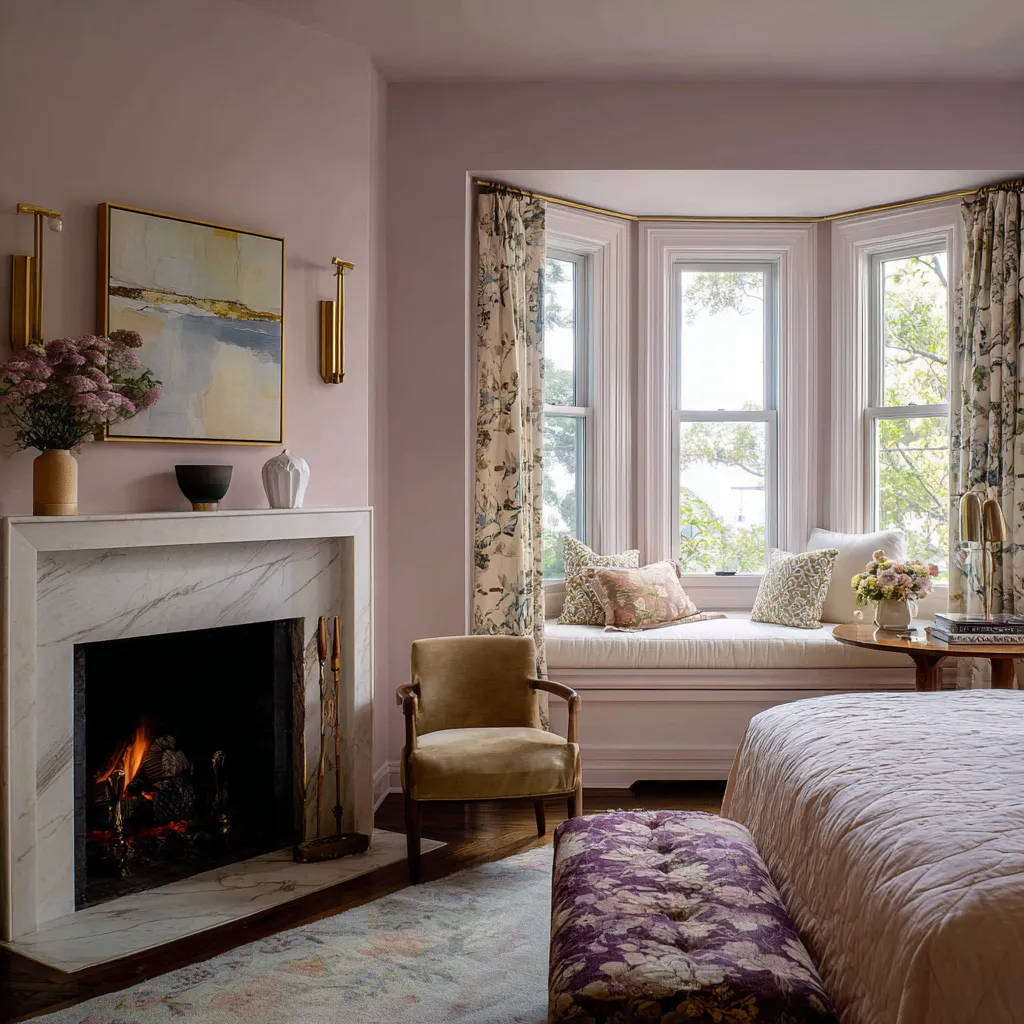
Modern maximalist bedroom ideas often use strong color, but they do not always distribute it widely. A concentrated zone of warmth or depth usually has more force than the same color scattered in small repetitions.
Rust, ochre, cinnamon, plum, teal, olive, tobacco, and warm rose tones often work best when gathered into one clear area: the front pillow cluster, the window bench cushions, one chair, a single throw band, a mural niche, or the upholstered seat at the foot of the bed. This compression gives color a center of gravity.
It also helps the eye understand where emotional emphasis belongs.
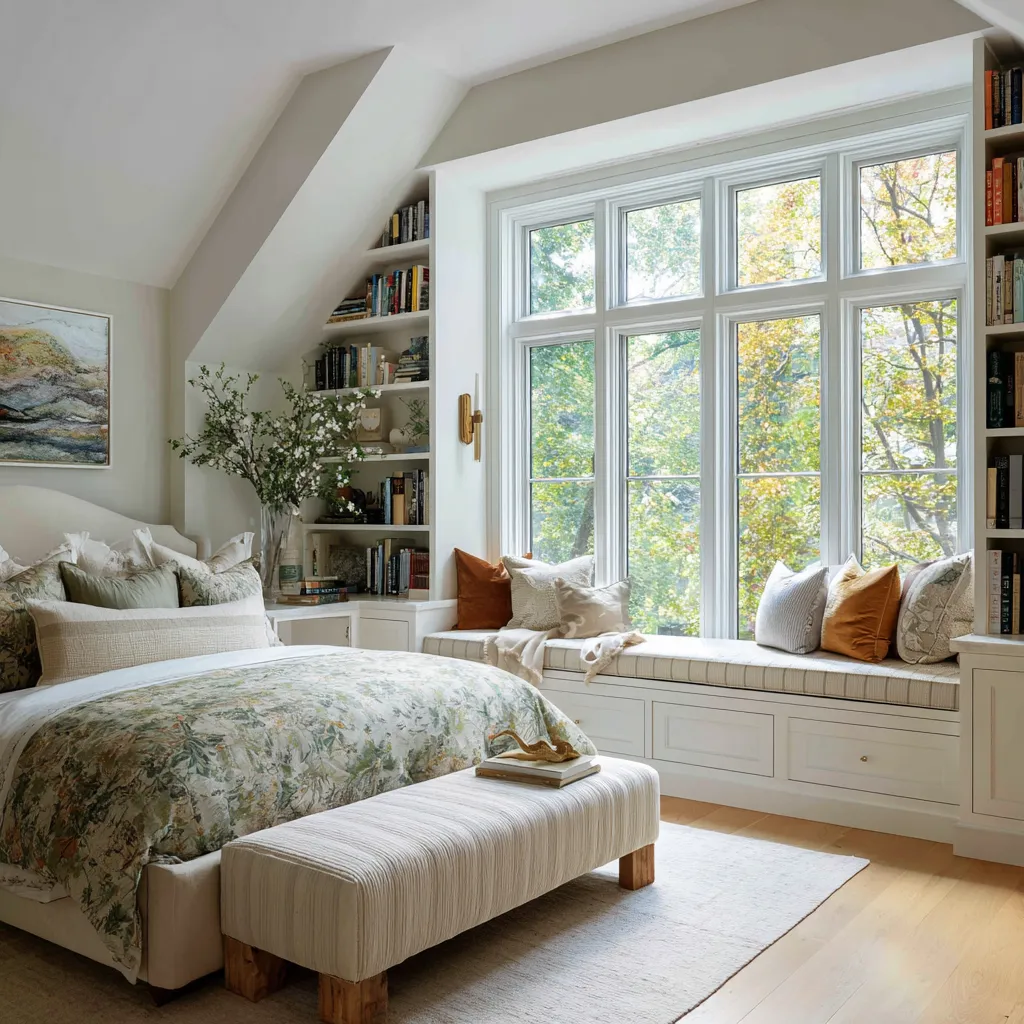
When warm accents are diluted into too many small gestures, they can begin to feel expected rather than powerful. One rust bench and two rust cushions on white bedding can feel richer than rust repeated in lamp base, vase, trim, drapery edge, and side art all at once.
Concentration gives color more impact because it creates a distinct zone rather than a thin decorative residue. That does not mean repetition has no role.
Repetition is useful when it spreads a palette from one end of the room to the other. But the repeated notes should stay secondary to one main concentration.
Built-ins are valuable only when they add life
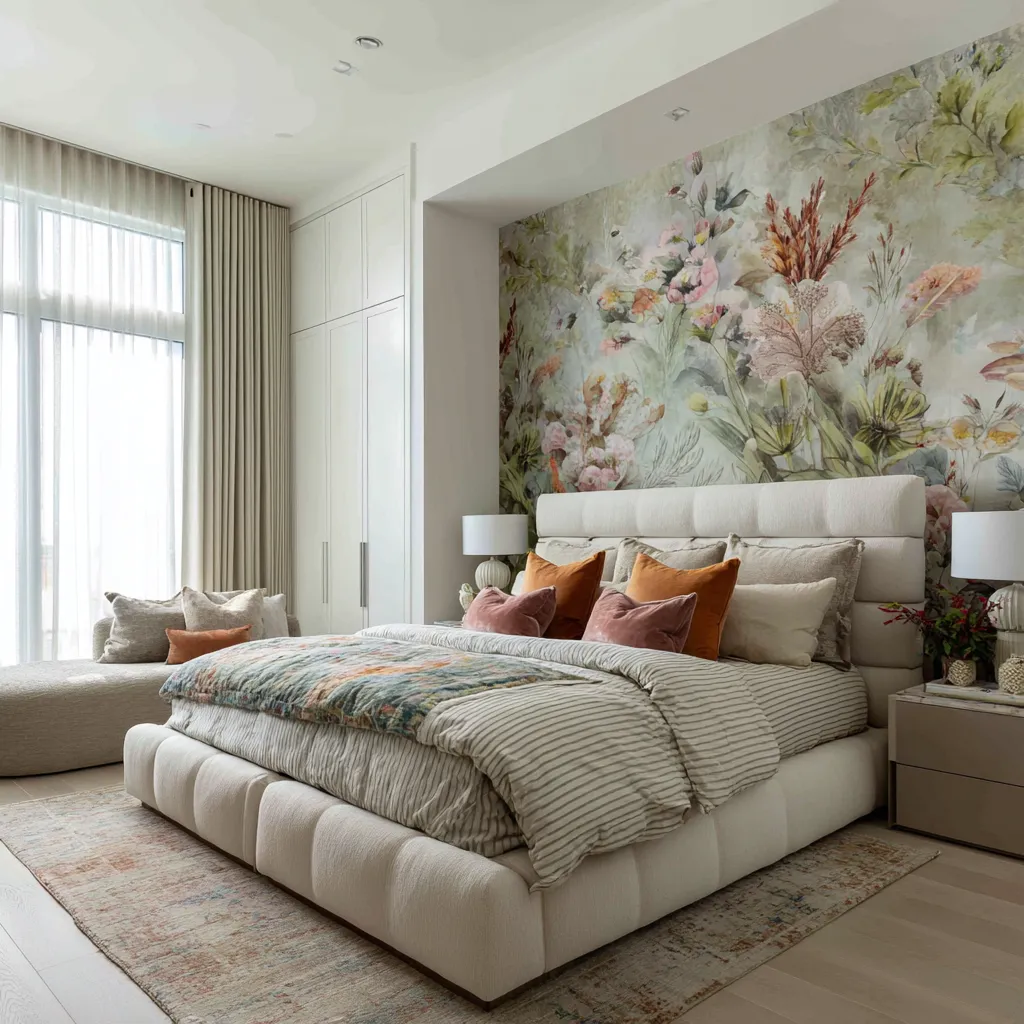
Built-ins play a major role in current maximalist bedrooms, but their success depends on what they do spatially. They cannot simply occupy wall area.
They need to add use, definition, or perimeter structure. A wardrobe run can quiet one side of a room so a mural wall opposite can remain special.
A library wall can give the bedroom intellectual density and a collected feeling without crowding the floor. A bay bench can capture light and create a second zone of comfort.
A media wall can absorb technology into a larger composition rather than letting the screen float awkwardly. A ledge bench can extend a fireplace wall into a lower human-scale surface.
A shelving tower can shift a room toward suite-like inhabitation.
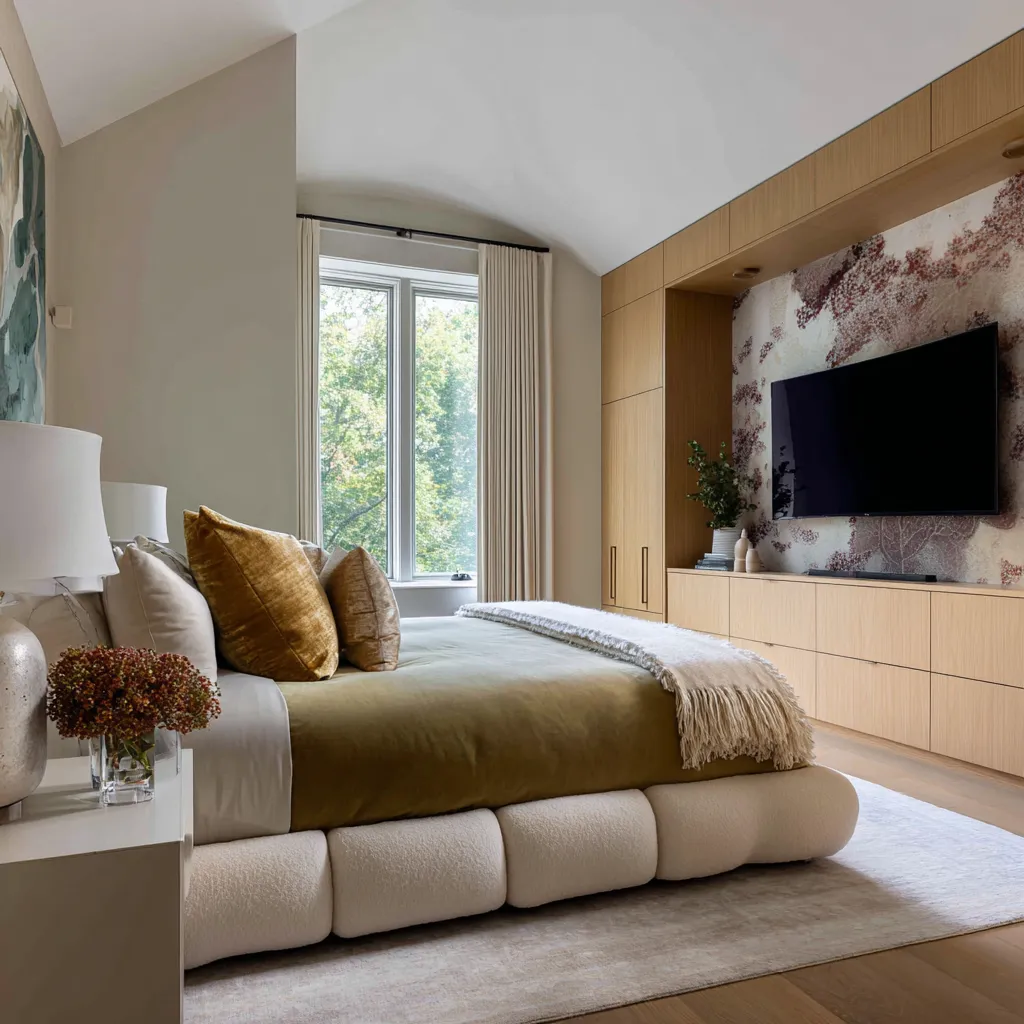
The problem begins when built-ins add bulk without giving anything back. If they darken the room too much, fill too much of the perimeter, or make the shell feel compressed without supplying another usable layer, they can reduce openness quickly.
Built-ins succeed when they shape the room and support life inside it. They fail when they simply increase mass.
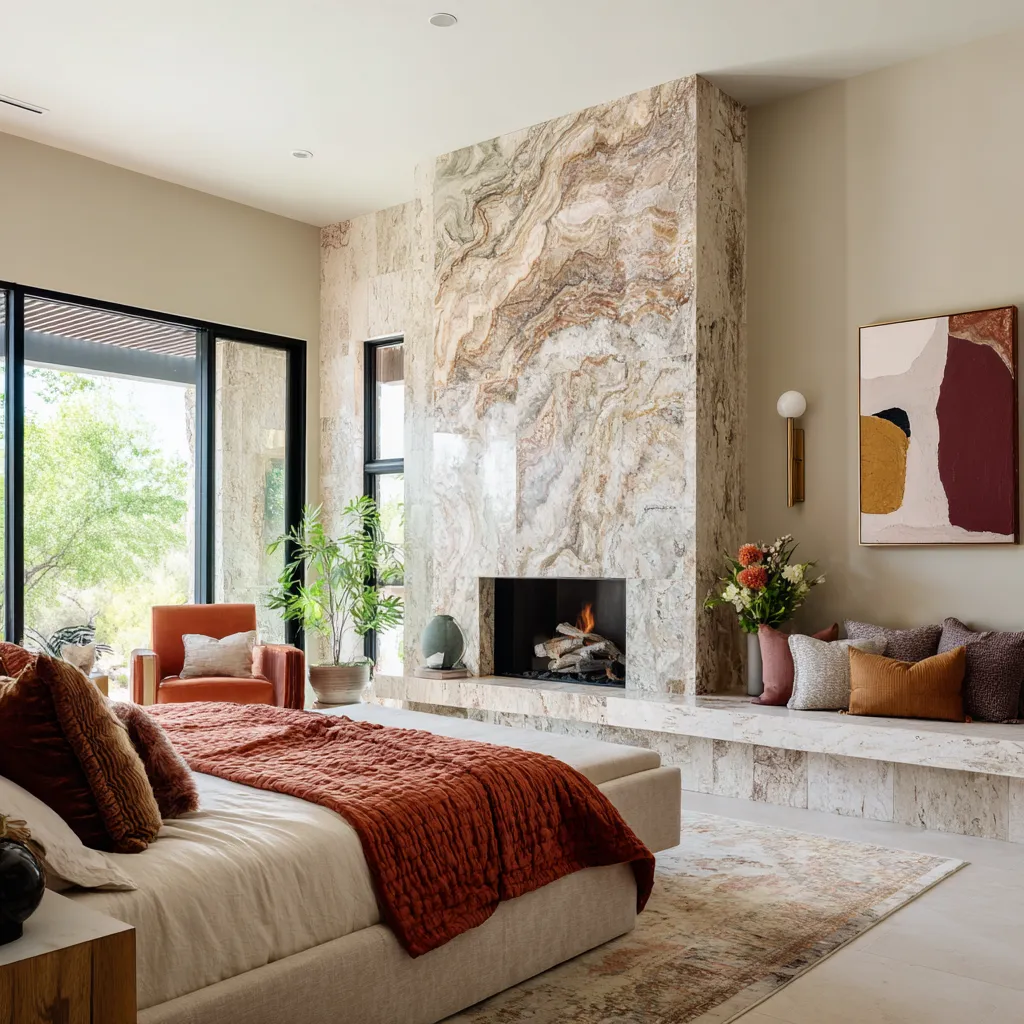
Darker maximalist bedrooms need structure, not only color
Moody maximalist bedrooms can be deeply beautiful, but they operate by different rules than pale luminous ones. Once a room moves into smoky taupes, plums, teals, charcoals, or deep mineral tones, the architecture and material layering need to work harder.
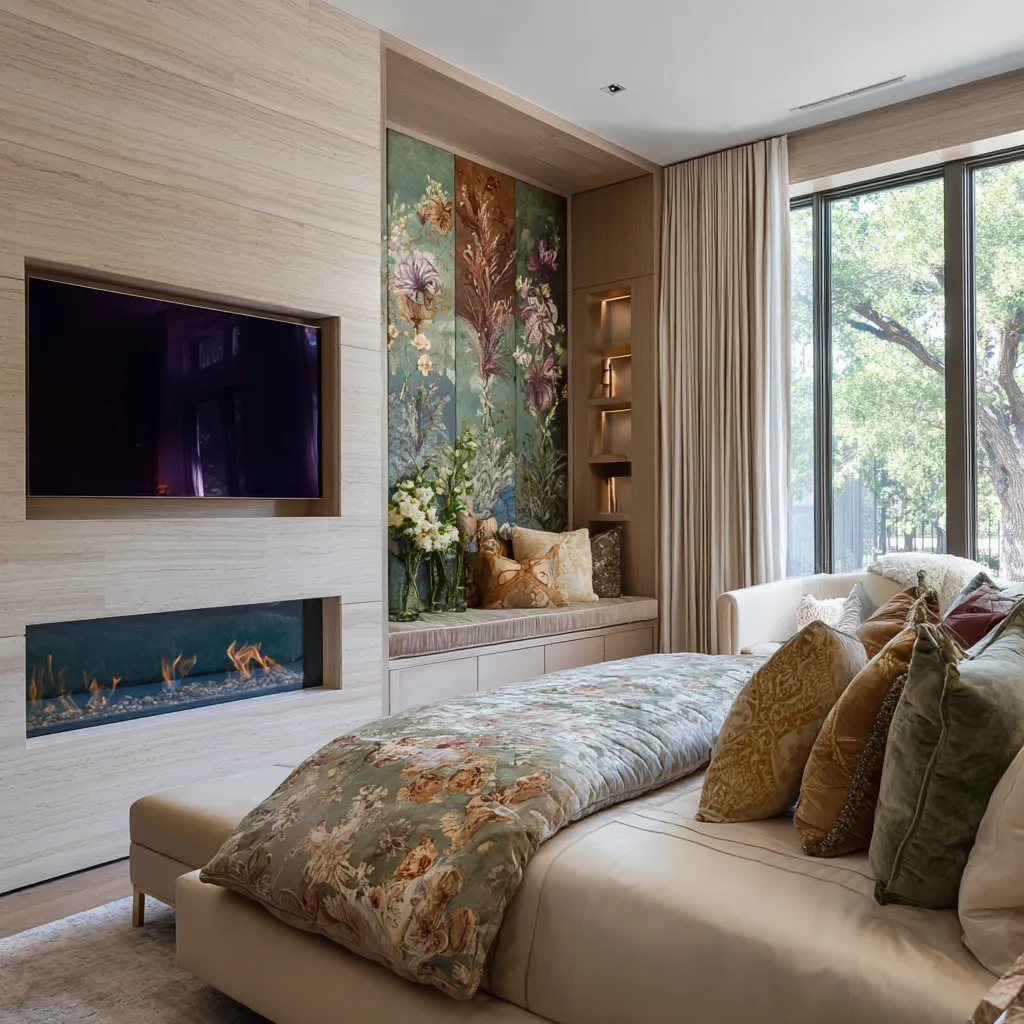
Dark color alone does not automatically create richness. Without enough structure it can flatten the room.
A dark maximalist bedroom often needs panel systems, stone fireplace mass, deep drapery folds, strong bed volume, illuminated shelving, mirror inserts, layered tonal fabrics, and carefully managed light. The room needs edge, relief, and material distinction, or else the darkness can become simply heavy.
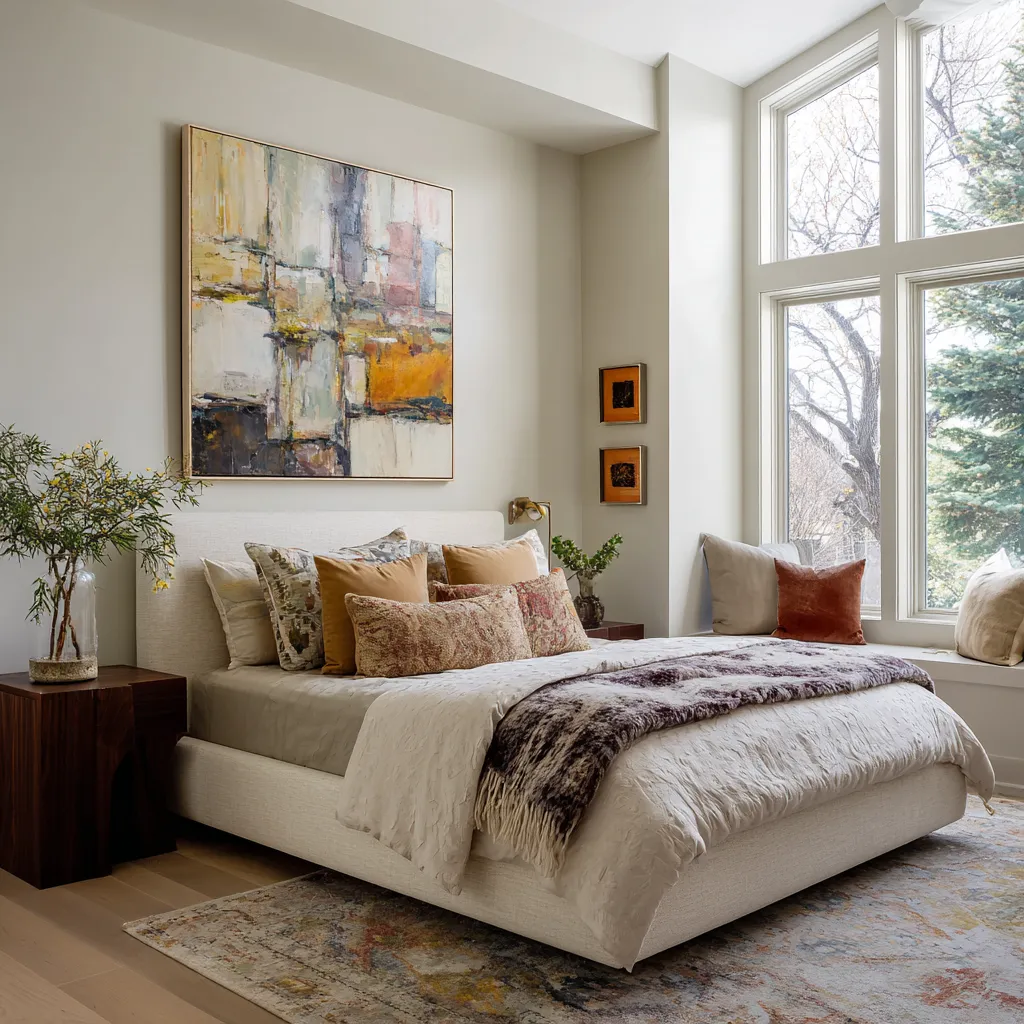
This is why some darker bedroom ideas rely on panelized walls, stacked art, fireplace compositions, media walls, or niche lighting. The room is carrying shadow, but it is also carrying shape.
There is enough internal structure to stop the darker envelope from becoming dull. Dark contrast is also most effective when it works as an edge.
Black window frames, dark mullions, charcoal nightstands, shadowed shelving, or dark lamp forms can sharpen a room beautifully. Once darkness expands into a near-universal field, the room needs more spatial support to stay open and legible.
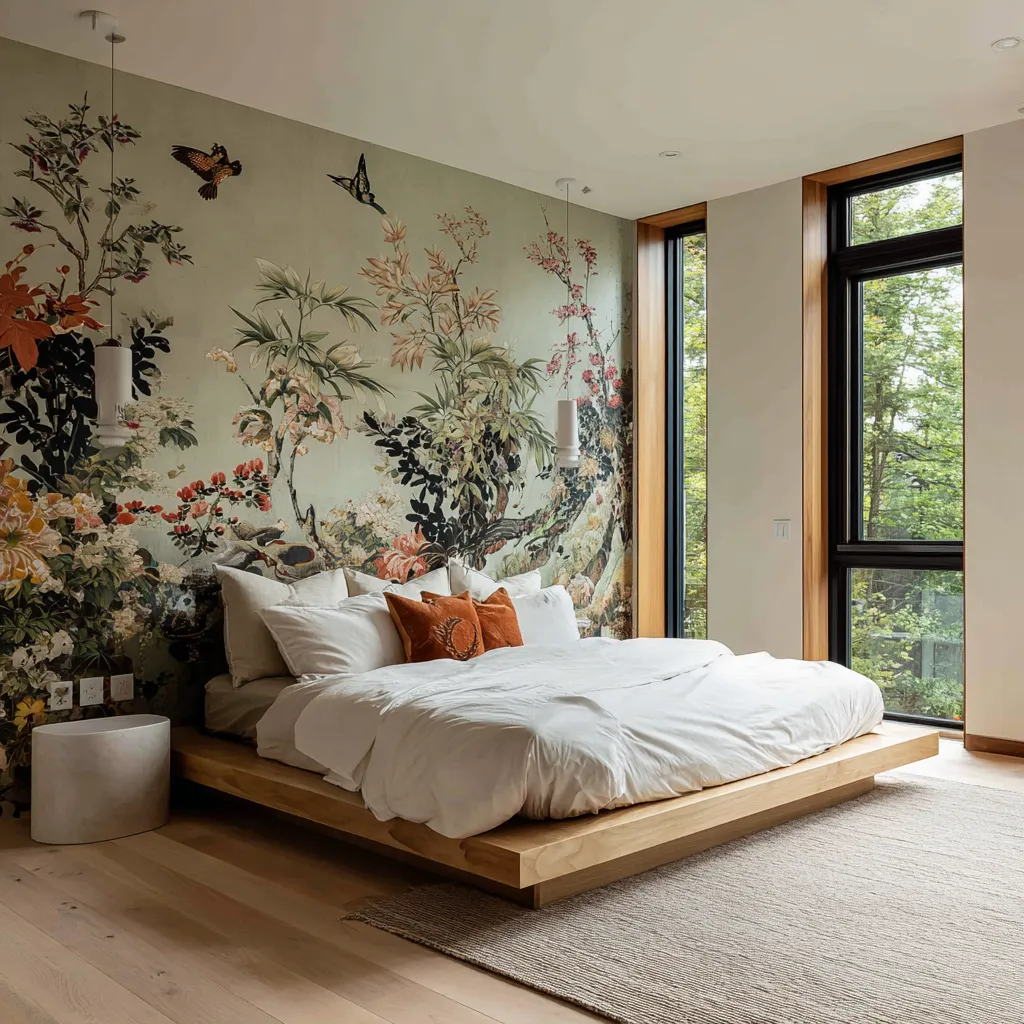
Pattern needs containment
Pattern is not the enemy of a maximalist bedroom design, but it does need hierarchy. Pattern works best when it is held in a clearly defined place.
That place may be the headboard wall, a recessed niche, the inner edge of drapery, one upholstered bench, one coverlet, or a rug large enough to ground the bed and not much else. What weakens many richly decorated bedrooms is not the existence of pattern but the lack of boundaries around it.
When every major surface carries a competing motif, the room can lose both depth and calm.
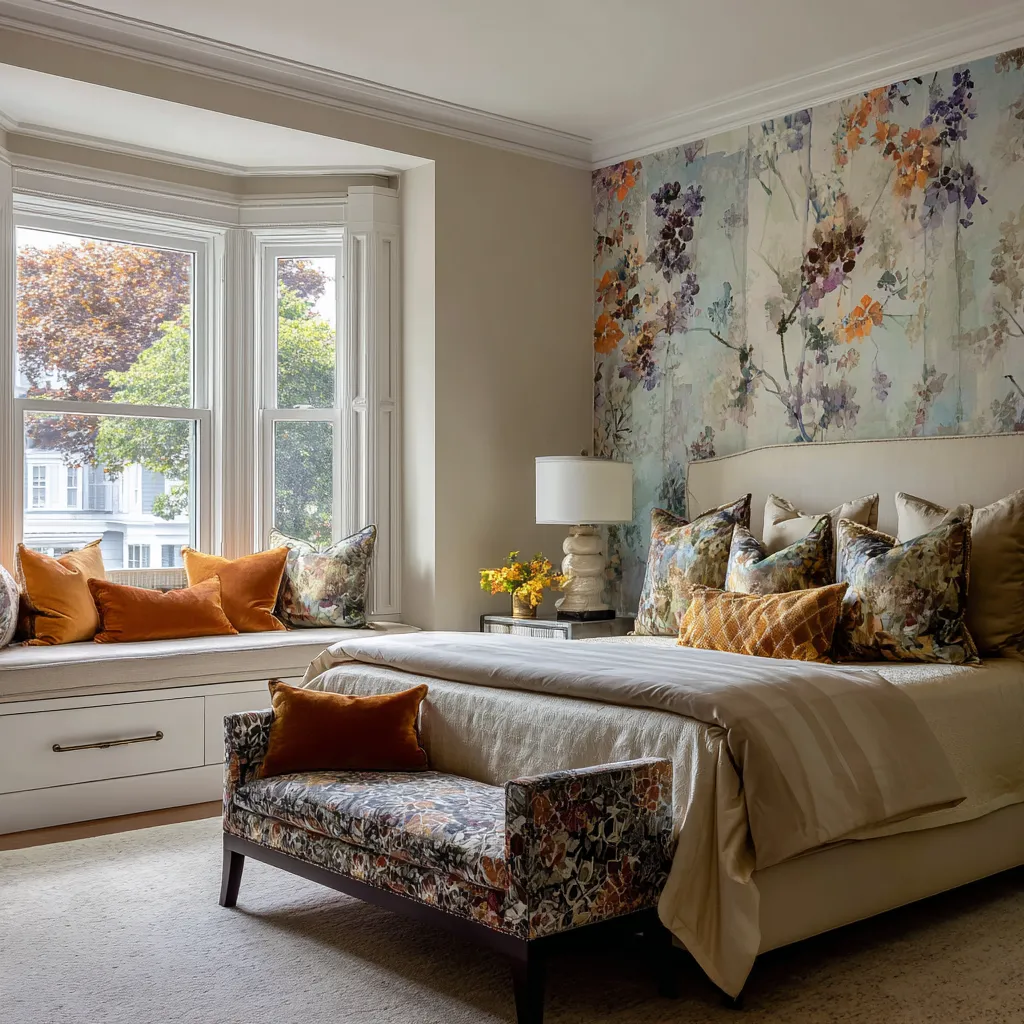
Containment gives patterned surfaces power. A floral mural inside a recess can feel stronger than the same floral spread thinly over all four walls.
Patterned drapery used only at the sides of a bay can frame the opening rather than swallowing it. A bench covered in dense fabric can add a compact decorative moment without destabilizing the bed wall.
A painterly duvet can support a quiet room without demanding a second strong wall treatment. Pattern should usually arrive as a field, not as noise.
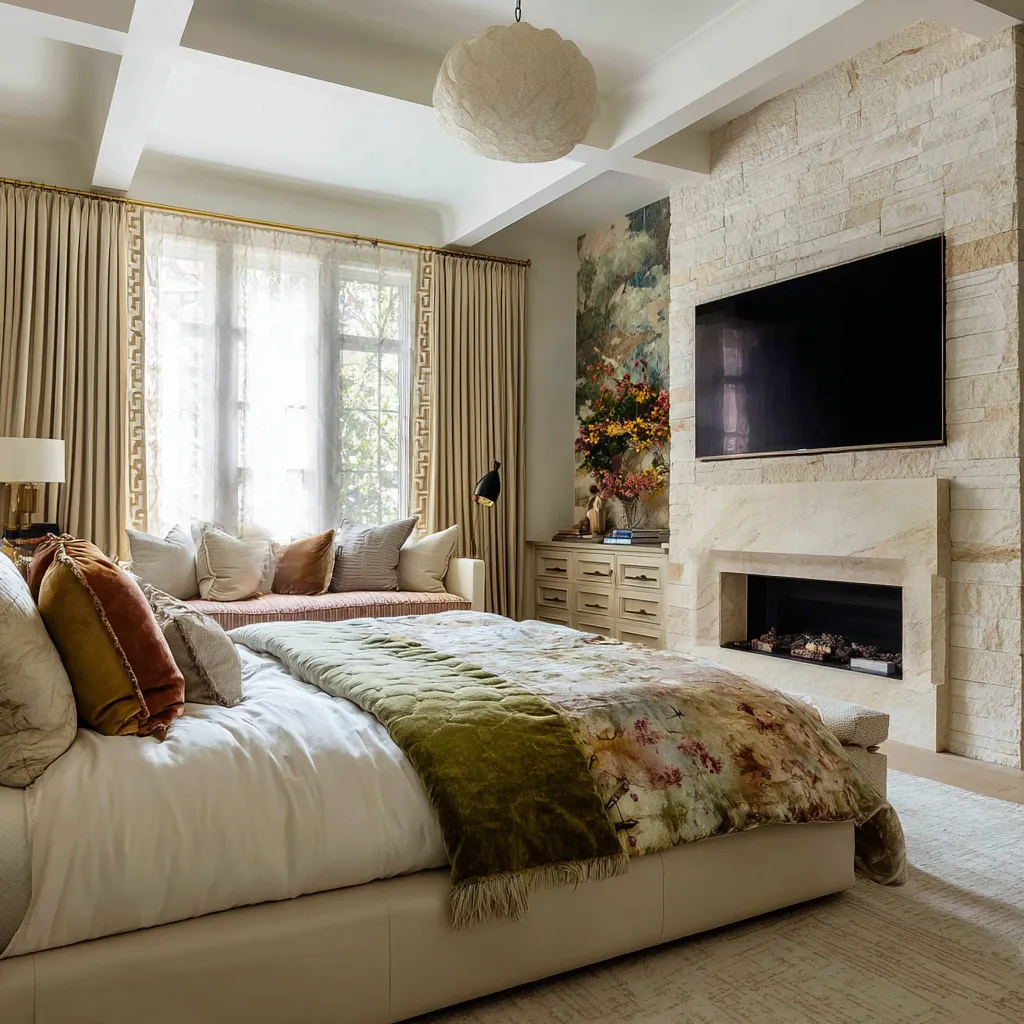
The bedroom designs keep hierarchy visible
Hierarchy is what allows abundance to remain attractive. Without hierarchy, a maximalist bedroom can become tiring very quickly.
The eye should understand what matters first, second, and third. Perhaps the room first presents a fireplace wall, then a bed with thick upholstery, then a window bench.
Or perhaps it first presents a giant abstract artwork, then a concentrated rust pillow cluster, then a painterly rug. In a floral room, perhaps the niche wall comes first, the white bedscape second, the patterned bench third.
Whatever the sequence is, it should be clear.
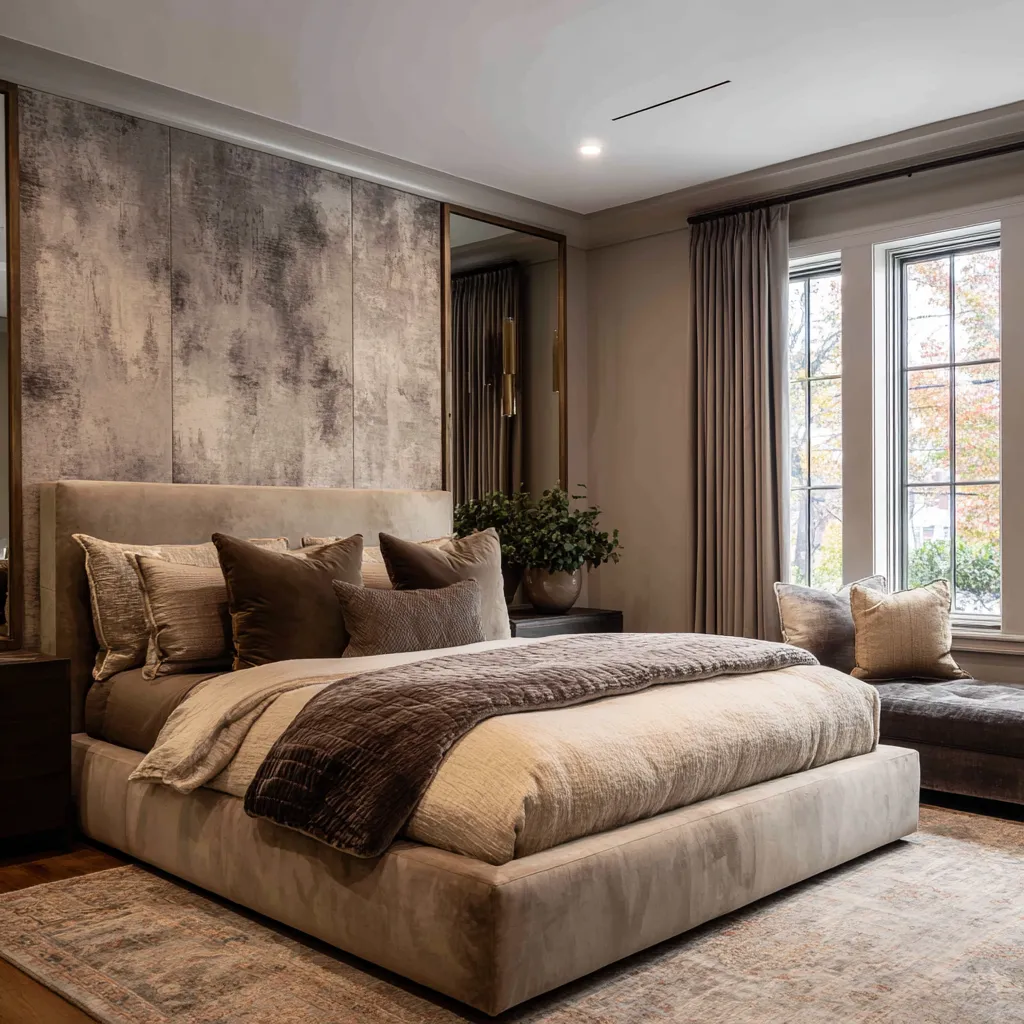
Hierarchy comes from several decisions working together:
- one dominant image field rather than several equal ones
- enough blank or pale surface around that field
- a bed form clear enough not to break the room into fragments
- accent color gathered rather than scattered
- secondary zones furnished, but not over-amplified
- built-ins or architecture arranged to support the main direction rather than compete with it
The room does not need to be simple. It needs to be readable.
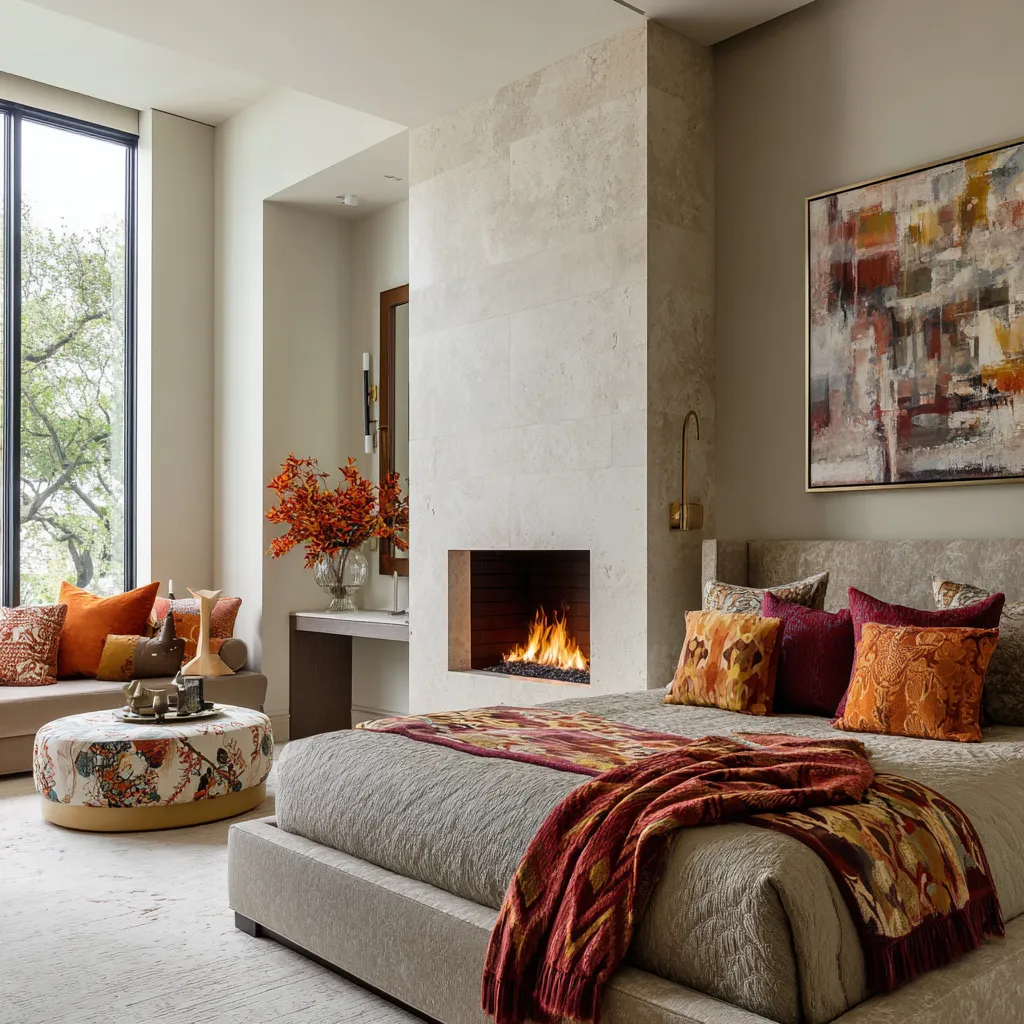
What makes the style feel current now
The current form of modern maximalist bedroom design is shaped by discipline. It does not reject richness, but it wants that richness organized.
It accepts mural walls, floral atmospheres, giant art, plush upholstery, moody envelopes, painterly rugs, and layered seating. Yet it asks those elements to work inside a clear framework.
That framework often includes:
- architecture strong enough to hold decoration
- more than one inhabitable zone
- texture doing as much work as pattern
- pale or carefully managed tonal fields
- large gestures instead of endless little ones
- accent concentration rather than scattered emphasis
- a bed that feels substantial, soft, and visually steady
In other words, the bedroom feels abundant because the room knows where abundance lives.
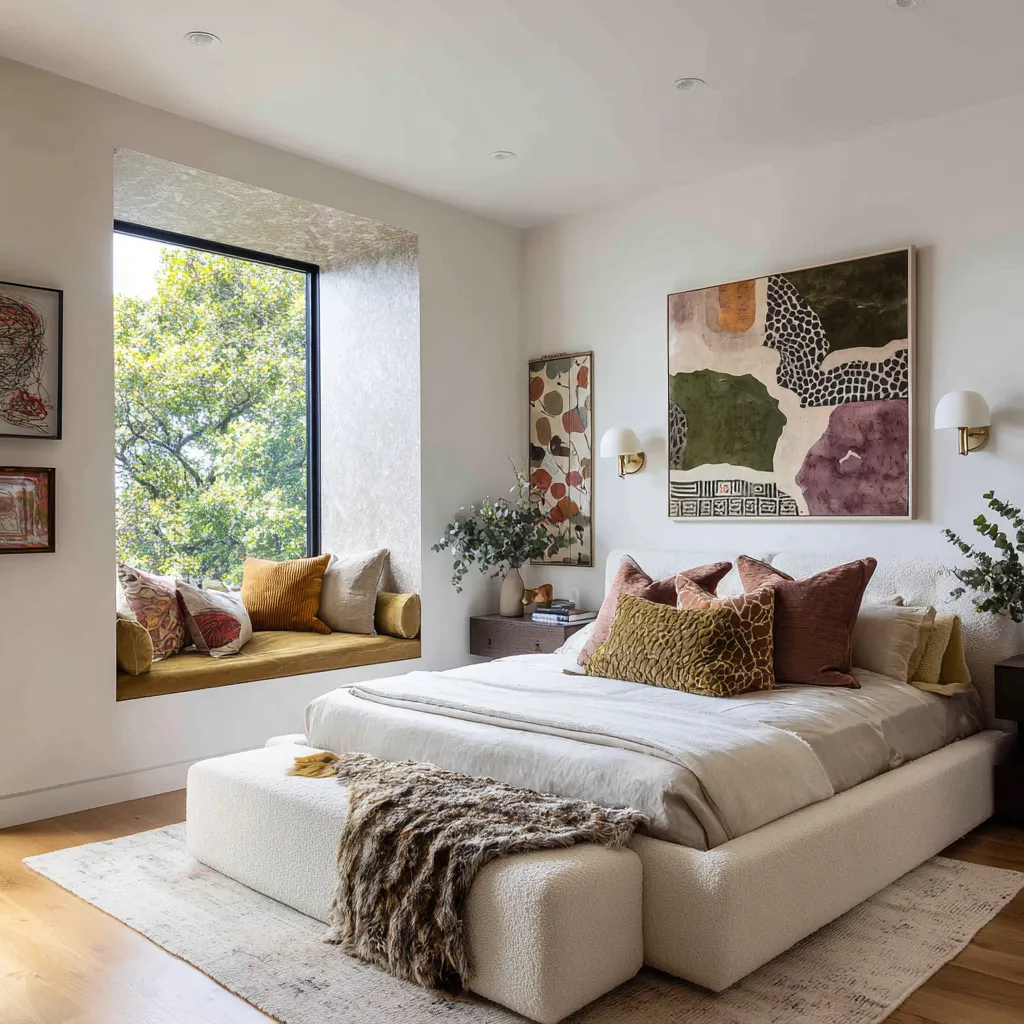
Final thoughts
A strong modern maximalist bedroom does not depend on endless addition. It depends on placement, magnitude, and structure.
It asks which surface should carry atmosphere, which zone should hold comfort, where the room needs visual release, and what kind of architectural frame can support the whole composition. That is why memorable maximalist bedroom ideas feel both rich and composed.
Their abundance has shape. Their softness has contrast.
Their pattern has boundaries. Their color has a center.
Their architecture gives the decorative layer somewhere to settle.
When those conditions are in place, a maximalist bedroom can feel deeply developed without turning busy, luxurious without stiffness, and expressive without losing rest. It becomes a room with presence, comfort, and identity that extends far past simple decoration.