A modern beach kitchen often loses its appeal at the exact moment it starts explaining itself too clearly. Once the room begins announcing the coast through shells, rope, striped accents, sea-blue splashes, or clusters of nautical objects, the air changes.
The kitchen stops feeling shaped by light, weather, and shoreline life and starts feeling arranged around a message. The richer approach is quieter in spirit and far more architectural.
It lets the coast enter through proportion, material, rhythm, and memory.
That shift matters because a believable contemporary coastal kitchen does not need to look like a beach house showroom. It needs to feel as though salt air, pale light, worn timber, chalky stone, and relaxed daily use have quietly affected the room over time.
The result is less about adding seaside décor and more about translating shoreline conditions into interior form.
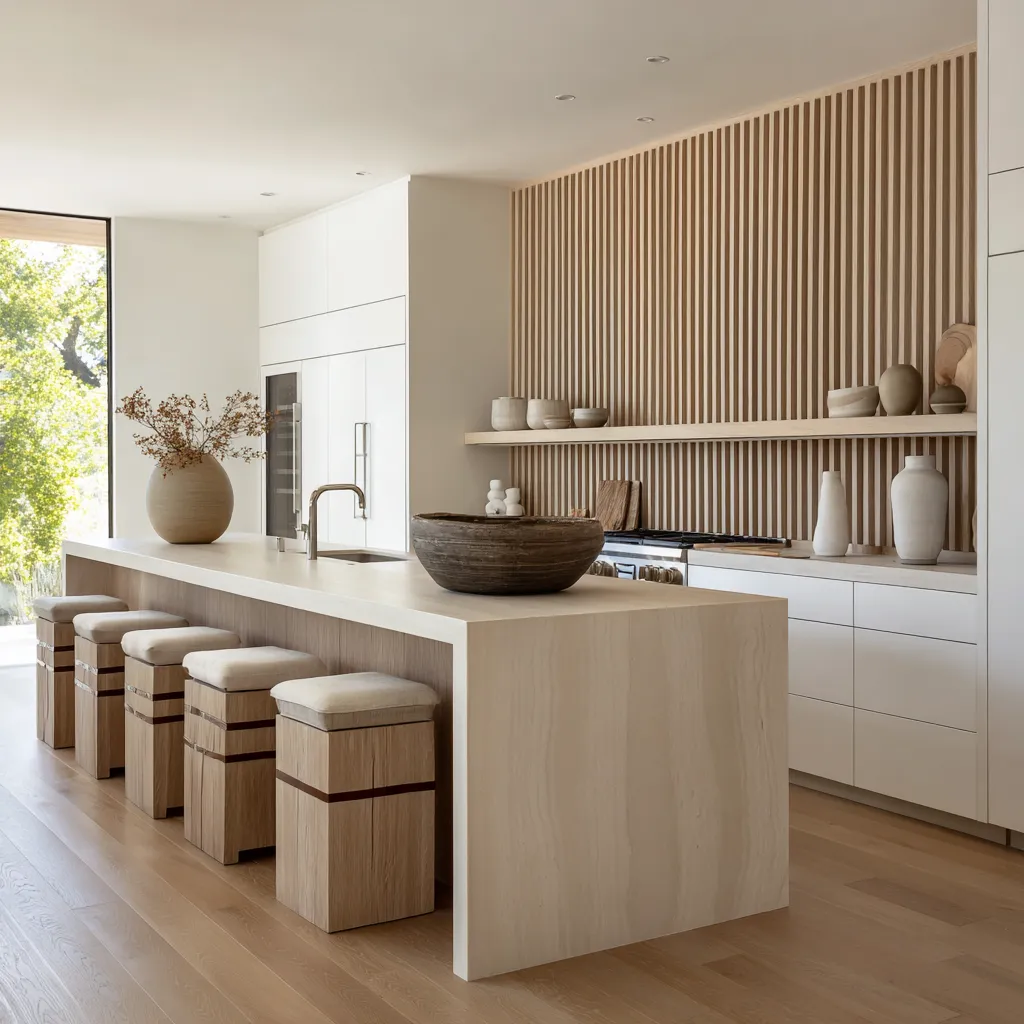
The kitchen ideas that do this well tend to share a clear internal discipline. They choose one or two primary carriers of coastal mood, then keep the rest of the room calm.
They let long horizontal lines suggest the horizon. They let slatted wood or reeded millwork suggest fencing, cladding, or filtered shadow.
They let pale mineral surfaces stand in for sand, limestone, or weathered rock. They let rough timber hint at exposure, age, and service.
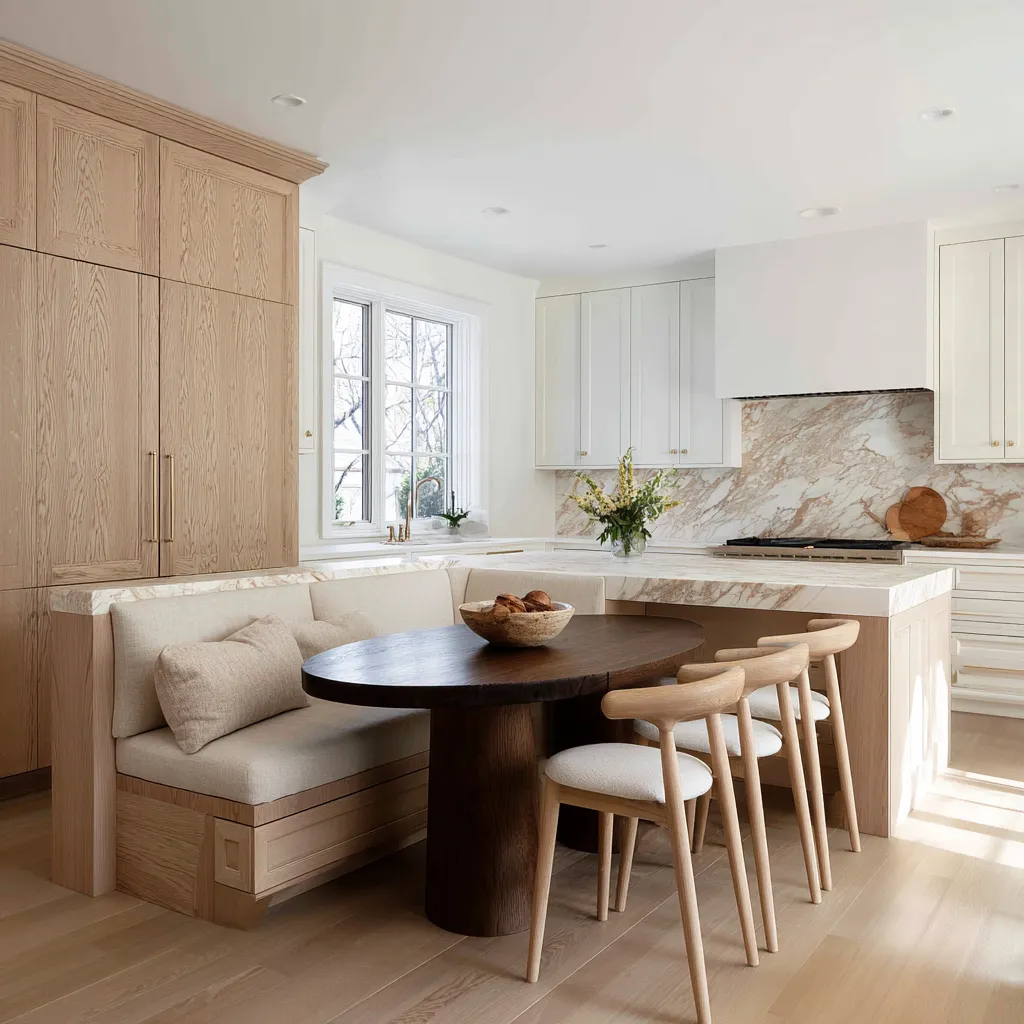
They let banquettes create sheltered corners that feel settled and inhabited. What they avoid is equally important: repeated symbols, decorative clutter, and an overexplained palette.
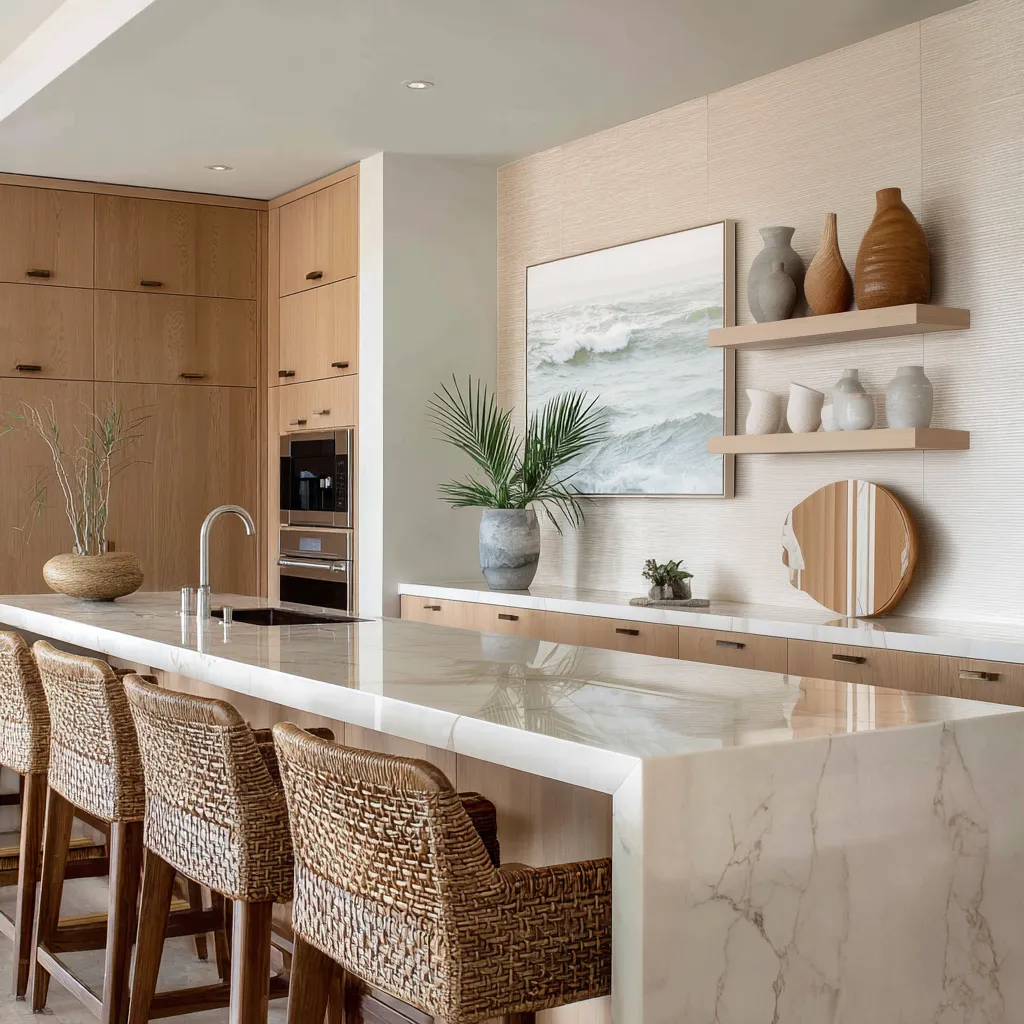
The coast enters first through structure, not color
One of the misunderstandings in beach-inspired kitchen design is the idea that coastal character begins with color. In weaker rooms, blue becomes the shortcut.
Pale blue cabinets, navy stools, aqua glass, striped runners, and a bowl of shells are expected to do all the work. But the contemporary coastal kitchen is usually far more dependent on structure than on hue.
Its dominant color story often stays close to chalk, sand, oat, pale stone, muted clay, washed timber, deep walnut, and warm metal. Blue may appear, but it is rarely the main force.
This matters because shoreline feeling is often spatial before it is chromatic. The coast is wide, low, weathered, and open.
It is formed by long horizontal edges, repeated vertical markers, drifting light, and material erosion. A kitchen that captures those conditions can feel deeply beach-adjacent without leaning on obvious beach color.
In fact, the absence of direct marine color often helps the room feel newer and more grounded.
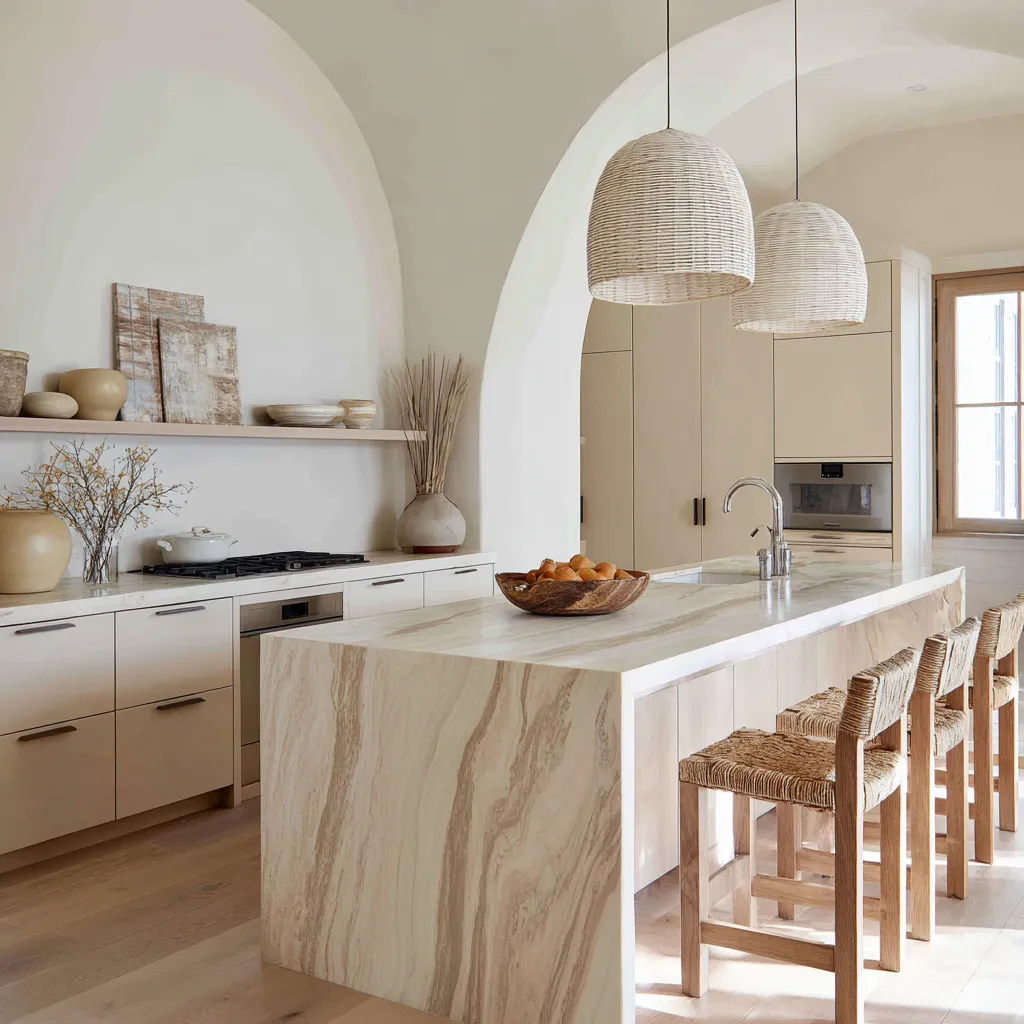
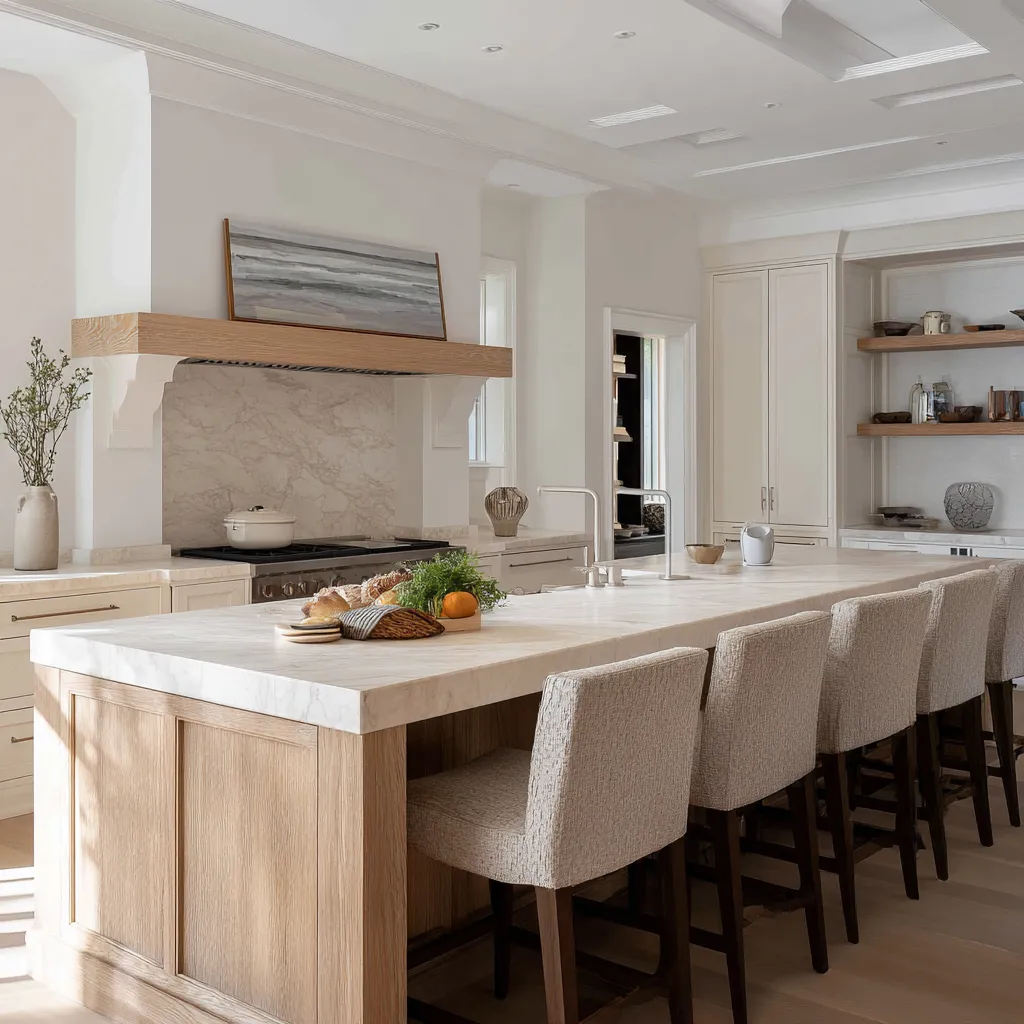
A pale stone island with soft sediment-like movement can carry more shoreline memory than a blue backsplash. A long timber shelf can suggest the coast more effectively than a basket of coral.
A slatted wall behind the cook zone can bring in boardwalk rhythm and dune-fence cadence without stating any of that literally. That is the central distinction: the room should absorb coastal logic, not perform coastal decoration.
Let the shoreline appear as a horizon line
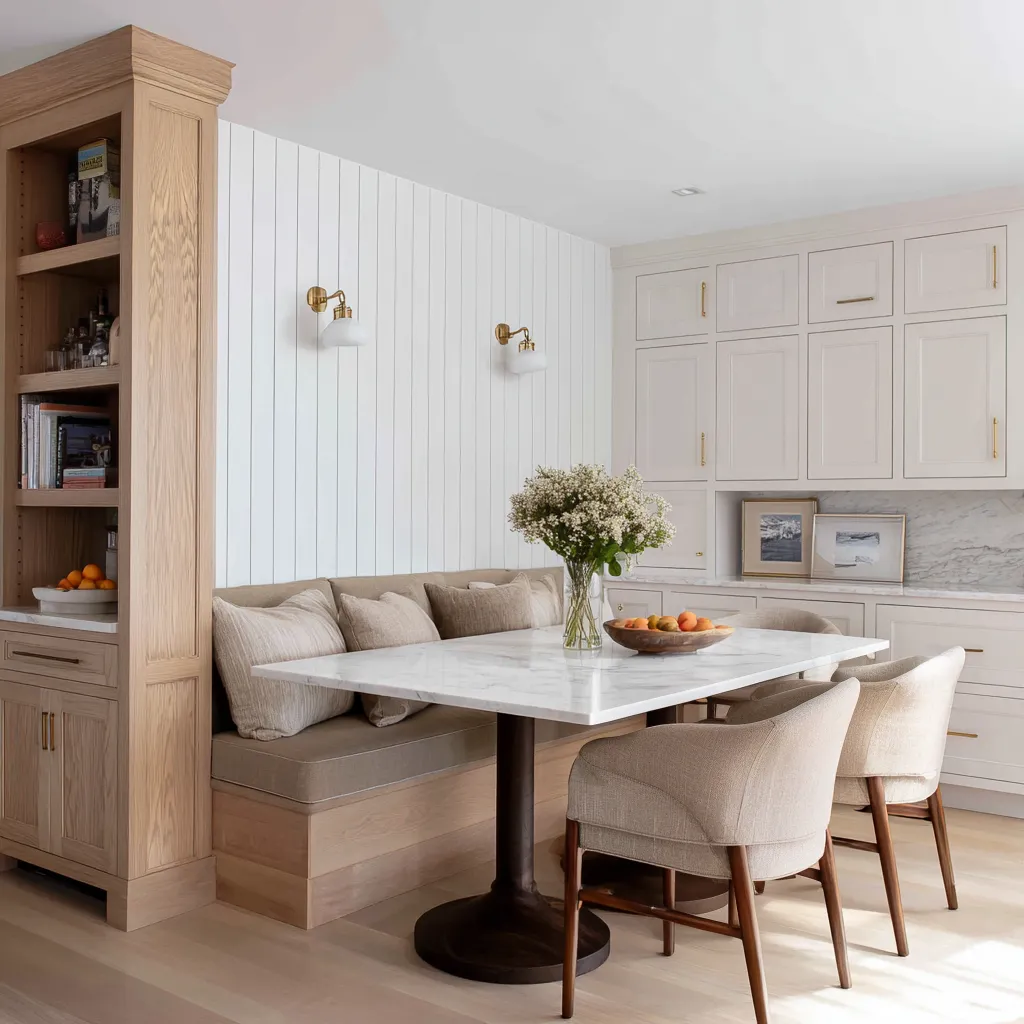
One of the ways to bring beach feeling into a kitchen is through long horizontal organization. The horizon is one of the coast’s visual constants, and many of the refined coastal kitchens borrow that condition without naming it.
Long benches, long ledges, long shelves, low landscape art, broad islands, and wide relief panels all create a calm, stretched composition that quietly recalls the line where land meets water.
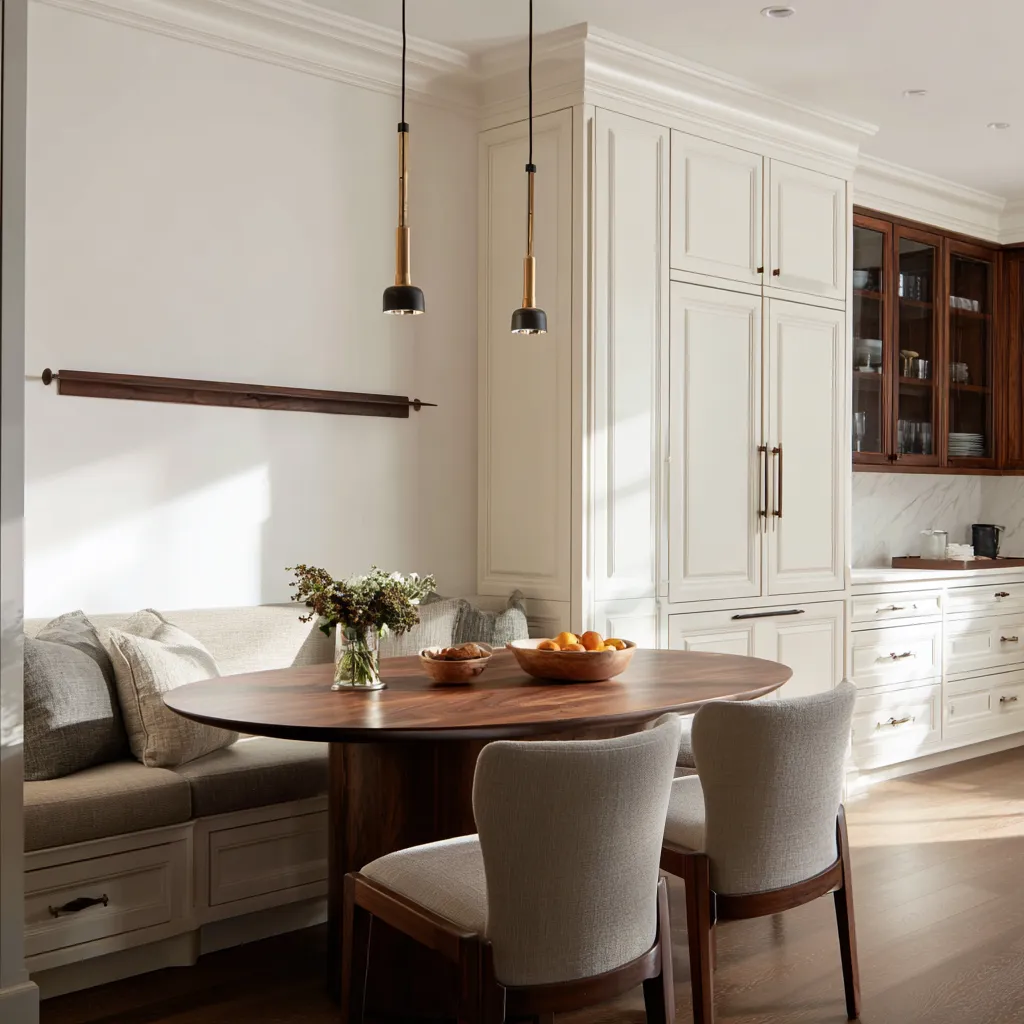
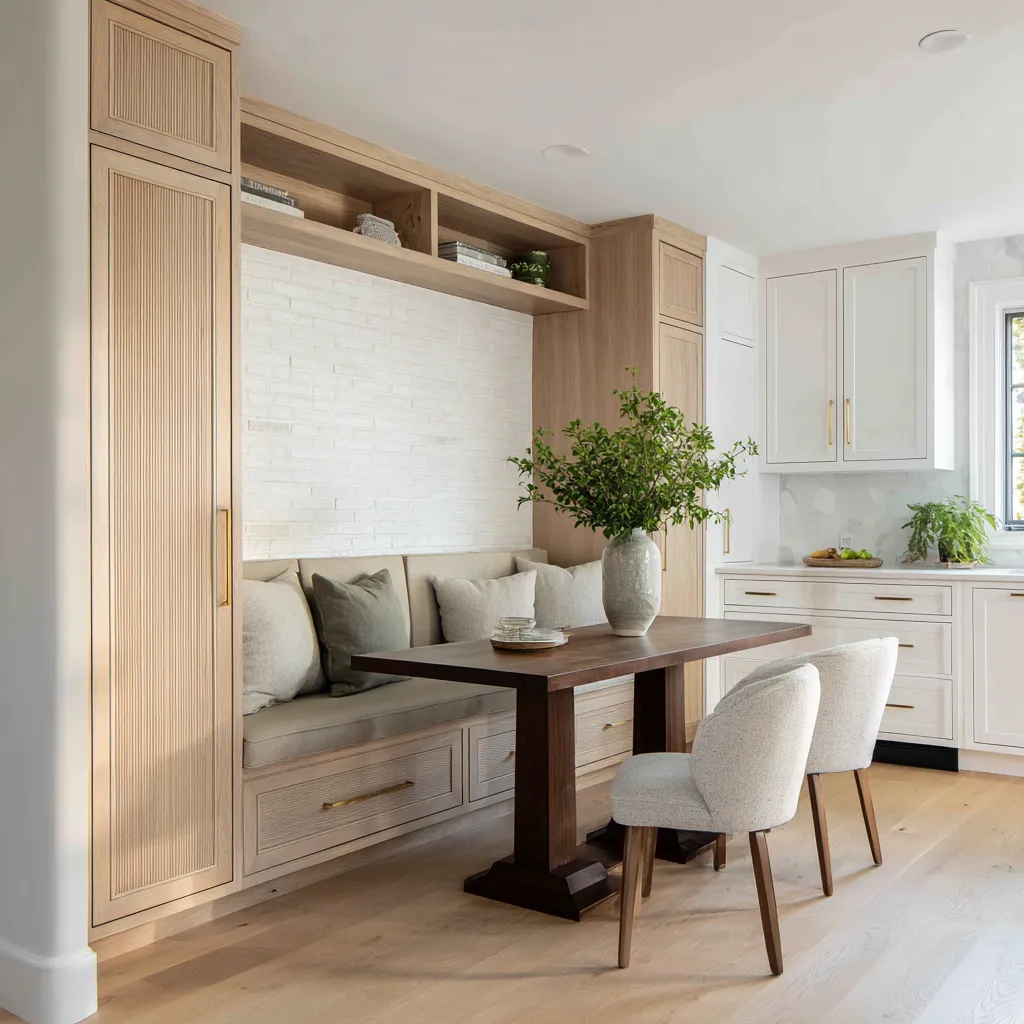
This can happen in very different ways. A built-in banquette with a tall straight back panel can become a low architectural band along the wall.
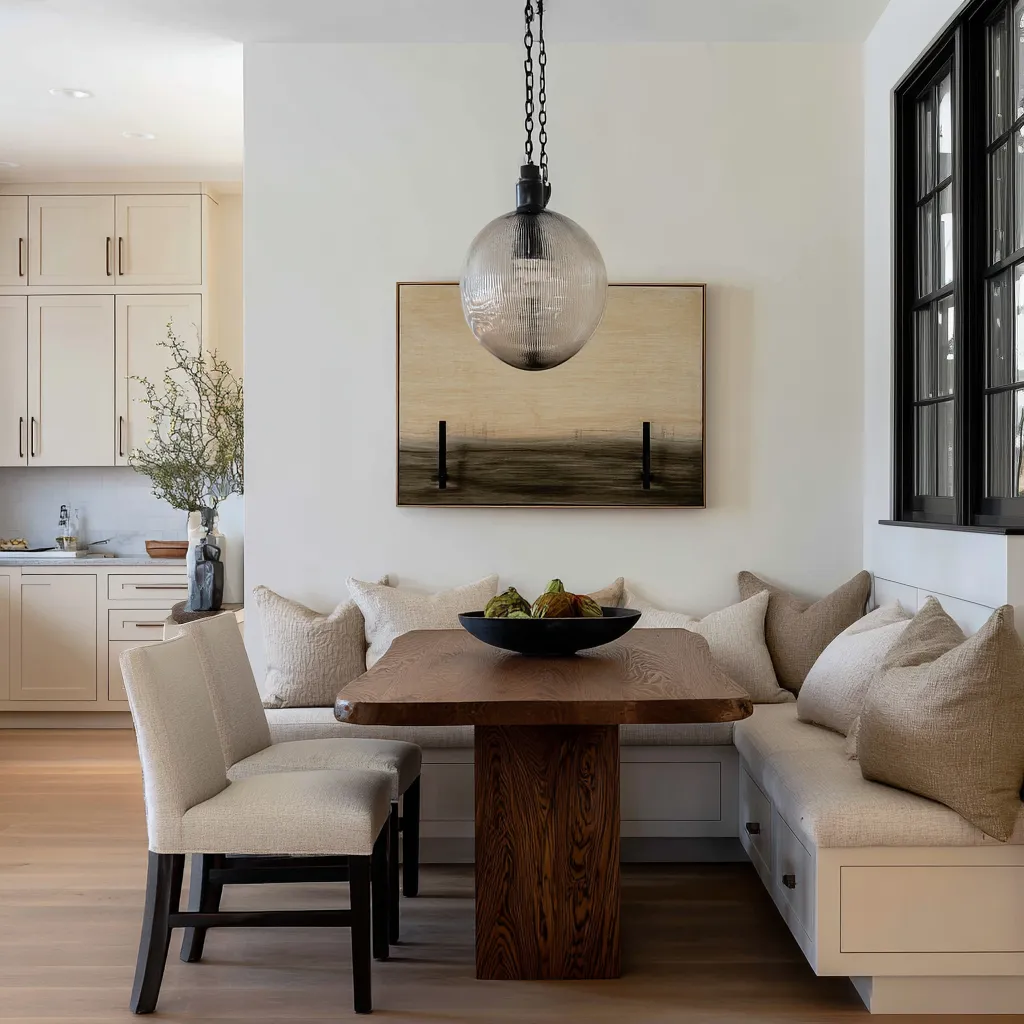
A thick floating shelf placed alone above a counter can create a strong horizontal datum that steadies the room. A narrow abstract work with blurred tonal bands can hint at sea, fog, sand, and sky without becoming illustrative.
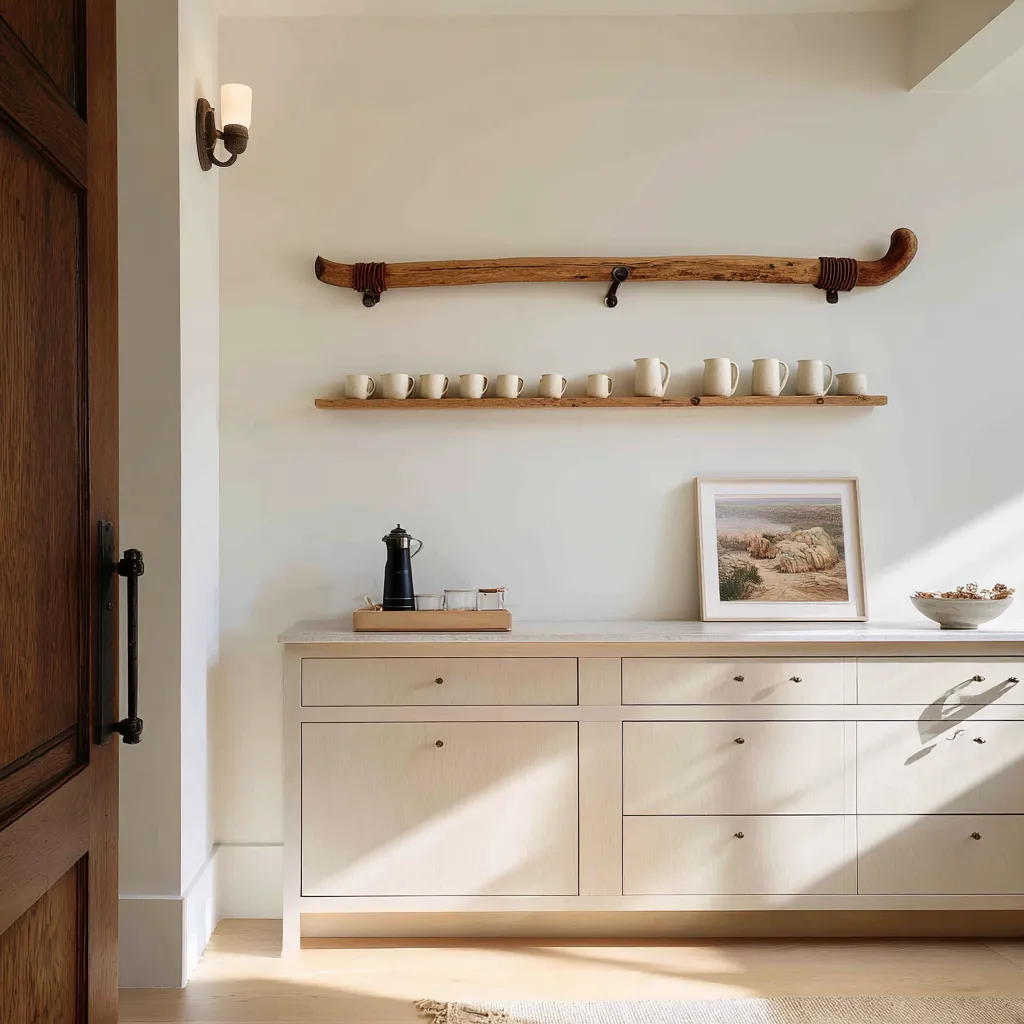
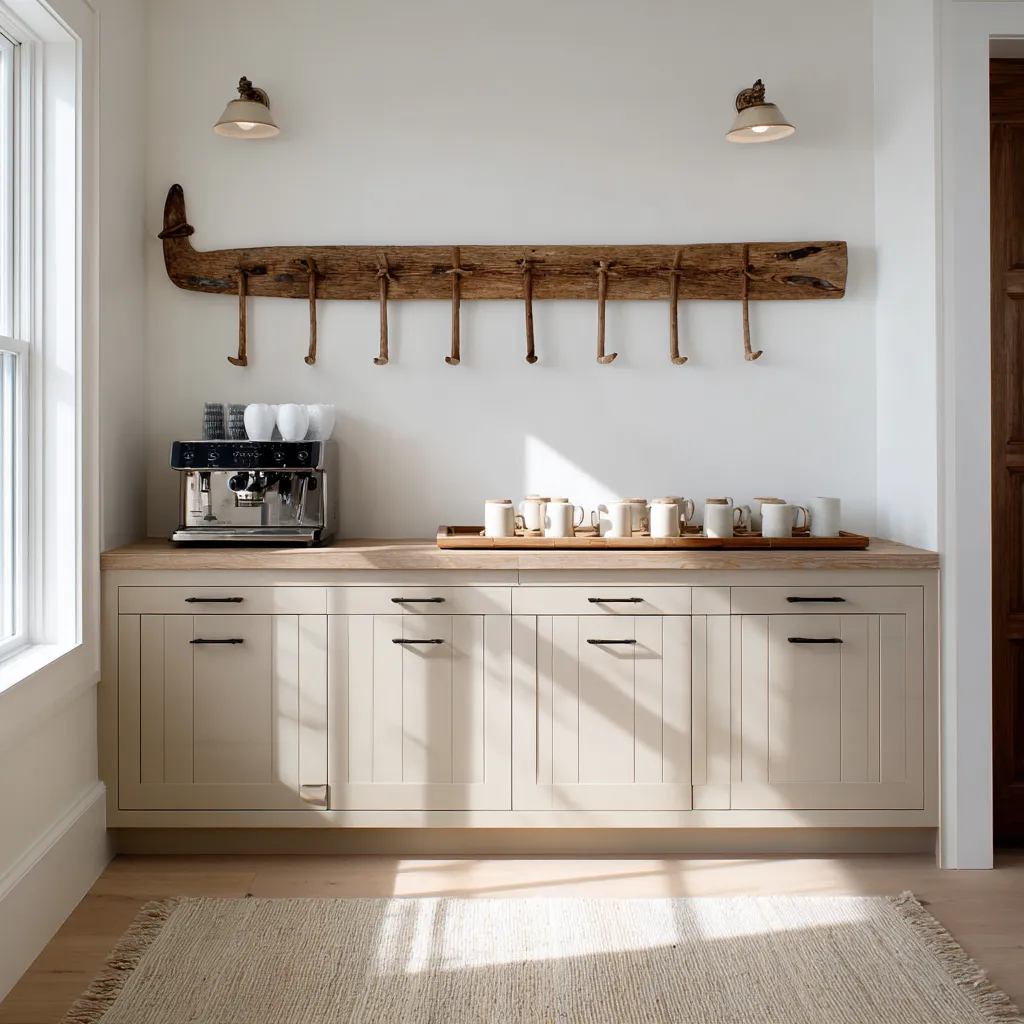
A surfboard or oar used by itself, mounted high on a blank wall, can work for the same reason: its length acts like a strong line first, a marine reference second.
That order matters. The object or art should contribute to the room’s geometry before it contributes to the theme.
Once it does that, the coastal note feels embedded rather than applied. This is why one long gesture often carries more power than several smaller decorative signals.
A kitchen does not need five shore references if one horizontal datum already gives the room its atmosphere.
Vertical rhythm can replace literal seaside imagery
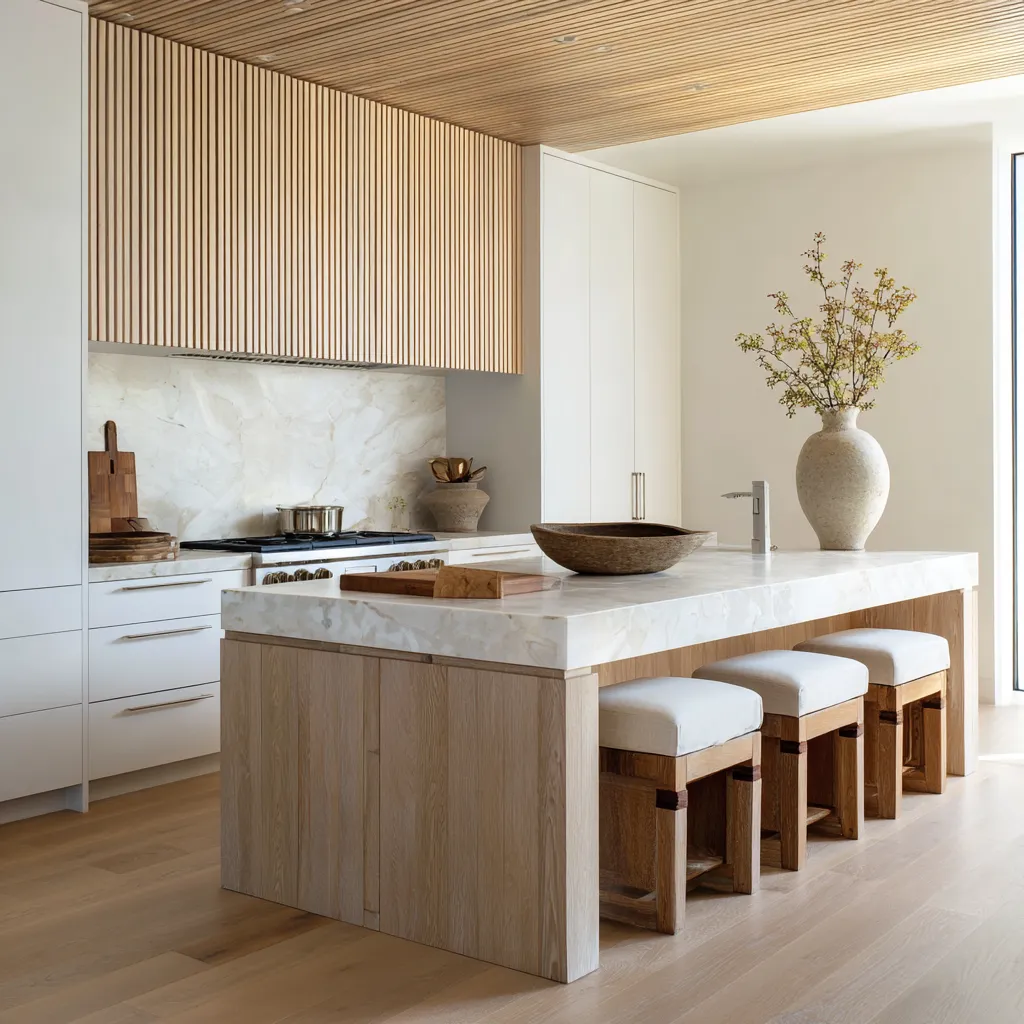
If horizontal organization carries the shoreline, vertical rhythm often carries the built environment near the shore. Slats, reeding, panel lines, beadboard-like wall treatment, ribbed plaster, and narrow timber intervals can all suggest dune fencing, board siding, reeds, shutter lines, weathered cladding, and filtered shadow.
These are some of the design tools in a contemporary coastal kitchen because they introduce shoreline memory while keeping the theme abstract.
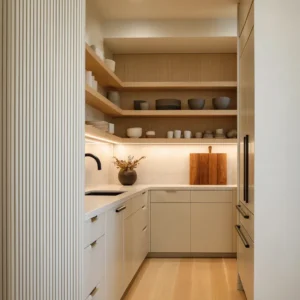
This is especially valuable for rooms that want the coast present but low in volume. A slatted hood wall or a reeded island end panel creates texture without adding an object.
A ribbed relief panel above a sideboard can suggest natural pattern and weathering without using art at all. Vertical white paneling inside a recessed niche can bring in a gentle beach-house memory while still feeling highly controlled.
Pale reeded millwork can create movement in a room that otherwise stays minimal. The beauty of this move is that it keeps the coast in the register of atmosphere and architecture.
The kitchen begins to feel shaped by boards, reeds, fencing, and sun rather than by decorative symbols. That makes the room feel more current because the reference remains inside the bones of the design.
Dry surfaces matter more than glossy ones
A great many contemporary coastal kitchens are built on a preference for dryness. Their stone is chalky rather than reflective.
Their ceramics are matte rather than glazed to a sharp shine. Their woods are washed, open-grained, or lightly oiled rather than heavily lacquered.
Their plaster is soft rather than slick. Their textiles are nubby, woven, or linen-like rather than polished.
This dry tactile field is a way to create beach feeling without overt beach styling. Shoreline environments are shaped by salt, wind, sand, chalk, fiber, stone, and weather.
The surfaces near water often feel softened, bleached, rubbed, and slightly desaturated. A kitchen that picks up that material quality will usually feel closer to the coast than one that relies on decorative marine references.
That does not mean the room should become rough everywhere. In fact, contrast is important.
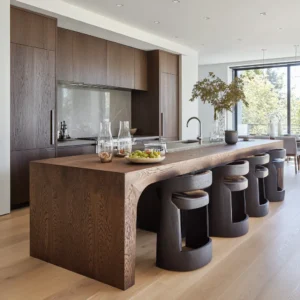
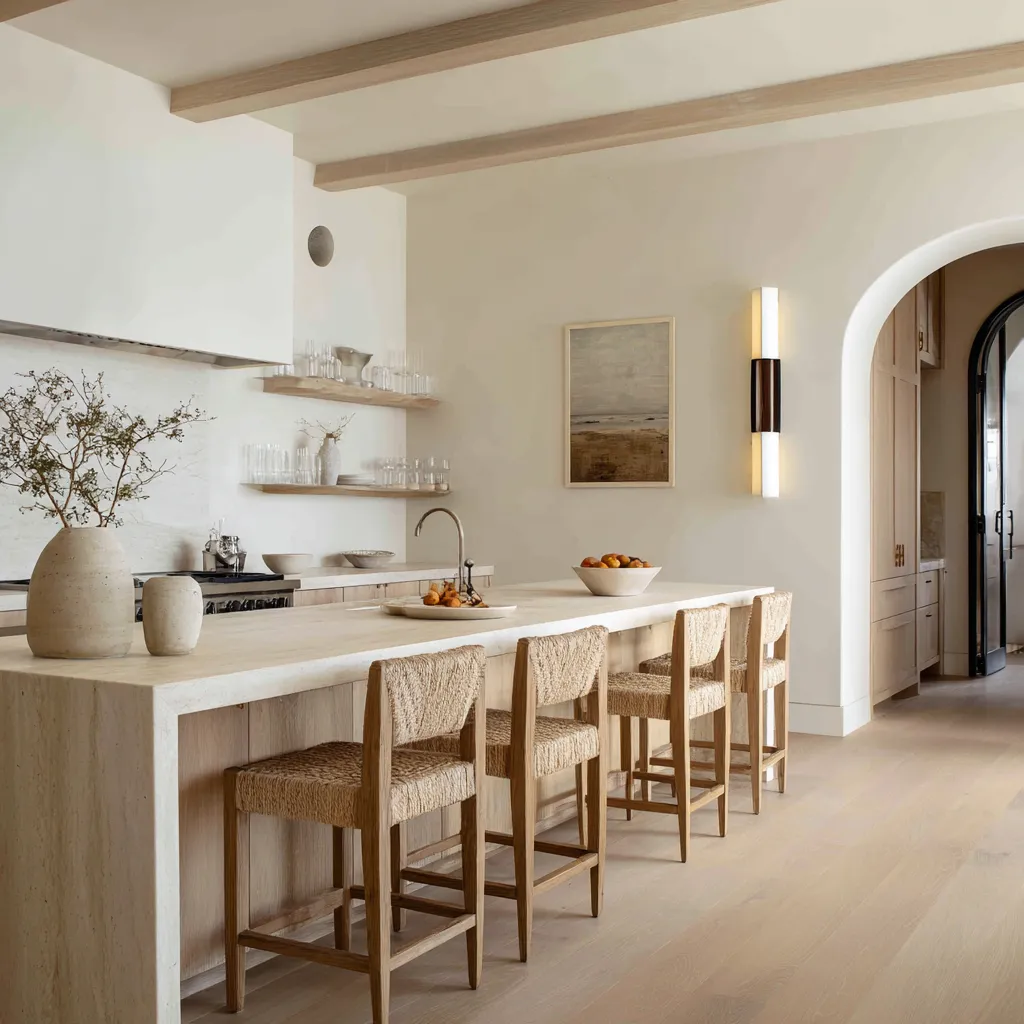
A pale monolithic island with broad waterfall sides can feel carved and still. A matte plaster hood can absorb light gently.
A row of rush or woven stools can add handworked texture. A group of pale vessels on an open shelf can extend the dry material story.
But if every surface is equally rough, the room turns heavy and rustic. The refinement comes from editing: one or two tactile notes placed inside a calm, broad shell.
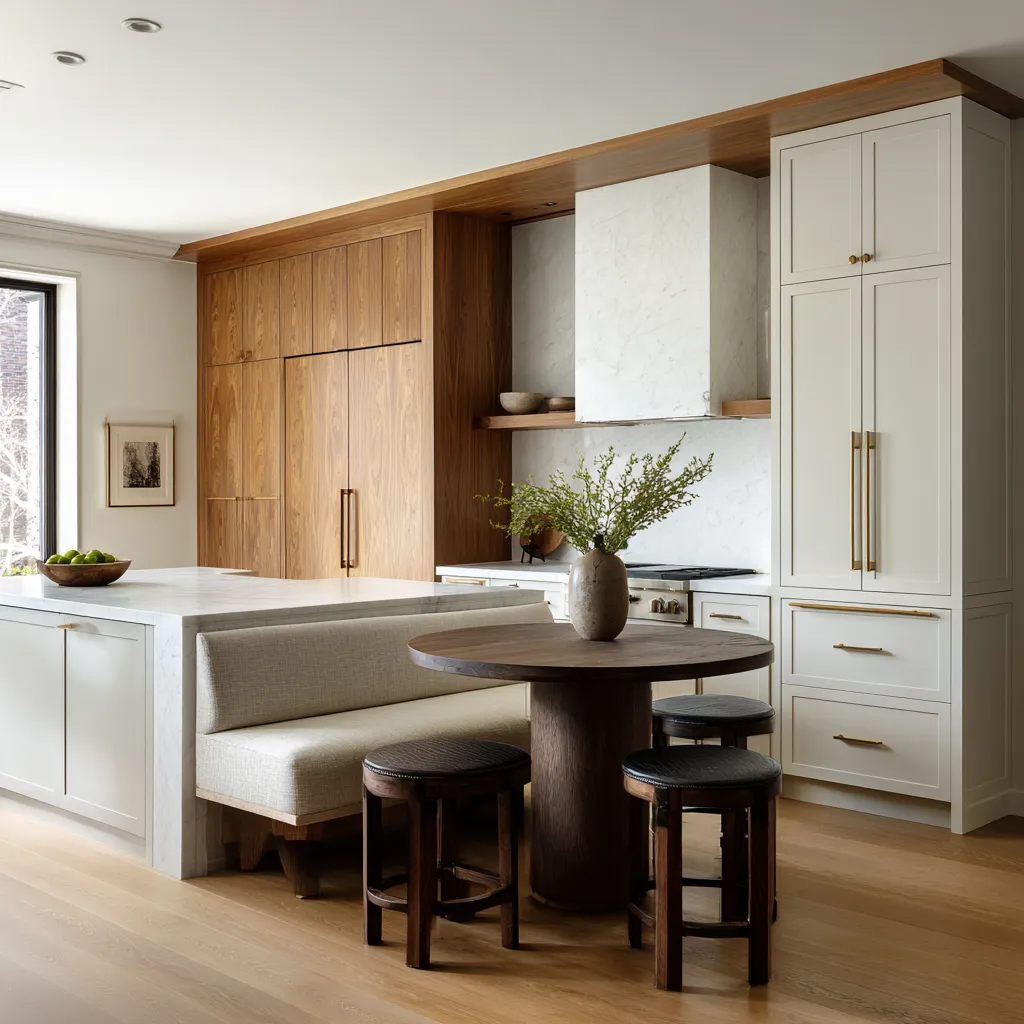
Give the kitchen one element with age and prior life
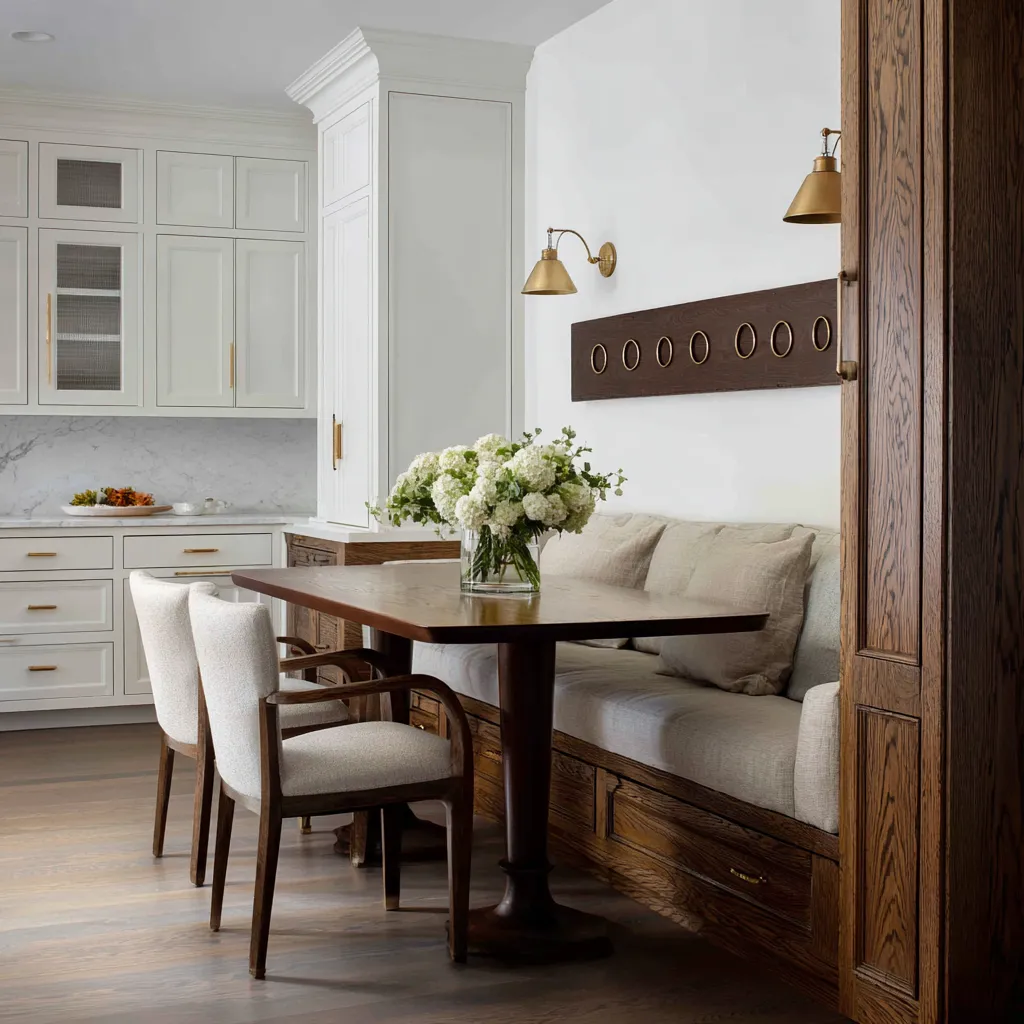
One of the ways to move a beach kitchen beyond prettiness is to give it one element that feels weathered, used, or older than the rest of the room. This can be a rough timber shelf, a reclaimed beam-like ledge, an aged rack above a coffee station, a surfboard mounted as sculpture, an oar-like form stretched along a breakfast nook wall, or a darkened wood piece whose irregularity carries the feeling of service and exposure.
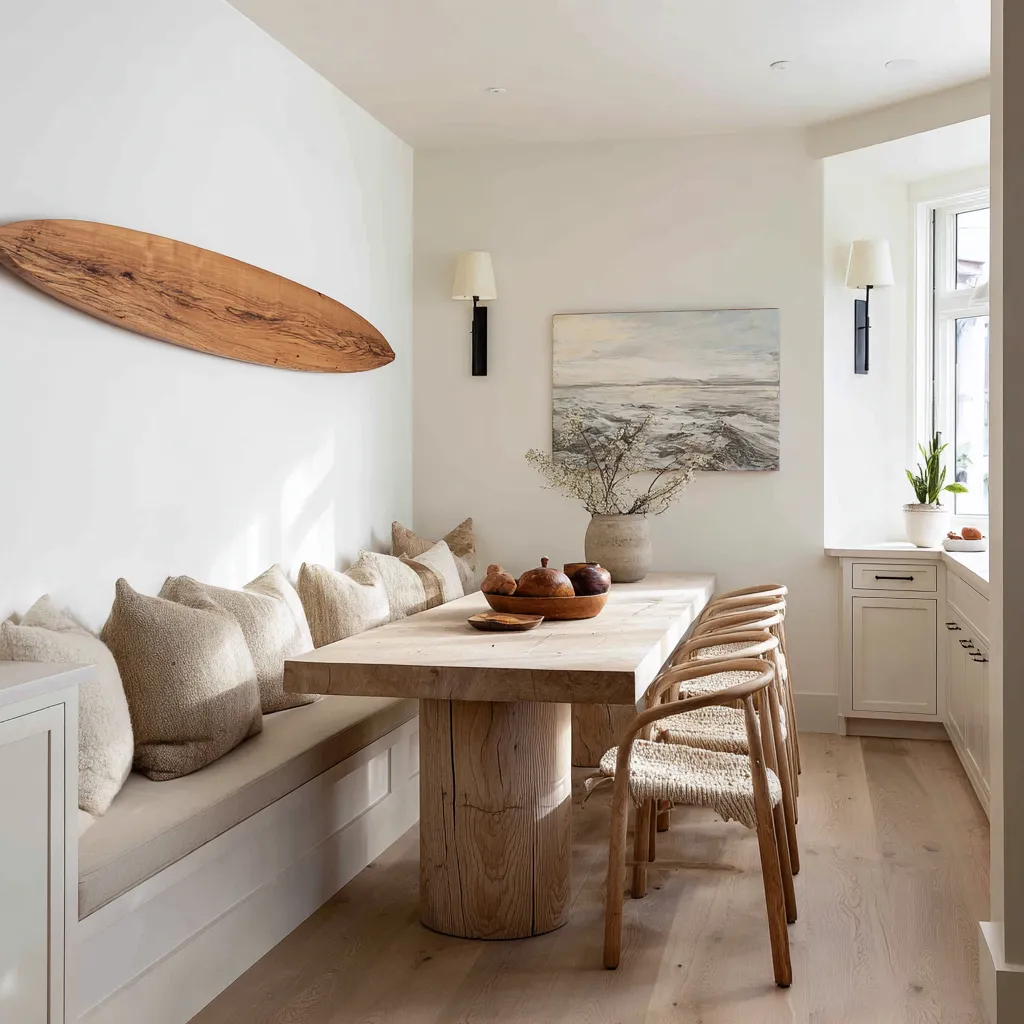
This works because coastal atmosphere often depends on time as much as on color or material. Shoreline interiors gain depth when the room contains one note of use, one note of weather, one note of something that seems to have lived another life before entering the kitchen.
That gives the room age-density. It prevents the pale cabinetry, smooth stone, and refined detailing from feeling weightless or overfinished.
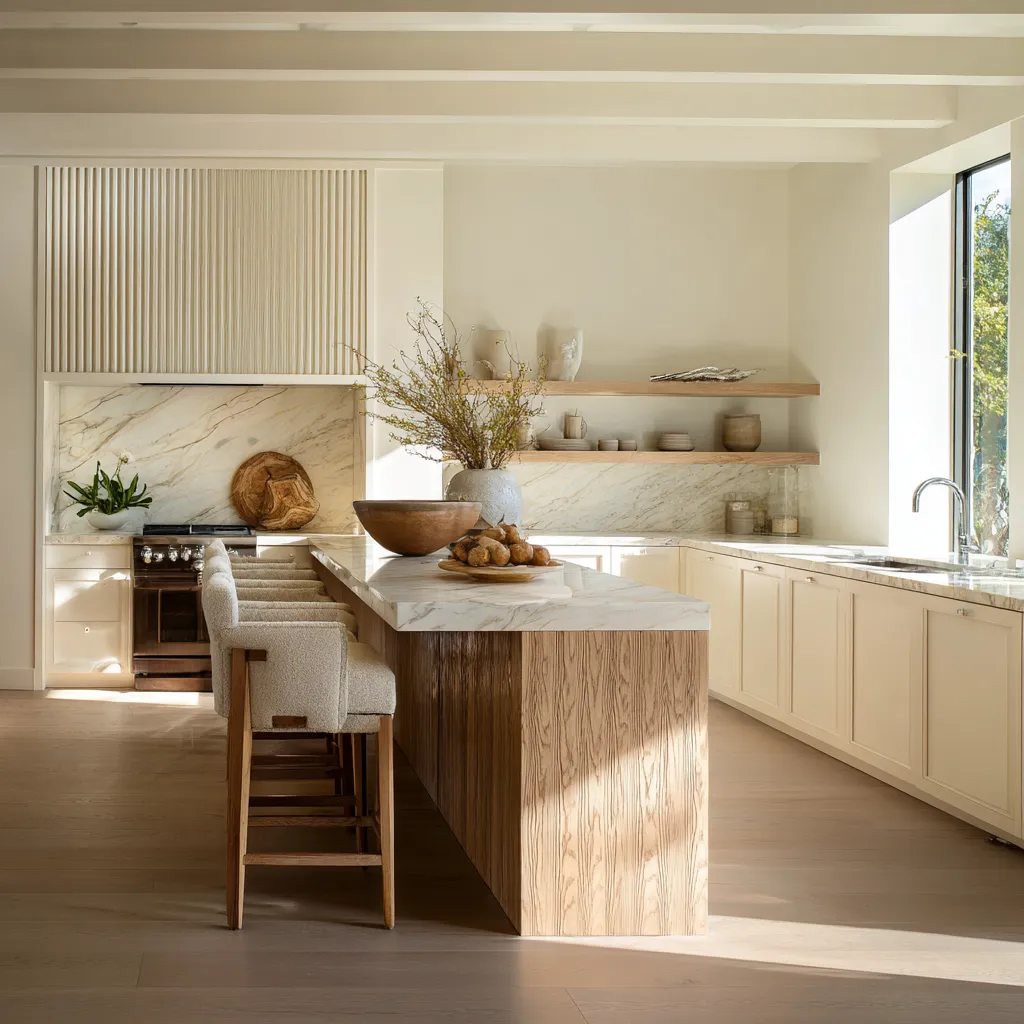
The important part is restraint. If the room has one rough timber shelf, it does not need driftwood lamps, rope pulls, shell bowls, and reclaimed stools as well.
The weathered piece should stand alone enough to hold its own meaning. Blank wall around it helps.
Calm cabinetry beneath it helps. Limited accessory styling helps.
The aged element should feel like an artifact with dignity, not a prop in a theme package.
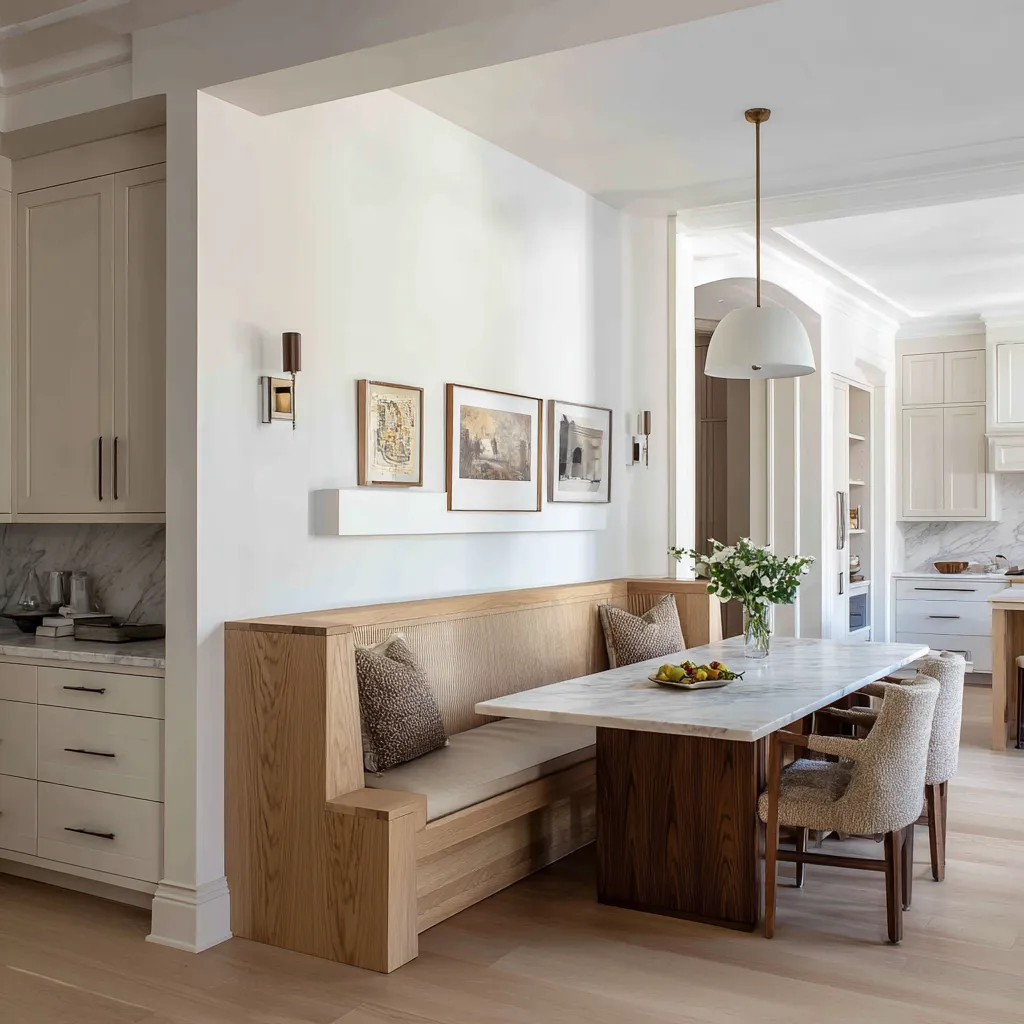
Pale stone modernizes the coastal mood
Many of the refined beach kitchens depend on pale mineral mass. Thick stone islands, broad waterfall ends, soft sediment-like veining, chalky marble backsplashes, limestone-toned counters, and plaster-like hood forms all help move the coastal idea away from décor and toward geology.
This is a major reason these kitchens stay contemporary.
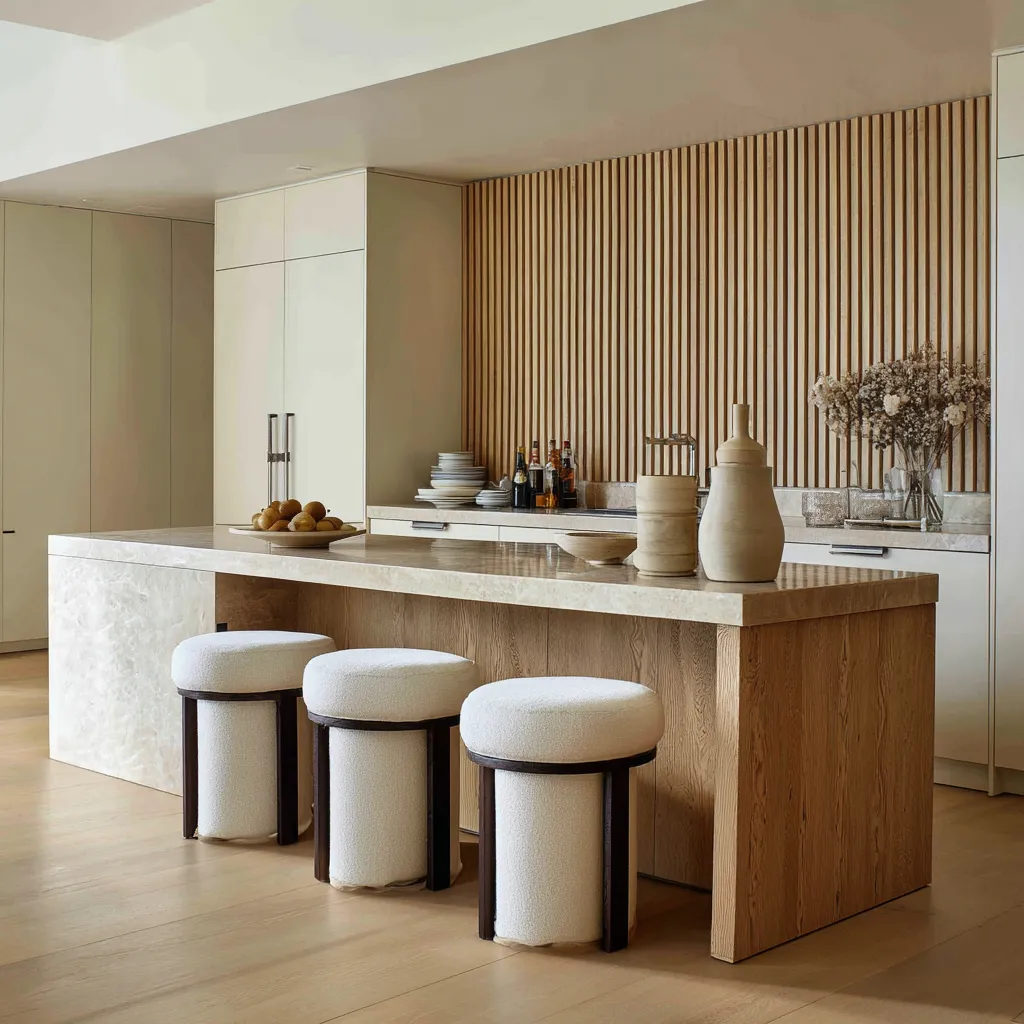
Once the room begins to think in terms of geology, it becomes less dependent on symbolic beach signals. The island can feel like a carved block of shoreline rock.
The backsplash can feel like layered mineral trace. The hood can feel like a whitewashed mass rather than a decorative crown.
The room begins to borrow from cliff, dune, limestone shelf, salt-marked plaster, and weathered masonry. That is a much richer source of coastal atmosphere than novelty styling.
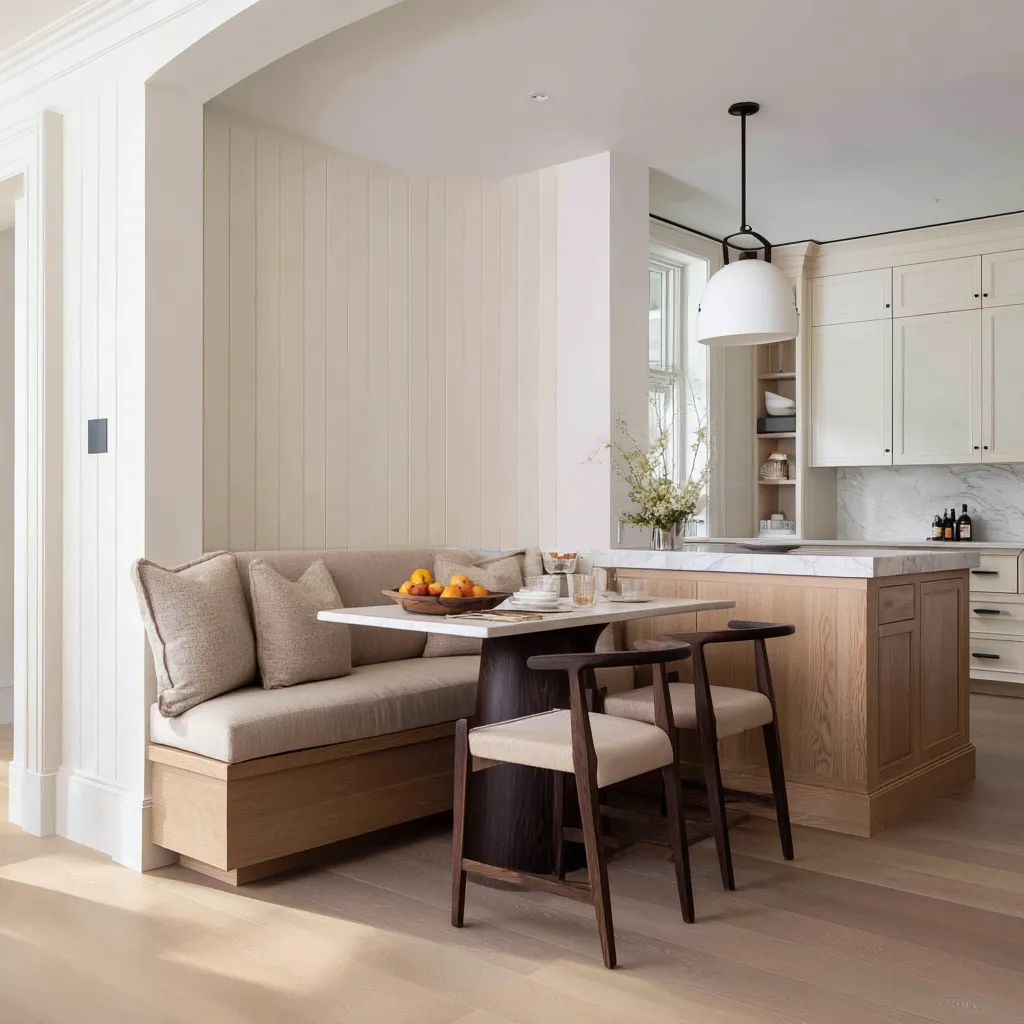
Pale stone is particularly useful because it creates stillness. It gives the kitchen calm center-of-gravity.
It also helps reduce accessory dependence. A strong monolithic island does not need constant decoration.
A pale stone cook wall can carry enough presence that the space around it can remain simple. This is one reason these kitchens often feel composed: the architecture is already doing enough.
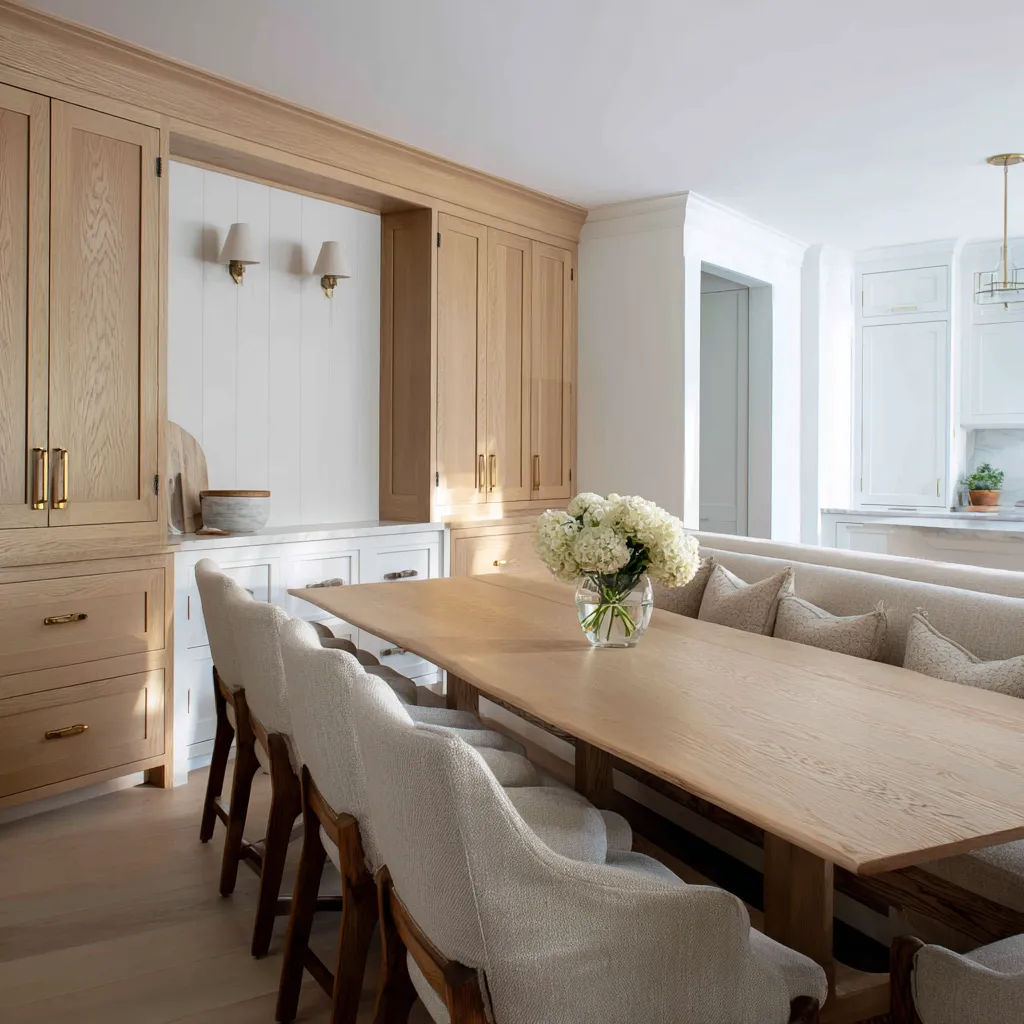
A banquette is less a beach signal than a social shelter
Built-in seating appears again and again in successful coastal kitchens, yet its role is often misunderstood. A banquette does not automatically make a room feel like it belongs by the water.
What it does much more reliably is create shelter. It forms an edge.
It turns a breakfast corner into a cove. It makes the room feel inhabited instead of staged.
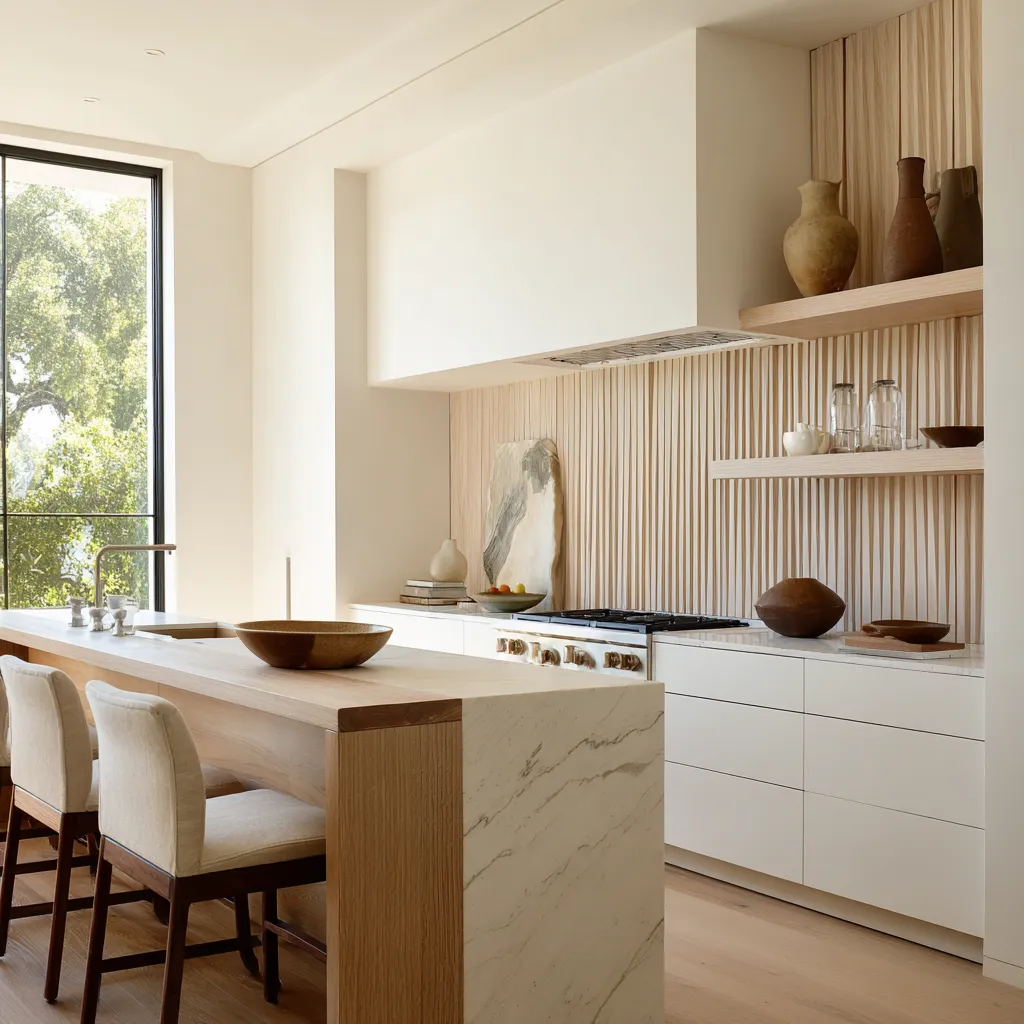
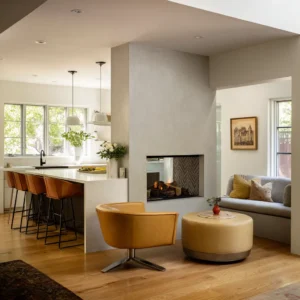
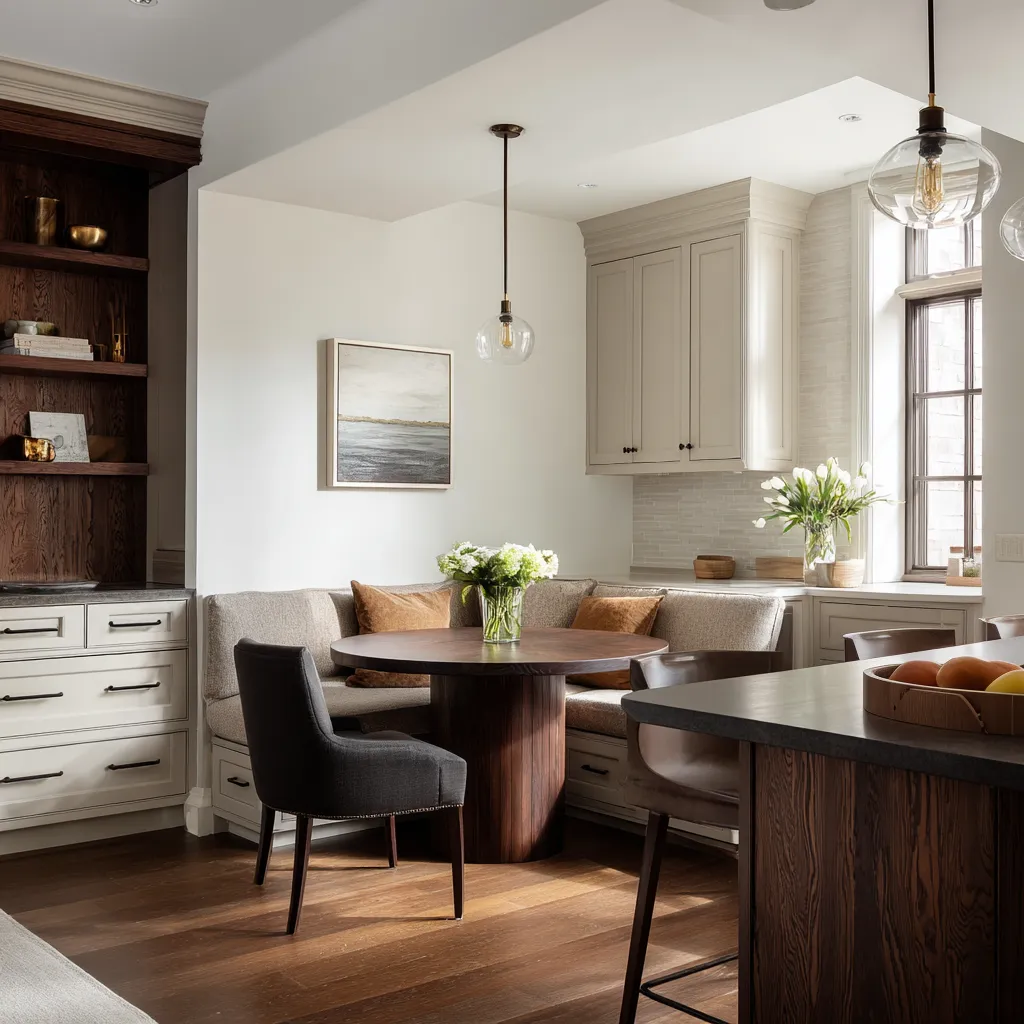
That is deeply useful in a beach-influenced kitchen because shoreline life is often associated with informal gathering, morning light, long meals, and daily ease. A built-in bench tucked into an island, wrapped into a corner, or set under a long wall ledge gives the room domestic permanence.
It creates a protected pocket inside the larger kitchen. That is why banquettes work so well in this style even though they are not primary coastal carriers by themselves.
To keep a banquette in a contemporary register, the detailing should stay broad and simple. Flat-front drawers, pale wood bases, restrained paneling, plain seat cushions, and low-contrast pillows tend to work better than overstuffed benches, cottage prints, or decorative trim.
The banquette should feel like part of the architecture, not an inserted theme vignette.
Dark wood and brass act as ballast
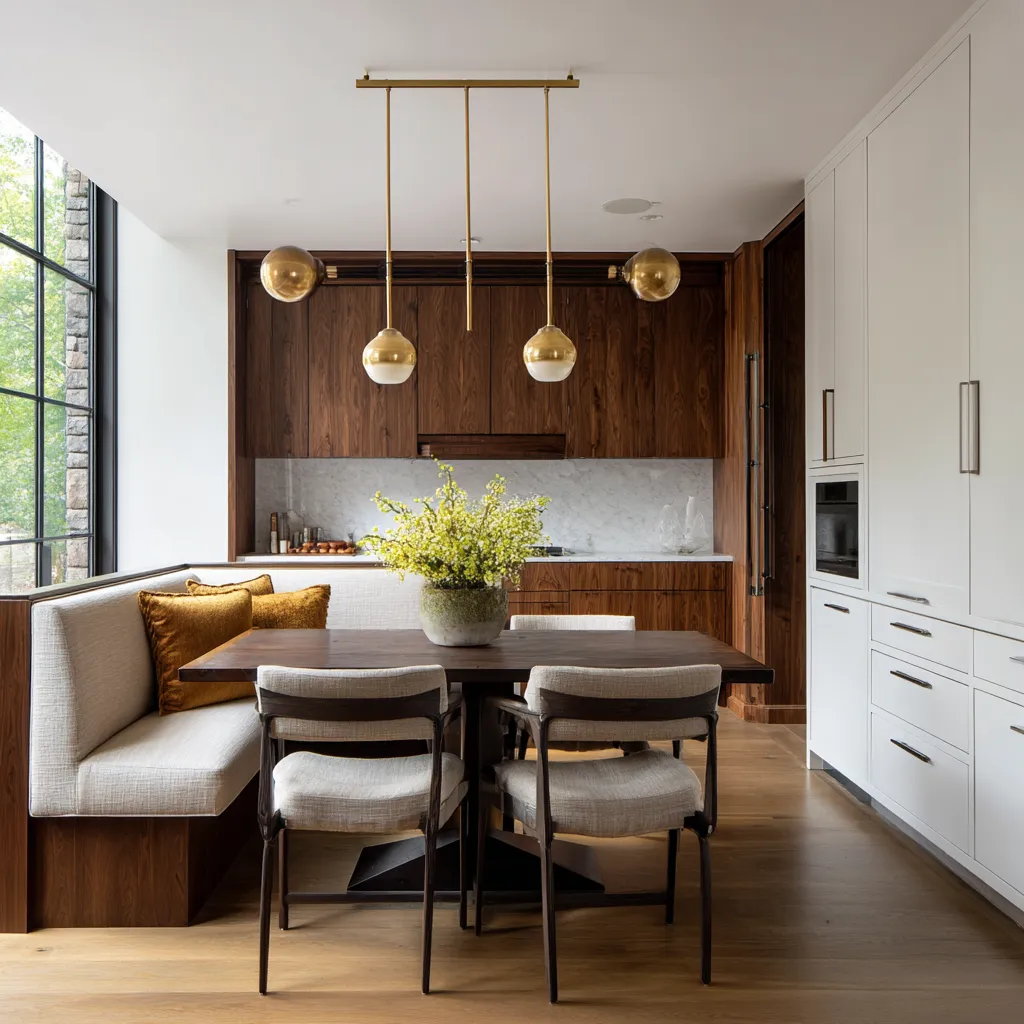
Another useful correction in modern beach kitchens is the idea that everything should be pale. In practice, many of the richer rooms rely on a darker anchor: walnut cabinetry, a dark pedestal table, black-framed windows, bronze-toned sconces, warm brass hardware, or deep stained shelving.
These darker notes do not create the coast by themselves, but they keep the room from dissolving into softness.
This is especially important in kitchens built from pale stone, creamy plaster, bleached oak, and woven textures. Without contrast, the room can become vague.
Dark wood adds gravity. It can hint at old joinery, boat-cabin craft, weathered timber, or aged millwork, but it also does more general compositional work.
It gives the eye somewhere to rest. It provides tonal depth.
It helps pale surfaces feel brighter and more intentional.
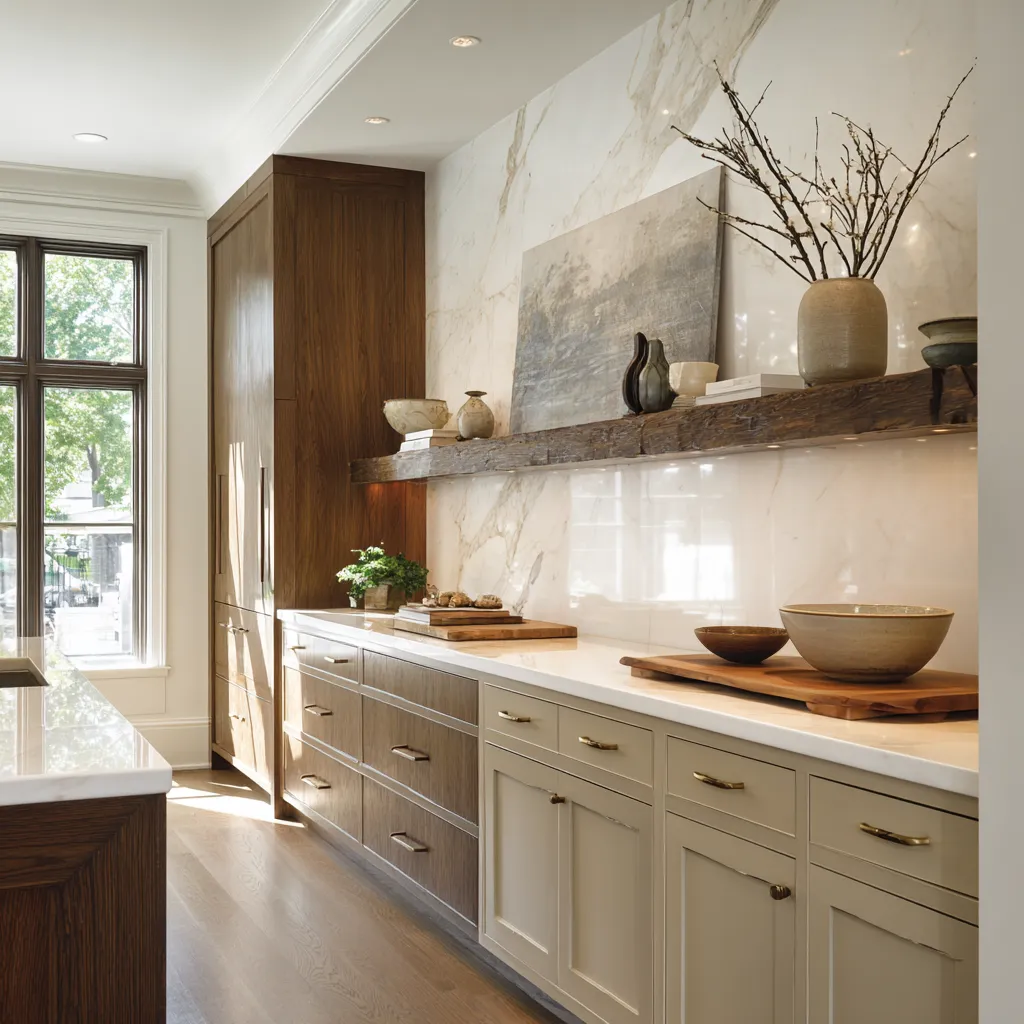
Brass plays a similar supporting role. Used lightly, it can bring in a faint marine hardware memory through cabinet pulls, sconces, pendants, pot fillers, or faucet finishes.
The key is moderation. Brass scattered too widely becomes decorative noise.
Brass repeated in a limited way becomes a unifying warm note that reinforces craft and utility.
Woven fiber softens a solid architecture
Woven stools, rush seats, basketry pendants, cane backs, and natural-fiber inserts often appear in contemporary coastal kitchens, but they are successful when they are attached to a broader architectural system. If the room already has pale stone mass, plaster softness, or one weathered object, woven fiber can add tactile warmth beautifully.
If the room has nothing else carrying the mood, woven pieces alone can feel too decorative.
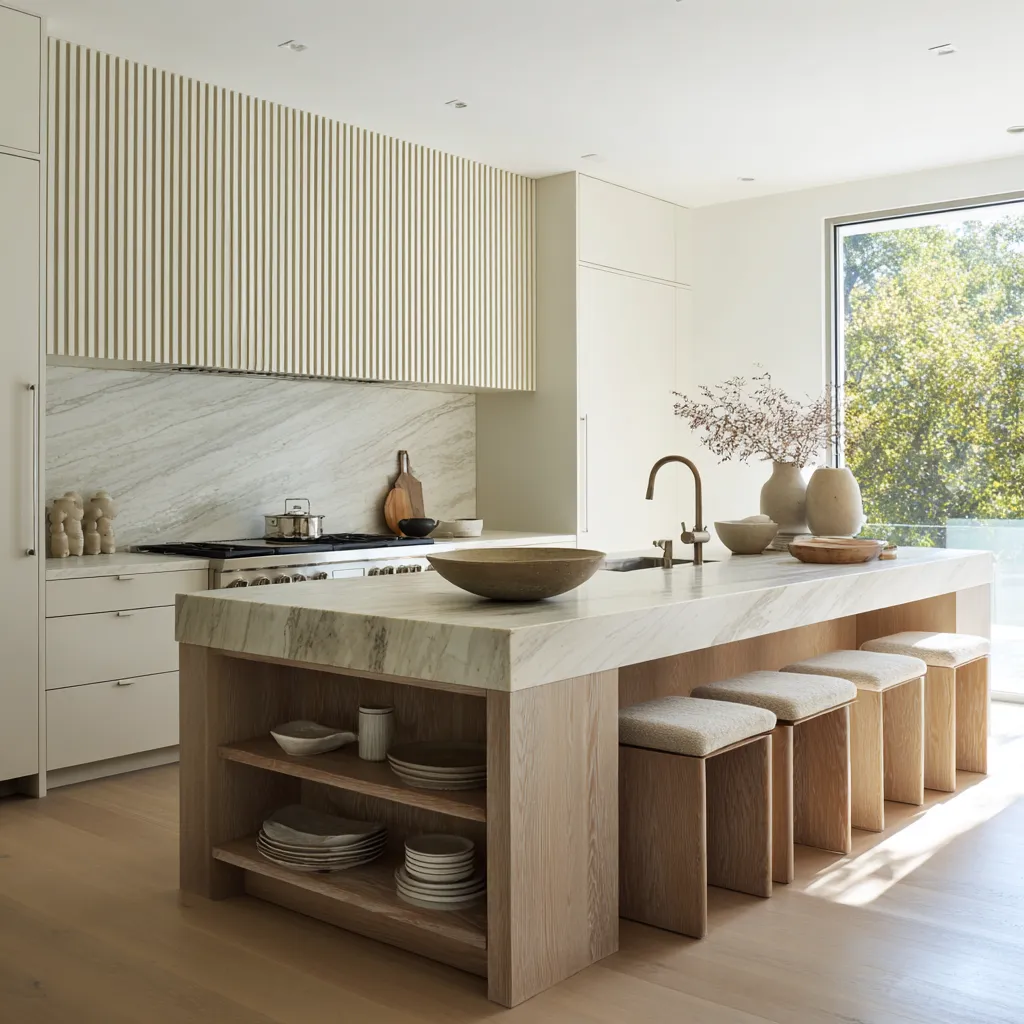
The reason is simple: fiber is a softener, not usually the whole structure. It adds handwork, dryness, and lightness.
It catches sunlight differently than stone or painted wood. It gives the room a small note of air movement and casual use.
But woven pieces feel richer when they are supporting larger gestures such as arches, niches, pale masonry, a broad island, or a restrained breakfast nook. This is also why woven elements need careful proportion.
A row of simple woven stools under a heavy island can feel grounded and architectural. One pair of woven pendants in a plaster kitchen can feel airy and warm.
Too many woven forms in one room can push the kitchen toward a decorative vacation-house effect rather than a mature coastal interior.
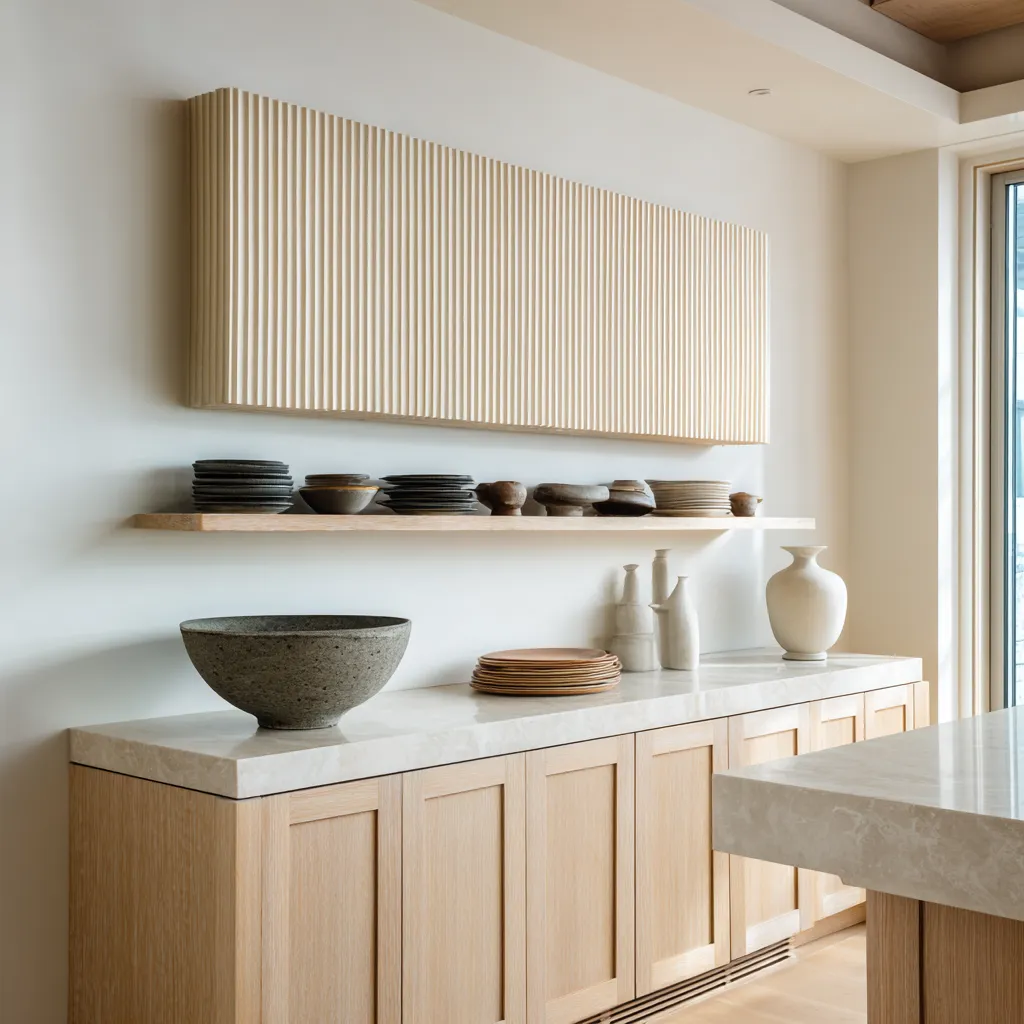
One object can say more than a collection
If someone wants a more legible beach reference, a disciplined route is often a single marine-adjacent object used with care. One surfboard.
One old oar. One boat tool.
One weathered rack. One mounted working form with enough blank wall around it to breathe.
This approach is far more refined than filling a room with smaller related items. The reason is hierarchy.
A single object can become an artifact-anchor. It can set tone, suggest shoreline life, and give the room narrative weight.
Once that happens, everything beneath it can remain calm. Plain cabinetry, pale counters, restrained pottery, and broad wall space allow the object to hold the coastal message by itself.
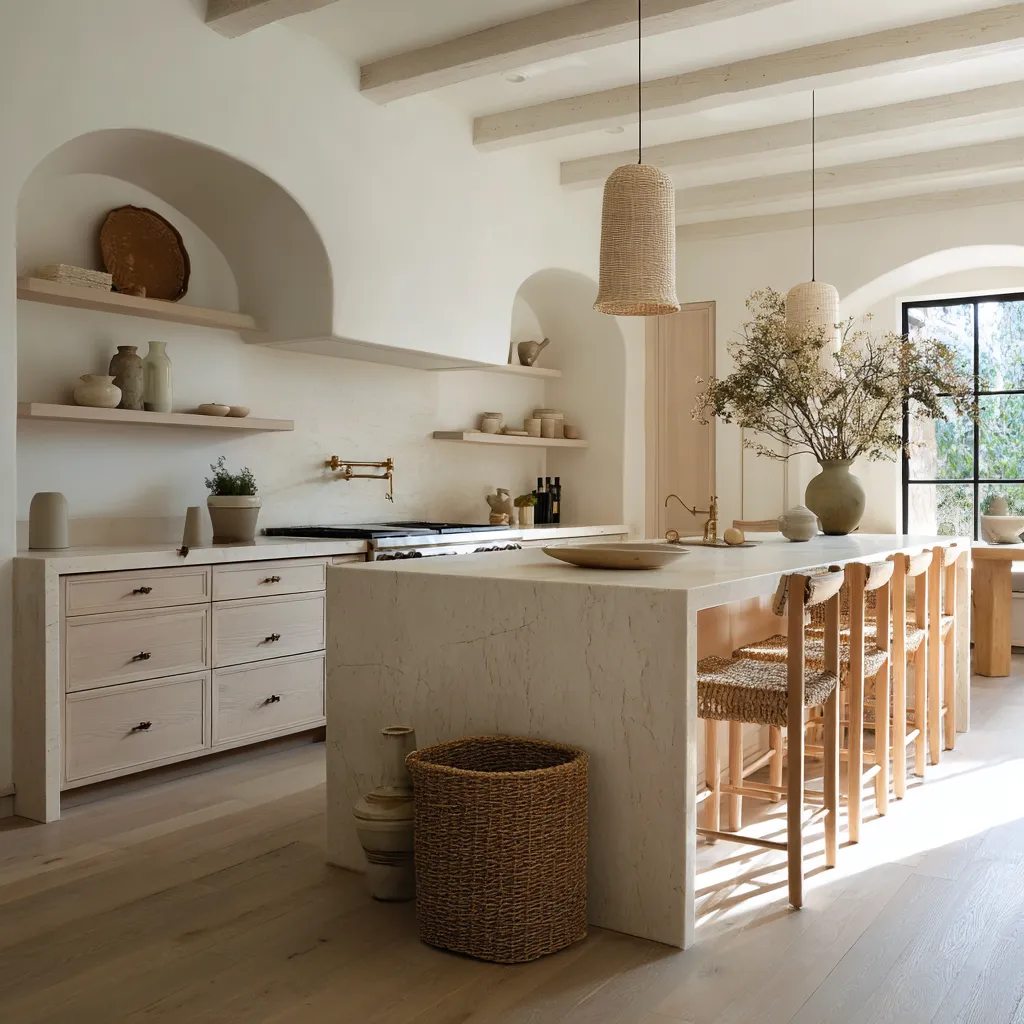
Collections tend to weaken that effect. As soon as the room has several obvious nautical pieces, each item begins competing with the others, and the whole kitchen starts reading as themed rather than settled.
The eye moves from object to object instead of resting within the architecture. One artifact used with compositional discipline keeps the shoreline note present and mature.
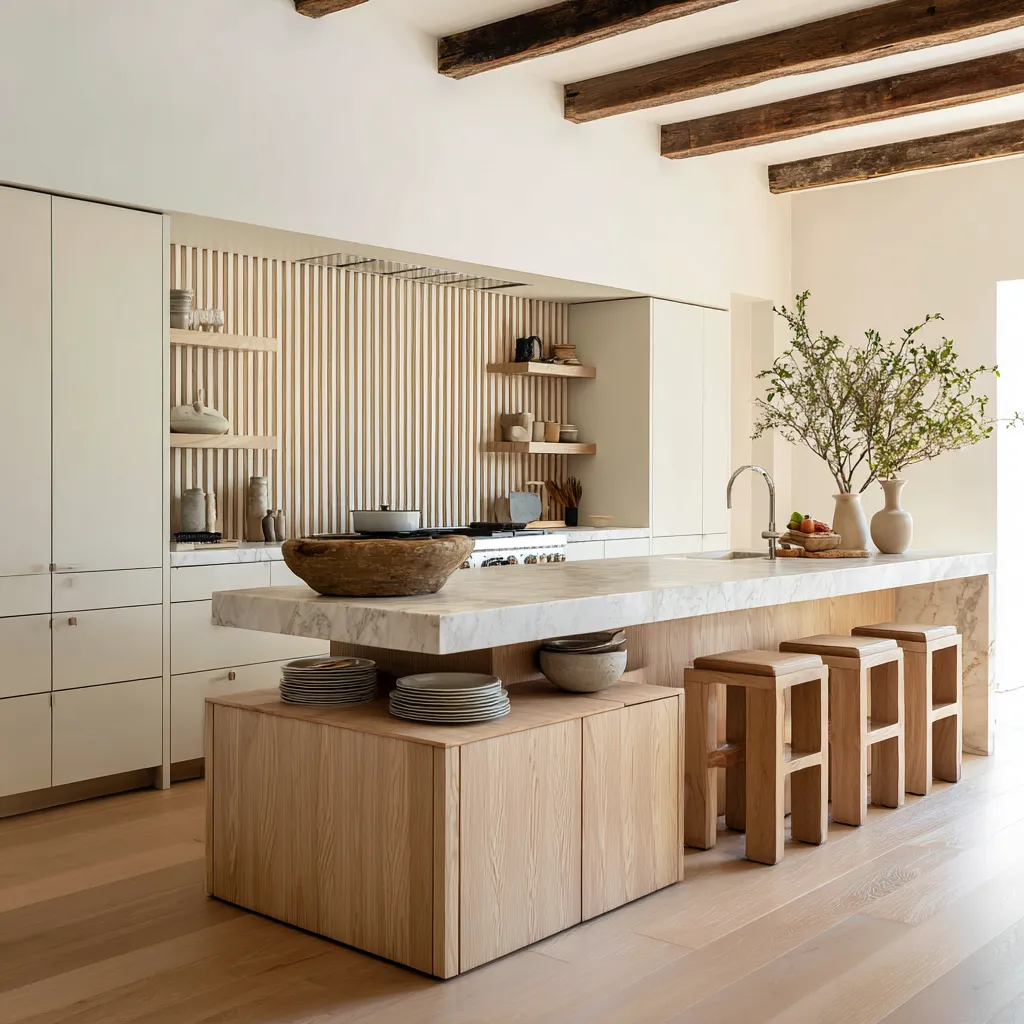
What to leave out to look current
A contemporary beach kitchen often gains credibility through omission. The details left out are part of the design intelligence.
Rooms with enduring appeal usually hold back from:
- Repeated blue accents used as the main source of coastal mood.
- Shells, coral, and rope spread through many locations.
- Striped textiles used as the primary style signal.
- Small nautical collectibles grouped in visible clusters.
- Busy upper shelves packed with decorative accessories.
- Too many explicit seaside artworks in one sightline.
- Glossy finishes that flatten the sense of weather and tactility.
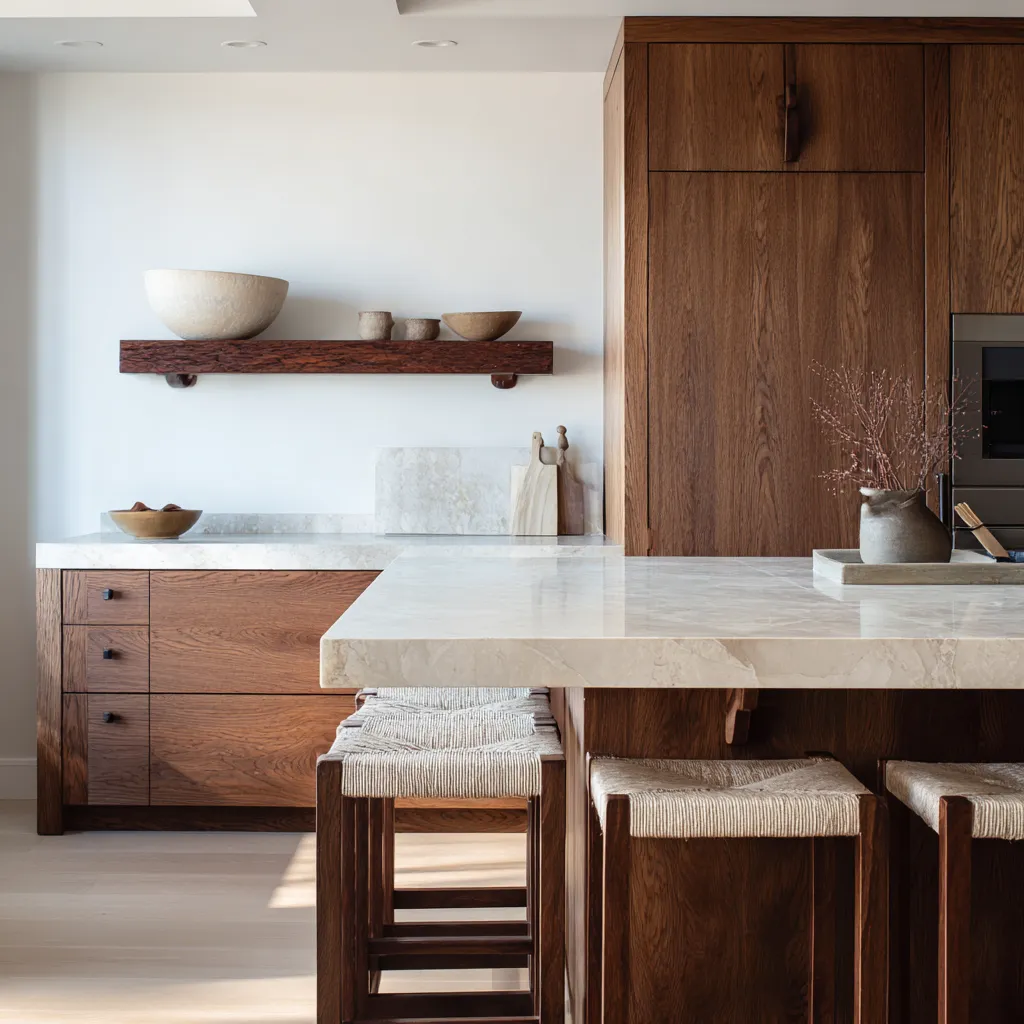
These omissions do not make the room empty. They give more authority to the surfaces, proportions, and materials that remain.
They also let daylight matter more, which is essential. In a good beach kitchen, natural light should feel like an active design ingredient, not merely illumination.
It should catch ribbed paneling, pale stone, dry pottery, woven seats, and washed wood in ways that keep the room alive without visual chatter.
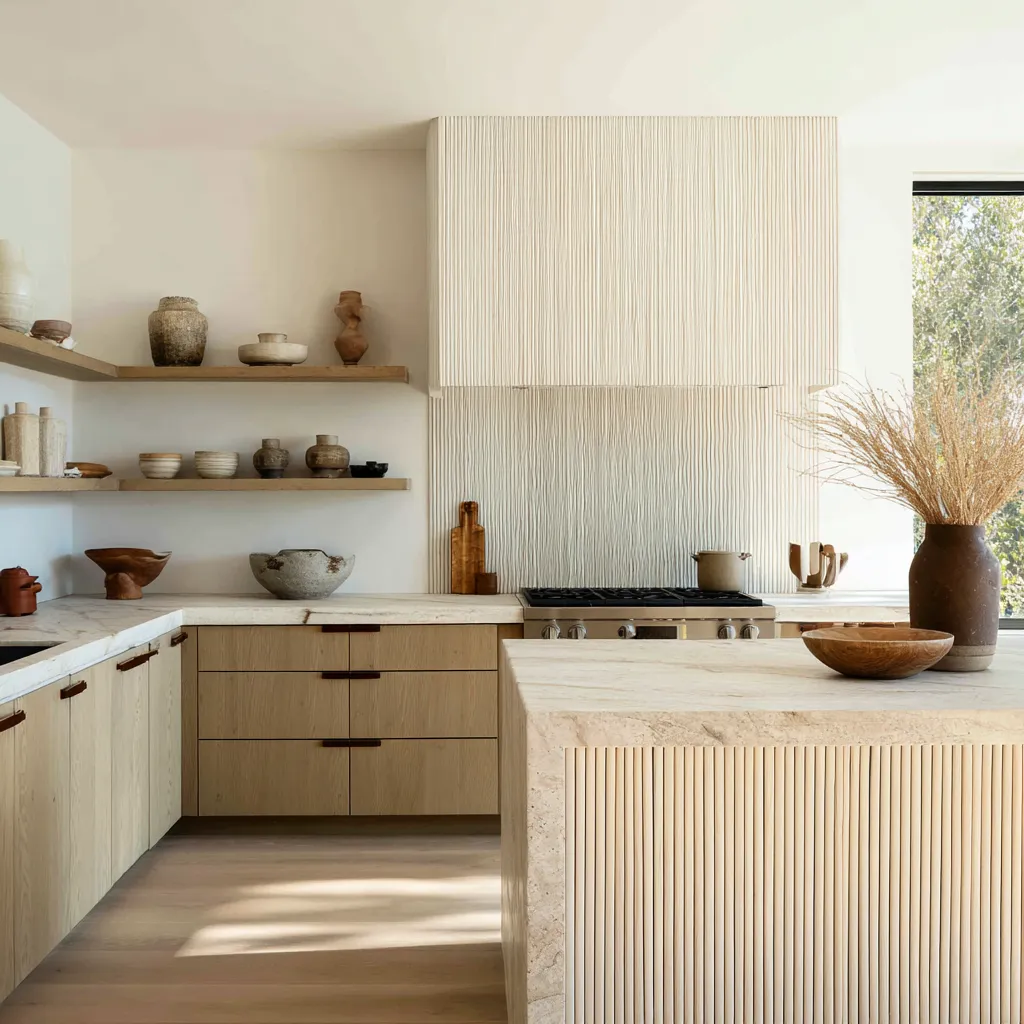
The contemporary coastal kitchen: translation, compression, and restraint
The lasting lesson in all of this is that beach feeling in a modern kitchen is usually created indirectly. The room translates shore conditions into design language.
It turns coastline into horizon lines, dunes into slats, rock into pale monoliths, age into rough timber, and harbor-like protection into banquettes and alcoves. It compresses the message into one or two clear carriers rather than repeating many medium-strength cues.
Then it holds the whole composition together through restraint.
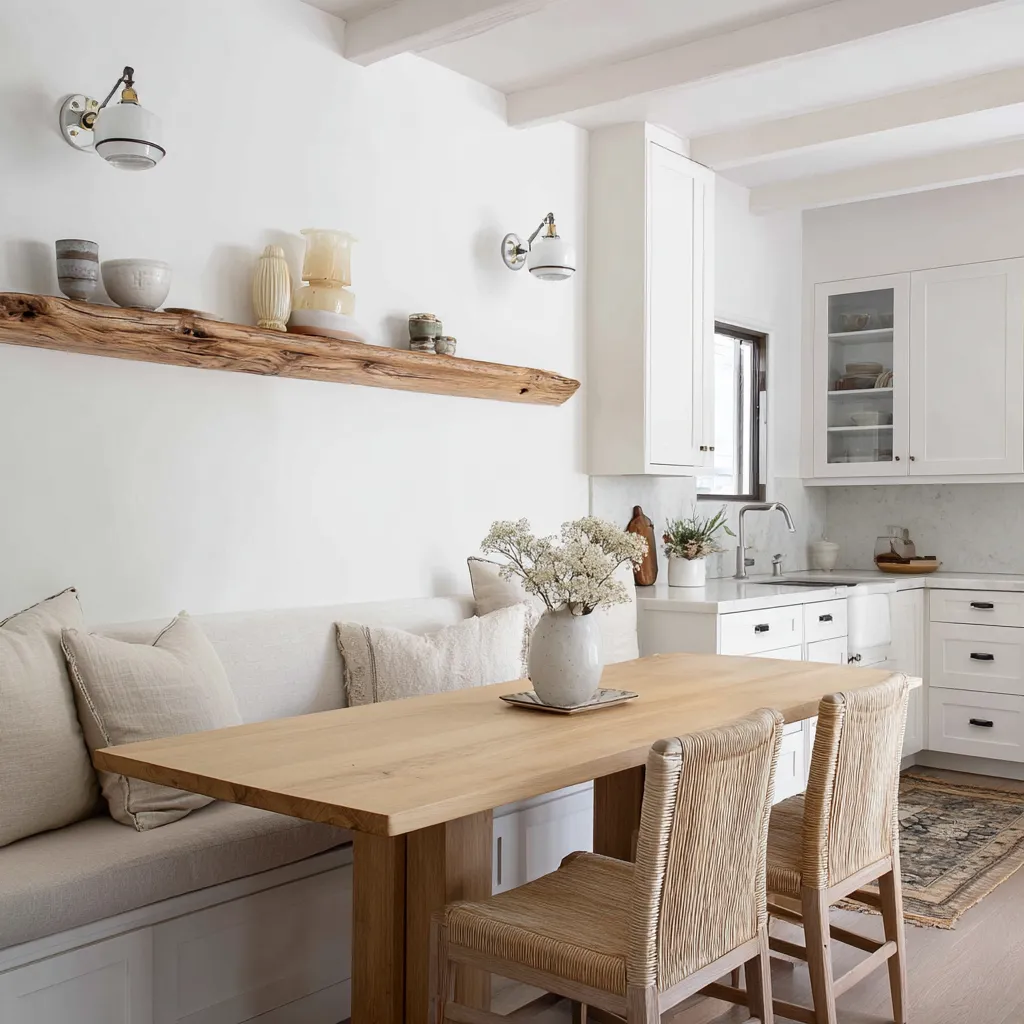
That is why the kitchens with a coastal atmosphere often feel the least eager to explain themselves. They do not depend on direct symbolism.
They use line, mass, weathered memory, filtered light, tactile dryness, and a few carefully chosen objects. They know that the coast does not need to be shouted to be felt.
A beautiful contemporary modern beach kitchen is therefore not a room that imitates the seaside. It is a room that has absorbed its logic: long and low, pale but grounded, tactile but controlled, relaxed but architectural, open to daylight, and edited enough that the shoreline remains present in the background rather than taking over the whole space.