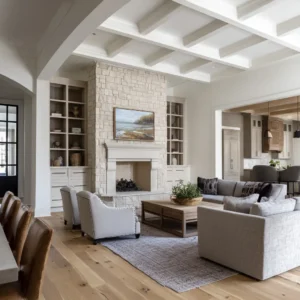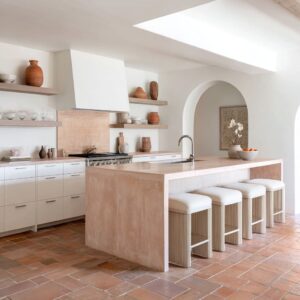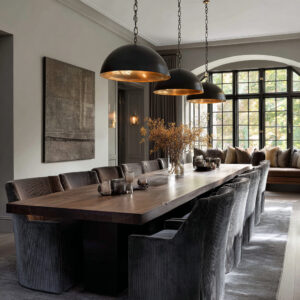
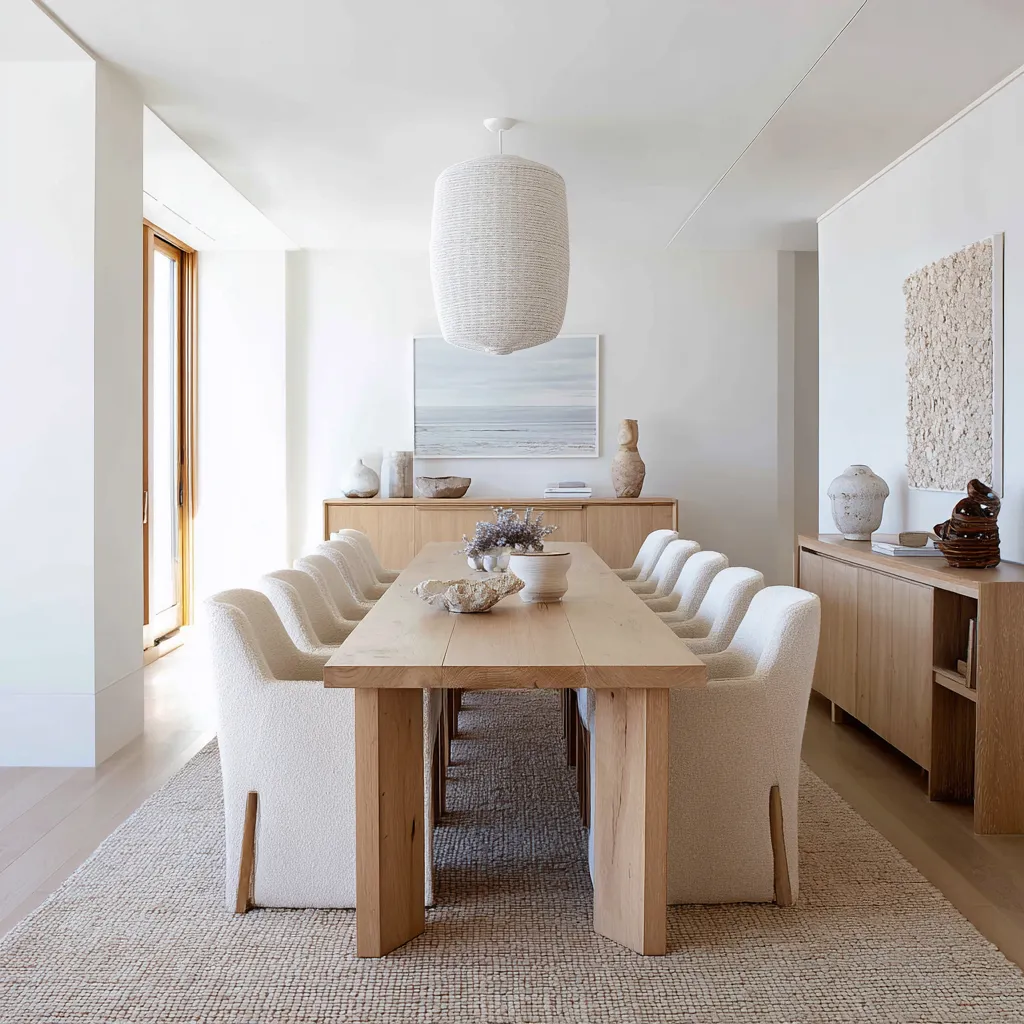
A strong modern coastal dining room usually does not begin with shells, striped fabric, painted anchors, or obvious blue-and-white contrast. It begins somewhere else.
It begins with the way shoreline life changes material. It begins with long sightlines, dry air, softened timber, filtered brightness, weather-shaped plant matter, and the visual memory of open distance.
That shift in thinking changes everything. Many dining rooms try to look coastal by adding coastal objects.
The stronger ones let the coast enter through structure, finish, proportion, and atmosphere. They suggest that the house has spent years near open water, bright sky, salt in the air, and seasonal wind.
The room feels touched by those conditions even if there is no literal marine symbol in view. That is what gives current coastal interiors their depth.
They feel tied to place without slipping into decorative storytelling.
The way to think about a modern coastal dining room is not as a beach room, but as a room shaped by four persistent shoreline conditions: distance, exposure, filtering, and edge. Distance brings horizon logic and long visual bands.
Exposure brings faded wood, chalky surfaces, and dry vegetation. Filtering brings woven light fittings, softened daylight, and materials that turn glare into glow.
Edge brings reeds, slats, fluting, dock-like lines, and the meeting of built form with climate-shaped irregularity. Once those conditions are understood, coastal design becomes much richer.
The room stops relying on signs of the sea and starts carrying evidence of life near it.
Start with distance, not decor
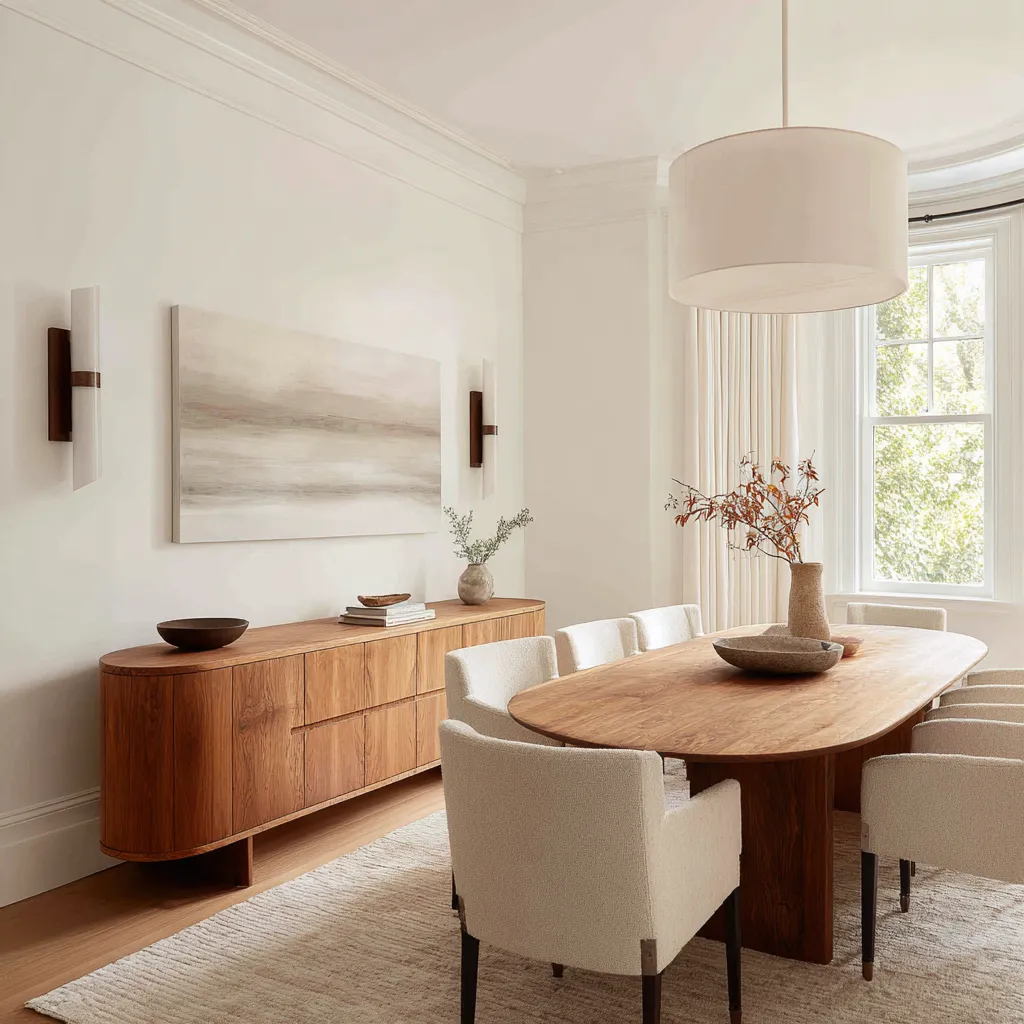
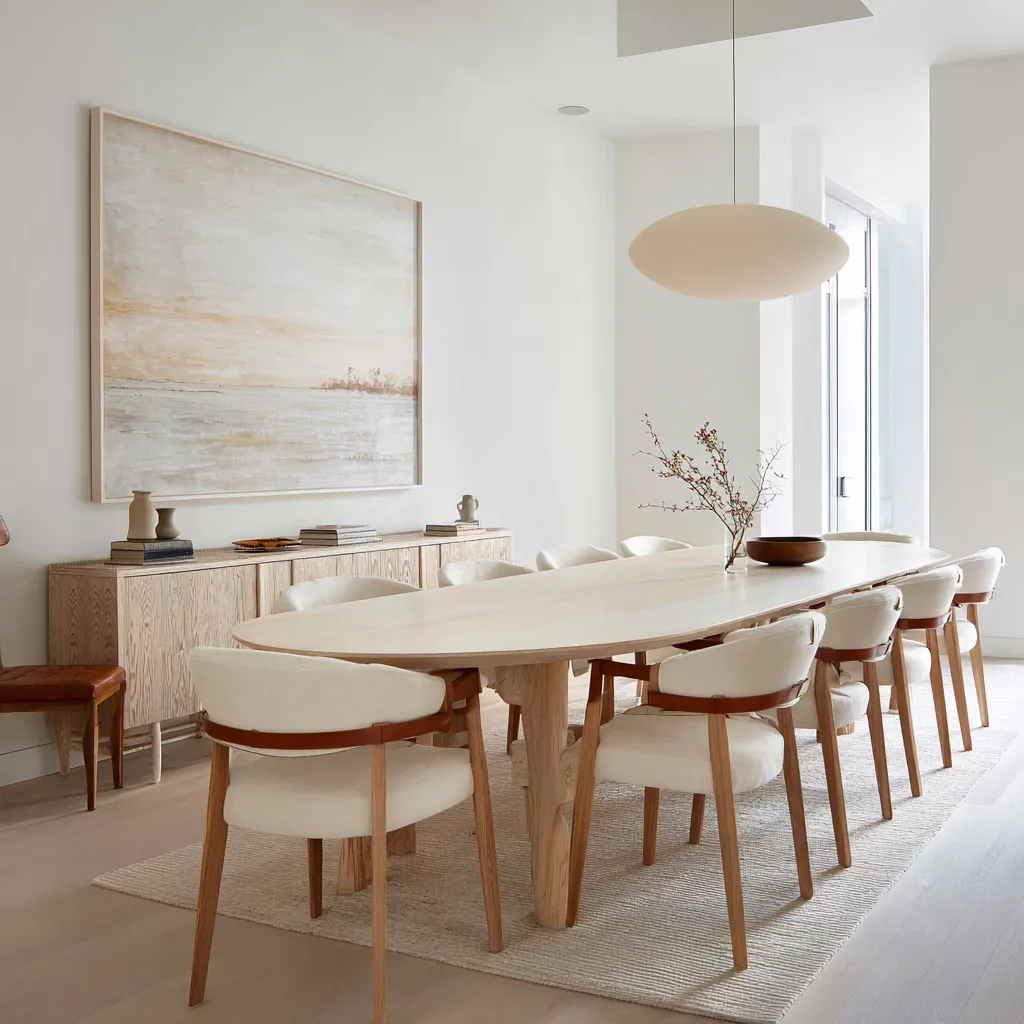
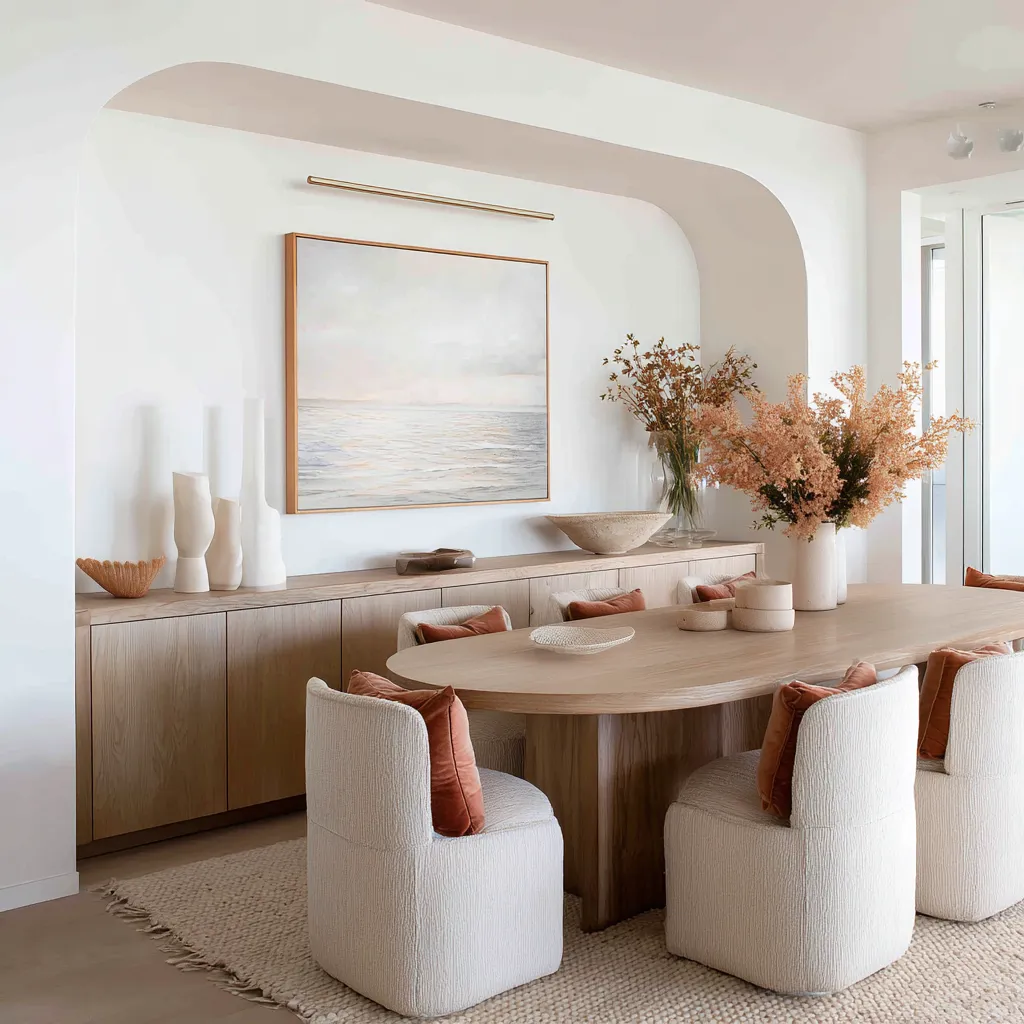
One of the design ideas in successful coastal dining rooms is the presence of distance. That distance may arrive through a seascape, an abstract horizon painting, a long sideboard, an elongated table, a wide wall left mostly open, or a composition that spreads laterally rather than stacking itself in busy layers.
Shoreline environments train the eye to look far. Sky and water meet in long bands.
Land sits low. Light stretches.
A room can take in that visual logic without showing an actual beach.
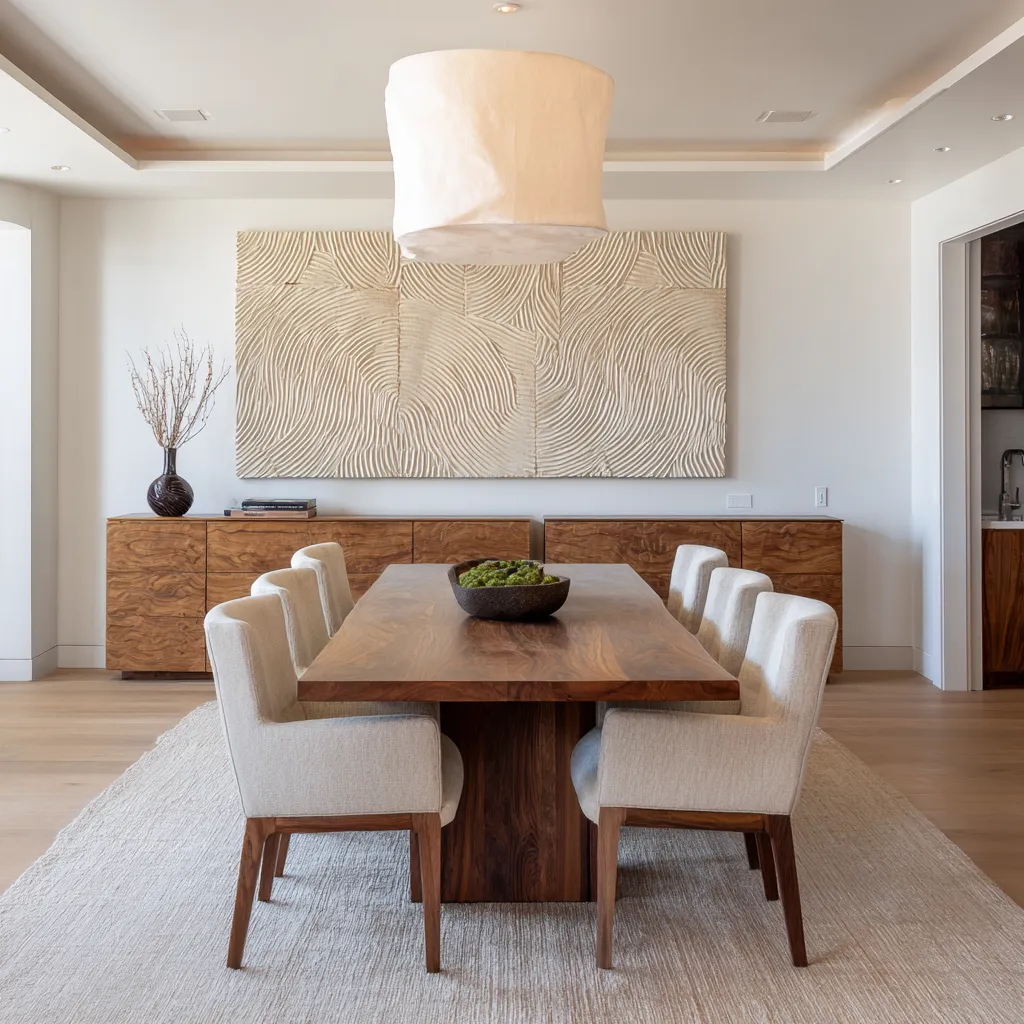
This is why horizon-based artwork keeps working in coastal dining spaces. Yet the modern deigns are rarely colorful, dramatic seascapes.
They are usually reduced fields of pale water, muted sky, distant shoreline, fogged blue-gray, washed sand, or softened mineral tones. They do not act like scenic interruptions.
They give the room a long register of space. A good horizon artwork tells the eye where to travel.
But horizon imagery should not carry the room by itself. On its own, it can remain decorative.
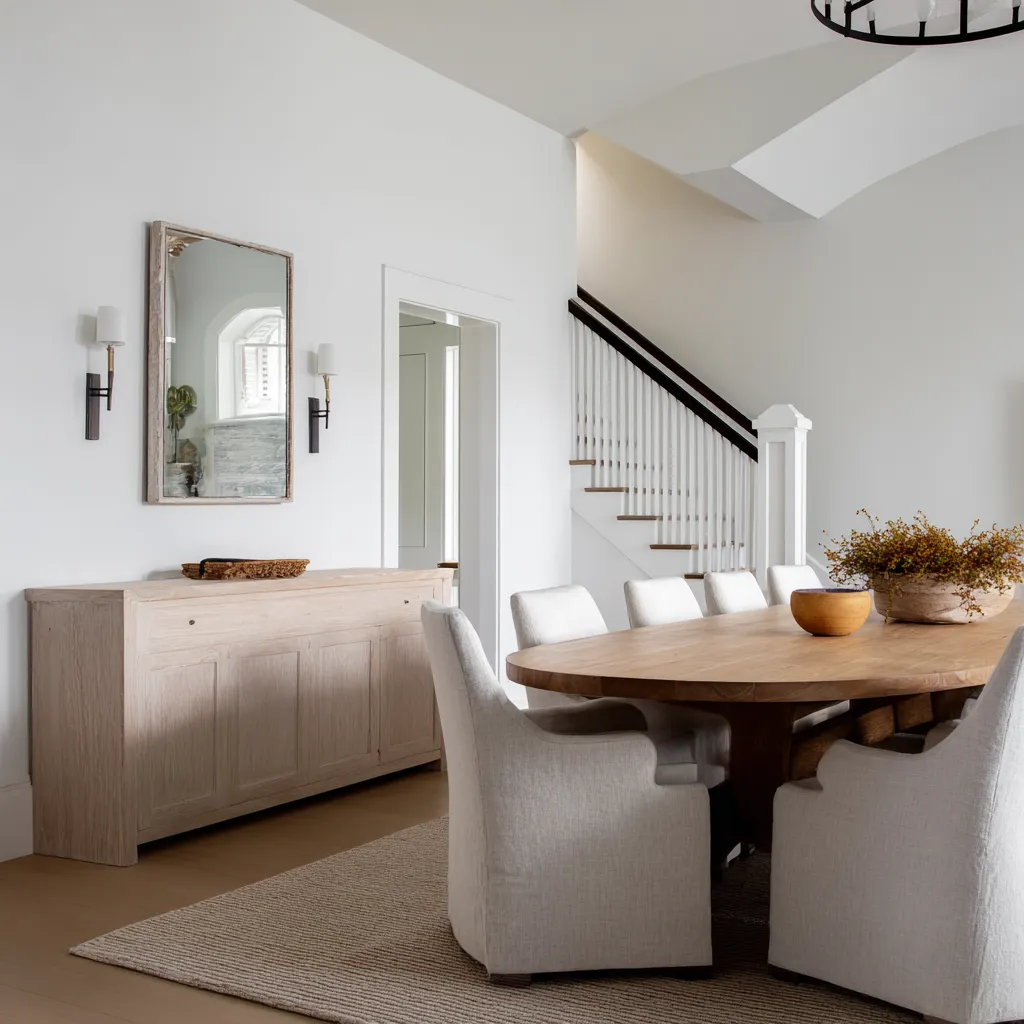
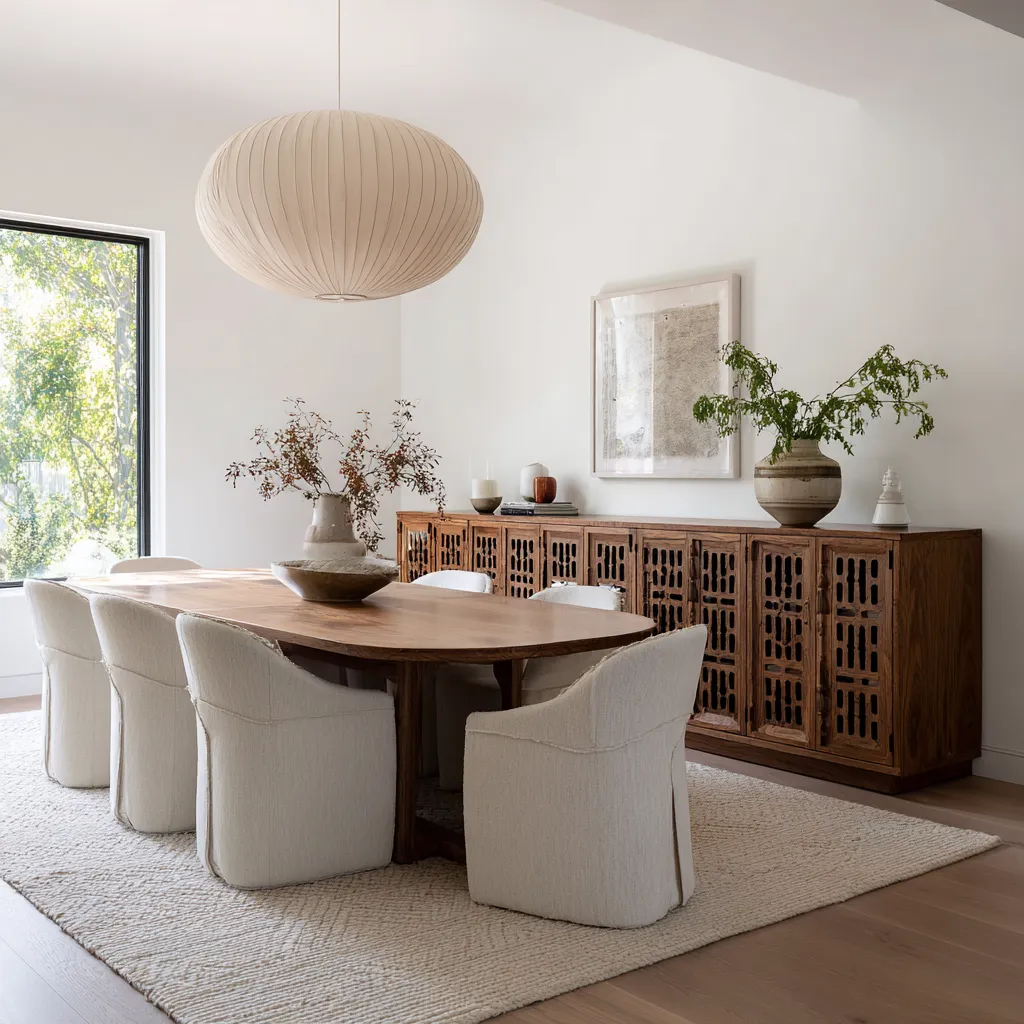
It becomes convincing when it has a material companion nearby. That companion might be a bleached oak sideboard with dry grain and lowered sheen.
It might be a tall vase of brittle branches that look shaped by exposure rather than by florist styling. It might be a slatted cabinet face, a cracked timber surface, or a pendant that diffuses light like woven fiber.
The wall says distance; the materials say climate. Together they turn scenery into environment.
That is a useful principle for anyone decorating a coastal dining room. If you hang horizon art, add one nearby material witness to the shore.
Do not let the artwork do all the coastal work alone.
Let wood show what weather does to it
Wood is one of the strongest carriers of shoreline memory, but only when it is chosen with precision. Fresh glossy oak does not say much about life near water.
Dry, sun-softened, salt-muted timber says far more. In a modern coastal dining room, wood often works when its yellow warmth has been reduced.
That does not mean every surface has to be pale. It means the finish should feel exposed to light rather than sealed away from it.
There are two very different wood directions that can work beautifully. The first is the washed, bleached, drifted register: pale oak, dry beige undertones, lightly chalked grain, surfaces that feel as though brightness has lifted the color over time.
This direction pairs well with airy rooms, light walls, large windows, woven rugs, horizon art, and soft upholstery. It suits a coast defined by morning glare, dry sand, and open sky.
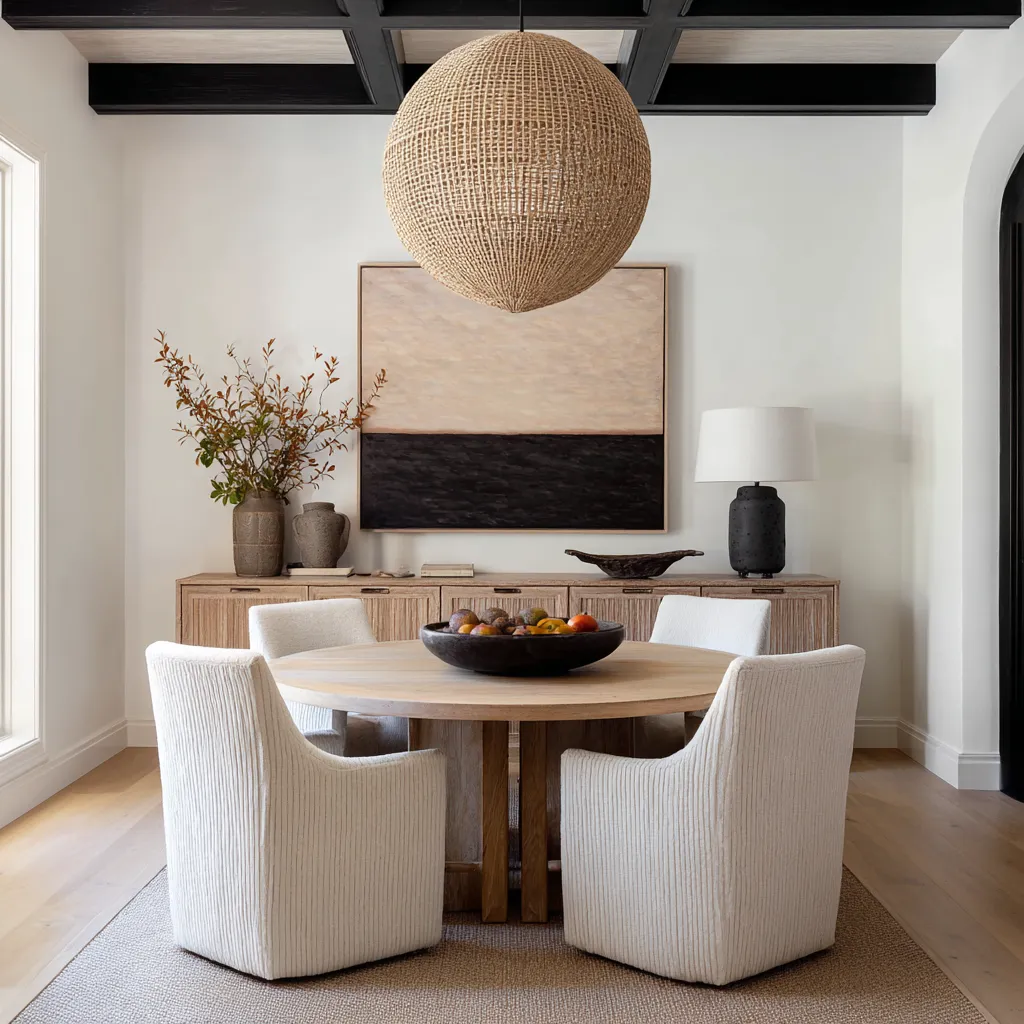
The second is the denser marine register: smoked wood, darkened timber, cracked or split surfaces, old board memory, tones close to wet rock, old piers, shadowed decking, or deepened boathouse framing. This direction suits coastal rooms that want gravity.
It works with broader tables, mineral ceramics, darker ceiling beams, low-light paintings, reed-like textures, and more serious tonal contrast. It brings in the side of the shore that people often forget: damp edges, old timber, tide lines, shadowed structures, and weather-built depth.
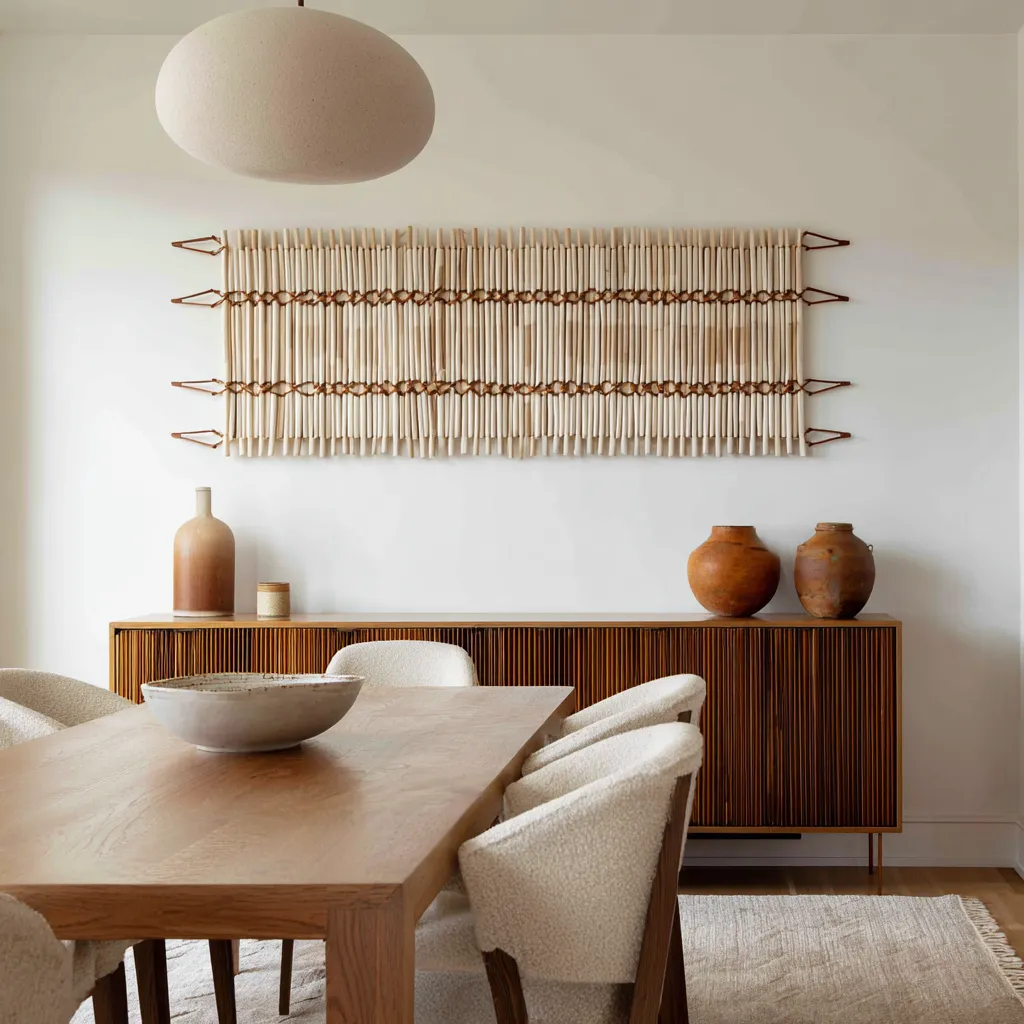
What is important is commitment. Many modern coastal rooms grow stronger when they choose one wood story and stay faithful to it.
Either the room leans toward filtered brightness and pale weather-softened timber, or it leans toward erosion, age, and darker marine wood. Mixing both with equal force can blur the design language.
A room does not need every coastal cue at once. It needs a clear sentence.
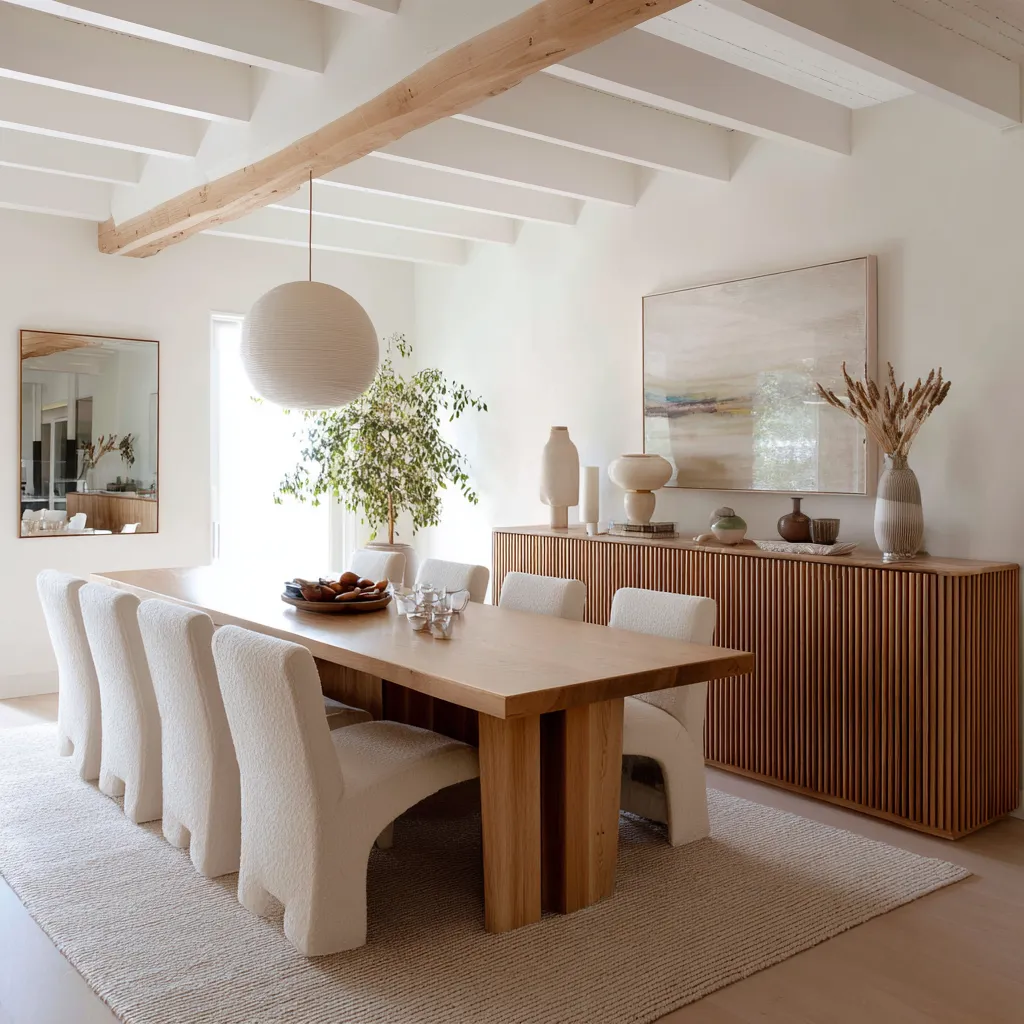
Use fiber to softened the design
If pale weathered wood is one major route into coastal design, fiber is the other. And fiber does not need to appear as craft display.
In modern coastal dining room ideas, fiber acts on light. It turns harshness into softness.
It makes brightness tangible. Woven pendants are especially effective for this reason.
A basket-like shade, a wrapped lantern form, a pleated shade with textile character, a capiz-like chandelier, or a rope-bound silhouette can all bring in shoreline memory because they suggest materials that belong to life near sun, salt, and air. They recall reed screens, matting, fish-basket logic, hand-bound utility, shade-making, rope craft, or shell-filtered luminosity.
Yet their role is not only symbolic. They also change how the room glows.
That functional shift is what makes them persuasive.
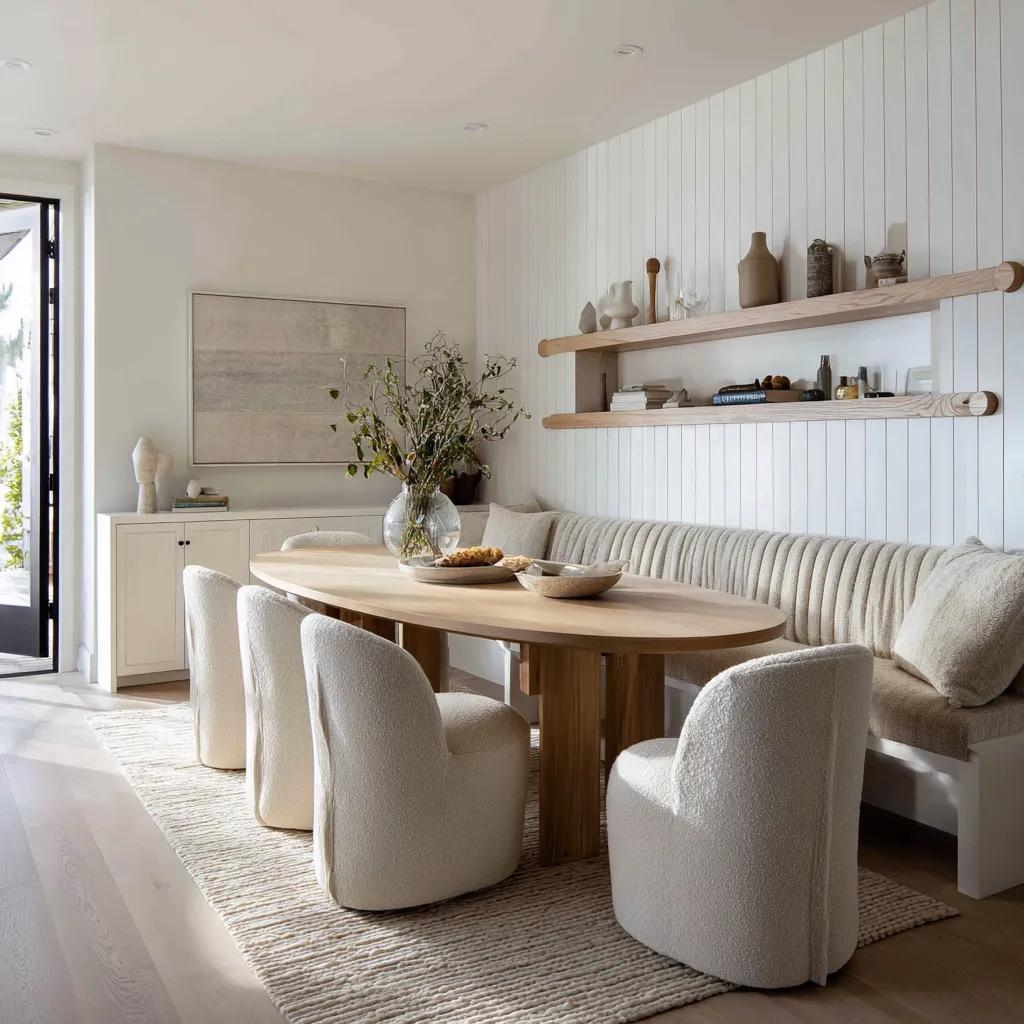
This is why fiber-based coastal rooms often feel very different from timber-based coastal rooms. Fiber brings permeability.
It brings filtering, wrapping, tying, screening, and moderated light. Timber brings drying, abrasion, saturation, splitting, and age.
One speaks in softness and weave; the other speaks in grain and weather. Both can be coastal, but they create different emotional structures.
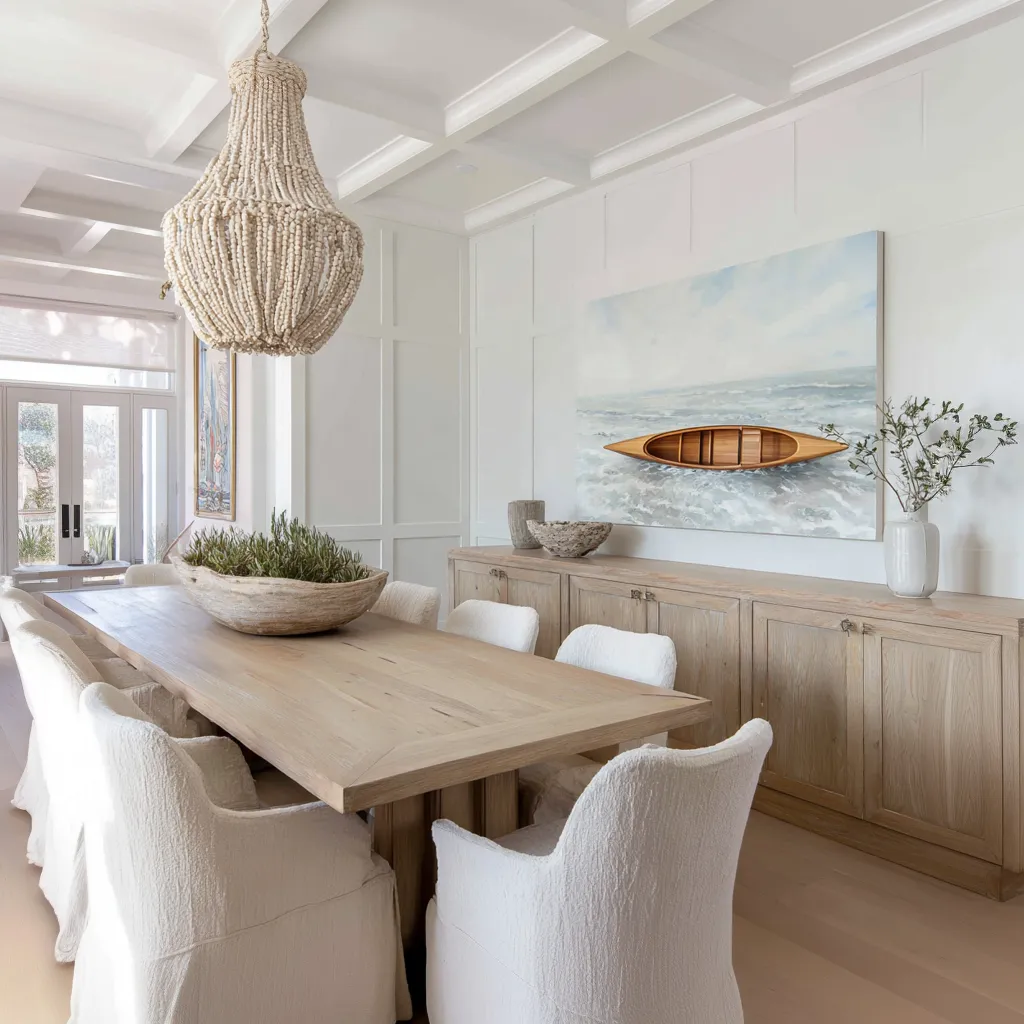
A dining room with a woven pendant, pale walls, screened light, dry branches, and a bench niche near the window belongs to a different coastal family from a room with dark plank art, cracked timber, dense wood mass, and low mineral lighting. Neither is better.
Each simply speaks a different dialect of the shore. That is why it helps to decide early: do you want the coast to enter through filter, or through weather?
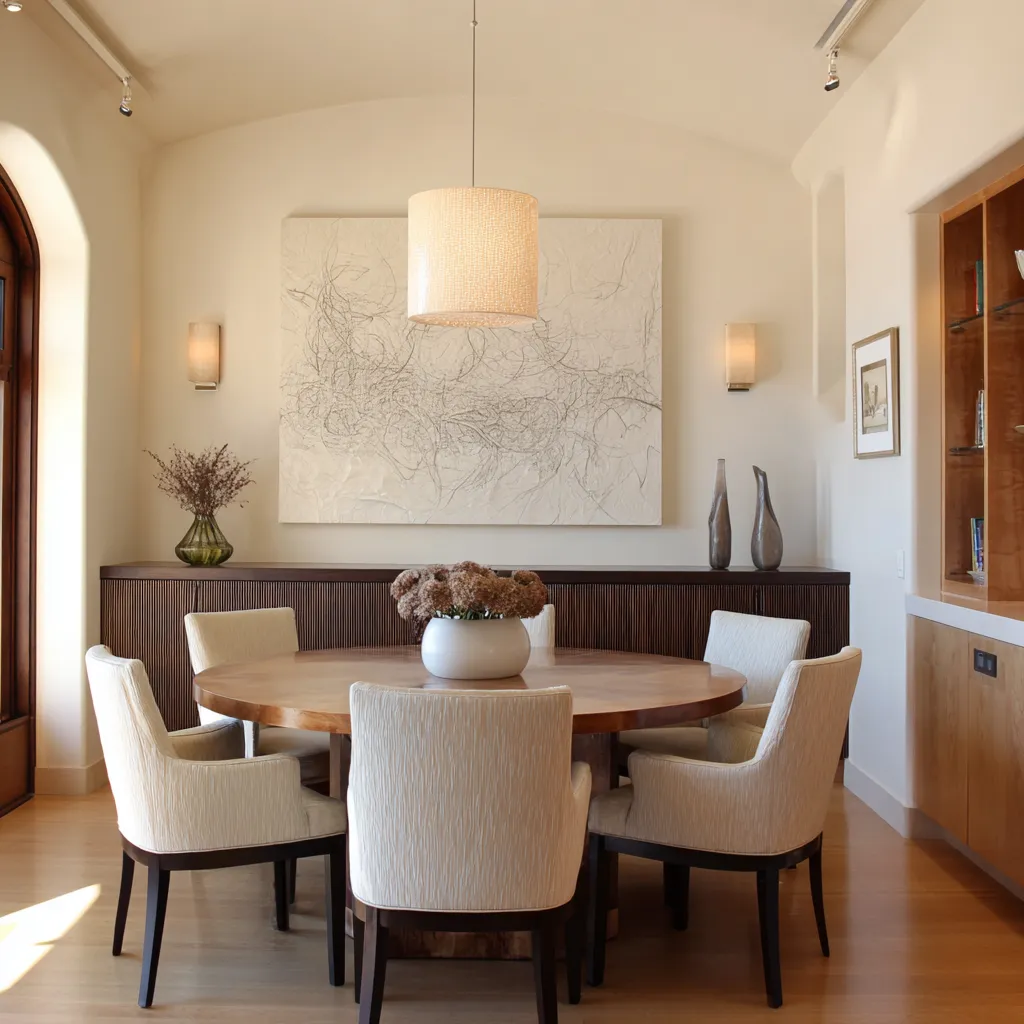
Dry plant material is not filler; it is climate made visible
Many people underestimate the role of plant matter in coastal interiors. In truth, it often carries an enormous share of the atmosphere.
Yet not all greenery does this equally well. Lush floral arrangements can easily push a coastal dining room toward garden-room prettiness or resort styling.
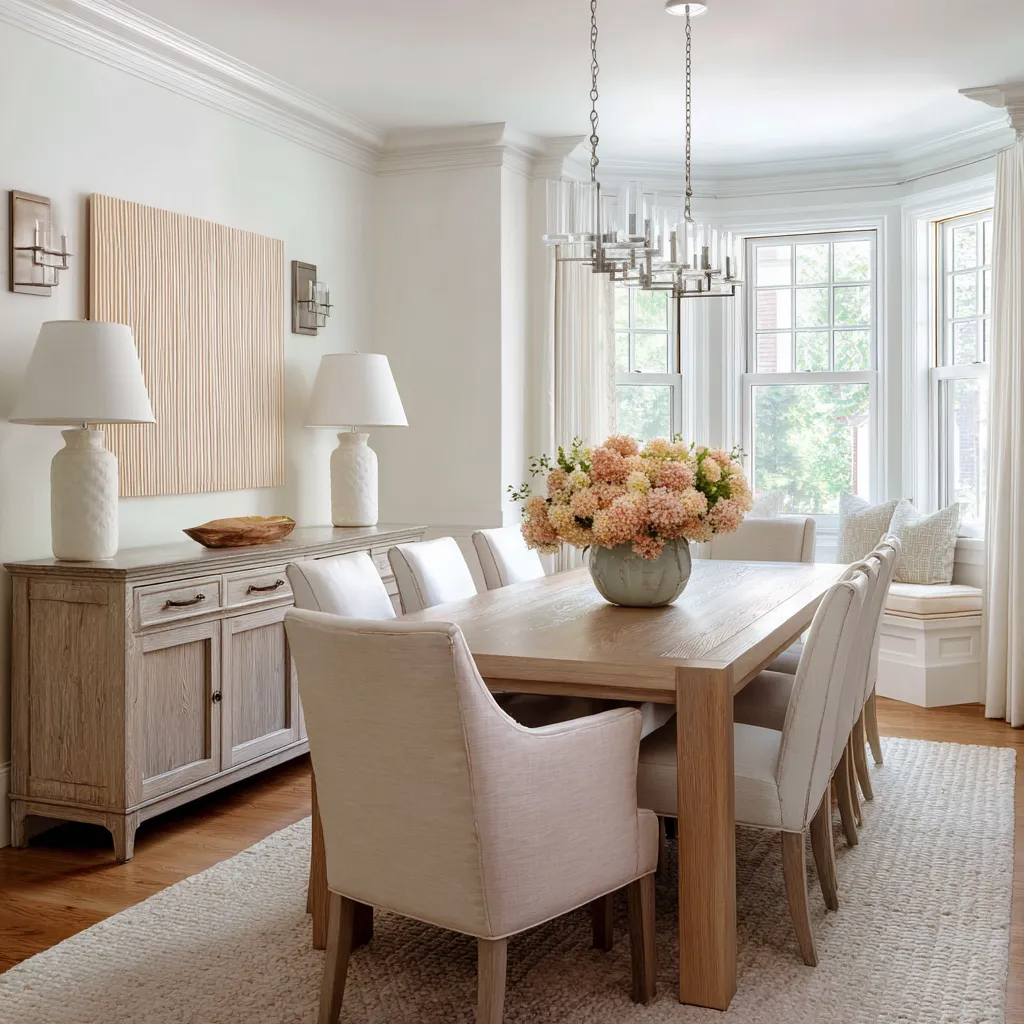
What proves far more effective is plant material that looks shaped by exposure: dry branches, marsh-like grasses, pale seed heads, wiry stems, sparse shrubs, silvery foliage, wind-bent twigs, faded hydrangea masses, or arrangements with a slightly brittle seasonal quality. These forms suggest actual shoreline ecology.
They feel touched by salt, sun, and air.
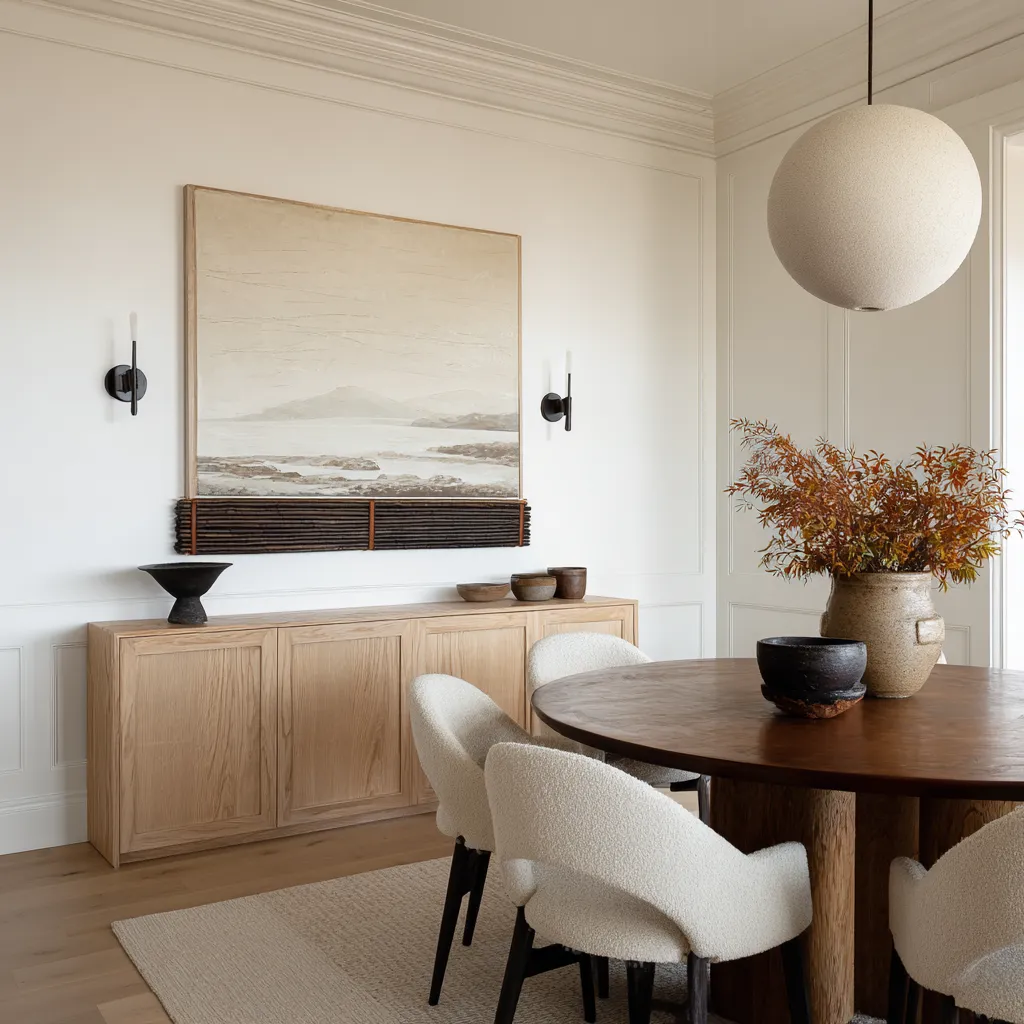
This kind of plant material does several jobs at once. It introduces irregular line into edited rooms with broad casework and simple envelopes.
It keeps pale interiors from becoming lifeless. It connects the room to dune edges, marsh growth, dry coastal gardens, and seasonal plant change.
It also shifts the coastal idea away from leisure and toward place. The room begins to feel located.
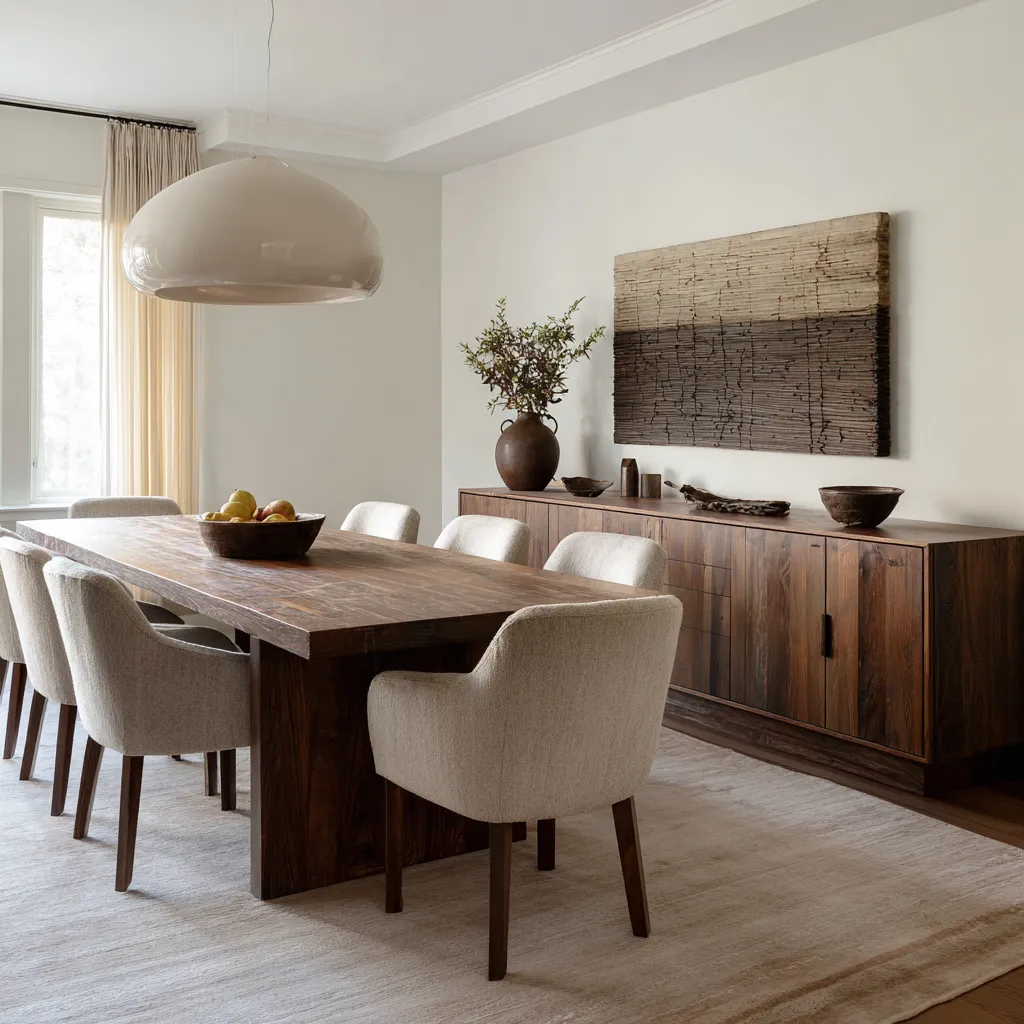
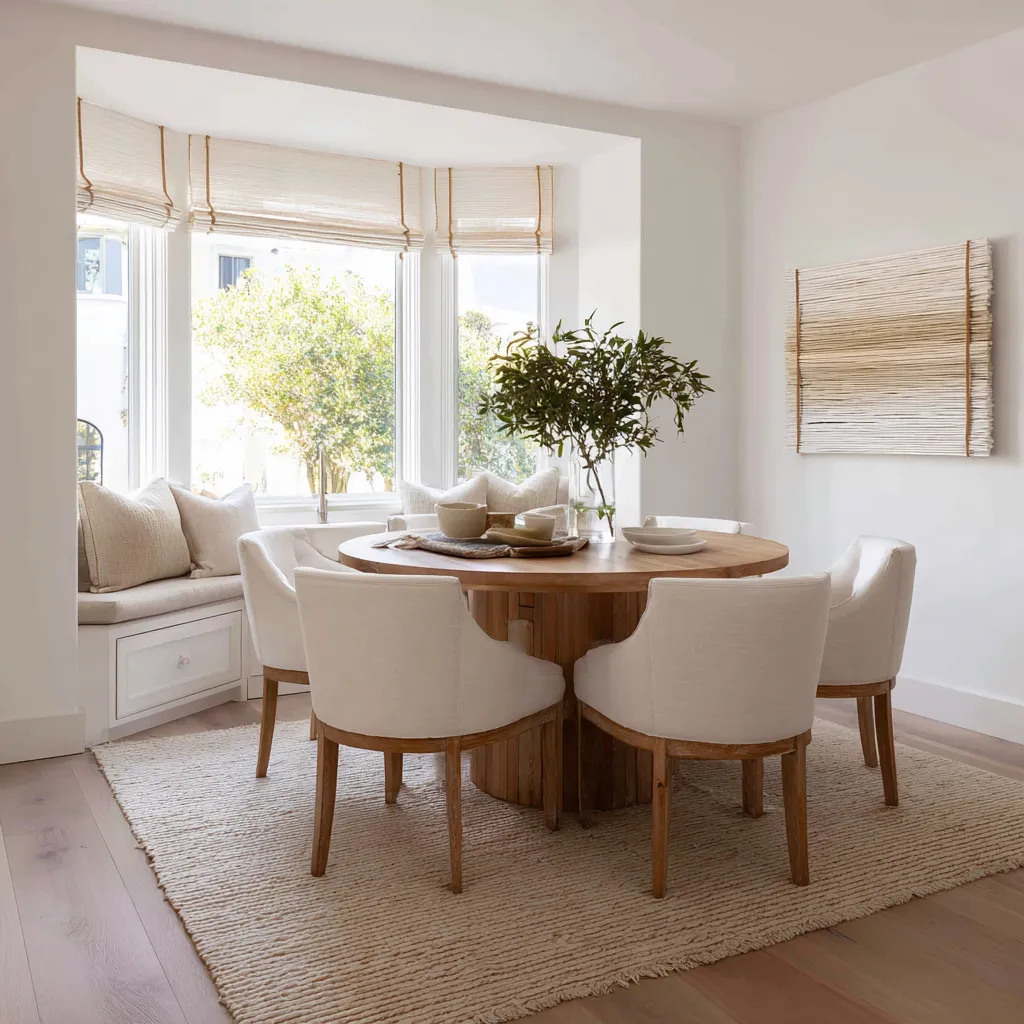
This is especially important in more sheltered dining spaces. If the room includes an alcove, a bay window bench, a cove-like arch, a darker niche, or a built-in dining corner, it may lose some of the open horizon feeling associated with the shore.
Dry plant material can restore that link. It tells the room that wind and bright outdoor climate still exist outside the enclosure.
In other words, branches and grasses are not merely table styling. They act almost like a climate transmitter.
They bring the exterior pressure of the shoreline inward.
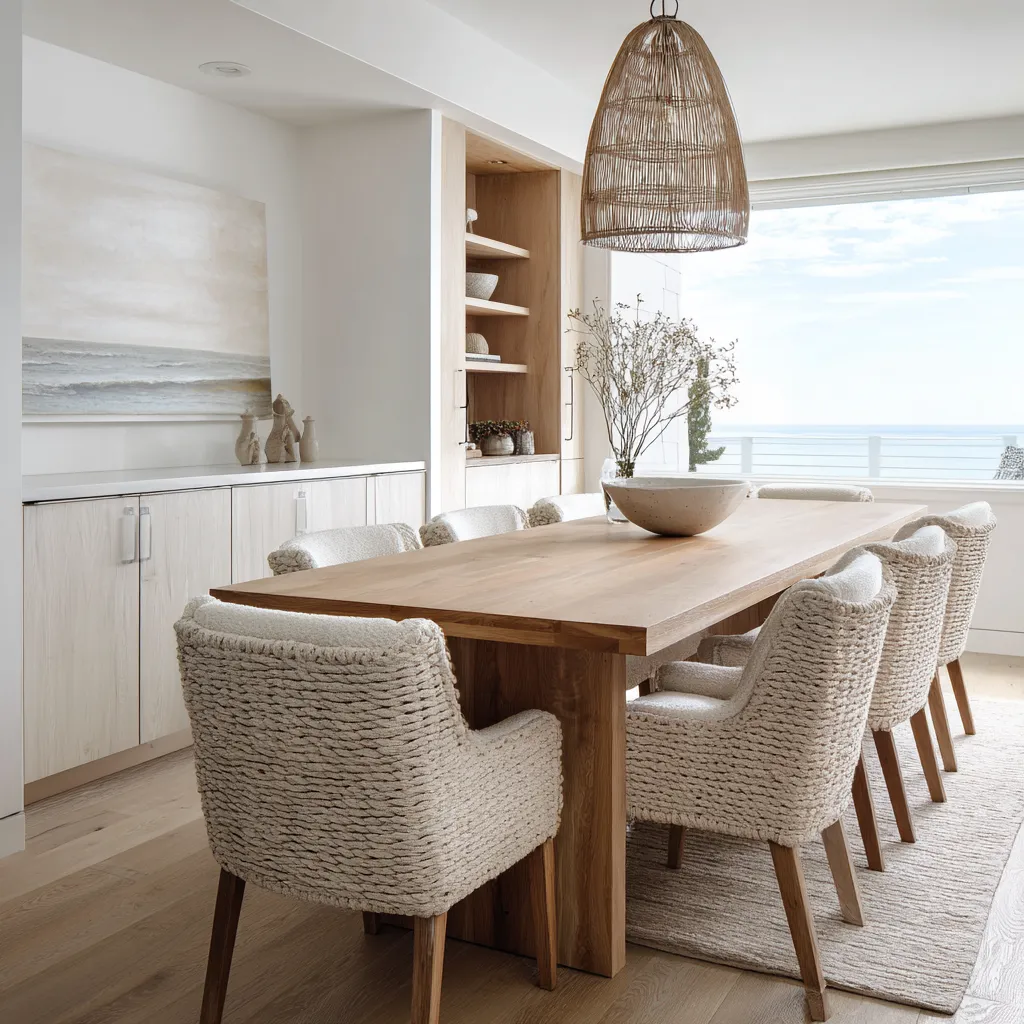
Shelter is part of coastal design too
There is a common assumption that coastal interiors must always feel open, breezy, expansive, and full of uninterrupted light. But that only describes one side of shoreline life.
The coast also produces a desire for shelter. People move between exposed edge and protected recess.
They leave bright glare and enter shade. They sit in window seats to watch weather.
They gather in built-in corners after time outdoors. They choose alcoves, porches, banquettes, deep thresholds, and rooms that frame light instead of surrendering fully to it.
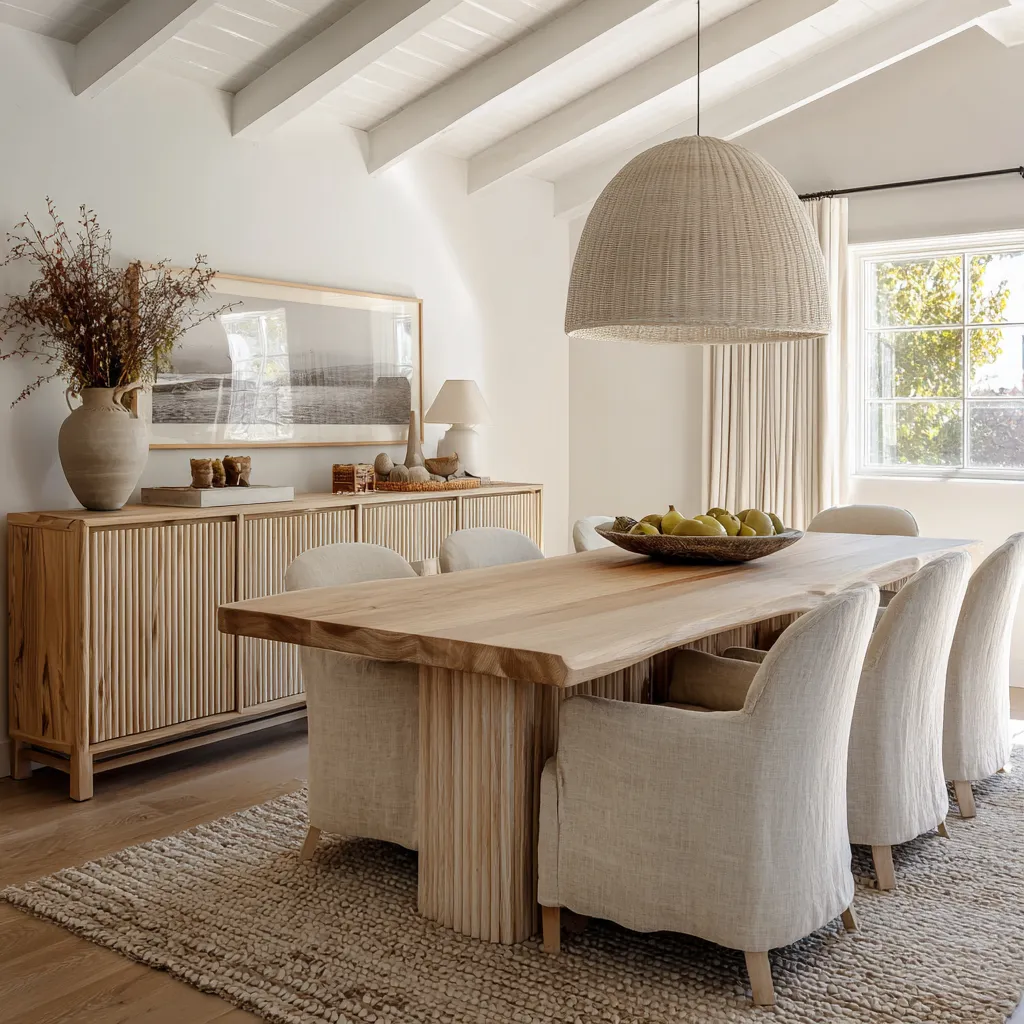
This is why architectural shelter matters so much in modern coastal dining spaces. A bay-window bench, an arched recess behind the sideboard, a dark timber alcove, exposed ceiling beams, a tucked banquette, a stair-hall openness that still frames the dining zone, or a built-in ledge under a window can all strengthen a coastal room when used well.
These elements recreate the coastal condition of protected interior life at the edge of a larger climate.
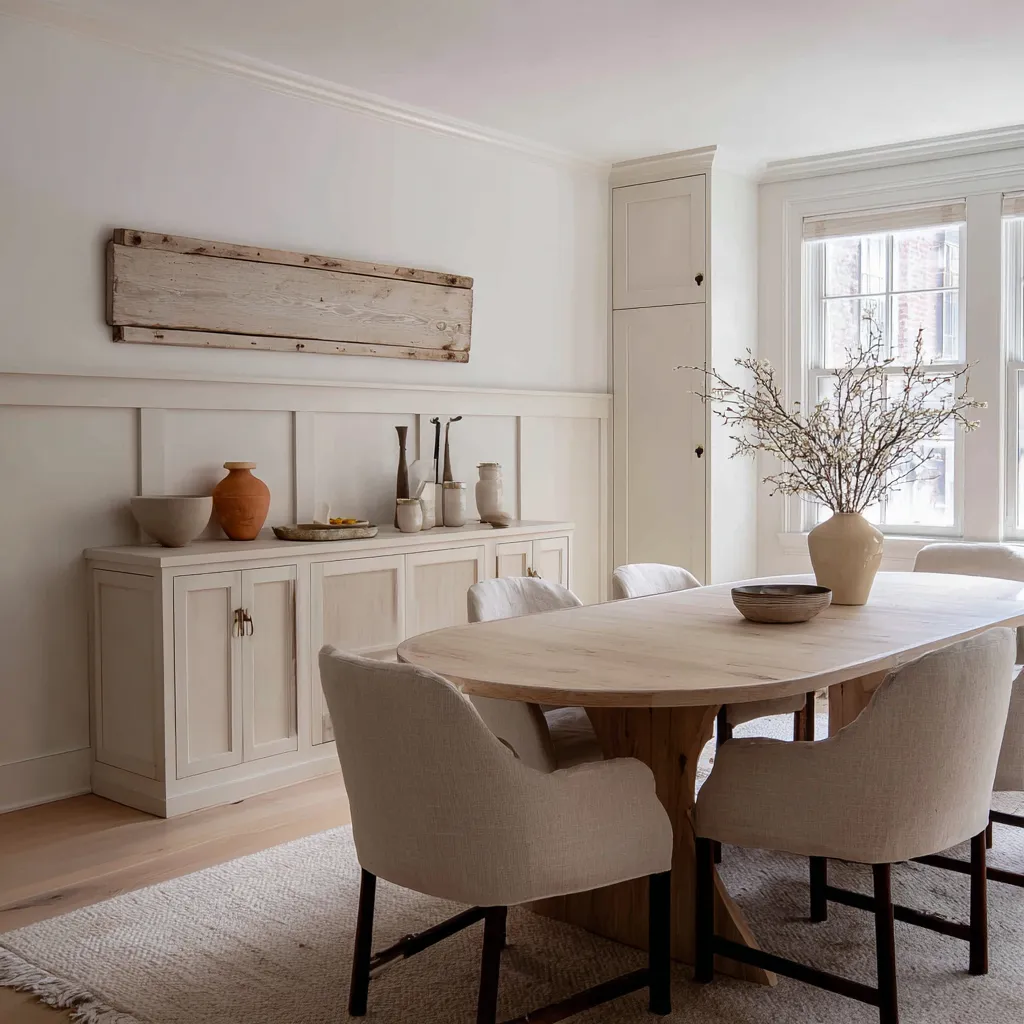
A room with shelter does not need to be small or dim. It simply needs some sense of being held.
Often dining room ideas pair that held feeling with one or two long horizon cues or with plant forms that imply open air beyond the room. The balance is important.
Too much shelter without any sign of exposure can make the space feel heavy. Too much openness without any framed comfort can make it feel thin.
The coastal designs can manage both. They offer a sense of distance and a place to sit inside it.
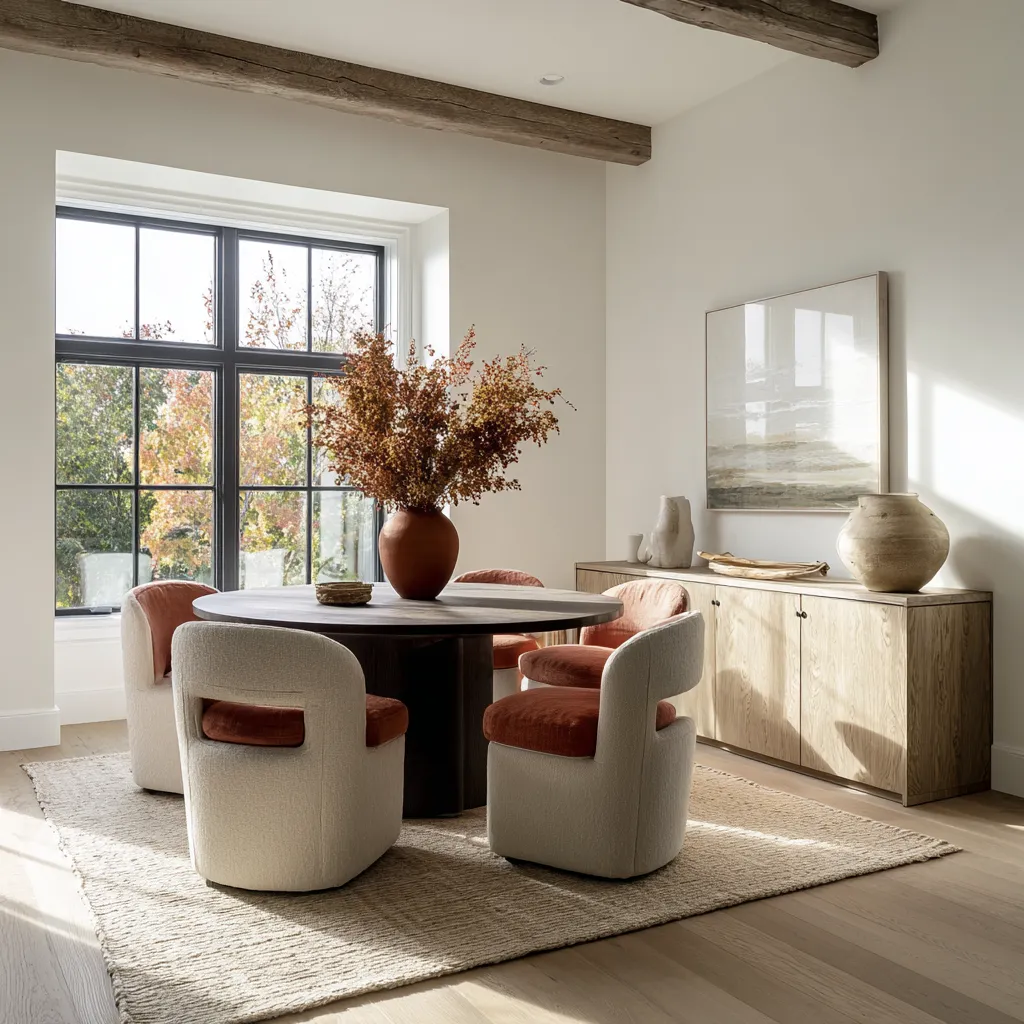
Linear texture can make a room feel coastal without a single seaside object
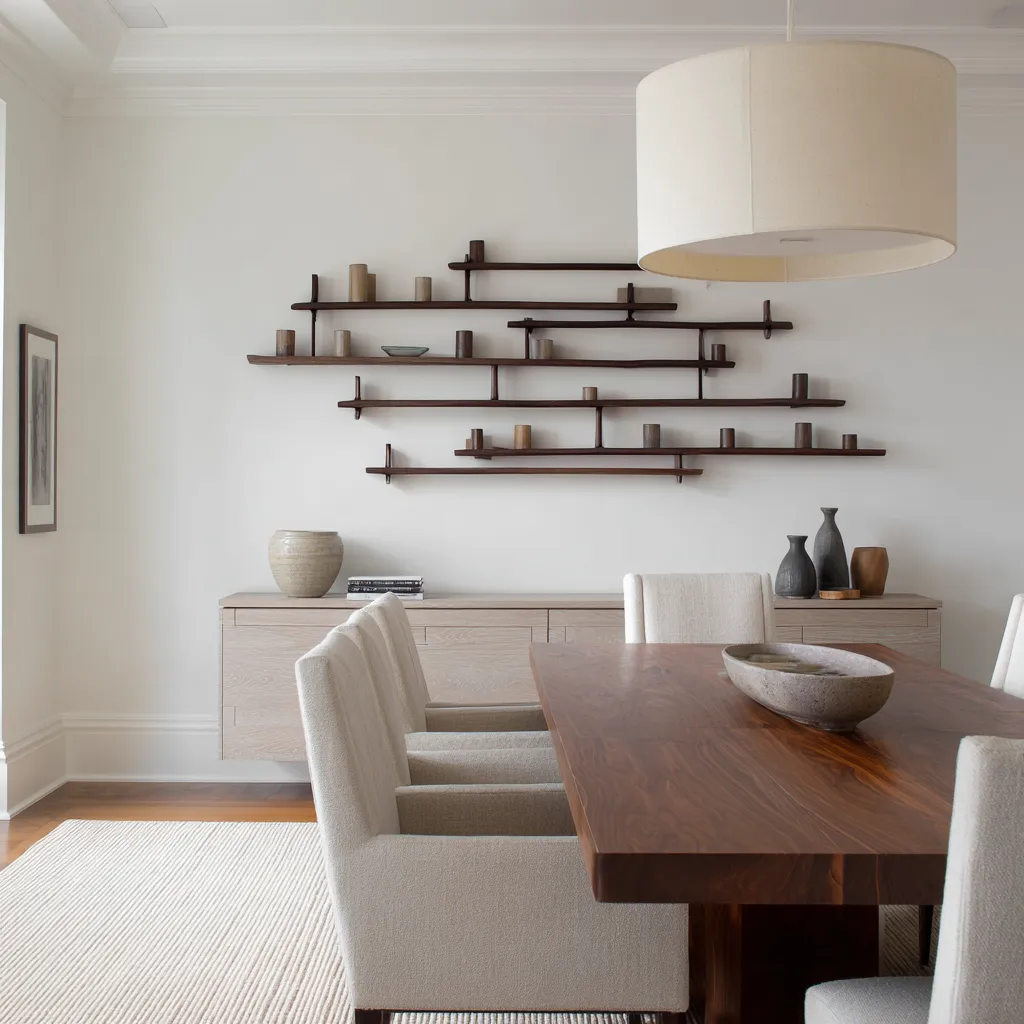
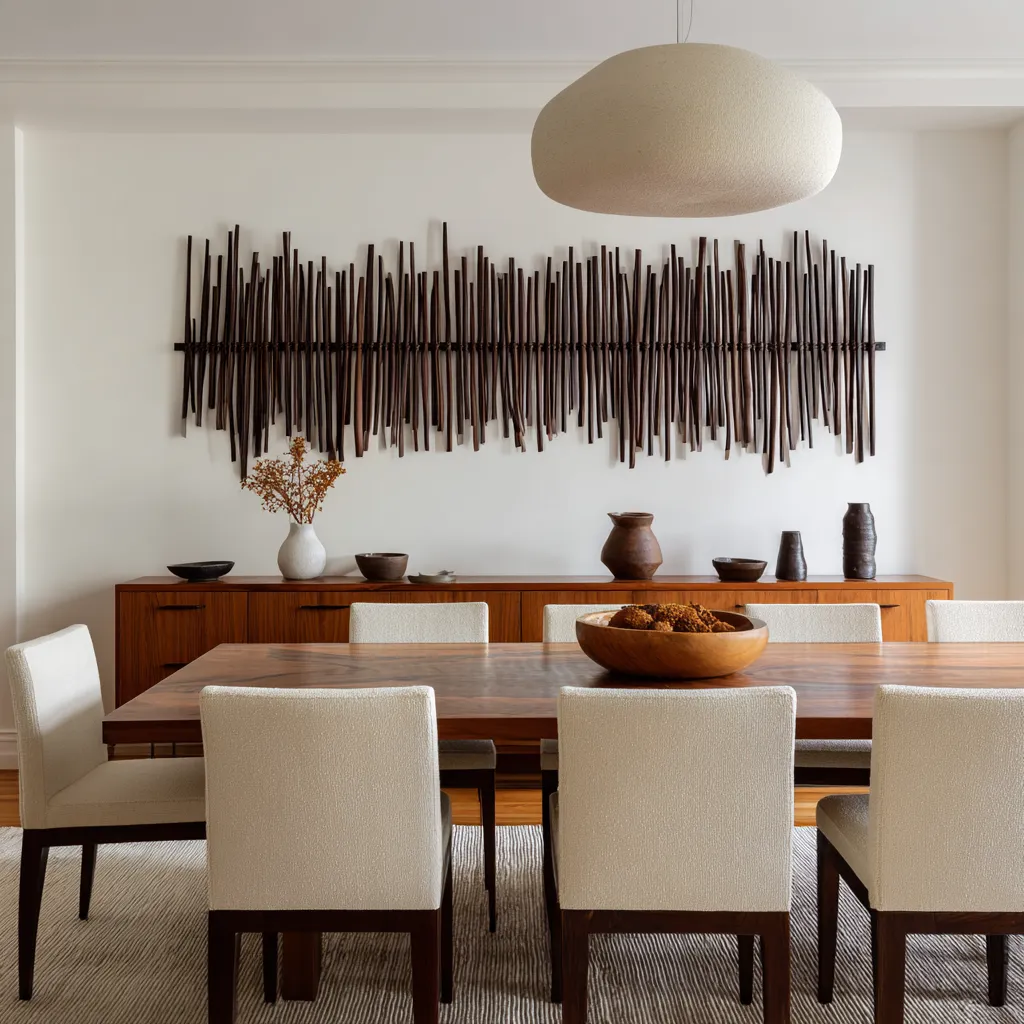
One of the ways to create shoreline atmosphere is through linear repetition. Slats, fluting, narrow rails, shelf bands, ribbed cabinet faces, reed-like wall pieces, and stacked horizontal marks can all produce coastal identity in a very reduced way.
They suggest tide lines, dune fencing, dock members, cladding, marsh reeds, weathered boards, slatted storage, and the measured horizontal structure of water meeting land.
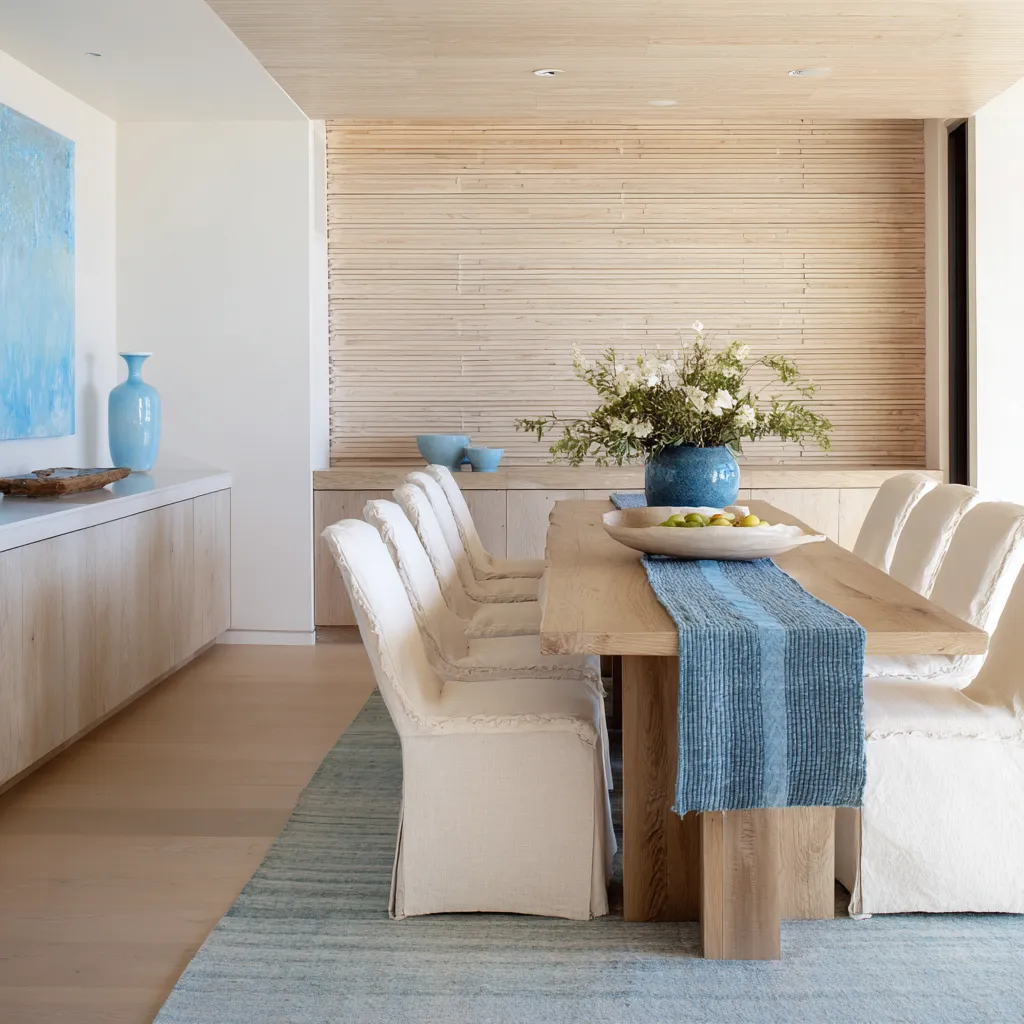
This kind of design move is especially useful for people who want a coastal dining room without obvious art of the sea. A ribbed sideboard can do part of the job.
So can floating shelves arranged as layered bands. So can a large wall relief scored with wave-like lines, or a narrow rectilinear work made of compressed horizontal reeds.
These elements build coastal feeling through structure rather than subject matter.
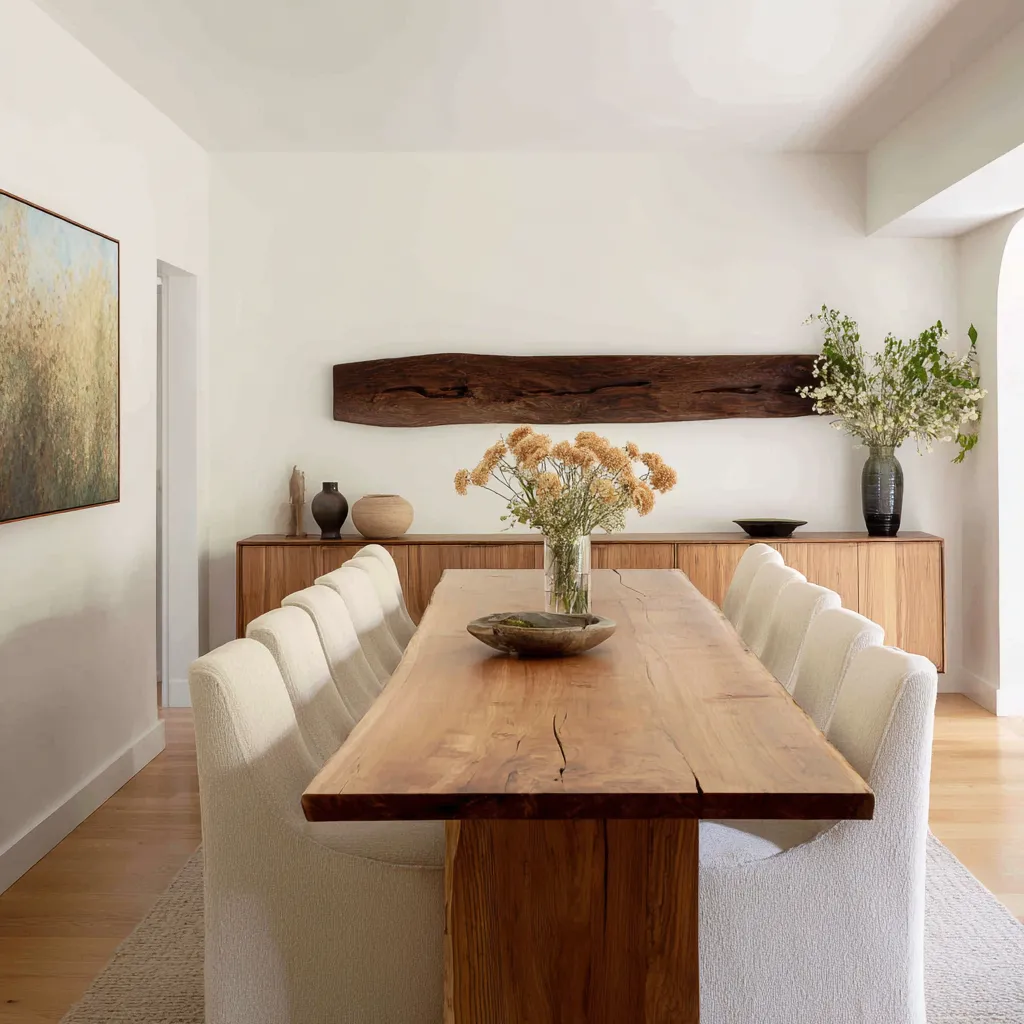
The reason they work is that the coast is full of repeated linear conditions. Think of water marks, reed fields, boardwalk planks, thin fence pickets near dunes, pilings along an edge, or bands of cloud, water, and shore.
When those rhythms are translated into millwork, wall composition, furniture texture, or shelving, the room begins to echo the shore without ever illustrating it. This is a route for contemporary interiors, because it keeps the design highly edited.
A coastal room built from line and spacing can feel architectural, restrained, and deeply tied to place all at once.
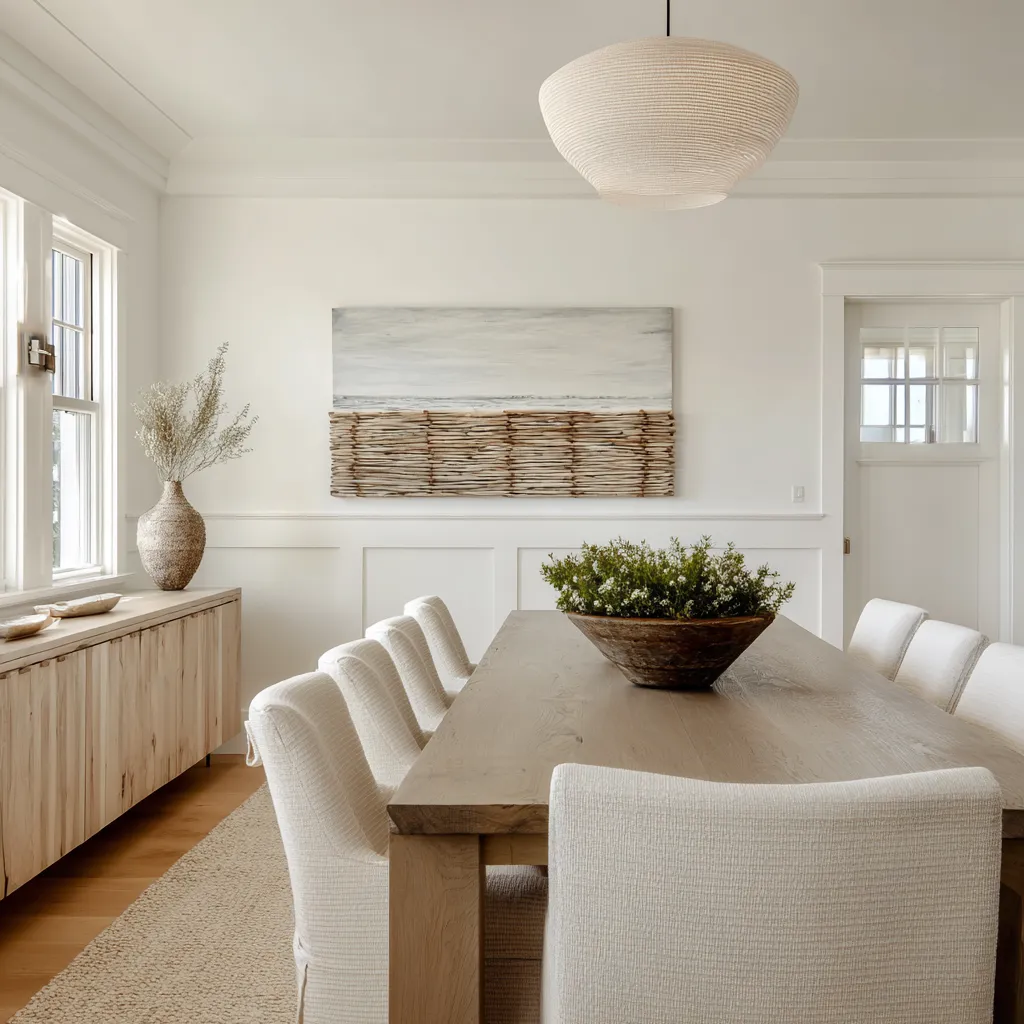
Curves matter because the shoreline reduces sharpness
Another subtle but powerful trait in many modern coastal dining rooms is the softening of outline. Oval tables, round pedestal dining tables, rounded credenza ends, pebble-like pendants, cove-like recesses, softly curved chair backs, and broad drum or dome shades all help remove visual stiffness from the space.
This is not accidental. Shoreline landscapes alter edges.
Water rounds stone. Exposure softens surface.
Sand reduces crispness. Even where there are hard constructed lines, the broader memory of the coast often includes smoothing, wearing down, and long continuous movement.
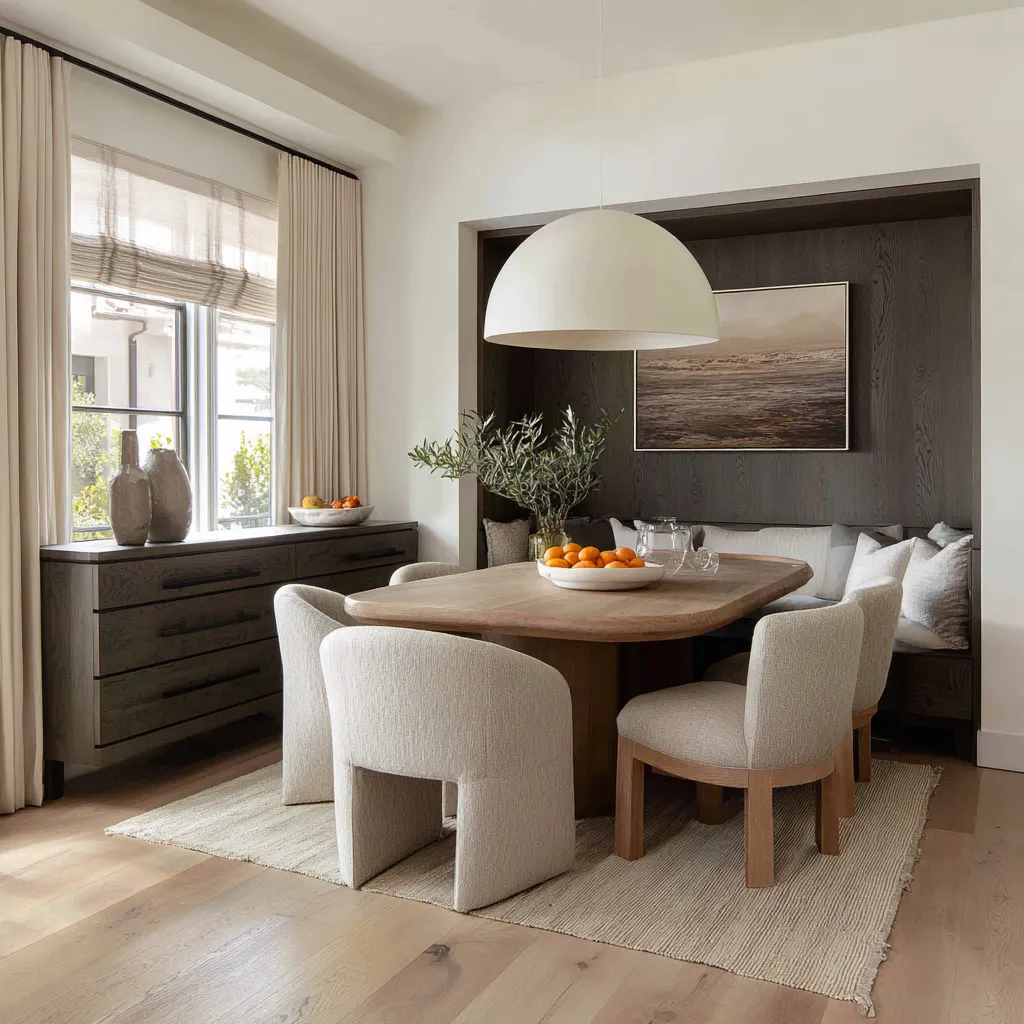
Curves are useful because they carry some of that effect indoors. An elongated oval table can suggest a boat form very indirectly, but even when that association is barely felt, the more important contribution is continuity.
There are no abrupt corner interruptions. Movement around the table improves.
The room feels more fluid. A round table can perform a different coastal task: it creates an inward gathering point inside a room shaped by long horizon bands or large areas of wall.
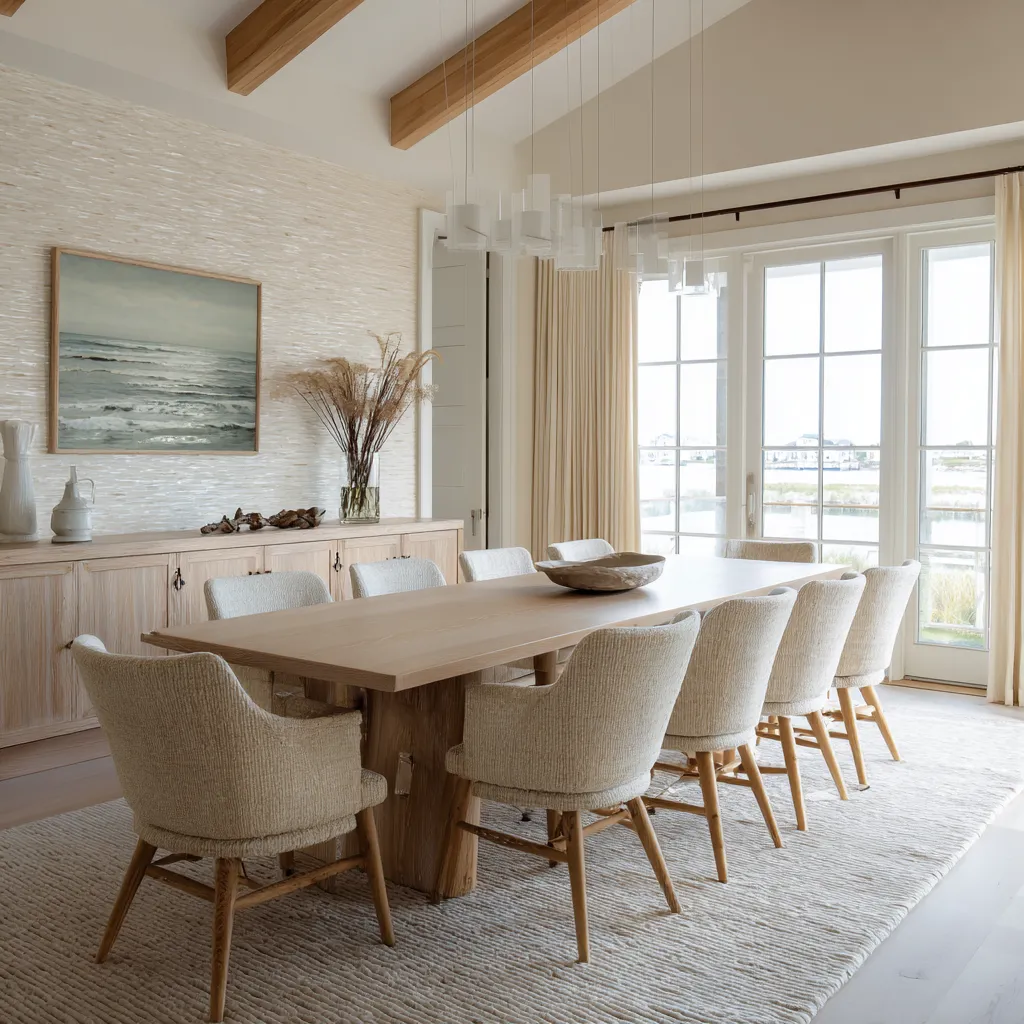
The key is balance. Curves become effective when paired with something straighter and steadier nearby.
A rounded table with a slatted sideboard. A pebble-like pendant over a broad plank table.
An arched alcove behind a long horizontal credenza. This pairing keeps the room from becoming overly soft and gives the composition tension.
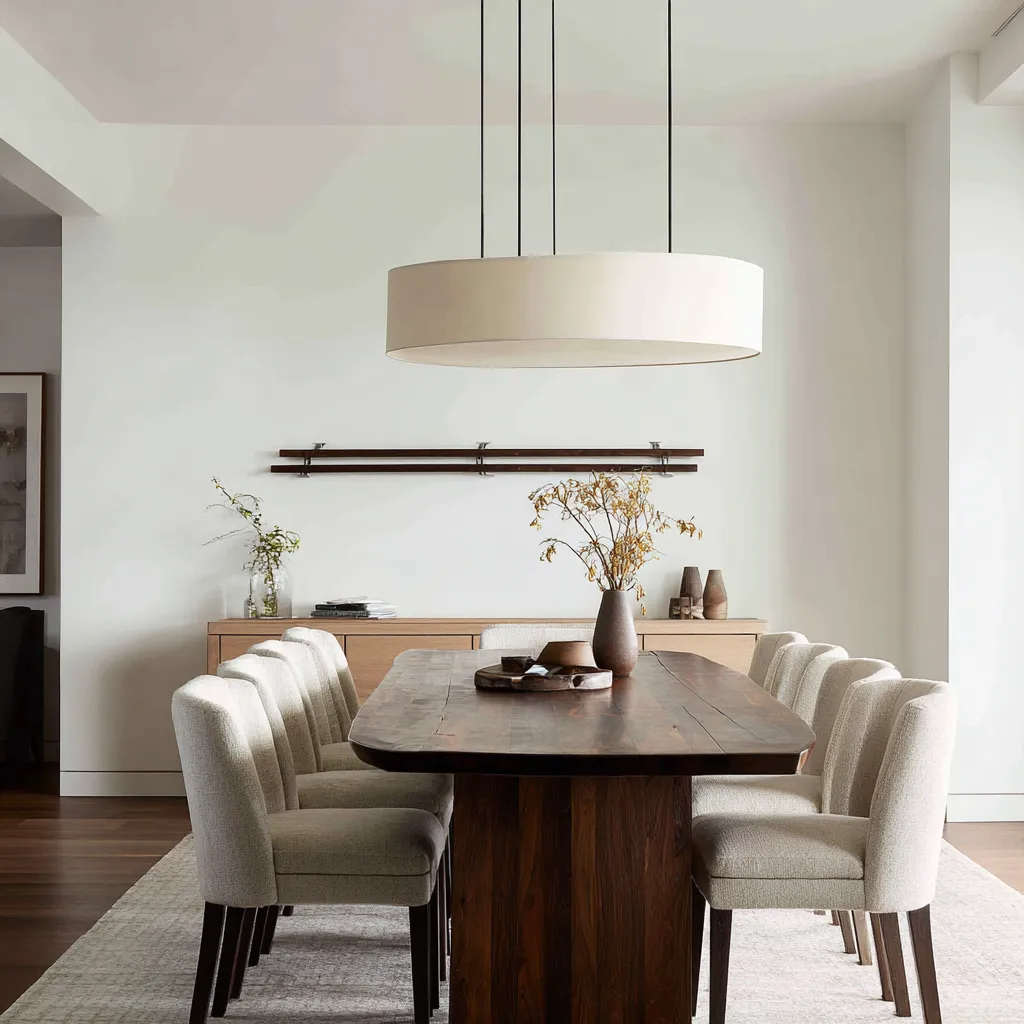
Dark coastal dining rooms need a different logic than pale ones
A darker coastal room should not be treated as a pale coastal room with fewer windows and deeper stain. That usually leads to confusion.
The source of the coastal feeling has to change. Bright coastal interiors often rely on haze, open daylight, shell-like translucency, pale oak, mirrors, softness, and watery reflection.
Darker coastal interiors rely on other evidence: geological weight, old marine timber, tide residue, smoked wood, charred slats, sediment-like art, crackled surfaces, rusted marsh tones, low mineral pendants, and a stronger contrast between bleached textile and dense wood.
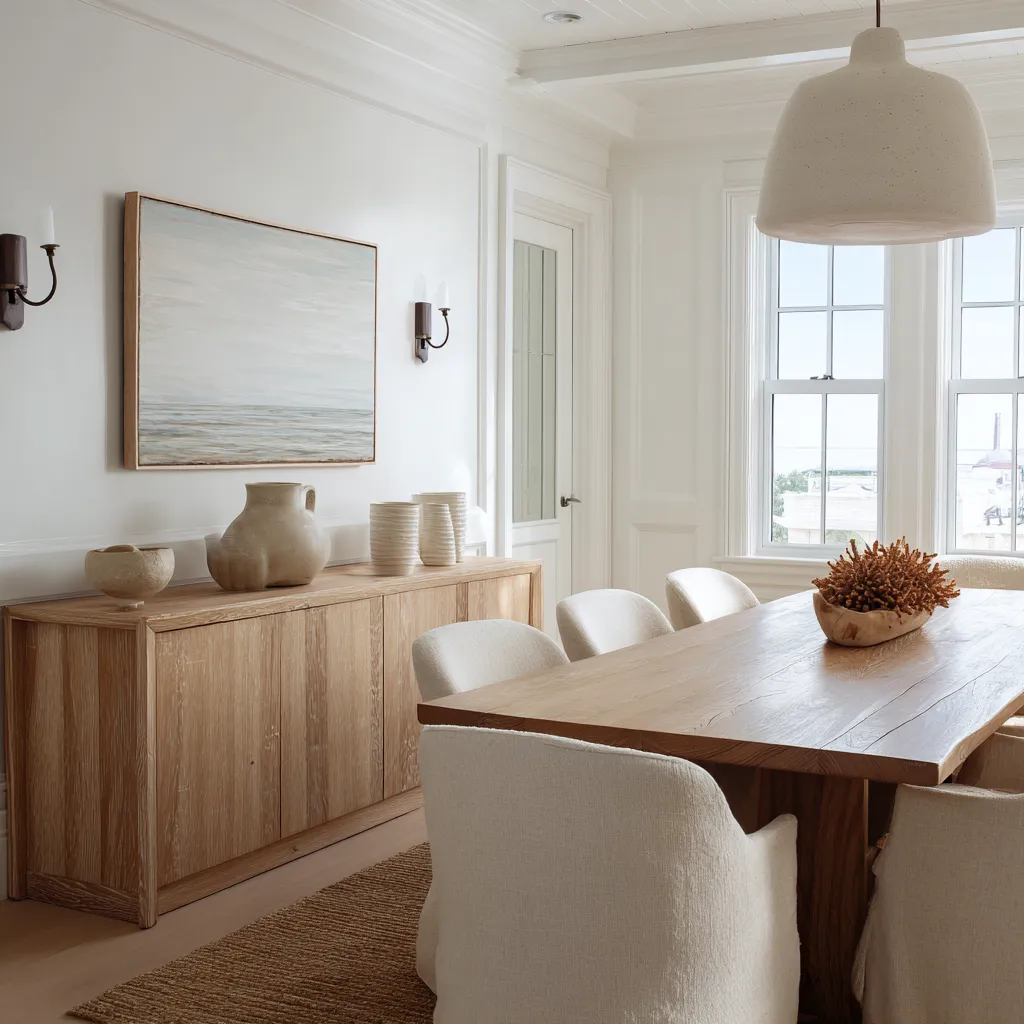
This matters because the coast is not only white glare and washed linen. It also includes wet piles, darkened piers, low tide residue, old boats, weathered harbor structures, and evening edges where land and water merge into deeper tone.
A dining room that wants to feel coastal in a darker way must build from those conditions. So if you are designing a moodier coastal dining space, do not force sparkle into it.
Do not depend on shiny glass, icy blue accents, or too much reflective sheen. Instead, look for dark timber tables, broad matte sideboards, textured paintings with tide-line logic, dry amber branches, creamy upholstered seating, and pendants with soft mineral presence.
That combination creates a coastal mood with depth rather than resort brightness.
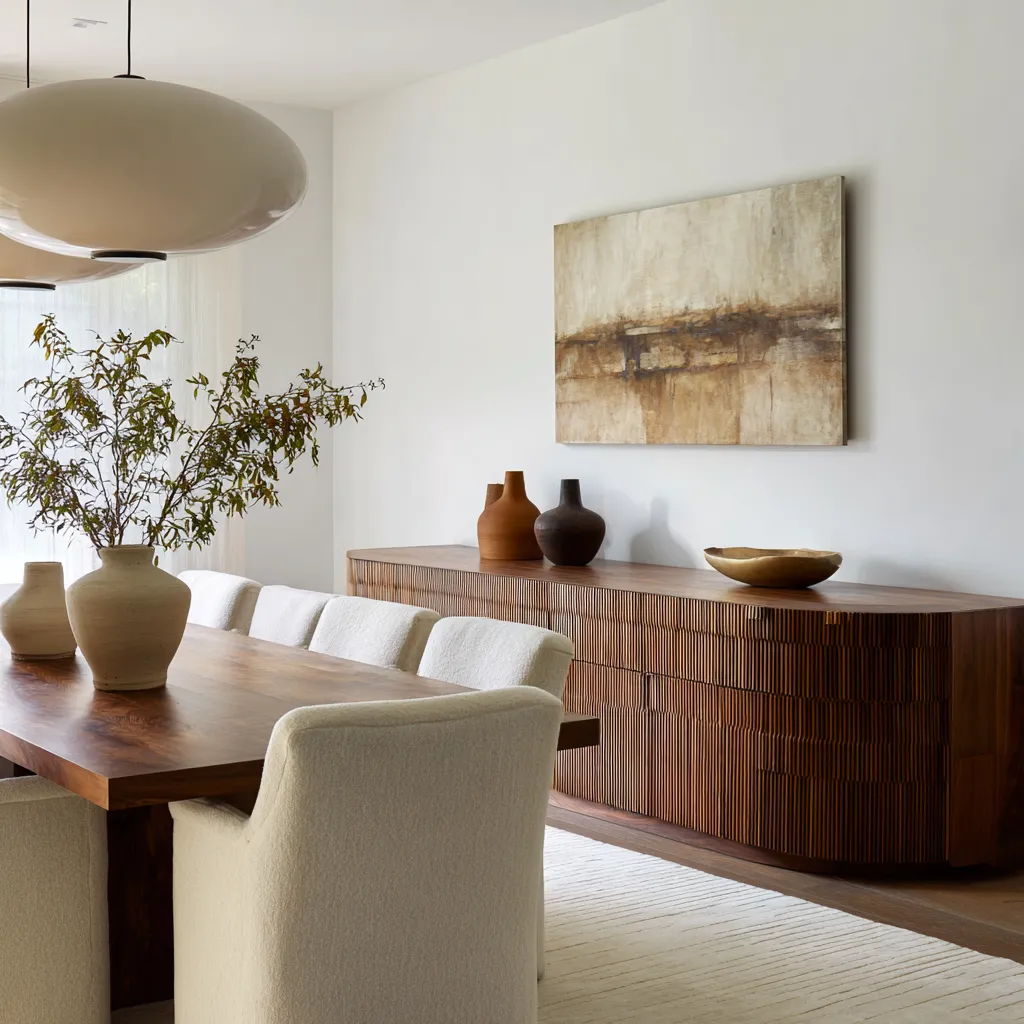
Blue should be treated as an event, not a default
One of limiting ideas in coastal decorating is the assumption that blue must dominate. Modern coastal dining room designs barely use it.
Their palette sits in sand, washed oak, shell, chalk, fog gray, pale clay, weathered linen, smoky brown, faded reed, dry cream, and muted marsh rust. These colors often carry shoreline atmosphere far better than aggressive blue-and-white contrast.
When blue appears, it usually works in concentrated form. A single painting.
A ceramic vessel. A runner down the center of a pale wood table.
A rug with softened wave-like blue-gray. A bowl near the window.
Used this way, blue acts like a glimpse of water between larger fields of dune, timber, and light. It feels earned.
The problem with distributing blue everywhere is that the room loses hierarchy. It becomes decorative too quickly.
The eye stops feeling the relationship between dry land tones and water tones. A more current approach is to let blue arrive where water would arrive in the landscape: in channels, bands, glimpses, surfaces of reflection, or one controlled field held by quieter neutrals.
This also opens the door to richer coastal palettes. Shell pink, faded coral, clay blush, oxidized brown, silvery olive, pale oat, and weather-softened peach can all belong to shoreline design, especially when they are tied to evening sky, dune flowers, marsh sedge, shell interiors, or late-season coastal gardens.
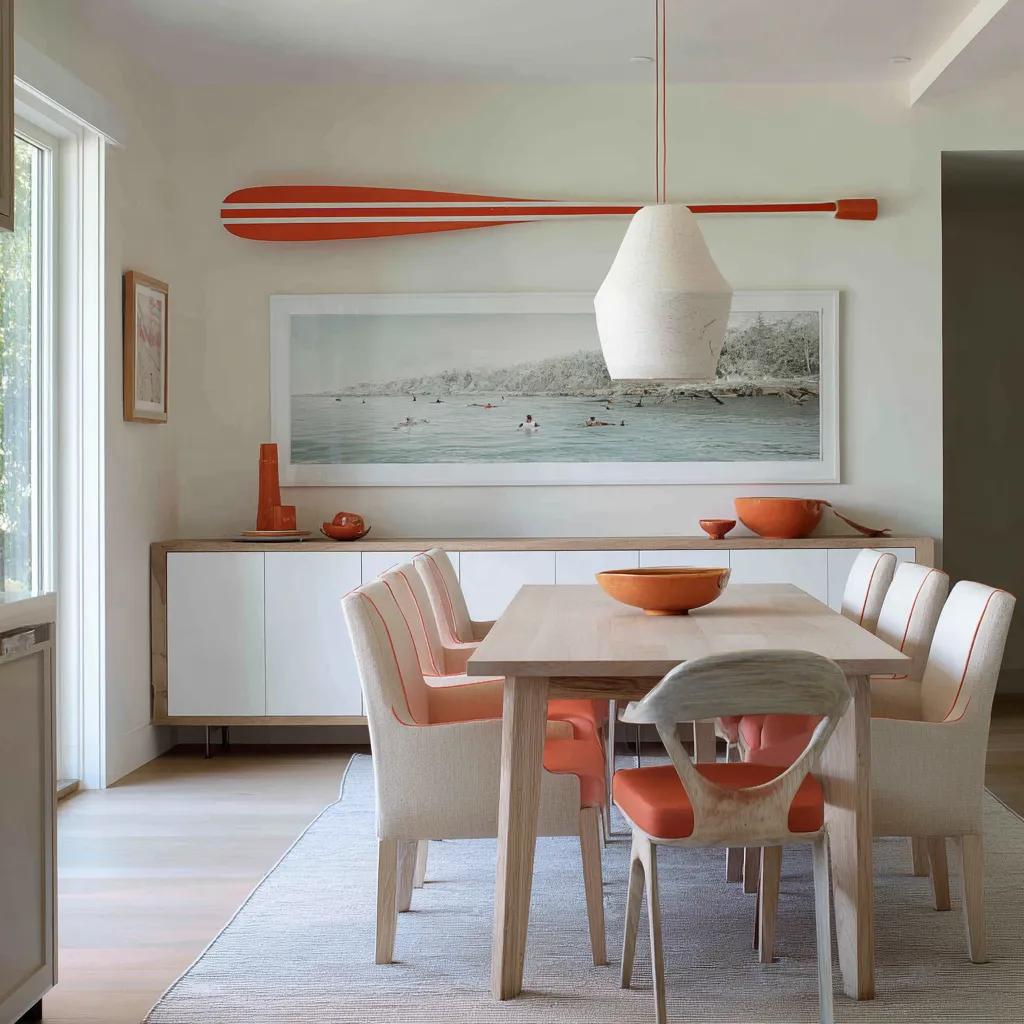
Stylish idea: a stand-alone marine object
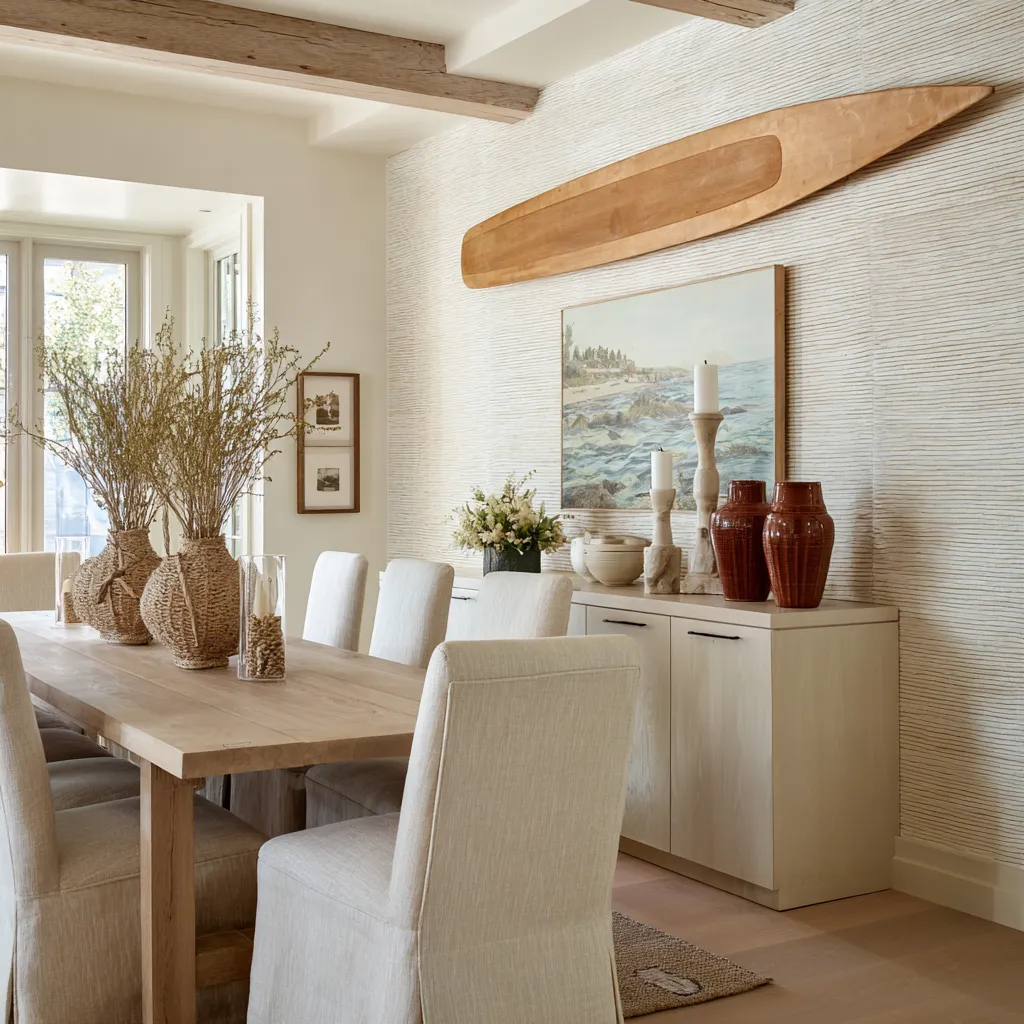
Canoes, paddles, oars, and similar forms can still work in a modern coastal dining room. But their success depends on discipline.
The mistake is rarely the object itself. The mistake is giving it too much company.
Once a paddle is joined by shell pillows, rope mirrors, striped runners, coral prints, and nautical lanterns, the room starts narrating instead of designing. The object loses force because it has become one voice in a chorus of explanation.
The stronger method is singular use. One canoe mounted over a quiet horizon painting.
One paddle against a finely textured wall. One long salvaged plank stretched above a sideboard.
One panoramic image of bathers beneath one marine-colored accent. In these cases, the object becomes a sculptural interruption inside a restrained composition.
The room does not ask the object to tell the whole story. It lets architecture, palette, and material language hold the story already.
The object simply sharpens it. If you want to use such a piece, ask whether the room already has enough coastal evidence without it.
If the answer is no, the object is being asked to work too hard. If the answer is yes, then the object may become exactly the right note.
Broad surfaces matter more than small accessories
A coastal dining room usually becomes convincing through major fields and large gestures, not through small decorative accumulation. A long sideboard, a broad table, a wide horizon painting, a woven pendant with volume, a ribbed cabinet front, a pale washed wall, a dark beam overhead, a cove-like niche, a bay-window bench, a large relief panel, or one long wall-mounted plank can all do more for the room than a dozen tabletop objects.
This is because broad surfaces create atmosphere at the scale of the room itself. They shift how the entire space is understood.
Small accessories tend to operate only at close range. They can support a concept, but they rarely generate it.
Modern coastal dining room ideas often feel sparse even when they are rich in detail. The detail is carried by finish, texture, silhouette, and proportion rather than by volume of objects.
The room has fewer things, but each one has more responsibility.
Modern coastal rooms keep their references uneven
One of the quiet reasons many interiors feel current is that they do not spread the coastal idea evenly. They concentrate it.
One side of the room may hold the main horizon field. Another may hold the main fibrous pendant.
The table may carry the heaviest timber statement while the sideboard remains pale. One plant arrangement may do the whole climate job.
One wall piece may establish the tide-line rhythm. This unevenness gives the design hierarchy and keeps it from becoming formulaic.
An interior design where every surface says coast often stops feeling like a room. A room where one or two areas say it strongly, and the rest support them, feels far more mature.
The coast enters in pulses rather than in blanket coverage. That principle is useful for styling as well.
If you already have a strong seascape, let the centerpiece stay dry and sparse. If your pendant is large and woven, let the table remain plain and substantial.
If your room has one dramatic weathered plank on the wall, keep the casework below steady and almost silent. The room needs agreement, not repetition.
What makes a coastal dining room feel current now
A current coastal dining room usually avoids three common failures.
- The first is too much iconography. Once the room depends on shells, anchors, stripes, coral, and overt marine props, it narrows itself too quickly.
- The second is lack of material tension. Strong coastal rooms usually hold oppositions: pale against dark, rough against smooth, airy against grounded, woven against solid, long horizontal against clustered vertical stems, shelter against openness, horizon against residue.
- The third is placing all coastal identity in décor instead of in the room’s physical language. A dining room becomes far more convincing when coastal atmosphere enters through the table form, the cabinet rhythm, the beam structure, the pendant material, the wall field, the finish on the wood, the direction of the light, and the type of plant material chosen.
That is why coastal dining spaces can feel both simple and layered. They are simple in the number of ideas they emphasize.
They are layered in the way those ideas are translated through multiple surfaces.
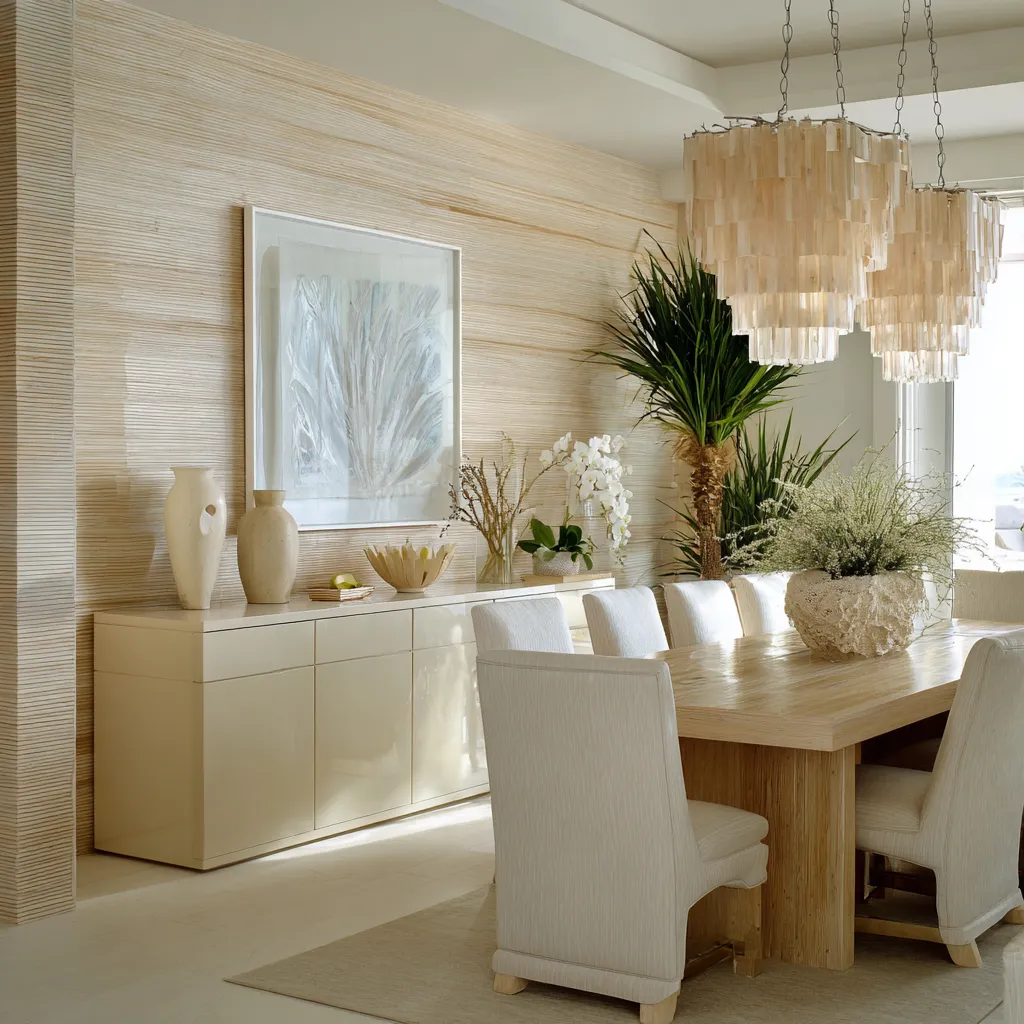
The goal
The goal of a modern coastal dining room is not to remind people of the sea in a direct way every time they look around. The goal is subtler.
It is to make the room feel as though bright air, distance, weather, and shoreline material have quietly shaped it over time. The space should feel settled near water, not dressed for it.
That is why the coastal dining rooms can often feel understated on first glance and much richer on second glance. Their coastal identity sits in low-contrast horizons, dry stems, softened oak, fibrous light, tide-line textures, dark timber weight, and broad surfaces left with room to breathe.
They borrow from what the shore leaves behind: residue, glare, filtered brightness, weathered matter, and a long sense of space. When a dining room works that way, it does not need to insist.
It already carries the place within it.