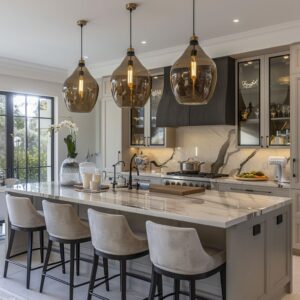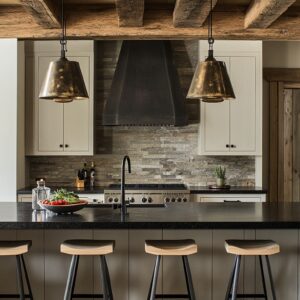
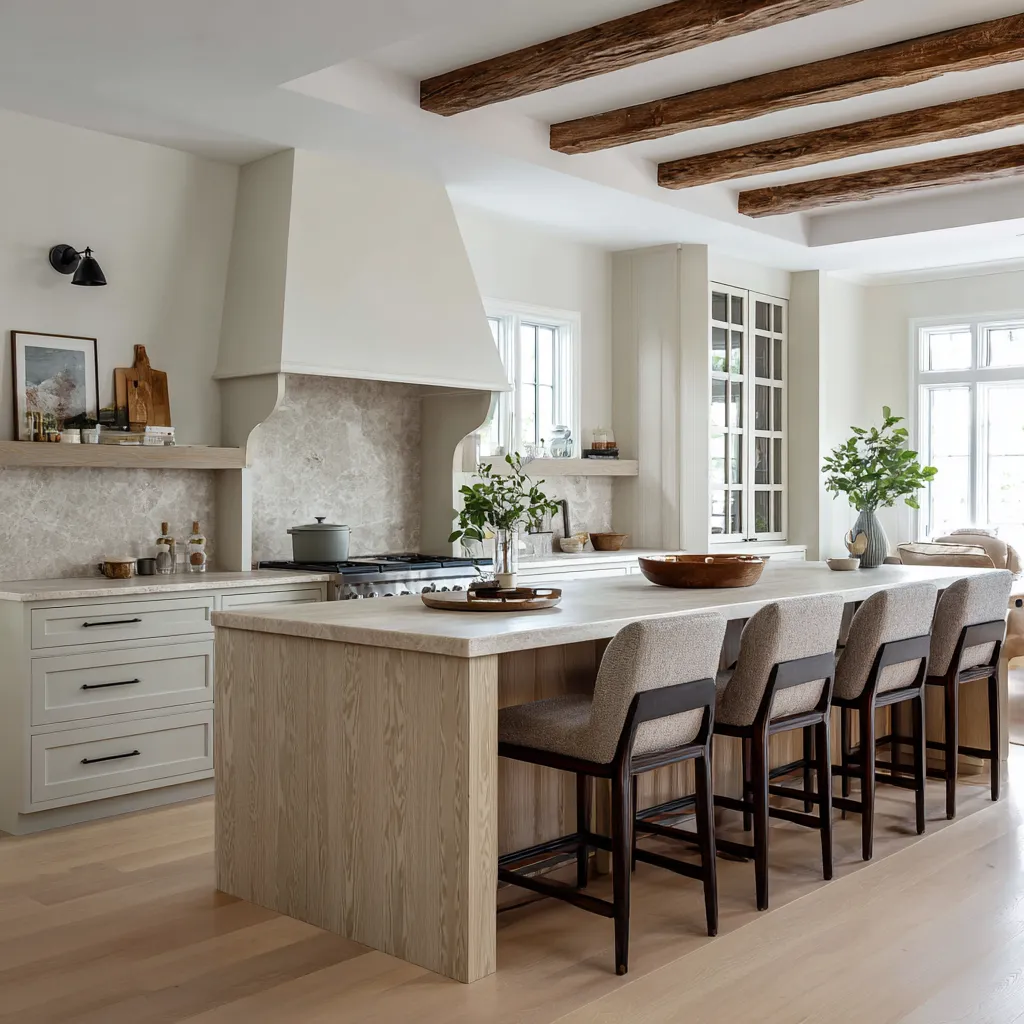
Many discussions of Cape Cod kitchens start in the wrong place. They start with brightness, white paint, breezy color, or seaside references.
That can produce a pleasant room, but it often misses the deeper reason the style feels convincing. A modern Cape Cod kitchen does not gain its identity from looking coastal in an obvious way.
It gains its identity from feeling tied to a house shaped by light, weather, family use, and architectural memory. That shift in viewpoint changes everything.
The kitchens that hold this style well do not usually depend on blue accents, shell decor, striped fabrics, or decorative maritime signals. Their character comes from framed windows, softened woods, built-in logic, roof shape, beadboard or plank memory, mineral surfaces that catch daylight without shouting, and a social center that feels believable in daily life.
The interior design feels near water, but it does not need to perform the fact. That is why modern Cape Cod kitchen ideas are more architectural.
It is less a decorating theme and more a way of organizing light, material, and domestic life so the room feels current while still rooted in New England house language.

The first mistake is to think brightness is enough
A bright kitchen can feel fresh, but brightness alone does very little to separate modern Cape Cod from generic coastal transitional design. Light is the baseline condition.
The real question is what the room does with it.
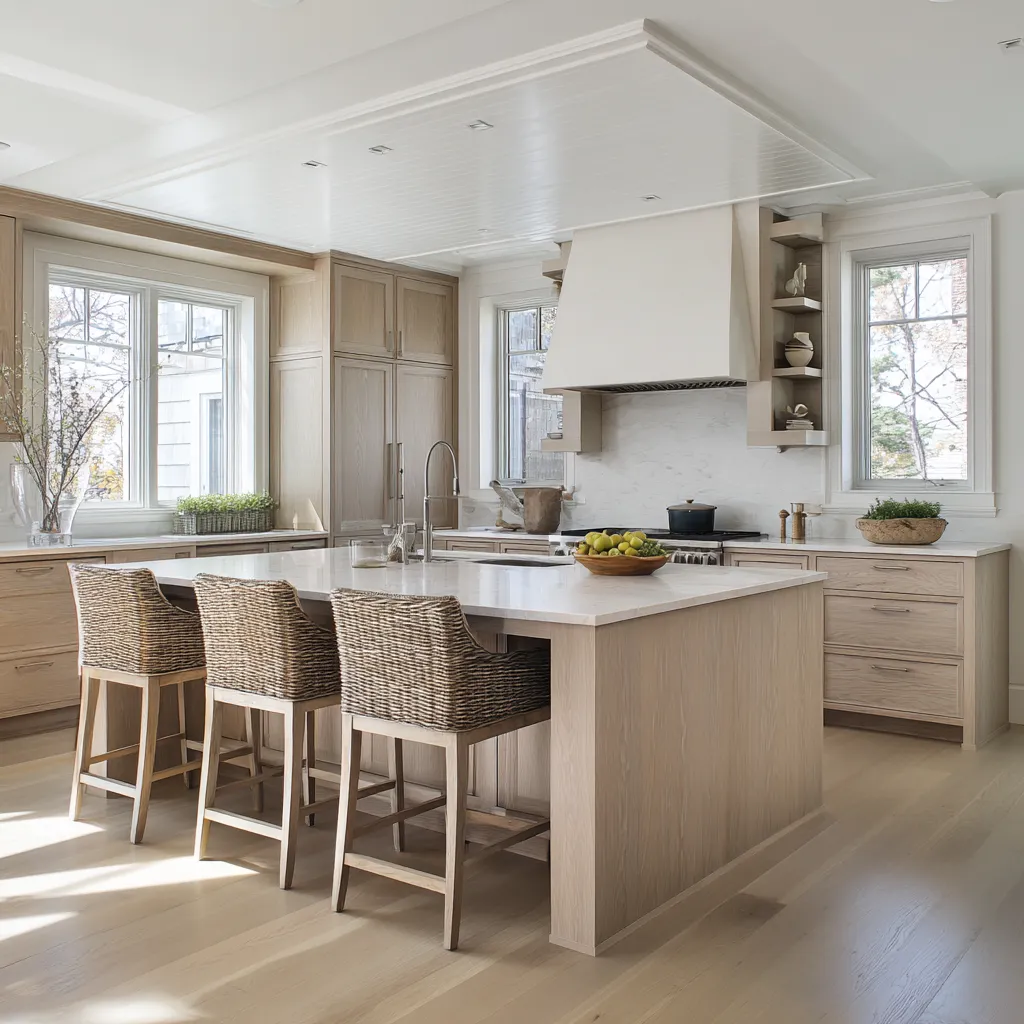
In a modern Cape Cod kitchen, daylight is given structure. It is framed by thick window casing.
It moves over pale but not empty surfaces. It lands on wood that has been desaturated enough to feel sun-softened rather than heavy.
It touches stone that reflects and diffuses light instead of turning into a dramatic luxury statement. It is held inside a room with enough trim, ceiling character, hood mass, or wall rhythm to keep the brightness from dissolving the architecture.

That is a crucial distinction. A room can be flooded with light and still feel generic.
It begins to feel Cape Cod when the light belongs to a house with bones. This is why framed openings matter so much.
Thick trim, crown, beadboard ceilings, exposed rafters, planked surfaces, arches, alcoves, and paneled hood forms all give the light something to work against. They make the room feel shaped rather than washed out.
In many of the strongest kitchens, the brightness is not the star. The star is the disciplined way brightness meets structure.

A modern move works only after the design proves it belongs to a house
This may be an useful design idea in this style. A waterfall peninsula, suspended box hood, linear brass pendant, slab backsplash, or monolithic island can all work beautifully in a Cape Cod kitchen.
But these moves do not become Cape Cod because they are softened with a coastal palette. They become Cape Cod because they are inserted into a room that already carries house evidence.

That evidence may come from a planked ceiling, painted millwork, a roof shape visible from the kitchen, a chimney-like hood body, a banquette tucked into a bay, or simply the thick framing of windows and doorways. Without that foundation, the same modern gestures start to drift toward generic high-end contemporary design.

So the interior design needs to establish its lineage first. Once that is clear, one current move can lift the whole kitchen into the present.
One move is often enough. In fact, one decisive modern act is frequently stronger than a room filled with repeated gestures trying too hard to look current.
A pale oak kitchen with a single slab range wall can work. A painted kitchen with one long linear pendant can work.
A beadboard-ceiling room with a crisp waterfall peninsula can work. The modern gesture succeeds because the room already feels house-rooted before the gesture enters.
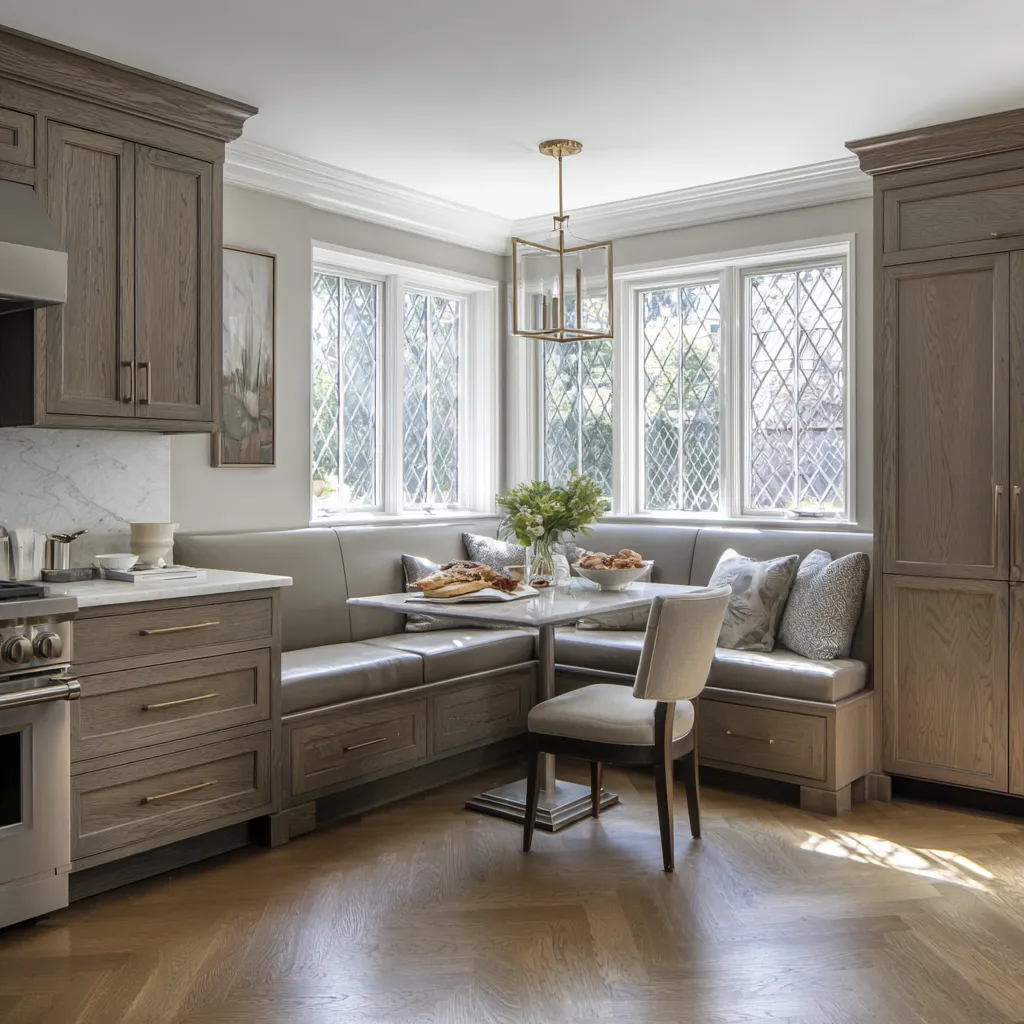
Wood carries freshness
For years, coastal kitchens leaned heavily on painted white cabinetry, with wood often limited to the floor or a stool seat. In newer Cape Cod kitchen ideas, wood can no longer be confined to supporting roles.
It can become the main field that modernizes the room. The key is the kind of wood being used.
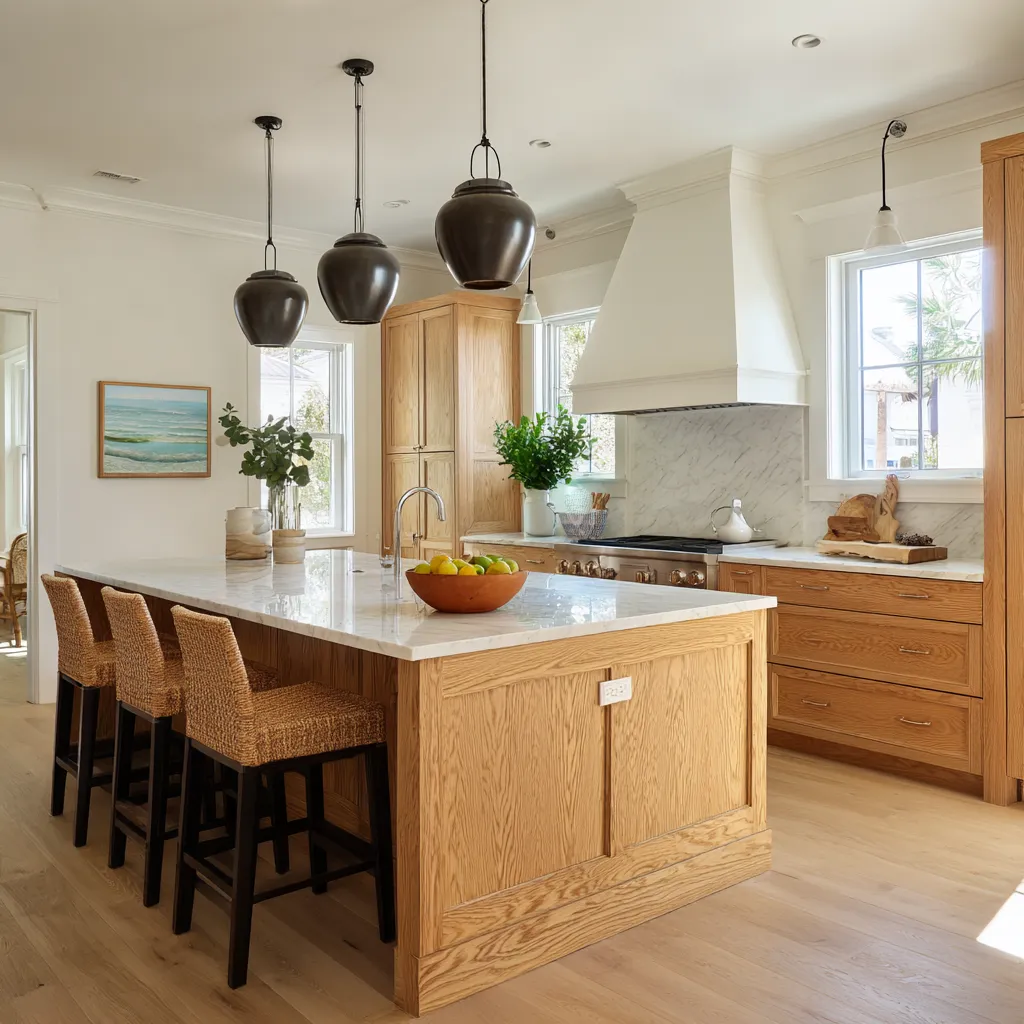
Effective-looking versions are pale oak, limed oak, cerused finishes, muted smoked oak, or warm white oak with a softened grain. These finishes hold warmth without pushing the kitchen into rustic territory.
They avoid orange undertones, glossy surfaces, strong red cast, and heavy knotty character. Their job is to suggest wood that has lived in daylight and salt air, not wood trying to show off its richness.

That shift matters because wood solves a problem that all-white kitchens often struggle with. White can make a room bright, but it can also flatten it.
Desaturated wood gives a Cape Cod kitchen texture, age association, and household warmth while still keeping the room current. It creates a stronger relationship between kitchen and house.
The cabinetry feels less like a fitted system from a showroom and more like part of the architecture.
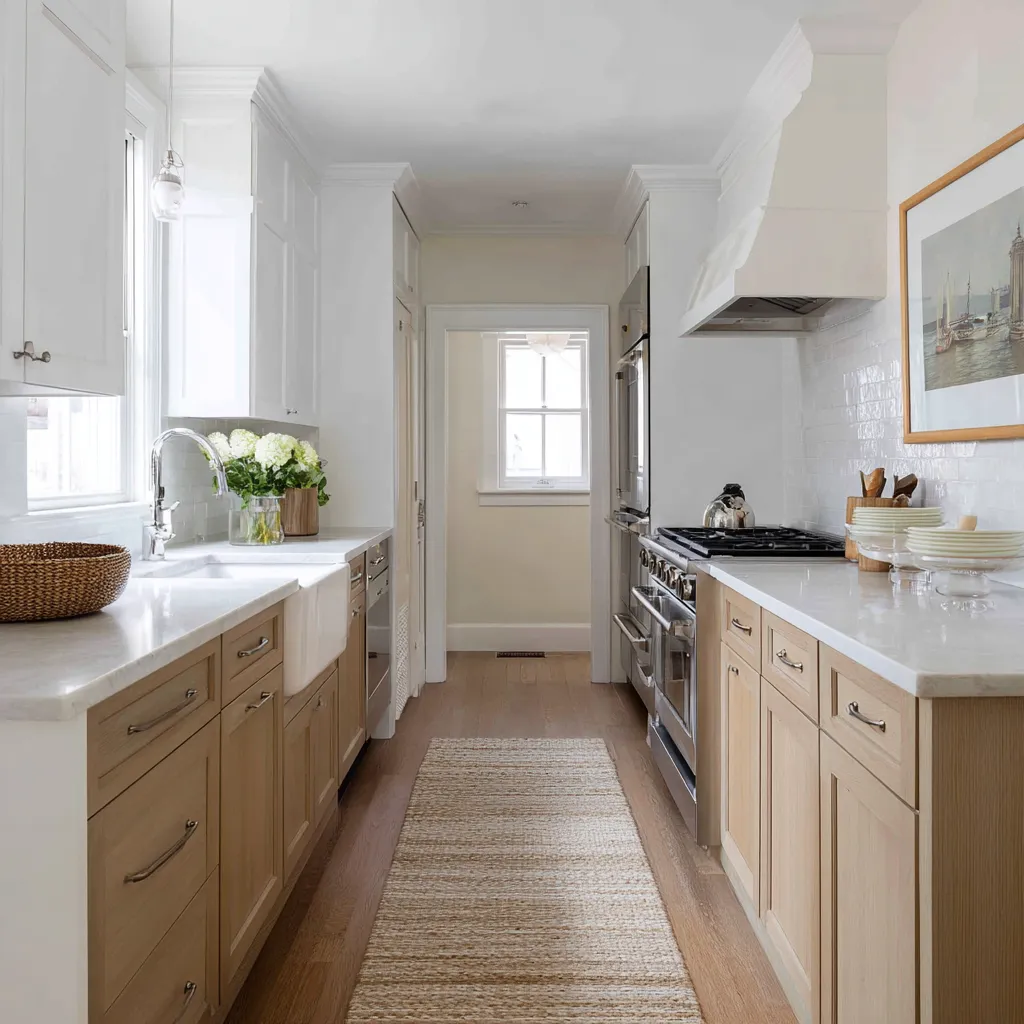
There is also a compositional reason wood works well here. In rooms with pale stone, warm neutral walls, and strong daylight, muted wood gives the eye a stable middle tone.
It prevents the kitchen from breaking into hard contrast while still giving it substance. That is why wood often feels fresher than white paint rather than heavier than white paint.

Stone matters
Stone plays a double role in modern Cape Cod kitchen designs. On one hand, it brings gravity.
It can make an interior design feel resolved, architectural, and fully composed. A slab backsplash behind the range, a waterfall peninsula, a full-height mineral wall, or a generous island top can give the kitchen a strong present-day anchor.
These are often the elements that make the room feel more designed and less ordinary.

On the other hand, stone can pull the design away from Cape Cod if it takes over the composition without support from the house shell. Too much stone, especially if it is dramatic, dark, or deployed on every major surface, can move the room toward urban luxury or broad upscale transitional language.
The kitchen loses some of its house-based ease and starts feeling like a display object.

The solution is not to avoid stone. The solution is to let stone act as an anchor rather than a takeover.
One main mineral event is often enough. That might be a full-height backsplash, a waterfall island, or a hood wall with strong surface continuity.
Once the design has its mineral center, the rest of the kitchen can stay quieter. The stone itself also matters.
Stylish Cape Cod ideas tend to use mineral surfaces with softened veining, warm cream or sand undertones, low-drama movement, or layered texture rather than sharp, theatrical contrast. The stone should hold light and depth, not demand constant attention.

The room has to support staying
A great deal of modern Cape Cod character comes from social credibility. Many of the kitchen designs that feel current are not specifically compact or efficient.
They are designs with a legible center for staying: a long island that behaves like a table, a breakfast booth under windows, a banquette in a bay, an attached dining surface, or a kitchen-family room relationship that makes lingering feel natural. That does not mean every Cape Cod kitchen needs a giant island.
It means the room should feel prepared for actual household life. Someone should be able to drink coffee there, sit while another person cooks, spread out homework, talk at the counter, or gather near a window.
The style grows stronger when the kitchen behaves like a lived room rather than a technical workspace.

This is one reason breakfast zones are powerful in Cape Cod houses. A booth, banquette, or built-in bench introduces family intimacy and gives the room a more rooted rhythm.
It makes the kitchen feel specific to a house rather than interchangeable with any other open-plan renovation. There is a trade-off, of course.
Built-in eating zones are less universal because they need the right footprint and window geometry. But when the room can support them, they add unusual depth.
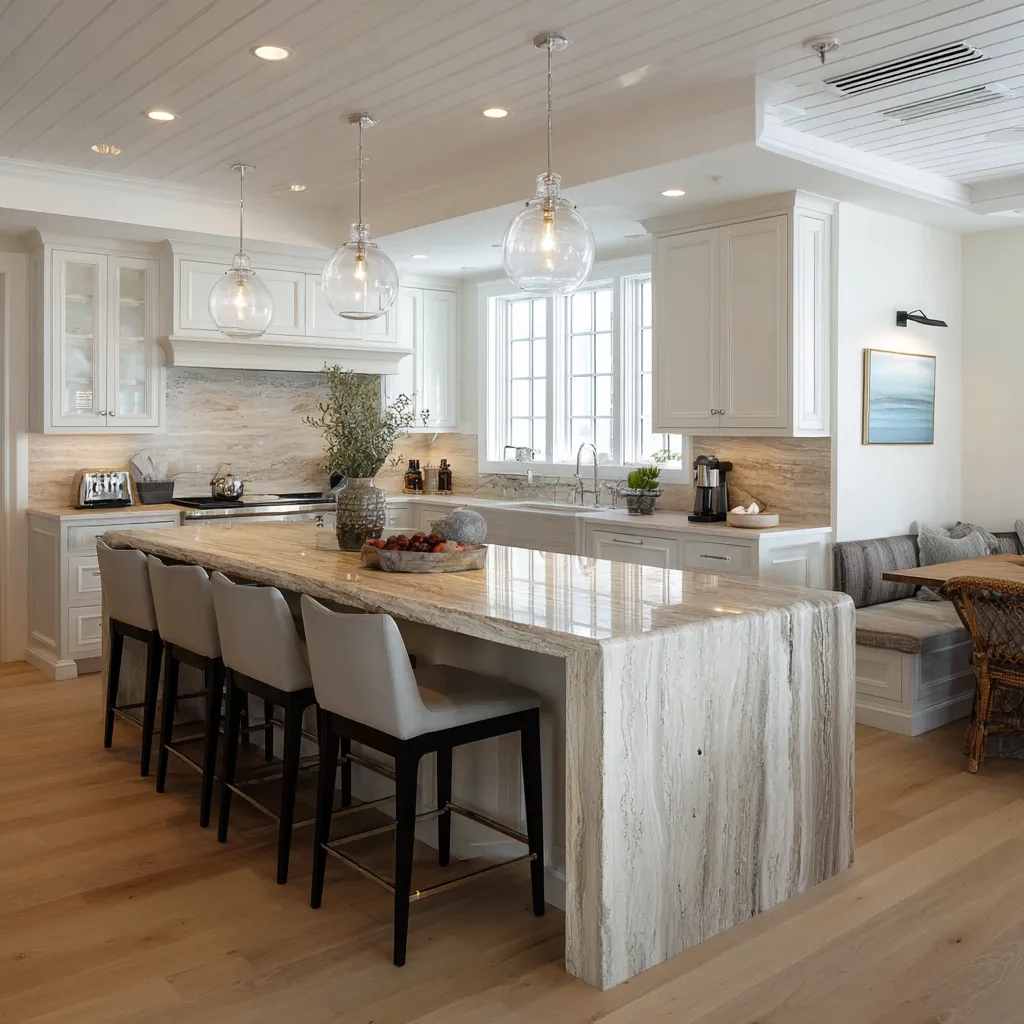
Even the island needs to behave socially. Strong islands in this style do not feel like hard sculptural blocks placed for visual effect alone.
They have enough warmth, seating comfort, and proportion to feel inhabited. Upholstered stools, woven seating, soft edges, or wood cladding often help the island cross from work surface into social core.

Small kitchens and large kitchens should not chase the same formula
This is where many kitchens lose their footing. The modern Cape Cod kitchen has two very different success patterns depending on size.

In compact kitchens, the style becomes clearer through discipline
A smaller Cape Cod kitchen can succeed through:
- galley or U-shaped efficiency
- a sink under a well-framed window
- pale surface continuity
- modest texture
- refined trim
- low visual clutter
- one restrained contemporary touch rather than several
These designs often feel convincing because compact planning suits the domestic modesty historically tied to the style. They do not need spectacle.
Their strength comes from clarity, proportion, and a sense that every inch belongs to household life. In these kitchen designs, chasing a large island-centered open-plan formula can do damage.
It can crowd circulation, weaken the room’s identity, and push the space toward an awkward version of a bigger kitchen type.

In larger kitchens, the room needs stronger architecture
A larger Cape Cod kitchen cannot rely on brightness alone because the scale will wash it out. It needs stronger architectural containment.
That can come from:
- a beadboard ceiling or ceiling inset
- exposed rafters or beam grids
- a major hood mass
- a framed arch into a family room
- a substantial island
- a clear range wall
- room-to-room transitions that still feel like rooms
Large kitchens become convincing when they recover some sense of roomhood. Otherwise they risk turning into generic open luxury spaces with coastal styling layered on top.

Texture and geometry need hierarchy
One of the more subtle tensions in modern Cape Cod kitchens is the relationship between tactile coastal craft and sharper contemporary form. Woven stools, limed grain, fluted island bases, plank ceilings, baskets, cane, rush, and fiber pendants all support the Cape Cod side of the room.
Suspended box hoods, waterfall edges, long linear pendants, and simplified monolithic masses support the present-day side. Both can appear in the same kitchen, but they should not usually fight for dominance at equal volume.
One should lead and the other should support.

If the room is highly textural, the modern geometry should stay edited and singular. If the room has a stronger geometric contemporary move, the tactile elements should appear as relief rather than as a second competing system.
This keeps the kitchen from feeling overworked. That is why one woven pendant can be enough.
One fluted island face can be enough. One dark pendant series can be enough.
The room does not need every available device.

Contrast works best as punctuation
Modern Cape Cod kitchens usually hold together through tonal softness: warm whites, pale oak, muted stone, sand, cream, and softened mineral gray. Contrast can help, but it works best in short, controlled bursts.
A stainless hood can sharpen a pale painted kitchen. Dark muntins can give definition to a room that risks becoming too diffused.
A set of dark pendants can energize warm oak cabinetry and pale walls. Brass fittings can add precision to a restrained envelope.

But once contrast becomes the main language rather than a small accent, the balance starts shifting. The kitchen becomes more graphic and less atmospheric.
It can begin to feel urban, sharper, or less connected to the softened coastal-house mood that makes Cape Cod distinctive. So contrast should behave like punctuation in a sentence.
It gives emphasis, direction, and rhythm. It should not replace the sentence itself.

The style weakens when it tries too hard to look coastal
Too many direct costal signals often weaken the room. A single seascape can work.
A woven fixture can work. A fiber runner or one marine-colored note can work.
But once the room starts distributing shells, stripes, nautical objects, rope references, navy accents, and themed accessories everywhere, the architecture loses authority. The room begins explaining itself too much.
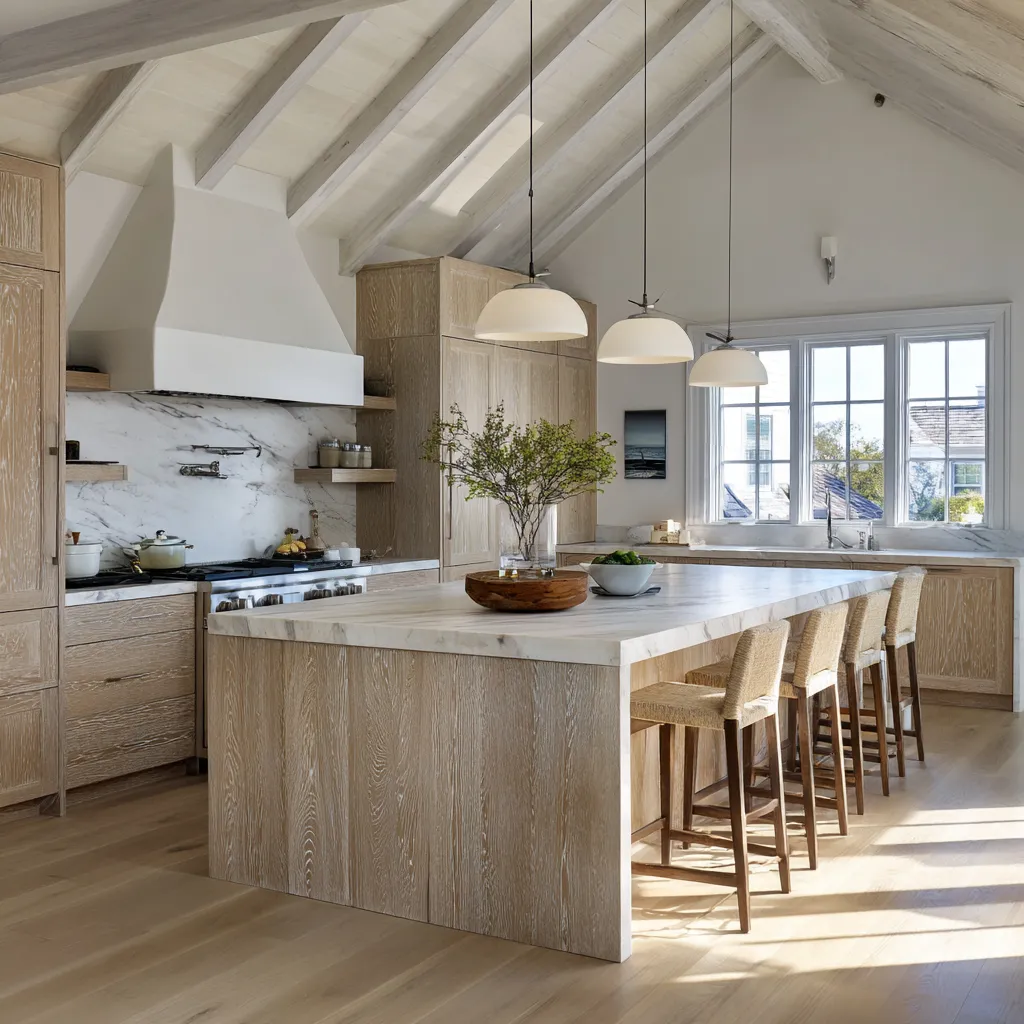
The style has greater depth when the coastal note is compressed. Let the house do the speaking.
Let the windows, wood, trim, hood mass, and pale stone establish the setting. Let one or two carefully placed cues confirm it.
That creates a kitchen that feels tied to place rather than decorated for a theme.
What a modern Cape Cod kitchen is trying to preserve
At its core, this style is preserving something very specific: the feeling that the kitchen belongs to a settled house where light, weather, family use, and architectural memory have shaped the room over time. Modernization does not erase that condition.
It clarifies it. That is why the convincing kitchen ideas are rarely the whitest, the most decorated, or the most overtly coastal.
They are the ones where present-day form and house memory reinforce each other. The room feels cleaner, more composed, and more current, yet it still feels like a kitchen that could only belong to this kind of house.
A good modern Cape Cod kitchen design does not ask you to admire a coast-themed set. It asks you to notice how a real domestic room can become lighter, warmer, and more exact in its proportions without losing its inheritance.