Rustic Scandinavian interiors tend to get flattened into a simple formula: pale walls, soft upholstery, wood beams, neutral textiles, maybe a stone fireplace. That surface description misses what makes the style feel so satisfying.
The look works well not because it piles together rustic materials and Nordic restraint, but because it assigns each part of the room a clear role. A rustic Scandinavian interior design usually does five things at once.
It gives the space one or two elements with real weight. It keeps the seating layer soft and human.
It compresses the palette so texture becomes visible. It protects some openness, even in rooms that feel sheltered.
And it lets decoration finish the room instead of carrying the whole identity.
That is why the style can move from a soft suburban family room to a mountain-type house with a stone chimney, from a paneled attic sitting room to a plaster-heavy room with deep arches, and still feel related. The ingredients change.
The balancing act stays. This matters a great deal.
Most people are not starting with an old Nordic farmhouse shell. They are working with suburban living rooms, builder-grade fireplaces, standard drywall, medium-height ceilings, wide-open family rooms, or transitional architecture with little built-in character.
Rustic Scandinavian design can work beautifully in those conditions, but only if the deeper structure of the style is understood.
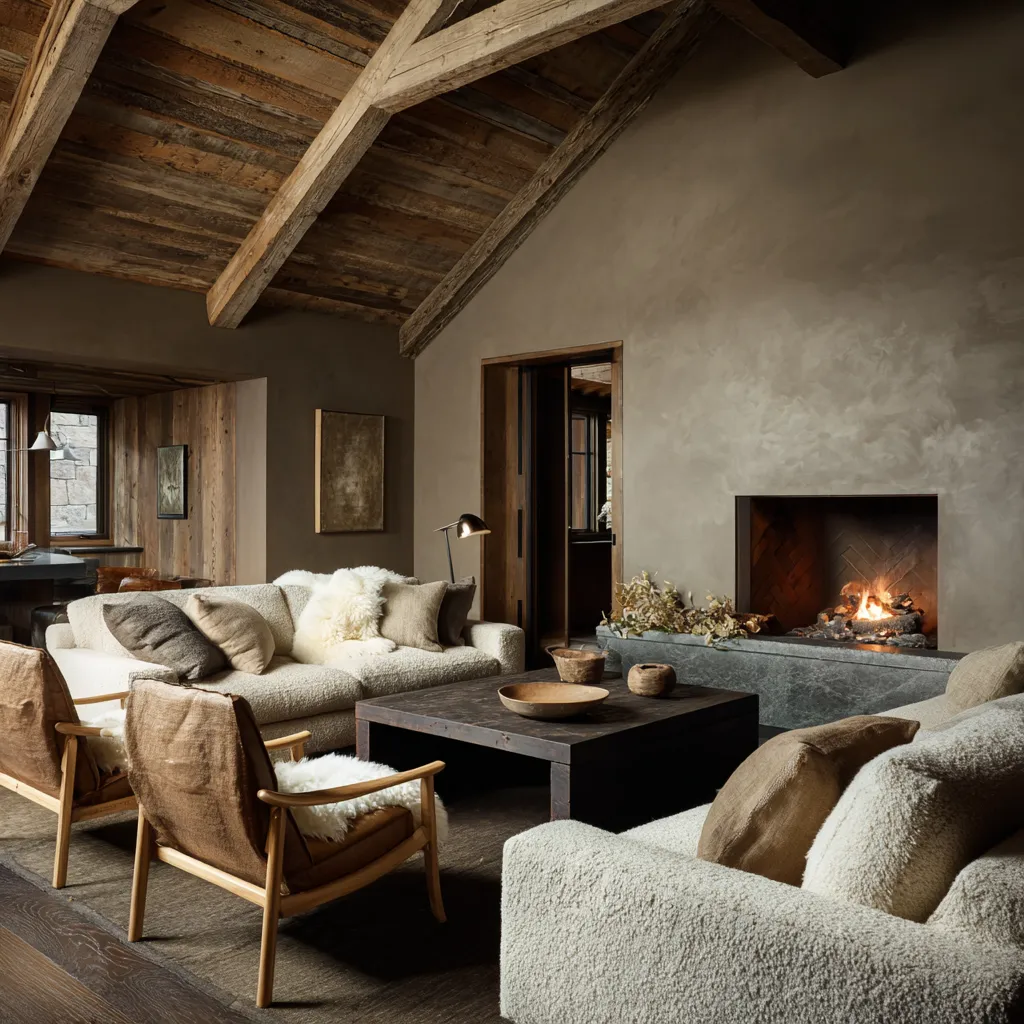
The first principle: keep the weight concentrated
One of the mistakes in rustic interiors is spreading rusticity everywhere. A rough beam ceiling, a stone fireplace, reclaimed tables, baskets, chunky shelves, heavy pottery, dark wood floors, distressed cabinets, and layered rustic accessories can all look appealing in isolation, but together they often flatten the room.
Instead of depth, the result is visual sameness. Instead of atmosphere, the result is a room working too hard.
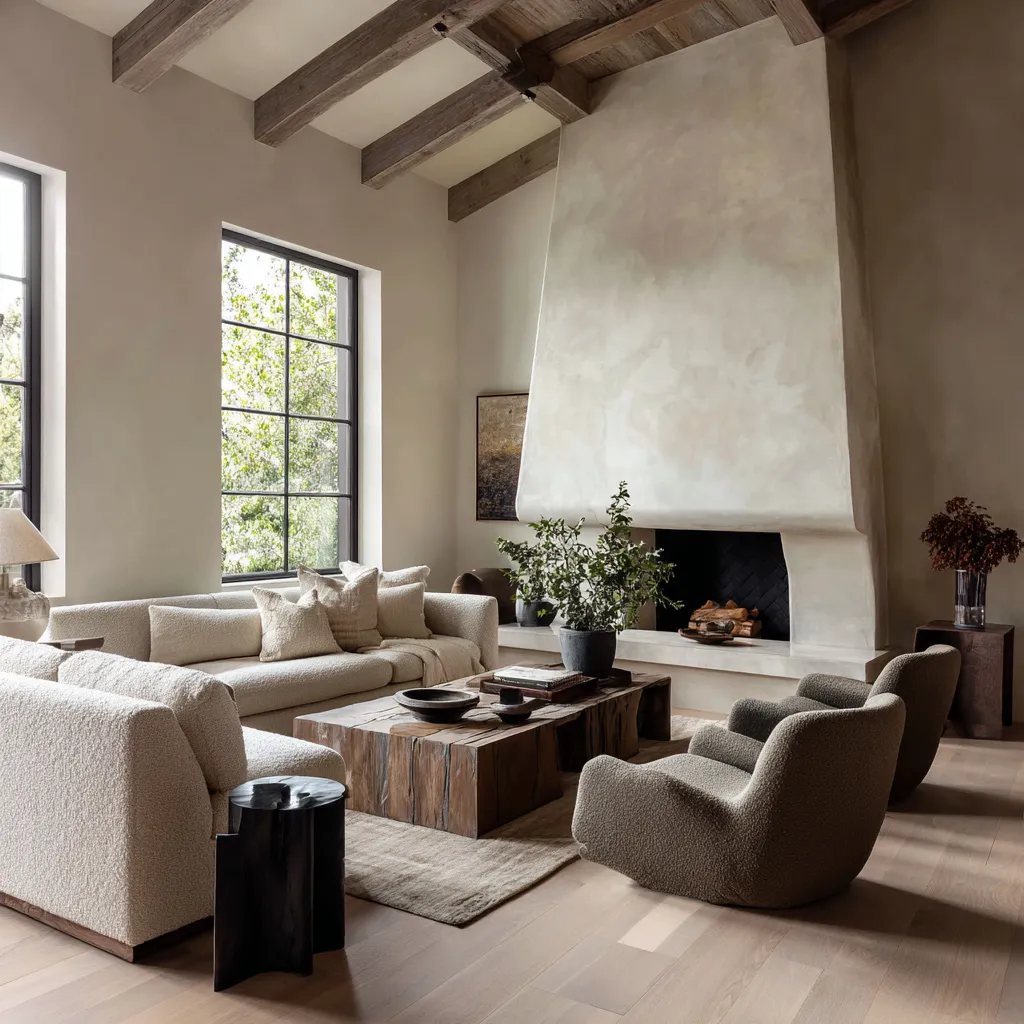
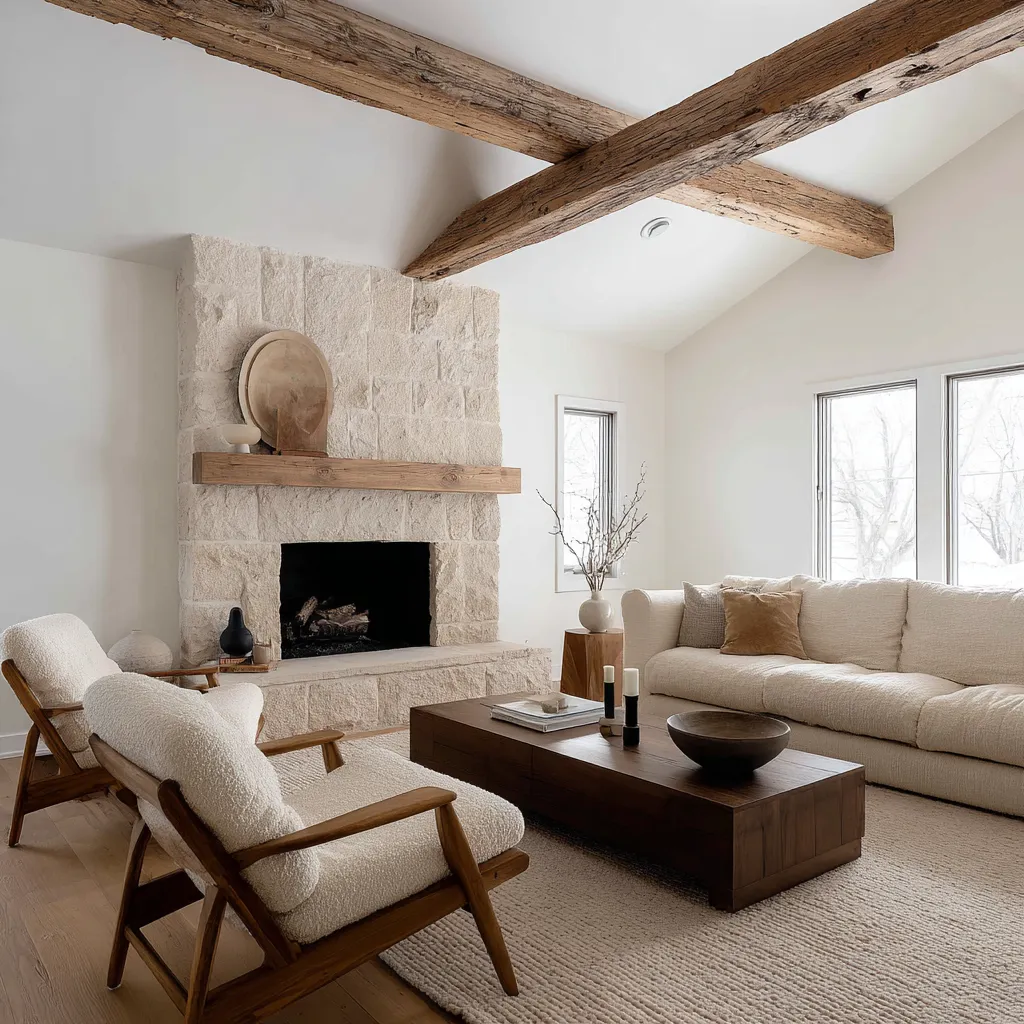
Rustic Scandinavian interior designs are usually better when the weight is concentrated. That weight might live in a plaster hood, one stone wall, a recessed timber niche, a full pale wood shell, a single rough-hewn table, a dark hearth mass, or a set of old beams overhead.
The rest of the room can then soften, lighten, or open around that feature. This is one of the ways to keep a room rustic without making it oppressive.
A room does not need ten heavy elements. It needs one serious anchor, or two at most, and then a supporting cast that knows when to step back.
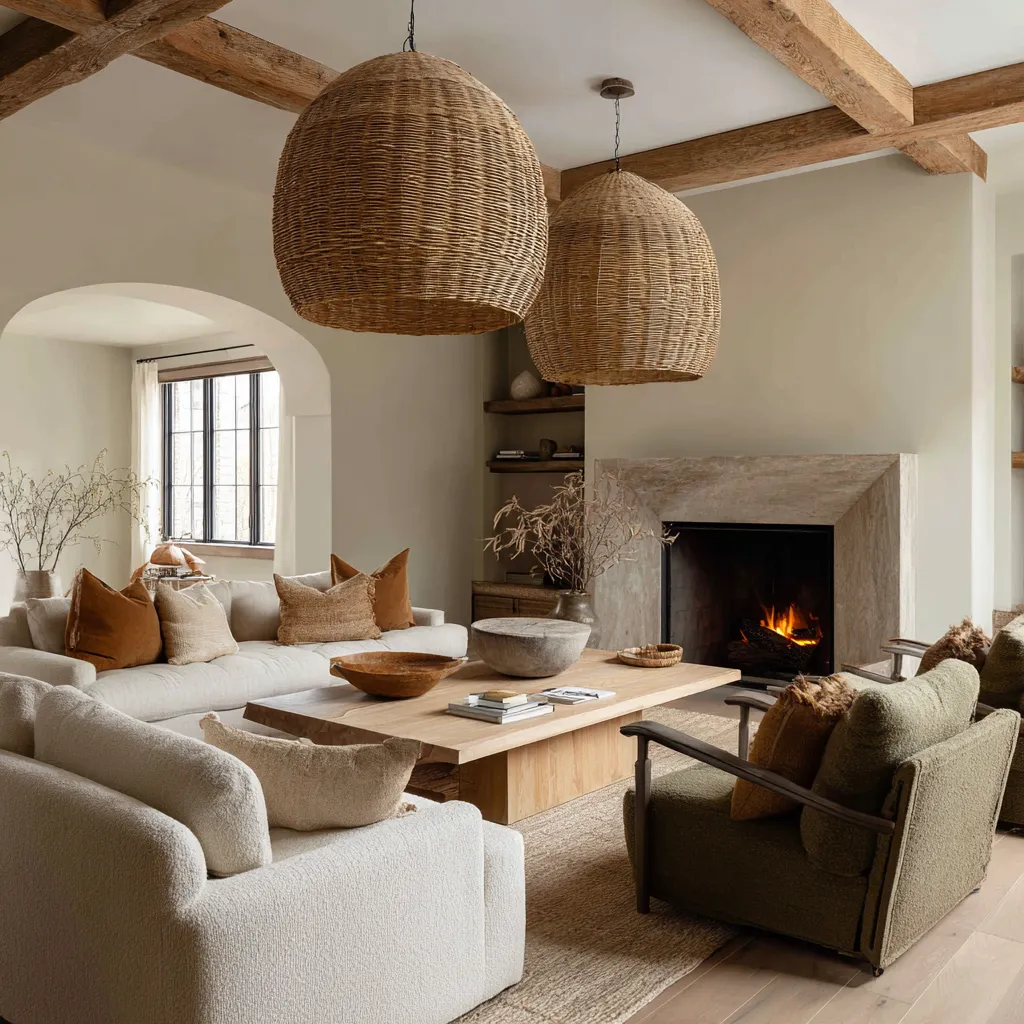
In a suburban living room, that might mean choosing one of the following:
- A rough plaster fireplace wall in a pale clay tone, with the rest of the walls left simple.
- A blocky wood coffee table with genuine mass, while the seating stays pale and broad.
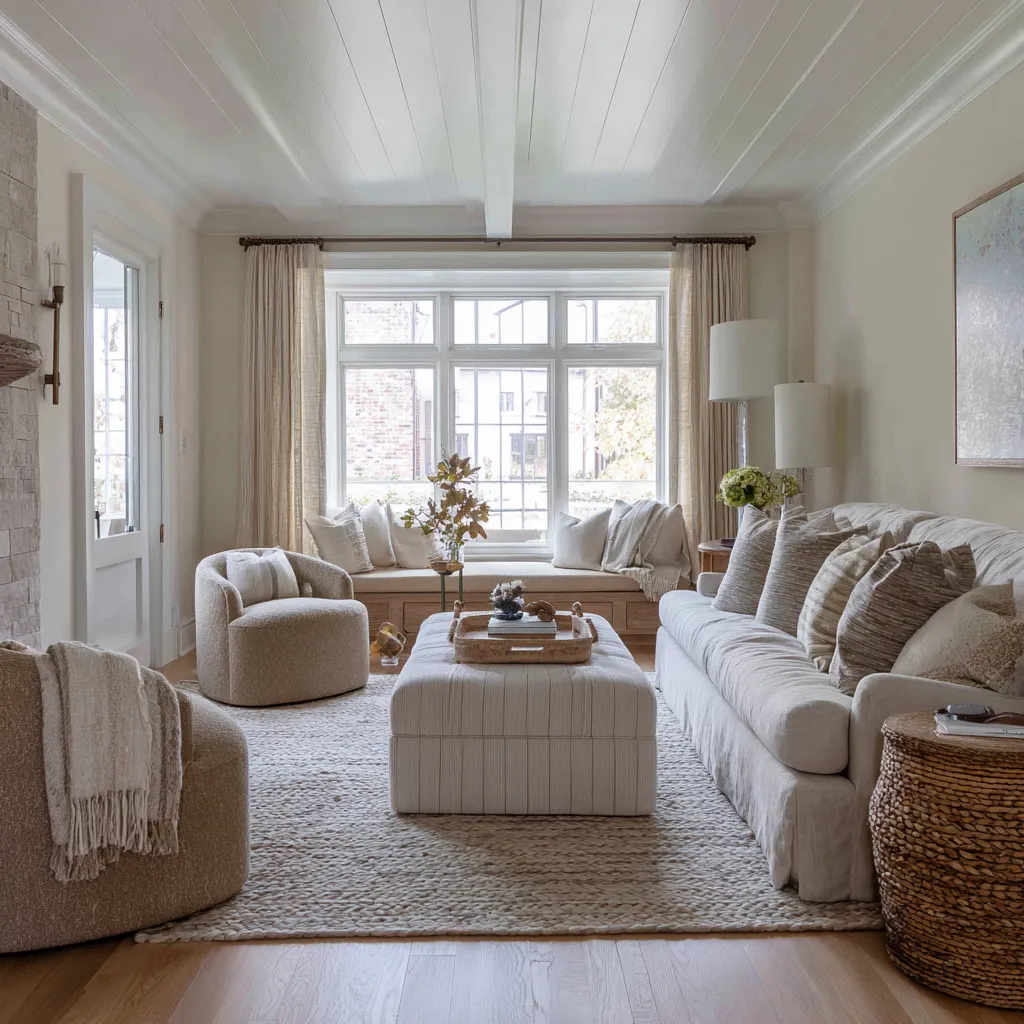
- A painted plank or coffered ceiling that adds memory overhead, while everything below remains soft and open.
- A built-in window bench or alcove that gives one side of the room shelter and character.
- A single dark stone or soapstone-like hearth volume in an otherwise light shell.
The common thread is concentration. The room becomes far more persuasive when one area carries the gravity instead of asking every surface to do it.
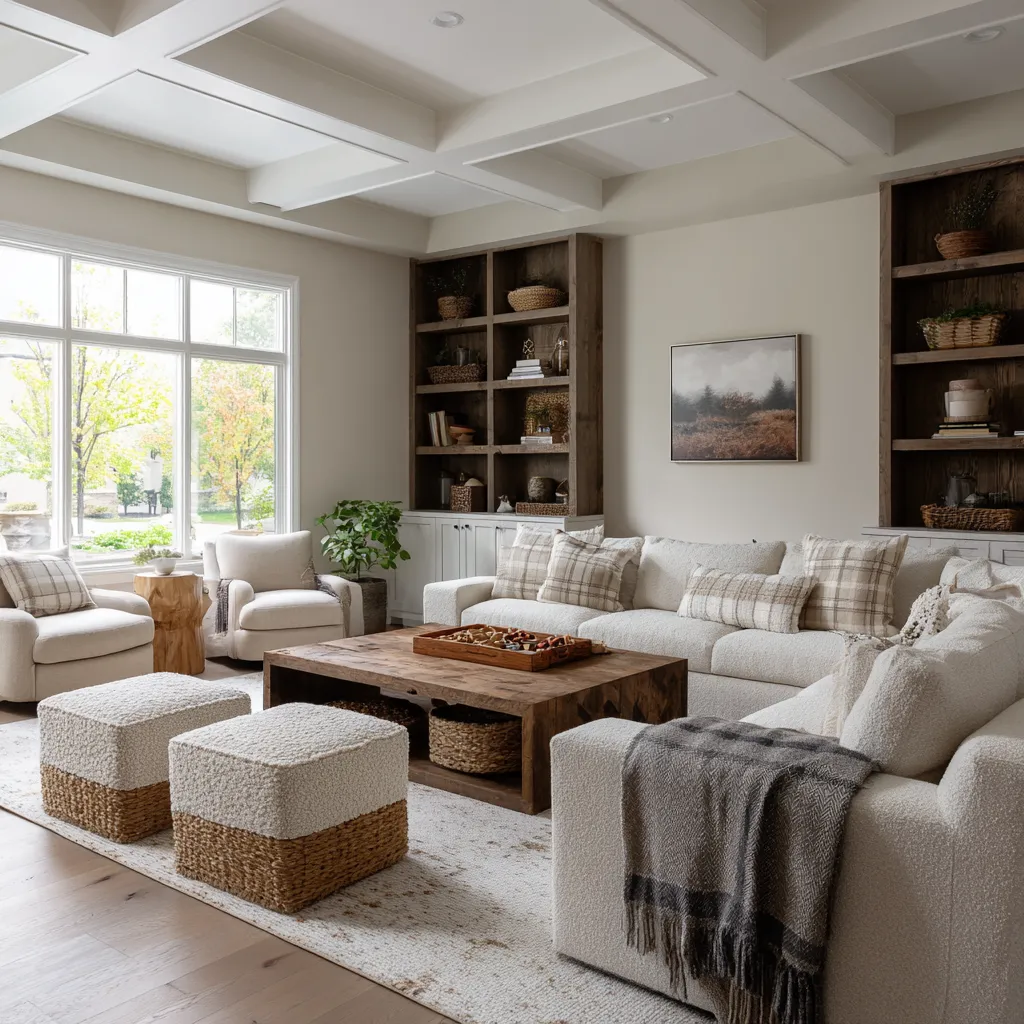
Warmth is created by shelter, not by warm color alone
Many rooms that try to look cozy rely too heavily on color. They lean on caramel, rust, tan, cognac, ochre, and layered browns and expect warmth to appear.
Sometimes it does. Often it does not.
Rustic Scandinavian warmth usually comes from something less obvious: shelter. A room feels warm when it suggests protection.
That can happen through a lower beam canopy, a recessed niche, a built-in bench under a window, a cocooning timber envelope, a deep fireplace wall, thick plaster openings, full drapery, or a seating plan that wraps inward rather than scattering outward.
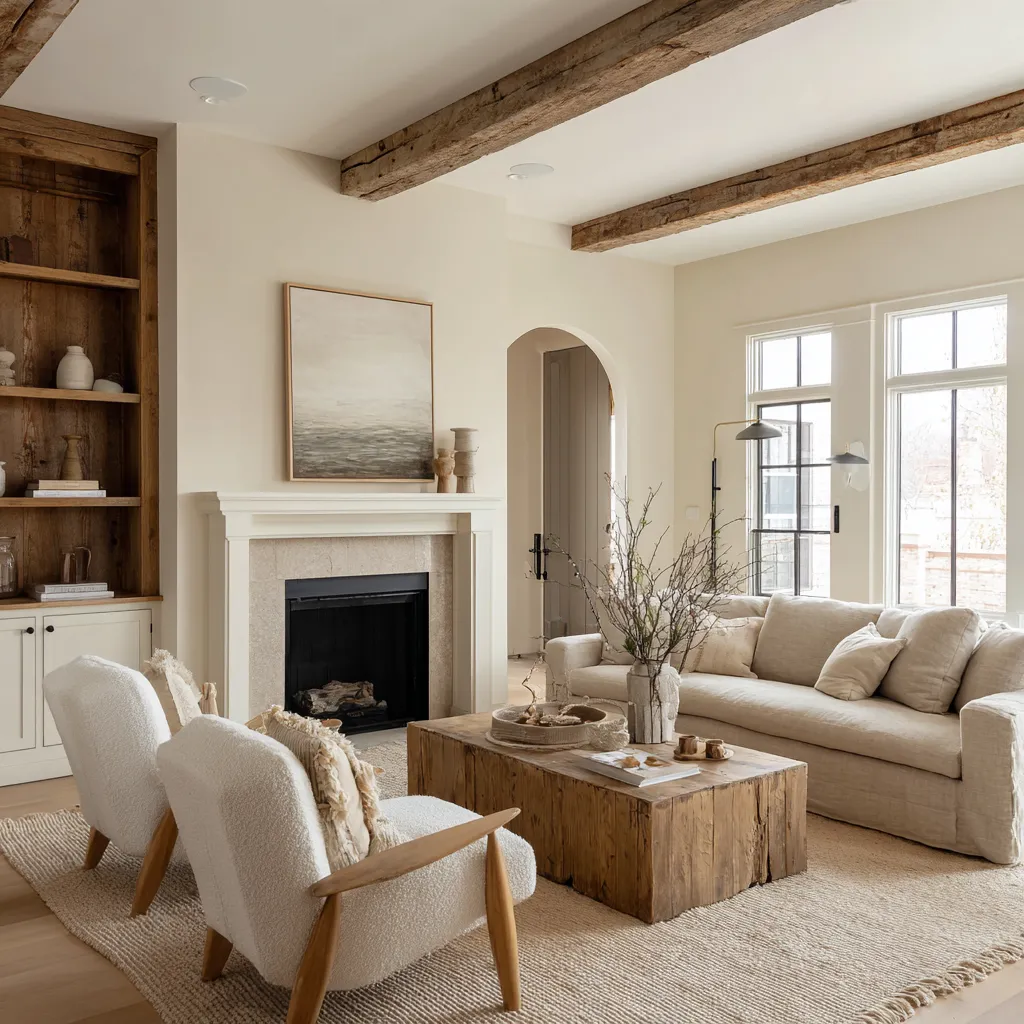
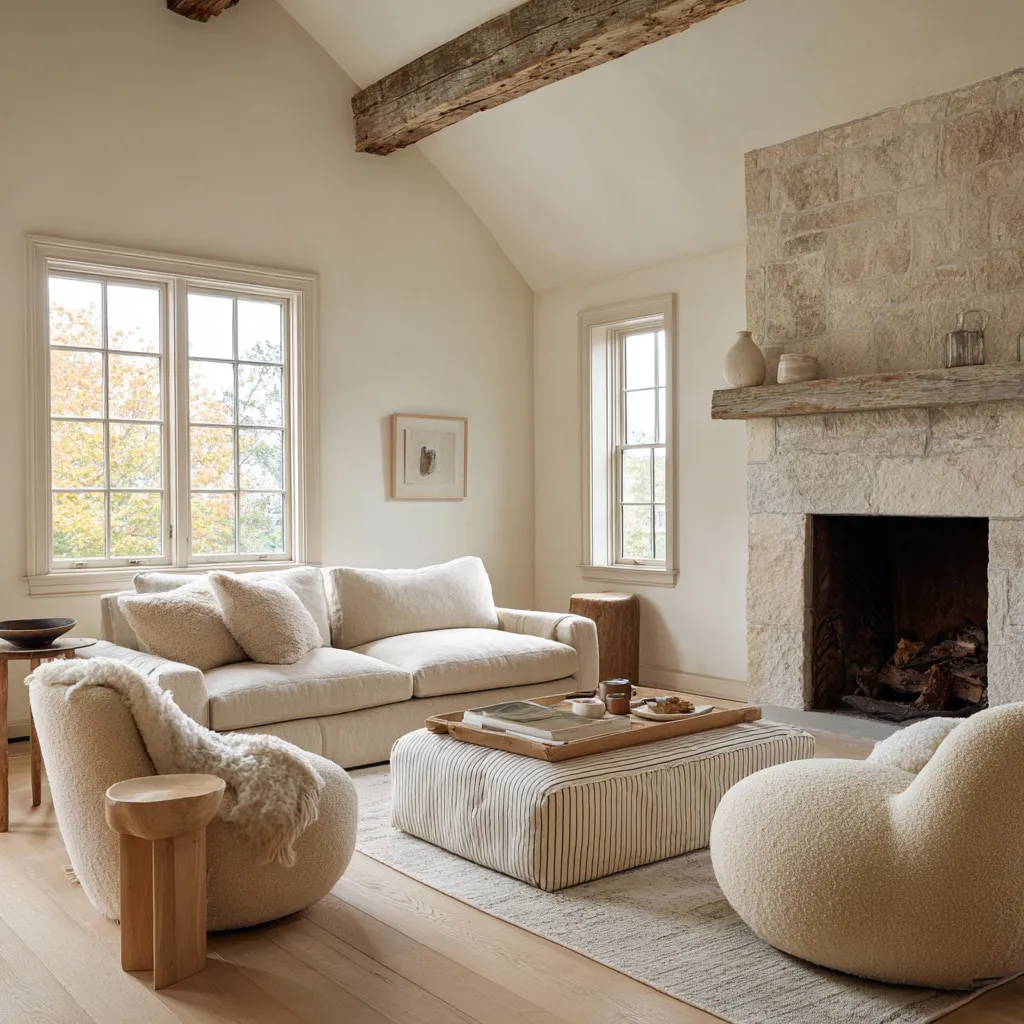
Soft textiles then reinforce that sheltered condition. A broad linen sofa, an upholstered ottoman, boucle or sheepskin on a chair, a woven rug with actual body, and drapery that diffuses daylight all make the body feel invited into the room.
The palette can stay restrained, even pale, and still feel warm because the room is holding you instead of merely showing you color. This is why some pale rustic Scandinavian rooms feel warmer than darker ones.
They are better at enclosure. They reduce friction between surfaces.
They create a softer transition from wall to floor to furniture. They do not depend on strong chromatic contrast to deliver comfort.
This is useful because shelter can be built in many ways even when the shell is ordinary. A window seat at the far wall, a heavier rug field under the seating group, fuller drapery, a lower wood beam detail over the main conversation zone, or a deeper fireplace surround can often change the emotional temperature of the room more effectively than adding stronger color.
Airiness does not require stripping the room bare
Another common misunderstanding is that Scandinavian influence requires a room to become visually thin. That often leads to spaces that are pale but not generous, minimal but not welcoming.
Airiness in rustic Scandinavian interiors usually comes from openness, but also from how that openness is shaped. The room needs release points.
That might mean broad glazing, a tall window field, visible floor perimeter, lower furniture profiles, pale ceiling fields between beams, or strong wall planes left largely uninterrupted. The useful twist is this: architectural definition can increase airiness when it is handled well.
A shaped plaster wall, a tall mullioned window, a monolithic but pale chimney breast, a vaulted ceiling, or a deep arched recess can all help a room feel larger and more memorable. The room becomes airy not because nothing is there, but because the major forms are clear and the transitions between them are smooth.
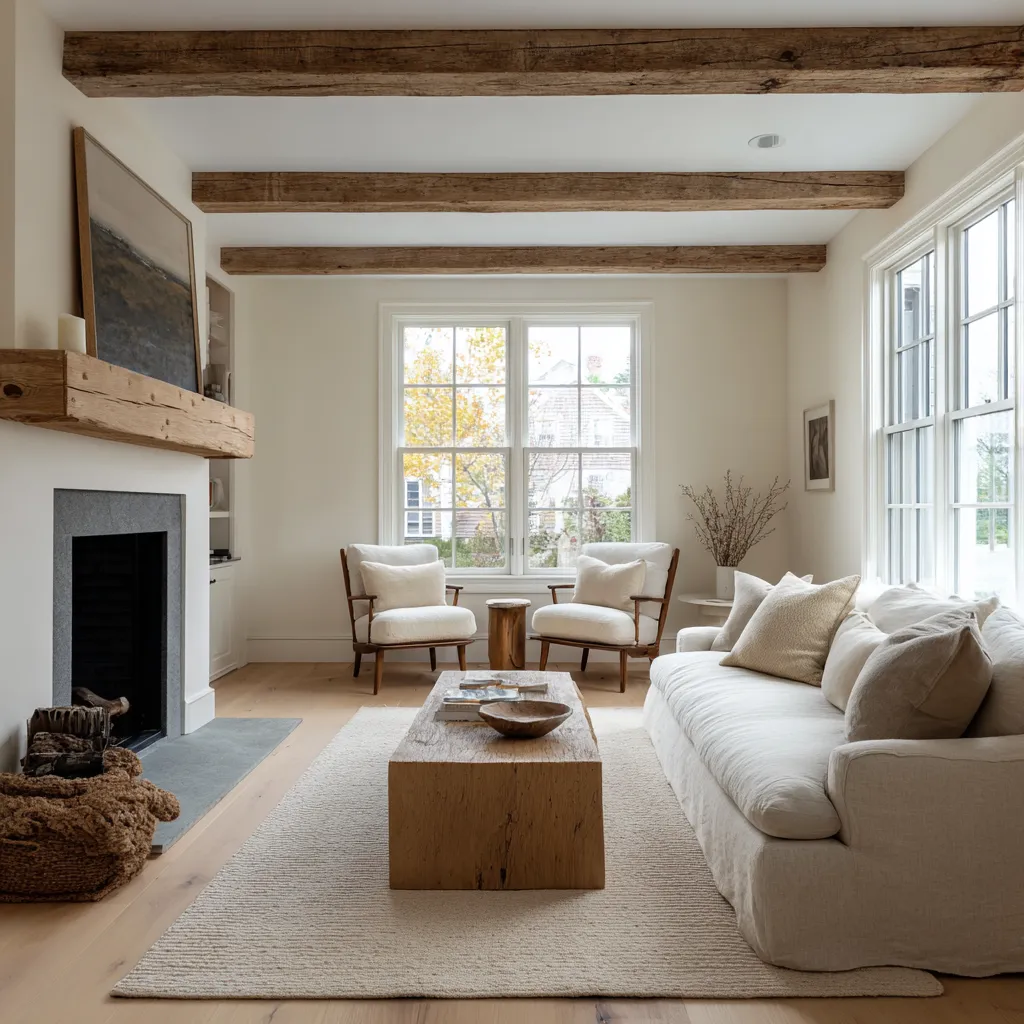
Timber is where many rooms go wrong. Heavy wood overhead or on the walls can compress the room quickly.
That does not mean timber should be avoided. It means timber needs compensation.
If the ceiling has serious beams, the furniture below should stay low and broad. If the room is wrapped in pale planks, the center should often soften rather than introducing another hard-edged timber object.
If there is a large rustic mantel, the surrounding wall may need to remain lighter and less worked. This is important in homes with standard ceiling heights.
A dramatic beam grid that looks good in a tall mountain room can feel oppressive in an eight-foot suburban family room. In that setting, painted plank ceilings, lighter beam tones, or one selective timber line often work far better than dense dark structure.
Depth comes from sequence, not from crowding
A lot of living rooms have width but not depth. They feel flat because everything is presented at once.
Sofa, coffee table, TV or fireplace, maybe two chairs. The eye lands, registers the arrangement, and stops.
Rustic Scandinavian rooms often feel deeper because they give the eye a route. There is usually an anchor and a continuation point.
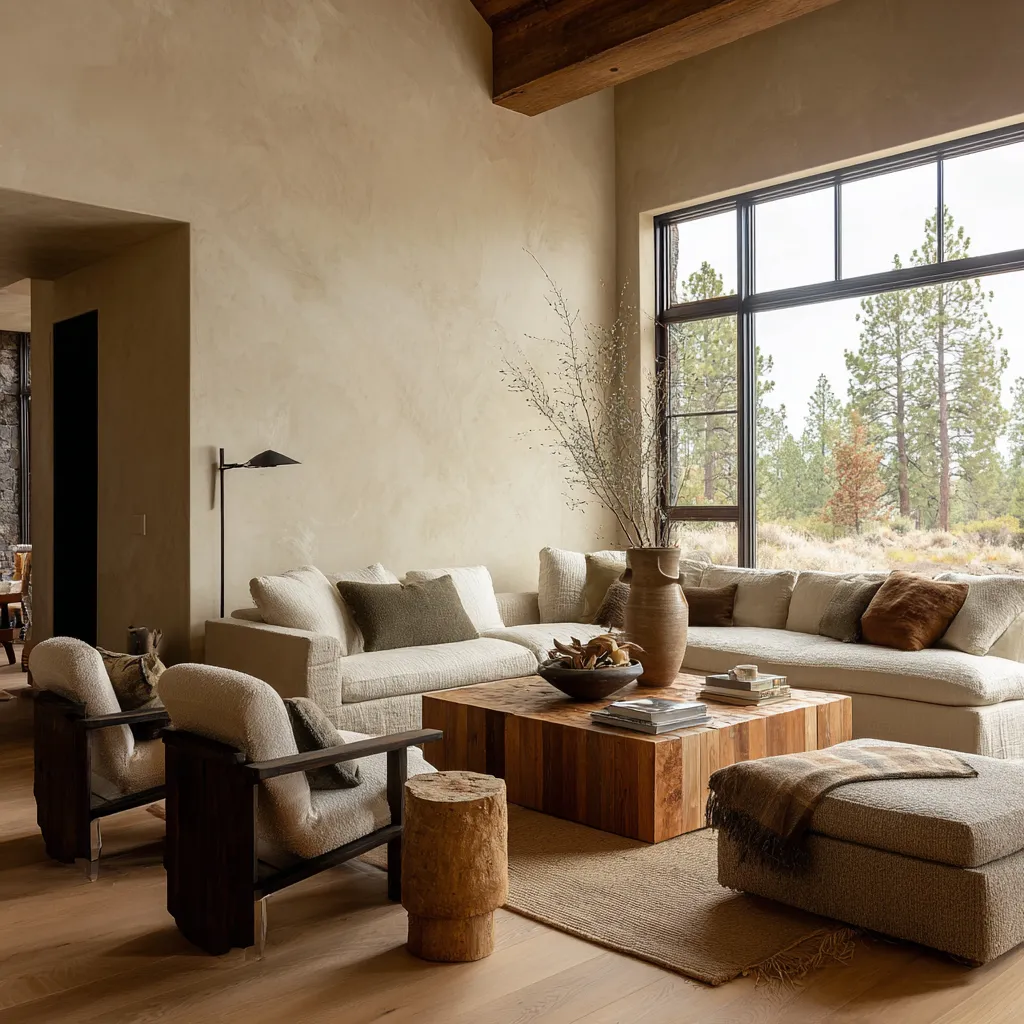
That continuation point might be a window seat beyond the main seating group, a tall glazed wall, a secondary pair of chairs at the far end, an arched opening into another zone, a deep shelving bay, or a distant hearth seen past a central table. Depth grows when the room offers both a place of pause and a place beyond.
This is one of the ideas for homes, especially builder-grade plans where the main room can feel broad but spatially shallow. It can be improved without major renovation by thinking in sequence rather than decoration.
A heavy center table can create the first pause. A bench under the far window can become the second.
Or the fireplace can be the first anchor while the window wall becomes the release. Or a dark shelving bay can hold one end while pale seating opens toward the other.
Once the eye has a route, the room feels larger, richer, and less generic. Depth is rarely created by adding more objects.
It is more often created by giving existing elements clearer jobs.
Two rustic Scandinavian paths
In practice, rustic Scandinavian interiors often fall into two broad branches.
- The first is the architecture-led version. This is the room with a major plaster hood, a full stone chimney, an enveloping timber shell, a strong beam field, or large carved openings. It has high identity. It often feels atmospheric from the moment you walk in. It can be deeply memorable. But it also asks more from the house itself. Without the right shell, this branch can be hard to copy well.
- The second is the family-soft version. This is the more portable branch. It depends less on rare architecture and more on broad seating, textile density, painted carpentry, woven texture, edited neutrals, one solid center anchor, and careful subtraction. It lives comfortably in suburban family rooms, renovated colonials, new builds, and transitional envelopes.
Neither path is better. They simply solve different conditions.
The first path suits homes with genuine architectural volume or owners ready to make major shell decisions. The second path suits people who want the atmosphere without rebuilding the house.
The mistake is trying to imitate the first path with decorative shortcuts. A room without a monumental chimney does not need fake monumentality.
It needs a different approach: quieter shell, stronger furniture mass, more tactile layering, and cleaner editing.
The line between rustic Scandinavian and modern farmhouse
Modern farmhouse, soft transitional, and rustic Scandinavian often share the same raw materials: pale upholstery, wood beams, white fireplaces, woven pieces, natural-fiber rugs, slipcovered seating, simple art, and neutral walls. The difference is usually not the ingredient list.
The difference is handling. Rustic Scandinavian interior ideas tend to keep the palette tighter.
They leave more breathing room. They use fewer styled objects.
Their art is often softer and lower in contrast. Their furniture silhouettes are broader and simpler.
Their rusticity is carried by mass, texture, and shell conditions rather than by decorative references.
Farmhouse drift often happens when the room starts leaning on themed cues: too many baskets, too many small vintage-style accessories, obvious country references, busier shelves, high-contrast signs or graphics, too much black-and-white outlining, or repeated small rustic gestures instead of one clear anchor.
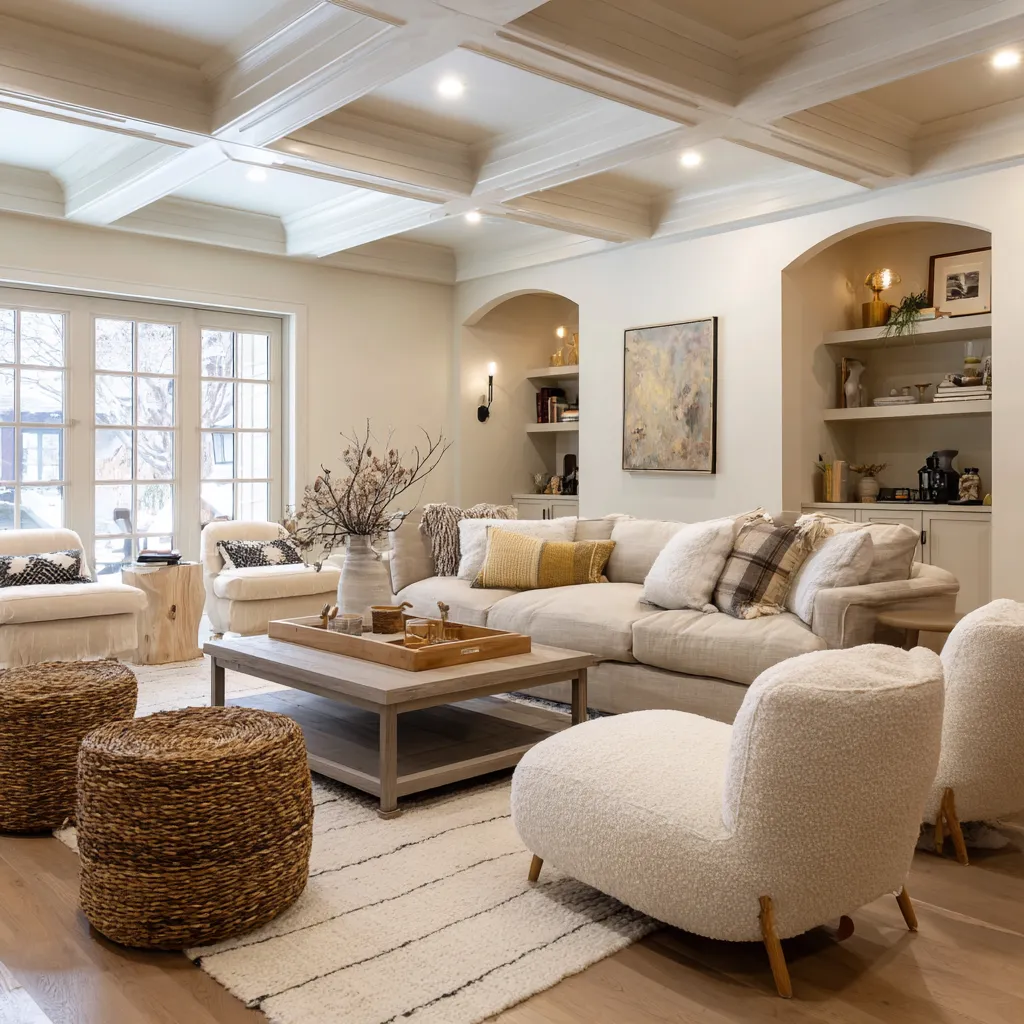
This boundary issue is important because many homes can move toward rustic Scandinavian without replacing everything. The shift often comes from editing harder, reducing motif-driven styling, simplifying the palette, and letting one or two material features take the lead.
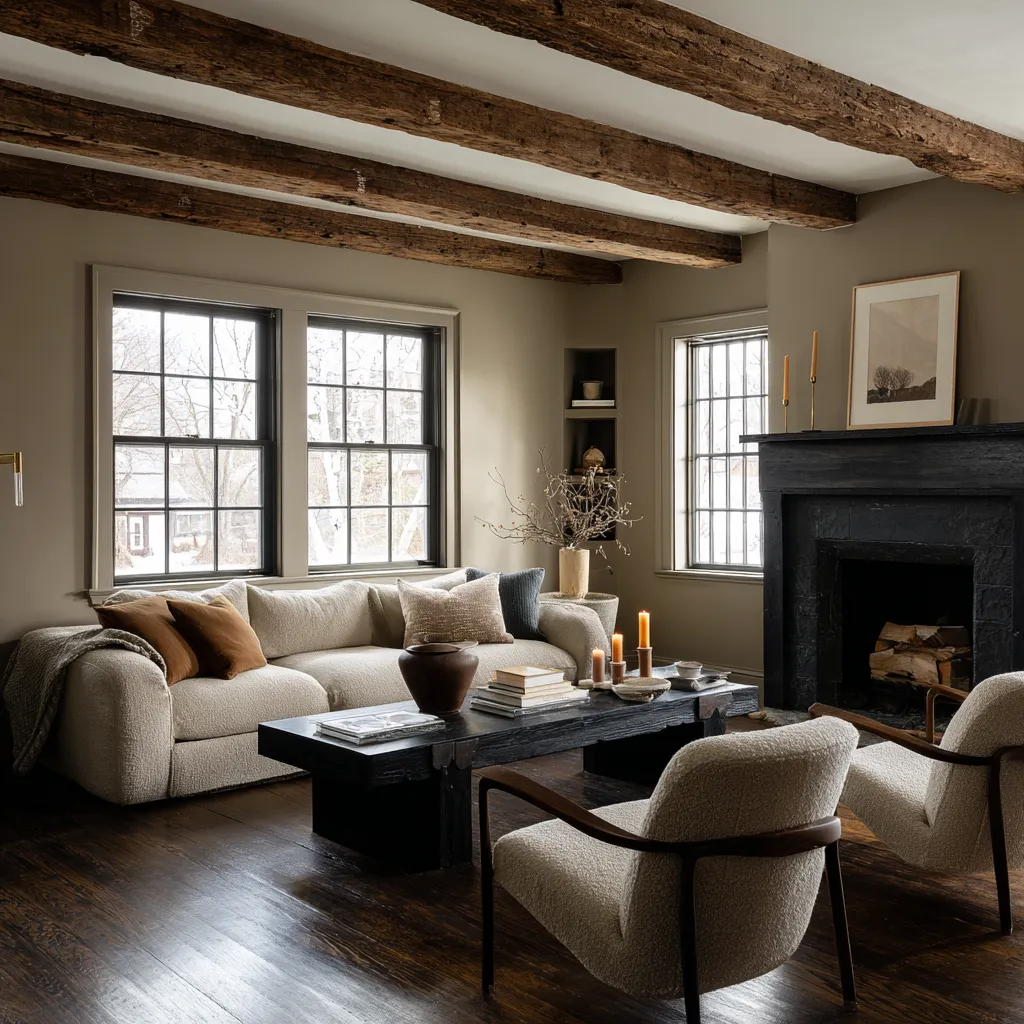
Texture should do the work that color is not doing
The palette in this style is often narrow. Cream, oat, pale taupe, flax, muted clay, chalky plaster, washed wood, soft olive, weathered brown, warm grey, maybe a little charcoal.
That limited range creates a settled room, but only if the surfaces are alive enough to hold attention. Texture carries the richness.
That can mean plaster with movement rather than flat paint. Linen upholstery rather than tight synthetic smoothness.
Boucle or nubby accent chairs. A woven rug with visible grain.
A heavy wood table with age in the surface. Stone with softness in value but enough surface variation to feel real.
Matte pottery rather than glossy accessories. A wool or sheepskin layer placed carefully where the body touches the room.
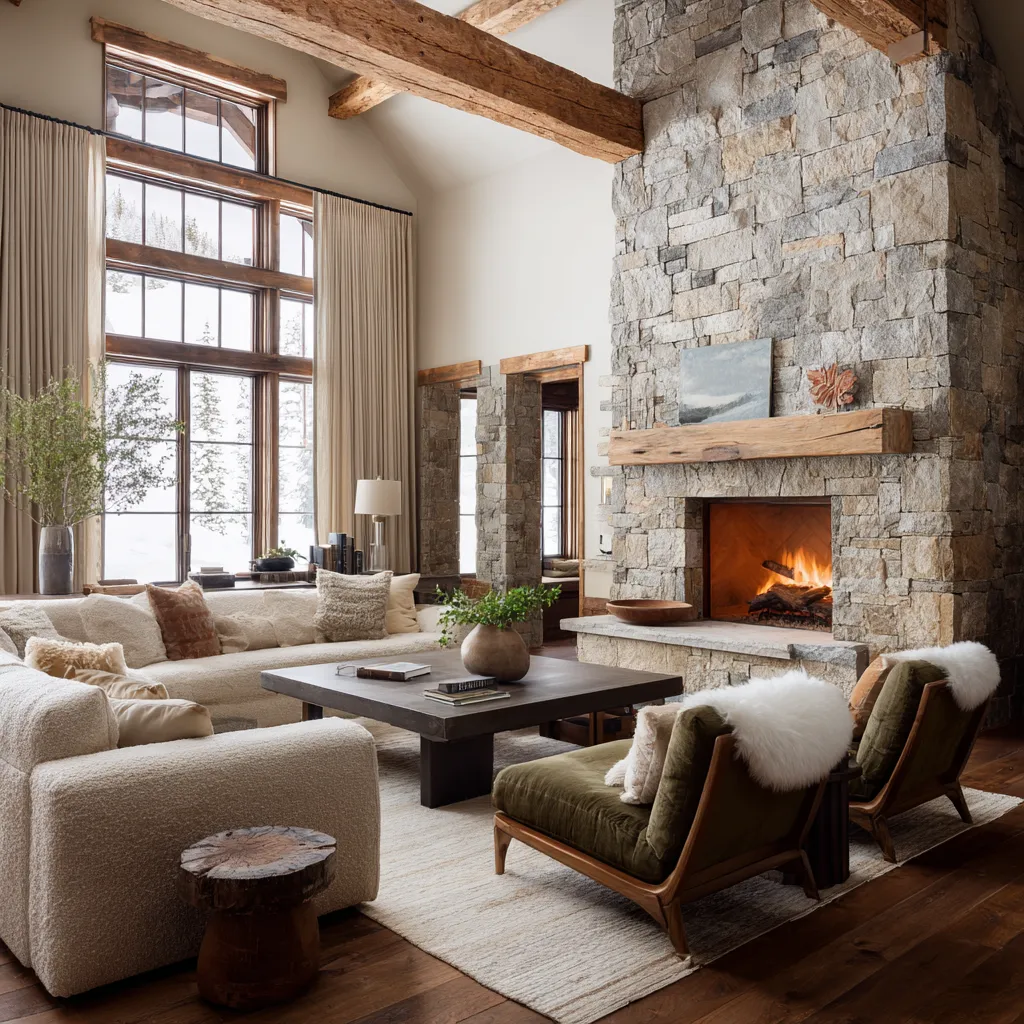
This is why highly pale rustic Scandinavian rooms can still feel substantial. The room does not need stronger color if the surfaces carry enough tactile difference.
But the reverse is also true. A pale room without surface life quickly becomes bland, especially in builder-grade shells where the architecture is already plain.
If the room is starting from standard drywall and standard trim, texture becomes even more important. One rough plaster wall can do what extra décor cannot.
One coarser rug can give the room body. One real wood block table can anchor a pale sofa better than several smaller styled objects.
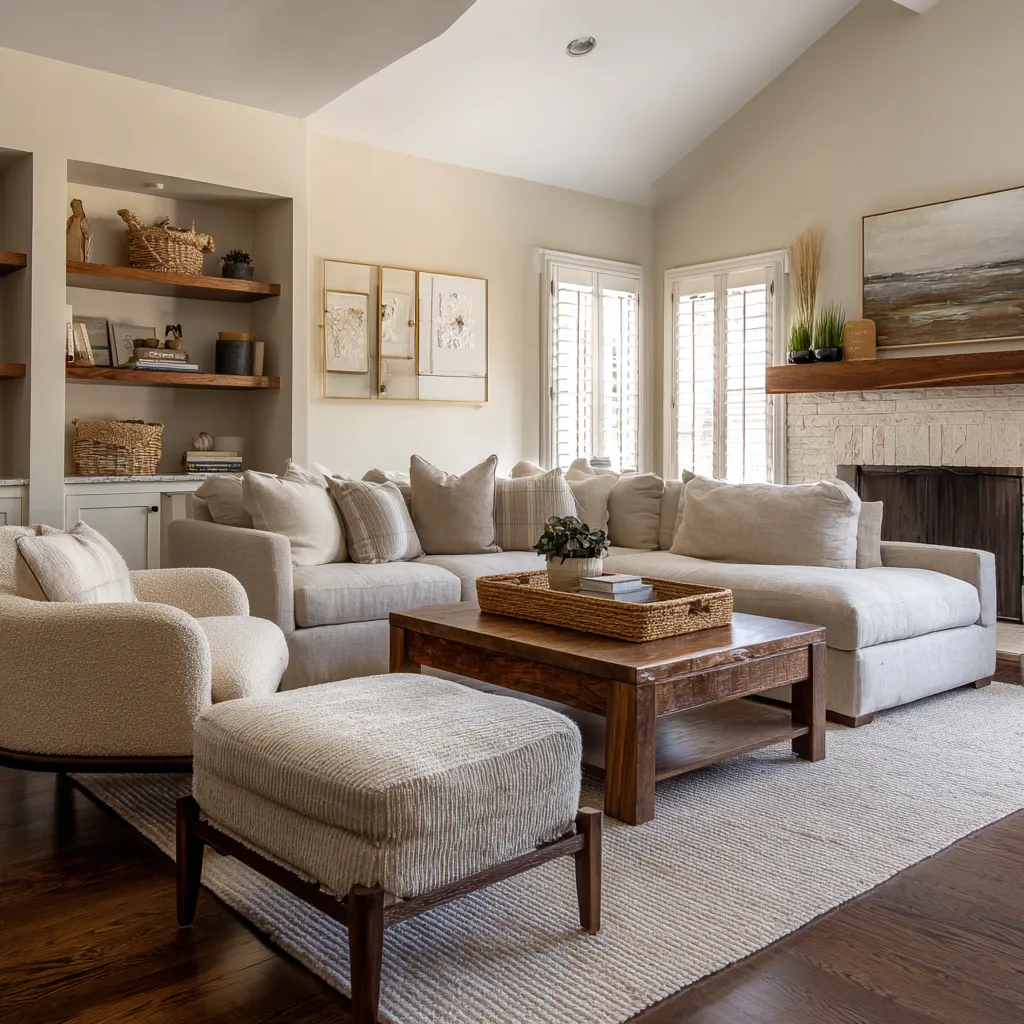
The seating layer should soften the architecture, not compete with it
This style nearly always places bodily comfort in the furniture layer and material honesty in the shell. Stone remains stone.
Timber remains timber. Plaster remains mineral and matte.
Then the sofa, chairs, ottoman, throw, and rug take on the role of softening those harder conditions. That separation is one of the reasons the rooms feel balanced.
The architecture stays grounded and believable. The furniture makes it livable.
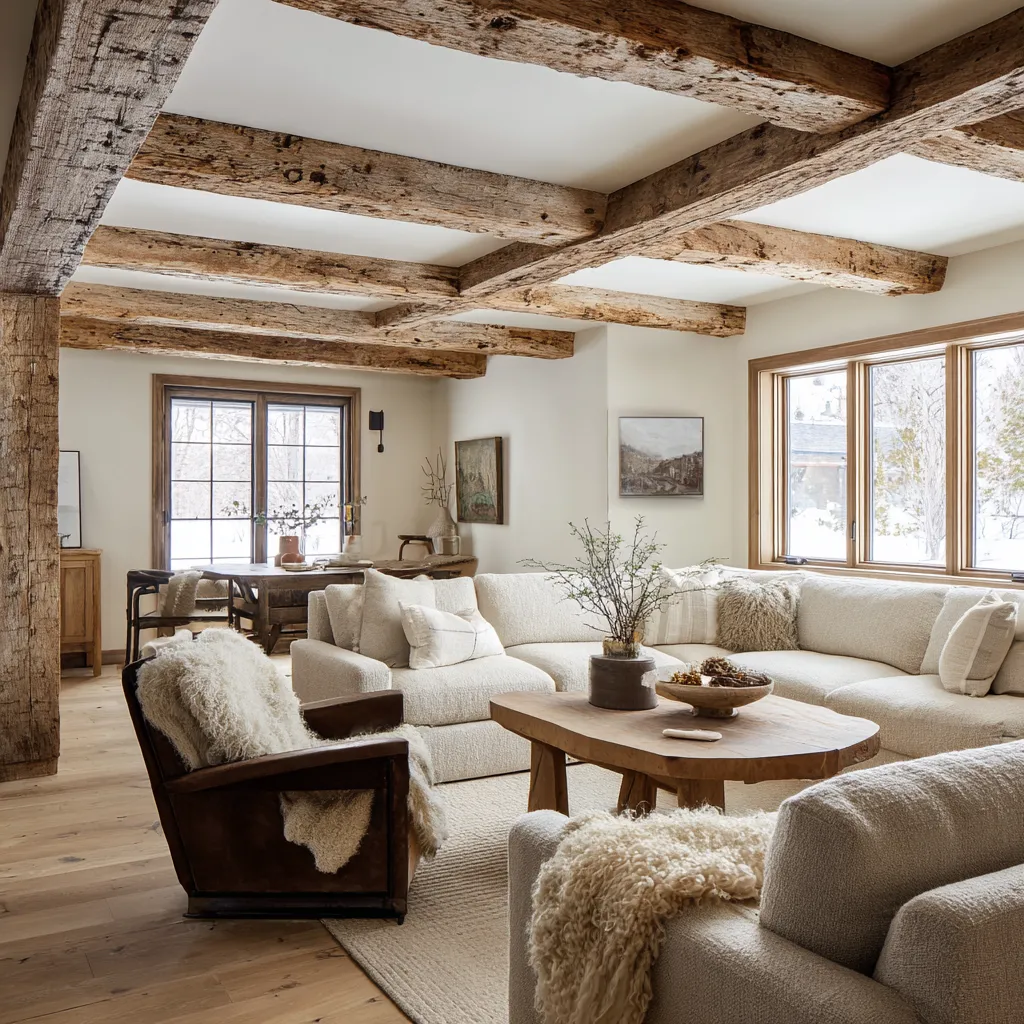
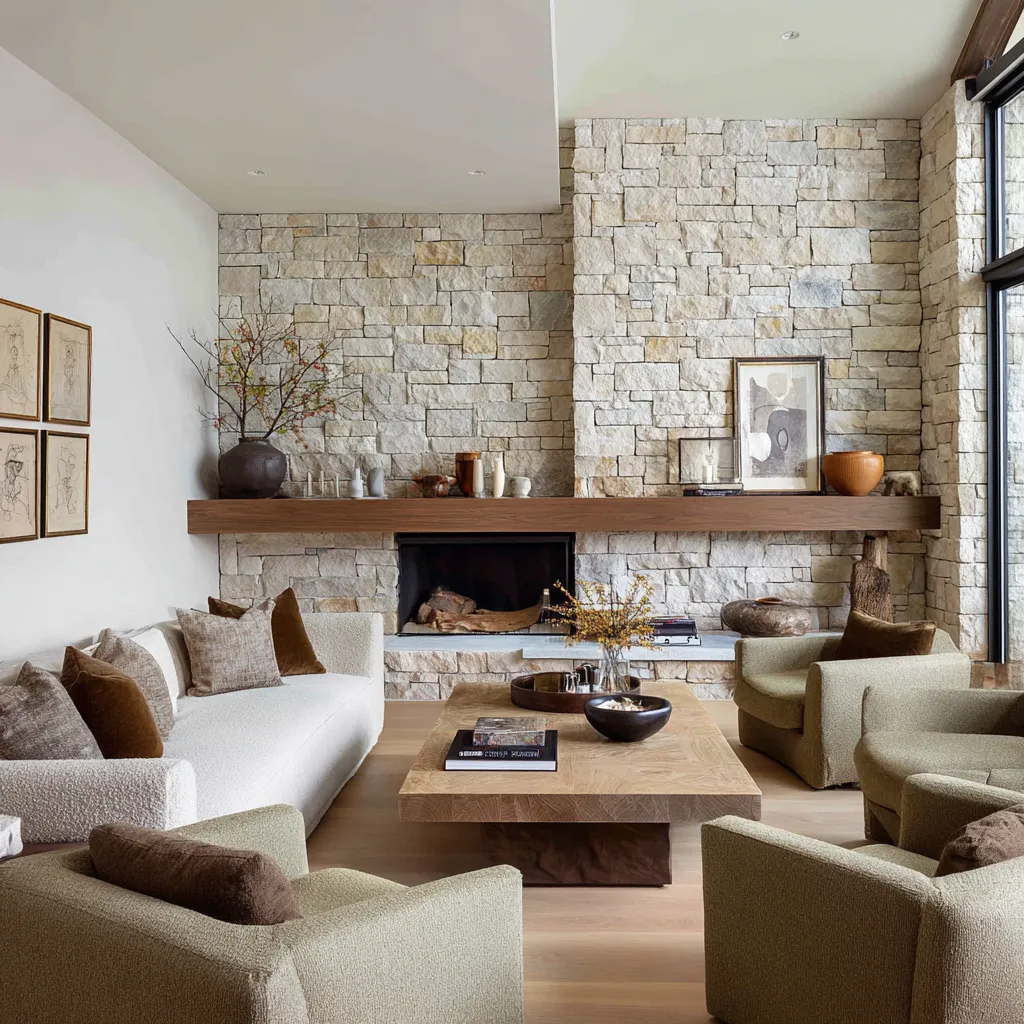
In practical terms, this means that strong shells usually need broad, low, tactile seating. A huge chimney wants a sofa with enough visual body to hold the opposite side of the room.
A dark timber ceiling wants pale upholstery beneath it. A full wood envelope often benefits from an upholstered ottoman rather than another large wood block at the center.
A plaster-heavy room may need chairs with visible dark frames to sharpen the scene, but the fabric itself should still soften the overall effect.
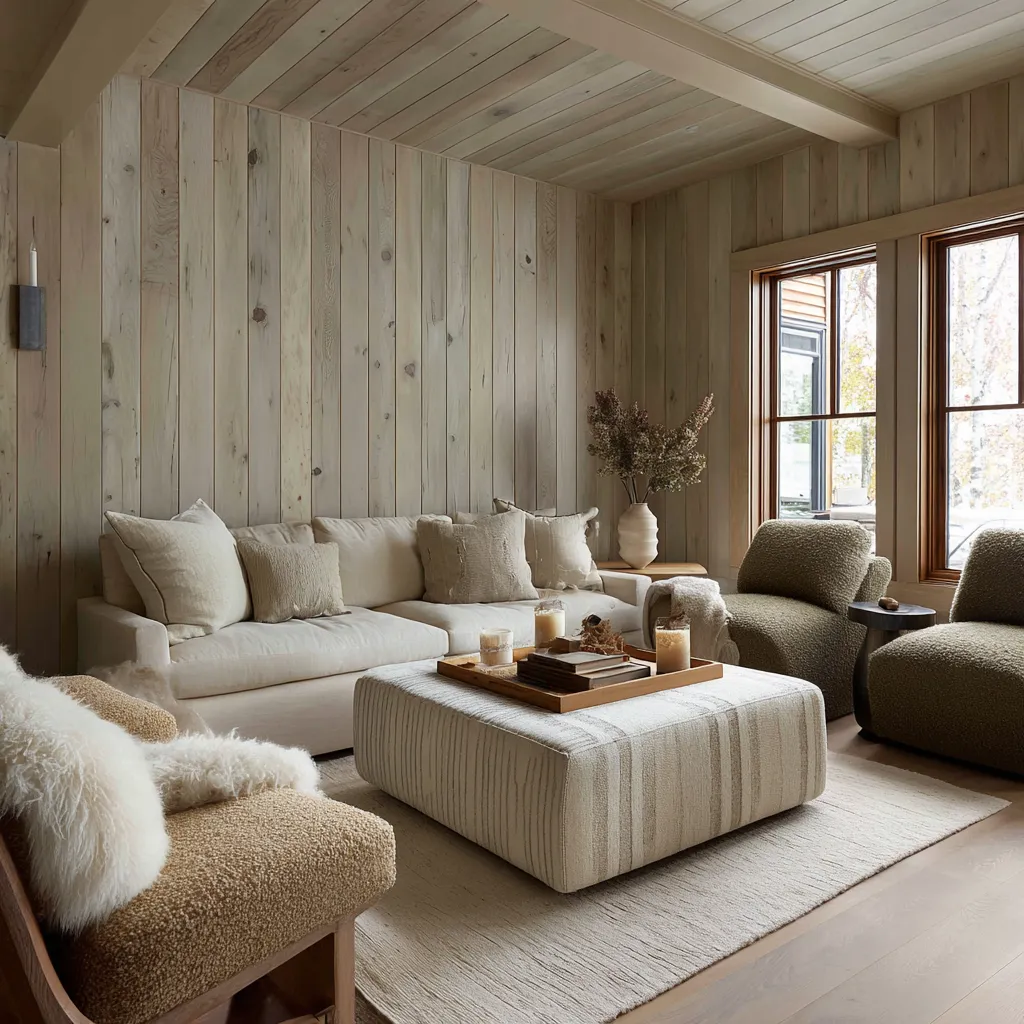
Designs often fail when both layers try to speak equally loudly. A heavy shell plus complicated, high-contrast furniture can become exhausting.
Or a plain shell plus overly soft furniture can drift into shapeless casual neutrality. The room usually improves when one layer carries seriousness and the other carries touch.
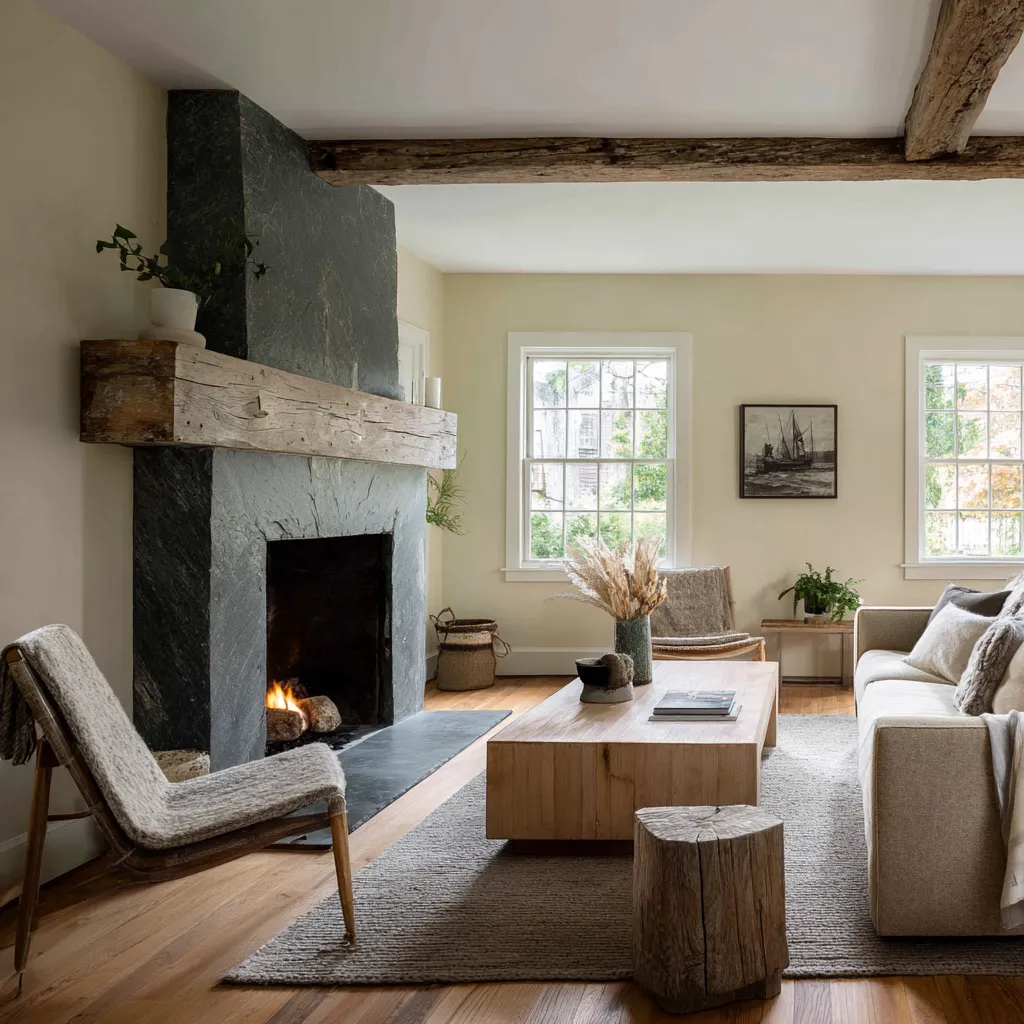
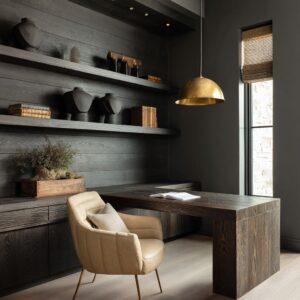
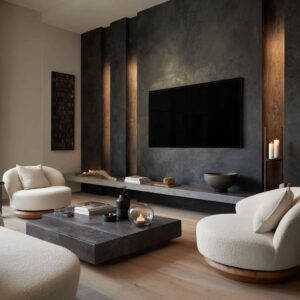
Dark rustic Scandinavian rooms can work, but they need discipline
The moody branch of the style can be beautiful: dark beams, shadowy plaster, deep hearths, warm brown undertones, candlelight, and a sheltered winter feeling. But this branch is much easier to mishandle in ordinary houses.
The problem is not darkness itself. The problem is what happens when darkness spreads without enough relief.
A dark rustic Scandinavian room needs several counterweights: pale or cream seating, broad furniture silhouettes, strong editing, some daylight release, and a limited accessory count. Without those elements, the room gets thick too quickly and starts feeling smaller, busier, and less coherent.
If you want a darker looking version of the style, it is usually safer to contain the darkness rather than repeat it everywhere. A single dark hearth mass, a set of old beams, or one shadowy shelving bay can be enough.
Let the walls, main seating, and larger floor field stay lighter. This is often a more successful route than darkening the entire envelope.
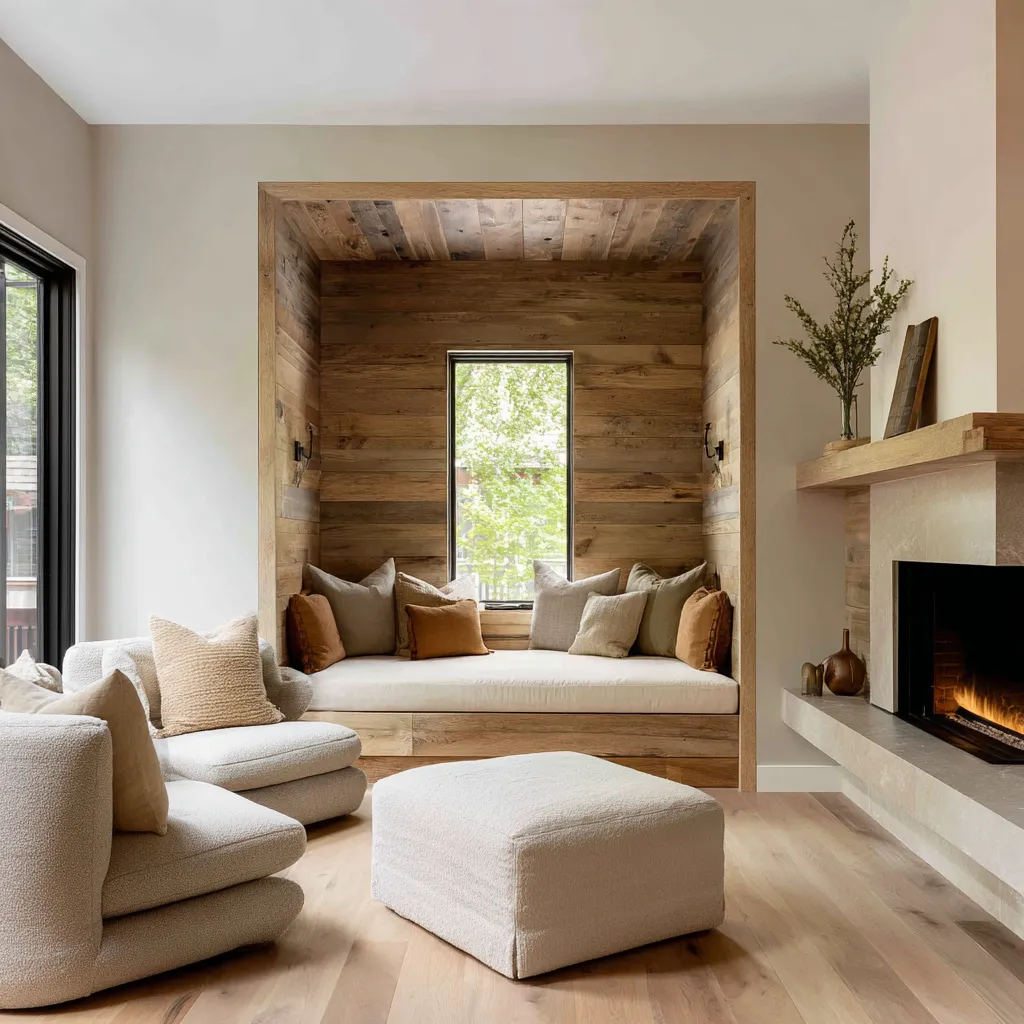
Monumental features need family-scale planning
One of the subtle ideas in the rustic Scandinavian approach is that a dramatic architectural feature becomes far easier to live with when the room remains socially usable. A giant stone wall, a sculpted plaster hood, or a broad timber ceiling gesture can feel over-formal if the room below behaves like a showroom composition.
The space starts looking impressive but not easy to inhabit.
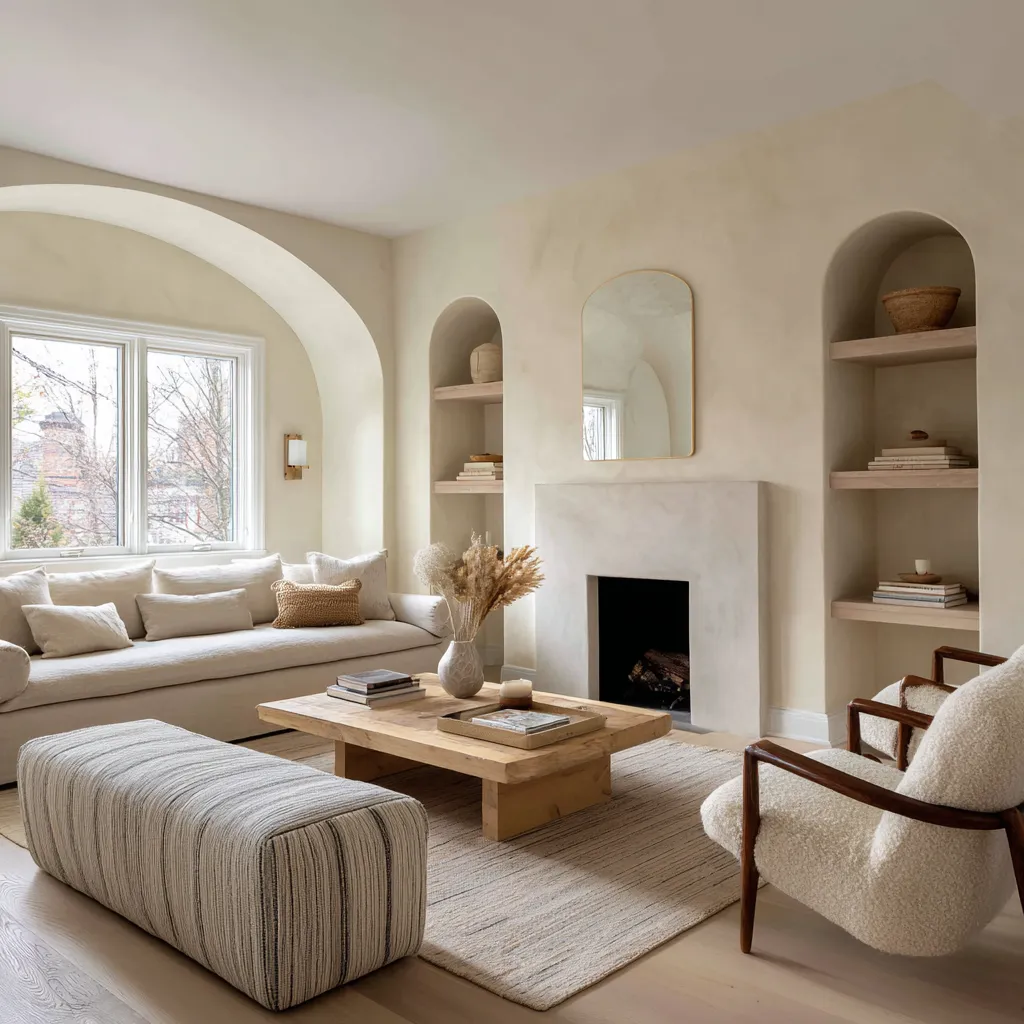
In larger layouts, monumental elements work better when the room also includes sectional logic, generous circulation, flexible extra seating, and a real center that can hold daily life. A room with major architecture but no usable social geometry can feel visually complete and emotionally stiff.
A room with major architecture and broad family-scale seating feels far more natural. This is why some large rustic rooms succeed while others feel theatrical.
The successful ones do not let architecture become the only event. They let architecture frame use.
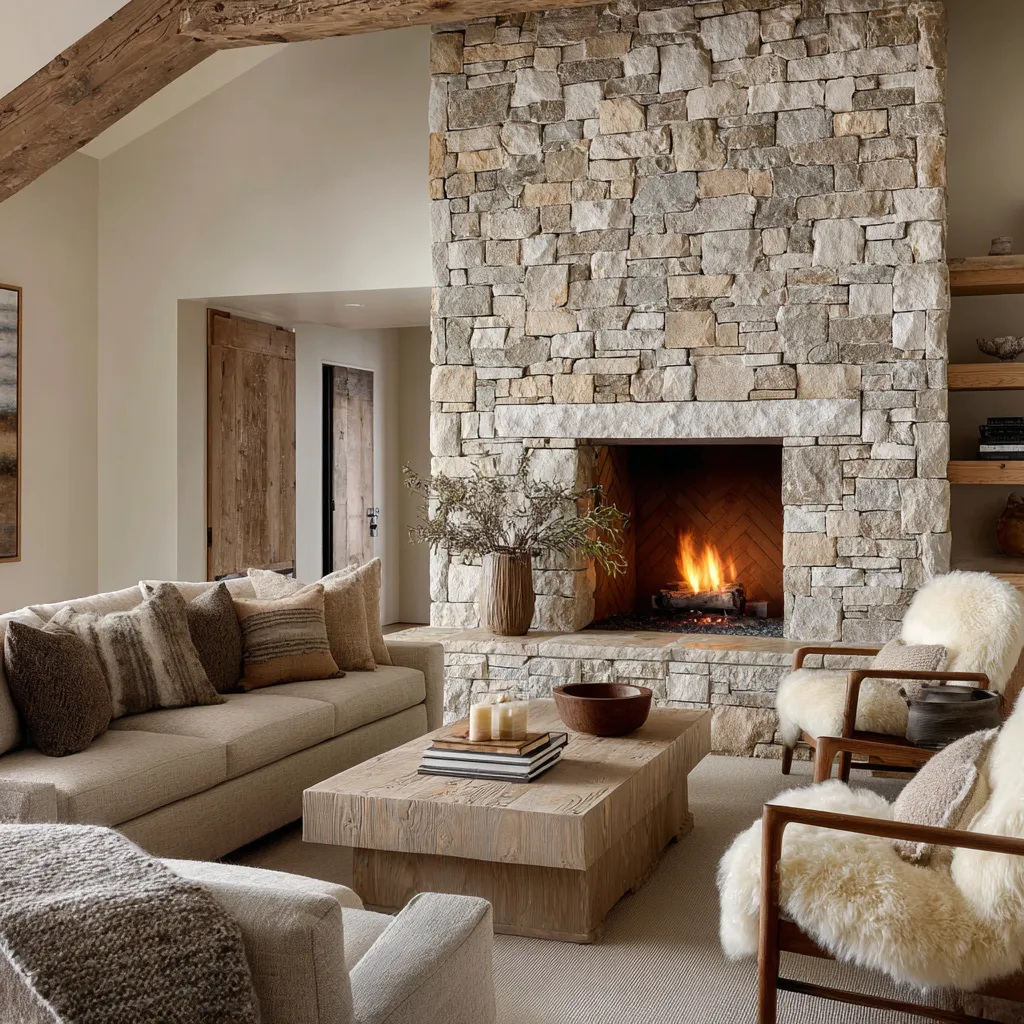
A plain shell can still produce a rich rustic Scandinavian room
This is reassuring for many homes because an average living room does not begin with deep plaster reveals, carved arches, old beams, or mountain-house glazing. A plain shell does not block the style.
It simply changes the design strategy. In a more ordinary room, effective moves are often these:
- One tactile wall with plaster, limewash, or another matte mineral finish.
- One center table with real thickness and visual seriousness.
- A painted plank or coffered ceiling rather than trying to imitate a much heavier timber structure.
- One seating alcove, bench, or framed shelving bay.
- Keeping the palette compressed so texture becomes visible.
- Broad seating with enough softness to humanize the room.
- Reducing decorative object count harder than feels necessary at first.
This softer route often produces an interior design that is easier to live with and easier to adapt than a dramatic imitation of a mountain lodge or old European plaster house.
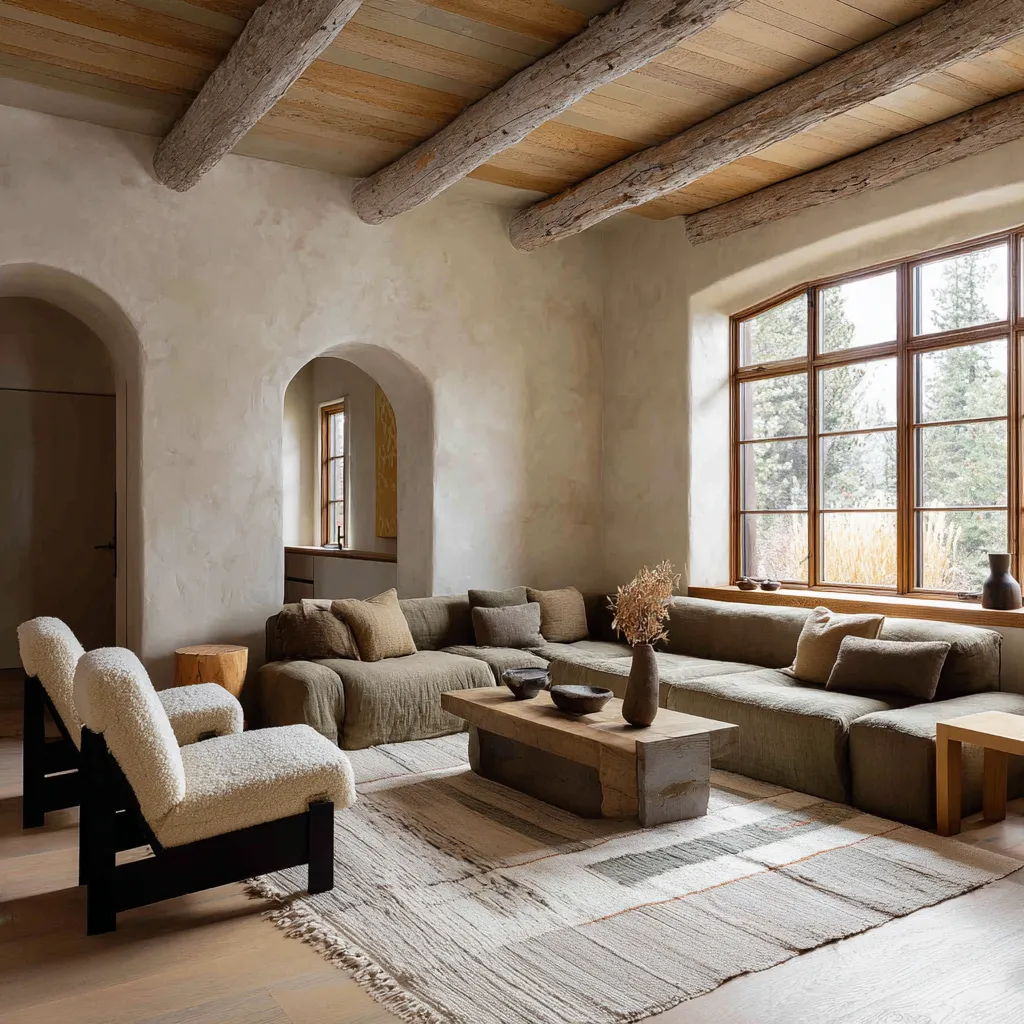
How to make the style feel right
In a suburban family room, a safe version is often the textile-led one. Use a broad sectional or long sofa, one grounded wood or stone center element, a pale but textured rug, painted ceiling articulation if possible, and very edited shelving.
Let the room feel generous and usable before making it feel rustic.
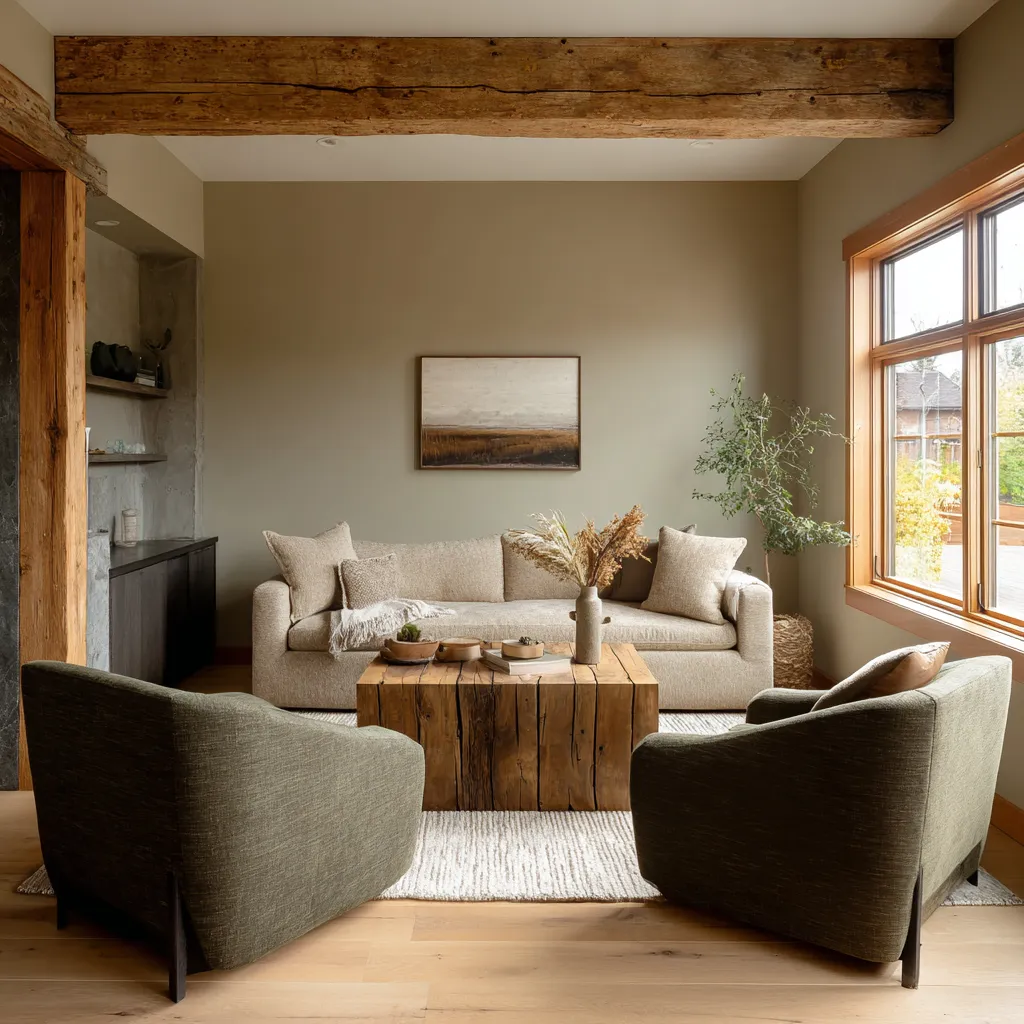
In a colonial or traditional shell, rustic Scandinavian often works by reducing ornament rather than layering over it. Simplify the mantel, lower the contrast in art, use wider and softer seating, compress the palette, and bring in one rougher table or plaster-like surface.
The goal is not to erase the house but to settle it.
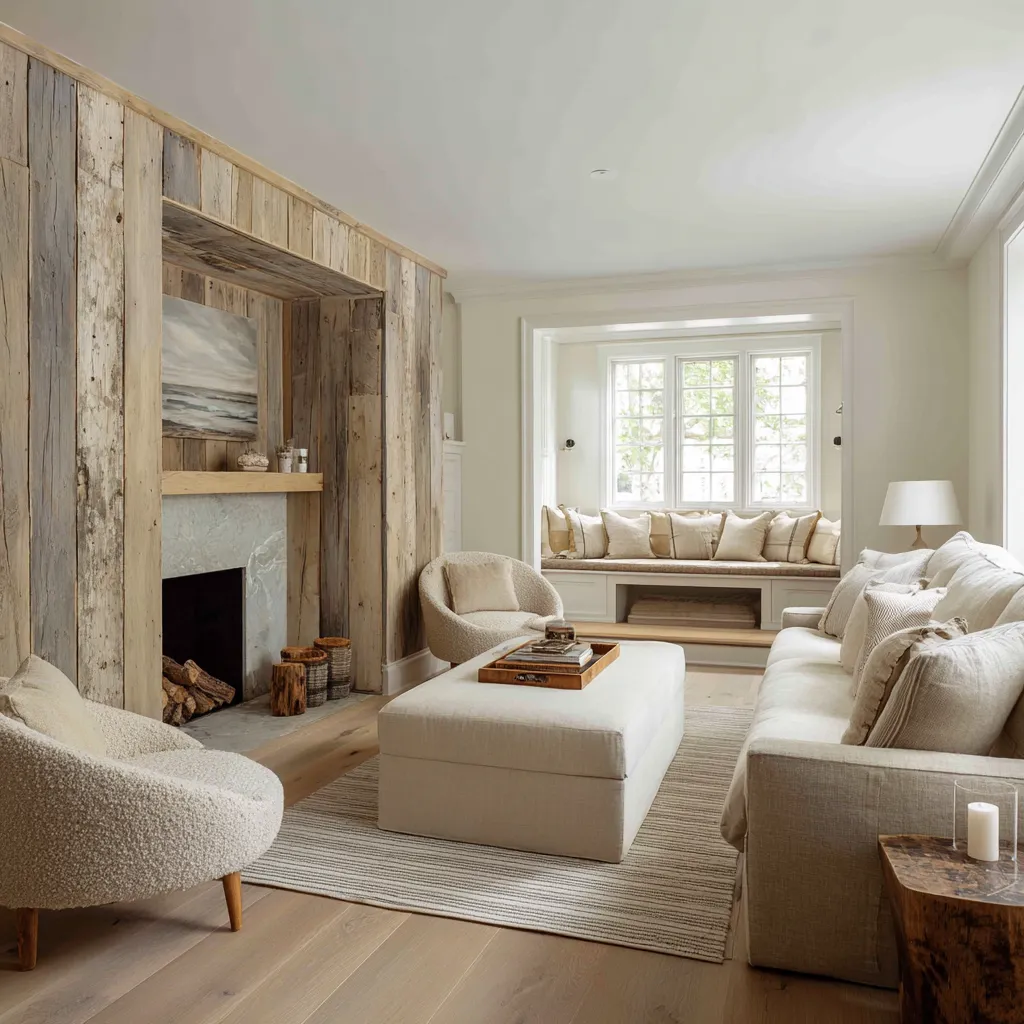
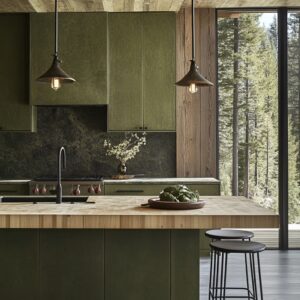
In a mountain or western home with volume, the risk is too much ruggedness. Let stone or timber carry the shell, but keep furniture broad, pale, and sparse.
Use muted greens, bark tones, and dry earth colors instead of stronger decorative color.
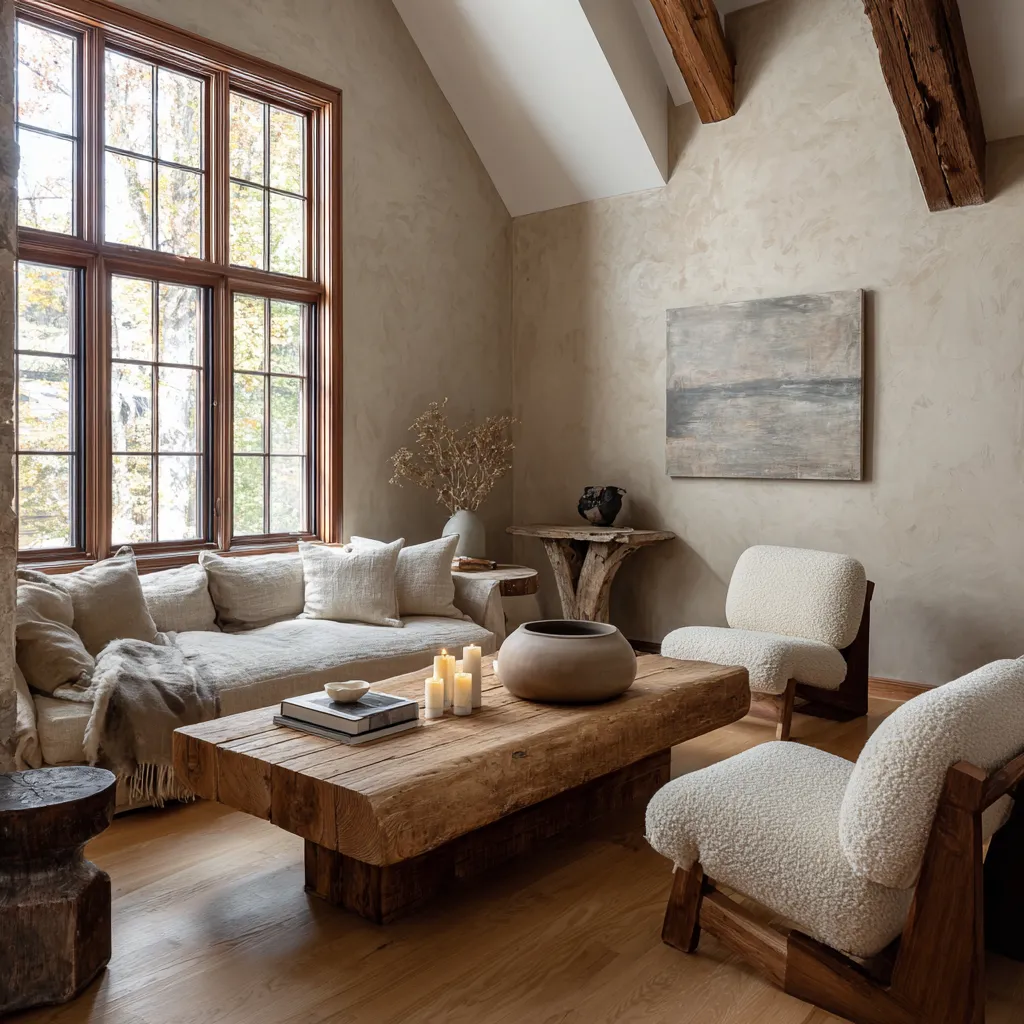
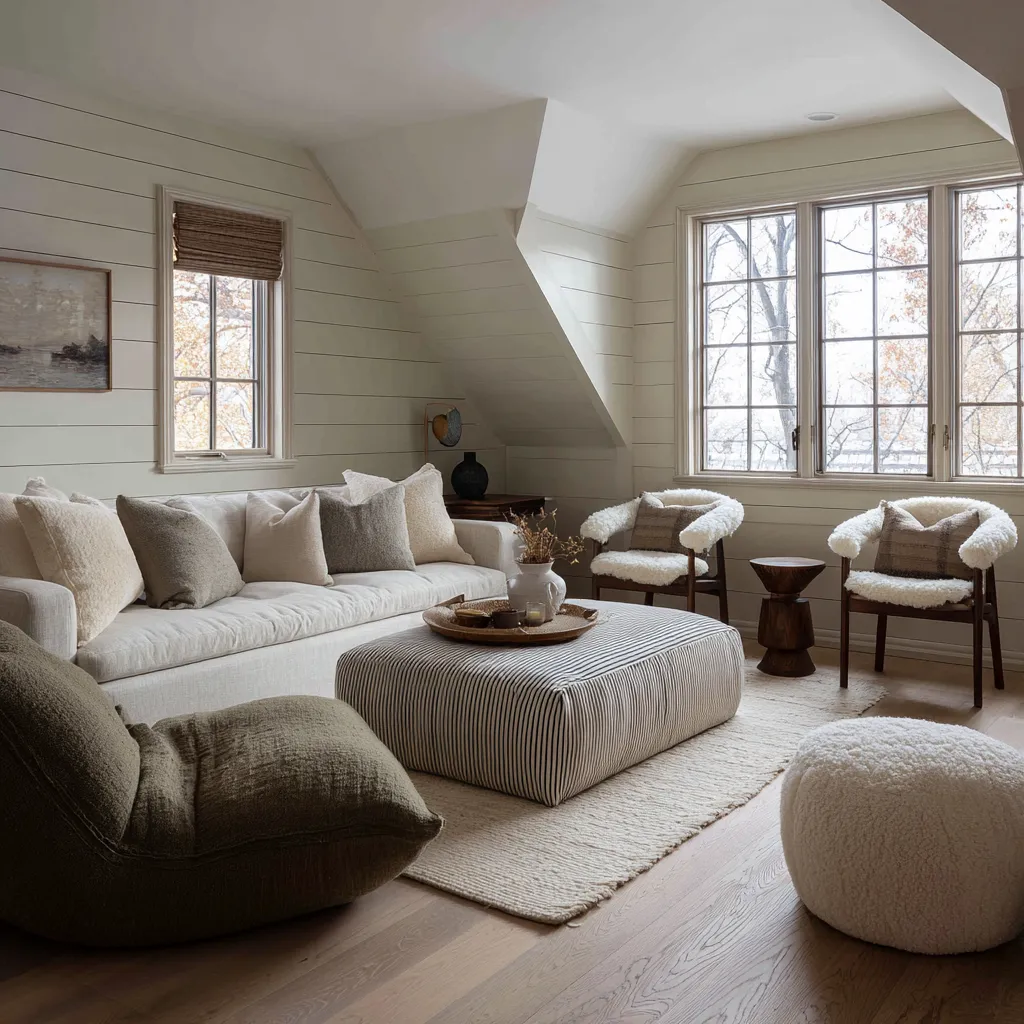
In an attic or sloped-ceiling room, lean into softness and low profiles. Painted boards, a striped or upholstered ottoman, one deeper-toned chair, and tactile seating near the window can make the angled architecture feel intimate rather than awkward.
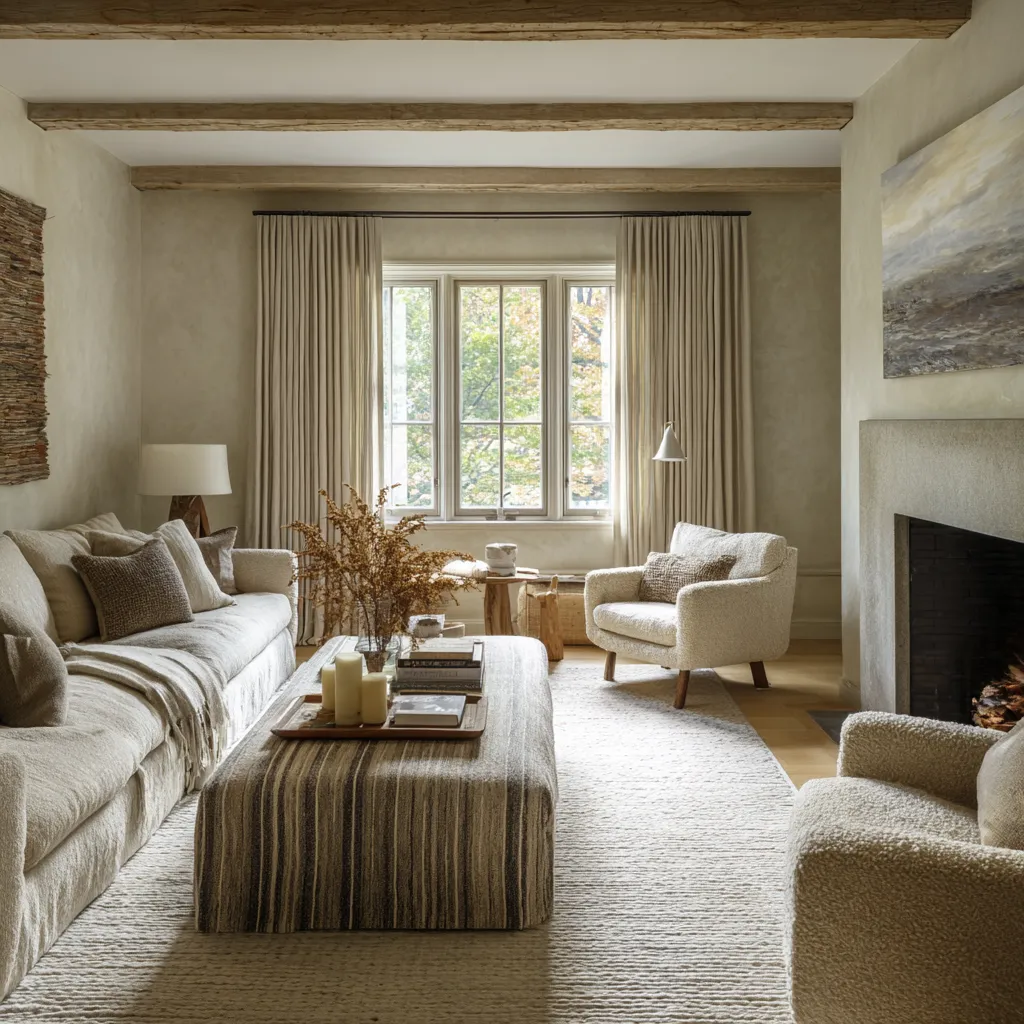
In an open-plan new build, material continuity matters. One family of woods, one restrained neutral field, and one anchor that organizes the living zone will usually work better than trying to create separate stylistic scenes in each area.
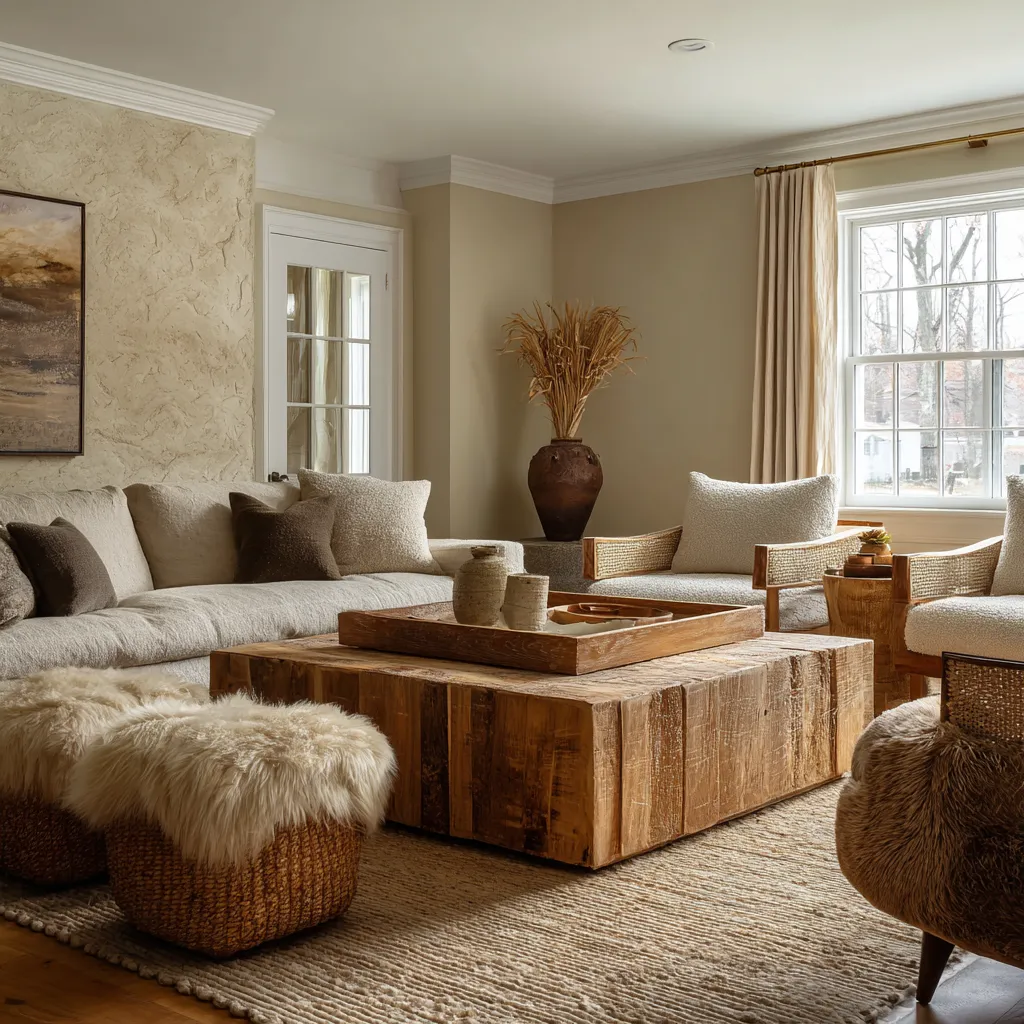
The rooms that feel finished are usually the least decorated
This style often gets stronger as objects are removed. That sounds simple, but it has a specific reason behind it.
Rustic Scandinavian interiors already contain texture in their major surfaces. The grain of the wood, the movement of the plaster, the nubbiness of the upholstery, the matte quality of stone, and the weave of the rug are already doing visual work.
Too many extra accessories only compete with that. A finished room in this style often has fewer objects than expected, but each one matters more.
A vessel with branches. A restrained piece of art.
A low stack of books. A bowl on the table.
A textile with visible character. A lamp with a simple silhouette.
These pieces support the room. They do not carry it.
That restraint is also what keeps the room from drifting into farmhouse cliché, soft transitional vagueness, or styled-for-a-photo excess.
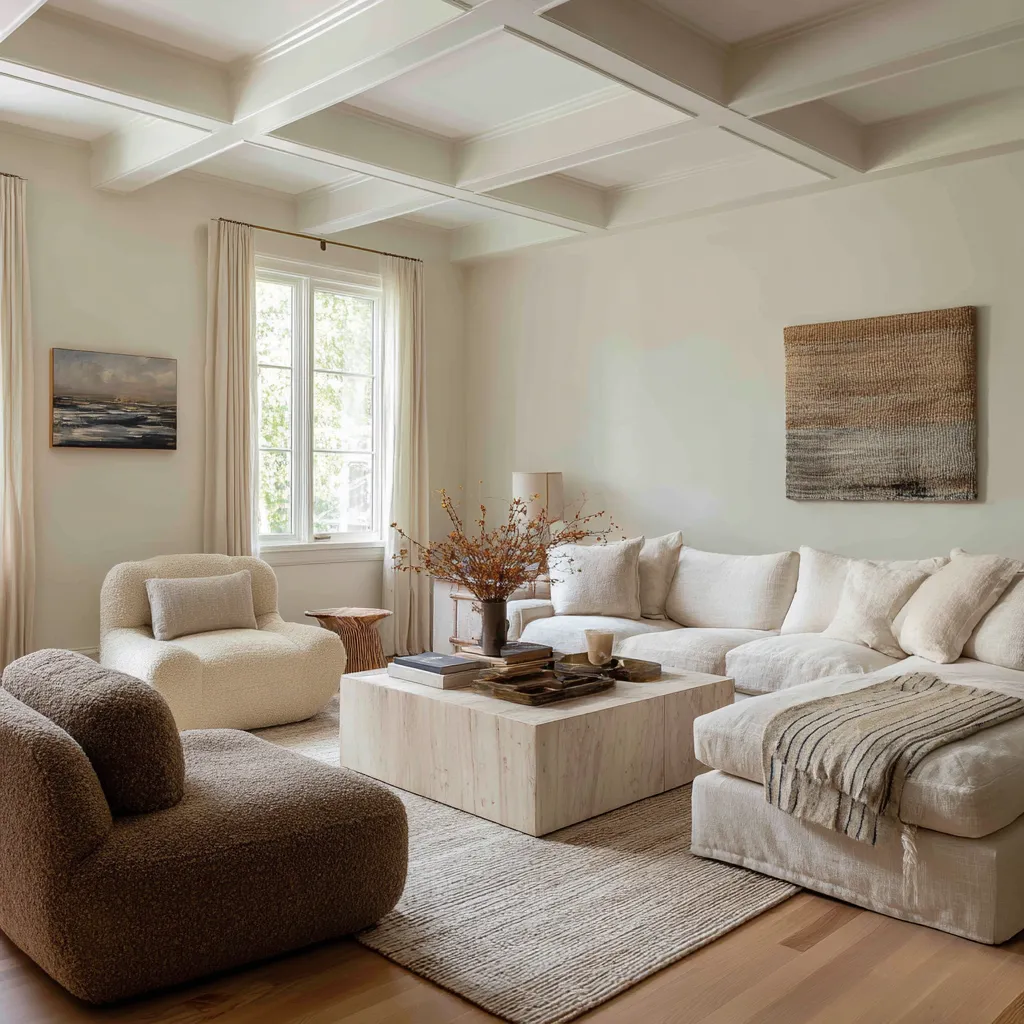
What rustic Scandinavian style is doing
This style creates a room that feels grounded without feeling burdened, warm without relying on obvious color, and refined without losing physical comfort. It gives interiors a way to become more tactile, more settled, and more spatially memorable without requiring every room to become a rustic fantasy.
The deeper logic is not about copying a Nordic house or inserting a few reclaimed beams into a suburban living room. It is about balance.
- One or two elements carry age, gravity, and structure.
- The seating layer carries softness and bodily ease.
- The palette stays close enough that texture can become visible.
- The room keeps some openness even when it feels sheltered.
- And the décor finishes the space rather than trying to invent it.
That is what makes rustic Scandinavian interiors feel lasting. They do not depend on noise.
They depend on clear roles, careful contrast, and a room that knows where its weight belongs.
Disclaimer: This article is intended as design inspiration only. It does not provide construction, architectural, structural, engineering, fire-safety, or code guidance.
Any work involving fireplaces, chimney elements, stone or plaster assemblies, beams, ceiling changes, built-ins, wall modifications, or other permanent architectural features should be reviewed and executed by qualified professionals in accordance with local code, permit, safety, and manufacturer requirements. Existing conditions vary from home to home, and unsuitable materials or improper installation can create safety, moisture, structural, or compliance problems.
Do not rely on this article as a substitute for project-specific professional guidance.